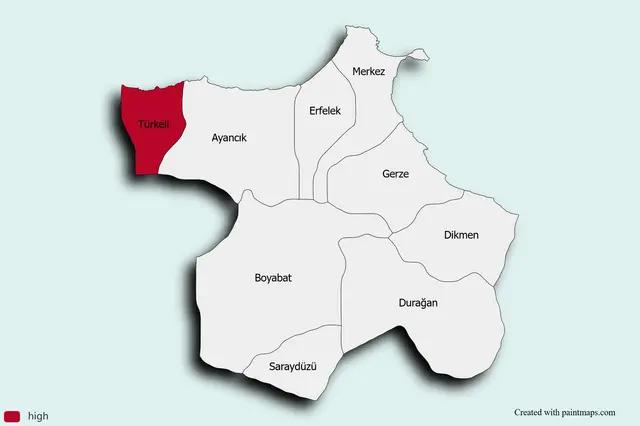


Turkeli (District)
Province(s) | Sinop | ||||||||
|---|---|---|---|---|---|---|---|---|---|
Area(s) | Black Sea | ||||||||
Population (2024) | 16,635 | ||||||||
Mayor(s) | Veysel Sahin | ||||||||
District Governor | Safa Kahraman | ||||||||
License Plate Code | 57 | ||||||||
Climate(s) | Temperate Black Sea climate | ||||||||
Economy | Agriculture fishing and forestry | ||||||||
Türkeli is a district located west of Sinop on the Black Sea coast. It gained district status in 1957. A significant portion of the population lives in rural areas. The district's economic activities include agriculture, fishing, and forestry.

Turkeli ( Sinop Governorship )
Written sources lack clear information regarding the naming and founding date of the Türkeli district. Two main hypotheses have been proposed. According to the first approach, after the Greek Pontus rule, the region was successively incorporated into the Seljuk and İsfendiyaroğulları Principality. It then joined Ottoman rule with the conquest of Sinop by Mehmed the Conqueror in 1461. The initial settlement name was "Yarna," but it later became known as "Gemiyanı" (Gemiyanı), referring to the remains of a ship found on the coast. It is believed that Turkish communities settling in the forested area later gave the name "Türkeli" to the Turkish settlement. Türkeli, a sub-district of the Ayancık district in the early years of the Republic, gained official district status on May 1, 1957.
The second view argues that the district's name was renamed "Türkeli" during the Republican era to commemorate the heroism of local Turkish communities who resisted enemy attacks. The common denominator in both approaches is that Sinop and its surrounding area were permanently incorporated into the Turkish cultural region after the Turkification of Anatolia. The inns, bathhouses, mosques, caravanserais, and masjids built in the region following the conquests demonstrate that the region held both strategic and commercial importance.
Türkeli is located west of Sinop province, on the Black Sea coast. Surrounded by the sea to the north, Çatalzeytin to the east, Taşköprü to the south, and Ayancık to the west, the district has a surface area of 263 km². The topography, which rises inland from the sea, creates sloping forest belts and canyoned valleys that reach altitudes of up to 300 m from the coast. The Ezine, İlişi, Hacıveli, and Kuğu streams flow into the coast within the district's borders, while the Zindan Forests provide a rich terrestrial forest cover with pine, fir, beech, hornbeam, oak, chestnut, poplar, and ash species.
Climate-wise, Türkeli lies in the transition zone between the western and eastern Black Sea climate types. While there are no significant differences between summer and winter temperature averages, it receives regular precipitation throughout the year. Humidity is high, with an average of 70–80 clear days, 190 semi-clear days, and 85–90 overcast days. The district is in the fourth-degree (low-risk) earthquake zone.
While the total population of Türkeli district was 14 263 people as of 2007, it reached 17 947 people in 2018, reaching the highest level of the period; it decreased to 15 859 in 2019, partial increases were observed in the 2020–2022 period and an increase to 17 211 in 2023, and it was recorded as 16 635 people as of 2024. The most significant increase between these years was 3 560 people between 2017–2018, and the largest decrease was 2 088 people between 2018–2019. According to 2024 data, the male population was 8 285 (49.80%) and the female population was 8 350 (50.20%), and the difference between the genders generally remained at the scale of a few hundred people. Annual population changes exhibit a fluctuating nature that can be explained by settlement-related movements and record updates.
Agriculture in the district is carried out on a family-run basis; machinery use is limited due to the narrow alluvial plains near the coast, and household agriculture constitutes the primary livelihood. Wheat, barley, corn, walnuts, chestnuts, apples, pears, cherries, grapes, figs, mulberries, olives, plums, and various vegetables can be produced under the local climatic conditions. In recent years, developments have been made in greenhouse farming and horticulture with the support of the District Agricultural Organization.
Inadequate agricultural income is driving the young population toward domestic and international labor markets. The resident population, which is around 7,000 during the summer months, experiences a seasonal increase of 25,000 to 30,000. The remittances sent by migrant workers stimulate local commerce, particularly in the construction sector. Construction labor and craftsmanship play a significant role in family income.
Livestock farming is generally limited to small family-level holdings, raising species such as sheep, cows, oxen, donkeys, and ostriches. The ostrich farm established in Hacıköy in 1999 and the trout farms in the villages of Çatak-Örencik and Gökçealan are examples of diversified animal production. Poultry farming, including chickens and roosters, and game such as wild boars, foxes, jackals, wolves, bears, and various bird species, offers economic potential. Beekeeping is also a secondary source of income.
Forestry is another primary source of income for the district. Timber obtained through licensed felling reaches the market by road from the Forest Management Directorate's warehouse. Parquet and furniture workshops, sawmills, and small industrial areas rely on the utilization of forest products. Chestnut trees are an important agricultural commodity whose potential can be increased through quality improvement efforts. Seafood hunting also provides an additional economic opportunity for families living along the coast.
In terms of industry and commerce, the town of Güzelkent boasts a parquet factory, glass factory, lumber cutting workshops, furniture and carpentry shops, and textile and wire factories. Numerous retail markets, craft workshops, and small-scale industrial sites are located in the town center. Financial services are provided by institutions such as Ziraat Bank, İş Bank, and Halk Bank; agricultural cooperatives in the villages provide consumption and credit support.
Türkeli's 25 km-long coastline along the Black Sea offers potential for sea tourism with its sandy beaches and clear waters. Mountain hiking trails, the Hacıveli Stream canyons, and the Iğrava and Karabalçık caves provide opportunities for nature tourism. The recreational areas of Yeşilyuva and Toza Seyir Tepesi provide daily recreation opportunities.
Within the scope of cultural heritage, traditional women's attire (fez, yemeni, shirt, shalwar, üç etek, sash, apron, and sandals) and men's footwear (lapçin, kudura, and black rubber) reflect regional identity. Folk songs performed with drums and zurna at weddings, engagements, henna nights, and holiday ceremonies, the köçek dance, the tradition of mehır, halva nights, and Hıdrellez celebrations strengthen social cohesion.
The region's culinary culture revolves around seafood such as anchovies, horse mackerel, bonito, grey mullet, and shad, all sourced through fishing, chestnut and mulberry honey, and fruits produced in walnut and chestnut orchards. Freshly caught fish are consumed boiled, fried, or steamed. Kiwi cultivation contributes to the summer table as fresh fruit and also facilitates the production of jams and marmalades. These elements support the tourism and gastronomy potential of Türkeli, which combines both natural and cultural values.
Paintmaps. “Türkiye Provinces Map – Highlighting Türkeli , Sinop.” Access date: April 15, 2025. https://paintmaps.com .
Republic of Türkiye Ministry of National Education, Turkeli District National Education Directorate. “Geographical Situation.” Turkeli District National Education Directorate. Access date: May 9, 2025. https://turkeli.meb.gov.tr/www/cografi-durumu/icerik/450
Republic of Türkiye Ministry of National Education, Turkeli District National Education Directorate. “Our District Economy.” Turkeli District National Education Directorate. Access date: May 9, 2025. https://turkeli.meb.gov.tr/www/ilcemiz-ekonomisi/icerik/451
Republic of Türkiye Ministry of National Education, Turkeli District National Education Directorate. “Our District Culture.” Turkeli District National Education Directorate. Access date: May 9, 2025. https://turkeli.meb.gov.tr/www/ilcemiz-kulturu/icerik/452
Republic of Türkiye Ministry of National Education, Turkeli District National Education Directorate. “History of Our District.” Turkeli District National Education Directorate. Access date: May 9, 2025. https://turkeli.meb.gov.tr/www/ilcemiz-tarihi/icerik/448
Republic of Türkiye Sinop Governorship. “Türkeli.” Sinop Governorship. Access date: May 9, 2025. http://www.sinop.gov.tr/turkeli
Republic of Türkiye Turkeli Municipality. “Türkeli Municipality.” Turkeli Municipality. Access date: May 9, 2025. https://turkeli.bel.tr/?page_id=2139
Republic of Türkiye Turkeli District Governorship. “Geography of Our District.” Turkeli District Governorship. Access date: May 9, 2025. http://www.turkeli.gov.tr/ilcemizin-cografyasi
Republic of Türkiye Turkeli District Governorship. “History of Our District.” Turkeli District Governorship. Access date: May 9, 2025. http://www.turkeli.gov.tr/ilcemizin-tarihi
Republic of Türkiye Turkeli District Governorship. “History.” Turkeli District Governorship. Access date: May 9, 2025. http://www.turkeli.gov.tr/tarihce
Republic of Türkiye Turkeli District Governorship. “Transportation.” Turkeli District Governorship. Access date: May 9, 2025. http://www.turkeli.gov.tr/ulasim
Turkish Statistical Institute (TurkStat). Address Based Population Registration System Results, 2024. Access date: April 20, 2025. https://data.tuik.gov.tr/Bulten/Index?p=Adrese-Dayali-Nufus-Kayit-Sistemi-Sonuclari-2024-53783

Turkeli (District)
Province(s) | Sinop | ||||||||
|---|---|---|---|---|---|---|---|---|---|
Area(s) | Black Sea | ||||||||
Population (2024) | 16,635 | ||||||||
Mayor(s) | Veysel Sahin | ||||||||
District Governor | Safa Kahraman | ||||||||
License Plate Code | 57 | ||||||||
Climate(s) | Temperate Black Sea climate | ||||||||
Economy | Agriculture fishing and forestry | ||||||||
History
Geography and Climate
Population and Demography
Economy
Tourism–Culture–Cuisine
This article was created with the support of artificial intelligence.