


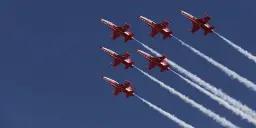
Turkish Stars Aerobatic Team
Establishment Date | November 7, 1992 | ||||||||
|---|---|---|---|---|---|---|---|---|---|
First Demonstration Date | June 18, 1993 | ||||||||
First Demonstration Location | 4th Main Jet Base Command, Akıncı/Ankara | ||||||||
Turkish Stars Akrotim Fleet Command, one of the formations representing the national and military values of the Republic of Türkiye, is not just an air demonstration team, but is considered as a strategic force element that presents the discipline, technological competence and piloting capabilities of the Turkish Air Force to the national and international public. This team aims to increase the interest of the Turkish nation in aviation and support the motivation of young generations in this field, following the evolutionary line in Turkish aviation history from past to present.
Turkish Air Force is a military organization whose foundations were laid in 1911 during the Ottoman Empire and was integrated into the modern war environment over time. Turkish aviation, since its establishment, has been involved in the Balkan Wars and World War I. It has undertaken critical missions in important conflicts such as World War II and the War of Independence, and has constantly improved its technical capabilities and personnel equipment in this process. The first aerobatic studies started with the "viril" maneuver performed by Pilot Lieutenant Fazıl Bey on March 5, 1914.
With the reforms made during the Republican period, in 1932, aviation personnel were defined as a separate combatant class, and blue uniforms began to be used as of 1933. As of 1944, the Turkish Air Force Command was officially established and the transition to jet technology was initiated.
Turkish Stars, TEKNOFEST Istanbul (Source: Turkish Stars)
The first official acrotim in the Turkish Air Force was established in 1952 at Balıkesir 9th Air Base Command under the name "National" call. This team took part in domestic and international shows with F-84 G Thunderjet aircraft. Then, teams operating under different names such as "Flying Swans", "Scorpion", "Bats", "Eagle/Coşkun", and the sixth acrotim established in 1971 contributed to the institutionalization of acrobatics culture.
However, no continuous acrotim activity was carried out between 1972 and 1992. During this period, limited air shows were performed only at some special ceremonies. As a result of the work initiated in 1992 under the direction of General Halis Burhan, Turkish Stars were officially established on December 25, 1992 and held their first show on June 18, 1993.
The first acrotim established in Balıkesir 9th Air Base Command in 1952, just after the transition to the modern jet age in the Turkish Air Force, bears the call name "National". This team, equipped with F-84 G Thunderjet aircraft, achieved success with the shows it performed both in Turkey and abroad (Italy and Belgium) between 1952 and 1962.
The "Flying Swans" team, established in 1955 at Eskişehir 4th Air Base Command, used F-86 E Sabre aircraft and attracted attention with its swan motifs. This team, which operated for ten years, stood out with its nine and ten-duo shows in 1964.
The "Scorpion" call team, established at Diyarbakır 8th Air Base Command in late 1957, served with F-84 G aircraft until 1959. The team, which also participated in international demonstrations in Pakistan, gained experience in a short time.
"Yarasalar" acrotim, established in 1964 at Merzifon 5th Main Jet Base Command, organized shows in various multiple formations with black-and-white painted F-86 E Sabre aircraft during its two-year activities.
The team, which was established in 1966 at Bandırma 6th Main Jet Base Command, initially used the call name "Kartal"; but on 21 May 1971 Hv. Plt. Lt. He took the name "Coşkun" after Coşkun Turan was martyred. He performed shows with F-5 A Freedom Fighter aircraft both in Turkey and Italy.
This acrotim, established at the Merzifon 5th Main Jet Base Command for the celebrations held on the 900th anniversary of the Battle of Manzikert in 1971, was specially structured for this ceremony. F-5A type aircraft were used.
A permanent acrotim structure could not be established between 1972 and 1992; During this period, short-term air shows were held exclusively for ceremonies. However, in 1992, with the directive of the 20th Air Force Commander, General Halis Burhan, the decision was taken to create a professional team again. The work initiated within the 3rd Main Jet Base 132nd Squadron Command on September 11, 1992, was concretized with the start of training with four NF-5 aircraft on December 25, 1992.
Turkish Stars, which held its first official show in Akıncı/Ankara on June 18, 1993, quickly rose to fleet status and earned the title of "The World's Youngest Supersonic Acrotim". Renovations and painting for the planes were completed in 1994, and in the same year, flights with five and six arms were started.
Turkish Stars, which were introduced in Diyarbakır on October 5, 1994 and during the October 29 Republic Day ceremonies, performed their first seven-aircraft show in Eskişehir within the scope of Distant Thunder-95 Exercise on April 20, 1995.
Having reached their 100th, 200th, 300th, 400th and 500th shows in the 2000s, Turkish Stars have performed 370 shows in 96 different locations in Turkey and 143 shows in 24 countries abroad as of 2018. Show formats; Classified as High, Low and Flat Show Packages, pilots can maneuver within 3 feet during flights.
The aircraft used in the demonstrations are 10 NF-5A 2000 and 6 NF-5B 2000 type aircraft. Demonstration speeds are between 370 km/h and 960 km/h and all maneuvers are performed with manual control and the psychomotor abilities of the pilots.
Turkish Stars (TRT News)
Turkish Stars is the first and only acrotim in the world that can perform demonstrations with eight supersonic fighter jets. The show they performed in Baku, the capital of Azerbaijan, on August 24, 2001, with the participation of more than one million spectators, increased the worldwide recognition of this team. In addition, the team is the only official supersonic acrotim representing the Republic of Türkiye.
The symbolism of Turkish Stars is also based on historical and cultural background. The double-headed eagle figure represents the protective spirit and mastery of the past and future in Central Asian Turkish belief. While this figure symbolizes both power and sovereignty, it has also been adopted as an institutional motif by the Turkish Air Force.
NF-5 type aircraft, which have been used in the Turkish Air Force since 1987, have been evaluated as one of the most suitable platforms for aerobatic missions thanks to their flight systems and high maneuverability. When the world aviation literature is examined, it is seen that the F-5 aircraft design is described as the most suitable design for supersonic jet flights. In this context, NF-5 was preferred as the main aircraft of the Turkish Stars Acrotim Squadron Command.
The aircraft allocated to Turkish Stars were subjected to a comprehensive modernization within the scope of a project initiated by Eskişehir 1st Air Supply Maintenance Center Command in August 1993. The structural and system modifications made are as follows:
-Structural renovations were applied to these areas by canceling the cannon barrels and replacing them with chaff/flare dispenser units that increase aerodynamic drag.
-The side panel was redesigned to provide ease of use and visibility to pilots.
-In order to improve the field of view, the mirrors in the cockpit were replaced with the mirrors used in F-4 aircraft, and an additional mirror was integrated.
-In order to enable smoke release during demonstration flights, the fuel tanks at the wing tips of the aircraft were converted into paint tanks; This paint was directed to the exhaust section via the hydraulic pump.
-The outer surface of the planes was painted for special purposes and restored to its current appearance.
In this context, the modifications and changes made to the nine NF-5A and one NF-5B aircraft allocated to Turkish Stars were completed in July 1994 and delivered to the unit. All these innovations have enabled aerobatic missions to be performed more safely and impressively.
In 2000, a three-axis VTR (camera recording system) was integrated into the aircraft in order to perform performance analysis more effectively after demonstration flights. Thanks to this system, flights are recorded in detail and constitute an important source for pilot training and mission analysis.
As of 2010, Turkish Stars started to perform their shows with modernized NF-5 2000 aircraft. The number of aircraft currently serving in the fleet is “10” NF-5A 2000 and “6” NF-5B 2000.
Air Pilot Captain Ümit Özer graduated from the Air Force Academy in 2002 and completed his pilot training at the 2nd Main Jet Base Command between 2002 and 2004. Afterwards, he was appointed as an F-5 training pilot to the 3rd Main Jet Base Command and served as a hunting-interception pilot in the 133rd Squadron Command between 2005 and 2011. In 2011, he joined the Turkish Stars team. Ümit Özer, who represented the Turkish Armed Forces and Air Forces, was martyred in a tragic accident during his duty.
Air Pilot Captain Burak Gençcelep completed his pilot training at the 2nd Main Jet Base Command between 2007 and 2009, after graduating from the Air Force Academy in 2007. He continued his professional career in the 1st, 3rd and 2nd Main Jet Base Commands, respectively; In 2020, he joined the Turkish Stars team. Burak Gençcelep reached the rank of martyr as a result of an accident that occurred during a flight he was conducting.
Anadolu Agency. "The Ministry of National Defense Shared Footage of the Turkish Stars’ Demonstration Flight at TEKNOFEST." Anadolu Agency. Accessed May 2, 2025. .
TRT New. "Our National Team in the Sky: Turkish Stars." TRT New. Accessed May 2, 2025. .
Turkish Stars. "About the NF-5 Aircraft." Turkish Stars. Accessed May 2, 2025. https://www.turkyildizlari.tsk.tr/Custom/TurkYildizlari/170.
Turkish Stars. "Fifth Aerobatic Team – Kartal (Coşkun)." Turkish Stars. Accessed May 2, 2025. https://www.turkyildizlari.tsk.tr/Custom/TurkYildizlari/167.
Turkish Stars. "First Aerobatic Practices." Turkish Stars. Accessed May 2, 2025. https://www.turkyildizlari.tsk.tr/Custom/TurkYildizlari/159.
Turkish Stars. "First Aerobatic Team – National." Turkish Stars. Accessed May 2, 2025. https://www.turkyildizlari.tsk.tr/Custom/TurkYildizlari/161.
Turkish Stars. "First Collective Aerobatic Practices." Turkish Stars. Accessed May 2, 2025. https://www.turkyildizlari.tsk.tr/Custom/TurkYildizlari/160.
Turkish Stars. "Flight Crew." Turkish Stars. Accessed May 2, 2025. https://www.turkyildizlari.tsk.tr/Custom/TurkYildizlari/330.
Turkish Stars. "Fourth Team – Bats." Turkish Stars. Accessed May 2, 2025. https://www.turkyildizlari.tsk.tr/Custom/TurkYildizlari/166.
Turkish Stars. "Our Martyrs." Turkish Stars. Accessed May 2, 2025. https://www.turkyildizlari.tsk.tr/Custom/TurkYildizlari/172.
Turkish Stars. "Purpose of the Turkish Stars Aerobatic Team." Turkish Stars. Accessed May 2, 2025. https://www.turkyildizlari.tsk.tr/Custom/TurkYildizlari/13.
Turkish Stars. "Second Aerobatic Team – Flying Swans." Turkish Stars. Accessed May 2, 2025. https://www.turkyildizlari.tsk.tr/Custom/TurkYildizlari/162.
Turkish Stars. "Seventh Aerobatic Team – Turkish Stars Aerobatic Team." Turkish Stars. Accessed May 2, 2025. https://www.turkyildizlari.tsk.tr/Custom/TurkYildizlari/169.
Turkish Stars. "Sixth Aerobatic Team." Turkish Stars. Accessed May 2, 2025. https://www.turkyildizlari.tsk.tr/Custom/TurkYildizlari/168.
Turkish Stars. "Third Aerobatic Team – Scorpion." Turkish Stars. Accessed May 2, 2025. https://www.turkyildizlari.tsk.tr/Custom/TurkYildizlari/165.
Turkish Stars. "Why So Special?." Turkish Stars. Accessed May 2, 2025. https://www.turkyildizlari.tsk.tr/Custom/TurkYildizlari/158.
YouTube. "Turkish Stars Demonstration Flight." YouTube Video. Accessed May 2, 2025. https://youtu.be/B56b9tgcLJE.

Turkish Stars Aerobatic Team
Establishment Date | November 7, 1992 | ||||||||
|---|---|---|---|---|---|---|---|---|---|
First Demonstration Date | June 18, 1993 | ||||||||
First Demonstration Location | 4th Main Jet Base Command, Akıncı/Ankara | ||||||||
Historical Background: 1911 to Present
Formation and Development of Acrotim Culture
First Acrotim in the Turkish Air Force
Second Akrotim: Flying Swans
Third Acrotim: Scorpion
Fourth Acrotim: Bats
Fifth Akrotim: Eagle / Coşkun
Sixth Akrotim: 1971 Merzifon Demonstration Team
Seventh Acrotim: Turkish Stars
Originality and International Impact of Turkish Stars
Symbolism: Double-Headed Eagle Figure
Turkish Stars and NF-5 Aircraft: Technical Transformation and Modernization Process
Selection of NF-5 Aircraft
Structural Renovation and Modernization
Technological Developments and VTR System
Technical Characteristics of the NF-5 Aircraft
Current Squad (As of 2024)
Our Martyrs
Aviator Pilot Captain Ümit Özer (13 March 2012)
Aviator Pilot Captain Burak Gençcelep (7 April 2021)
This article was created with the support of artificial intelligence.