


This article was automatically translated from the original Turkish version.
+2 More
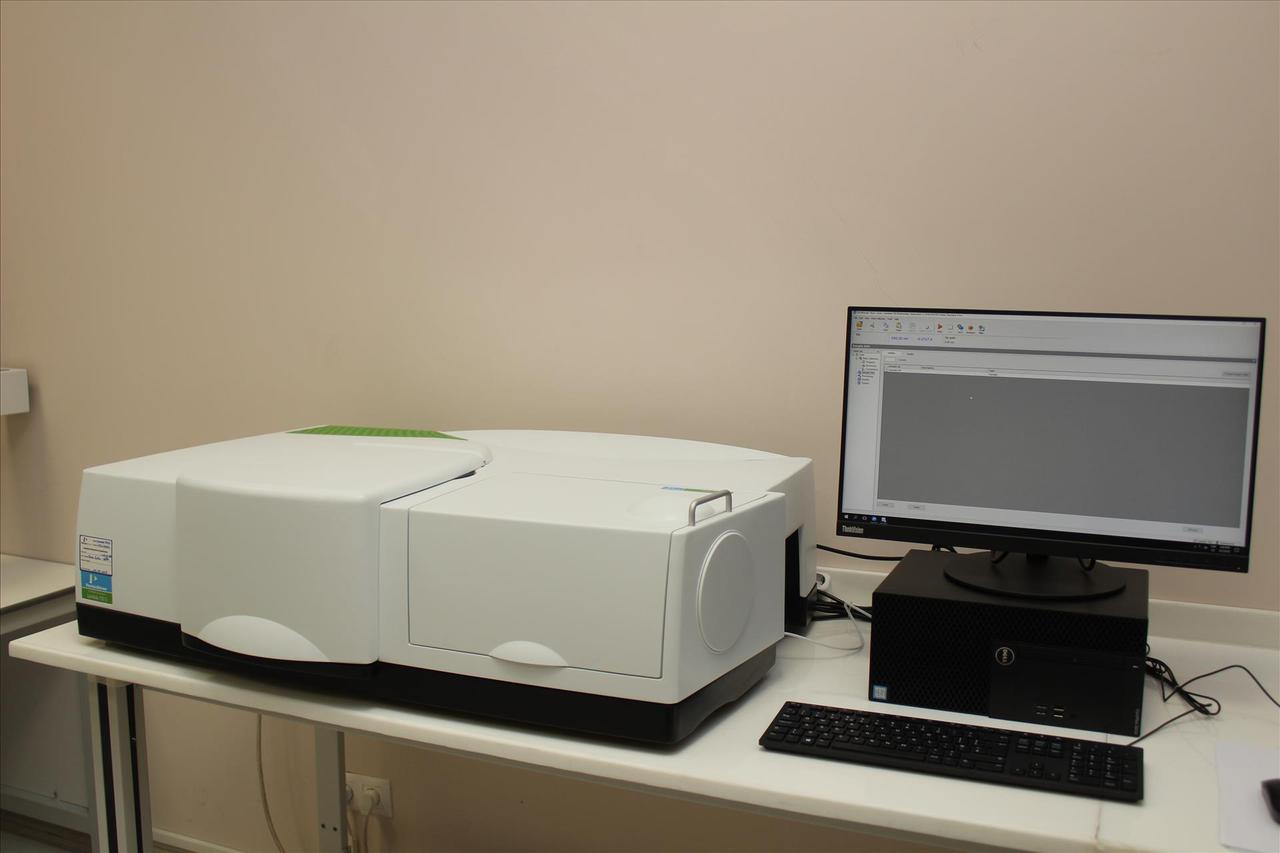
UV-VIS
Basic Components | UV-Vis spectrophotometers consist of fundamental components such as a light source (deuterium and tungsten lamps), a monochromator, a sample cuvette, and a detector. | ||||||||
|---|---|---|---|---|---|---|---|---|---|
Spectral Range | Standard UV-Vis instruments typically operate between 190–800 nm; UV-Vis-NIR instruments can extend this range up to 3200 nm. | ||||||||
Ultraviolet-visible spectrophotometer (UV-Vis) is an instrument that measures the absorption of light by a substance in the wavelength range of 200–800 nm. Molecules that absorb light in the UV (200–400 nm) and visible (400–800 nm) regions exhibit characteristic spectral responses. UV-Vis spectroscopy is directly or indirectly used in approximately 80% of chemical analyses. It is particularly preferred in biochemistry laboratories for determining protein and nucleic acid concentrations, in environmental laboratories for water quality analysis, and in the pharmaceutical industry for purity testing.
The theoretical basis of this method is the Beer-Lambert law, and absorbance is defined by the following formula:
Where:
The molar absorptivity (ε) value indicates how strongly a substance absorbs light at a specific wavelength and determines the analytical sensitivity of the selected analyte.

UV-VIS (ARUM)
In a UV-Vis spectrophotometer, light emitted from a source is filtered by a monochromator to select a specific wavelength. This light passes through a cuvette containing the sample, and the reduction in light intensity (transmittance) is measured. This reduction corresponds to the amount of light absorbed by the sample.
The relationship between absorbance and concentration is linear, and for a substance with ε = 10⁴ L/mol·cm, analysis with over 95% accuracy is achievable. Electronic transitions in the UV region typically occur as π→π* and n→π* transitions, which are generally associated with conjugated double bonds or structures containing heteroatoms.
The wavelength resolution of monochromators is typically 0.1 nm, providing high resolving power for selective analyses.
UV-Vis spectrophotometry is used in a wide range of analytical applications:
Advantages:
Limitations:
BOREN. "Ultraviyole-Görünür Bölge ve Yakın Kızılötesi Bölge Spektrofotometresi (UV-Vis-NIR)." Accessed July 13, 2025. https://boren.tenmak.gov.tr/tr/kimyasal-analizler/214-ultraviyole-gorunur-bolge-ve-yakin-kizilotesi-bolge-spektrofotometresi-uv-vis-nir.html.
Harris, Daniel C. *Quantitative Chemical Analysis*. 7th ed. New York: W.H. Freeman and Company, 2007. Accessed July 13, 2025. https://archive.org/details/quantitative-chemical-analysis-harris.
Middle East Technical University, Merlab. "UV-Vis Spektrofotometresi." Accessed July 13, 2025. http://merlab.metu.edu.tr/tr/uv-vis-spektrofotometresi.
Ondokuz Mayıs Üniversitesi, AVYS. "UV-Vis Spektrofotometresi." Accessed July 13, 2025. https://avys.omu.edu.tr/storage/app/public/hkutuk/120963/UV.pdf.
Osmangazi Üniversitesi, ARUM. "Morötesi-Görünür Işık Spektrofotometresi (UV-Vis-NIR)." Accessed July 13, 2025. https://arum.ogu.edu.tr/Sayfa/Index/76/morotesi-gorunur-isik-spektrofotometresi-uv-vis-nir.

UV-VIS
Basic Components | UV-Vis spectrophotometers consist of fundamental components such as a light source (deuterium and tungsten lamps), a monochromator, a sample cuvette, and a detector. | ||||||||
|---|---|---|---|---|---|---|---|---|---|
Spectral Range | Standard UV-Vis instruments typically operate between 190–800 nm; UV-Vis-NIR instruments can extend this range up to 3200 nm. | ||||||||
No Discussion Added Yet
Start discussion for "Ultraviolet-Visible Spectroscopy" article
A=ε⋅l⋅c
Working Principle
Components
Applications
Types of Spectrophotometers
Advantages and Limitations