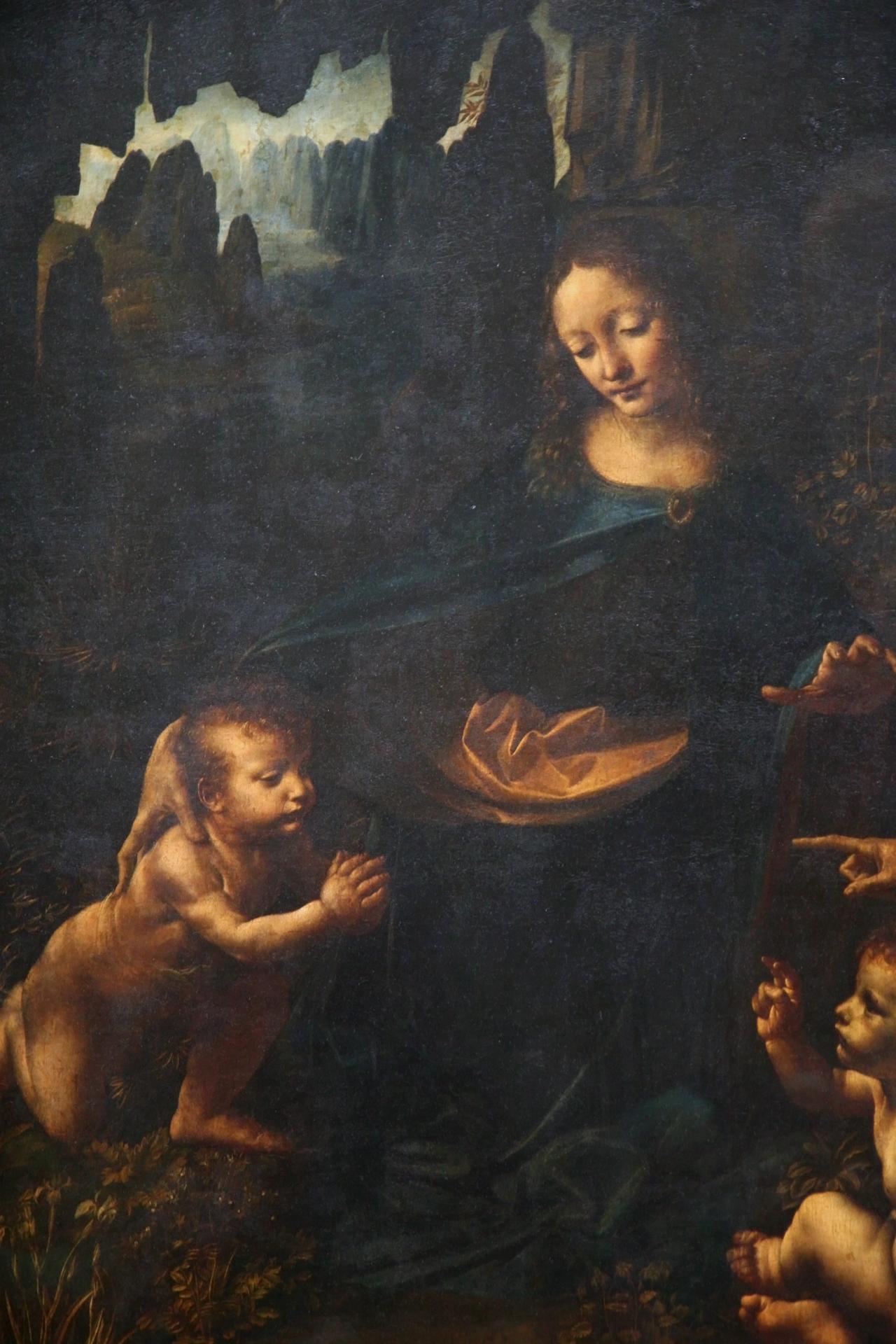



Virgin of the Rocks (Madonna of the Rocks) is a large-scale painting by Leonardo da Vinci, executed in oil on a wooden panel, begun around 1491/1492–1499 and completed between 1506–1508. The work is regarded as one of the masterpieces reflecting the technical innovations and artistic vision of Italy’s High Renaissance period. Today, it is part of the collection of the National Gallery in London, displayed in Room 51. Its dimensions are 189.5 × 120 cm.
An earlier version of the same composition (1483–1486) is housed in the Louvre Museum, and the London version is the painter’s second rendition.
Leonardo began his painting career in Florence and, in the early 1480s, moved to Milan to enter the service of the Sforza dynasty. While in Milan, the Virgin of the Rocks was commissioned as part of a large altarpiece arrangement for the Chapel of the Immaculate Conception in the church of San Francesco Grande.
The altarpiece was planned to include a wooden sculpture of the Virgin Mary above the painting. The commission was given shortly after Pope Sixtus IV officially approved the celebration of this feast in 1477.
Due to a financial dispute between Leonardo and the confraternity over the first version (Louvre), Leonardo sold that painting to another buyer. Later, an agreement was reached, and he began producing a second version. The completion of this second version in London was not achieved until 1508.

Left: Leonardo da Vinci, Virgin of the Rocks, c. 1483–86, Oil on Panel, 199 × 122 cm (Louvre Museum); Right: Leonardo da Vinci, Virgin of the Rocks, c. 1491–1508, Oil on Panel, 189.5 × 120 cm (SmartHistory)
The scene depicts the Virgin Mary, the Christ Child, the infant John the Baptist, and an angel, set within a landscape dominated by rock formations.

Pyramidal Structure in the Painting 'Virgin of the Rocks'. (SmartHistory)
Leonardo’s interest in the observation of nature emerges strikingly in this work. In the background, conical rock masses, dark crevices, and vertical ascents dominate the scene. The hard surfaces of the rocks are rendered as if they are volcanic formations newly risen from the depths of the earth.
In the foreground, plants and flowers are painted with meticulous detail, yet their forms are hybrid and imaginary, not corresponding to real species. This imparts both a realistic and otherworldly atmosphere to the scene. The wetlands visible between the rocks allude to the moment of the first creation.
Leonardo painted the distant landscape in bluish tones and soft contours to create a sense of depth. He observed that green tones appear bluer with distance and applied this optical knowledge to his painting.
The contours of the figures are indistinct; transitions between light and shadow are smooth. The sfumato technique, meaning “smoky effect,” is particularly evident in Mary’s face and hands. This makes the figures seem to emerge gradually from the dark background.

Sfumato Technique Used on the Face of the Virgin Mary. (flickr)
Most of the sky is obscured by the rocks, and the figures are illuminated as if under a “spotlight” emerging from darkness. This highlights the divine beauty of the holy figures.
The figures are linked through their gazes and hand gestures. The pyramidal arrangement provides both spatial depth and visual balance.
A leading figure of the High Renaissance, Leonardo da Vinci was a painter, engineer, anatomist, inventor, and natural scientist. Trained in the workshop of Andrea del Verrocchio in Florence, he brought a scientific approach to art through his studies in optics, anatomy, plant morphology, and geology.
Virgin of the Rocks is considered a product not only of Leonardo’s artistry but also of his scientific observations. Depictions of plants and rocks, his knowledge of anatomy, and his optical experiments are all integrated into the work.

Leonardo da Vinci. (leonardoda-vinci)
After being removed from San Francesco Grande, the painting passed to the S. Caterina alla Ruota Hospital.
Flickr. “Virgin, Babies and Rocks | Detail from Da Vinci's ‘Madonna of the Rocks’.” Photo by Slices of Light. Accessed August 9, 2025. https://www.flickr.com/photos/justaslice/3516004086.
Leonardo da Vinci Website. “Leonardo Da Vinci Biography In Details.” Accessed August 9, 2025. https://leonardoda-vinci.org/biography.html.
National Gallery, London. “Leonardo and The Virgin of the Rocks.” As part of the Leonardo: Experience a Masterpiece exhibition. Accessed August 9, 2025. https://www.nationalgallery.org.uk/exhibitions/past/leonardo-experience-a-masterpiece/leonardo-and-the-virgin-of-the-rocks.
National Gallery, London. “Leonardo da Vinci: ‘The Virgin of the Rocks’.” Accessed August 9, 2025. https://www.nationalgallery.org.uk/paintings/leonardo-da-vinci-the-virgin-of-the-rocks.
Smarthistory. “Leonardo, The Virgin of the Rocks.” Accessed August 9, 2025. https://smarthistory.org/leonardo-virgin-of-the-rocks/.


No Discussion Added Yet
Start discussion for "Virgin of the Rocks (Painting)" article
History and Commission Process
Subject and Iconography
Natural Setting and Landscape
Technical Features
Aerial Perspective
Sfumato
Chiaroscuro (Light-Dark Contrast)
Compositional Unity
Artist: Leonardo da Vinci (1452–1519)
Provenance and Ownership History
Exhibitions and Events
Artistic Significance
This article was created with the support of artificial intelligence.