

+2 More

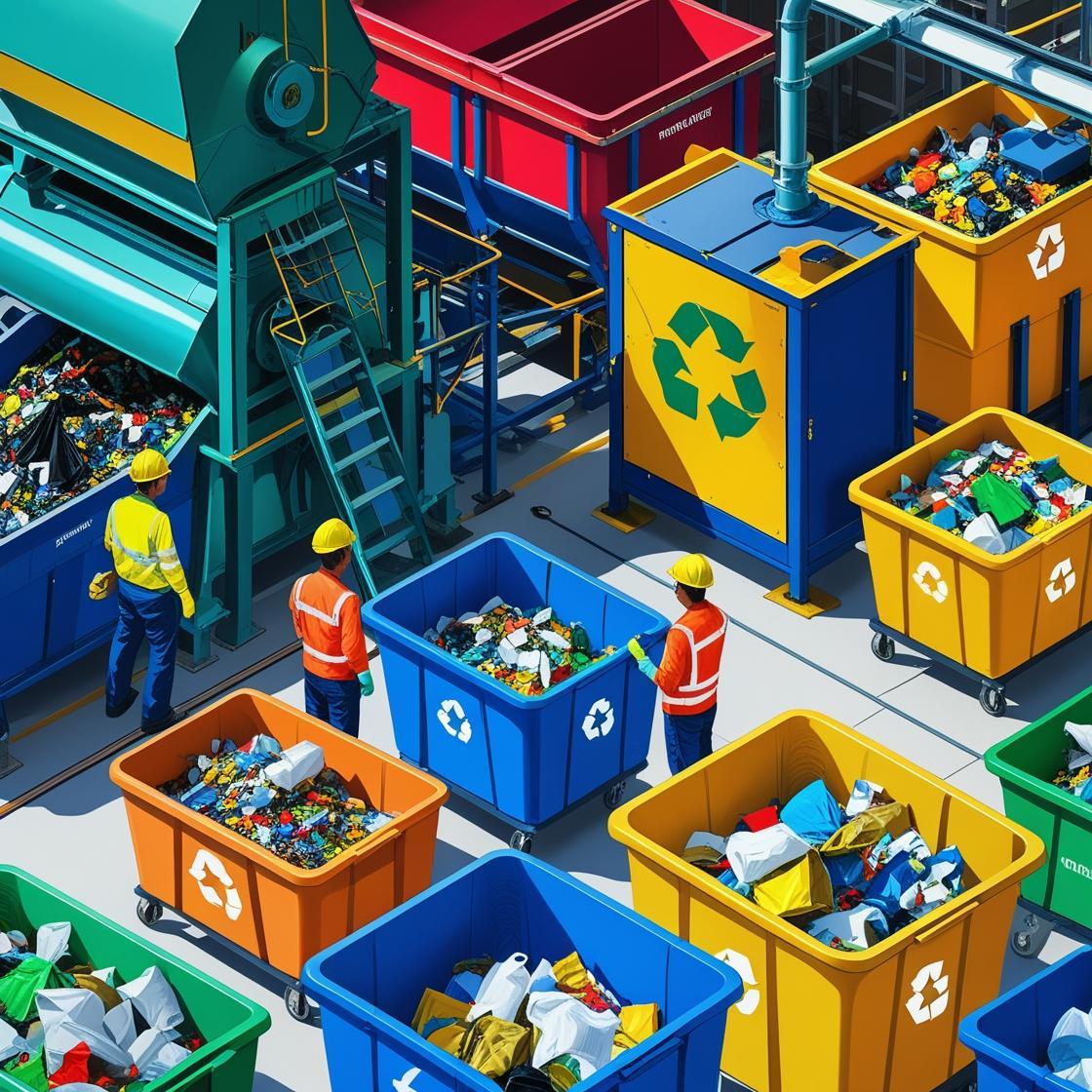
Waste Management in Türkiye
(Generated by Artificial Intelligence)
Key Policies and Strategies | Circular Economy Approach Recovery Contribution Fee (GEKAP) & Deposit System & Environmental Labeling Practices Zero Waste Policy | ||||||||
|---|---|---|---|---|---|---|---|---|---|
Responsible Main Institution | Ministry of Environment & Urbanization & Climate Change | ||||||||
In Türkiye, waste management policies are shaped in line with environmental sustainability principles, based on both national legislation and legal frameworks harmonized with the European Union. Chief among these is the Environmental Law (Law No. 2872), which sets the foundation for a waste management hierarchy that includes prevention, reduction, reuse, recycling, energy recovery, and final disposal. Waste management systems are implemented through detailed practices, including the separate handling of specific waste streams such as municipal and packaging waste.

Waste Management Visualization (Imagine Created by AI)
Since 2010, a significant increase in total waste generation has been observed in Türkiye. Even excluding large-scale mineral wastes, the trend remains upward. Among the most prominent waste categories are incineration residues and mixed municipal waste. Additionally, the amount of recyclable waste has approximately tripled. During the same period, both Gross Domestic Product and population have grown, indicating that waste generation remains closely tied to economic development. This reflects the direct impact of population growth and economic activity on waste production. Accelerated urbanization and industrialization, coupled with changing consumption patterns, further contribute to this increase.
Disparities in infrastructure and capacity across regions and municipalities in collecting, sorting, and disposing of waste hinder the effectiveness of waste management. Therefore, strengthening waste prevention and minimization at the source is critical to achieving sustainable waste management.
Between 2010 and 2021, per capita municipal waste generation in Türkiye remained largely stable. It stood at 416 kg/person in 2021 and decreased slightly to 382 kg/person in 2022, which is below the EU-27 average of 527 kg/person. As of 2021, 81% of municipal waste was disposed of in sanitary landfills. Only 12% was recycled, significantly lower than the EU average of 49%.
Composting and anaerobic digestion of biodegradable municipal waste are still at a very limited level. Moreover, municipal waste incineration is not practiced in Türkiye. According to 2020 data, 69.4% of municipal waste was disposed of in sanitary landfill sites, 17% in municipal dumping areas, 13.2% in recovery facilities, and 0.4% via open burning, burial, or illegal discharge into rivers or unregulated areas.
Due to inconsistencies in data systems and challenges in measurement, discrepancies exist between the recycling figures reported by different institutions. For instance, according to reports by the Ministry of Environment, Urbanization and Climate Change, the municipal waste recovery rate increased from 13% in 2017 to 35% in 2023. However, this data only covers waste reported by municipalities providing collection and transport services.
As of 2022, the quantity of packaging waste reported to the Waste Declaration System was 1,031,326 tons, with paper and cardboard accounting for nearly half of the total. According to 2018 data, the recovery rates for packaging waste were: 93% for paper and cardboard, 68% for metal, 63% for plastic, and 64% for composite packaging.
The management of packaging waste is regulated under the “Regulation on the Control of Packaging Waste,” which came into force in 2021. This regulation obligates municipalities to collect packaging waste separately at the source and assigns financial responsibilities to producers and entities placing products on the market in accordance with the principle of extended producer responsibility.

Waste Management Visualization (Imagine Created by AI)
Waste management policies and strategies in Türkiye are designed and implemented in accordance with the goals of environmental sustainability and resource efficiency. In this context, comprehensive policies — including zero waste and circular economy approaches — have been introduced alongside regulatory frameworks.
The primary institution responsible for waste management in Türkiye is the Ministry of Environment, Urbanization and Climate Change. At the provincial level, responsibilities are carried out by Provincial Directorates of Environment and Urbanization. Under Law No. 5216 on Metropolitan Municipalities and Law No. 5393 on Municipalities, local governments are responsible for the collection and transportation of waste. In metropolitan areas, municipalities are also tasked with recovery, storage, and final disposal processes.
Launched in 2017, the Zero Waste Policy aims to prevent waste generation, increase recovery rates, and raise environmental awareness throughout society. The Zero Waste Regulation, which came into effect in 2019, serves as the legislative backbone of this policy. Key instruments implemented under this policy include the Recovery Contribution Fee (GEKAP), mandatory deposit-refund systems, and eco-labeling schemes. In 2022, a Zero Waste Resolution proposed by Türkiye was adopted by the United Nations General Assembly, encouraging all member states to advance zero waste practices.
Circular economy principles were officially identified as strategic goals in the 2023 Special Expert Commission Report on Solid Waste Management. Plans for the 2024–2028 period include the development of a national waste data system, integration of GEKAP revenues into municipal waste services, implementation of sustainability criteria in public procurement, and support for reverse logistics infrastructure. Additionally, specific waste streams such as textiles and plastics are targeted for transformation into high-value-added products within the circular economy framework. The Renewable Energy Support Scheme (YEKDEM) is also planned to be restructured with a stronger focus on recovery and recycling.

Waste Management Visualization (Imagine Created by AI)
Aligned with the European Green Deal and its 2050 climate neutrality target, Türkiye aims to reform its waste management systems according to circular economy principles. The European Union’s Sustainable Products Initiative mandates that products be designed with recyclability and resource efficiency in mind from the early stages. In this regard, Türkiye is developing new legal frameworks that prioritize product recyclability and the circular use of raw materials.
Türkiye has established a robust legislative framework for waste management. However, increasing recycling rates and reducing reliance on landfilling remain top priorities. Major challenges include the separate collection and treatment of biodegradable waste, regional disparities in infrastructure, data consistency, and financial sustainability. Strengthening extended producer responsibility mechanisms and ensuring effective implementation of zero waste strategies at the local level are key to improving Türkiye’s waste management system.
European Environment Agency.Türkiye Municipal and Packaging Waste Management Profile – 2025. Published on April 15, 2025. Accessed on June 23, 2025.
Food and Agriculture Organization of the United Nations (FAO).National Strategy Document and Action Plan for the Prevention, Reduction, and Monitoring of Food Loss and Waste in Türkiye. Ankara, 2020. Accessed on June 23, 2025.
Ministry of Environment and Urbanization. National Waste Management and Action Plan 2016–2023. Accessed on June 23, 2025. https://webdosya.csb.gov.tr/db/cygm/haberler/ulusal_at-k_yonet-m--eylem_plan--20180328154824.pdf
Presidency of the Republic of Türkiye, Directorate of Strategy and Budget.Twelfth Development Plan (2024–2028): Special Expert Commission Report on Solid Waste Management. Ankara, 2023. Accessed on June 23, 2025. https://www.sbb.gov.tr/wp-content/uploads/2025/03/Twelfth-Development-Plan_2024-2028.pdf
Waste Management in Türkiye
(Generated by Artificial Intelligence)
Key Policies and Strategies | Circular Economy Approach Recovery Contribution Fee (GEKAP) & Deposit System & Environmental Labeling Practices Zero Waste Policy | ||||||||
|---|---|---|---|---|---|---|---|---|---|
Responsible Main Institution | Ministry of Environment & Urbanization & Climate Change | ||||||||
No Discussion Added Yet
Start discussion for "Waste Management in Türkiye" article
Waste Generation and General Trends
Municipal Waste
Packaging Waste
Waste Management Policies and Strategies
Legal and Institutional Framework
Zero Waste Policy
Circular Economy Approach
International Alignment and Harmonization
Current Status of Waste Management Practices and Legislation in Türkiye
This article was created with the support of artificial intelligence.