



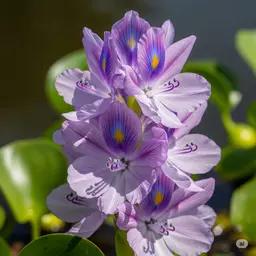
Water Hyacinth (Eichhornia crassipes) is a flowering plant that can rapidly proliferate in freshwater areas of tropical and subtropical regions, posing serious environmental and economic threats despite its aesthetic appearance. Introduced to different regions in the 19th century for ornamental purposes, this species has now become an undesirable invasive plant in many parts of the world.
The water hyacinth belongs to the plant family Pontederiaceae. Although it was previously known under the name Eichhornia, recent genetic studies have shown that it actually belongs to the Pontederia genus. Therefore, its scientific name is now accepted as Pontederia crassipes. This taxonomic revision has helped clarify the evolutionary relationships of the species. Moreover, research has identified certain genetic traits—such as the presence of numerous copies of specific genes—that explain the plant’s ability to spread rapidly and effectively.
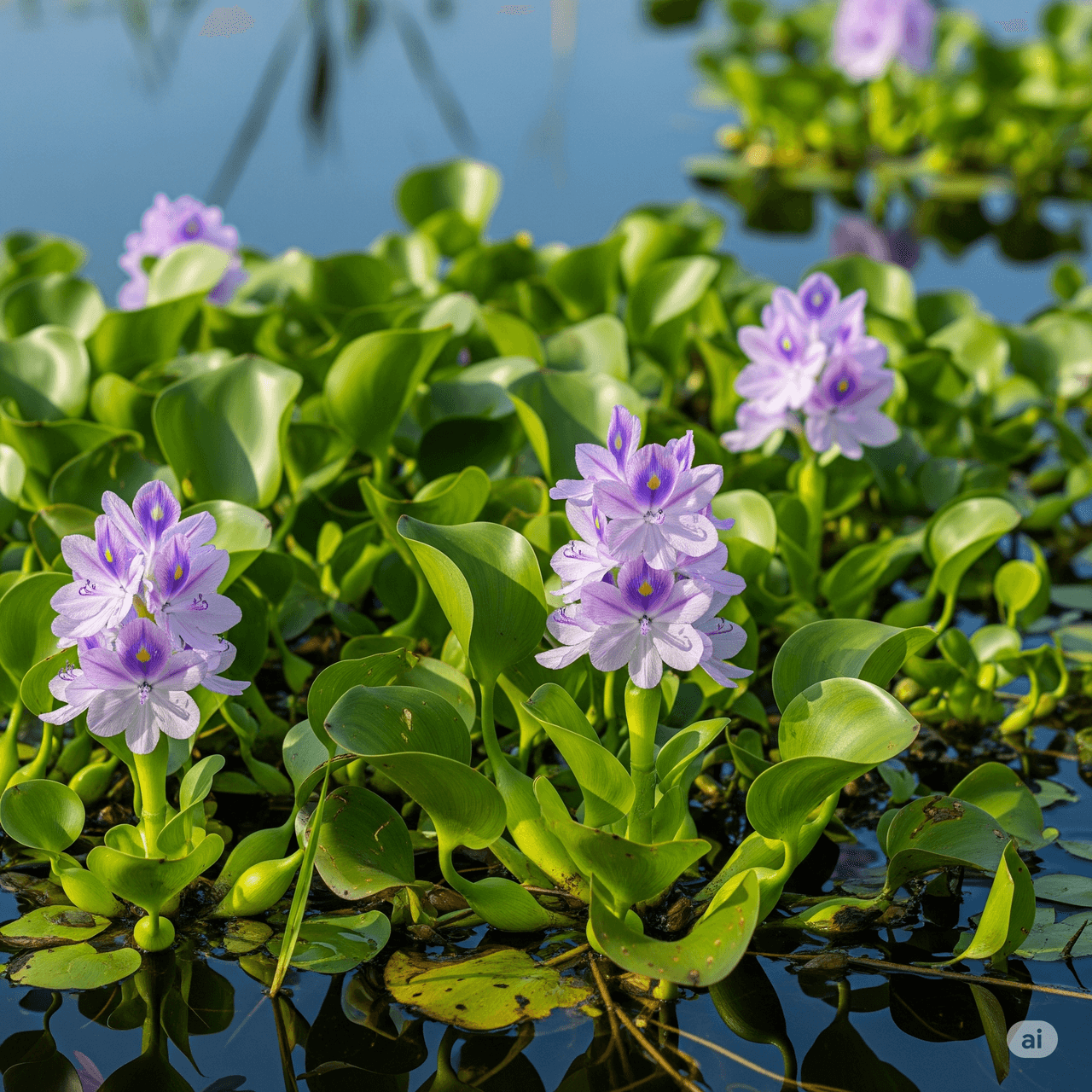
Water Hyacinth (Created by Artificial Intelligence)
Water hyacinth has a floating structure that allows it to rest on the surface of the water. The plant’s lower part contains the main roots, and its leaf stalks are filled with air, which helps it stay afloat. The leaves are oval-shaped, glossy green, and covered with a thick outer layer. This structure reduces water loss, making the plant more resilient in hot and humid environments. It does not have a distinct stem, but at the end of a short stalk, it bears pale-colored, six-lobed flowers with a purplish hue.
These flowers contain both male and female reproductive organs and are pollinated by insects. The plant reproduces through horizontal runners (extensions) emerging from the root, which can grow 5 to 15 cm per day. Thanks to this rapid growth, water hyacinth can cover an entire water surface within just a few weeks. It also produces a large number of seeds, which can remain viable in the mud at the bottom of the water for several years.
Water hyacinth is similar to many other plants in its ability to produce nutrients through photosynthesis, but it can also grow in low-light conditions. The structure of its leaves and the pigments they contain help the plant generate energy even in dim environments. The roots have specialized spongy tissues that allow the plant to survive in water or low-oxygen areas. These tissues transport oxygen from the roots to the surrounding water, supporting the survival of other aquatic organisms. When nutrients like nitrogen and phosphorus are abundant in the water, water hyacinth can reproduce even more rapidly. The plant grows best in water temperatures ranging from 25–30°C.
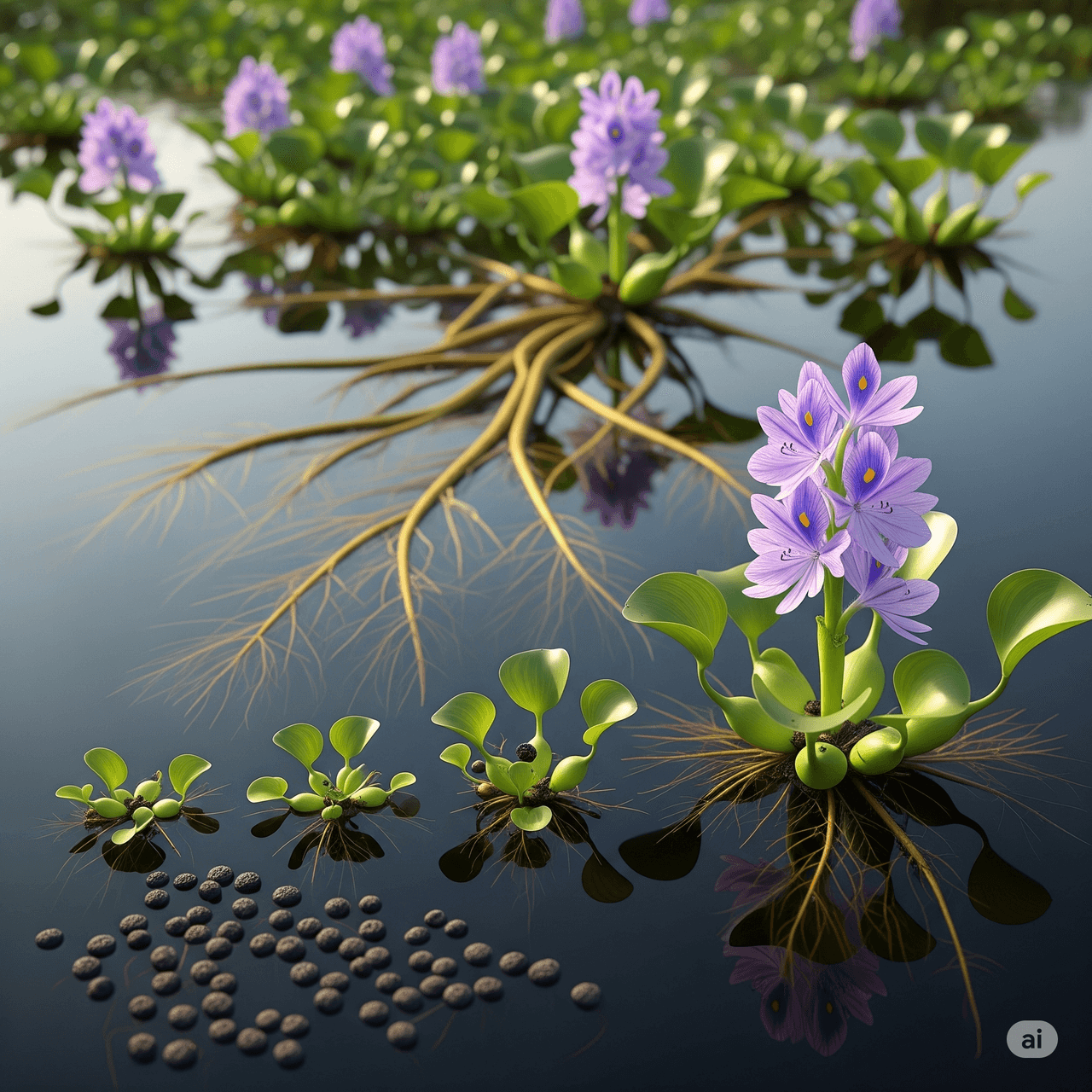
Life Cycle (Created by Artificial Intelligence)
Although originally native to South America, the species is now recorded in over 100 countries, including regions in Africa, Asia, Oceania, and North America. Major dispersal vectors include the ornamental plant trade, ballast water, irrigation canals, and flood events. Winter temperatures above thermal thresholds due to global warming are facilitating range expansion both northward and southward.
Water hyacinth reproduces rapidly and forms a thick mat on the water surface. This dense plant cover severely limits the penetration of sunlight into the water, reducing the population of organisms that rely on photosynthesis and decreasing the diversity of submerged aquatic plants. As the plants die and decompose, they consume oxygen in the water, leading to hypoxic conditions. Reduced oxygen levels result in increased fish mortality and the release of harmful gases, particularly methane. Furthermore, the dense vegetation provides an ideal breeding ground for disease vectors such as mosquitoes and snails. This increases the risk of the spread of diseases like malaria and other waterborne parasitic infections.
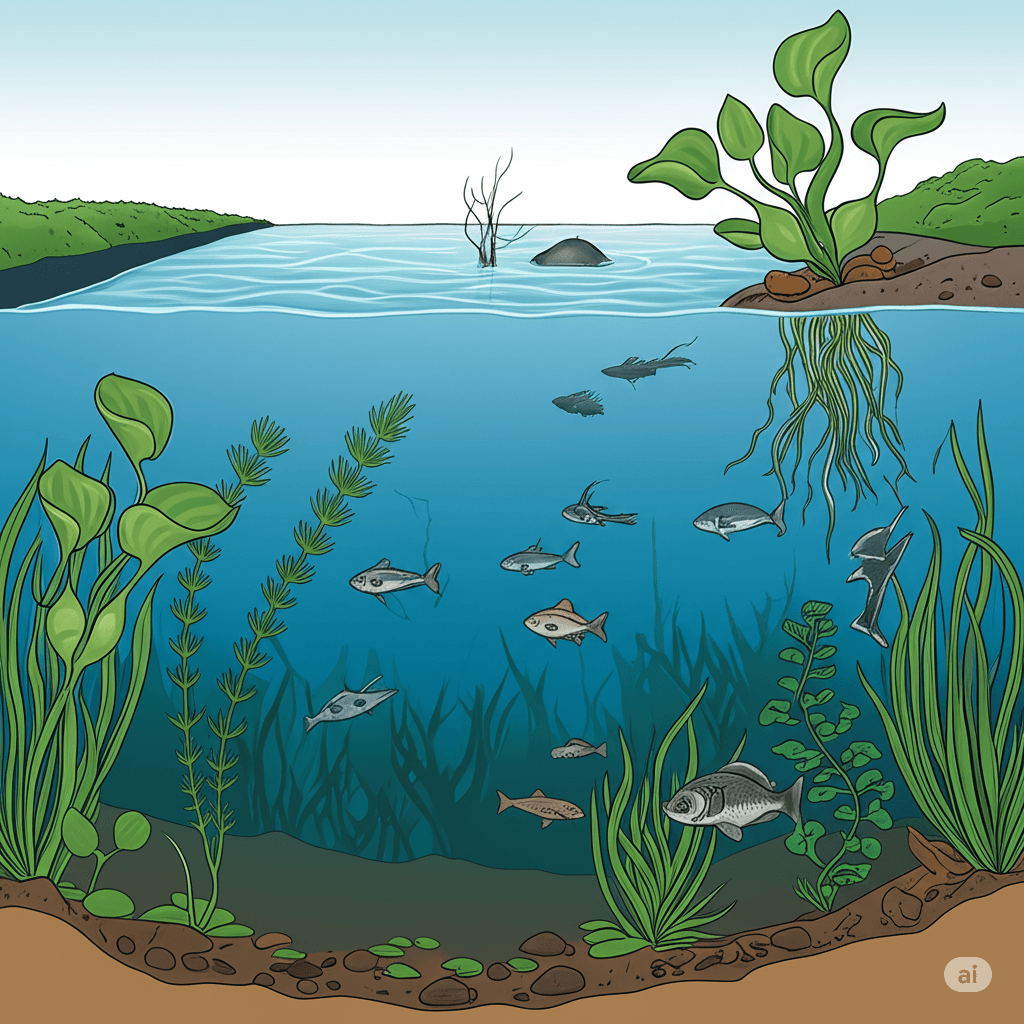
Impacts on the Ecosystem (Generated by Artificial Intelligence)
The obstruction of waterways by water hyacinth disrupts irrigation, fishing, and transportation activities, and may cause damage to turbines in hydroelectric power plants. In Lake Victoria, mechanical removal costs alone have been reported to reach several million USD annually. Rural communities suffer livelihood losses due to declining fish stocks and increased incidence of malaria.
Cárdenas-Cuadrado, C., Morocho, L., Guevara, J., Cepeda, M., Hernández-Paredes, T., Arcos-Jácome, D., Ortega, C., & Portalanza, D. (2025). Modeling The Impact Of Water Hyacinth On Evapotranspiration In The Chongón Reservoir Using Remote Sensing Techniques: Implications For Aquatic Ecology And Invasive Species Management. Hydrology, 12(4), 80. Accessed May 30, 2025. https://doi.org/10.3390/hydrology12040080.
De Laet, C., Matringe, T., Petit, E., & Grison, C. (2019). Eichhornia Crassipes: A Powerful Bio-İndicator For Water Pollution By Emerging Pollutants. Scientific Reports, 9(1). Accessed May 30, 2025. https://doi.org/10.1038/s41598-019-43769-4.
Desautels, D. J., Hartman, R. B., Weber, M. E., Jacob, N., Sun, A., & Civitello, D. J. (2022). Experimental Water Hyacinth Invasion And Destructive Management Increase Human Schistosome Transmission Potential. Ecological Applications, 33(2). Accessed May 30, 2025. https://doi.org/10.1002/eap.2767.
Harun, I., Pushiri, H., Amirul-Aiman, A. J., & Zulkeflee, Z. (2021). Invasive Water Hyacinth: Ecology, Impacts And Prospects For The Rural Economy. Plants, 10(8), 1613. Accessed May 30, 2025. https://doi.org/10.3390/plants10081613.
Hayyat, M. U., Nawaz, R., Irfan, A., Al-Hussain, S. A., Aziz, M., Siddiq, Z., Ahmad, S., & Zaki, M. E. A. (2023). Evaluating The Phytoremediation Potential Of Eichhornia Crassipes For The Removal Of Cr And Li From Synthetic Polluted Water. International Journal Of Environmental Research And Public Health, 20(4), 3512. Accessed May 30, 2025. https://doi.org/10.3390/ijerph20043512.

No Discussion Added Yet
Start discussion for "Water Hyacinth (Eichhornia crassipes)" article
Taxonomic Position
Morphological Structure
Physiology and Life Cycle
Global Spread and Ecological Impacts
Natural and Invasive Distribution
Impacts on Ecosystems
Socioeconomic Implications
This article was created with the support of artificial intelligence.