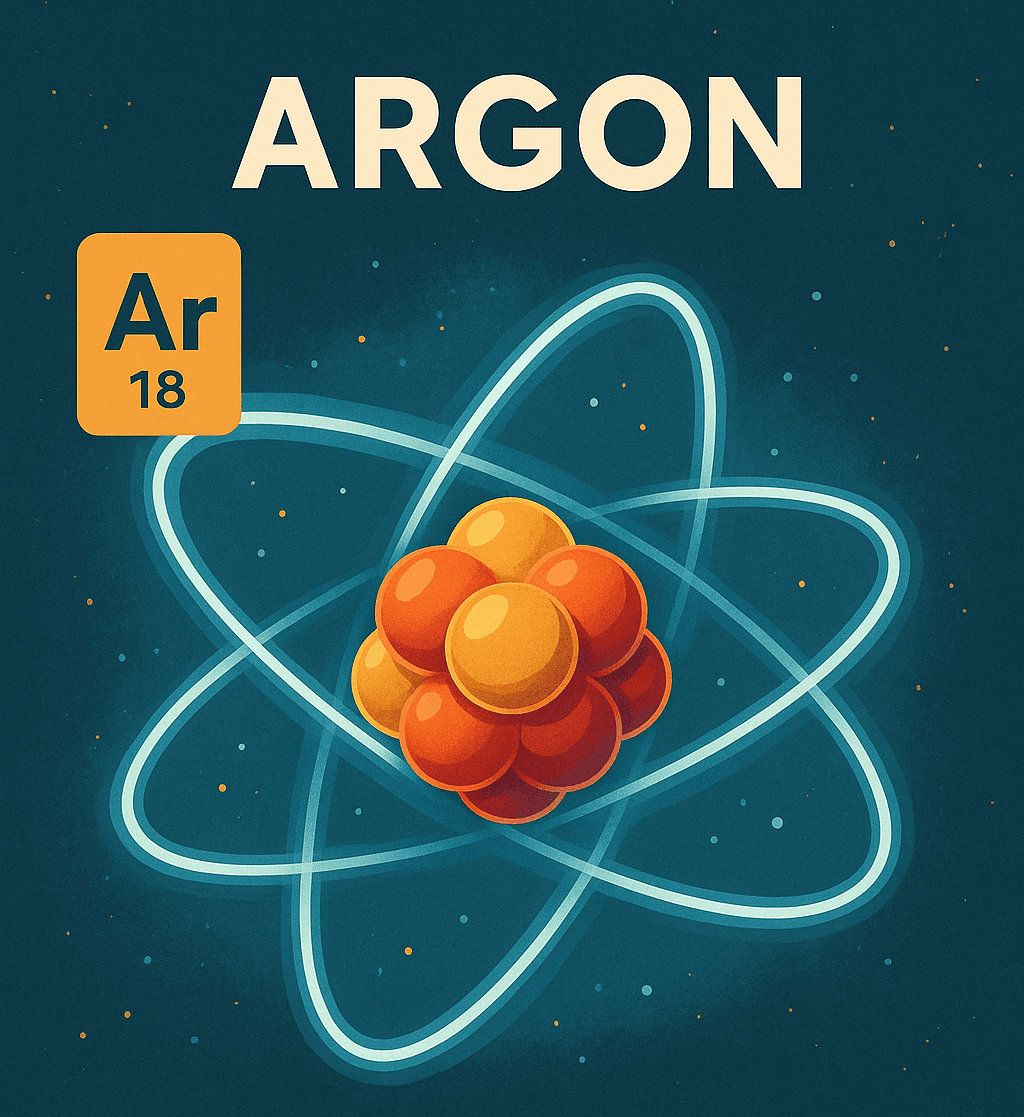




Argon Element
Argon is a silent gas hidden within the atmosphere. It is an element with atomic number 18 located in group 18 of the periodic table. It has no color or odor; we cannot see it but it performs many tasks exceptionally well.

(Generated by Artificial Intelligence.)
Where is it found?
Argon exists in small amounts in Earth’s atmosphere. Approximately 0.94 percent of the air we breathe is argon. It is also stored in specialized cylinders in factories and laboratories.
📦 Time Travel: How Was Argon Discovered?
Let us travel to the 1890s. Argon was discovered in 1894 by Lord Rayleigh and Sir William Ramsay through isolation from air. Scientists found that some gases in the atmosphere behaved differently than expected and thus separated argon. At the time, the discovery of new gases was helping humanity make major advances in understanding the world. Argon was discovered in this way.
Properties
Colorless and odorless. It cannot be detected by sight or smell.
Does not react (noble gas). It rarely combines with other elements. This makes it useful as a protective agent.
Liquefies at low temperatures. It changes from a gas to a liquid at very low temperatures.

(Generated by Artificial Intelligence.)
Where is it used?
Lamps: The interior of old incandescent bulbs is filled with argon; this helps the filament last longer, extending the bulb’s lifespan.
Welding and Metalworking: During metal joining processes, argon protects the weld area from oxygen in the air, creating a protective atmosphere.
Thermal Insulation: Argon can be filled between double-glazed windows; this reduces heat transfer and improves insulation.
Ancient Documents and Artifacts: In some preservation efforts, argon is used for storage to slow down the deterioration of artifacts.
🎨 Activity: The Argon Hunt
Find a light bulb and draw an image imagining the gas inside it.
Imagine argon’s role in a window: depict how this gas, placed between double panes, helps protect the window.
Create a small poster with a friend explaining argon’s uses, using colorful icons and short sentences.