




History of the Book (Children)
Book has become one of humanity’s most information essential tools for collecting and sharing knowledge. The word “book” comes from Arabic, meaning “to write, to gather.” In ancient times, people tried to preserve knowledge by writing it on various materials. Let us now embark on a journey through the history of the book and discover how books looked in antiquity!

Ancient Sumerian Tablets and the Origins of Writing
First Books: Clay Tablets
The first books were not made of today’s like paper. People wrote their texts using wedge-shaped marks on kil clay tablets. This writing system was called cuneiform. The Sumerians began producing these tablets around 3000 BCE. After writing, the tablets were dried in the sun or baked in ovens, allowing them to be preserved for very long duration long periods.

Ancient Sumerians and Cuneiform Writing
King Ashurbanipal of Assyria established the world’s oldest library. This library contained more than 20,000 clay tablet tablets! These tablets recorded stories, poems, laws and scientific knowledge.

Ashurbanipal’s Library
Papyrus Scrolls: The Books of Ancient Egypt
In ancient Egypt, people used paper made from a plant called papyrus to write. Papyrus strips were glued together to form long rolls, typically about six to seven meters in length. People wrote their texts in vertical columns on these scrolls, which were then rolled up for storage.

Egyptian Papyri and Hieroglyphic Writing
Texts written on papyrus scrolls usually dealt with important subjects such as the achievements of pharaohs, religious texts and medical knowledge.
Parchment: A New Form of the Book
Parchment, a type of fine leather, began to replace papyrus as a writing material. Parchment was particularly popular in Bergama, modern-day Türkiye. Parchment sheets were folded and sewn together, giving rise to the earliest examples resembling today’s books.

Bergama and Parchment Production
Books in the Islamic World
In the Islamic world, great value was placed on books. The Kur’an-ı Kerim was first compiled during the time of Hz. Abu Bakr and later copied extensively during the time of Hz. Osman. Due to the high regard for knowledge and science in the Islamic world, many library were established. For example, during the Abbasid era, vast libraries in Baghdad housed hundreds of thousands of books.

Books and Knowledge in the Islamic World
Science scholars wrote books on medicine, astronomy, mathematics and literature. These books were often written in elaborate scripts, decorated with intricate designs and carefully bound.
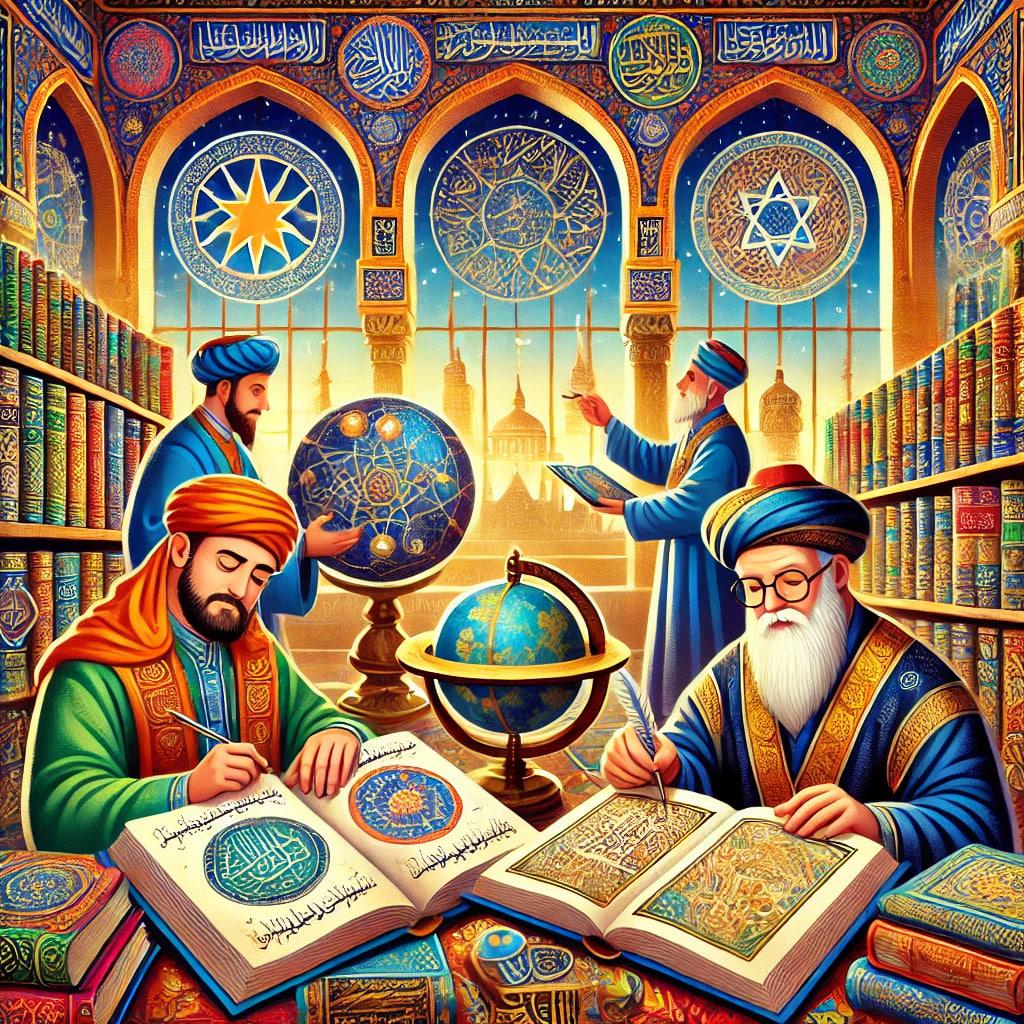
Islamic Scholars and Astronomy Books
Turks and the Book
Long before Islam, the Turks became familiar with books. After adopting Buddhism, they began compiling their religious texts into book form. The Uyghurs even learned bookbinding and produced some of the world’s oldest leather-bound art manuscripts.

Uyghur Turks and the Writing of Religious Texts
The Spread of Books
Over time, books became widespread. People began learning and sharing knowledge through books. Books were not only a source of information but also works of art. Beautiful handwriting (hat art), ornamental designs (tezhip) and miniatures adorned these volumes.

The Art of Book Decoration
In the past, books were extremely valuable. Each book was handwritten and manually copied, so very few existed and each one was precious. But with the invention of today printing, books became easier to produce, allowing us to read as many as we wish.
The Importance of Books
Books are treasures that carry the knowledge of the past into the present. Through books, we learn new information, explore different worlds and develop our dream imagination. Ancient people understood the importance of books very well and did everything in their power to preserve them. Today, we too can continue this legacy by reading books! 🌟

Knowledge and Dreams Emerging from Books