



The Little Prince
The Little Prince (Le Petit Prince) is one of the most popular, most translated, and timeless classics of world literature, written by French author and pilot Antoine de Saint-Exupéry. Although it appears at first glance to be a children’s book, it explores profound philosophical themes such as friendship, love, loss, human nature, and the superficiality of the adult world, using a simple, fairy-tale-like, and enchanting language accessible to children.
Plot
A pilot stranded in the Great Sahara Desert, desperately trying to repair his crashed plane, suddenly encounters an extraordinary child with golden hair who comes from another planet: The Little Prince. The Little Prince lives alone on his tiny planet, B-612, where he cleans three volcanoes, pulls up harmful baobab seedlings, and cares tenderly for his beloved but vain Rose. After a disagreement with his Rose, he leaves his home to embark on an interplanetary journey in search of new knowledge.
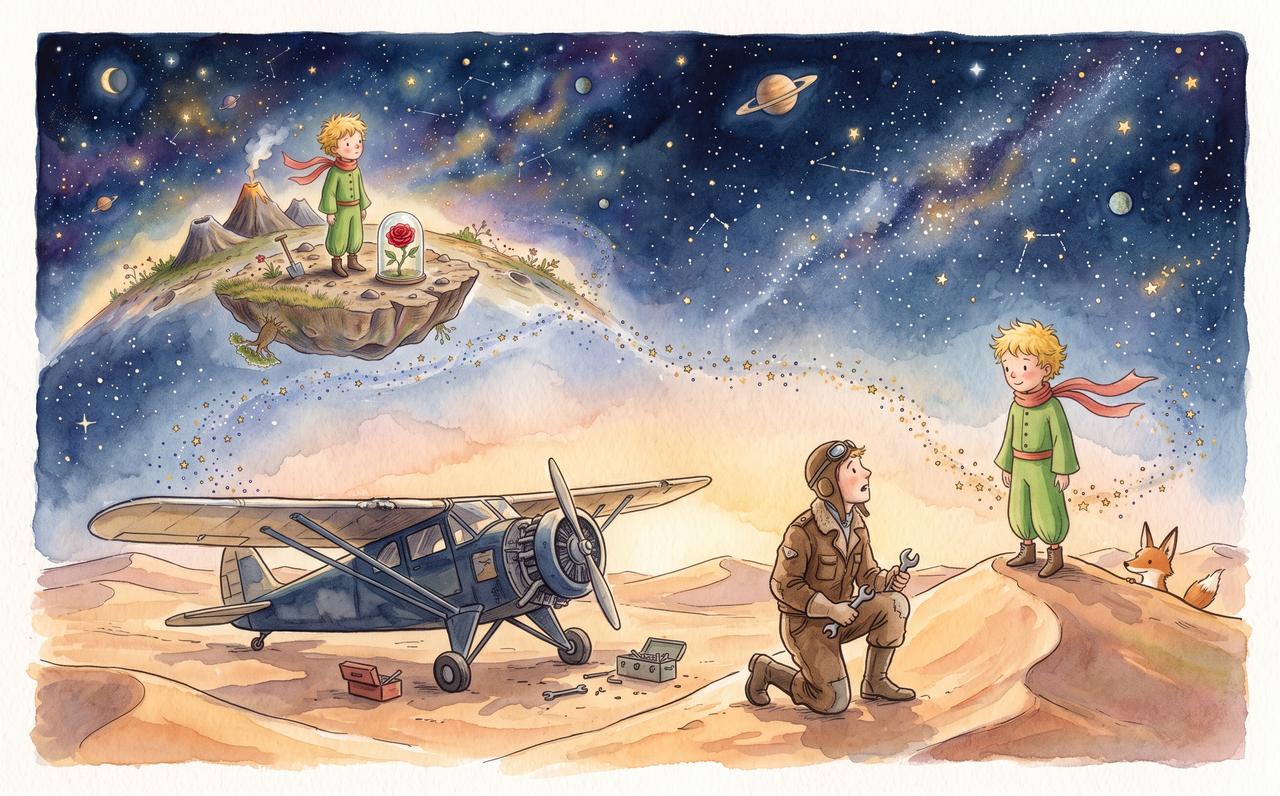
An excerpt from the subject matter of The Little Prince. (Generated by artificial intelligence)
During his journey, he visits six different planets, each inhabited by a single adult who symbolizes a negative trait of the adult world: a king obsessed with giving orders, a vain man who craves only praise, a drunkard who drinks to forget his shame, a businessman who counts and claims ownership of stars as a form of wealth, a lamplighter who blindly follows a meaningless rule, and a geographer who writes without ever having traveled the world.
Finally arriving on Earth, the Little Prince meets a Snake, a garden filled with thousands of roses, and above all, a Fox who teaches him what it means to “tame” and to “form bonds.” He tells the pilot about his bond with his Rose and what he has learned during his travels. At the end of the story, he says his body has become too heavy and that he wishes to return to his planet and his Rose; with the Snake’s help, he sheds his physical form and returns to his star.
Themes
- What Is Essential Is Invisible to the Eyes (Appearance vs. Essence): The book’s most fundamental message is contained in the Fox’s whisper to the Little Prince: “One sees clearly only with the heart. What is essential is invisible to the eye.” While adults value appearances, numbers, and superficial qualities, the story argues that true love, friendship, and meaning can only be felt with the heart.
- Love, Effort, and “Taming”: The Fox teaches the Little Prince the meaning of “taming”—forming bonds. By investing time and effort into something and accepting responsibility for it, one makes it unique and special among all others in the world. When the Little Prince first sees the thousands of roses in the garden, he feels disappointed, but he soon realizes that his own Rose is unique because of the time he has devoted to her.
- Critique of the Adult World and Alienation: Through the characters on the six planets he visits, the story critiques adult preoccupations with meaningless ambitions, power, superficiality, and emotionless logic. While adults become fixated on numbers, possessions, and titles, children perceive the world through sincerity, curiosity, and love.
- Responsibility and Growth: Although the Little Prince’s departure from his planet seems like an act of freedom and exploration, his journey leads him to understand the value of responsibility and love. “It is the time you have wasted for your rose that makes your rose so important” reflects the idea that becoming an individual and maturing lies at the core of loyalty and responsibility.
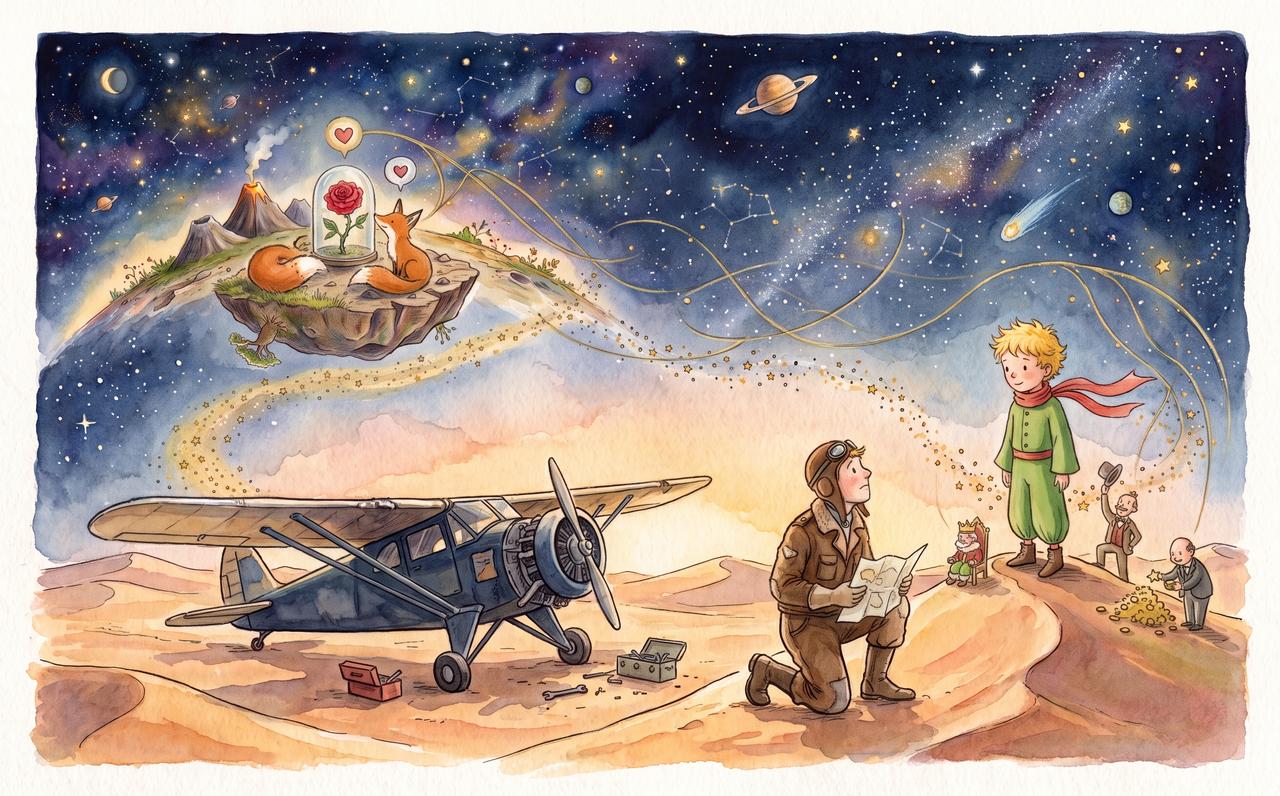
Excerpts from book themes. (Generated by artificial intelligence)
Characters
- The Little Prince: He embodies innocence, curiosity, unconditional love, and childlike logic. He never stops asking questions, cannot comprehend the meaningless world of adults, and seeks pure love at his core.
- The Pilot (Narrator): A grown-up who, as a child, drew a picture of a boa constrictor digesting an elephant but could not make adults understand it, so he gave up drawing. He still carries a child’s heart within him. Through his bond with the Little Prince in the desert, he rediscovers his lost childhood perspective.
- The Rose: The delicate, proud, fragile, yet uniquely special flower on the Little Prince’s planet. Her vanity drives him away, yet she remains his only true love. She symbolizes the journey from selfishness to genuine love.
- The Fox: The wise guide of the story. A philosophical figure who teaches the Little Prince the meaning of friendship, love, effort, and “taming” (forming bonds).
- The King, the Vain Man, the Businessman, the Drunkard, the Lamplighter, the Geographer: These characters represent negative attitudes of the adult world. They embody human flaws such as obsession with authority, craving for applause, greed, meaningless habits, and rote knowledge.
- The Snake: A mysterious and abstract figure symbolizing physical existence and death on Earth. He offers the Little Prince the means to return to his planet by helping him shed his body.
Style
Antoine de Saint-Exupéry’s style is profoundly poetic, simple, and symbolic. He conveys complex philosophical ideas and human relationships in a clear, fairy-tale-like language accessible to children. The watercolor illustrations drawn by the author’s own hand are an inseparable part of the text; they support the narrative and awaken the reader’s imagination. Using the form of a fairy tale, the work offers not instruction or advice but a humanist narrative that invites readers to reflect, explore their emotions, and rediscover the child within themselves.
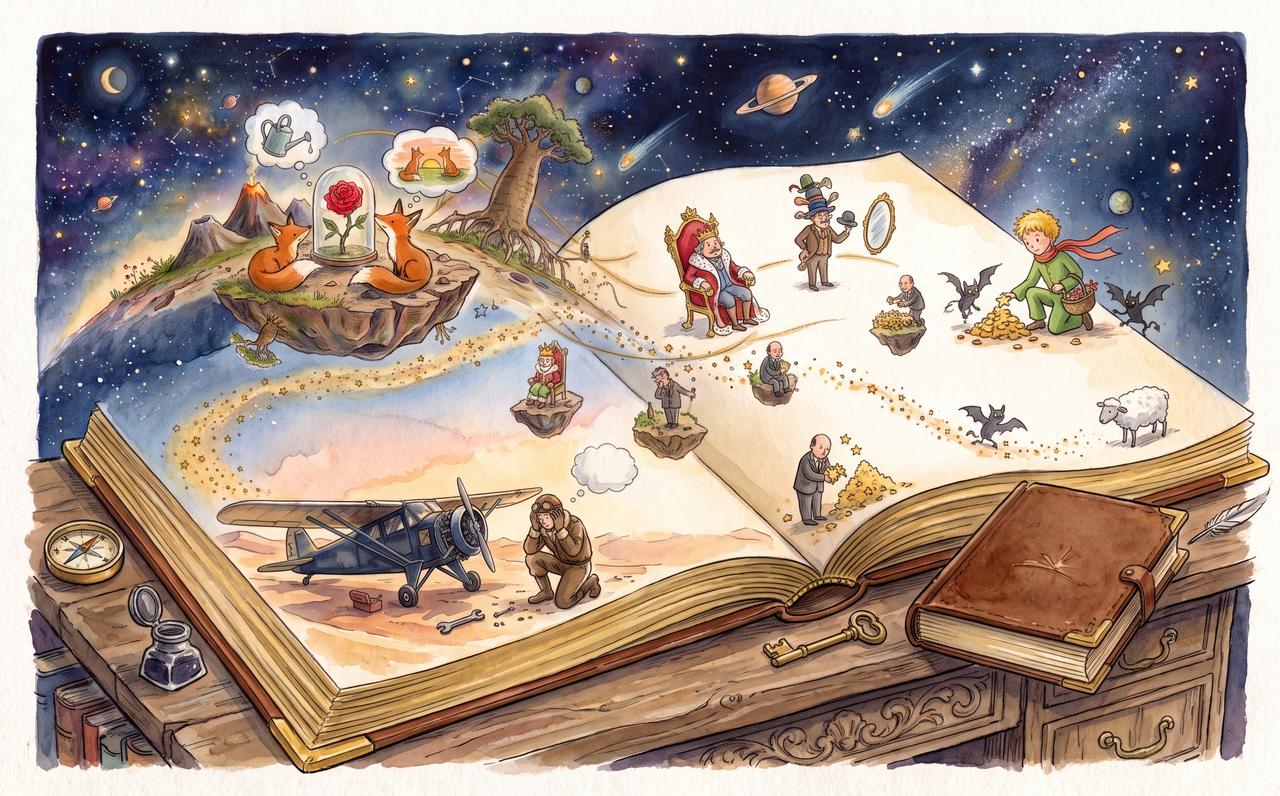
The Little Prince. (Generated with artificial intelligence)