


Bu içerik Türkçe olarak yazılmış olup yapay zeka ile otomatik olarak İngilizceye çevrilmiştir.
+1 Daha
Ebbinghaus Forgetting Curve is a mathematical and psychological model first demonstrated experimentally by German psychologist Hermann Ebbinghaus, quantifying the decline in memory retention over time. This model describes how memory traces fade at varying rates when information is not rehearsed and captures the temporal dynamics of memory.
The curve’s origins lie in systematic experiments conducted by Ebbinghaus on himself between 1879–1880 and 1883–1884. Ebbinghaus observed that earlier memory studies using poetry or meaningful texts introduced measurement errors due to the associative load of words. To control for this variable, he invented “nonsense syllables” — combinations of two consonants with a vowel in between, such as “BAP” or “KEX”.
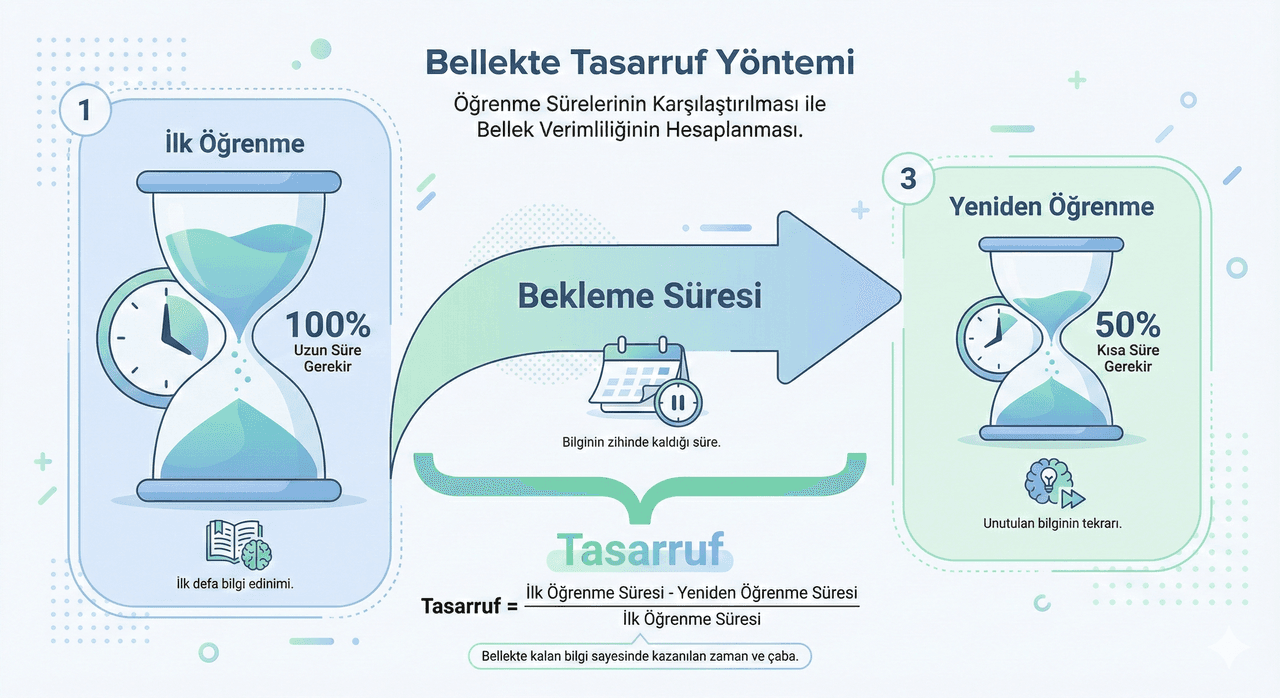
Diagram illustrating the principle and measurement logic of Ebbinghaus’s Savings Method (Generated by AI)
Ebbinghaus repeatedly memorized lists of these syllables until he could recite them flawlessly. He then measured the time required to relearn the same lists after specific intervals: 20 minutes, 1 hour, 9 hours, 1 day, 2 days, 6 days, and 31 days. During this process, he developed a measurement technique known as the “Savings Method” (Savings Method / Ersparnismethode). This method calculates the proportional difference between the time or number of repetitions required to learn material initially and the time or repetitions needed to relearn it after a delay. For example, if initial learning required 10 repetitions and relearning required only 5, a 50% savings was assumed.
Ebbinghaus’s findings revealed that forgetting is not a linear process. The forgetting process begins rapidly immediately after learning and gradually slows down, approaching a plateau. According to his data, more than half of the learned material is forgotten within the first hour. By the end of the day, the rate of forgetting declines significantly, and the curve becomes nearly parallel to the horizontal axis.
Various formulations have been proposed for the mathematical description of the forgetting curve:
In his 1885 publication, Ebbinghaus proposed a logarithmic function to explain his data.
Analysis of Ebbinghaus’s earliest handwritten notes from 1880 and subsequent studies by later researchers indicate that forgetting is better described by a power function . This model assumes that the rate of forgetting continuously slows over time.
Modern analyses, particularly when examining individual data rather than averages, have shown that exponential functions also fit the data well. Additionally, Pareto functions have been proposed as an alternative model, consistent with Jost’s Law, which posits that memory traces strengthen over time (consolidation) and become more resistant to forgetting.
Research diverges on whether the forgetting curve approaches zero (complete forgetting) or stabilizes above chance level (persistent memory trace). Some modern analyses suggest that after a certain period, memory performance plateaus above chance levels, indicating that complete forgetting does not occur.
Ebbinghaus’s single-subject study (himself) has been replicated and extended by subsequent researchers over the years.
In a study involving 14 participants, the rate of forgetting was found to be slower than Ebbinghaus reported, though the overall shape of the curve remained similar. Finkenbinder determined that learning and recall performance varies throughout the day (diurnal variation), with morning hours showing the highest cognitive efficiency. He also reported that the previously observed “spike in forgetting after 8 hours” (noted in earlier studies by Radossawljewitsch) was likely an artifact of measurements taken during periods of daily fatigue.
In a replication adhering closely to Ebbinghaus’s original methodology, results closely matched the original curve. A notable finding was a higher-than-expected recall rate at the 24-hour mark — a kind of “boost” not predicted by the theoretical curve. This phenomenon has been linked to the positive effect of sleep on memory consolidation.

Memory and Sleep: Memory Protection Curves (Generated by AI)
In a study within the context of industrial learning curves, differences in forgetting between procedural tasks (performing an assembly sequence step-by-step) and continuous control tasks (disassembly) were examined. Procedural tasks showed a pattern of forgetting similar to the Ebbinghaus curve, dependent on the amount learned and time elapsed. However, forgetting was found to be negligible in tasks requiring continuous motor skills.

Difference in Forgetting Rates Between Procedural Tasks and Motor Skills According to Bailey’s Study (Generated by AI)
The shape and slope of the forgetting curve vary depending on several variables:

Key Variables and Environmental Factors Directly Affecting the Forgetting Curve and Memory Performance (Generated by AI)
The strength of initial learning is a primary factor influencing the rate of forgetting. Higher initial mastery slows the rate of forgetting.
Items at the beginning and end of lists (primacy and recency effects) are recalled better and forgotten more slowly than items in the middle.
Learning and recall performance fluctuate throughout the day; morning hours are generally identified as the most cognitively efficient time period.
Sleep following learning can enhance memory consolidation, thereby slowing the expected decline in the forgetting curve or producing a temporary performance boost.

Production Interruption and Forgetting Cost Analysis Graph (Generated by AI)
The Ebbinghaus Forgetting Curve is not limited to individual psychology but plays a critical role in industrial production planning. “Forgetting cost” calculations are used to estimate how much skill loss occurs during breaks in production. In this context, forgetting is not viewed as the inverse of the learning curve but as a function of the amount learned and the time elapsed. Research shows that the speed of relearning is not correlated with the original learning speed — fast learners do not necessarily relearn quickly — but rather that the amount of skill lost determines the duration required for recovery.
Accessed December 5, 2025. - http://www.jstor.org/stable/2631976
Accessed December 5, 2025. - https://doi.org/10.2307/1413271
Accessed December 5, 2025. - https://journals.plos.org/plosone/article?id=10.1371/journal.pone.0120644
Accessed December 5, 2025. – https://www.sciencedirect.com/science/article/pii/S0022249610001100
Bailey, Charles D. "Forgetting and the Learning Curve: A Laboratory Study." Management Science 35, no. 3 (1989): 340–352.
Finkenbinder, E. O. "The Curve of Forgetting." The American Journal of Psychology 24, no. 1 (1913): 8–32.
Lee Averell, Andrew Heathcote "The Form of the Forgetting Curve and the Fate of Memories." Journal of Mathematical Psychology 55, no. 1 (2011): 25–35.
Murre, Jaap M. J., and Joeri Dros. "Replication and Analysis of Ebbinghaus’ Forgetting Curve." PLOS ONE 10, no. 7 (2015).


Henüz Tartışma Girilmemiştir
"Ebbinghaus Forgetting Curve" maddesi için tartışma başlatın
Historical Development and Methodology
Key Features and Mathematical Models of the Curve
Logarithmic Function
Power Law
Exponential and Pareto Functions
Existence of an Asymptote
Replication Studies and Consistency of Findings
Finkenbinder (1913)
Murre and Dros (2015)
Bailey (1989)
Influencing Factors and Variables
Level of Learning
Seriation Position Effect
Time of Day
Sleep
Industrial and Practical Applications