


Bu içerik Türkçe olarak yazılmış olup yapay zeka ile otomatik olarak İngilizceye çevrilmiştir.

EfficientNet is a deep learning architecture designed to achieve high accuracy in image classification tasks while minimizing computational cost. Introduced in 2019 by Google AI, the EfficientNet family has delivered significant improvements over previous convolutional neural network (CNN) architectures in both accuracy and efficiency. The foundation of the model lies in the balanced scaling of three key dimensions: depth, width, and resolution.
Unlike traditional CNN architectures that rely on single-dimensional scaling strategies, EfficientNet introduces a compound scaling method. This approach simultaneously and coordinately increases the model’s width, depth, and input resolution, achieving higher accuracy while keeping computational complexity under control.
Traditional CNNs attempt to improve performance by increasing only depth or width. EfficientNet, however, scales its parameters uniformly using the following equations:
In EfficientNet, instead of increasing a single dimension, a multi-dimensional and balanced scaling strategy is applied.
EfficientNet is fundamentally based on Mobile Inverted Bottleneck Convolution (MBConv) blocks, which enable selective information flow and efficient parameter utilization.
MBConv blocks maintain information density by transitioning between narrow and wide feature maps between input and output. These blocks reduce the number of parameters while enhancing efficiency.
The SE module learns the importance of each channel and rescales features accordingly, enabling the model to emphasize critical attributes.
The EfficientNet family consists of eight distinct models, ranging from B0 to B7. Each subsequent model contains more parameters than the previous one and delivers higher accuracy.
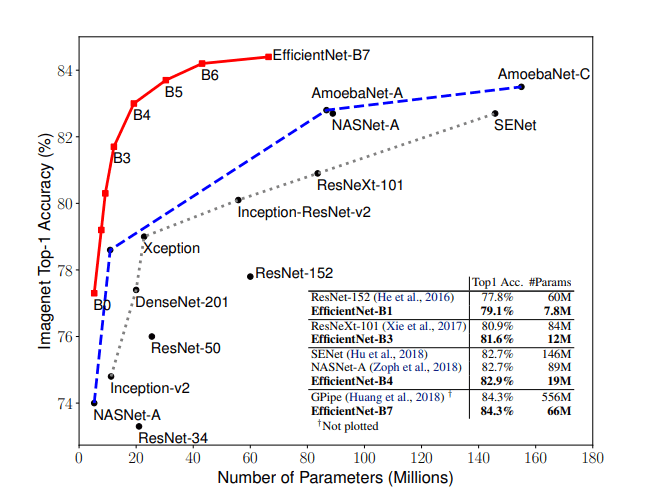
Model Size vs ImageNet Top-1 Accuracy (
Tan, Mingxing, and Quoc V. Le. 2020. “EfficientNet: Rethinking Model Scaling for Convolutional Neural Networks.” ArXiv.org. September 11, 2020. https://doi.org/10.48550/arXiv.1905.11946.
Tan, Mingxing, and Quoc V. Le. 2021. “EfficientNetV2: Smaller Models and Faster Training.” Arxiv.org, April. https://doi.org/10.48550/arXiv.2104.00298.

Henüz Tartışma Girilmemiştir
"EfficientNet" maddesi için tartışma başlatın
Efficient Scaling Strategy
Compound Scaling
EfficientNet Architecture
MBConv Blocks
Squeeze-and-Excitation (SE) Module
EfficientNet Model Family
Advantages
Applications