


Bu madde henüz onaylanmamıştır.
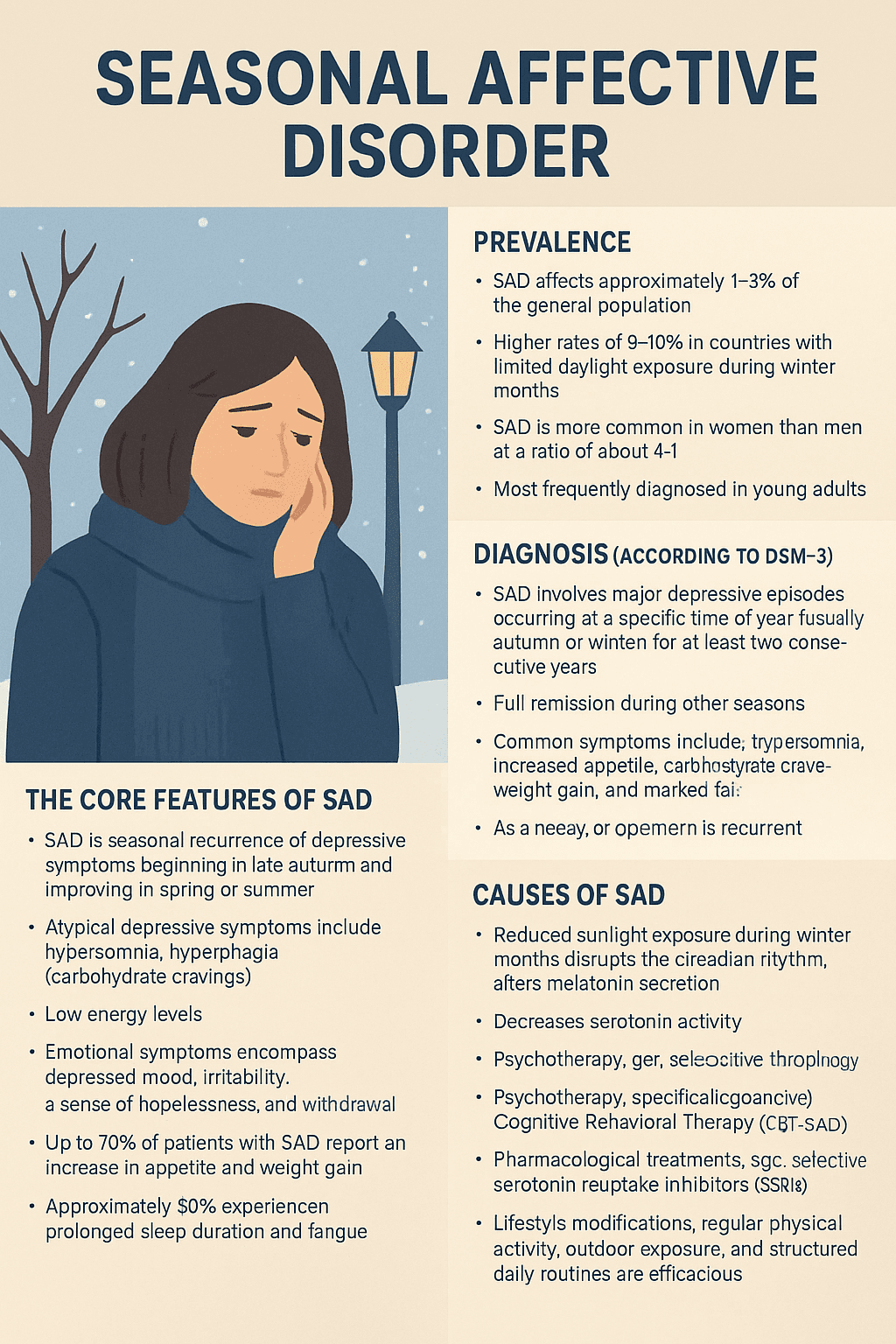
yapay zeka tarafından oluşturulmuştur.
Seasonal affective disorder (SAD) is a type of recurrent major depressive disorder that occurs in a seasonal pattern, most commonly during the fall and winter months when daylight hours are at their shortest. The condition is characterised by a persistent low mood, decreased energy levels, changes in sleep patterns and appetite, and a loss of interest in daily activities. According to the Diagnostic and Statistical Manual of Mental Disorders, Fifth Edition (DSM-5), SAD is not classified as a distinct disorder but rather as a specifier for major depressive disorder or bipolar disorder ("with seasonal pattern").
Prevalence
On a global scale, the prevalence of SAD is estimated to be approximately 1–3% of the general population. However, higher rates, ranging from 9–10%, have been reported in countries with limited daylight exposure during the winter months. The condition manifests more frequently in women than in men, with a ratio of approximately 4:1, and is most frequently diagnosed in young adults. In Turkey, SAD has been increasingly recognised in psychiatric settings, particularly in northern regions where seasonal changes in daylight are more pronounced.
Diagnosis (According to DSM-5)
The DSM-5 criteria for SAD include the presence of major depressive episodes that occur at a specific time of the year (usually autumn or winter) for at least two consecutive years, with full remission during other seasons. It is a common occurrence for patients to manifest symptoms including, but not limited to, hypersomnia, increased appetite, carbohydrate cravings, weight gain, and marked fatigue. In order to confirm a diagnosis, it is necessary that the seasonal pattern is recurrent and not better explained by other psychosocial or environmental factors. In Turkey, diagnosis is typically established through psychiatric evaluation and standardized clinical interviews based on DSM-5 criteria.
The Core Features of SAD
The hallmark of SAD is the seasonal recurrence of depressive symptoms, which characteristically commence in late autumn and abate in spring or summer. Patients frequently present with atypical depressive symptoms, including hypersomnia, hyperphagia (particularly of carbohydrates), and low energy levels. The emotional symptoms may encompass depressed mood, irritability, a sense of hopelessness, and social withdrawal. Research indicates that up to 70% of patients diagnosed with SAD report an increase in appetite and weight gain, while approximately 80% experience a prolonged sleep duration and fatigue.
Causes of SAD
The aetiology of SAD is multifactorial in nature, involving biological, psychological, and environmental factors. Reduced sunlight exposure during the winter months has been demonstrated to disrupt the circadian rhythm, alter melatonin secretion, and decrease serotonin activity. Collectively, these factors have been shown to contribute to the development of depressive symptoms. Genetic susceptibility is also a contributing factor, with increased concordance rates observed among first-degree relatives. Psychological vulnerability, such as pre-existing mood disorders, and sociocultural factors, including lifestyle and work patterns, have been demonstrated to increase the risk of developing SAD. In Turkey, the growing recognition of SAD has been linked to both increasing clinical awareness and the influence of changing social and environmental conditions.
Treatment Approaches
The treatment of SAD (Seasonal Affective Disorder) involves a combination of biological and psychological interventions. The utilisation of light therapy, also known as phototherapy, is widely regarded as the primary treatment modality. Studies have demonstrated that this approach successfully ameliorates symptoms in 60–80% of patients by emulating natural sunlight and regulating circadian rhythms. Psychotherapy, in particular Cognitive Behavioral Therapy (CBT-SAD), has been demonstrated to be efficacious in the treatment of negative thought patterns and the prevention of relapse. Pharmacological treatments, such as selective serotonin reuptake inhibitors (SSRIs), are also employed, particularly in cases of severe or recurrent symptoms. Lifestyle modifications, incorporating regular physical activity, outdoor exposure, and the maintenance of structured daily routines, have been demonstrated to be efficacious. In Turkey, there has been an increasing trend of university hospitals and private psychiatric clinics employing multidisciplinary approaches that combine light therapy, psychotherapy and pharmacological interventions.
American Psychiatric Association. (2013). Diagnostic and statistical manual of mental disorders (5th ed.). Arlington, VA: American Psychiatric Publishing.
Lam, R. W., & Levitan, R. D. (2000). Pathophysiology of seasonal affective disorder: A review. Journal of Psychiatry & Neuroscience, 25(5), 469–480.
Rosenthal, N. E., Sack, D. A., Gillin, J. C., Lewy, A. J., Goodwin, F. K., Davenport, Y., ... & Wehr, T. A. (1984). Seasonal affective disorder: A description of the syndrome and preliminary findings with light therapy. Archives of General Psychiatry, 41(1), 72–80.
Roecklein, K. A., & Rohan, K. J. (2005). Seasonal affective disorder: An overview and update. Psychiatry (Edgmont), 2(1), 20–26.
Melrose, S. (2015). Seasonal Affective Disorder: An overview of assessment and treatment approaches. Depression Research and Treatment, 2015, 178564.

yapay zeka tarafından oluşturulmuştur.
Henüz Tartışma Girilmemiştir
"Seasonal Affective Disorder (SAD)" maddesi için tartışma başlatın
Bu madde yapay zeka desteği ile üretilmiştir.
