




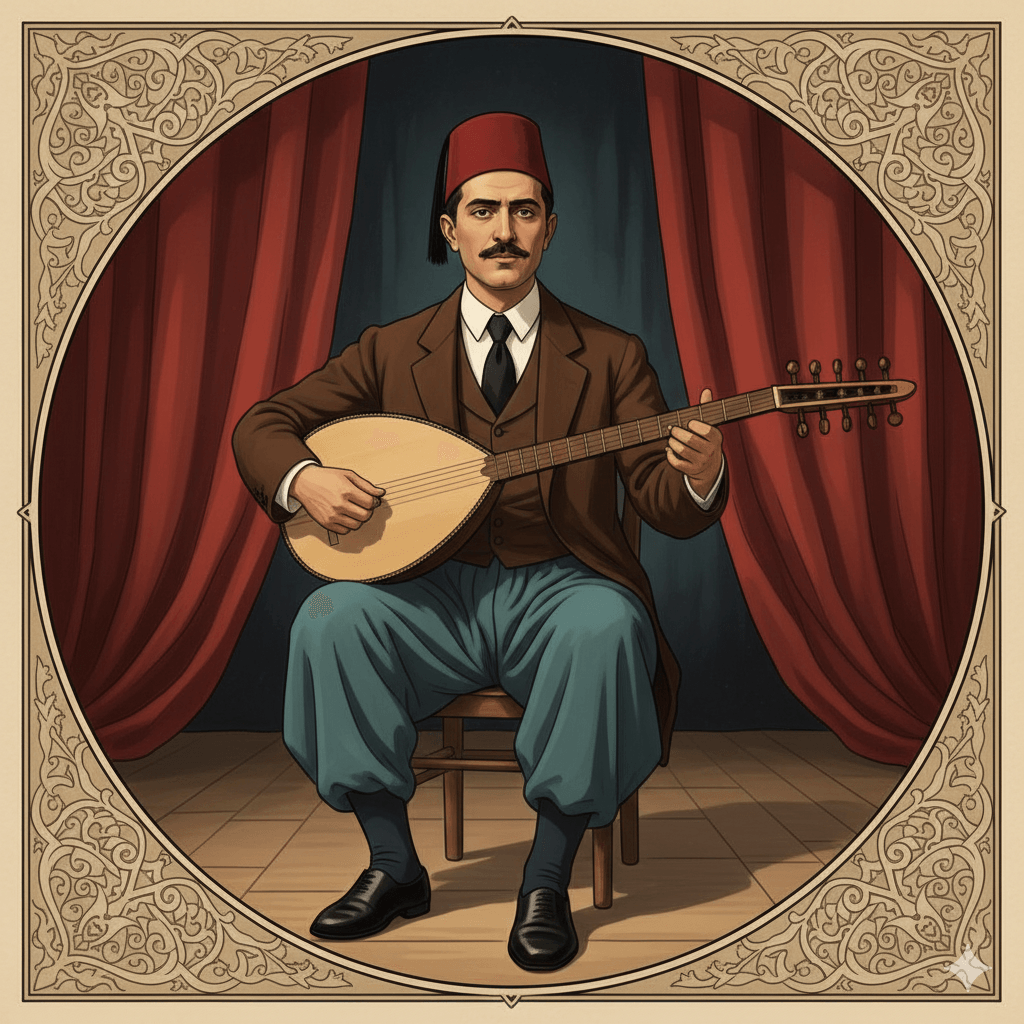
Tanbûrî Cemil Bey
Let’s embark on a brief musical journey through time. Now we will travel to 19th-century Istanbul. There exists a miracle who, with his tanbur in hand, gave voice to the instruments and told the people the language of melody: his name is Tanbûrî Cemil Bey. Who was this fascinating figure? What did he accomplish? Let’s discover!
👨🏻👩🏻👦🏻Birth Family and Childhood Years
Tanbûrî Cemil Bey was born in the Molla Gürânî neighborhood of Istanbul’s Fatih district. Although his exact birth date is uncertain, it is known to have been around 1872 or 1873. His father was Mehmed Tevfik Bey and his mother was Zihniyâr Hanım. After losing his father at the age of three, Cemil was raised by his uncle Refik Bey. He attended the neighborhood school and learned French through private lessons. His introduction to music came through his elder brother Ahmed Bey.
🎼Music in Youth and Early Steps
Cemil Bey encountered the tanbur at the age of fifteen. He quickly demonstrated extraordinary talent, gaining recognition within just two years. He studied the subtleties of classical Turkish music under Tanbûrî Ali Efendi.

Representative illustration of Tanbûrî Cemil Bey’s instrumental training process (Image generated by artificial intelligence).
Over time he mastered not only the tanbur but also other instruments such as the kemençe, lavta and cello. He briefly held positions in state offices, but his heart led him back to music.
🎖️Early Career Before Music
At the age of nineteen, Cemil Bey began working in state service. He first served briefly at the Bâbıâli Translation Office, then became a clerk at the Ministry of Foreign Affairs, eventually rising to the position of chief clerk.

Representative illustration of Cemil Bey working in a state office (Image generated by artificial intelligence).
In recognition of his achievements, Sultan Abdülhamid II awarded him a special honor. After the Second Constitutional Era, he voluntarily resigned from his post and in 1912 began working as a music teacher at the newly established Dârülbedâyi.
🪕Artistic Life and Innovative Approaches
Tanbûrî Cemil Bey was sufficiently innovative to reshape the musical understanding of his time. He brought greater vitality to the sound of the tanbur, played the lavta using tanbur techniques, and integrated the kemençe into the ensemble of classical instruments. He was also a prolific composer, producing works in many forms including peşrev, saz semâisi, oyun havası and longa.

Tanbur (Image generated by artificial intelligence).
⭐ Some of his most famous compositions are the saz semâisi titled “Şedd-i Araban” and “Ferahfezâ”.

Lavta (Image generated by artificial intelligence).
He also engaged deeply with music theory and authored an important book titled “Rehber-i Mûsikî”. This work served as a bridge between Turkish music and Western notation and holds great value in the history of Turkish music. Tanbûrî Cemil Bey was also among the first Turkish artists to give public concerts.
💍Family Life and Final Years
In 1901 he married Şerife Saide, whom he met at the Adile Sultan Palace. A year later their son Mesut was born. However, their marriage experienced occasional tensions. In the final years of his life, he chose to live in a small cabin in his garden, which he named “uzletgah”. He passed away in Istanbul in 1916 and was buried in the Merkezefendi Cemetery. Unfortunately, the exact location of his grave is unknown today.

Representative illustration of Merkezefendi Cemetery in Istanbul (Image generated by artificial intelligence).
🎶Legacy, Influence and Students
Tanbûrî Cemil Bey is regarded as one of the most important figures who shaped Turkish music. He infused life into instruments, guiding each to find its own voice. He trained many students, including notable names such as Refik Fersan, Fâhire Fersan and Şemseddin Ziyâ Bey. His style became a school of thought for subsequent composers and performers.
🎧You Can Experience Tanbûrî Cemil Bey’s “Şedd-i Araban Saz Semâisi” by Listening!
Tanburi Cemil Bey - Şedd-i Araban Saz Semâisi (Tanbur) (YouTube)