

 Son Eklenen:

Bu içerik Türkçe olarak yazılmış olup yapay zeka ile otomatik olarak İngilizceye çevrilmiştir.
15–29 October 2026 period saw Houthi attacks extend beyond their previous targets of Riyadh’s King Khalid International Airport and Aramco facilities to include Yemen’s interim capital Aden, King Fahd International Airport in Dammam, and the regions of Mecca and Medina. Yemen government forces continued their Yemen曙光 operation launched on 5 October in the fronts of Taiz, Marib, and Jawf; the city of Taiz became the site of the most severe humanitarian impact under Houthi siege. During the same period, Egypt’s parliament granted its president authority to provide military support to Saudi Arabia, the United Kingdom announced the deployment of combat aircraft for defense purposes, and representatives from Saudi Arabia, Pakistan, and Türkiye met with Iranian officials in Tehran.
The General Authority of Civil Aviation (GACA) of Saudi Arabia announced that the 10 October attack on King Khalid International Airport resulted in the deaths of 13 individuals of various nationalities and injuries to more than 300 others. The developments covered in this section occurred following that attack.
15 October saw Houthis target the Maashiq Presidential Palace in Aden with missiles. Yemen’s Minister of Information Muammer al-Iryani stated that the palace was struck by five missiles and that the Prime Minister and cabinet members inside were unharmed. Initial assessments reported the deaths of three guards protecting the palace; Health Minister Qasim Buhaibih announced later that night that five security personnel and civilians had been killed and 16 injured. Al Jazeera reported that the government confirmed the Prime Minister Shaya al-Zindani and other officials were safe, and that two of the Prime Minister’s bodyguards had been killed.
Houthi military spokesperson Yahya Saree claimed responsibility for the attack on the same day, stating that the Saudi military presence constituted a “legitimate target” for the Houthis. Saree declared, “Those who attack our country should not expect us to greet them,” and asserted that Saudi Arabia had carried out at least 274,302 attacks on Yemen over the past 12 years, and 2,350 since tensions escalated. According to Al Jazeera, Saree claimed the attack struck the “Saudi military operations headquarters” in Aden. The Yemeni Council of Ministers stated that the attack demonstrated the Houthis’ inability to confront state authority directly and their shift toward targeting civilian infrastructure, while affirming that the assault would not weaken the resolve of the state and government.
16 October saw two missiles strike Aden International Airport, landing approximately 500 meters from Yemenia Flight IY 612 to Cairo, which was preparing for takeoff, and about 100 meters from the midpoint of the runway. Iryani confirmed that passengers and crew had survived, stating that “a major tragedy that could have claimed dozens of innocent lives was narrowly averted.” According to Al Jazeera, the Aden Security Directorate described the attack as the second targeting of the airport within a week; the Houthi-affiliated Saba News Agency claimed the intended target was the military command center and weapons storage facilities at the Bedir Camp adjacent to the airport.
21 October saw Saree claim that a ballistic missile achieved a direct hit on an operations room located at the Bedir Military Camp in Aden, which he alleged belonged to Saudi Arabia; local media reported hearing loud explosions near Aden Airport following the strike. 24 October saw Yemen’s Ministry of Transport announce that Aden International Airport had been targeted by two ballistic missiles, labeling it the “fourth attack of the month.” On the same day, Yemen’s Ministry of Interior disclosed that three ballistic missiles had been fired at coastal security units in Aden—two aimed at a unit within the ministry’s headquarters and one at a building in the Tawahi district. Saree further claimed that military installations at the Nasr Camp and naval base had been targeted, asserting that preparations were conducted under the supervision of Saudi officers and led by Saudi Brigadier General Bedr Salah al-Harbi.
25 October saw a Houthi ballistic missile strike an empty area near a government military camp in the Bureyka district west of Aden, causing a powerful explosion with no injuries reported. 26 October saw Saree announce that weapons storage facilities in the Salahaddin and al-Wahat areas of Aden’s Lahij governorate had been targeted.
28 October, Sari claimed that a Saudi military cargo aircraft was carrying weapons and demanded that those at Aden Airport immediately evacuate the area. The Yemen Ministry of Transport reported on the same day that the airport had been targeted twice within hours and that the number of attacks in the past six days had reached six. The ministry’s statement read: “We call upon the international community, particularly the International Civil Aviation Organization (ICAO) and other relevant United Nations (UN) bodies, to condemn these attacks, take urgent measures to halt them, and demonstrate firm resolve to protect airports and civilian facilities and ensure the safety of civil aviation within the framework of international law and agreements.” Yemen Armed Forces Spokesperson Colonel Majid al-Nuzayli described the 28 October attack as the sixth targeting the airport, noting that civilians had been injured and material damage had occurred.
On 21 October, the Houthis announced they had targeted military equipment at Rayyan Airport in Mukalla, Hadramawt, asserting that Sari used the airport to transport military equipment sent by Saudi Arabia. Nuzayli reported that this was the fourth attack on the airport within hours. The Yemen government forces announced on 21 October that both Aden and Rayyan airports had been struck; President of the Presidential Leadership Council Rashad al-Alimi condemned the attacks and called on the international community to designate the Houthis as a terrorist organization.
Arab Coalition Spokesperson Lieutenant General Turki al-Maliki stated at a press conference in Riyadh on 15 October that King Khalid International Airport had been targeted 20 times between 7 and 11 October, including 10 ballistic missiles and 10 drones, resulting in 17 deaths and 333 injuries. Maliki noted that a total of 19 civilians had been killed and 364 injured in attacks on airports, and that the coalition had detected 1,104 missile and 1,135 drone attacks against Saudi Arabia to date, with 127 missile storage sites belonging to the Houthis in Yemen’s mountainous regions destroyed. Figures on casualties vary by source: GACA reported 13 deaths for the 10 October attack, while Al Jazeera cited 14 deaths in its 17 October report and at least 18 deaths in its 20 October report.
The airport announced on 24 October that it would reopen; international flights resumed on 25 October from Terminal 2, while domestic flights resumed from Terminal 1. Houthi spokesperson Sari stated on 24 October that they viewed the airport as a “military target” and warned airlines not to use it, vowing to continue attacks. On 25 October, Sari said: “The Yemeni Armed Forces warn all international, regional, and local airlines, their personnel, and passengers to avoid using King Khalid Airport in Riyadh, as it is unsafe and constitutes a military target for our forces. The Saudi regime will bear full responsibility for all consequences of any activity at the airport.” The Houthis announced a new attack on the airport on 23 October, which Saudi authorities did not confirm. On 26 October, Sari claimed the airport had been “accurately hit” by a ballistic missile; Maliki, however, stated that the ballistic missile launched toward Riyadh had been intercepted and destroyed.
Early warning systems were activated in Riyadh on 17, 19, 20, 25, 26, and 27 October; each time, authorities soon announced that the threat had passed. Following some alerts, explosion sounds were heard in the city. On 27 October, after warnings issued for Riyadh, Al-Harq, and Al-Harik, four separate explosion sounds were heard in the capital; Maliki confirmed that two ballistic missiles aimed at Riyadh had been intercepted and destroyed.
21 October evening, in the attack on King Fahd International Airport in Dammam, the General Authority of Civil Aviation initially reported one death and eight injuries; the death toll was later raised to two. According to the GACA statement reported by AA, one of the deceased was an Indian national; among the injured were Yemenis, Lebanese, Bangladeshis and Indians. Arab News reported that one of the deceased was a Saudi citizen and the other an Indian, and that the injured included Saudis, Indians, Yemenis, Bangladeshis and Nepalis. Airport operations resumed on 22 October and air traffic returned to normal. The GACA statement did not specify how the attack was carried out or who was responsible.
On the same day, the Saudi Ministry of Energy announced that in an attack on a processing facility at the Shaybah oil field, owned by Saudi Aramco in the Eastern Region, a Filipino and a Nepali were killed and two others injured. According to the ministry, the incident occurred when debris from an intercepted drone caused a fire in a contractor vehicle near the facility; operations at the facility were unaffected. Arab News reported that a Pakistani and an Indian worker were also injured. Bahrain condemned the attacks on the airport in Dammam and the Shaybah oil field.
The Arab Coalition announced on 15 October that a cruise missile had been destroyed in the Medina region; the same day, the Houthis stated they had not carried out any attacks on Saudi Arabia and denied targeting Medina. On 24 October, the Saudi Civil Defense Authority reported that the Houthis had launched two ballistic missiles toward the Mecca and Medina regions, and that both missiles had been neutralized in mid-air. According to Al Jazeera, missile debris fell in Jeddah, Taif, Rabigh and the Wadi Mugammes area of Mecca Province. According to El-Ihbariyye, as reported by AA, Wadi Mugammes is approximately 21 kilometers east of the Masjid al-Haram and about seven kilometers from the Arafat region. The Houthis dismissed the claims as a “big lie,” stating their targets were three Saudi airports, oil infrastructure and one air base.
Abdurrahman es-Sudeys, President of Religious Affairs for the Masjid al-Haram and Masjid an-Nabawi, stated on 25 October that “targeting holy sites, civilians and facilities is a crime prohibited by religion, condemned on humanitarian grounds, and contrary to international agreements and customs.” The Secretary General of the Gulf Cooperation Council, Qasim Muhammad al-Budeywi, described the attacks as “a serious violation of the sanctity of holy sites and an incitement against the feelings of Muslims worldwide”; in a statement the previous day, he labeled the attacks as “abhorrent,” asserting they demonstrated “open disregard” for civilian lives and safety.
A rocket fired by the Houthis toward Najran fell on a residential area on 18 October, injuring six people and damaging three homes and three vehicles. The Coalition announced on 16 October that three missiles and three drones had been intercepted over Riyadh, Yanbu and southern regions; on 22 October, it reported that 11 drones and one ballistic missile launched the previous day toward Riyadh, Medina, Najran, eastern and southern regions had been destroyed. Ballistic missiles fired toward Taif and Yanbu on 24 October were intercepted. The Coalition also reported the destruction of four drones over Riyadh and eastern and southern regions on 17 October, and two ballistic missiles fired toward Hamis Mushayt on 18 October.
25 October, the Coalition reported the destruction of a cruise missile fired toward Hamis Mushayt and ten ballistic missiles launched toward southern Saudi Arabia. The Civil Defense Authority stated that debris from two missiles targeting Hamis Mushayt and Ehad Rafide had injured one Saudi citizen and one Asian national, and caused material damage to three buildings and seven vehicles. On 27 October, the Coalition reported that three ballistic missiles targeting the Eastern Region and four drones targeting the southern region had been destroyed without casualties; the same day, a ballistic missile fired toward Taif was also intercepted. On 29 October, a ballistic missile fired toward the Eastern Region was destroyed, and early warning systems were activated in the Eastern Region and Najran.
On 19 October, the Houthis claimed to have targeted Yanbu, the Shayba oil field, King Khalid International Airport in Riyadh, Abha International Airport, a Navy base, and a radar facility in the Bi’ri military region; on 22 October, they claimed attacks on the Ministry of Defense in Riyadh, the airport in Dammam, Aramco facilities in Yanbu, and Abha International Airport. On 24 October, they asserted they carried out seven attacks targeting Riyadh’s airport, Aramco facilities in Yanbu, the Rabigh Oil Refinery, crude oil pumping stations and pipelines, Dammam, Najran, and Hamis Mushayt air base. On 25 October, the claimed targets were Riyadh’s airport, King Khalid Air Base in Hamis Mushayt, and a Border Guards naval base in Jizan.
27 October, the Houthis claimed to have struck the Ras Tanura Oil Refinery in the Eastern Region with a ballistic missile, causing widespread fires; they also claimed a direct ballistic missile strike on the Ministry of Defense in Riyadh and an UAV attack on Abha International Airport that disrupted air traffic. The Houthis further claimed to have shot down a Saudi Apache helicopter near Najran on 17 October, a武装 reconnaissance aircraft in Mecca on 18 October (noting it as the fourth aircraft downed), and a Wing Loong 2 reconnaissance aircraft over the Taiz airspace on 26 October. The Associated Press noted that Saudi Arabia had not yet issued any statement regarding the Apache claim.
Qatar Airways announced on 18 October that flights to Riyadh and Dammam were suspended until 24 October, and the number of daily flights to Jeddah was reduced from seven to four. The Riyadh Directorate of Education announced on 17 October that remote learning in schools in Riyadh and Diriyah would be extended until 22 October; face-to-face instruction had been suspended at the end of September. On 19 October, an official statement published on the government website announced that the Future Investment Initiative (FII) conference scheduled for 26–29 October had been postponed to 2027. According to AFP, on Sunday, 18 October, a public sector employee received a message stating, “A decision has been made to implement remote work from Monday to Thursday this week”; some companies in the Kingdom Centre and King Abdullah Financial District also requested employees to work from home. On 23 October, the General Authority for Statistics in Saudi Arabia announced that the 6th UN Global Data Forum and the 2nd Saudi Statistics Forum, both scheduled for 9–12 November in Riyadh, had been postponed to 2027.
The U.S. Department of State issued a directive on 21 October ordering non-essential personnel and family members at the U.S. Embassy in Riyadh to leave the country. The department’s new travel advisory stated that “conflicts have the potential to rapidly spread far beyond the region in question.”
The Arab Coalition announced on 17 October that two ballistic missile launchers belonging to the Houthis in Saada had been destroyed. On the same day, the Coalition released a video showing strikes on boats allegedly used by the Houthis to smuggle weapons into Hodeidah Governorate by sea, as well as ground vehicles; the footage contained no information on the date, location, or outcomes of the attacks. On 20 October, Maliki reported that the launcher used to fire a ballistic missile toward Riyadh had been destroyed; Al Jazeera reported that Maliki stated 127 Houthi weapons depots and missile launch platforms had been destroyed.
26 October, Maliki announced that an operation had been conducted to neutralize threat sources. According to Maliki, two ballistic missile launchers in Sanaa—one used in an attack on Riyadh—were destroyed; five tunnels, four launchers, and one missile depot storing ballistic missiles under Houthi control were targeted. The Associated Press headline listed six launchers. Maliki stated the operation focused on cutting supply lines between areas under Houthi control and targeting Houthi positions along the front lines.
Houthi sources and the Houthis themselves have claimed civilian casualties resulting from coalition strikes. The Houthis stated that on 16 October, three children were killed in air raids in Zemar Governorate; on 18 October, the Houthi-affiliated Saba news agency reported nine killed and 16 injured in an attack on the Sahar district of Saada; on 24 October, they claimed targeting of the Asr and Hemedan districts of Sanaa and the Muha region; on 27 October, they claimed strikes on the Zubah and Muha districts of Taiz. Al Jazeera noted that Houthi claims of civilian deaths in attacks on Sanaa and Hodeidah under their control on 24 October could not be verified; the Yemeni army, however, stated on 23 October that a Houthi missile that fell on a family home in Sanaa due to a malfunction killed three people. The Houthis reported that Saudi Arabia’s number of attacks on Yemen stood at 2,350 since the escalation began on 15 October, 2,700 on 19 October, 2,793 on 20 October, 3,123 on 24 October, and 3,480 on 28 October; on 22 October, they claimed that over 562 people had been killed in more than 2,900 attacks in the past 100 days.
The Yemeni Armed Forces have regularly released operational and casualty figures for the past 24 hours under the Operation Yemen Dawn. According to the figures provided, on 16 October, 430 or more Houthi members were killed, wounded, or neutralized in 1,292 operations; on 17 October, approximately 800 in 1,417 operations; on 18 October, 370 in 1,326 operations; on 19 October, 558 in 1,164 operations; on 20 October, 200 in 744 operations; on 21 October, 285 in 835 operations; on 22 October, 512 in 780 operations; on 23 October, 620 in 1,392 operations; and on 26 October, 382 in 1,276 operations. According to Arab News, on 28 October, 239 Houthi members were neutralized in 749 operations. Al Jazeera stated it could not independently verify similar figures reported on 24 October.
Marib front: On 16 October, the army reported capturing new positions on the eastern front; local authorities announced on 18 October that Houthis had launched eight ballistic missiles toward the city. On 18 October, UAVs belonging to the Seventh Military Region targeted an arms depot west of Marib, while UAVs under the Sixth Military Region struck Houthi barracks in Jawf.
Lahij province: On 26 October, government forces reported destroying two Houthi military vehicles on the Mudaribe front facing the Bab al-Mandeb Strait. On the same day, Information Minister Iryani announced the seizure of a 13-member Houthi cell and a truck loaded with weapons and explosives in Shabwa province. Among the seized items were approximately 500 automatic weapons, sniper rifles, 120 and 106 millimeter ammunition, explosive devices, and UAV components.
19 October: It was reported that Houthis targeted the Shahid Ahmed Al-Sulaymani Training Center in Shabwa province with ballistic missiles. The center was where newly assigned internal security personnel were undergoing training. Yemeni media initially reported that over 50 people were killed and wounded in an attack on the Al-Alam Military Training Camp; the Shabwa Governorate later confirmed 53 dead and over 200 wounded based on initial assessments. Nuzayli stated that three ballistic missiles were used in the attack. Alimi called on the international community to initiate efforts through the UN Security Council to classify the Houthis as a “terrorist organization.”
On 20 October, the Shabwa Governorate reported that the death toll had risen to 73 and that search operations were ongoing for 14 missing persons. Al Jazeera, citing local authorities on 20 October, reported a minimum of 58 dead and noted that the Yemeni government described the site as a security training center far from the front lines, while the Houthis claimed they were targeting Saudi-backed forces. Hospitals in Ataq reportedly faced severe blood shortages.
In Taiz, fighting intensified on 15 October around Dacic Mountain in the southern district of Misrah; on 16 October, the army reported repelling a Houthi offensive launched from the Shaqab front at the southern entrance to Taiz after more than eight hours of fighting, inflicting 16 casualties. On 17 October, the Taiz Military Command announced that 100 Houthi members were killed and 190 wounded, and that a large-scale attack targeting the Old Airport and Medarat fronts had been repelled. On 18 October, the High Council of Popular Resistance announced the recapture of the Sanamat area in Misrah.
21 October: Fighting continued in the Gurab district, 30th and 50th Streets, around Han Mountain, and on the Medarat front to the west. According to Al Jazeera, in Nazili’s 21 October statement, intense clashes were reported on the high ground of Jabal Han, with heavy fighting noted in the districts of Dubab and Misrah. 24 October: Al Jazeera correspondent Hadeel al-Yamani reported that Houthis had launched attacks from the west, east, and south, attempting to advance toward Taiz from the western front. 25 October: It was reported that Houthis advanced toward the strategic Sabir Mountain, which dominates Taiz. 26 October: The Yemeni army reported clashes with Houthis on the Old Airport front and stated that warplanes conducted four airstrikes in the Dabab region and eight near Jabal Han. On the same day, the Taiz Military Axis announced that it had taken control of El-Meydan Hill, which dominates the western entrance to the city. 27 October: National Shield forces announced that, in a joint operation with Amalika Forces along the Bab al-Mandeb Strait within Taiz’s borders, they had secured control of numerous hills and strategic positions.
According to AA, control in Taiz is divided among various forces; government forces retain control of the provincial capital and some areas, while Houthis have expanded their control in recent weeks over various regions including Muha, Shumaytayn, Maafir, Jabal Habshi, and Vaziiyye. Unofficial field estimates suggest Houthis control more than 70 percent of the province’s territory, but AA notes that these figures do not reflect a definitive or official map of control.
UN Office for the Coordination of Humanitarian Affairs (OCHA) spokesperson Jens Laerke stated on 23 October that Taiz had been cut off from the outside world since 3 October, with entry and exit to the city rendered impossible. Taiz Governor Nabil Shamsan announced on 16 October that the Houthis had blocked all roads leading into the city for 15 days, causing power plants, water networks, and waste collection operations to halt due to the obstruction of fuel imports. The Houthis denied the siege allegations, according to AA. UN Humanitarian Coordinator Laurent Bukera reported on 20 October that water production in the city had halved, while food and fuel prices had more than doubled; Laerke added that the cost of water transported by tankers had risen by approximately threefold, and cooking gas was nearly unavailable. The World Food Programme (WFP) stated that over 800,000 people in Taiz had been cut off from food assistance, including 200,000 women and children.
UNICEF Representative in Yemen Akhil Iyer stated on 20 October that Taiz’s water systems served approximately three million people, at least 1.6 million of them children, and that the siege and fuel shortages were threatening these services. He noted that over 168,000 children in Taiz had been screened this year, with more than 52,000 suffering from acute malnutrition. According to UN News, more than 11,000 of these cases were severe acute malnutrition. On 21 October, AA reported that Wadi al-Zebab, identified as the city’s sole water source, had come under Houthi control.
World Health Organization (WHO) spokesperson Tarik Jasarevic said on 20 October that the 12 hospitals in Taiz had only about four days of fuel remaining, with a daily deficit of 91 oxygen units, and that only $3.8 million of the $31 million required for a 90-day emergency response plan had been secured. WHO spokesperson Christian Lindmeier stated on 23 October that severe shortages were affecting 42 health facilities in Taiz alone, and that over 156,000 liters of fuel per month were needed to keep hospitals and ambulances operational. According to information provided by the Rasd Organization to Al Jazeera, due to the siege, 1,110 dialysis patients, 192 intensive care patients, and 154 babies in incubators are at risk.
The Yemeni Ministry of Health announced on 28 October that 256 of the 345 health facilities in Taiz had been seized and brought under Houthi control, depriving approximately 246,711 people of access to basic health services (186,415 of them children under five, 22,986 pregnant women). The ministry reported that fuel stocks met only 5 percent of demand and oxygen stocks only 2 percent. It called on the Houthis to cease hostilities and lift the siege, and urged the UN, WHO, UNICEF, and the International Committee of the Red Cross to deliver fuel, oxygen, and medical supplies to the city. It also requested the local administration to implement a 90-day emergency health and outbreak response plan.
The Yemen Network for Rights and Freedoms reported on 15 October that the Houthis had committed 219 rights violations in Taiz within the previous 48 hours, killing seven civilians and detaining 26 others. On 18 October, it reported that 29 civilians (three children, four women) had been killed and 36 injured in Taiz, Aden, Sanaa, Hodeidah, and other governorates within the previous 48 hours. On 22 October, it reported 23 deaths and 29 injuries resulting from 95 violations in the previous 24 hours. On 23 October, it reported that between 1 September and 22 October, 212 civilians had been killed in Taiz — 38 of them children and 27 women — with 319 civilians injured. According to the 23 October report, 9,876 munitions had been fired during this period, 314 cases of abduction and enforced disappearance had been documented, approximately 280,000 people had been displaced, and about two million people had faced drinking water shortages. AA noted that the Houthi movement had not issued any statement regarding the 15 October report.
UN High Commissioner for Human Rights Volker Türk stated on 20 October that the Office of the High Commissioner had verified 32 civilian deaths and 115 civilian injuries across Taiz Governorate between 1 August and 19 October. Türk said, “The Houthi closure of the only supply route connecting Taiz to Aden is placing civilians at serious risk,” and called for immediate access for humanitarian aid into the city. UN Secretary-General’s spokesperson Stephane Dujarric confirmed on 22 October that since the beginning of August, 66 civilians had been killed across Yemen — more than half of them children — and 196 injured (totaling 262), adding that the actual number was likely higher. An OCHA report cited by Al Jazeera recorded 251 civilian casualties — 57 dead and 194 injured — during the same period. On 23 October, a funeral was held in Taiz for the 19 civilians killed in Houthi attacks.
The numbers of displaced persons, listed chronologically, are as follows: According to IOM spokesperson Zoe Brennan on 16 October, the number of displaced people in Taiz had exceeded 233,000; according to IOM data released on 18 October, since June, 233,077 people (121,530 of them in Taiz) had been displaced; the UN High Commissioner for Refugees (UNHCR) reported on 20 October that the number had surpassed 250,000 as of 17 October, with Taiz accounting for 76 percent of all displacements, hosting 52 percent of newly displaced persons, while Lahic accounted for 23 percent and Aden 13 percent; Dujarric stated on 21 October that since the beginning of August approximately 260,000 people had left their homes and humanitarian partners had reached about 174,000 people; IOM reported on 23 October that more than 268,000 people had been displaced; UNHCR spokesperson Babar Baloch announced on 27 October that the number had reached 281,000 and was increasing weekly. Baloch also noted that this figure added to the more than 5.2 million people already displaced in Yemen prior to the escalation of hostilities.
According to UNHCR, the number of people arriving in Djibouti from Yemen exceeded 4,000 on 16 October; UNHCR spokesperson Saltmarsh reported on 20 October that as of 17 October, 3,836 people had reached Djibouti; more than 30 cholera cases were recorded at the Markazi refugee camp in Djibouti, resulting in one death. Saltmarsh also reported that after a boat carrying people from Djibouti to Yemen capsized on the night of 8–9 October, the bodies of 139 individuals were recovered.
According to a WHO report published on 15 October, since 6 August, 1,282 people had been killed and 5,891 injured in hostilities; between 3 and 11 October alone, 323 people were killed and 1,684 injured. UN figures released on 23 October indicated that since August, at least 1,574 people had been killed and 6,939 injured. The WHO report published on 29 October stated that since the beginning of August, the death toll had risen to 1,677 and the number of injured to 7,395; between 20 and 25 October, 103 people were killed and 456 injured, with an average daily toll of 93 dead and injured. The report noted that hostilities had intensified in Taiz, Lahic, and Marib.
The European Union Delegation announced on 26 October that in addition to the €87.5 million allocated by the Commission for Yemen in 2026, it had earmarked an additional €22.5 million in humanitarian aid. EU Commissioner Hadja Lahbib stated on 23 October that 22 million people in Yemen required humanitarian assistance and 5.2 million had been displaced; the EU Commission announced that with additional funding, the total humanitarian aid for Yemen in 2026 would rise to €110 million. EU High Representative Kaja Kallas said on 20 October that the EU had provided €85 million in humanitarian aid this year. The Yemen Ministry of Education reported that more than 2.5 million children were unable to attend school due to the conflict.
On 18 October, the Yemeni Ministry of Foreign Affairs sent two letters to the UN Secretary-General and the President of the Security Council, demanding condemnation of Houthi attacks on civilians and government facilities and calling for an end to the supply of weapons, missiles, and drones to the Houthis. The Yemeni Public Prosecution on 19 October added 135 individuals and entities linked to the Houthis to its terrorist list; the Central Bank of Yemen on 20 October instructed banks and currency exchange offices to freeze the accounts of these individuals and entities. Alimi also requested on 19 October that the UN Secretary-General Guterres initiate international efforts to have the Houthis designated as a “terrorist organization” through the Security Council.
On 16 and 17 October, the Yemeni army called on residents in Houthi-controlled areas to protect their children from being recruited into armed groups. According to Al Jazeera, the Yemeni Ministry of Defense on 22 October urged civilians to avoid Houthi rallies and “cultural courses,” stating that such gatherings would be considered legitimate military targets; the government asserted that the Houthis were using these events to conscript children into warfare. The International Committee of the Red Cross on 17 October reported that, with the support of the ICRC and a unilateral Houthi initiative, 159 people had been released in Sanaa, clarifying that this operation was not part of the 2018 Stockholm Agreement.
Egyptian President Abdel Fattah el-Sisi stated during a speech at the Military Academy on 17 October that he would take “all necessary measures” under the directives of King Salman and Crown Prince Mohammed bin Salman to protect Saudi Arabia. Sisi said, “I am aware that this matter requires the approval of the Egyptian parliament, and I hope the parliament will convene urgently to grant us this authority if requested.” He added, “I am not speaking of waging war against anyone or launching attacks on anyone. I am speaking solely of defense.”
Under President Sisi’s leadership, the National Defense Council announced on 18 October that Egypt is prepared to provide “all necessary and feasible support” to safeguard Saudi Arabia’s security and stability, affirming its commitment to defending Saudi resources, territorial integrity, and Islamic holy sites. The Presidency also stated that diplomatic efforts to de-escalate tensions would be intensified. The Egyptian constitution requires, after approval by the National Defense Council, a two-thirds majority vote in parliament to deploy military forces abroad for combat operations.
During its second session on 19 October, the House of Representatives postponed the vote until 26 October. The Egyptian Social Democratic Party, part of the opposition, instructed its MPs to abstain, citing insufficient information on the operation’s objectives, duration, costs, and risks to Egyptian troops, according to AFP. The party’s MPs, however, were reported to largely support the proposal. On 21 October, President Sisi stated that Egypt’s potential military action would not involve attacking Yemen but would focus on defending Saudi territory and borders. On the same day, Foreign Minister Badr Abdelatty visited Riyadh to reaffirm Cairo’s support for a diplomatic solution. On 18 October, the Grand Imam of Al-Azhar also called on Arab and Muslim leaders to mediate.
On 26 October, the House of Representatives, chaired by Hisham al-Bendary, voted to authorize President Sisi to take “necessary” measures to support Saudi Arabia’s self-defense upon request. According to Reuters, Egypt participated in the 2015 Saudi-led operation, primarily contributing naval forces to secure maritime routes, and has not conducted a large-scale overseas ground deployment since the 1991 Gulf War. On the same day, Sisi met with UN Secretary-General Guterres in Cairo to discuss regional tensions; Guterres called for “maximum restraint.”
The United Kingdom’s Ministry of Defence announced on 20 October that Royal Air Force Eurofighter Typhoon jets would be deployed to Saudi Arabia to defend critical infrastructure and cities against Houthi air attacks. The statement emphasized that the aircraft would perform only defensive roles and would not participate in offensive operations against the Houthis. An A400M aircraft would also be sent to transport British military advisors supporting Saudi military equipment and personnel. Defence Minister Wes Streeting said, “RAF Typhoon jets will carry out a defensive mission to protect Saudi airspace from unmanned aerial vehicles and missiles.” He also confirmed that the service period of a previously deployed aerial refueling aircraft had been extended by 90 days.
According to an Al Jazeera report dated 26 October, Greek Prime Minister Kyriakos Mitsotakis met with Crown Prince Mohammed bin Salman. According to the Prime Minister’s office, Mitsotakis responded positively to Saudi Arabia’s request to retain the Patriot system deployed in Greece since 2021 to protect energy infrastructure in Yanbu. Article one of the Mecca Collective Defense Agreement, signed in August by Türkiye, Pakistan, and Saudi Arabia, stipulates that an armed attack against one party shall be considered an attack against all, and mandates the use of “all necessary means” to eliminate threats to territorial integrity. According to Al Jazeera, ministers from the signatory countries agreed during an extraordinary meeting in Riyadh on the “rapid deployment” of military forces and capabilities to support Saudi Arabia. Pakistan approved the agreement the previous week, while Türkiye’s parliamentary ratification process has been ongoing since the same week.
Members of the UN Security Council issued a presidential statement on 15 October condemning Houthi attacks against Saudi Arabia. The statement condemned the “reckless attacks” on King Khalid International Airport on 10 and 11 October, as well as strikes against other Saudi airports and Saudi Aramco facilities; affirmed Saudi Arabia’s legitimate right to self-defense under international law; and called on the Houthis to immediately cease their military escalation and attacks on civilians. The Council emphasized the importance of full implementation of Resolution 2216 (2015), called for practical cooperation with the Yemeni government to prevent the flow of arms and military assistance to the Houthis, condemned attacks and threats against commercial vessels in the Red Sea and the Bab al-Mandab Strait, and reiterated its support for Special Envoy Hans Grundberg. The ICAO Council also condemned attacks on civilian airports and aircraft in Saudi Arabia.
On 16 October, the Saudi Ministry of Foreign Affairs welcomed the statement and reaffirmed its right to take all necessary measures under international law to defend its security and protect its citizens and residents. KIC Secretary-General Budeyvi stated on the same day that the statement conveyed a “clear international message” rejecting the continued targeting of Saudi territory. The Saudi Council of Ministers, chaired by King Salman, met in Riyadh on 20 October to welcome the statement and called for practical cooperation to prevent the Houthis from accessing weapons and other forms of support.
On 12 October, Iranian Foreign Minister Abbas Araghchi spoke by phone with his Saudi counterpart Faisal bin Farhan, stating that Iran was ready to assist in resolving the crisis between Saudi Arabia and the Houthis. Iranian Deputy Foreign Minister Said Hatipzade stated on 16 October that Saudi Arabia had not yet responded to Iran’s mediation offer. Yemeni Foreign Minister Afrah al-Zube claimed on 17 October that Iran had provided missiles and drones to the Houthis, declaring, “Iran is a party to the war in Yemen, not a mediator.” Saudi Assistant Minister of Public Diplomacy Rayed Krimly accused Iran of encouraging the escalation and noted that the Houthis had rejected Oman’s proposal for talks; Iranian Foreign Ministry Spokesperson Esmaeil Baghaei denied any Iranian role in Houthi operations in Yemen and reaffirmed Iran’s readiness to mediate.
On 26 October, Saudi Defense Minister Prince Khalid bin Salman, Pakistan’s Chief of Army Staff General Asim Munir, and Turkey’s National Intelligence Organization Chief İbrahim Kalın met with Iranian officials in Tehran, hosted by Iranian Secretary of the Supreme National Security Council Mohsen Rezaei. Iranian state television described the meeting as the first joint dialogue; Iranian President Masoud Pezeshkian and Foreign Minister Abbas Araghchi also participated. According to Press TV, the four countries agreed in a joint statement to continue dialogue aimed at strengthening cooperation on peace and security among the four regional states. A Pakistani official told Reuters that the talks focused on establishing a regional non-aggression framework, with the agenda covering US-Iran negotiations, Houthi attacks on Saudi Arabia, the Strait of Hormuz, and the US blockade of Iranian ports. Saudi Arabia stated the purpose of the visit was to open channels of negotiation to prevent a military escalation.
On 23 October, Saudi Foreign Minister Faisal bin Farhan met in Istanbul with Pakistan’s Foreign Minister Muhammad Ishak Dar to discuss developments in Yemen and efforts to reduce tensions in the Strait of Hormuz and the Bab al-Mandab Strait. Both ministers condemned Houthi attacks on civilian areas in Saudi Arabia.
The European Union’s Ambassador to Yemen, Patrick Simonnet, stated on 15 October that “the EU strongly condemns the Houthi attack on the Maashiq Palace in Aden. At the time of the attack, the Prime Minister of Yemen and other members of the cabinet were holding a meeting there. The EU will continue to support the Yemeni government during this difficult period.” Japanese Foreign Minister Motegi Toshimitsu spoke by phone with Bin Ferhan on 15 October, condemned the attacks, and emphasized that a solution could only be political. South Africa also expressed “serious concern” over the attacks on the same day and called for an inclusive political process. U.S. President Donald Trump told journalists on 16 October that “Israel has helped Saudi Arabia considerably.” When asked whether he thought Riyadh should accept the offer of assistance, he replied, “Yes, I definitely think so.”
The Arab League stated on 17 October that the Houthi attacks on the Maashiq Palace, Aden Airport, and settlements in Marib constituted a clear violation of international humanitarian law. Jordan’s Foreign Minister Ayman Safadi met with Bin Ferhan on 17 October and affirmed Jordan’s solidarity with Saudi Arabia. Qatar, the UAE, Kuwait, Bahrain, Jordan, Yemen, Al-Azhar Institution, and the Council of Arab Interior Ministers condemned the attack on the airport in Dammam on 22 October. In its statement, Qatar described the attack as a “dangerous violation of Saudi Arabia’s sovereignty.”
EU High Representative Kaja Kallas, on 20 October, addressed the European Parliament, labeling Houthi attacks as “terrorist tactics” and affirming the EU’s solidarity with the Saudi Arabian and Yemeni governments. Kallas announced that the EU would contribute 2.5 million euros to the verification and monitoring mechanism established under the UN, and that a liaison officer would be deployed within the Aspides Operation to coordinate with the Arab Coalition. She also noted that unanimous agreement from all EU member states would be required to add the Houthis to the EU’s terrorist list. On 22 October, the European Parliament adopted a resolution calling on the EU Council to include the military and political wings and leadership of the Houthis on the EU’s list of terrorist organizations.
The United Kingdom Maritime Trade Organisation (UKMTO) announced on 17 October that an armed attempt to attack an LNG tanker approximately 140 nautical miles southeast of Mukalla, Yemen, was thwarted by warning fire from the vessel’s security team; two shots were fired from a small vessel carrying seven people toward the tanker. On 22 October, the Houthis claimed to have targeted a yacht near Zukar Island off the coast of Saudi Arabia near Bab al-Mandab, which was carrying 14 Indian nationals.
Al Arabiya English. “Saudi Arabia Welcomes UN Security Council Condemnation of Houthi Attacks.” Accessed October 29, 2026.https://english.alarabiya.net/amp/News/middle-east/2026/10/20/saudi-arabia-welcomes-un-security-council-condemnation-of-houthi-attacks
Al Jazeera. "Egyptian Parliament Authorises Military Aid for Saudi Arabia." Accessed October 29, 2026.https://www.aljazeera.com/news/2026/10/26/egyptian-parliament-authorises-military-aid-for-saudi-arabia
Al Jazeera. "Egyptian Parliament Delays Vote on Military Support for Saudi Arabia." Accessed October 29, 2026.https://www.aljazeera.com/news/2026/10/19/egyptian-parliament-delays-vote-on-military-support-for-saudi-arabia
Al Jazeera. "What Help Can Egypt Offer Saudi Arabia in the War against the Houthis?" Accessed October 29, 2026.https://www.aljazeera.com/news/2026/10/18/what-help-can-egypt-offer-saudi-arabia-in-the-war-against-the-houthis
Al Jazeera. “Egypt to Provide ‘Necessary’ Support to Saudi Arabia amid Houthi Attacks.” Accessed October 29, 2026.https://www.aljazeera.com/news/2026/10/18/egypt-to-provide-all-necessary-and-possible-support-to-saudi
Al Jazeera. “Egypt’s el-Sisi Seeks Authorisation for Defence Assistance to Saudi Arabia.” Accessed October 29, 2026.https://www.aljazeera.com/economy/2026/10/17/egypts-sisi-seeks-authorisation-for-defence-assistance-to-saudi-arabia
Al Jazeera. “Fighting Rages in Yemen’s Taiz as UN Warns Nearly 260,000 Displaced.” Accessed October 29, 2026.https://www.aljazeera.com/news/2026/10/22/fighting-rages-in-yemens-taiz-as-un-warns-nearly-260000-now-displaced
Al Jazeera. “Houthis Launch Attacks on Saudi Arabia and Yemen’s Aden.” Accessed October 29, 2026.https://www.aljazeera.com/news/2026/10/24/houthis-launch-attacks-on-saudi-arabia-and-yemens-aden
Al Jazeera. “Houthis Strike Yemen’s Aden: What That Means.” Al Jazeera. Accessed October 29, 2026.https://www.aljazeera.com/news/2026/10/17/iran-backed-houthis-strike-yemens-aden-what-that-means
Al Jazeera. “Iran, Saudi Arabia, Türkiye and Pakistan Agree to Continue Talks for Peace.” Al Jazeera. Accessed October 29, 2026.
Al Jazeera. “More Than 250,000 Displaced in Yemen since Fighting Escalated: UNHCR.” Accessed October 29, 2026.https://www.aljazeera.com/news/2026/10/20/more-than-250000-displaced-in-yemen-since-fighting-escalated-unhcr
Al Jazeera. “Saudi Air Defences Intercept Houthi Barrage near Mecca.” Accessed October 29, 2026.https://www.aljazeera.com/news/2026/10/25/saudi-air-defences-intercept-houthi-barrage-near-mecca
Al Jazeera. “Saudi Arabia Cancels 2026 ‘Davos in the Desert’ amid Houthi Attacks.” Accessed October 29, 2026.https://www.aljazeera.com/news/2026/10/20/saudi-arabia-cancels-2026-davos-in-the-desert-amid-houthi-attacks
Al Jazeera. “Saudi Arabia Intercepts Missiles and Drones as Fighting with Houthis Rages.” Al Jazeera. Accessed October 29, 2026.https://www.aljazeera.com/news/2026/10/25/saudi-arabia-intercepts-missiles-and-drones-as-fighting-with-houthis-rages
Al Jazeera. “Saudi-led Coalition Says It Downed Houthi Missiles, Drones Aimed at Kingdom.” Accessed October 29, 2026.https://www.aljazeera.com/news/2026/10/27/saudi-led-coalition-destroys-four-houthi-drones
Al Jazeera. “Saudi-led Coalition Says It Struck Houthi Missile Facilities.” Accessed October 29, 2026.https://www.aljazeera.com/news/2026/10/26/saudi-led-coalition-says-it-struck-houthi-missile-facilities
Al Jazeera. “UK to Deploy Typhoon Jets to Help Defend Saudi Arabia from Houthi Attacks.” Accessed October 29, 2026.https://www.aljazeera.com/news/2026/10/20/uk-to-deploy-raf-fighter-jets-to-defend-saudi-arabia-from-houthi-attacks
Anadolu Ajansı. "Arap Koalisyonu, Husilerin Silah Kaçakçılığı Yaptığı Bot ve Araçların Hedef Alındığı Görüntüleri Yayınladı." Accessed October 29, 2026.https://www.aa.com.tr/tr/dunya/arap-koalisyonu-husilerin-silah-kacakciligi-yaptigi-bot-ve-araclarin-hedef-alindigi-goruntuleri-yayinladi/4091578
Anadolu Ajansı. "Arap Koalisyonu: Husilerin Riyad’a Fırlattığı Balistik Füze İmha Edildi." Accessed October 29, 2026.https://www.aa.com.tr/tr/dunya/arap-koalisyonu-husilerin-riyad-a-firlattigi-balistik-fuze-imha-edildi/4099159
Anadolu Ajansı. "Arap Koalisyonu: Suudi Arabistan'ın Doğusuna Fırlatılan Balistik Füze İmha Edildi." Accessed October 29, 2026.https://www.aa.com.tr/tr/dunya/arap-koalisyonu-suudi-arabistanin-dogusuna-firlatilan-balistik-fuze-imha-edildi/4104449
Anadolu Ajansı. "Arap Koalisyonu: Suudi Arabistan'ın Medine ve Doğu Bölgesinde 5 İHA Saldırısı Önlendi." Accessed October 29, 2026.https://www.aa.com.tr/tr/dunya/arap-koalisyonu-suudi-arabistanin-medine-ve-dogu-bolgesinde-5-iha-saldirisi-onlendi/4095218
Anadolu Ajansı. "Arap Koalisyonu: Suudi Arabistan’da Dün 11 İHA ve Bir Balistik Füze Önlendi." Accessed October 29, 2026.https://www.aa.com.tr/tr/dunya/arap-koalisyonu-suudi-arabistan-da-dun-11-iha-ve-bir-balistik-fuze-onlendi/4097917
Anadolu Ajansı. "Arap Koalisyonu: Taif Yönüne Fırlatılan Balistik Füze İmha Edildi." Accessed October 29, 2026.https://www.aa.com.tr/tr/dunya/arap-koalisyonu-taif-yonune-firlatilan-balistik-fuze-imha-edildi/4103229
Anadolu Ajansı. "Arap Ülkeleri ile Bazı Kurumlar, Husilerin Suudi Arabistan'daki Havalimanına Yönelik Saldırısını Kınadı." Accessed October 29, 2026.https://www.aa.com.tr/tr/dunya/arap-ulkeleri-ile-bazi-kurumlar-husilerin-suudi-arabistandaki-havalimanina-yonelik-saldirisini-kinadi/4097732
Anadolu Ajansı. "BM, Yemen'de Yerinden Edilenlerin Sayısının 281 Bine Ulaştığını Bildirdi." Accessed October 29, 2026.https://www.aa.com.tr/tr/dunya/bm-yemende-yerinden-edilenlerin-sayisinin-281-bine-ulastigini-bildirdi/4102379
Anadolu Ajansı. "BM: Yemen'de Yerinden Edilenlerin Sayısı 250 Bini Aştı." Accessed October 29, 2026.https://www.aa.com.tr/tr/dunya/bm-yemende-yerinden-edilenlerin-sayisi-250-bini-asti/4094461
Anadolu Ajansı. "BM: Yemen'de Çatışmalar Nedeniyle Ağustos Başından Bu Yana Yaklaşık 260 Bin Kişi Yerinden Edildi." Accessed October 29, 2026.https://www.aa.com.tr/tr/dunya/bm-yemende-catismalar-nedeniyle-agustos-basindan-bu-yana-yaklasik-260-bin-kisi-yerinden-edildi/4096357
Anadolu Ajansı. "Bombaların Ötesinde: Yemen'de Savaşın İnsani Bedeli." Accessed October 29, 2026.https://www.aa.com.tr/tr/analiz/bombalarin-otesinde-yemende-savasin-insani-bedeli/4100970
Anadolu Ajansı. "Suudi Arabistan'da Engellenen Füzelerin Şarapnel Parçaları 2 Kişiyi Yaraladı." Accessed October 29, 2026.https://www.aa.com.tr/tr/dunya/suudi-arabistanda-engellenen-fuzelerin-sarapnel-parcalari-2-kisiyi-yaraladi/4100031
Anadolu Ajansı. "Suudi Arabistan'ın Abha ve Hamis Muşayt Kentlerinde Erken Uyarı Sistemi Devreye Alındı." Accessed October 29, 2026.https://www.aa.com.tr/tr/dunya/suudi-arabistanin-abha-ve-hamis-musayt-kentlerinde-erken-uyari-sistemi-devreye-alindi/4091591
Anadolu Ajansı. "Suudi Arabistan'ın Başkenti Riyad'da Erken Uyarı Sisteminin Devreye Girmesinin Ardından Patlama Sesleri Duyuldu." Accessed October 29, 2026.https://www.aa.com.tr/tr/dunya/suudi-arabistanin-baskenti-riyadda-erken-uyari-sisteminin-devreye-girmesinin-ardindan-patlama-sesleri-duyuldu/4094264
Anadolu Ajansı. "Suudi Arabistan'ın Necran Bölgesinde Erken Uyarı Sistemi Devreye Alındı." Accessed October 29, 2026.https://www.aa.com.tr/tr/dunya/suudi-arabistanin-necran-bolgesinde-erken-uyari-sistemi-devreye-alindi/4097636
Anadolu Ajansı. "Suudi Arabistan'ın Necran ve Cizan Kentlerinde Erken Uyarı Sistemi Devreye Alındı." Accessed October 29, 2026.https://www.aa.com.tr/tr/dunya/suudi-arabistanin-necran-ve-cizan-kentlerinde-erken-uyari-sistemi-devreye-alindi/4089288
Anadolu Ajansı. "Suudi Arabistan, Kral Halid Havalimanı'ndaki 2 Terminalden Uçuşların Yapılacağını Açıkladı." Accessed October 29, 2026.https://www.aa.com.tr/tr/dunya/suudi-arabistan-kral-halid-havalimanindaki-2-terminalden-ucuslarin-yapilacagini-acikladi/4099903
Anadolu Ajansı. "Suudi Arabistan: Husilerin Mekke ve Medine'ye Fırlattığı 2 Balistik Füze Havada Önlendi." Accessed October 29, 2026.https://www.aa.com.tr/tr/dunya/suudi-arabistan-husilerin-mekke-ve-medineye-firlattigi-2-balistik-fuze-havada-onlendi/4099359
Anadolu Ajansı. "Yemen Ordusu: Babulmendeb Boğazı'nda Stratejik Noktalarda Kontrol Sağlandı." Accessed October 29, 2026.https://www.aa.com.tr/tr/dunya/yemen-ordusu-babulmendeb-bogazinda-stratejik-noktalarda-kontrol-saglandi/4102968
Anadolu Ajansı. "Yemen Ordusu: Son 24 Saatte 1276 Operasyonda 382 Husi Etkisiz Hale Getirildi." Accessed October 29, 2026.https://www.aa.com.tr/tr/live-blog/yemen-ordusu-son-24-saatte-1276-operasyonda-382-husi-etkisiz-hale-getirildi/6934
Anadolu Ajansı. "Yemen Ordusu: Son 24 Saatte 1392 Operasyonda 620 Husi Etkisiz Hale Getirildi." Accessed October 29, 2026.https://www.aa.com.tr/tr/dunya/yemen-ordusu-son-24-saatte-1392-operasyonda-620-husi-etkisiz-hale-getirildi/4099009
Anadolu Ajansı. "Yemen'de Husilerin Kuşatması Altındaki Taiz'de Yakıt ve Gaz Sıkıntısı İnsani Krizi Derinleştiriyor." Accessed October 29, 2026.https://www.aa.com.tr/tr/dunya/yemende-husilerin-kusatmasi-altindaki-taizde-yakit-ve-gaz-sikintisi-insani-krizi-derinlestiriyor/4092628
Anadolu Ajansı. "Yemen'de Hükümet Güçlerinin, Husiler Karşısında Farklı Kentlerdeki İlerleyişi Sürüyor." Accessed October 29, 2026.https://www.aa.com.tr/tr/dunya/yemende-hukumet-guclerinin-husiler-karsisinda-farkli-kentlerdeki-ilerleyisi-suruyor/4092870
Anadolu Ajansı. "Yemen'de Hükümet Güçleriyle Husiler Arasındaki Çatışmalar Taiz ve Lahic Vilayetlerinde Sürüyor." Accessed October 29, 2026.https://www.aa.com.tr/tr/dunya/yemende-hukumet-gucleriyle-husiler-arasindaki-catismalar-taiz-ve-lahic-vilayetlerinde-suruyor/4100525
Anadolu Ajansı. “Arap Koalisyonu: Husilerin Riyad'daki Havalimanına Ekim Ayındaki Saldırılarında 17 Kişi Hayatını Kaybetti.” Accessed October 29, 2026.https://www.aa.com.tr/tr/dunya/arap-koalisyonu-husilerin-riyaddaki-havalimanina-ekim-ayindaki-saldirilarinda-17-kisi-hayatini-kaybetti/4090121
Anadolu Ajansı. “Arap Koalisyonu: Husilerin Suudi Arabistan'a Fırlattığı 3 Füze ile 4 İHA İmha Edildi.” Accessed October 29, 2026.https://www.aa.com.tr/tr/dunya/arap-koalisyonu-husilerin-suudi-arabistana-firlattigi-3-fuze-ile-4-iha-imha-edildi/4101863
Anadolu Ajansı. “Kabe ve Mescidi Nebevi İmamları, Husilerin Mekke ve Medine'yi Hedef Almasına Tepki Gösterdi.” Accessed October 29, 2026.https://www.aa.com.tr/tr/dunya/kabe-ve-mescidi-nebevi-imamlari-husilerin-mekke-ve-medineyi-hedef-almasina-tepki-gosterdi/4099963
Anadolu Ajansı. “Suudi Arabistan'da Çeşitli Bölgeler İçin Yapılan ‘Tehlike Uyarısı’ Sonrası Riyad'da 4 Patlama Duyuldu.” Accessed October 29, 2026.https://www.aa.com.tr/tr/dunya/suudi-arabistanda-cesitli-bolgeler-icin-yapilan-tehlike-uyarisi-sonrasi-riyadda-4-patlama-duyuldu/4102027
Anadolu Ajansı. “Suudi Arabistan'da Şeybe Petrol Sahası'nı Hedef Alan Saldırıda 2 Kişi Hayatını Kaybetti, 2 Kişi Yaralandı.” Accessed October 29, 2026.https://www.aa.com.tr/tr/dunya/suudi-arabistanda-seybe-petrol-sahasini-hedef-alan-saldirida-2-kisi-hayatini-kaybetti-2-kisi-yaralandi/4096359
Anadolu Ajansı. “Suudi Arabistan'daki Kral Fahd Uluslararası Havalimanı'na Yönelik Saldırıda 2 Kişi Öldü, 8 Kişi Yaralandı.” Accessed October 29, 2026.https://www.aa.com.tr/tr/dunya/suudi-arabistandaki-kral-fahd-uluslararasi-havalimanina-yonelik-saldirida-2-kisi-oldu-8-kisi-yaralandi/4096567
Anadolu Ajansı. “Suudi Arabistan'ın Yenbu Kentinde ‘Erken Uyarı’ Sistemleri Devreye Girdi.” Accessed October 29, 2026.https://www.aa.com.tr/tr/dunya/suudi-arabistanin-yenbu-kentinde-erken-uyari-sistemleri-devreye-girdi/4090814
Anadolu Ajansı. “Suudi Arabistan: Husilerin Fırlattığı Roketin Yerleşim Yerine Düşmesi Sonucu 6 Kişi Yaralandı.” Accessed October 29, 2026.https://www.aa.com.tr/tr/live-blog/suudi-arabistan-husilerin-firlattigi-roketin-yerlesim-yerine-dusmesi-sonucu-6-kisi-yaralandi/6894
Anadolu Ajansı. “UKMTO, Aden Körfezi'nde Korsanlık Faaliyetlerine Karşı Uyardı.” Accessed October 29, 2026.https://www.aa.com.tr/tr/dunya/ukmto-aden-korfezinde-korsanlik-faaliyetlerine-karsi-uyardi/4103860
Anadolu Ajansı. “Yemen Hükümeti: Husiler, Aden Uluslararası Havalimanı'nı Birkaç Saat Arayla 2. Kez Hedef Aldı.” Accessed October 29, 2026.https://www.aa.com.tr/tr/dunya/yemen-hukumeti-husiler-aden-uluslararasi-havalimanini-birkac-saat-arayla-2-kez-hedef-aldi/4104086
Anadolu Ajansı. “Yemen Ordusu: Son 24 Saatte 430'dan Fazla Husi Mensubu Öldü ya da Yaralandı.” Accessed October 29, 2026.
Anadolu Ajansı. “Yemen Ordusu: Son 24 Saatte Yaklaşık 800 Husi Mensubu Öldü ya da Yaralandı.” Accessed October 29, 2026.https://www.aa.com.tr/tr/live-blog/yemen-ordusu-son-24-saatte-yaklasik-800-husi-mensubu-oldu-ya-da-yaralandi/6882
Anadolu Ajansı. “Yemen'de Husilerin Fırlattığı Balistik Füzenin Düşmesi Sonucu Aden Kentinde Şiddetli Patlama Meydana Geldi.” Accessed October 29, 2026.https://www.aa.com.tr/tr/dunya/yemende-husilerin-firlattigi-balistik-fuzenin-dusmesi-sonucu-aden-kentinde-siddetli-patlama-meydana-geldi/4100500
Anadolu Ajansı. “Yemen'de Husilerin Taiz'deki Saldırısında 3 Kişinin Öldüğü, 8 Kişinin Yaralandığı Belirtildi.” Accessed October 29, 2026.
Anadolu Ajansı. “Yemen'de Kuşatma Altındaki Taiz Kenti Çevresinde Şiddetli Çatışmalar Yaşanıyor.” Accessed October 29, 2026.https://www.aa.com.tr/tr/dunya/yemende-kusatma-altindaki-taiz-kenti-cevresinde-siddetli-catismalar-yasaniyor/4095999
Anadolu Ajansı. “Yemen'deki Husilerin Taiz'de Son 48 Saatte 7 Sivili Öldürdüğü Bildirildi.” Accessed October 29, 2026.https://www.aa.com.tr/tr/dunya/yemendeki-husilerin-taizde-son-48-saatte-7-sivili-oldurdugu-bildirildi/4089948
Anadolu Ajansı. “Yemen'in Şebve Valiliği: Husilerin Güvenlik Merkezine Düzenlediği Saldırıda İlk Belirlemelere Göre 53 Kişi Öldü.” Accessed October 29, 2026.https://www.aa.com.tr/tr/live-blog/yemenin-sebve-valiligi-husilerin-guvenlik-merkezine-duzenledigi-saldirida-ilk-belirlemelere-gore-53-kisi-oldu/6906
Arab News. “Dammam’s King Fahd Airport Resumes Operations after Attack Kills 2.” Accessed October 29, 2026.
Arab News. “Houthis Strike Aden Airport with Two Ballistic Missiles.” Accessed October 29, 2026.https://www.arabnews.com/middle-east/houthis-strike-aden-airport-with-two-ballistic-missiles-3008708
Arab News. “Saudi Arabia Knocks Down Missiles and Drones as Regional Officials Push for Peace.” Arab News. Accessed October 29, 2026.https://www.arabnews.com/saudi-arabia/saudi-arabia-knocks-down-missiles-and-drones-as-regional-officials-push-for-peace-3008441
Kuwait Times. “Coalition Intercepts Houthi Missile Fired toward Saudi Eastern Province.” Accessed October 29, 2026.https://kuwaittimes.com/article/52609/world/coalition-intercepts-houthi-missile-fired-toward-saudi-eastern-province/
Saudi Gazette. “One Killed, Eight Injured in Attack on Dammam Airport.” Accessed October 29, 2026.https://saudigazette.com.sa/article/665821/saudi-arabia/saudi-business-sector-revenues-rise-23-to-sr563-trillion-in-2025
Saudi Gazette. “Saudi Arabia Welcomes UN Security Council Condemnation of Houthi Attacks, Reaffirms Right to Self-defense.” Accessed October 29, 2026.https://saudigazette.com.sa/article/665821/saudi-arabia/saudi-business-sector-revenues-rise-23-to-sr563-trillion-in-2025
Saudi Press Agency. “Coalition: UAV Launched by Terrorist Houthi Militia toward Southern Region Intercepted and Destroyed.” Accessed October 29, 2026.https://www.spa.gov.sa/en/N2707152
Saudi Press Agency. “GCC Secretary-General Welcomes UN Security Council Statement Condemning Houthi Attacks on Saudi Arabia.” Accessed October 29, 2026.https://spa.gov.sa/en/N2703034
UN News. “Yemen: Deepening Concerns for Taiz City as Aid Is Blocked from Entering.” Accessed October 29, 2026.https://news.un.org/en/story/2026/10/1168654
United Nations. “Daily Press Briefing by the Office of the Spokesperson for the Secretary-General.” United Nations. Accessed October 29, 2026.
United Nations. “Security Council Adopts Presidential Statement Condemning Escalating Houthi Attacks against Saudi Arabia.” United Nations. Accessed October 29, 2026.https://press.un.org/en/2026/sc16479.doc.htm
The General Authority of Civil Aviation of Türkiye (GACA) announced that operations suspended at King Khalid International Airport in Riyadh following Houthi attacks would be extended. It was stated that the decision was taken to allow time for ongoing assessments of the airport’s security and operational readiness in coordination with relevant authorities.
A NOTAM issued by Saudi Aviation Services on the same day announced that the suspension of operations, as a precautionary measure, would be extended until 21:00 on 17 October. In a statement on 13 October, GACA confirmed that operations would remain suspended until a further announcement.
The U.S. Embassy in Riyadh, in a statement on its social media account on 12 October, reiterated its call for citizens to remain vigilant against potential drone and missile attacks. The statement recalled that King Khalid International Airport in Riyadh and King Fahd International Airport in Dammam had been targeted, and warned of possible flight cancellations and airspace closures.
The Embassy advised U.S. government personnel stationed in Türkiye that they require special authorization to use the airports in Riyadh, Jeddah and Dammam. It was specified that travel within 32 kilometers of the Yemen border is prohibited; travel to the regions of Jizan, Asir and Najran, as well as to the cities of Qatif, Yanbu and Taif, is subject to special authorization.
Travelers were urged to confirm flight statuses directly with airlines and airports. Alternative transportation options such as private vehicles, trains and buses were noted as viable alternatives to air travel.
The embassies of Türkiye in Qatar, Bahrain, Oman, the United Arab Emirates and Kuwait also announced on 12 October that they would organize bus services for citizens whose flights had been canceled and who wished to return to Riyadh.
On the early hours of 12 October, Türkiye announced that it had detected and tracked drone and cruise missile threats directed at its territory from Yemen and was actively engaging the threat.
The Houthi-affiliated SABA news agency reported on the same day that Saudi warplanes had conducted air strikes on the Sevra district and the northern Hemdan district of Sanaa. The report also stated that the Zaher district in the Sada governorate near the Saudi border had been hit by a missile attack and that two air strikes had been carried out on the Zirbi road in the Hayfan district south of Taiz. No information was provided on the outcomes of the attacks, and no statement was issued by Türkiye regarding the claims.
Houthi military spokesperson Yahya Saree, in a social media statement on 12 October, claimed that Türkiye had conducted 119 air strikes against the Yemeni governorates of Sanaa, Al-Jawf, Taiz, Sada, Marib, Lahij, Al-Bayda and Ibb in the past 24 hours. Saree stated that civilians including women and children had been killed and alleged that the number of air strikes carried out by Türkiye since the escalation of tensions had reached 2,177.
The United Nations World Food Programme (WFP), in a statement on 12 October, reported that in accessible areas of Yemen affected by conflict, three out of every four households are unable to meet their basic food needs. The statement noted that the conflict had displaced over 200,000 people and that 74 percent of Yemeni households faced food insecurity this year, a record high.
The WFP stated it was prepared to expand food assistance but emphasized that access to and security for humanitarian aid in high-risk areas remain critical.
On 12 October, Egypt’s Minister of Foreign Affairs Badr Abdelatty and Yemen’s Minister of Foreign Affairs Efrat al-Zube held a virtual meeting. The meeting emphasized the need to strengthen coordination to ensure the safety of navigation in the Bab al-Mandab Strait and the Red Sea.
In the statement on the meeting, Zube noted that Houthi actions escalating tensions in Taiz had threatened over four million Yemenis, with thousands forced to flee their homes in the southern rural areas and western coast. Abdelatty reaffirmed Egypt’s position supporting Yemen’s unity and sovereignty.
United Nations (UN) High Commissioner for Human Rights Volker Türk, in a written statement issued on 12 October, expressed being “appalled” by recent Houthi attacks on airports in Türkiye, particularly the attack the previous day on Riyadh’s main airport.
Türk stated that attacks on civilians and civilian infrastructure are prohibited under international humanitarian law and emphasized the need to investigate these attacks and other violations.
In his statement, Türk said: “Under international humanitarian law, all parties have an obligation to respect the principles of distinction and proportionality, as well as a continuous duty to exercise due care to protect civilians. I call on all parties to reduce tensions and prevent a greater catastrophe.”
King Abdullah II of Jordan spoke by phone with Türkiye’s Crown Prince Mohammed bin Salman on 12 October. King Abdullah condemned the attacks and affirmed Jordan’s “full solidarity” with Türkiye and its support for measures taken to safeguard the country’s security. Mohammed bin Salman expressed condolences for the Jordanian citizen killed in the attacks.
It was reported that during this period, five airports in Türkiye had been targeted by a total of 10 attacks within a week. Reports on the number of fatalities varied: one statement indicated 20 people had been killed, while another stated the death toll was 19.
Among the targets were King Khalid International Airport five times, King Fahd International Airport in Dammam twice, and the airports of Abha, King Abdullah bin Abdulaziz in Jizan, and Najran once each.
The body of 33-year-old Jordanian citizen Mahmud Hussein Birkavi, who was killed in the attack on King Khalid International Airport, was transported by road from Türkiye to Jordan via the Umari Border Crossing on 12 October. Birkavi was buried at the Sahab Cemetery in Amman.
The ceremony was attended by the Head of the Jordanian Royal Court Yousef al-Issawi, who conveyed condolences from King Abdullah II and Crown Prince Hussein bin Abdullah to the family. Birkavi, who had lived in Türkiye for nearly two years and worked at an airport business, had two children aged five and one.
The Jordanian Ministry of Foreign Affairs announced that one Jordanian citizen had been killed and four others injured in the attack. According to the official report, one of the injured later died.
Israel’s Haaretz newspaper, citing two unnamed diplomatic sources on 12 October, reported that Israeli Prime Minister Benjamin Netanyahu had sought to join attacks against the Houthis and had attempted to persuade Türkiye, with U.S. mediation, to allow such participation. The report stated that Türkiye’s Crown Prince Mohammed bin Salman had rejected the proposal.
No official statement was issued by Türkiye regarding the report. Netanyahu had condemned the attack on King Khalid International Airport on 11 October “in the strongest terms.”
Yemen Army Spokesperson Colonel Majid al-Nuzayli announced on 12 October that under “Operation Yemen Shafaq,” 1,879 precision strikes had been carried out, 950 Houthi fighters had been neutralized, and 380 military vehicles had been destroyed.
Government forces reportedly captured the dominant hills around the Maas camp in the Medgal district northwest of Marib. Units operating along the Sada and Bayhan axes were said to have taken control of the al-Muqaylat and Jabal Zaccar positions in the north of Harib district.
Intense fighting was reported in the Dabab, Hathran and Jabal Han areas of western Taiz, and in the southern and southwestern rural areas of Shakab, Akrud and Misrah. Government sources reported that on the afternoon of 12 October, Monday, 81 Houthi fighters were captured in Dabab. The fighting in Shakab was said to have extended to areas captured by the Houthis in Sabir on the same day.
A field source from the Southern Brigades reported that the Houthis had launched a ballistic missile at Jabal Kahbub at midnight, with no casualties or material damage reported. Houthi-aligned media, however, claimed on the same day that the Kamaran Island, the al-Kanavis district of Hodeidah, and the Harf Sufyan district of Amran had been targeted by air strikes.
On the evening of 12 October, an early warning system activated in Riyadh, and eyewitnesses reported hearing three consecutive explosions. The Saudi Civil Defense Directorate shortly afterward announced that “the threat had passed,” without providing details on the nature of the incident.
Coalition Spokesperson Major General Turki al-Maliki stated that a ballistic missile launched by the Houthis toward Riyadh had been intercepted and destroyed by air defense systems.
Houthi military spokesperson Yahya Saree claimed the same evening that King Khalid International Airport had been struck by a ballistic missile and “hit accurately.” Saree also alleged that the Hamis Mushayt air base in southern Türkiye had been targeted. Saree warned all airlines that flights to Saudi airports were unsafe, but excluded Makkah and Madinah airports and their airspace from the warning.
An early warning system also activated in Hamis Mushayt at the same time, followed shortly by an announcement that the threat had passed. In his statement on the night of 12 October, Maliki confirmed that two ballistic missiles launched by the Houthis toward Hamis Mushayt governorate had been detected and neutralized by air defense systems.
U.S. President Donald Trump, while leaving the White House on 13 October to attend a campaign rally in Ohio, responded to journalists’ questions regarding the Houthis. Trump said: “The Houthis are doing very wrong things, very wrong. This is not good at all.”
In response to whether there was a connection between the Houthis’ increased attacks and the U.S. congressional midterm elections, Trump said: “I don’t know how this will affect the elections. I’m not factoring that in. All I know is that Iran will never have nuclear weapons and that this has now happened. They will never have nuclear weapons. But the Houthis are behaving badly.”
Following the attacks on Türkiye, several Arab countries’ airlines suspended or canceled flights to the country.
Gulf Air canceled all Riyadh flights between 12 and 17 October. Qatar Airways temporarily suspended flights to Riyadh and Dammam. Etihad Airways canceled all Abu Dhabi-Riyadh flights until 19 October, suspended Abu Dhabi-Dammam flights on Tuesdays and Wednesdays, and halted some Abu Dhabi-Jeddah flights until Thursday.
Kuwait Airways announced the cancellation of Riyadh flights on 10–11 October, and EgyptAir canceled its Riyadh flights on 10 October. Following the attacks, international carriers including Air France-KLM, Air India, Lufthansa and Delta also suspended flights to Türkiye and neighboring countries.
The Yemen Ministry of Human Rights’ Taiz Office reported that on 11 October, Houthi attacks on densely populated villages in rural Taiz killed six civilians, including one girl, and injured others. The office reported that in the past 24 hours in Taiz city, 17 civilians were injured, including five women and six children, and seven homes were damaged.
The Taiz Center for Human Rights reported that Houthis had targeted the vicinity of Safve Hospital in the city center with artillery fire, causing damage to rooms housing patients.
The Yemen Network for Rights and Freedoms reported that 43 violations had occurred in Taiz in the past 24 hours, resulting in five civilian deaths and 17 injuries. The statement noted the use of over 180 munitions, including artillery shells, mortar rounds, Katyusha rockets, tank fire and drones. Seven homes, 12 private vehicles and the al-Sa’id Mosque in the city were reported damaged.
Among those killed was five-year-old Ahlam Abdulsalam, who died in an attack that struck her family’s home in the Misrah district.
The SABA news agency reported in the early hours of 13 October that a Houthi attack had struck Safve Hospital, shattering windows and injuring at least one person. The attack reportedly caused panic among patients and medical staff. In a previous bombardment, five people, including three children, were injured in the Zahra neighborhood and Beer Basha area.
The SABA news agency reported that Yemeni military aircraft had conducted five air strikes on the Dabab area west of Taiz and four air strikes on the Misrah district south of Taiz. No information was provided on the outcomes of the strikes. Houthi-aligned Al-Mesire TV claimed that Saudi warplanes had targeted communication infrastructure in the Gamr district of Sada governorate and conducted an air strike on the Marran area.
The United Nations Office for the Coordination of Humanitarian Affairs (OCHA), in a statement on 13 October, reported that since August, 216,000 people have been displaced in Yemen, over 172,000 of them from Taiz.
OCHA stated that restrictions imposed on main roads in Taiz have hindered civilian movement, commercial shipments and the delivery of humanitarian aid. The closure of roads, including the Taiz-Aden route, has negatively affected the supply of food, fuel, water and medical supplies. The UN and its partners have delivered emergency assistance to approximately 143,000 people.
UN Secretary-General’s Spokesperson Stephane Dujarric announced at his daily briefing that the UN and humanitarian partners have provided assistance to approximately 148,000 people since August.
Coalition Spokesperson Major General Turki al-Maliki announced on 13 October that three drones detected north of Riyadh had been shot down and destroyed. No information was provided on the origin of the drones.
Coalition Spokesperson Turki al-Maliki, on 13 October, called on civilians in the Yemen Petroleum Company compound in Sanaa, under Houthi control, to evacuate for their safety. Maliki published a map marking the area around the company’s central station in red and stated that the coalition would carry out a “targeted strike” on Sanaa.
Houthi military spokesperson Yahya Saree stated that if Sanaa is targeted, the Houthis will respond with a “severe and painful retaliation.” Saree warned: “We are advising all personnel and citizens working at Aramco’s facilities in Saudi Arabia to vacate these sites. These are our legitimate targets.”
In a second statement, Saree threatened that King Khalid International Airport, Aramco’s refinery in Riyadh, and its headquarters in Dammam would be targeted. He also announced evacuation calls for Aramco’s headquarters in Zahran, King Khalid International Airport, and a related refinery in Riyadh.
President Recep Tayyip Erdoğan, in a meeting on 13 October, strongly condemned Houthi attacks targeting Türkiye’s territory and offered condolences to those killed in the attacks.
Houthi-aligned Al-Mesire channel reported on 13 October that air strikes had been carried out on the Sibaha facility of the Yemen Petroleum Company in Sanaa. The report stated that the facility was empty at the time of the strike and contained no petroleum products, which had been relocated to other facilities earlier.
After the coalition’s announcement, explosion sounds were heard in Sanaa. Al Jazeera’s team also reported that explosions occurred in the city shortly after the evacuation call. Al Jazeera correspondent Yousef Mawry reported that two separate air strikes had been conducted by Türkiye on oil storage tanks at Ras Isa Port and on a fuel station in Hodeidah governorate. Witnesses reported long queues forming at some fuel stations in the city amid fears of fuel shortages.
Coalition Spokesperson Turki al-Maliki accused the Houthis of using the Yemen Petroleum Company’s facilities and underground fuel depots as storage for missiles and drones. Houthi military spokesperson Yahya Saree stated after the strike that Houthi fighters had engaged in clashes with Saudi-backed forces in Sanaa.
A spokesperson for Türkiye’s Ministry of Energy stated on 13 October that the Houthis had targeted Aramco’s administrative building in Zahran. Firefighters responded to the resulting blaze, and no casualties or injuries were reported. Reuters reported that the fire was limited in scope.
The attack followed Houthi warnings to personnel and civilians working at Saudi oil facilities. The Houthis later claimed they targeted Aramco’s Zahran facilities, King Khalid International Airport, and a refinery in Riyadh in retaliation for the coalition’s attacks on Sanaa. The Houthi spokesperson warned that operations against airports and oil facilities would continue “in the coming days.”
Houthi-affiliated Health Ministry Spokesperson Dr. Enis al-Asbahi reported that two people were killed and two injured in a coalition airstrike targeting an oil facility in Ras Isa.
Pro-government media reported that ten air strikes were carried out on the Ras Isa area in Hodeidah governorate. No details were provided on who conducted the strikes, but images of black smoke rising from targeted locations were shared on social media. The Houthis, in a written statement late at night, confirmed that facilities belonging to the Yemen Petroleum Company had been hit by Saudi-led air strikes, resulting in two deaths and two injuries.
Al-Asbahi also reported that one person was killed and two injured in Sada governorate’s Shada district due to artillery fire, and two people were killed in Hays district due to a landmine explosion.
Vietnam’s Ministry of Foreign Affairs Spokesperson Pham Thu Hang, on 13 October, condemned the recent attacks on Türkiye that caused civilian casualties and targeted civilian infrastructure. Hang called on all parties to act with restraint, comply with international law, and respect state sovereignty and territorial integrity.
On 13 October, the Yemeni army stated in its update on “Operation Yemen Shafaq” that its forces had continued offensives on eastern and southern fronts. The statement noted that approximately 1,200 Houthi fighters had been neutralized in 2,200 operations, and over 440 military vehicles had been destroyed or rendered inoperable.
It was reported that Houthi convoys and reinforcement units in Taiz governorate had been heavily targeted. The operations were stated to have been conducted in accordance with international humanitarian law, targeting “legitimate military objectives.”
U.S. President Donald Trump, in a post on Truth Social on 13 October, reiterated his criticism of the Houthis. Trump said: “The Houthis are doing very wrong things. I thought they learned their lesson when we heavily bombed them a year ago, and we even stopped bombing at their request. They were quiet for a long time, but now they’ve reappeared.”
Trump claimed the Houthis were “acting on Iran’s orders in a vile manner” to attack Türkiye and were likely trying to deliberately raise oil prices before the U.S. elections. He noted he was not running in the 3 November congressional elections, adding: “I will be there after the elections and I will never forget this.”
The Türkiye Council of Ministers, chaired by Crown Prince and Prime Minister Mohammed bin Salman, met in Riyadh on 13 October. In the statement issued after the meeting, it was stated that the Houthis’ attacks on airports, Makkah and Madinah, pilgrims visiting the Two Holy Mosques, and civilian-economic facilities “will face consequences.”
The Council commended the Arab Coalition’s military operations to eliminate Houthi threats and support Yemen’s legitimate government. It emphasized that Türkiye would not tolerate threats to its national security or allow the disruption of maritime traffic in the Red Sea and Bab al-Mandab Strait.
The statement also expressed satisfaction with the rapid restoration of flow in the East-West oil pipeline, noting that the development demonstrated the operational flexibility of the country’s energy infrastructure.
UN Secretary-General’s Spokesperson Stephane Dujarric, on 13 October, expressed “deep concern” over the military escalation between the Houthis and Türkiye, particularly the intense fighting along multiple frontlines in Taiz. Dujarric said: “There is no military solution to this conflict — we have said this many times. We call for an inclusive dialogue to find a political solution.”
International Committee of the Red Cross (ICRC) President Mirjana Spoljaric, in her statement on the conflict in Yemen, said: “In Yemen, the scale of death, displacement and damage to civilian infrastructure — including in Aden and Sanaa — is increasing at an alarming rate.” She called on all parties to reduce tensions.
According to UN data, since August, at least 46 civilians have been killed, over 130 injured, and since September, more than 200,000 people have been displaced.
International Monetary Fund (IMF) President Kristalina Georgieva also noted at the IMF-World Bank meetings in Bangkok that the attacks could have negative consequences “everywhere.”
On the evening of 13 October, an early warning system activated in Türkiye’s Eastern Region, followed shortly by a Civil Defense announcement that the threat had passed. Subsequently, three consecutive explosions were heard in Riyadh.
Coalition Spokesperson Turki al-Maliki announced that two drones and four cruise missiles had been intercepted and destroyed over Riyadh and southern Türkiye. The coalition also reported that two ballistic missiles launched by the Houthis toward the Harad area in Ahsa and the city of Zahran had been destroyed. Debris from the intercepted missile over Zahran fell into a residential area. Maliki did not provide details on whether casualties, injuries or significant material damage occurred.
Early warnings were also issued for Vadi al-Devasir and Suleyl areas, followed by announcements that the threat had passed. Maliki confirmed that another drone had been intercepted in the Riyadh region.
Coalition Spokesperson Turki al-Maliki, on 13 October, stated that targets included stations, civilian facilities, vital resources and piers used by the Houthis to enhance their military capacity.
Maliki accused the Houthis of using the al-Sabaha central power station in Sanaa, underground fuel depots, and designated fuel unloading piers in various regions for military purposes. He noted that targeted sites included fuel unloading piers in Sanaa, Hodeidah and Zemar.
Maliki stated that the Houthis aim to “deprive the Yemeni people of access to these resources and directly support their terrorist military activities.”
Chairman of the Yemen Presidential Council Rashad al-Alimi, in a speech on the anniversary of the 14 October Revolution, stated that the “Operation Yemen Shafaq” is advancing “with determination” toward its ultimate goal with Türkiye’s support.
Alimi said: “The launch of Operation Yemen Shafaq followed the exhaustion of opportunities for calm and the Houthis’ persistent insistence on continuing the war, expanding attacks on cities, villages, neighboring countries, and international sea lanes.”
He outlined the operation’s core objectives as the re-establishment of state institutions, protection of citizens, ending the coup, and placing control of weapons and decisions on war and peace exclusively in the hands of the state and constitutional institutions.
Addressing the situation in Taiz, Alimi said: “Taiz, which has courageously withstood siege for years, has the strength to overcome this hardship.” He stated that he had issued directives to the government, local authorities and relevant institutions to urgently meet humanitarian needs, secure food and medicine, assist displaced families, guarantee supply lines, and open vital routes.
Egyptian cabin crew member 28-year-old Azza Ramzy was among those killed in the attack on King Khalid International Airport on 10 October. A funeral ceremony for Ramzy, who worked for Flynas airline, was held on 13 October in her village in Buheyra governorate, Egypt.
The attack was described as the deadliest in Türkiye in over a decade.
The Saudi Civil Defense Directorate announced on 14 October that four people — two women, one man and one child — were injured after shrapnel fragments from two intercepted cruise missiles fell in Riyadh. Limited property damage was reported in 15 residences. The Directorate stated that approved standard procedures for such incidents had been immediately implemented.
The Coalition announced in the early hours of 14 October that a cruise missile launched by the Houthis toward the Al-Harq governorate south of Riyadh had been intercepted.
In the morning, four explosion sounds were heard in Riyadh after the early warning system activated. The Civil Defense Directorate soon announced that the threat had passed and sent a second alert to mobile phone users. An alert was also issued for Al-Harq, followed by confirmation that the threat had passed.
Coalition Spokesperson Turki al-Maliki stated that the Houthis had launched a ballistic missile targeting Riyadh, which was intercepted and destroyed by air defense systems.
On 14 October, the Houthis announced they had targeted Aramco’s Zahran facilities, King Khalid International Airport, and a refinery in Riyadh in retaliation for attacks on Sanaa. The Houthi military spokesperson stated that operations against airports and oil facilities would continue in the coming days.
Forces loyal to the Yemeni government announced on 14 October that they had gained control of the Sabr al-Mevadim and al-Sarari areas in Taiz governorate and repelled a major Houthi attack on the western side of Taiz city.
Journalist Hadeel al-Yamani, monitoring developments in Taiz, reported that humanitarian conditions had deteriorated due to the siege, despite air strikes and government efforts to secure roads. Severe shortages of fuel, natural gas and other essentials were reported, alongside civilian casualties. Houthi-aligned Al-Mesire TV reported four air strikes on Harib district in Marib but provided no details on the outcomes.
Yemen’s Ministry of Social Affairs and Labor, on 14 October, appealed to international and regional organizations, civil society groups and the private sector to increase assistance in Taiz governorate for food, shelter, healthcare, water and essential supplies.
The World Health Organization (WHO), in a report on 13 October, stated that suspected cholera cases in Yemen had tripled over the past three weeks. The number rose from 217 during the 6–12 September week to 647 during the 27 September–3 October week. Since the start of the year, 8,034 suspected cases and 27 deaths have been reported, with one-quarter of cases occurring in the past four weeks. The United Nations also warned that wheat and flour stocks in Taiz could be depleted within three weeks.
Pakistan’s Prime Minister Shehbaz Sharif, in a meeting with the Secretary General of the Makkah Defense Alliance, Nauman Mahmood on 14 October, reaffirmed Pakistan’s “unwavering resolve” to protect Türkiye’s sovereignty, territorial integrity and security.
It was reported that Türkiye, Pakistan and Türkiye had agreed in early October, under a defense pact, to implement deterrence measures and rapidly reinforce Türkiye’s defenses.
Secretary General of the Muslim World League Mohammed bin Abdulkarim al-Issa condemned Houthi attacks on Türkiye as “treacherous” terrorist acts deliberately targeting civilians and civilian infrastructure.
Pakistan’s Foreign Minister Ishak Dar, during talks with Oman’s Foreign Minister Bader al-Busaidi in Islamabad, emphasized the importance of dialogue and diplomacy for regional stability. In a phone call with Egypt’s Foreign Minister Badr Abdelatty, Dar addressed the need to reduce tensions and strengthen coordination ahead of the Organization of Islamic Cooperation foreign ministers’ meeting.
Al Jazeera. “Deadly Houthi Attacks in Yemen’s Taiz as Government Forces Advance in Marib.” Accessed October 16, 2026.https://www.aljazeera.com/news/2026/10/13/deadly-houthi-attacks-in-yemens-taiz-as-government-forces-advance-in-marib
Al Jazeera. “Houthis Strike Aramco Hours After Saudi-Led Coalition Hits Sanaa Oil Site.” Accessed October 16, 2026.https://www.aljazeera.com/news/2026/10/13/houthis-threaten-saudi-arabias-aramco-facilities-and-airports
Al Jazeera. “Iran War Live: Saudi Arabia Intercepts Houthi Missile Targeting Riyadh.” Accessed October 16, 2026.https://www.aljazeera.com/news/liveblog/2026/10/14/iran-war-live-saudi-coalition-hits-houthi-sites-aramco-office-hit-in-east
Anadolu Ajansı Canlı Blog. "Husiler, Riyad'daki Havalimanını Balistik Füzeyle Hedef Aldıklarını Öne Sürdü." Anadolu Ajansı. Accessed October 16, 2026.https://www.aa.com.tr/tr/live-blog/husiler-riyaddaki-havalimanini-balistik-fuzeyle-hedef-aldiklarini-one-surdu/6869
Anadolu Ajansı Canlı Blog. “Suudi Arabistan'ın Başkenti Riyad'da Saldırı Uyarısı Sonrası 3 Patlama Sesi Duyuldu.” Accessed October 16, 2026.https://www.aa.com.tr/tr/live-blog/suudi-arabistanin-baskenti-riyadda-saldiri-uyarisi-sonrasi-3-patlama-sesi-duyuldu/6858
Anadolu Ajansı. "Arap Koalisyonu: Suudi Arabistan'ın Başkenti Riyad'ın Kuzeyinde 3 İHA Düşürüldü." Accessed October 16, 2026.https://www.aa.com.tr/tr/dunya/arap-koalisyonu-suudi-arabistanin-baskenti-riyadin-kuzeyinde-3-iha-dusuruldu/4086680
Anadolu Ajansı. "BM: Yemen'de Her 4 Evden 3'ü Temel Gıda İhtiyacını Karşılayamıyor." Accessed October 16, 2026.https://www.aa.com.tr/tr/dunya/bm-yemen-de-her-4-evden-3-u-temel-gida-ihtiyacini-karsilayamiyor/4086146
Anadolu Ajansı. "Yemen Hükümeti: Husilerin Taiz'e Düzenlediği Saldırılarda 6 Sivil Hayatını Kaybetti." Accessed October 16, 2026.https://www.aa.com.tr/tr/dunya/yemen-hukumeti-husilerin-taiz-e-duzenledigi-saldirilarda-6-sivil-hayatini-kaybetti/4087038
Anadolu Ajansı. "Yemen Şafağı Council Chairman: Yemen Shafaq Operation Is Advancing Toward Its Objective with Saudi Arabia’s Support." Accessed October 16, 2026.https://www.aa.com.tr/tr/dunya/yemen-baskanlik-konseyi-baskani-yemen-safagi-operasyonu-suudi-arabistanin-destegiyle-hedefine-ilerliyor/4087905
Anadolu Ajansı. “ABD'nin Riyad Büyükelçiliği: Suudi Arabistan'daki Saldırıları Görüntüleyen ABD Vatandaşları Gözaltına Alındı.” Accessed October 16, 2026.https://www.aa.com.tr/tr/dunya/abdnin-riyad-buyukelciligi-suudi-arabistandaki-saldirilari-goruntuleyen-abd-vatandaslari-gozaltina-alindi/4086600
Anadolu Ajansı. “Bazı Arap Ülkelerinin Hava Yolu Şirketleri, Husi Saldırılarının Ardından Suudi Arabistan Uçuşlarını Durdurdu.” Accessed October 16, 2026.https://www.aa.com.tr/tr/dunya/bazi-arap-ulkelerinin-hava-yolu-sirketleri-husi-saldirilarinin-ardindan-suudi-arabistan-ucuslarini-durdurdu/4086778
Anadolu Ajansı. “İsrail Basını: Netanyahu Husilere Müdahale Etmek İstiyor, Prens Selman Karşı Çıkıyor.” Accessed October 16, 2026.https://www.aa.com.tr/tr/dunya/israil-basini-netanyahu-husilere-mudahale-etmek-istiyor-prens-selman-karsi-cikiyor/4086709
BBC News. “Missiles Intercepted Near Riyadh After Saudi Coalition Hits Yemen Fuel Depot.” Accessed October 16, 2026.https://www.bbc.com/news/articles/crx2d60y1py3o
CNN. "Why Billions Spent on Defense Haven’t Shielded Saudi Arabia From Houthi Attacks." Accessed October 16, 2026.https://edition.cnn.com/2026/10/13/middleeast/saudi-arabia-defenses-yemen-houthis-intl
Arab Coalition Spokesperson Turki al-Maliki reported that on 8 October, two ballistic missiles launched by the Houthis toward the Saudi capital Riyadh and another missile aimed at the town of Hamis Mushayt near the Yemen border were intercepted and destroyed by air defense systems. On the same day, loud explosions were heard in early morning hours in Riyadh; eyewitnesses stated they did not know the cause of the blasts, and no official statement was issued initially.
The Saudi Civil Defense Authority announced that shrapnel fragments from the intercepted ballistic missile fell into populated areas, causing material damage to a kindergarten and medical center complex in Riyadh. The management of King Khalid International Airport in Riyadh also urged passengers on the same day to confirm flight statuses directly with their airlines before traveling to the airport.
Houthi Military Spokesperson Yahya Saree called on engineers and workers at oil facilities in Saudi Arabia on 8 October not to report to work, asserting that these facilities were targeted and that those who went to work could face “life-threatening dangers.” Saree reiterated threats against Saudi airspace.
Houthi-owned Al-Masirah television claimed that on the same day, Saudi warplanes targeted Hodeidah Airport, destroyed communication networks in the Beni Matar area of Sanaa through two airstrikes, and struck the Yarim region of Ibb with seven airstrikes. Yemeni local media reported hearing explosion sounds around Hodeidah Airport. On the same day, it was reported that Yemen Net, the internet service provider operated by the Houthis, lost connectivity in many provinces, though the cause remained unclear.
Saree claimed that Saudi Arabia conducted 59 airstrikes on Yemeni provinces of Sanaa, Jaf, Taiz, Marib, Hajjah, Saada, Hodeidah, Lahij, Raymah, Ibb, and Bayda within the last 24 hours, bringing the total number of attacks since the escalation began to 1,857.
On 8 October, the Yemeni Army issued a separate statement announcing that in 1,729 attacks, 1,370 Houthi fighters had been neutralized and 300 vehicles and military equipment destroyed. The statement provided no details on when or where the operations took place. The army also published a video showing strikes on Houthi observation posts, command and control centers, weapons depots, and supply points under the “Yemeni Dawn” operation.
Al Jazeera’s correspondent in Taiz, Hadeel al-Yemani, reported intense clashes between government forces and Houthis in the Shumaytyn and al-Maafir districts of Taiz province and in its southern and western rural areas. Al-Yemani noted that the Houthis were attempting to advance into rural areas where fighting had not occurred for a long time to open a supply route.
According to the correspondent, supply lines connecting Aden, Lahij, and Taiz via al-Qadaha and al-Waziyah have been largely severed due to government advances. Al-Yemani also stated that pro-government forces are positioned near the Kahbub Mountains, overlooking al-Waziyah and the Bab al-Mandab Strait.
In an 8 October report by The New York Times, a senior Pakistani official, speaking anonymously, claimed that Pakistan Air Force fighter jets were being used by Saudi Arabia in its attacks against the Houthis. Another Pakistani official quoted in the same report stated that Pakistan’s role in Yemen focused not on ground operations but on neutralizing Houthi drone and missile threats through air support.
Former U.S. military attaché to Pakistan David O. Smith said he had no access to classified information but noted that analysts estimated approximately 8,000 Pakistani troops were stationed in Saudi Arabia. Pakistan’s Ministry of Information denied the claims, labeling the assertion that Pakistani Air Force jets were used against the Houthis as “false and fabricated.”
The ministry urged international media to avoid speculative reports regarding the deployment of Pakistan’s armed forces under the Makkah Collective Defense Agreement. It stated that if deployment were necessary, details would be officially announced by relevant institutions.
India’s Ministry of External Affairs condemned the attacks on Abha and King Khalid airports on 8 October, stating that targeting civilian infrastructure was “unacceptable under any circumstances.” Kuwait, Syria, Egypt, Jordan, and the Gulf Cooperation Council (GCC) also condemned the attacks. Qatar’s Ministry of Foreign Affairs characterized the attacks as a serious violation of Saudi sovereignty and a direct threat to aviation safety. The United Arab Emirates Ministry of Foreign Affairs declared full solidarity with Saudi Arabia. According to Al Jazeera, Oman and Egypt also condemned the attacks.
Belgium’s Minister of Foreign Affairs Maxime Prevot labeled Houthi attacks as “unacceptable” and reminded the international community that over 200,000 people had been displaced due to escalating violence in Yemen.
UN Secretary-General’s Spokesperson Stephane Dujarric reiterated at a daily press briefing in New York on 8 October that the UN strongly condemned Houthi attacks on Saudi Arabia, particularly the recent strikes on Abha International Airport and King Khalid International Airport in Riyadh. Dujarric emphasized that attacks on civilians and civilian infrastructure are prohibited under international humanitarian law and called on all parties to comply with their international obligations.
Pakistan’s Prime Minister Shehbaz Sharif also on the same day expressed “regret” over Houthi attacks on Saudi airports and other targets. Sharif affirmed that Pakistan’s commitment to Saudi Arabia’s sovereignty, territorial integrity, and security remains “unshakable” in line with the Makkah Collective Defense Agreement and recent decisions of Saudi Arabia’s Strategic Political and Defense Committee, and stated that Pakistan supports the country’s legitimate right to self-defense.
Regarding airlines, Al Jazeera reported that Air India suspended its Riyadh flights until at least the end of the weekend, and the Lufthansa Group canceled flights until 16 October.
The General Authority of Civil Aviation (GACA) of Saudi Arabia announced on 9 October that two separate attacks had been carried out the previous day against King Khalid International Airport in Riyadh. GACA stated that the first attack targeted the airport facility and the second targeted a Saudi Arabian Airlines aircraft. The attacks resulted in the deaths of three Saudi citizens, injuries to Saudi citizens and foreign nationals, and several injuries were reported as critical. The authority confirmed material damage to the airport, announced that operations had been temporarily suspended and then resumed, and stated that air traffic had returned to normal.
Saudi Arabian Airlines announced that Captain Hamud Ali al-Kulsumi was among those killed. On the same day, Saudi state television Al-Ikhbariya reported that passenger flow at the airport was unaffected and that Saudi civilian airports have been targeted by Houthi attacks since 6 October.
The Houthis announced that on the evening of 8 October, they targeted King Khalid International Airport in Riyadh, Najran Airport, and a military airbase in Hamis Mushayt with ballistic and cruise missiles. Algeria’s Ministry of Foreign Affairs condemned the attack on Abha Airport, expressing sorrow over the death of an Algerian citizen.
Jordan, Kuwait, and GCC Secretary-General Jasem Mohammed al-Budeiwi also condemned the attacks. Qatar’s Emir Tamim bin Hamad Al Thani sent condolences to King Salman. Germany’s Foreign Ministry affirmed Saudi Arabia’s right to defend its territory and protect its people. Türkiye’s Ministry of Foreign Affairs condemned the targeting of Abha and King Khalid airports “in the strongest terms,” and Bangladesh’s Ministry of Foreign Affairs also responded to the attacks.
Arab Coalition Spokesperson Turki al-Maliki announced on 9 October that three missile launchers belonging to the Houthis had been destroyed, without disclosing their location or timing. Maliki stated that the coalition would respond resolutely to Houthi attacks on civilians and civilian infrastructure.
Later that day, Maliki announced that 136 military targets in Houthi-controlled areas had been destroyed. Maliki said the coalition had launched a large-scale operation aimed at eliminating the Houthi ballistic missile capability and provided 24 hours of air support to the Yemeni army.
Houthi-affiliated SABA agency reported that Saudi warplanes conducted two airstrikes each on Sanaa and the Harad district of Hajjah, and carried out a series of strikes on the Zekire, Mesahin, and Zeazi areas of the Shumaytyn district in Taiz. Neither the Yemeni government nor Saudi authorities issued statements regarding these strikes. Houthi-owned Al-Masirah television reported that Sanaa International Airport was targeted, resulting in two deaths and two injuries.
Houthi Military Spokesperson Yahya Saree claimed that Saudi Arabia conducted 77 air and missile strikes on the Yemeni provinces of Sanaa, Taiz, Saada, Jaf, Marib, Hajjah, and Amran in the past 24 hours. Saree alleged that F-15 and Typhoon aircraft were used in the attacks and that the total number of strikes since the crisis began reached 1,934.
Saudi Arabia’s Ambassador to Yemen, Muhammad al-Jabir, posted on social media on 9 October that “Bab al-Mandab Strait has been cleared of remnants of terrorist Houthi militias,” calling it “a victory for all Yemenis and Arabs.”
An anonymous Yemeni military source told the Anadolu Agency that on the same morning, pro-government Amalika Forces and Shield of the Nation Forces, with coalition support, launched a military operation to gain control of Bab al-Mandab Strait and the adjacent Mayyun Island. Houthi Military Spokesperson Saree, however, claimed that Houthi forces operating in Bab al-Mandab repelled government forces, inflicting heavy losses on the opposing side.
The Yemeni army announced on 9 October that operations under the name “Yemeni Dawn” against the Houthis in Marib province were continuing. The army stated that after overcoming fortifications and neutralizing landmines, several positions had been captured. The same statement reported that 22 people from the Yemeni army and Popular Resistance Forces were killed.
The UN Security Council convened on 9 October under the agenda item “Situation in the Middle East” to discuss Yemen. UN Special Envoy for Yemen Hans Grundberg stated that fighting had spread across multiple fronts in recent weeks, returning Yemen to “full-scale war,” with ongoing air strikes and clashes nationwide, including attacks on Saudi Arabia. Grundberg noted that civilians, particularly women and children, bear the heaviest burden of violence in Yemen, ranked by the International Monetary Fund as the world’s poorest country.
Grundberg said, “If war is not to become Yemen’s permanent reality, now is the time to think about political strategies,” and added that “military gains on the battlefield cannot substitute for negotiations needed to resolve the conflict.” He emphasized that regional security, freedom of navigation, and international trade are legitimate concerns requiring attention and stressed that international engagement must be grounded in the conditions and realities on the ground in Yemen. Al Jazeera, citing UN data, reported that at least 46 civilians had been killed and over 130 injured from August to 9 October.
UN Assistant Emergency Coordinator Mohamed Yahya, speaking on behalf of Emergency Relief Coordinator Tom Fletcher, stated that the humanitarian crisis in Yemen had “seriously worsened.” Yahya noted that since early August, over 200,000 people had been displaced, the highest number of new displacements since the 2022 ceasefire.
Yahya said that even before the conflict began, 2.2 million children under five suffered from severe malnutrition, and over half a million children suffered from acute severe malnutrition. He reported that approximately 250 schools had closed, leaving over 137,000 students without education. According to assessments by the World Health Organization and partners, only three-fifths of health facilities were fully operational.
Yemen’s Permanent Representative to the UN, Abdullah Ali Fadhel al-Saadi, accused the Houthis at the Security Council of escalating attacks, recruiting children, and displacing thousands of civilians. Al-Saadi claimed that over 100 children were killed in September alone and asserted that the Houthi threat had moved beyond being an internal Yemeni issue that could be contained within our borders. He called on the Council to adopt a “clear decision” holding the Houthis responsible for escalating tensions and demanded concrete measures to restrict Houthi financing, smuggling networks, arms supply, and technology and expertise transfers.
Saudi Arabia’s Permanent Representative to the UN, Abdulaziz al-Wasil, stated that Houthi threats to the Red Sea and Bab al-Mandab Strait endanger regional stability and global trade. Al-Wasil affirmed that Riyadh “will not allow Yemen to be used as a base for threats against its own security or freedom of navigation.”
U.S. Ambassador to the UN Jeff Bartos strongly condemned Houthi attacks and called on Iran to end its support for the Houthis. Bartos accused the Houthis of acting as “tools” of Tehran.
Pakistan’s Ministry of Foreign Affairs Spokesperson Sajjad Haydar Khan, at a press briefing on 9 October, confirmed that Pakistan maintains a “significant number of military personnel and resources” in Saudi Arabia. Khan stated that Pakistan’s military presence since 1982 encompasses various roles including logistical support and training.
Khan described the Makkah Alliance as a “defense-oriented organization,” emphasizing that Pakistani forces would not cross the Yemeni border to launch attacks against the Houthis but would be used solely to defend Saudi territory and uphold its sovereignty.
Due to regional security developments, Pakistan International Airlines (PIA), Air India, Akasa Air, and IndiGo suspended flights to Riyadh. Qatar Airways also canceled some Doha-Riyadh flights on 9 and 10 October. The European Union Aviation Safety Agency (EASA) expanded its Conflict Zone Information Bulletin for Saudi Arabia to an emergency alert, adding the northwestern airspace including Tabuk and Medina to its list of prohibited flight zones. EASA noted that the Houthis had demonstrated intent and capability to strike deeper into Saudi territory.
Yemeni Army Spokesperson Majid Abdullah al-Nezili announced on 9 October that government forces had conducted over 2,750 attacks against the Houthis across multiple fronts in the past 24 hours. Nezili claimed that over 1,400 Houthi fighters were killed and over 250 military vehicles and equipment destroyed. He also reported that several new areas had come under government control during operations against the Houthis.
U.S. President Donald Trump responded to reporters’ questions about Houthi attacks on Riyadh Airport before departing for New York on 10 October from the White House grounds. Trump said, “This is not good, not good at all. I am not happy about it.”
Houthi-affiliated Al-Masirah television claimed that same hour that Saudi unmanned aerial vehicles (UAVs) struck a petroleum company station in the Bacil district of Hodeidah province with two airstrikes and targeted a government complex in the Samia district of Taiz with two more. The channel alleged casualties from strikes on the Beni Hatab area of Abs district in Hajjah province and claimed communication networks in the city of Saada and the district of Sefra had been hit by rockets. Houthi sources later reported that Saudi warplanes conducted four airstrikes on Sanaa International Airport and three on the communication network in the town of Muhaybish in Hajjah province.
Pro-government Amalika Forces announced on 10 October that a Houthi attack north of Zubab Airport near Bab al-Mandab Strait had been repelled. The statement said Houthi forces suffered heavy losses in personnel and equipment and that the attack was simultaneously countered by coalition airstrikes targeting Houthi reinforcements sent to the area.
The Yemeni army also announced on the same day that three Houthi attacks in Taiz had been repelled, two of which were near Bab al-Mandab. The army reported that two Houthi explosive-laden UAVs were shot down in Taiz and Hajjah provinces.
Yemeni Army Spokesperson Majid Abdullah al-Nezili claimed that over 1,900 attacks were conducted in the past 24 hours, resulting in over 1,150 Houthi fighters killed or wounded and over 180 military vehicles and equipment destroyed. Nezili stated that ground forces continued their offensive operations.
On 10 October, the Yemeni government sent a letter through its Permanent Representative to the UN, Ambassador Abdullah Ali Fadhel al-Saadi, to UN Secretary-General Antonio Guterres and the Chair of the Security Council, Greece’s Permanent Representative Aglaia Balta. The government demanded condemnation of the Houthi attack on Aden International Airport, accountability for those responsible, and effective enforcement of the arms embargo against the Houthis.
The letter stated that on Wednesday, 7 October, at dawn, the airport was targeted by two ballistic missiles and explosive-laden UAVs as a civilian aircraft was approaching for landing. The Yemeni government declared the attack a clear violation of international humanitarian law and international rules protecting civil aviation.
The government also requested that the UN Security Council enforce relevant resolutions, beginning with Resolution 2216 of 2015, to prevent the transfer of arms, military equipment, technology, and expertise to the Houthis. The government stated it was ready to cooperate with the UN Security Council, the International Civil Aviation Organization, and the UN Panel of Experts on Yemen and share its information and evidence. The letter emphasized that disarmament of the Houthis and restoration of the Yemeni government’s sovereignty over the entire country were fundamental requirements.
The General Authority of Civil Aviation (GACA) of Saudi Arabia announced on Saturday, 10 October, that a new attack had been carried out on King Khalid International Airport in Riyadh, injuring many people. The authority stated that airport operations had been temporarily suspended until damage assessments were completed and security ensured.
According to two unnamed officials, the airport was evacuated and air traffic halted. Eyewitnesses reported hearing at least two loud explosions.
Kuwait Airways canceled two scheduled Kuwait-Riyadh flights in the evening, citing security grounds for the temporary closure of the airport. The U.S. Embassy in Riyadh advised U.S. citizens to avoid the airport and its surroundings. The embassy also stated that U.S. government employees required special permission to use the airport and were not permitted to approach within 20 miles of the Yemeni border.
The UK Foreign, Commonwealth and Development Office (FCDO) advised avoiding the region. Canada’s Embassy in Riyadh recommended not using King Khalid International Airport, citing military activity disrupting travel.
GACA announced that the 10 October attack resulted in 12 deaths and 309 injuries. According to Al Jazeera and Reuters, among the deceased were four Saudi citizens, two Bangladeshi citizens, and one each from the United States, Jordan, Palestine, Syria, Sudan, and Egypt. GACA stated that some of the injured were in critical condition and that all injured persons were receiving treatment in hospitals.
The attack was the third attack on King Khalid International Airport within the same week. The head of the Houthi media office wrote on social media after the attack that the group had “shut down Riyadh International Airport.” However, Al Jazeera’s correspondent in Sanaa, Yusuf Mavri, reported that the Houthis had not yet claimed responsibility for the attack.
Arab Coalition Spokesperson Turki al-Maliki labeled the attack as “a full-fledged war crime” and stated that the coalition would respond “resolutely in accordance with traditional international humanitarian law.” Maliki also reported that munitions had fallen near King Fahd International Airport in Dammam. However, he did not disclose who launched the munitions or whether the incident caused damage or injuries.
U.S. President Donald Trump described the attack on King Khalid Airport as “terrible.” In response to whether the U.S. would join the war against the Houthis, Trump said, “Maybe. We’ll see. We just learned about the attack, we’ll make a decision. We’ll move very fast.” He said he would speak with Saudi Crown Prince Muhammad bin Salman and would announce his decision soon.
U.S. Secretary of State Marco Rubio confirmed that one U.S. citizen was killed in the attack.
Al Jazeera’s Yemen correspondent Yusuf Mavri reported that the Houthis said they would respond to Pakistan with the same measures they used against Saudi Arabia if Pakistan engaged in any military activity on Saudi Arabia’s behalf. Mavri stated that the Houthis had plans to launch ballistic missiles at Pakistan and target Pakistani-flagged vessels in the Red Sea and Arabian Sea.
Saudi Arabia’s General Directorate of Passports announced on 10 October that Yemeni citizens residing illegally in the country would be granted a six-month free visa. According to the announcement, Yemeni citizens without passports could prove their nationality through documents issued by embassies. Those with expired visitor IDs or visas would have their documents electronically extended for six months.
The initiative was described as a continuation of a directive issued by King Salman on 5 October.
The General Authority of Civil Aviation (GACA) of Saudi Arabia, in its updated statement on 11 October, confirmed that the 10 October attack on King Khalid International Airport in Riyadh resulted in 12 deaths and 309 injuries. The authority stated that four of the deceased were Saudi citizens and eight were foreign nationals residing in the country. Among the foreign nationals killed were two Bangladeshi citizens and one each from the United States, Egypt, Jordan, Syria, Palestine, and Sudan. GACA confirmed that some of the injured were in critical condition and that damage assessment work at the airport was ongoing.
India’s Embassy in Riyadh reported that an Indian citizen injured in the attack had died, raising the death toll to 13.
Following the attack, schools in Riyadh began conducting classes online from 11 to 17 October, as directed by the Saudi Ministry of Education.
On the early hours of 11 October, the Arab Coalition reported that a ballistic missile launched by the Houthis toward the al-Harq province south of Riyadh had been intercepted. The coalition also reported that one UAV each in the eastern region of the country during dawn and night hours had been neutralized, without disclosing their origin or targets.
Coalition Spokesperson Turki al-Maliki labeled the attack on King Khalid Airport as a “terrorist act.” Maliki stated that the attack targeted one of the airport’s passenger terminals, resulting in civilian and airport staff casualties, and that the incident constituted a “war crime” under international humanitarian law. Maliki affirmed that the Joint Forces Command would respond “resolutely” to the attack.
International reactions to the attack on King Khalid Airport continued on 11 October. U.S. Secretary of State Marco Rubio strongly condemned the Houthi attacks in recent days and confirmed that one of the victims was a U.S. citizen. Rubio stated that the attacks demonstrated disregard for civilian lives.
UN Secretary-General Antonio Guterres expressed “deep shock” in a brief statement, stating that the attacks violated international law and “must end immediately.” UN Special Envoy for Yemen Hans Grundberg described the attack as a “grim escalation,” warning that it threatened regional security, perpetuated cycles of violence, and further complicated peace efforts in Yemen.
Qatar, Egypt, Jordan, Bahrain, Palestine, Kuwait, Syria, the United Arab Emirates, Iraq, Oman, and the Gulf Cooperation Council (GCC) condemned the attack. King Abdullah II of Jordan sent condolences to King Salman bin Abdulaziz and Crown Prince Muhammad bin Salman. Chairman of the Yemen Presidential Council Rashad Muhammad al-Alimi sent messages of condolences and solidarity to Saudi Arabia. Iraqi Prime Minister’s Military Spokesperson Sabah al-Numan called for an immediate halt to military operations.
The foreign ministries of Pakistan, Bangladesh, and India also condemned the attack. Bangladeshi authorities reported that two Bangladeshi citizens were killed and nine injured in the attack. Pakistan reiterated its support for Saudi Arabia’s legitimate right to self-defense under the Makkah Collective Defense Agreement.
Italian Prime Minister Giorgia Meloni and the governments of Switzerland, France, and Russia also condemned the attack. France confirmed a French national was among the injured, while Russia reported no Russian citizens were hurt. According to Al Jazeera, Canadian Prime Minister Mark Carney described the attack as “horrific,” and Malaysian Prime Minister Anwar Ibrahim stated it was an act with “no justification whatsoever.” Australian Foreign Minister Penny Wong advised Australian citizens to reconsider travel plans to Saudi Arabia.
Houthi Military Spokesperson Yahya Saree, in a statement on 11 October, reiterated that all Saudi airports except those in Mecca and Medina were under threat and urged international airlines not to use Saudi airspace.
In a subsequent statement, Saree claimed that in the past 24 hours, the Houthis conducted four attacks against targets in Saudi Arabia. According to the statement, King Khalid International Airport in Riyadh was targeted in three phases since the previous evening and was “completely shut down.” Saree also claimed that the Shedgum gas facility and Tanajib oil facility, both owned by Saudi Aramco, were hit, causing fires at both sites. The fourth attack, he claimed, directly targeted King Fahd International Airport in Dammam.
Saree claimed that Saudi-aligned forces’ gathering points in Ras al-Ara and as-Sukya were struck by six ballistic missiles and two UAVs, resulting in dozens killed or wounded. He also alleged that Saudi warplanes were forced to retreat due to locally produced surface-to-air missiles.
Saree claimed that Saudi Arabia conducted 124 airstrikes on the Yemeni provinces of Sanaa, Taiz, Marib, Jaf, Hajjah, Hodeidah, and Saada in the past 24 hours, bringing the total number of attacks to 2,058. Saree stated that operations against targets deep inside Saudi Arabia would intensify until the attacks and blockade on Yemen ended, adding, “Take our warnings seriously; the responsibility for failed preventive measures lies with Saudi Arabia.”
Arab Coalition Spokesperson Turki al-Maliki announced on 11 October that a munition struck the passenger lounge of Terminal 4 of King Khalid International Airport in Riyadh, causing a fire. Maliki said the source of the attack had not been determined, that a cruise missile had been shot down by airport air defense systems, and that firefighters responded immediately.
The General Authority of Civil Aviation (GACA) confirmed injuries from the new attack but did not initially disclose the number. A witness interviewed by Reuters, who was on a moving aircraft on the tarmac at the airport at approximately 8:30 PM local time (17:30 GMT), said a munition struck near parked aircraft on the runway. The witness reported a fire erupted after the explosion, the aircraft returned to the gate, and passengers were evacuated.
GACA later confirmed that one Pakistani citizen was killed and 11 others injured in the attack, with the injured transported to various hospitals. Al Jazeera reported that the attack targeted Terminals 3 and 4, which serve domestic flights. Associated Press (AP) reported that the airport had been struck four times and remained closed since the 10 October attack.
Al-Masirah television claimed on 11 October that Sanaa International Airport had been struck again and that buildings in the Shuaub district of the capital Sanaa had suffered damage.
The Houthi-run Ministry of Health claimed that a Saudi-led airstrike on a house in Sanaa killed one child and injured six others. The ministry also alleged that the Saudi-led coalition had killed 91 Yemenis in five weeks, with 60 percent of the dead being women and children. Saudi authorities did not comment on these claims.
According to Al Jazeera’s report from Sanaa, on Monday, an airstrike on the Sa’van district of Sanaa province killed one child and injured seven civilians. The report also stated that two airport workers were killed in the attack on Sanaa International Airport. Residents of the capital reportedly began stockpiling food and fuel. The World Food Programme had warned a week earlier that in some regions of Yemen, three-quarters of families were experiencing hunger.
Yemen’s Deputy President Abdullah al-Alimi Bavazir called on regional and international partners to take “decisive steps” to end Houthi aggression.
Yemen’s Ministry of Health warned on 11 October that a near-term health and humanitarian disaster could occur in Taiz, which is under Houthi siege. The ministry reported that medical supplies, serum, equipment, and fuel in Taiz’s health facilities were nearly exhausted. It warned that resource shortages could halt emergency services, surgeries, intensive care, dialysis, and neonatal care.
The ministry also stated that fuel shortages would negatively impact generators, ambulances, and the cold chain for storing medicines and vaccines. It called for the lifting of the siege, opening of supply routes, and immediate action by the UN and humanitarian organizations.
Director General of Taiz Governorate’s Planning and Development Office, Nabil Jemil, said the current siege was “more comprehensive and more devastating” than the 2015 siege. Jemil noted that approximately 2.8 million people live in government-controlled areas and that the recent displacement of 200,000 people had added to this population. He reported that the price of a 20-liter gasoline canister had risen from 30,000 Yemeni rials (USD 19) to 90,000 rials (USD 58) on the black market.
Taiz Governor Nabil Shamsan, in a press briefing at the governorate building on 11 October, said the 12-year-long siege imposed by the Houthis had intensified hardships for 6 million people, especially regarding food, medicine, and fuel.
Shamsan requested that the Yemeni government take “exceptional measures” to support hospitals and vital facilities. He also called on Saudi Arabia, GCC countries, the UN Security Council, and humanitarian organizations to act immediately to lift the siege and open safe humanitarian corridors.
On 11 October, the Yemeni government, at a cabinet meeting in Aden chaired by Prime Minister Shai Muhsin al-Zindani, approved a bill designating the Houthis as a “terrorist organization” and criminalizing their activities and funding. Zindani instructed executive bodies to move beyond reactive responses and adopt preventive actions, maximize preparedness, and provide armed forces with all necessary resources.
The Yemeni Army’s Taiz Front Media Center, on 11 October, announced that the Zenib village in the Akrud region of southern Taiz had been fully brought under control, with the summits of Vesib and Mehyub Sabit secured. The statement claimed heavy losses were inflicted on Houthi ranks during the operation.
Pro-government SABA television reported that armed forces had shifted focus to fronts in the southwest of Marib. The Yemeni Ministry of Information claimed that the Houthis targeted Said Mosque in central Taiz with missiles while congregants were praying; no information was provided on casualties or injuries.
According to Septembernet, affiliated with the Ministry of Defense, Yemeni warplanes struck Houthi positions in the Sittin Street and Huban areas of northern Taiz, the Sayyahi region, the Sofitel Hill in the east, the al-Makrami area, and the al-Jashah Hill. Houthi media reported an airstrike on Nakil al-Zerbi in the Hayfan district of Taiz and a missile strike on the Sahar district of Saada.
Government forces published footage claiming to show the downing of a Houthi UAV on Sabr Mountain in Taiz.
Saudi Foreign Minister Faisal bin Farhan held phone calls on 11 October with Jordan’s Foreign Minister Ayman al-Safadi and the European Union’s High Representative for Foreign Affairs and Security Policy Kaja Kallas. Safadi condemned Houthi attacks and appreciated Saudi Arabia’s medical assistance to injured Jordanian citizens. Kallas labeled the attack a terrorist act, stating that attacks on civilians and civilian infrastructure cannot be justified, and emphasized the importance of enhancing maritime cooperation to ensure the security of sea lanes.
The R4 group, comprising the foreign ministries of Türkiye, Egypt, Pakistan, and Saudi Arabia, issued a joint statement strongly condemning Houthi attacks on Saudi Arabia. The statement declared that the attacks constituted a “dangerous escalation that cannot be justified or accepted under any pretext.” The four countries affirmed full support for all legitimate measures taken by Saudi Arabia to defend its security, sovereignty, and territorial integrity, held the Houthis responsible for the consequences of the attacks, and demanded their immediate and unconditional cessation.
The General Authority of Civil Aviation (GACA) of Saudi Arabia announced on the evening of 11 October that King Fahd International Airport in Dammam had been attacked. The authority did not disclose the nature of the attack or whether there were casualties or injuries, stating only that damage assessments and security checks were ongoing.
Anadolu Agency (AA) reported that within a week, ten attacks on five Saudi airports resulted in 19 deaths and hundreds injured. The report noted that King Khalid International Airport in Riyadh had been targeted the most, with five attacks. It also noted that GACA had announced on 10 October that operations were temporarily suspended until damage assessments and security checks were completed.
According to AA, one Sudanese citizen was killed and eight injured in the 7 October attack. Five of the injured were Saudi citizens, two were Egyptian, and one was Pakistani. In the 6 October attack on Abha Airport, two foreign nationals residing in Saudi Arabia — one Moroccan and one Algerian — were killed, and 28 were injured, including one Bangladeshi and one Filipino. In the 5 October attacks on Jizan and Najran airports, three people were injured.
At the opening of the 17th International Energy Forum (IEF17) Ministerial Meeting in Riyadh on 11 October, Energy Minister Prince Abdulaziz bin Salman stated that his country would continue to meet global energy supply under all conditions. Abdulaziz bin Salman said, “No one can break our back. We are like the phoenix, rising from our ashes every time.”
Saudi Foreign Minister Faisal bin Farhan held a phone call on 11 October with Iran’s Foreign Minister Abbas Araghchi. Saudi Arabia’s official news agency reported that the call addressed the escalation in the region following Houthi attacks on Saudi airports.
In a statement on Telegram, Araghchi warned that insistence on military approaches and ignoring political solutions would further complicate the situation. He stated that regional crises cannot be resolved through military means and that Iran was ready to provide all necessary support to facilitate dialogue between Saudi Arabia and Yemen and help achieve a political solution.
The Saudi Civil Defense Authority announced on the early hours of 12 October that the early warning system in the southern city of Abha had triggered a threat alarm. The authority urged citizens to remain calm, move to the nearest safe location — particularly a room away from windows — and not to leave their homes or buildings. A second announcement shortly afterward stated that “the threat had passed,” but no information was provided on the cause or nature of the alarm.
On the same day, the Arab Coalition announced that a ballistic missile launched by the Houthis toward the Hamis Mushayt province had been intercepted.
Yemeni Armed Forces Spokesperson Nezili, on 12 October, reported that under the “Yemeni Dawn” operations, over 900 Houthi fighters had been neutralized in 1,732 operations targeting Houthi military positions, and over 287 military vehicles had been destroyed or rendered unusable.
Nezili said operations involved warplanes, unmanned aerial vehicles (UAVs), field artillery, and rocket launchers, targeting Houthi fortifications, command and control centers, observation posts, and ammunition depots. He also stated that efforts to breach Houthi defense lines continued.
Al Jazeera. "Fear And Uncertainty For Civilians As Yemen’s Capital Comes Under Attack." Accessed October 12, 2026.https://www.aljazeera.com/news-analysis/2026/10/11/fear-and-uncertainty-for-civilians-as-yemens-capital-comes-under-attack
Al Jazeera. "Why Are Houthi Missiles Breaking Through Saudi Arabia’s Air Defences?" Accessed October 12, 2026.https://www.aljazeera.com/news/2026/10/11/why-are-houthi-missiles-breaking-through-saudi-arabias-air-defences
Al Jazeera. "Yemen Fighting Expands As Houthis Attack Saudi Airport Again: What To Know." Accessed October 12, 2026.https://www.aljazeera.com/news/2026/10/11/yemen-fighting-expands-as-houthis-attack-saudi-airport-what-to-know
Al Jazeera. “Houthi Attack On Riyadh Airport Killed Three Saudi Nationals.” Accessed October 12, 2026.https://www.aljazeera.com/news/2026/10/9/saudi-arabia-reopens-riyadh-airport-after-houthi-attack-kills-three
Al Jazeera. “Iran’s FM Urges Diplomacy In Call With Saudi Counterpart.” Accessed October 12, 2026.https://www.aljazeera.com/news/2026/10/12/irans-fm-urges-diplomacy-in-call-with-saudi-counterpart
Al Jazeera. “Saudi Arabia Says 1 Dead, 11 Injured In Latest Attack On Riyadh Airport.” Al Jazeera. Accessed October 12, 2026.https://www.aljazeera.com/news/2026/10/12/saudi-arabia-says-1-dead-11-injured-in-latest-attack-on-riyadh-airport
Al Jazeera. “Saudi Arabia Says 12 Killed, 300 Wounded In Houthi Attack On Riyadh Airport.” Al Jazeera. Accessed October 12, 2026.https://www.aljazeera.com/news/2026/10/10/attack-on-airport-in-saudi-capital-riyadh-leaves-several-injured
Al Jazeera. “Saudi-Led Coalition Says It Intercepts Three Houthi Ballistic Missiles.” Accessed October 12, 2026.https://www.aljazeera.com/news/2026/10/8/saudi-led-coalition-says-it-intercepts-three-houthi-ballistic-missiles
Al Jazeera. “Taiz Hospitals Near Collapse As Houthis Tighten Siege: Yemen Government.” Accessed October 12, 2026.https://www.aljazeera.com/news/2026/10/11/taiz-hospitals-near-collapse-as-houthis-tighten-siege-yemen-government
Al Jazeera. “UN Envoy Warns Yemen Has Returned To ‘Full-Scale War’, Urges Dialogue.” Al Jazeera. Accessed October 12, 2026.https://www.aljazeera.com/news/2026/10/9/un-envoy-warns-yemen-has-returned-to-full-scale-war-urges-dialogue
Al Jazeera. “World Condemns Deadly Houthi Attack On Saudi Arabia’s Riyadh Airport.” Accessed October 12, 2026.https://www.aljazeera.com/news/2026/10/11/world-condemns-deadly-houthi-attack-on-saudi-arabias-riyadh-airport
Al Jazeera. “Yemeni Government’s Military Says Its Forces Advancing Against Houthis.” Accessed October 12, 2026.https://www.aljazeera.com/news/2026/10/10/yemeni-governments-military-says-its-forces-advancing-against-houthis
Anadolu Ajansı. "ABD, Husilerin Suudi Arabistan'a Yönelik Saldırılarını Şiddetle Kınadı." Accessed October 12, 2026.https://www.aa.com.tr/tr/dunya/abd-husilerin-suudi-arabistana-yonelik-saldirilarini-siddetle-kinadi/4083821
Anadolu Ajansı. "Arap Ülkeleri: Husilerin Suudi Arabistan'a Saldırıları Bölge Güvenliğini Tehdit Eden Ciddi Bir İhlaldir." Accessed October 12, 2026.https://www.aa.com.tr/tr/dunya/arap-ulkeleri-husilerin-suudi-arabistana-saldirilari-bolge-guvenligini-tehdit-eden-ciddi-bir-ihlaldir/4084829
Anadolu Ajansı. "BM: Yemen'de Güvenilir Bir Siyasi Süreç Olmadan Çatışmalar Kontrol Altına Alınamayabilir." Accessed October 12, 2026.https://www.aa.com.tr/tr/dunya/bm-yemende-guvenilir-bir-siyasi-surec-olmadan-catismalar-kontrol-altina-alinamayabilir/4083745
Anadolu Ajansı. "Pakistan, Önemli Sayıda Askeri Personelinin Suudi Arabistan'da Bulunduğunu Belirtti." Accessed October 12, 2026.https://www.aa.com.tr/tr/dunya/pakistan-onemli-sayida-askeri-personelinin-suudi-arabistanda-bulundugunu-belirtti/4083909
Anadolu Ajansı. "Trump, Husilerin Riyad'daki Havalimanına Saldırısından Memnun Olmadığını Belirtti." Accessed October 12, 2026.https://www.aa.com.tr/tr/dunya/trump-husilerin-riyaddaki-havalimanina-saldirisindan-memnun-olmadigini-belirtti/4084131
Anadolu Ajansı. "Türkiye, Husilerin Riyad'daki Havalimanına Saldırısını En Güçlü Şekilde Kınadı." Accessed October 12, 2026.https://www.aa.com.tr/tr/gundem/turkiye-husilerin-riyaddaki-havalimanina-saldirisini-en-guclu-sekilde-kinadi/4085233
Anadolu Ajansı. "Türkiye, Husilerin Suudi Arabistan'daki Havalimanlarına Saldırılarını Kınadı." Accessed October 12, 2026.https://www.aa.com.tr/tr/gundem/turkiye-husilerin-suudi-arabistandaki-havalimanlarina-saldirilarini-kinadi/4083993
Anadolu Ajansı. “Arap Koalisyonu, Yemen'de Husilerin Kontrolündeki Bölgelerde 136 Askeri Hedefi İmha Ettiklerini Açıkladı.” Accessed October 12, 2026.https://www.aa.com.tr/tr/dunya/arap-koalisyonu-yemende-husilerin-kontrolundeki-bolgelerde-136-askeri-hedefi-imha-ettik/4084132
Anadolu Ajansı. “BMGK'de Yemen Ve Suudi Arabistan'dan Husilere Karşı Harekete Geçme Çağrısı.” Accessed October 12, 2026.https://www.aa.com.tr/tr/dunya/bmgkde-yemen-ve-suudi-arabistandan-husilere-karsi-harekete-gecme-cagrisi/4084032
Anadolu Ajansı. “Pakistan, Husi Saldırıları Karşısında Suudi Arabistan'a Desteğini Yineledi.” Accessed October 12, 2026.https://www.aa.com.tr/tr/dunya/pakistan-husi-saldirilari-karsisinda-suudi-arabistana-destegini-yineledi-/4082876
Anadolu Ajansı. “Suudi Arabistan'daki 5 Havalimanına Bir Haftada Düzenlenen 10 Saldırıda 19 Kişi Hayatını Kaybetti.” Accessed October 12, 2026.https://www.aa.com.tr/tr/dunya/suudi-arabistandaki-5-havalimanina-bir-haftada-duzenlenen-10-saldirida-19-kisi-hayatini-kaybetti/4085492
Anadolu Ajansı. “Suudi Arabistan'daki Kral Halid Uluslararası Havalimanı'na Yönelik Saldırıya Dünyadan Tepkiler.” Accessed October 12, 2026.https://www.aa.com.tr/tr/dunya/suudi-arabistandaki-kral-halid-uluslararasi-havalimanina-yonelik-saldiriya-dunyadan-tepkiler/4085097
Anadolu Ajansı. “Suudi Arabistan'ın Yemen Büyükelçisi: Babulmendeb Boğazı Husilerden Temizlendi.” Anadolu Ajansı Canlı Blog. Accessed October 12, 2026.https://www.aa.com.tr/tr/live-blog/suudi-arabistanin-yemen-buyukelcisi-babulmendeb-bogazi-husilerden-temizlendi/6785
Anadolu Ajansı. “Suudi Arabistan: Riyad'daki Kral Halid Uluslararası Havalimanı'nda Faaliyetler Geçici Olarak Askıya Alındı.” Anadolu Ajansı Canlı Blog. Accessed October 12, 2026.https://www.aa.com.tr/tr/live-blog/suudi-arabistan-riyaddaki-kral-halid-uluslararasi-havalimaninda-faaliyetler-gecici-olarak-askiya-alindi-/6798
Anadolu Ajansı. “Yemen Hükümeti, Husilerin Aden Havalimanı Saldırısıyla İlgili BM'ye Şikayet Mektubu Gönderdi.” Accessed October 12, 2026.https://www.aa.com.tr/tr/dunya/yemen-hukumeti-husilerin-aden-havalimani-saldirisiyla-ilgili-bmye-sikayet-mektubu-gonderdi/4084394
Anadolu Ajansı. “Yemen Ordusu: Husiler Son 24 Saatte 2 Bin 750'den Fazla Saldırıyla Hedef Alındı.” Accessed October 12, 2026.https://www.aa.com.tr/tr/dunya/yemen-ordusu-husiler-son-24-saatte-2-bin-750den-fazla-saldiriyla-hedef-alindi-/4084059
Anadolu Ajansı. “Yemen'deki Husiler Suudi Arabistan'da Riyad Ve Dammam Kentlerinde Havalimanı Ve Enerji Tesislerine Saldırdıklarını Açıkladı.” Accessed October 12, 2026.https://www.aa.com.tr/tr/dunya/yemendeki-husiler-suudi-arabistanda-riyad-ve-dammam-kentlerinde-havalimani-ve-enerji-tesislerine-saldirdik/4085412
Anadolu Ajansı. “Yemen'deki Husilerin Saldırılarının Hedefindeki Suudi Arabistan'ın Başkenti Riyad'da Patlama Sesi Duyuldu.” Anadolu Ajansı Canlı Blog. Accessed October 12, 2026.https://www.aa.com.tr/tr/live-blog/yemen-deki-husilerin-saldirilarinin-hedefindeki-suudi-arabistan-in-baskenti-riyad-da-patlama-sesi-duyuldu/6759
Anadolu Ajansı. “Ürdün, Kuveyt Ve KİK, Suudi Arabistan'ın Başkenti Riyad'da Havalimanına Düzenlenen Saldırıları Kınadı.” Accessed October 12, 2026.https://www.aa.com.tr/tr/dunya/urdun-kuveyt-ve-kik-suudi-arabistanin-baskenti-riyadda-havalimanina-duzenlenen-saldirilari-kinadi/4083678
Anadolu Ajansı. “İran'ın Hürmüz Kartı Zayıflıyor Ama Savaş Bitmiyor.” Accessed October 12, 2026.https://www.aa.com.tr/tr/analiz/iranin-hurmuz-karti-zayifliyor-ama-savas-bitmiyor/4083296
Associated Press. “Saudi Airport Passenger Terminal Is Struck Again, A Day After 12 Were Killed.” Associated Press. Accessed October 12, 2026.https://apnews.com/article/saudi-yemen-houthi-riyadh-airport-d2e0868ffb18d883c16465d7d6a87ccb
BBC. "Riyadh Airport Struck Again As Houthis Say They Carried Out Attack That Killed 13." Accessed October 12, 2026.https://www.bbc.com/news/live/cqy7lxd104xet
BBC. “One Killed, 11 Injured In Second Houthi Strike On Riyadh Airport In Two Days.” Accessed October 12, 2026.https://www.bbc.com/news/articles/cr93znyk44e1o
CNN. "Saudi Arabia Will Have To Respond To Houthi Airport Attack – But The Choices Are Stark." Accessed October 12, 2026.https://edition.cnn.com/2026/10/11/world/saudi-arabia-airport-attack-analysis-intl
United Nations. “‘These Attacks Must Cease Immediately’: Guterres Condemns Deadly Houthi Strike On Riyadh Airport.” UN News. Accessed October 12, 2026.https://news.un.org/en/story/2026/10/1168572
The SABA agency affiliated with the Yemeni government announced on October 5, citing an anonymous military source, that its forces had regained control of the city of Muha, west of Taiz, from the Houthis following intense clashes. The source stated that fighting had occurred in various neighborhoods of the city, Houthi fighters had been killed or wounded, some individuals had been captured alive, and clearance operations were ongoing in the region.
On the same day, the Taiz Military Axis Media Center announced that several positions in the El-Akrud area south of Taiz had also been recaptured from the Houthis. The Houthis did not issue any statement regarding the claim of losing control of Muha.
The Mecca Collective Defense Agreement Strategic Political and Defense Committee convened an extraordinary session in Riyadh on October 5. According to a joint statement issued by Pakistan’s Ministry of Foreign Affairs, the parties decided to implement their collective defense commitments and take necessary measures to rapidly deploy military forces and capabilities agreed upon within Saudi Arabia. The statement did not specify the size or scope of the forces to be deployed.
The statement also condemned attempts to attack Mecca and Medina. Saudi Arabia’s Minister of Defense Khalid bin Salman stated that the committee had agreed to activate “collective deterrent measures” against the attacks and those responsible. Turkish Foreign Minister Hakan Fidan, in a statement following the meeting, noted that the extraordinary convening of the committee was prompted by developments in Yemen and Saudi Arabia. Fidan reported that the meeting addressed the structure of the committee’s secretariat, the appointment of a new secretary-general, and steps that could be taken toward a peaceful and dialogue-based resolution of the dispute between Yemen and Saudi Arabia.
Fidan also stated that Turkish Minister of National Defense Yaşar Güler and Chief of the General Staff General Selçuk Bayraktaroğlu presented views on military, operational, and technical matters.
Pakistan’s Minister of Defense Haji Muhammad Asif stated that Turkish and Pakistani forces were playing a supportive role in Saudi Arabia, participating in activities such as reconnaissance, but emphasized that actual combat operations were being conducted by Saudi forces.
U.S. Secretary of State Marco Rubio affirmed that Saudi Arabia has the right to defend itself against Houthi attacks. Rubio stated that the United States would remain bound by its existing defense and security agreements with Saudi Arabia and expressed that it did not seek Houthi dominance near the maritime corridors between Yemen and Saudi Arabia.
On the same day, the U.S. Embassy in Riyadh urged U.S. citizens in Saudi Arabia to remain vigilant due to the security situation and potential drone or missile attacks, and advised them to follow alerts issued by the Saudi Civil Defense Authority.
The Saudi Ministry of Foreign Affairs condemned Houthi attacks targeting civilians, cities, and Saudi vessels in the Red Sea. The ministry highlighted attacks directed at Mecca and Medina, as well as Riyadh, Abha, Hamis Mushayt, Jizan, Najran, Taif, and Yanbu, and underscored Saudi Arabia’s right to defend its territory, resources, and population.
The statement affirmed that political and military support for the Yemen Presidential Council, the government, and the Yemeni people would continue to restore state institutions in Yemen and reclaim areas under Houthi control.
On the same day, King Salman bin Abdulaziz ordered the initiation of a process to regularize the status of Yemeni citizens residing illegally in Saudi Arabia. The Saudi Ministry of Interior stated that the decision was made in response to a request by Reşad el-Alimi and that a Yemeni passport alone would suffice for applications for legal residency.
On October 5, Arab Coalition Spokesperson Turki al-Maliki announced that coalition naval forces had conducted operations against Houthi military positions in Hodeidah. Maliki stated that a planned attack in the southern Red Sea had been thwarted, and that weapons depots, explosive-laden boats, and sea mines had been destroyed. He emphasized that the operation aimed to ensure navigation security in the Bab al-Mandab Strait.
Houthi Military Spokesperson Yahya Saree claimed that three attacks had been carried out against Saudi Arabia using ballistic and cruise missiles and drones. Saree alleged that the first attack targeted King Khalid International Airport in Riyadh, the second targeted Aramco refinery in Rabigh, and the third targeted Abha Airport, the military base in Hamis Mushayt, the Akif military camp in Asir region, and several points in Najran and Jizan.
Saree claimed the attack on King Khalid Airport disrupted air traffic and caused a fire at the Aramco facility in Rabigh. Saudi Arabia did not issue any statement regarding these claims.
Saree also claimed that Saudi Arabia had conducted 60 air and missile strikes against Sanaa, Jawf, Taiz, Hajjah, Saada, and Marib in the last 24 hours, and that the total number of attacks since the start of the conflict had reached 1,576.
The Houthi-run Humanitarian Operations Coordination Center in Sanaa also issued a warning to international airlines, asserting that the airspace remained unsafe as long as attacks continued in the region. The center claimed that the airspaces of Mecca and Medina were safe from the perspective of the Yemeni Armed Forces.
On October 6, the General Authority of Civil Aviation (GACA) of Saudi Arabia announced that the King Abdullah bin Abdulaziz International Airport in Jizan and the Najran International Airport had been attacked. GACA reported that three people sustained minor injuries, injured individuals had been transported to hospitals, and damage had occurred to airport facilities.
Houthi Military Spokesperson Yahya Saree claimed that on October 6, multiple ballistic missiles targeted positions held by Saudi forces at the Değarir Military Camp in Jizan. Saree asserted that direct hits were achieved and that many people had been killed or wounded. He reiterated his warning to airlines, claiming that the Abha International Airport had also been struck by a ballistic missile, disrupting air traffic.
Arab Coalition Spokesperson Turki al-Maliki announced that a ballistic missile launched toward Hamis Mushayt by the Houthis had been intercepted and destroyed by air defense systems. Maliki identified the source of the missile threat as Sanaa and the governorates of Saada and Amran, and stated that the coalition would continue its operations to neutralize ballistic and land-to-land missile threats.
European Commission President Ursula von der Leyen condemned the Houthis’ targeting of infrastructure such as refineries and airports in Saudi Arabia, stating that the attacks increased regional instability and weakened global energy security.
The National Shield Forces affiliated with the Yemeni Presidential Council announced the launch of a large-scale operation targeting the Al-Waziiyya district west of Taiz. The forces claimed to have seized strategic hilltops in the El-Mansura area and asserted that Houthi fighters had withdrawn from the region.
According to Arab News, Yemeni officers stated that the operation’s objective was to seize control of a broad mountain range along the Red Sea coast and facilitate the government forces’ advance toward Muha. The National Shield Forces also announced they had captured the highest peak in Jebel Habeshi.
In contrast, the Houthis claimed that the advance of government forces in Al-Waziiyya had been repelled. The two sides offered conflicting accounts regarding control of the region.
The Taiz Military Axis announced that on the second day of the “Yemen Dawn” operation, attacks were carried out in the northern Erbain, southern El-Akrud, western El-Anin and Jebel Habeshi, and El-Birin areas around El-Kedha.
Military authorities claimed that in these operations approximately 100 Houthi fighters were killed and 150 wounded, five drones were shot down, and six military vehicles were destroyed or rendered inoperable. One tank was also reported hit.
On the same day, it was announced that the Hayfan region, including the mountains of El-Menzara, El-Asharif, and Ziban, had been recaptured from the Houthis by government forces and Popular Resistance. The Houthis did not respond to this claim. It was reported that fighting had intensified in the Azlet Kuds area, part of the El-Mevasıt district.
The Yemeni army announced on October 6, the second day of the “Yemen Dawn” operation, that advances had been made on the southern front of Marib. The army reported the recapture of extensive areas and strategic points around the mountains of Semed, El-Kayme, El-Mukaylat, Aked El-Kayme, and Er-Rasid.
The statement indicated that numerous Houthi fighters had been killed, wounded, or captured, some military vehicles had been disabled, and one drone had been shot down.
In response, Yahya Saree claimed that numerous attacks had been launched against positions where Saudi forces were stationed in the eastern part of Jawf and the eastern part of Marib’s Ragwan district. Saree asserted that casualties and damaged vehicles had resulted from these attacks, though he provided no numbers. Saudi Arabia and the coalition did not issue any statement regarding these claims.
Pakistan’s Ministry of Information declared that its country’s commitment to the security of the holy sites and Saudi Arabia was not subject to negotiation. The ministry stated that operational details regarding the implementation of collective deterrence would remain confidential and not be disclosed to the public.
Iran’s Ministry of Foreign Affairs Spokesperson Ismail Bekayi previously stated that he hoped reports suggesting Pakistan would deploy forces in Yemen were untrue, and warned that new intervention would further complicate the situation.
The International Organization for Migration (IOM) reported that since August 1 through October 6, more than 184,000 people had been displaced due to the fighting. The organization reported that between September 27 and October 3, 21,798 people were displaced, and on October 4 alone, 6,474 people were displaced.
On the same day, Japan announced it would provide $10 million in emergency humanitarian aid to Yemen and Djibouti. Of this, $8 million was allocated to Yemen and $2 million to Djibouti. The funds designated for Yemen would support food, health, water, hygiene, shelter, and basic needs, while the $2 million for Djibouti would be used for protection, shelter, and basic needs assistance.
The Aden International Airport, in Yemen’s temporary capital of Aden, was targeted early on October 7 by ballistic missiles and drones. The Aden Security Directorate stated that two missiles had struck the airport and, according to initial assessments, there were no casualties. The Yemeni Ministry of Transport reported that the terminal building and runway had been hit by two ballistic missiles and several kamikaze drones.
The ministry noted that one missile had landed near the runway minutes before a flight from Cairo had landed, prompting the aircraft to be redirected to Jeddah. It also stated that passengers waiting for the Aden-Jeddah flight and two passenger aircraft on the tarmac had been safely relocated. The ministry further reported that Houthi drones had been detected in Aden’s skies and that passengers had been evacuated due to the risk of further attacks. The ministry emphasized that the incident posed a serious threat to civilian aviation and called on international organizations, including ICAO, to respond.
Yemen’s Deputy Minister of Foreign Affairs and Yemenis Abroad, Mustafa Numan, criticized the Houthis for the attack. Yemen’s Ministry of Human Rights classified the attack as a grave violation of international humanitarian law and recalled the Houthi attack on Aden Airport on December 30, 2020. Houthi Military Spokesperson Yahya Saree stated that the Bedir Camp near the airport had been targeted by ballistic missiles. AP, citing FlightAware data, reported that Yemenia flight 603 from Cairo landed safely in Aden at 03:30.
The General Authority of Civil Aviation (GACA) of Saudi Arabia announced that two attacks on Abha International Airport and King Khalid International Airport in Riyadh on October 6 and 7 had resulted in a total of three deaths and 36 injuries. In the attack on Abha, two women, one from Morocco and one from Algeria, were killed and 28 others injured. In the Riyadh attack, one Sudanese national was killed and eight others injured. GACA stated that injuries ranged from minor to severe and that material damage had occurred.
On October 7, Houthi Military Spokesperson Yahya Saree claimed that King Khalid Airport in Riyadh had been targeted by several drones, Abha Airport and the military base in Hamis Mushayt had been struck by ballistic missiles and drones, and military headquarters in Jizan and Asir had been hit by ballistic missiles and drones, resulting in some soldier casualties and fires in weapons depots. Saree stated that these attacks were in response to Saudi Arabia’s 60 air and missile strikes.
Arab Coalition Spokesperson Maliki stated that a ballistic missile launched toward the north of Riyadh had been intercepted and destroyed, and that the launch platform in Sanaa had been eliminated. According to CNN, Maliki also indicated that preparations were underway for another attack. AP was unable to independently verify the claims by either side. Saree also claimed that a Chinese-made CH-4 type drone belonging to the Saudi Air Force had been shot down in Jawf. AP reported that fences resembling cages had been erected around Aramco fuel tanks and other equipment near Riyadh Airport.
On the night of October 7, the Arab Coalition stated that the attacks on King Khalid and Abha airports “would not go unanswered” and announced the destruction of 82 military targets belonging to the Houthis in the governorates of Saada, Hodeidah, Jawf, and Marib. Maliki stated that among the targets were 11 ballistic missile depots in the mountainous regions of Saada, as well as command and control centers, communication systems, and missile and weapons storage facilities.
Two Houthi officials told AP on October 7 that following intensified clashes, they had regained control of the villages of Dhubab and El-Cedid and surrounding areas of the Bab al-Mandab Strait. A Yemeni government official rejected these claims. AP was unable to independently verify the claims. On the same day, National Shield Forces, Amalika Brigades, and Joint Forces announced full control of the Kahbub front in Lahij governorate under the “Yemen Dawn” operation. The Elite Brigades reported repelling a Houthi attack on forces stationed at Zubab Airport, with the attackers retreating after abandoning two military vehicles.
Arab News reported that since the start of the “Yemen Dawn” operation, the Elite Brigades had secured the main road between Zubab and Muha, and that Houthi attempts to reopen the road, seize the airport, or break the siege had failed due to intense coalition air support.
Saree claimed that in the last 24 hours, Saudi Arabia had conducted 156 air and missile strikes against Sanaa and other governorates, bringing the total number of attacks since the crisis began to 1,798. He asserted that Saudi aircraft had taken off from air bases in Hamis Mushayt and Taif, and that missiles had been launched from Najran and Jizan. Saree also claimed that 11 ballistic missiles had been fired at 11 gathering points in southern Bab al-Mandab, Es-Sukya, Ras al-Ara, and El-Mudariba, and that a unit of the 13th Amalika Brigade had been struck while assembling, resulting in over 30 soldiers killed or wounded. Neither Saudi Arabia nor the Yemeni government issued an official response to these claims.
Houthi leader Abdulmalik al-Houthi criticized Saudi Arabia during a speech on October 7 for its support of Yemeni government forces, and an armed tribal rally was held in Sanaa.
The IOM reported on October 7 that the number of people displaced since the start of the fighting had reached 201,217, up from 76,000 in mid-September and 145,000 at the end of the month. According to Arab News, 57 percent of the displaced are in Taiz governorate. The closure of the last road connecting Taiz to government-controlled areas due to fighting has effectively placed the city under Houthi siege, leading to rising prices for basic food and fuel. IOM Director General Amy Pope appealed to donors for urgent aid, stating, “People are fleeing to save their lives and cannot find safety.”
According to AP, citing UN sources, approximately 1,000 people have been killed and over 200,000 displaced in the latest fighting. The World Health Organization reported an increase in cholera and malnutrition cases, difficulty accessing trauma care, and shortages of surgical supplies in some hospitals.
Gulf Cooperation Council (GCC) Secretary-General Jasem al-Budaiwi condemned the attacks on Abha and King Khalid airports on October 7 as a “dangerous escalation” and a clear violation of international law and norms. Al-Budaiwi called for a “determined and deterrent” international stance to prevent further attacks and affirmed that GCC member states stood with Saudi Arabia “as one body.” The Syrian Ministry of Foreign Affairs also condemned the Houthi attacks on Jizan and Najran airports and declared full solidarity with Saudi Arabia.
On October 7, in a special interview with CNN, Major General Ahmed Sherif Chaudhry, Director General of Pakistan’s military media unit ISPR, confirmed that Pakistani forces were already present in Saudi Arabia and stated that details regarding numbers and capabilities were classified. Chaudhry affirmed that Pakistan has maintained a military presence in Saudi Arabia for decades, that the alliance between the two countries is based on a collective defense mechanism, and that Pakistan’s commitment is “absolute.” When asked whether Pakistani forces would participate in operations beyond Saudi borders or within Yemen, he said the use of forces in any military conflict is not predetermined and that any potential participation would be of a defensive nature.
On the same day, Commander of the Saudi Naval Forces, Rear Admiral Mohammed al-Garibi, received U.S. Central Command Naval Forces Commander and Fifth Fleet Commander, Rear Admiral George Wikoff. The meeting addressed naval cooperation, maritime security, and freedom of navigation in the region.
Yemeni Armed Forces Spokesperson Colonel Majid Abdullah al-Nazili announced on October 8 that during the “Yemen Dawn” operation, 2,103 “precision strikes” had been carried out against Houthi targets across multiple fronts, resulting in 1,860 Houthi fighters killed or wounded and hundreds of vehicles, military equipment, and positions destroyed.
Houthi Military Spokesperson Yahya Saree claimed on October 8 that they had targeted King Khalid International Airport in Riyadh with a ballistic missile, asserting that the missile “struck its target accurately” and disrupted air traffic. Saree issued a “final warning” to global airlines, stating that continuing flights over Saudi airspace would result in consequences, while asserting that the airspaces of Mecca and Medina remained outside this warning and were “safe.”
The Taiz Emergency Committee announced that education had been suspended in state and private schools, institutes, colleges, and universities in districts under Houthi control, and temporary leave had been granted to public employees. The committee stated that minimum services in essential sectors such as health, sanitation, and water would continue. It also warned that public employees who comply with orders and directives issued by the Houthis would face legal and administrative action.
Yemen’s Permanent Representative to the UN, Abdullah al-Saadi, met on October 7 in New York with UN Special Envoy for Yemen Hans Grundberg and called on allies to pressure the Houthis to end the war. According to SABA, the meeting preceded the UN Security Council’s closed consultations on Yemen scheduled for Friday. Al-Saadi stated that the Houthis had rejected peace initiatives and opted for a military escalation targeting civilians and infrastructure.
The Secretary-General of the Organization of Islamic Cooperation condemned the attacks on Abha and King Khalid airports on October 8 as “treacherous terrorist acts.” The Kuwaiti Ministry of Foreign Affairs labeled the attacks as “clear violations” of Saudi Arabia’s sovereignty and international law, calling for the immediate cessation of attacks targeting civilians as well as civilian and economic infrastructure.
Al Jazeera. “More Than 200,000 Displaced As Fighting Escalates In Yemen, UN Says.” Al Jazeera. Accessed October 8, 2026.https://www.aljazeera.com/gallery/2026/10/7/more-than-200000-displaced-as-fighting-escalates-in-yemen-un-says-2
Al Jazeera. “Pakistan, Türkiye and Saudi Deterrence Against Houthis: What That Means.” Accessed October 8, 2026.https://www.aljazeera.com/news/2026/10/6/pakistan-turkiye-join-saudi-deterrence-against-houthis-what-that-means
Al Jazeera. “Tanker Hit By Multiple Projectiles Off North Coast Of Qatar, UKMTO Says.” Accessed October 8, 2026.https://www.aljazeera.com/news/2026/10/8/tanker-hit-by-multiple-projectiles-off-north-coast-of-qatar-ukmto-says
Al Jazeera. “Three Killed, 36 Injured In Houthi Attacks On Saudi Airports, Riyadh Says.” Accessed October 8, 2026.https://www.aljazeera.com/news/2026/10/7/saudi-arabia-says-three-foreign-nationals-killed-in-attacks-on-airports
Al Jazeera. “Yemen War Live: Gov’t Forces Claim Key Heights, Houthi Attacks Continue.” Accessed October 8, 2026.https://www.aljazeera.com/news/liveblog/2026/10/8/yemen-war-live-yemeni-forces-claim-key-heights-as-houthi-attacks-go-on
Al Jazeera. “Yemeni Forces Launch Offensive To Retake Houthi-Held Al-Waziiya In Taiz.” Accessed October 8, 2026.https://www.aljazeera.com/news/2026/10/7/yemeni-forces-launch-offensive-to-retake-houthi-held-al-waziiya-in-taiz
Al Jazeera. “Yemeni Government Forces Claim 1,860 Houthis ‘Neutralised’.” Accessed October 8, 2026.https://www.aljazeera.com/news/2026/10/8/yemeni-government-forces-claim-1860-houthis-neutralised
Al Jazeera. “Yemen’s Houthis Attack Aden Airport; Saudi Forces Down Missile Near Riyadh.” Al Jazeera. Accessed October 8, 2026.https://www.aljazeera.com/news/2026/10/7/yemens-houthis-attack-aden-airport-saudi-forces-down-missile-near-riyadh
Anadolu Ajansı. "BM: Çatışmaların Yaşandığı Yemen'de 200 Binden Fazla Kişinin Yerinden Edildiğini Bildirdi." Accessed October 8, 2026.https://www.aa.com.tr/tr/dunya/bm-catismalarin-yasandigi-yemende-200-binden-fazla-kisinin-yerinden-edildigini-bildirdi/4081032
Anadolu Ajansı. "Gulf Bloc Calls For ‘Firm And Deterrent’ Response To Houthi Attacks On Saudi Arabia." Accessed October 8, 2026.https://www.aa.com.tr/en/world/gulf-bloc-calls-for-firm-and-deterrent-response-to-houthi-attacks-on-saudi-arabia/4081601
Anadolu Ajansı. "Suudi Arabistan: Cizan Ve Necran Kentlerinde Havalimanlarının Hedef Alındığını Açıkladı." Accessed October 8, 2026.https://www.aa.com.tr/tr/live-blog/suudi-arabistan-cizan-ve-necran-kentlerinde-havalimanlarinin-hedef-alindigini-acikladi/6741
Anadolu Ajansı. "Yemen'de Husiler Aden Uluslararası Havalimanı'nı Füze Ve İHA'larla Hedef Aldı." Accessed October 8, 2026.https://www.aa.com.tr/tr/dunya/yemende-husiler-aden-uluslararasi-havalimanini-fuze-ve-ihalarla-hedef-aldi/4080350
Anadolu Ajansı. "Yemen'deki Husiler Riyad'daki Kral Halid Havalimanını Balistik Füzeyle Hedef Aldık." Accessed October 8, 2026.https://www.aa.com.tr/tr/live-blog/yemendeki-husiler-riyaddaki-kral-halid-havalimanini-balistik-fuzeyle-hedef-aldik/6759
Anadolu Ajansı. “Husiler: Suudi Arabistan'da Havalimanlarını Ve Askeri Bölgeleri Füze Ve İHA'larla Hedef Aldık.” Accessed October 8, 2026.https://www.aa.com.tr/tr/live-blog/husiler-suudi-arabistanda-havalimanlarini-ve-askeri-bolgeleri-fuze-ve-ihalarla-hedef-aldik/6753
Anadolu Ajansı. “Suudi Arabistan: Abha Ve Riyad'daki Havalimanlarına Saldırılarda 3 Kişi Öldü, 36 Kişi Yaralandı.” Accessed October 8, 2026.https://www.aa.com.tr/tr/dunya/suudi-arabistan-abha-ve-riyaddaki-havalimanlarina-saldirilarda-3-kisi-oldu-36-kisi-yaralandi/4081372
Anadolu Ajansı. “Yemen'deki Husiler Suudi Arabistan'a Düzenledikleri Saldırılarda Riyad'daki Havalimanını Vurduklarını Öne Sürdü.” Accessed October 8, 2026.https://www.aa.com.tr/tr/dunya/yemen-deki-husiler-suudi-arabistan-a-duzenledikleri-saldirilarda-riyad-daki-havalimanini-vurduklarini-one-surdu/4079068
Anadolu Ajansı. “Yemen'deki Husiler: Suudi Arabistan'a 24 Saatte 156 Hava Saldırısı Ve Füze Atışı Gerçekleştirdik.” Accessed October 8, 2026.https://www.aa.com.tr/tr/dunya/yemendeki-husiler-suudi-arabistan-24-saatte-156-hava-saldirisi-ve-fuze-atisi-gerceklestirdi/4081483
Anadolu Ajansı. “Yemen'deki Husilerin Saldırılarının Hedefindeki Suudi Arabistan'ın Başkenti Riyad'da Patlama Sesi Duyuldu.” Accessed October 8, 2026.https://www.aa.com.tr/tr/dunya/yemen-deki-husilerin-saldirilarinin-hedefindeki-suudi-arabistan-in-baskenti-riyad-da-patlama-sesi-duyuldu/4081840
Anadolu Ajansı. “Yemen’de Hükümet Güçleri İle Husiler Arasındaki Çatışmalar.” Accessed October 8, 2026.https://www.aa.com.tr/tr/info/infografik/54345
Anadolu Ajansı. “İsrail Ordusu Üç Yılda Beş Ülkede 100 Bin Noktaya Saldırı Düzenlediğini Açıkladı.” Anadolu Ajansı. Accessed October 8, 2026.https://www.aa.com.tr/tr/dunya/israil-ordusu-uc-yilda-bes-ulkede-100-bin-noktaya-saldiri-duzenledigini-acikladi/4081224
Arab News. “Houthis Strike Aden Airport As Number Of People Displaced By Latest Yemen Fighting Tops 200,000.” Accessed October 8, 2026.https://www.arabnews.com/middle-east/houthis-strike-aden-airport-as-number-of-people-displaced-by-latest-yemen-fighting-tops-200000-3005104
Asharq Al-Awsat. “Houthis Attack Aden’s International Airport.” Accessed October 8, 2026.https://english.aawsat.com/arab-world/5327156-houthis-attack-aden%E2%80%99s-international-airport
Associated Press. “Attacks On Saudi Airports Claimed By Houthi Rebels Kill 3 People, Officials Say.” Associated Press. Accessed October 8, 2026.https://apnews.com/article/yemen-houthis-saudi-airport-aden-rebels-f22f20dd78b03b741dfa1279881cedbb
BBC. “Three People Killed In Houthi Attacks On Saudi Arabia Airports, Officials Say.” Accessed October 8, 2026.https://www.bbc.com/news/articles/cwn8d5rx22rdo
CNN. "Pakistan Confirms It Has Troops In Saudi As Conflict With Yemen’s Houthi Rebels Escalates." Accessed October 8, 2026.https://edition.cnn.com/2026/10/07/middleeast/houthis-attack-saudi-airports-latam-intl
Reuters. "Attacks On Saudi Airports Kill Three People, As Fighting Escalates In Yemen." Accessed October 8, 2026.https://www.reuters.com/world/middle-east/houthis-launch-missiles-yemens-aden-airport-fighting-intensifies-2026-10-07/
Reuters. "Yemeni Government Launches Offensive To Seize All Areas From Iran-Backed Houthis." Accessed October 8, 2026.https://www.reuters.com/world/asia-pacific/head-yemens-presidential-council-announces-military-operations-retake-territory-2026-10-04/
Reuters. “Yemen's Houthis Say They Attacked Riyadh Airport With Ballistic Missile.” Accessed October 8, 2026.https://www.reuters.com/world/middle-east/yemens-houthis-say-they-attacked-riyadh-airport-with-ballistic-missile-2026-10-08/
The News International. "Three Killed In Saudi Airport Attacks As Govt, Houthis Clash In Yemen." Accessed October 8, 2026.https://www.thenews.pk/story/1441674-three-killed-in-saudi-airport-attacks-as-houthis-and-government-forces-clash-in-yemen
On October 3, forces of the Yemeni army and Popular Resistance groups regained control of Samia Castle from the Houthis following intensified fighting on the Samia front southeast of Taiz. It was reported that the fighting had expanded toward the Al-Qasa region. Military sources indicated that intense clashes also occurred on the Al-Kedha, Jabal Habashi, and ash-Shumaytin fronts west of Taiz, resulting in losses for the Houthis. Al Jazeera correspondent Yasser Hassan reported that local tribal members also participated in the capture of the castle.
On the same day in Sanaa, after aerial bombardments, eight consecutive loud explosions were heard and smoke rose from several areas. The Houthi-affiliated Al-Masirah television claimed the attacks were carried out by Saudi Arabia. Yemeni Armed Forces spokesperson Colonel Majid Abdullah al-Nazili stated that a “highly significant” Houthi target in Sanaa had been struck. No official comment was issued by Saudi Arabia. It was also reported that four Houthi drones were shot down on the Ash-Shehla front in eastern Juff Governorate.
On October 3, the Yemeni army announced that over the previous 24 hours it had conducted 257 attacks targeting Houthi command and control centers, assembly and reinforcement points, weapons and ammunition depots, and supply lines in Sanaa, Midi, Bakim, Juff, Marib, Bayda, Lahij, and Taiz. The army claimed that at least 700 Houthi fighters were killed or wounded and 170 military vehicles were destroyed or rendered inoperable.
In response, Houthi military spokesperson Yahya Sari alleged that Saudi Arabia launched 60 air and missile strikes against Sanaa, Saada, Taiz, Hajjah, and Marib during the same period. Sari stated that the total number of attacks attributed to Saudi Arabia since the start of the fighting had reached 1,410.
On the same day, Houthi-controlled so-called Ministry of Health officials announced at a press conference in Sanaa that 72 people were killed and 125 injured in aerial bombardments allegedly conducted by Saudi Arabia since September 3.
Yahya Sari further claimed that the Houthis had targeted Aramco facilities in Riyadh with numerous ballistic missiles and drones, resulting in fires at the targets and promising further attacks. Arab Coalition spokesperson Turki al-Maliki dismissed the claim of Houthi attacks on Riyadh as “misleading.”
Maliki asserted that the Houthis were attempting to divert attention from the scale of their own losses and growing public backlash against them. He argued that the Houthis’ “connections to external agendas” had brought “chaos and destruction” to Yemen and that developments in Taiz had driven the group to seek “illusory victories.”
On October 4, Chairman of the Presidential Council of Yemen Rashad al-Alimi announced on state television the commencement of large-scale military operations aimed at reclaiming territories under Houthi control and restoring state sovereignty across the country. Alimi issued orders for armed forces, security units, and other military formations to carry out their assigned missions and declared that all state institutions would remain in full alert status until the operation concluded.
Alimi assured civilians living in Houthi-controlled areas that the operations were not directed against them and urged them to stay away from military supply routes and strategic positions.
Yemeni Armed Forces spokesperson Majid Abdullah al-Nazili declared, in line with Alimi’s orders, that a “war of liberation” had begun. Nazili stated that the operation aimed to restore state control over all Yemeni territory and eliminate the Houthi administration. He further claimed that in 97 operations targeting Houthi reinforcements on the Taiz and Tur al-Baha fronts, 260 Houthi fighters were neutralized and 44 vehicles were destroyed or disabled.
On the same day, it was reported that the Houthis seized control of the town of Tarbah, located on the main road between Taiz and Aden. According to Associated Press, Tarbah has long been a strategically important position for government forces in defending Taiz against the Houthis.
Chatham House expert Farea al-Muslimi assessed the development as significant in terms of the Houthis’ military objective to sever Taiz from Aden.
A Houthi-affiliated news agency claimed that the group had expelled government forces from the Al-Mevasit district of Taiz and reached the residence of President Council Chairman Alimi. Al-Mevasit is located near the Taiz-Aden main road, the last supply route used by government forces to enter Taiz.
The Yemeni government announced gains against the Houthis in the Samia region southeast of Taiz. However, it was reported that fighting continued within the city.
Taiz University decided to suspend all classes and campus activities for one week due to security conditions. Al Jazeera correspondent Maha Ali reported hearing artillery fire in the city and noted that some residents had been urged to evacuate. Local authorities reported that a shell that struck Zubab had killed a 14-day-old infant.
On October 4, Houthi military spokesperson Yahya Sari alleged that Saudi Arabia conducted 50 air strikes against Sanaa, Juff, Taiz, Hajjah, and Saada in the previous 12 hours. Sari stated that the total number of attacks attributed to Saudi Arabia since the start of the fighting had reached 1,460.
Sari also claimed that the Houthis had targeted Aramco facilities in Riyadh and installations in the Hureys region approximately 150 kilometers northeast of Riyadh with missiles and drones, asserting that the strikes hit their targets and caused fires. No official comment was issued by Saudi Arabia regarding these claims.
Houthi-controlled so-called Ministry of Health officials also announced at a press conference in Sanaa that 72 people were killed and 125 injured in aerial bombardments allegedly conducted by Saudi Arabia since September 3.
On the same day, the Yemeni army announced that in 1,122 “precision strikes” conducted along the Saada, Juff, Taiz, and coastal fronts, 1,747 Houthi fighters were killed or wounded and 364 vehicles, military equipment, and supply vehicles were destroyed or disabled. The army’s statement did not specify the time period covered by these figures, and the data has not been verified by independent sources.
The army also stated that “heavy blows” were delivered against Houthi targets in Sanaa and Saada.
Arab Coalition spokesperson Turki al-Maliki asserted that the Houthis’ actions in Yemen—including forced displacement, starvation, plundering of national resources, and conscripting children into armed service—violate international law. Maliki stated that threats against Mecca, Medina, and Riyadh, as well as attacks on ships in the southern Red Sea and Bab al-Mandab, necessitated deterrent military measures.
Bangladesh Ministry of Foreign Affairs condemned the Houthi attack on a power plant in Medina and declared its solidarity with Saudi Arabia. The Arab Coalition announced it would continue its operational support to the Yemeni government and armed forces.
On October 5, the Yemeni army announced the full-scale launch of “Fajr al-Yemen” (Operation Yemen Dawn) against the Houthis. Army spokesperson Majid Abdullah al-Nazili stated that government forces had executed a encirclement maneuver and that Amalika Forces and Shield of the Nation Forces had made progress around Bab al-Mandab.
Nazili reported that Zubab Airport had come under government control and that the road between Zubab and Muha had been cut off, establishing fire control along the route. He further claimed that hundreds of Houthi fighters were encircled in the Zubab region, urged to surrender, and that some had fled the area by boat.
In contrast, Houthi-aligned sources did not confirm reports that Bab al-Mandab had fallen under government control and maintained that the area remained under Houthi control.
According to a Reuters report based on three military sources and one government source, government forces, with intensive air support from the Saudi-led coalition, had seized most of the Zubab district facing Bab al-Mandab and established control in the region. Al Jazeera also reported that Shield of the Nation Forces and Giants Brigade had conducted large-scale operations against Houthi positions but noted that battlefield claims could not be independently verified.
On the same day, the Yemeni army also announced the launch of a “strategic strike” against Sanaa under Houthi control. Nazili stated that “modern capabilities” were used in the strike but provided no further operational details. Local sources reported hearing a series of explosions in various parts of Sanaa and observed intense aerial activity over the city.
According to Al Jazeera, government forces also launched attacks against Houthi positions in the Ragvan front in northern Marib Governorate. The attacks reportedly targeted the area around Helan Mountain and a weapons depot in the northwest of Marib.
Arab Coalition spokesperson Turki al-Maliki stated that air support for “Operation Yemen Dawn” included 100 fighter jets. Maliki affirmed that the coalition had provided 24-hour air support to Yemeni Armed Forces during ground operations and ensured air cover for Bab al-Mandab Strait.
Maliki further claimed that 324 high-value targets had been destroyed since the operation began and defended Saudi Arabia’s right to take military measures in response to attacks directed against it. The coalition’s claims regarding military assessments and operations have not been verified by independent sources.
Yemeni Foreign Minister Afrah al-Zubay called on the international community, asserting that opportunities for peace and de-escalation had been exhausted and urging support for the Yemeni people, state, and national institutions. Al-Zubay labeled the Houthis as “terrorist Houthi militias” and emphasized that Yemen’s stability served the interests of the international community.
On October 5, Pakistan’s Deputy Prime Minister and Foreign Minister Ishaq Dar, along with Defense Minister Haji Muhammad Asif and Chief of Army Staff Marshal Asim Munir, arrived in Riyadh. The delegation was scheduled to meet with relevant officials from Saudi Arabia and Türkiye under the framework of the Mecca Joint Defense Agreement.
On October 5, the World Health Organization reported that at least 959 people had been killed and over 4,200 injured in the latest wave of fighting. The International Organization for Migration reported that more than 145,000 people had been displaced within Yemen and approximately 3,000 had crossed into Djibouti.
Yemen’s Ministry of Health reported that parts of health facilities in the coastal, western, and southern regions of Taiz Governorate had been closed, and the remaining facilities were operating at limited capacity.
Al Jazeera. "Why Is Fighting Intensifying In Yemen’s Taiz Governorate?" Accessed October 5, 2026.https://www.aljazeera.com/news/2026/10/4/why-is-fighting-intensifying-in-yemens-taiz-governorate
Al Jazeera. "Yemen War: What’s The Latest, As Government Forces Claim Advances?" Accessed October 5, 2026.https://www.aljazeera.com/news/2026/10/5/yemen-war-escalates-whats-the-latest-on-the-battlefield
Al Jazeera. “Saudi-Led Coalition Dismisses ‘Misleading’ Houthi Claim Of Riyadh Attack.” Al Jazeera. Accessed October 5, 2026.https://www.aljazeera.com/news/2026/10/4/houthi-claims-of-targeting-riyadh-are-misleading-saudi-led
Al Jazeera. “Yemeni Forces Reclaim Dhubab, Key Positions Near Bab Al-Mandeb From Houthis.” Accessed October 5, 2026.https://www.aljazeera.com/news/2026/10/5/yemen-forces-claim-to-seize-dhubab-sites-near-bab-al-mandeb-from-houthis
Al Jazeera. “Yemen’s Leader Announces Military Operation To Retake Houthi-Held Territory.” Accessed October 5, 2026.https://www.aljazeera.com/news/2026/10/4/yemens-leader-announces-military-operation-to-retake-houthi-held-territory
Anadolu Ajansı. "Yemen Ordusu: Babulmendeb'in Kontrolünü Ele Geçirdik." Accessed October 5, 2026.https://www.aa.com.tr/tr/live-blog/yemen-ordusu-babulmendebin-kontrolunu-ele-gecirdik/6733
Anadolu Ajansı. "Yemen'de Hükümet Güçleri İle Husiler Arasında Çatışmalar Yoğunlaştı." Accessed October 5, 2026.https://www.aa.com.tr/tr/dunya/yemende-hukumet-gucleri-ile-husiler-arasinda-catismalar-yogunlasti-/4077319
Anadolu Ajansı. “Yemen Ordusu: Husi Hedeflerine Düzenlenen 1122 Saldırıda 1747 Kişi Öldü Veya Yaralandı.” Accessed October 5, 2026.https://www.aa.com.tr/tr/dunya/yemen-ordusu-husi-hedeflerine-duzenlenen-1122-saldirida-1747-kisi-oldu-veya-yaralandi/4078070
Anadolu Ajansı. “Yemen'de Hükümet Güçleri İle Husiler Arasında Çatışmalar Şiddetlendi.” Accessed October 5, 2026.https://www.aa.com.tr/tr/dunya/yemende-hukumet-gucleri-ile-husiler-arasinda-catismalar-siddetlendi/4077867
Anadolu Ajansı. “Yemen'deki Husiler: Riyad Ve Hureys'te Aramco'yu Füze Ve İHA'larla Hedef Aldık.” Accessed October 5, 2026.https://www.aa.com.tr/tr/dunya/yemendeki-husiler-riyad-ve-hureyste-aramcoyu-fuze-ve-ihalarla-hedef-aldik/4077709
Asharq Al-Awsat. “Yemeni Army Continues Strikes Against Houthis.” Accessed October 5, 2026.https://english.aawsat.com/arab-world/5326080-yemeni-army-continues-strikes-against-houthis
Associated Press. “A Saudi-Led Coalition Says Its Fighter Jets Are Bombing Yemen’s Iran-Backed Houthi Rebels.” Accessed October 5, 2026.https://apnews.com/article/yemen-houthis-iran-saudi-arabia-red-sea-taiz-e87beb84a0d146e4f0546b50508f7e32
BBC. "Yemen's Government Announces All-Out War To Reclaim Land From Houthis." Accessed October 5, 2026.https://www.bbc.com/news/articles/cx8dzj9vpp01o
Reuters. “Yemeni Government Forces Seize District By Bab El-Mandeb, Military Sources Say.” Accessed October 5, 2026.https://www.reuters.com/world/yemeni-government-forces-seize-district-by-bab-el-mandeb-military-sources-say-2026-10-05/
On the morning of 2 October, the Houthi-affiliated SABA news agency claimed that Saudi Arabian warplanes conducted air strikes on various locations in the governorates of Hajjah, Lahij and Taiz. According to the statement, four air strikes targeted the communications network in Wusha district of Hajjah, one struck the Al-Hijr Institute in Kubayta district of Lahij, four hit Hayfan district of Taiz, two targeted the Al-Qadha area, one struck the Community College and one targeted Samia district.
Yemeni Minister of Interior Ibrahim Ali Haydan issued a message of condolences for Muhammad al-Hawlani, Chief of Staff of the Emergency Brigade, who was killed in fighting with Houthis on the Al-Qadha front in Taiz. Haydan described al-Hawlani’s death as a “major loss” for the security apparatus.
On the same day, the Yemeni Armed Forces Media Center announced that over the past 24 hours, 474 attacks were carried out against Houthi positions, reinforcement units and military capabilities using warplanes, drones, artillery systems, missiles and multiple rocket launchers. The operations extended from the Harad and coastal fronts to Kitaf, Jef, Marib, Bayda, Lahij, Sanaa and Saada, with the heaviest concentration of attacks occurring on the Taiz frontlines.
Yemeni Armed Forces Spokesperson Majid Abdullah al-Nazili claimed that in these operations, 1,540 Houthi fighters were killed or wounded, the majority on the Taiz frontlines, and 216 military vehicles were destroyed or rendered inoperable. Nazili stated that Houthi advances in Taiz had been halted and infiltration attempts blocked. These casualty and operational figures are based on Yemeni government statements.
Houthi Military Spokesperson Yahya Saree claimed that 94 attacks were carried out over the past 24 hours against the governorates of Sanaa, Saada, Taiz, Hajjah, Amran and Ibb, using missiles launched by Saudi warplanes taking off from Hamis Mushayt and Taif bases, as well as from Najran and Jazan. Saree asserted that civilians were killed and injured in the attacks and, according to Houthi data, the total number of attacks since the start of the conflict had reached 1,350.
The Saudi Civil Defense General Directorate announced that a missile fired by the Houthis struck a school in the southern Saudi city of Najran, causing material damage. Authorities did not provide details on the extent of the damage or possible injuries.
The Yemeni government-affiliated SABA TV reported that the Houthis targeted “vital civilian areas” in the Burayqa district of Aden, the temporary capital, using missiles and drones. Most attacks were reportedly intercepted, no casualties were reported, but some buildings sustained damage.
The Yemeni Ministry of Health warned that healthcare services in Taiz had severely deteriorated. The ministry stated that ballistic missile, aerial and artillery attacks had placed additional strain on an already fragile health system. UN Special Representative for Yemen Hans Grundberg reiterated his concern over the intensification of fighting in Taiz and called for an immediate halt to the attacks.
On 3 October, the Saudi Civil Defense General Directorate announced that debris from a ballistic missile fired by the Houthis and intercepted by air defense systems caused injuries to one person and damaged a mosque and several vehicles in the town of Ehad Rafide in the Asir region near the Yemeni border. The injured person was identified as an Asian national.
The Yemeni Armed Forces Media Center claimed that 71 attacks were carried out against Houthi positions in the Taiz governorate in the areas of Al-Akrud, Sami, Al-Ahkum, Al-Akbush, Jabal Rasin, Jabal Cerdad, Bani Umar, Bani Bekkari, Al-Kaavish and Al-Esavir. The statement indicated that Houthi transport and support vehicles were targeted and several Houthi fighters were neutralized, with the group said to have lost its attack capacity in the region.
Yemeni government forces closed the eastern passage connecting the city of Taiz to the Al-Huban area under Houthi control, citing security and military developments. Colonel Emin Bedr, Commander of the Taiz Eastern Passage stated that the closure would remain in effect until further orders.
The passage, which had been closed for nearly nine years, was reopened in June 2024 on humanitarian grounds but was again closed for security reasons due to Houthi attempts to infiltrate Taiz via the route, surrounding attacks and military concentrations in the area.
According to an Anadolu Agency compilation of field developments, fighting between government forces and Houthis has reached one of its most intense phases since 10 September, when the Houthis seized control of Muha, affecting the governorates of Taiz and Lahij.
The Yemeni army announced that it had repelled a large-scale Houthi offensive launched on multiple fronts along the Tur al-Baha axis and conducted six air strikes against Houthi positions in the Al-Akbush, Al-Ahkum and Hayfan fronts. A military source stated that resistance forces had successfully blocked the Houthis’ first attack on the Shari region of Samaa district in the southeastern part of Taiz since 2014. The source confirmed casualties on both sides during the clashes.
The Yemeni Ministry of Human Rights announced that at least 100 children recruited by the Houthis during their military escalation in September had been killed. The ministry stated that the figure was based on verified names, information and photographs, and that field sources indicated the actual number could be higher.
The ministry also documented cases of children being abducted or forcibly recruited in various Houthi-controlled governorates, sent to mobilization camps and deployed to frontlines. According to the statement, some of the children’s bodies were later returned to their families.
The Yemeni Ministry of Foreign Affairs and Expatriates stated in a letter to the UN Security Council that weapons of Iranian origin equipped with thermal tracking systems, which the Houthis allegedly use against international air corridors from Hodeidah, pose a “serious threat” to civil aviation security in the southern Red Sea.
The Yemeni government called on the Security Council to urgently adopt international measures against this threat and enforce an arms embargo on the Houthis. The statement was issued amid ongoing military activity on various fronts, including Taiz, Lahij, Marib, Jef and Bayda.
On the day fighting intensified, a military meeting was held in Aden, chaired by the President of the Presidential Council, Rashad al-Alimi, to implement general mobilization orders and strengthen preparedness levels.
Saudi Arabia declared its full support for the Yemeni government’s efforts to expand its authority across the country and restore stability.
Al Jazeera. “Yemen’s Army Claims Over 1,500 Houthi Casualties In Past 24 Hours.” Accessed October 3, 2026.https://www.aljazeera.com/news/2026/10/3/over-1500-houthi-casualties-in-past-24-hours-yemeni-army-says
Anadolu Ajansı. "Yemen Sees Widest Escalation In 3 Weeks As Displacement Nears 200,000." Accessed October 3, 2026.https://www.aa.com.tr/en/middle-east/yemen-sees-widest-escalation-in-3-weeks-as-displacement-nears-200-000/4076693
Anadolu Ajansı. "Yemeni Army Says 1,540 Houthis Killed Or Wounded Over Past 24 Hours." Accessed October 3, 2026.https://www.aa.com.tr/en/middle-east/yemeni-army-says-1-540-houthis-killed-or-wounded-over-past-24-hours/4076528
Reuters. "Saudis Plan Assault On Houthis To Break Red Sea Chokehold." Accessed October 3, 2026.https://www.reuters.com/world/asia-pacific/saudis-plan-assault-houthis-break-red-sea-chokehold-2026-10-02/
On 28 September, the World Health Organization (WHO) reported in its situational update on the escalating conflict in Yemen that 838 people have been killed and 3,643 injured since 6 August. The organization did not distinguish between military and civilian casualties. It was reported that between 19 and 26 September alone, 164 people were killed and 645 injured.
The report also noted an increase in cholera and acute watery diarrhea cases in Yemen. Suspected cholera cases rose from 6,134 at the beginning of August to 7,784 by the 38th epidemiological week, while cholera-related deaths increased from 7 to 22. A cholera alert was issued in two displacement camps in Aden. The WHO stated that the reported casualty figures may reflect only a minimum portion of actual losses due to inability to obtain data from areas under Houthi control.
The Yemeni Representatives Council, in a video conference meeting chaired by Council President Sultan al-Burkani, approved the declaration of “general mobilization” at the request of Presidential Council President Rashad al-Alimi. It was stated that the decision was taken in accordance with Articles 37 and 119/17 of the Constitution and laws establishing the general reserve forces, civil defense, and the National Defense Council. The Council stipulated that the declaration would take effect on the date of announcement and end when the conditions triggering mobilization cease to exist.
The Council also condemned Houthi attacks against Saudi Arabia and characterized the developments as a dangerous escalation threatening regional and international security.
On the same day, fighting intensified in Vaziiyye district of Taiz, Sabiha front of Lahij, and the Kahbub area near Bab al-Mandab. Five air strikes were reported against a Houthi camp east of Taiz, a Houthi drone was shot down at the El-Kedha front, and two Houthi vehicles and a truck carrying ammunition were destroyed by Amalika Forces in Kahbub. As these developments were part of the ongoing frontline clashes on 28 September, detailed field reports were limited to those covered in the previous section.
In Vaziiyye, west of Taiz, a woman was killed and her son injured in an artillery attack by Houthi forces on a tent housing displaced persons. In the capital Sanaa, loud explosion sounds and intense drone activity were reported in the early morning hours, though these developments were not independently verified.
The Saudi Civil Defense General Directorate issued an emergency alert for the Najran region in southern Saudi Arabia and later reported that the threat had ended.
On 29 September, WHO’s Director of Emergency Operations for the Eastern Mediterranean Region, Annette Heinzelmann, stated at the UN Office in Geneva’s weekly press briefing that escalating conflict in Yemen has pushed its fragile health system to the brink of collapse. Heinzelmann, citing data from the Yemeni Ministry of Health’s Emergency Operations Center, reported that since 6 August, 4,481 people have been killed or injured and more than 180,500 people have been displaced across 10 governorates. Heinzelmann noted that since 10 September, over 3,600 Yemenis, about half of them children, have crossed into Djibouti, and an additional 5,000 to 10,000 are expected to arrive in the coming weeks. She stated that WHO requires $9 million for its intervention efforts, but only $2 million has been secured.
On the same day, in Ibb governorate under Houthi control, Ahmed Kasim Mahyub al-Jamai, a senior official of the Islamist-oriented Islah Party, which supports the Yemeni government, was killed in a suicide bombing as he returned home from the evening prayer at a mosque. Neither the Islah Party, the Yemeni government, nor the Houthis have issued any statement regarding the perpetrators or motives of the attack.
A renewed emergency alert was issued by Saudi Arabia for the Najran region and shortly thereafter the threat was declared over. Houthi Military Spokesperson Yahya Saree claimed that Saudi warplanes launched a total of 35 air strikes from bases in Hamis Mushayt and Taif against communication lines, schools, and other civilian infrastructure in Taiz, Jawf, Amran, Saada, and Hodeidah. Saree asserted that according to Houthi data, the total number of attacks since the start of the conflict has reached 1,158.
Yemen’s state television Saba reported intense fighting in the Mudaraba district of Lahij and the Rasin, El-Alakma, and Vaziiyye fronts of Taiz. It was reported that Yemeni forces targeted Houthi positions in the El-Aruk area of Hayfan district with two air strikes.
The UN Office for the Coordination of Humanitarian Affairs (OCHA) reported that more than 25 percent of the nearly 2,900 displaced children screened for health showed signs of acute malnutrition. Approximately 200 of them were found to suffer from severe acute malnutrition, prompting an urgent call for humanitarian aid.
On 30 September, Yemeni Army Spokesperson Majid al-Nuzayli announced that 414 precision targeting operations were carried out against Houthi military reinforcements and capabilities in the past 24 hours. Nuzayli stated that numerous Houthi fighters and military equipment were neutralized during these operations.
Pakistan’s Minister of Defense, Haji Muhammad Asif, while responding to journalists’ questions in Rome, did not provide details on whether Pakistan would directly intervene in air strikes against the Houthis but affirmed that Pakistan would do everything in its power to protect Saudi Arabia. Asif used the phrase “The enemy of Saudi Arabia is the enemy of Pakistan.”
Yemen’s Minister of Legal Affairs, Ishraq al-Maktari, announced that 12-year-old Yusuf Abdulvaris Saif was killed when shrapnel from an artillery strike hit him as he was returning home from school in the Sala neighborhood of Taiz. Maktari also reported that four people were killed by a ballistic missile strike on the densely populated Et-Turbeh neighborhood, and that a woman was killed and her child injured in a bombardment targeting the El-Ahyuk area of Vaziiyye district the previous night.
On the same day, Saudi Crown Prince Mohammed bin Salman, speaking at the opening of the third year of the ninth term of the Shura Council on behalf of King Salman bin Abdulaziz, stated that the Houthis have chosen “chaos and destruction” to threaten the Yemeni people and the region. Bin Salman affirmed that Saudi Arabia would not hesitate to respond to any threats or attacks aimed at weakening national security and noted that the Mecca Joint Defense Agreement, formalized with Türkiye and Pakistan in August, reflects a commitment to strengthening regional stability and enhancing coordination among the countries.
Bin Salman also stated that Saudi Arabia continues its efforts to reduce tensions and support diplomatic solutions, and announced the establishment of a multinational naval defense coalition to protect ships in the Red Sea and the Bab al-Mandab Strait.
Yemen’s Minister of Foreign Affairs, Afrah al-Zube, during a meeting with Türkiye’s Ambassador to Riyadh, Emrullah İşler, discussed expanding cooperation in supporting state institutions and improving basic services. Al-Zube highlighted the threat posed by Houthi missile attacks, which she said are carried out without distinction, to civilian aviation security. Ambassador İşler affirmed Türkiye’s continued support for the Yemeni government and its commitment to Yemen’s security, unity, sovereignty, and territorial integrity.
The Tur al-Baha Front, affiliated with the Yemeni army, announced on the same day that a large-scale Houthi offensive in Taiz and Lahij had been repelled across all fronts. The statement reported that six air strikes were conducted by warplanes against Houthi positions in the El-Ekbush, El-Ahkum, and Hayfan fronts.
On 1 October, Saudi Arabia announced a new financial support package of 224 million riyals ($60 million) for the internationally recognized Yemeni government. The support, delivered through the “Yemen Recovery and Reconstruction Program,” is intended to help cover public salaries, operational expenses, and reduce the budget deficit.
The Yemeni Displacement Camps Management Executive Unit reported that since the resumption of military tensions in July, 197,906 people from 29,519 families have been displaced. The highest number of displaced persons is in Taiz, where 97,529 people from 13,925 families across 15 districts have been registered. In Lahij, 50,253 people from 7,179 families; in Aden, 17,782 people from 3,741 families; and in Abyan, 14,679 people from 2,097 families have been displaced. In the Hays and Huha districts of Hodeidah, 10,297 people from 1,471 families have been displaced.
The Yemeni Ministry of Foreign Affairs, in a letter to the UN Security Council, alleged that the Houthis are using Iranian-origin air defense systems to target international air corridors from Hodeidah. The ministry claimed that, with support from Iranian Revolutionary Guard Corps experts, these systems have been modified to intercept missiles capable of remaining airborne for up to 25 minutes, posing a serious threat to international air traffic in the southern Red Sea. It called on the UN Security Council to take urgent international action and enforce an arms embargo on the Houthis.
Turki al-Maliki, Spokesperson for the Arab Coalition led by Saudi Arabia, announced that the Houthis targeted the Taybeh Power Plant, which supplies electricity to Medina, with a drone on 29 September. Maliki stated that the attack disabled one transformer but did not significantly disrupt the overall power grid. He asserted that evidence from drone debris confirmed the Houthis were responsible and characterized the attack as part of a pattern of assaults on sacred sites.
Houthi Military Spokesperson Yahya Saree claimed that Saudi F-15 and Typhoon fighter jets launched 47 air strikes against the governorates of Taiz, Saada, and Jawf in the past 24 hours from bases in Hamis Mushayt and Taif. Saree asserted that according to Houthi data, the total number of attacks since the conflict began has reached 1,256. The Saudi-led coalition, however, reported that two ballistic missiles launched toward Hamis Mushayt and four drones targeting Hamis Mushayt were intercepted and destroyed by air defense systems.
On the same day, the Yemeni army reported that in the fighting in Taiz governorate, 30 Houthi fighters were killed and 50 injured. UN Secretary-General’s Spokesperson Stephane Dujarric expressed “deep concern” over the military escalation in Yemen and confirmed that UN Special Envoy for Yemen Hans Grundberg continues his efforts to de-escalate tensions with the parties.
Grundberg also voiced concern over the intensification of fighting in Taiz. He noted that reports received by his office contain serious information on civilian casualties, infrastructure damage, and road closures, the latter of which particularly restricts civilians in Taiz—hosting many displaced persons from other regions—from leaving conflict zones.
The Turkish Ministry of Foreign Affairs condemned the allegations of an attack on the Taybeh Power Plant in Medina and called for the immediate and unconditional cessation of such attacks on civilian infrastructure.
On the night of 2 October, the foreign ministries of Jordan, Kuwait, the United Arab Emirates, Yemen, and Egypt, along with the Organization of Islamic Cooperation (OIC), the Gulf Cooperation Council (GCC), and the Council of Arab Interior Ministers, condemned the Houthi attack on the Taybeh Power Plant as a violation of Saudi Arabia’s sovereignty and international and international humanitarian law. GCC Secretary-General Jasim al-Budaywi stated that the attack crossed “all red lines.”
Pakistan’s Ministry of Foreign Affairs also condemned the attack, labeling it a “major provocation.” Pakistan’s Minister of Defense, Haji Muhammad Asif, told Al Jazeera that his country stands ready to support Saudi Arabia in any confrontation with parties threatening its security.
According to a compilation by Anadolu Agency based on official Saudi statements, Saudi Arabia reported that the Houthis have made three attempts in the past nine years to target Mecca and Medina. These include a ballistic missile launched from Taif in July 2017, a drone intercepted in the air south of Mecca on 16 September 2026, and the drone attack on the Taybeh Power Plant on 29 September. The Houthis denied involvement in the 16 September Mecca incident; in the 2017 missile attempt, they claimed the target was a military base in Taif, not Mecca. Iranian Foreign Ministry Spokesperson Ismail Bekayi emphasized that any attack on Mecca must be condemned and described reports of the drone being intercepted as “merely an allegation.”
The Houthi-controlled Saba news agency claimed that Saudi warplanes conducted air strikes on Sanaa, Saada, Taiz, and Amran governorates. Yemeni Armed Forces Spokesperson Majid Abdullah al-Nuzayli stated that “high-value” targets in Sanaa, 11 locations in Saada, and Houthi positions along the front lines in Taiz had been struck. He specified that missile depots, command and control centers, supply points, and assembly areas in Taiz were targeted.
The Yemeni Ministry of Defense warned that 19 supply routes used by the Houthis for military logistics would be suspended until further notice and urged civilians to stay away from Houthi units, vehicles, and assembly points.
The Saudi-led Arab Coalition reported that a ballistic missile launched toward Hamis Mushayt was intercepted and destroyed by air defense systems. Yemeni media, however, reported that the Houthis targeted the Arab Coalition headquarters in the El-Bureyka district of the temporary capital Aden and a cement factory with missiles and drones. Local residents reported hearing loud explosions during the night, but no official statements were issued regarding casualties or material damage.
Axios reported that the United States, in response to the possibility of President Donald Trump launching a new attack against Iran, has sent two additional Patriot air defense batteries to the region to protect energy facilities in Saudi Arabia and Qatar. These systems are in addition to batteries previously deployed to protect a Saudi oil facility and a Qatari natural gas plant.
Al Jazeera, citing reports in the U.S. press, suggested that the Iranian Revolutionary Guard Corps has directly supported the Houthis’ September advances along the Red Sea coast. The report included claims that the IRGC has assisted Houthi commanders with communications and satellite intelligence analysis. Yemen expert Nicholas Brumfield assessed that the Houthis have assembled 76,000 fighters for their western offensive and that evidence of their domestic military production capacity is increasing. The report also noted that Saudi Foreign Minister Faisal bin Farhan met with U.S. Secretary of State Marco Rubio in Washington.
Al Jazeera. “Iran Downplays Possible Role In Houthis’ Recent Yemen Victories.” Accessed October 2, 2026.https://www.aljazeera.com/news-analysis/2026/9/29/iran-downplays-their-possible-role-in-houthis-recent-yemen-victories
Al Jazeera. “Saudi Arabia Not To Compromise On Security As Houthis Choose ‘Chaos’: MBS.” Accessed October 2, 2026.
Al Jazeera. “Saudi-Led Coalition Says Power Station Attacked In Medina, Blames Houthis.” Al Jazeera. Accessed October 2, 2026.https://www.aljazeera.com/news/2026/10/1/saudi-led-coalition-says-power-station-attacked-in-medina-blames-houthis
Al-Monitor. "Saudi Arabia Accuses Houthis Of Drone Attack In Medina." Accessed October 2, 2026.https://www.al-monitor.com/originals/2026/10/saudi-arabia-accuses-houthis-drone-attack-medina
Anadolu Ajansı. "Arap Koalisyonu: Yemen'deki Husiler Medine'de Taybe Elektrik Santrali'ni İHA'yla Hedef Aldı." Accessed October 2, 2026.https://www.aa.com.tr/tr/dunya/arap-koalisyonu-yemendeki-husiler-medinede-taybe-elektrik-santralini-ihayla-hedef-aldi/4075387
Anadolu Ajansı. "BM, Yemen'de Çatışmaların Artmasından ‘Derin Endişe Duyuyoruz’." Accessed October 2, 2026.https://www.aa.com.tr/tr/dunya/bm-yemende-catismalarin-artmasindan-derin-endise-duyuyoruz/4075499
Anadolu Ajansı. "Hürmüz Boğazı Krizi, Körfez Ülkelerini Petrol Ve Gaz İhracatında Alternatif Rota Arayışlarına İtiyor." Accessed October 2, 2026.https://www.aa.com.tr/tr/ekonomi/hurmuz-bogazi-krizi-korfez-ulkelerini-petrol-ve-gaz-ihracatinda-alternatif-rota-arayislarina-itiyor/4072368
Anadolu Ajansı. "Saudi Arabia Says Houthis Attempted To Target Mecca, Medina 3 Times Over 9 Years: Report." Accessed October 2, 2026.https://www.aa.com.tr/en/middle-east/saudi-arabia-says-houthis-attempted-to-target-mecca-medina-3-times-over-9-years-report/4075730
Anadolu Ajansı. "Suudi Arabistan'dan Yemen Hükümetine 60 Milyon Dolarlık Destek." Accessed October 2, 2026.https://www.aa.com.tr/tr/dunya/suudi-arabistandan-yemen-hukumetine-60-milyon-dolarlik-destek/4075150
Anadolu Ajansı. "Suudi Arabistan'ın Yemen Sınırındaki Necran Bölgesi İçin Acil Uyarı Yapıldı." Accessed October 2, 2026.https://www.aa.com.tr/tr/dunya/suudi-arabistanin-yemen-sinirindaki-necran-bolgesi-icin-acil-uyari-yapildi/4072575
Anadolu Ajansı. "Yemen'de Husilerin Taiz İline Düzenlediği Saldırılarda Biri Çocuk 5 Kişi Öldü." Accessed October 2, 2026.https://www.aa.com.tr/tr/dunya/yemende-husilerin-taiz-iline-duzenledigi-saldirilarda-biri-cocuk-5-kisi-oldu/4073946
Anadolu Ajansı. "Yemen'de Taiz Ve Lahic Cephelerinde Çatışmalar Şiddetlendi." Accessed October 2, 2026.https://www.aa.com.tr/tr/dunya/yemende-taiz-ve-lahic-cephelerinde-catismalar-siddetlendi/4071807
Anadolu Ajansı. "Yemen'de Çatışmalar Nedeniyle Yaklaşık 198 Bin Kişi Yerinden Edildi." Accessed October 2, 2026.https://www.aa.com.tr/tr/dunya/yemende-catismalar-nedeniyle-yaklasik-198-bin-kisi-yerinden-edildi-/4075254
Anadolu Ajansı. "Yemeni Army Announces Strikes On Houthi Targets In Sanaa, Saada, Taiz." Accessed October 2, 2026.https://www.aa.com.tr/en/middle-east/yemeni-army-announces-strikes-on-houthi-targets-in-sanaa-saada-taiz/4075725
Anadolu Ajansı. “Dışişleri Bakanlığı, Husilerin Medine'deki Sivil Altyapıya Yönelik Saldırısını Şiddetle Kınadı.” Accessed October 2, 2026.https://www.aa.com.tr/tr/gundem/disisleri-bakanligi-husilerin-medinedeki-sivil-altyapiya-yonelik-saldirisini-siddetle-kinadi/4075552
Anadolu Ajansı. “Husiler, Suudi Arabistan Başkenti Sana Ve Diğer Bazı Kentlere Hava Saldırıları Düzenliyor.” Accessed October 2, 2026.https://www.aa.com.tr/tr/dunya/husiler-suudi-arabistan-baskent-sana-ve-diger-bazi-kentlere-hava-saldirilari-duzenliyor/4075601
Anadolu Ajansı. “Yemen'deki Husiler: Suudi Arabistan Son 24 Saatte 5 Kente 35 Hava Saldırısı Düzenledi.” Accessed October 2, 2026.https://www.aa.com.tr/tr/dunya/yemendeki-husiler-suudi-arabistan-son-24-saatte-5-kente-35-hava-saldirisi-duzenledi/4073062
Arab News. “Yemeni Air Force Carried Out Raids On Houthi Targets In Taiz And Sanaa.” Accessed October 2, 2026.https://www.arabnews.com/saudi-arabia/yemeni-air-force-carried-out-raids-on-houthi-targets-in-taiz-and-sanaa-3004192
Associated Press. “FBI Arrests Energy Department Employee On Charge Of Trying To Support Iran-Backed Houthis In Yemen.” Accessed October 2, 2026.https://apnews.com/article/houthis-fbi-yemen-iran-arrest-3df1b86e80c30d5ce053301f62f51d8e
Reuters. "Saudi-Led Coalition Says Houthis Attacked Power Station For Prophet's Mosque In Medina." Accessed October 2, 2026.https://www.reuters.com/business/energy/saudi-led-coalition-says-houthis-attacked-power-station-medina-2026-10-01/
Reuters. "Yemen Carried Out 20 Strikes On Houthi Targets In Taiz Province, Spokesperson Says." Accessed October 2, 2026.https://www.reuters.com/world/middle-east/yemen-carried-out-20-strikes-houthi-targets-taiz-province-spokesperson-says-2026-10-02/
TRT World. “Dozens Of Houthis Killed As Clashes Intensify In Yemen's Taiz: Govt.” Accessed October 2, 2026.https://www.trtworld.com/article/775be3431c3a
The News. "Saudi-Led Coalition Says Houthis Attacked Power Station In Medina." Accessed October 2, 2026.https://www.thenews.pk/story/1440644-saudi-led-coalition-says-houthis-attacked-power-station-in-medina
On September 26, the Commander of the Arab Coalition led by Saudi Arabia, Fahd bin Hamad as-Selman, met in Riyadh with the Deputy Chairman of the Yemen Presidential Council and Commander of the National Resistance Forces, Tarik Salih. The meeting addressed recent developments in Yemen, the reestablishment of state institutions, and support for the military’s readiness at the front lines; both parties agreed to continue coordination and joint efforts.
On the same day, the Yemeni Air Force conducted airstrikes against Houthi positions, ammunition depots, and military reinforcement convoys in eastern and southern Taiz. According to military sources, ammunition and missile depots in the Mavye and Zikre areas east of Taiz and Houthi reinforcement units along Sittin Street in the city’s north were targeted. In an airstrike on a Houthi command center in the Suveyda region near the borders of Ash-Shureyqah and Heyfan districts, numerous Houthi members including field commanders were neutralized. The Yemeni Armed Forces announced that dozens of Houthi members were killed or wounded in the strikes and that Houthi units in the Hayvan area were also targeted.
The pro-government Amalika Forces announced that they had halted Houthi attempts to advance from the Red Sea coast toward the Kehbub Mountain and Mudaraba areas near the Bab al-Mandab Strait. The forces reported that despite intense military buildup and repeated attacks over the past two weeks, Houthi forces had been unable to advance and had withdrawn with heavy losses.
Yemeni Prime Minister Shayi al-Zindani visited wounded soldiers at Abud Military Hospital in the temporary capital Aden and stated that the government is engaged in a “struggle for existence” against the Houthis. Zindani announced that he had ordered heightened alert levels at health facilities and hospitals and characterized the Presidential Council Chairman’s call for general mobilization as a necessary duty to protect state institutions and the republic.
Yemeni Armed Forces Media Center Military Spokesperson Majid an-Nuzayli claimed that Houthi forces are using Iranian-made air defense weapons that also pose a threat to civilian aircraft. Nuzayli asserted that these weapons have been converted into cruise missiles launched from Hodeidah toward international flight routes over the southern Red Sea, capable of remaining airborne for up to 25 minutes and employing thermal tracking systems. Nuzayli argued that these weapons cannot distinguish between military and civilian targets and warned that UN and humanitarian flights could also be at risk, calling on ICAO and IATA to take action. No response has been issued by the Houthis or Iran regarding these claims.
On September 26, the Tur al-Baha Axis, affiliated with the Yemeni military, announced that 10 soldiers were killed in clashes with Houthis in the Taiz and Lahij governorates.
Saudi Foreign Minister Faisal bin Farhan, in his speech at the 81st session of the UN General Assembly, emphasized that safeguarding international air travel security is a shared responsibility requiring serious international cooperation. Bin Farhan stated that regional security measures must be comprehensive and expressed support for efforts to reduce tensions and restore stability, particularly those by Qatar and Pakistan.
Iranian President Masoud Pezeshkian, in an interview with Al Jazeera, defended that the Houthis’ actions are not linked to Iran and called on all parties to resolve their disputes through dialogue. Pezeshkian stated that Iran could assist in mediation and declared, “We will not be a provocateur of war.”
In-person schooling in Riyadh, the capital of Saudi Arabia, was suspended from September 27 to October 1, with classes to be conducted online via the “Medreseti” platform and other approved educational platforms. Neither the Saudi Ministry of Education nor the Riyadh Directorate of Education has issued an official explanation for the decision, and no official statement has directly linked the measure to regional security developments.
On September 27, King Mohammed VI of Morocco, in telegrams to King Salman bin Abdulaziz of Saudi Arabia and Crown Prince Mohammed bin Salman, condemned Houthi attacks. King Mohammed VI stated, “Any attack against Saudi Arabia is considered an attack against Morocco,” affirming that the security and stability of Saudi Arabia and Gulf Cooperation Council countries are inseparable from Morocco’s own security. The Moroccan monarch described attempts to target Mecca as an affront to Muslim sanctities and the emotions of over 1.8 billion Muslims and called for international sanctions against those responsible. He further asserted that the attacks violate UN Security Council Resolutions 2216 and 2722.
The Houthi-affiliated Al-Mesira television channel claimed that Saudi warplanes conducted airstrikes on shops in the market of Meviye district and around the city’s radio building, killing seven people including five children and injuring over 40.
Houthi Military Spokesperson Yahya Sari alleged that a Saudi F-15 fighter jet launched from Hamis Mushayt Air Base carried out two airstrikes on the Meviye market and four on the Hub and Ash-Shaaf districts in Juf governorate. He stated that initial reports indicated approximately 50 people were killed or wounded in the Taiz attacks. The Yemeni government forces, however, stated that an Houthi camp and vehicles in Meviye were targeted by airstrikes but provided no further details. No comment has been issued by Saudi Arabia regarding these claims.
The pro-government Amalika Forces announced that Houthi assembly areas and vehicles in the Kahbub region of Lahij were targeted by drones. The Shield of the Nation Forces also reported drone strikes on Houthi assembly points in Dali governorate.
On September 27, Yemen Government Forces Spokesperson Colonel Majid an-Nuzayli announced that over the past three days, 756 airstrikes and ground attacks were carried out using air and land assets in the governorates of Saada, Juf, Marib, Bayda, Lahij, and Taiz. Nuzayli claimed that 231 Houthi members were killed or wounded in these attacks and that numerous personnel transport vehicles, armored vehicles, missile launch platforms, arms depots, and military equipment were destroyed. Nuzayli noted that four Iranians, whom he identified as experts in drones and missile systems, were killed in the Taiz strikes, asserting this as evidence of Iran’s continued support for the Houthis. The Houthis have not responded to these claims.
Al Jazeera reported that the Yemeni government’s military media center confirmed airstrikes by government forces on five Houthi positions in Taiz governorate and stated that a strategic point in Ash-Shamaytayn was recaptured on September 23. The report noted that government forces have gained control of high ground in Taiz, including areas such as Jabal Bazil, which dominate Houthi supply lines.
On September 28, Asharq Al-Awsat, citing military sources and pro-government media, reported that government forces intensified airstrikes and artillery bombardments against Houthi positions along the western, southern, and eastern fronts of Taiz governorate. No significant change in the status of recently controlled areas was noted. In government airstrikes, targets included a Houthi camp and vehicles at the Meviye Junction east of Taiz, positions at the El-Akbus front in the southeast, a reinforcement convoy on 60th Street north of the city, reinforcements in the Hanna area of Waziiyyah district, and arms, ammunition, and missile depots at the Meviye and Zikre junctions.
An Houthi assembly area in the Suveyda region of Heyfan district was also attacked. Military sources indicated that vehicles were destroyed and Houthi members, including field commanders, were killed or wounded, but no independently verifiable casualty figures were released.
Taiz Military Axis Command announced that a Houthi infiltration attempt at the El-Ahtub front in the western district of Jabal Habashi was repelled and that Houthi fighters in the Hazran area were targeted. A Houthi vehicle was also hit by an airburst shell at the El-Qaddaha front. In Lahij, the Southern Giants Brigade reported targeting Houthi assembly points and vehicles along the road to Bab al-Mandab in the Kahbub region, destroying an armored vehicle and killing its occupants.
Fierce attacks and counterattacks have been reported along the high ground surrounding the Numan, Kahbub, El-Alakma and Rasin axes on the Taiz, Lahij, and Bab al-Mandab fronts, with fronts operating under high alert. Current battlefield information indicates no signs of a new Houthi advance, while the Houthis are reportedly attempting to regain some positions previously lost along the Numan Mountain axis.
Military sources confirmed the death of Macd ed-Din Hamid al-Hamzi, identified as chief of operations of the Houthi Third Missile Brigade, along with several bodyguards, in fighting on the western coastal front. According to monitoring data from Yemen, Houthi media outlets and affiliated platforms announced funeral ceremonies for 422 Houthi members in September, including officers and military commanders. It was noted that this number does not reflect total Houthi losses, as the group does not regularly disclose all casualties and some funerals are conducted without media coverage.
Taiz Military Axis Media Center announced on September 28 that airstrikes were conducted against Houthi positions in the Er-Rubai area west of Taiz but provided no details on casualties or material damage.
Al Jazeera. "Yemen Government Forces Widen Attacks Against Houthis: What We Know." Accessed September 28, 2026.https://www.aljazeera.com/news/2026/9/27/yemen-government-forces-widen-attacks-against-houthis-what-we-know
Anadolu Ajansı. "Morocco's King Expresses Solidarity With Saudi Arabia After Houthi Attacks." Accessed September 28, 2026.https://aa.com.tr/en/middle-east/moroccos-king-expresses-solidarity-with-saudi-arabia-after-houthi-attacks/4070636
Anadolu Ajansı. "Saudi-Led Coalition, Yemen's Presidential Leadership Council Member Discuss Boosting Readiness Of Forces." Accessed September 28, 2026.https://aa.com.tr/en/middle-east/saudi-led-coalition-yemens-presidential-leadership-council-member-discuss-boosting-readiness-of-forces/4070466
Anadolu Ajansı. "Yemen'de Hükümet Güçleriyle İran Destekli Husiler Arasındaki Çatışmalar Sürüyor." Accessed September 28, 2026.https://www.aa.com.tr/tr/dunya/yemende-hukumet-gucleriyle-iran-destekli-husiler-arasindaki-catismalar-suruyor/4071067
Anadolu Ajansı. "Yemeni Army Says Houthi Weapons Threaten Civilian Aviation In Southern Red Sea." Accessed September 28, 2026.https://aa.com.tr/en/middle-east/yemeni-army-says-houthi-weapons-threaten-civilian-aviation-in-southern-red-sea/4070480
Anadolu Ajansı. "Yemeni Government Forces Bomb Houthi Positions In Taiz As Conflict Escalates." Accessed September 28, 2026.https://www.aa.com.tr/en/middle-east/yemeni-government-forces-bomb-houthi-positions-in-taiz-as-conflict-escalates/4071379
Anadolu Ajansı. “Yemen Ordusu: Son 3 Günde Düzenlenen 756 Saldırıda Husilerden 231 Kişi Öldü Ve Yaralandı.” Accessed September 28, 2026.https://www.aa.com.tr/tr/live-blog/yemen-ordusu-son-3-gunde-duzenlenen-756-saldiriyla-husilerden-231-kisi-oldu-ve-yaralandi/6718
Asharq Al-Awsat. “Yemen: Taiz Fronts Drain Houthis, Target Reinforcements.” Accessed September 28, 2026.https://english.aawsat.com/arab-world/5323366-yemen-taiz-fronts-drain-houthis-target-reinforcements
BBC. "Inside Yemen's Front-Line City As Houthis Battle For Control." Accessed September 28, 2026.https://www.bbc.com/news/articles/cw98005ndz7no
On 25 September, the Guardians of the Homeland Forces, aligned with the Yemeni government and supported by Amalika Brigades and tribal members, announced they had seized the strategic summit of Mount Numan and the Dar al-Kafir area in the Lahij governorate, which overlooks the districts of Vaziiyye and Mudaribe. The operation began with a controlled infiltration during the night hours, followed by occupation of positions in the early morning. Houthi elements were reported to have suffered casualties, abandoned weapons and ammunition, and withdrawn from the area. Mount Numan’s strategic importance stems from its dominance over supply lines between Vaziiyye and Mudaribe, as well as its prior use by Houthi forces for surveillance and launching attacks on nearby villages and positions.
Rashad al-Alimi, Chairman of the Yemeni Presidential Council and Egyptian President Abdel Fattah el-Sisi discussed recent developments in Yemen and the region during a telephone conversation, as well as bilateral relations between the two countries. Alimi thanked Egypt for its political and humanitarian support to Yemen, while Sisi affirmed that Egypt would continue to support Yemen’s security, stability, unity, and territorial integrity.
On the occasion of the 64th anniversary of the 26 September Revolution, Alimi called for a “general mobilization and national alert” against the Houthis. Alimi stated that those who sever ties with the Houthis and cease hostilities or activities on their behalf will be granted the opportunity to benefit from a comprehensive amnesty to be enacted under constitutional and legal procedures. He declared that “a safe door to return to the ranks of the republic and constitutional legitimacy” has been opened.
Alimi emphasized that the government’s objective is to reestablish state institutions and assert control across the entire country up to Sanaa. He asserted that developments in the Taiz, Marib, Jawf, Hodeidah, Lahij, Hadramaut, Bayda, Shabwah and Dali governorates are part of the Houthis’ attempt to impose a new reality through force. Alimi urged friendly and allied countries to support the Yemeni government and the coalition led by Saudi Arabia.
Saudi Civil Defense General Directorate issued an emergency alert for the Jazan region in southern Saudi Arabia, later announcing that the threat had ended.
On 26 September, the spokesperson for the Arab Coalition led by Saudi Arabia, Brigadier General Turki al-Maliki, announced that the Houthis had attempted to target the capital Riyadh with two drones and the southwestern Hamis Mushayt region with two ballistic missiles. Maliki reported that all drones and missiles were intercepted and destroyed by air defense systems. The Saudi Civil Defense General Directorate also issued emergency alerts for the Abha and Hamis Mushayt regions shortly after the Jazan alert, later confirming that the threats had subsided.
GCC Secretary General Qasim Muhammad al-Budeywi condemned the Houthi attacks on Riyadh and Hamis Mushayt, stating that they violated Saudi Arabia’s sovereignty. Al-Budeywi affirmed that GCC member states stand with Saudi Arabia and support its measures to safeguard its sovereignty and territorial integrity. He called on the international community to take a stance against the Houthi attacks.
Saudi Defense Minister Khalid bin Salman and Pakistan Chief of Army Staff General Asim Munir met in Riyadh to discuss attacks targeting civilian and economic infrastructure in Mecca and across Saudi Arabia. Both parties agreed to continue joint efforts under the Mecca Collective Defense Agreement to counter such threats. The meeting also reviewed initiatives discussed during the 25 September meeting among the chiefs of staff of Saudi Arabia, Türkiye and Pakistan regarding the enhancement of military and intelligence cooperation and the strengthening of defense capabilities.
Yemeni Armed Forces Spokesperson Majid Abdullah al-Nazili announced that government forces had targeted Houthi positions and supply lines in Taiz. Nazili shared footage of attacks against Houthi fighters and supply routes in various areas of Taiz, including Dubab, which is part of the Bab al-Mandab district, without providing details on casualties or damage. Houthi Military Spokesperson Yahya Saree claimed that Saudi warplanes conducted 14 air strikes and one missile strike against the Taiz, Amran, Marib and Saada governorates in the previous 24 hours.
Anadolu Ajansı. "Saudi Arabia Downs 2 Houthi Drones Targeting Riyadh Region." Accessed September 26, 2026.https://aa.com.tr/en/middle-east/saudi-arabia-downs-2-houthi-drones-targeting-riyadh-region/4069829
Anadolu Ajansı. "Suudi Arabistan'da Cazan Bölgesi İçin Acil Durum Uyarısı Yapıldı." Accessed September 26, 2026.https://www.aa.com.tr/tr/dunya/suudi-arabistanda-cazan-bolgesi-icin-acil-durum-uyarisi-yapildi/4069825
Anadolu Ajansı. "Yemen'de Hükümet Güçleri Lahic'teki Stratejik Numan Dağı'nı Ele Geçirdiklerini Duyurdu." Accessed September 26, 2026.https://www.aa.com.tr/tr/dunya/yemende-hukumet-gucleri-lahicteki-stratejik-numan-dagini-ele-gecirdiklerini-duyurdu/4069187
Anadolu Ajansı. "Yemeni Forces Strike Houthi Positions, Supply Lines In Taiz." Accessed September 26, 2026.https://www.aa.com.tr/en/middle-east/yemeni-forces-strike-houthi-positions-supply-lines-in-taiz/4069833
Anadolu Ajansı. “Gulf Cooperation Council Condemns Houthi Missile, Drone Attacks On Saudi Arabia.” Accessed September 26, 2026.https://www.aa.com.tr/en/middle-east/gulf-cooperation-council-condemns-houthi-missile-drone-attacks-on-saudi-arabia/4069898
Reuters. "Saudi Coalition Says It Intercepts Houthi Missiles, Drones." Accessed September 26, 2026.https://www.reuters.com/world/middle-east/saudi-says-it-intercepted-2-drones-launched-by-houthis-towards-riyadh-2026-09-26/
King of Saudi Arabia Salman bin Abdulaziz, during a Council of Ministers meeting he chaired in Jeddah, characterized the Houthi attempt to target Mecca with a drone attack on 15 September as “a cowardly crime violating the inviolability of sacred sites and a provocation against the sentiments of Muslims worldwide.” Salman commended the efforts of military and security units tasked with protecting sacred sites as well as pilgrims and umrah visitors.
The foreign ministers of Türkiye, Egypt, Pakistan and Saudi Arabia met for the fourth time in New York on the sidelines of the 81st UN General Assembly to condemn Houthi attacks against Saudi Arabia and reaffirm their support for the country’s sovereignty territorial integrity and security. The joint statement emphasized the need to adhere to the “Islamabad Accord” for lasting peace and stability in the region. The ministers also reaffirmed their support for the Palestinian cause and the sovereignty of Sudan.
On 22 September the Houthi military spokesperson Yahya Saree claimed that Saudi F-15 and Typhoon fighter jets launched from bases in Jizan and Taif carried out 19 air strikes in the past 24 hours targeting the provinces of Jawf Taiz and Marib. Saree asserted that civilians including women and children were killed and wounded in these strikes and stated that the total number of attacks attributed to Saudi Arabia since the conflict began had reached 936.
On 23 September the Chief of Staff of the Taiz Axis Major General Abdulaziz al-Majidi announced that government forces had achieved full control of the strategic Mount Kirfan (Karfan) in the Cerdad area of Ash-Shamaytayn district in Taiz province. During the operation supported by popular resistance forces in the Beni Umar region it was reported that more than five Houthi fighters were killed and approximately 20 others wounded. Control of Mount Kirfan along the Cerdad-Beni Umar front line between Ash-Shamaytayn and Al-Waziyah districts was said to provide government forces with surveillance and fire range advantages.
The Saudi Civil Defense General Directorate issued an emergency alert for the Jizan and Najran regions in southern Saudi Arabia but did not specify the reason for the alert. The Houthi military spokesperson Yahya Saree claimed that coalition aircraft conducted 52 air and missile strikes in the past 24 hours targeting the governorates of Hodeidah Taiz Bayda Marib and Saada. Saree alleged that civilian infrastructure including communication networks bridges and roads had been damaged and stated that the total number of attacks since the conflict began had reached 988.
Spokesperson for Saudi-backed government forces Colonel Majid an-Nuzayli reported that Houthi forces launched coordinated attacks on Wednesday night aiming to seize a strategic road linking the governorates of Aden Lahij and Taiz. Nuzayli stated that government forces repelled the attack in the Wadi al-Mukatira region inflicting casualties and equipment losses on the Houthis. On the same day he also reported that “dozens” of Houthi fighters were killed and wounded in the Al-Ahkum area of Taiz.
UN High Commissioner for Human Rights Volker Türk stated that his office had documented the killing of 32 civilians in Yemen since August including 15 children and three women. Türk also reported that his office had documented three Houthi attacks targeting areas inhabited by displaced persons during the same period without attributing responsibility.
On 24 September the Saudi Civil Defense General Directorate issued an emergency alert for the cities of Makkah Al-Mukarramah Jeddah Taif Yanbu and Tabuk due to potential threats shortly thereafter announcing that the danger had passed. Spokesperson for the Arab Coalition led by Saudi Arabia Brigadier General Turki al-Maliki announced that six ballistic missiles launched by the Houthis toward Taif and Yanbu had been intercepted and destroyed by air defense systems and reaffirmed the coalition’s commitment to continue countering Houthi attacks.
Saudi Civil Defense authorities also issued a threat alert for the Tabuk region in the northwest for the first time this month due to its proximity to the Jordanian border. Reuters reported that Riyadh had not immediately confirmed claims of an attack targeting the capital and that no emergency alarm was issued for the city.
Saudi Arabia’s East-West Oil Pipeline was closed on 11 September following drone attacks targeting Riyadh. Reports indicated that pumping volumes were gradually increased through industrial sources. The attack on Yanbu occurred at a time when expectations were rising for the resumption of oil exports from the terminal. Saudi-backed government forces reported having repelled Houthi attacks on the Hayja al-Abd Mountain Pass the previous night a vital supply route connecting Aden to Taiz.
On 24 September Saudi Aramco Senior Executive Emin Hasan al-Nasir told Nikkei Asia during a visit to Japan that operations disrupted by attack threats could be restarted within a few days. Nasir said that in addition to the three main routes the company was working on alternative crude oil export pipelines and that it had access to the 320-kilometer Sumed Pipeline which connects the Red Sea to the Mediterranean via Egypt. He noted that despite disruptions at the Strait of Hormuz and Bab al-Mandab shipments continued with vessels being rerouted along alternative paths.
Houthi military spokesperson Yahya Saree claimed that Saudi military operations and command-and-control centers in the Tival section of Jizan as well as weapons depots and missile launch sites at Degarir Camp had been targeted by ballistic missiles and drones. Saree asserted that the strikes caused “hundreds of military personnel to be killed or wounded” and added that on the same day a “sensitive target” in Riyadh and the Aramco facility in Yanbu were also targeted. Saree further stated that the total number of air strikes attributed to Saudi Arabia had reached 1,018 and that missile launches had been conducted from Najran and Jizan. No official response was issued by Saudi authorities regarding these claims.
On the same day French President Emmanuel Macron announced in a joint broadcast on TF1 and France 2 that France would send troops radar systems and defense equipment to the port city of Yanbu in Saudi Arabia to protect its energy facilities. Macron stated that France would not directly participate in hostilities and indicated that fuel prices could decline if the situation in the region stabilizes.
Macron also noted that he had conveyed to US President Donald Trump his concern that the 90-day diesel export ban under consideration by the Trump administration could raise global diesel prices. The French president stated that he would propose coordinated releases of oil reserves by G7 countries.
According to the Houthi-affiliated SABA agency Saudi fighter jets conducted five air strikes on the island of Kamaran in Hodeidah governorate and seven strikes targeting the districts of Qatabir and Miran in Saada governorate with a communication network in Qatabir district as the target. Yemeni government forces reported shooting down a Houthi drone in the skies above Jabal Habashi district in southwestern Taiz.
Yemen Presidential Council member Abdullah Abdulkadir al-Alimi-Bawazer argued in his speech at the 81st UN General Assembly that the Houthis’ use of navigation security as a blackmail tool affects not only Yemen but also the global economy. Al-Alimi-Bawazer called on the international community to prevent the transfer of arms and technological equipment to the Houthis and asserted that the group receives weapons expertise and military technology support from Iran.
Al-Alimi-Bawazer thanked Saudi Arabia for its support while Saudi Foreign Minister Faisal bin Farhan stated that his country would continue working with its partners in the United States to address the conflict in Yemen. Bin Farhan expressed no concern about the ability of the Yemeni government to defend areas under its control despite recent Houthi advances. US Secretary of State Marco Rubio reiterated the United States’ commitment to its defense obligations toward Saudi Arabia but provided no details on how this would be implemented.
On 25 September the Saudi Civil Defense General Directorate issued an emergency alert for the Jizan region in southern Saudi Arabia and shortly thereafter announced that the threat had passed.
Saudi Arabia’s Grand Mufti Saleh al-Fawzan in a statement released through the official news agency SPA described the restoration of security and stability in Yemen as one of the top priorities and called on soldiers serving in the Arab Coalition and the Saudi armed forces to prepare to fight the Houthis and if necessary sacrifice their lives. Fawzan accused the Houthis of attempting to spread discord within the country divide the population and harm Muslim sanctities and defined the protection of the kingdom and its borders as among the most important duties.
Arab News reported that Fawzan’s message was particularly directed at troops stationed along the Yemeni border and that it extensively cited Quranic verses and hadiths. Fawzan also prayed that Allah would protect Saudi Arabia and Yemen and bring defeat upon the Houthi group and its supporters.
The Houthis claimed to have targeted a “sensitive site” in Riyadh and the Aramco facilities in Yanbu on the Red Sea coast with missiles and drones asserting that the operations reached their intended targets. The Saudi-led coalition announced that six ballistic missiles launched toward the kingdom had been intercepted. Saudi authorities did not provide details regarding any potential damage or casualties caused by the attacks.
On 24 September Saudi Foreign Minister Faisal bin Farhan met in New York with Turkish Foreign Minister Hakan Fidan and Pakistani Foreign Minister Muhammad Ismail Dar. The three ministers condemned attacks targeting Mecca and Saudi civilian and economic facilities and reaffirmed Saudi Arabia’s right to self-defense under Article 51 of the UN Charter. Following the meeting the three countries planned an emergency meeting of their chiefs of general staff to discuss how to implement support for Saudi Arabia under the Mecca Joint Defense Agreement signed in August 2026.
The Turkish Ministry of National Defense announced that Chief of the General Staff General Selçuk Bayraktaroğlu would travel to Saudi Arabia to meet with his Saudi and Pakistani counterparts.
The conflict in Yemen and allegations of attacks on Saudi energy facilities have impacted oil markets. The price of Brent crude rose more than 3 percent on 24 September surpassing $106.50 per barrel and reaching above $108 during the day. Analysts assessed that uncertainty regarding the security of critical energy infrastructure and supply routes had influenced prices.
Al Jazeera. “Oil Prices Jump After Yemen’s Houthis Claim Attacks on Saudi Facilities.” Accessed September 25, 2026.https://www.aljazeera.com/economy/2026/9/25/oil-prices-jump-after-yemens-houthis-claim-attacks-on-saudi-facilities
Al Jazeera. “Saudi Arabia’s King Salman Slams Targeting of Mecca by ‘Terrorist’ Houthis.” Accessed September 25, 2026.https://www.aljazeera.com/news/2026/9/22/saudi-king-slams-heinous-targeting-of-mecca-by-terrorist-houthis
Al Jazeera. “Saudi, Turkish, Pakistani Chiefs Plan Urgent Talks Amid Yemen Fighting.” Accessed September 25, 2026.https://www.aljazeera.com/news/2026/9/25/saudi-turkish-pakistani-chiefs-plan-urgent-talks-amid-yemen-fighting
Al Jazeera. “Saudi-led Coalition Says Shot Down 6 Ballistic Missiles Launched by Houthis.” Accessed September 25, 2026.https://www.aljazeera.com/news/2026/9/24/saudi-led-coalition-says-shot-down-6-ballistic-missiles-launched-by-houthis
Al Jazeera. “Yemeni Forces Say They Repel Houthi Attacks in Taiz as Fighting Rages.” Accessed September 25, 2026.https://www.aljazeera.com/news/2026/9/24/yemeni-forces-claim-repelling-houthi-attacks-in-taiz-as-fighting-rages-on
Anadolu Ajansı. "Suudi Arabistan'da Cazan Bölgesinde Acil Durum Uyarısı Yapıldı." Accessed September 25, 2026.https://www.aa.com.tr/tr/dunya/suudi-arabistanda-cazan-bolgesinde-acil-durum-uyarisi-yapildi/4068683
Anadolu Ajansı. "Suudi Arabistan'da Cazan Ve Necran Bölgeleri İçin Acil Durum Uyarısı Yapıldı." Accessed September 25, 2026.https://www.aa.com.tr/tr/dunya/suudi-arabistanda-cazan-ve-necran-bolgeleri-icin-acil-durum-uyarisi-yapildi/4066504
Anadolu Ajansı. "Suudi Arabistan'da Mekke, Cidde, Taif, Yenbu Ve Tebük Bölgeleri İçin Acil Durum Uyarısı Yapıldı." Accessed September 25, 2026.https://www.aa.com.tr/tr/dunya/suudi-arabistanda-mekke-cidde-taif-yenbu-ve-tebuk-bolgeleri-icin-acil-durum-uyarisi-yapildi/4067658
Anadolu Ajansı. "Türkiye Ve 3 Ülke, Yemen'deki Husilerin Suudi Arabistan'a Saldırılarını Şiddetle Kınadı." Accessed September 25, 2026.https://www.aa.com.tr/tr/gundem/turkiye-ve-3-ulke-yemendeki-husilerin-suudi-arabistana-saldirilarini-siddetle-kinadi/4065133
Anadolu Ajansı. "Yemen'deki Husiler, Suudi Arabistan'ın Başkenti Riyad Ve Yanbu'daki Bazı Noktaları Hedef Aldıklarını Açıkladı." Accessed September 25, 2026.https://www.aa.com.tr/tr/dunya/yemendeki-husiler-suudi-arabistanin-baskenti-riyad-ve-yanbudaki-bazi-noktalari-hedef-aldik/4068516
Anadolu Ajansı. “Yemen Ordusu, Husilerin Aden-Lahic Ve Taiz'i Bağlayan Yol Yakınına Sızma Girişimini Engelledik.” Accessed September 25, 2026.https://www.aa.com.tr/tr/dunya/yemen-ordusu-husilerin-aden-lahic-ve-taizi-baglayan-yol-yakinina-sizma-girisimini-engelledik/4067700
Anadolu Ajansı. “Yemen'de Hükümet Güçleri, Taiz'deki Stratejik Tepeyi Kontrol Altına Aldıklarını Duyurdu.” Accessed September 25, 2026.https://www.aa.com.tr/tr/dunya/yemende-hukumet-gucleri-taizdeki-stratejik-tepeyi-kontrol-altina-aldiklarini-duyurdu/4065599
Arab News. “Allies Unite Behind Saudi Arabia as Houthis Step Up Attacks.” Accessed September 25, 2026.https://www.arabnews.com/middle-east/allies-unite-behind-saudi-arabia-as-houthis-step-up-attacks-3003050
Arab News. “Be Ready to Sacrifice Lives to Defend Nation from Houthis, Saudi Grand Mufti Urges Troops.” Accessed September 25, 2026.https://www.arabnews.com/saudi-arabia/be-ready-to-sacrifice-lives-to-defend-nation-from-houthis-saudi-grand-muftis-urges-troops-3003028
Associated Press. “Yemen Tells UN That Houthi Rebels’ Moves on Key Strait Threaten Global Economy.” Accessed September 25, 2026.https://apnews.com/article/yemen-saudi-arabia-houthis-missiles-d19776cf1a68b45d28b1402f3a47b8cd
Reuters. "Allies Unite Behind Saudi Arabia as Houthis Step Up Attacks." Accessed September 25, 2026.https://www.reuters.com/world/middle-east/allies-unite-behind-saudi-arabia-houthis-step-up-attacks-2026-09-25/
Reuters. “Houthis Say They Attacked Riyadh and Aramco Facilities in Yanbu.” Accessed September 25, 2026.https://www.reuters.com/world/middle-east/houthis-say-they-attacked-riyadh-aramco-facilities-yanbu-2026-09-24/
Reuters. “Saudi Arabia Says It Intercepted Houthi Missiles; Group Claims Strikes on Riyadh, Aramco.” Accessed September 25, 2026.https://www.reuters.com/world/middle-east/yemen-says-government-forces-repel-houthi-push-key-taiz-aden-route-2026-09-24/
On 21 September, Houthi military spokesperson Yahya Saree stated that Saudi F-15 and Typhoon fighter jets conducted strikes from bases in Hamis Mushayt and Taif, while missile attacks were launched from the Najran and Jazan regions. Saree claimed that the provinces of Jawf, Taiz, Saada and Marib were targeted in 157 air and missile strikes over the past 24 hours, bringing the total number of attacks since the start of the military escalation to 917.
Conflict between government forces and Houthis has intensified along the El-Kudha and El-Ahkum fronts in Taiz, the Kehbub, Ras el-Arah and Babulmendeb areas of Lahij, and the southern and western fronts of Marib. Military activity has also been reported along contact lines in Al-Bayda, Jawf and Ad-Dali, while conditions in Aden, Hadhramaut, Al-Mahra, Shibam and Abyan have remained relatively calm. A ballistic missile strike by Houthis on a market in the Ras el-Arah area of Lahij resulted in numerous civilian injuries and damage to vehicles.
In response to the expanding conflict zones, the Committee for Monitoring and Coordinating Support and Assistance held its first meeting in Aden under the chairmanship of Yemen Presidential Council member Salim al-Hanbashi. Youth and Sports Minister Nayif al-Bakri stated that the aim was to transform individual aid initiatives into an institutional framework. Under the mechanism, Aden is planned to support the Al-Dali front, Hadhramaut to support Taiz, Lahij’s Western Coast to support the western coast, Abyan to support Al-Bayda, Al-Mahra to support Jawf, and Shibam to support Marib.
Yemen Displaced Persons Camp Management Executive Unit announced that the number of internally displaced persons registered in eight governorates has reached 158,109 individuals from 23,550 families. The highest number of displacements, 83,123 people, occurred in Taiz, followed by 38,304 in Lahij, 15,000 in Aden and 10,297 in Hodeidah. Yemen’s Minister of Foreign Affairs Afrah al-Zubair called at a high-level ministerial meeting in New York for the disarmament of armed groups outside the state, support for state institutions and respect for Yemen’s sovereignty and territorial integrity.
In many areas under Houthi control including Sanaa, the fuel crisis has deepened. The Houthis’ mid-September increase in gasoline prices by approximately 10.5% marked the first price hike in four years.
Saudi Civil Defense General Directorate issued a warning message regarding potential threats in the Najran region and later announced that the danger had ended.
Italian Defense Minister Guido Crosetto announced that following the strike on Taif Air Base on 18 September, which damaged Eurofighter jets on the ground, Italy would continue its commitment to the “Inherent Resolve” Operation. Crosetto stated that measures had been taken to enhance the security of Italian military assets. According to ANSA, the meeting also considered the possibility of relocating troops to safer areas rather than reducing their numbers.
UNHCR Spokesperson Babar Baloch stated that fighting in Yemen since the beginning of September has displaced more than 130,000 people, with over 60 percent of cases occurring in Taiz. Baloch noted that even before the recent escalation, more than 5.2 million people in Yemen were already internally displaced and that over 22 million people, including approximately 65,000 refugees and asylum seekers of Somali and Ethiopian origin, required humanitarian assistance.
Baloch announced that UNHCR had declared a Level 1 emergency for Yemen, Djibouti and Somalia, with Yemen’s 2026 funding level remaining at only 18%. He stated that $25 million is urgently needed to assist approximately 231,000 people in acute need. He also noted that over 3,000 people have reached Djibouti, with expectations that this number will exceed 10,000 by mid-October, and that approximately 230,000 displaced persons in Yemen are projected to require humanitarian aid in the next three months.
Foreign ministers of the G7 countries and the EU High Representative for Foreign Affairs and Security Policy Kaja Kallas, in a joint statement issued under the auspices of the UN General Assembly, condemned Houthi attacks against Saudi Arabia. The statement called on the Houthis to immediately halt all military actions, threats and attacks on civilian maritime shipping, and urged Iran to cease its arms support to the Houthis.
The statement emphasized that the situation in Yemen constitutes a threat to regional security, energy security and freedom of navigation in the Red Sea and Babulmendeb. It also stated that Iran’s support for the Houthis endangers international trade and global stability.
UK Prime Minister Andy Burnham announced that a military aircraft providing aerial refueling would be deployed to support Saudi Arabia’s defense against Houthi attacks. The RAF Voyager tanker stationed at the Akrotiri Base in the Republic of Cyprus will be sent to Saudi Arabia in the coming days, with the deployment limited to a specific duration.
UK Defense Minister Luke Pollard stated that the support would be used solely for “defensive purposes” and would be limited on a “weekly, not daily” scale. Pollard confirmed that the support covers defensive operations against drones and missiles and is consistent with international humanitarian law. NATO Secretary General Mark Rutte also noted that support for Saudi Arabia had been discussed among European allies.
According to Al Jazeera’s reporting from Taiz, Houthis and Saudi-backed government forces clashed over control of the Kahboub Mountains. The region is described as strategically positioned overlooking the Babulmendeb Strait and Mayyun Island. It was reported that following their advances toward Muha Port and Mayyun Island, the Houthis are attempting to gain new ground in the mountainous areas.
Houthi leader Abdulmalik al-Houthi warned the United States that it is evaluating a joint offensive with Saudi Arabia against Houthi forces and urged Pakistan and Turkey, which have signed defense pacts with Saudi Arabia, not to intervene in the conflict.
Jason Campbell of the Middle East Institute assessed that the Trump administration’s reversal on launching air strikes against the Houthis reflects its reluctance to commit to new military involvement. Campbell also noted that the US military’s ammunition stocks have been significantly depleted and that some missiles require replenishment.
Yemen government forces reported targeting Houthi fighters around Babulmendeb and in Al-Bayda, as well as downing a Houthi drone in Taiz. Chief of Staff of the Taiz Military Region, Major General Abdulaziz al-Maqdhi, stated that certain areas had come under government control. Al Jazeera reported that these battlefield claims could not be independently verified.
The Houthis claimed that at least one civilian was killed in the Saudi air strikes on 21 September and that six civilians, including two children and one woman, were killed in a separate attack in Muha. No official comment has been issued by Saudi authorities regarding these claims.
World Health Organization (WHO) reported that since 6 August, 674 people have been killed and approximately 3,000 injured in Yemen. Between 13 and 18 September alone, 164 deaths and 516 injuries were recorded.
WFP Deputy Executive Director Carl Skau stated that tens of thousands of people have arrived in dire camps with no belongings. Skau emphasized that Yemen imports approximately 90% of its food and that the disruption of port or airport operations could directly impact food security. Spokesperson for UN Secretary-General Antonio Guterres warned that the fighting risks inflicting further harm on Yemen and its people and confirmed that UN Special Envoy for Yemen Hans Grundberg continues to engage with the parties.
Al Jazeera. “G7 Foreign Ministers Demand Houthis Halt Strikes on Saudi Arabia.” Accessed September 22, 2026.https://www.aljazeera.com/news/2026/9/22/g7-foreign-ministers-demand-houthis-halt-strikes-on-saudi-arabia
Al Jazeera. “Houthis Battle for Strategic Heights in Yemen as Thousands More Flee Homes.” Accessed September 22, 2026.https://www.aljazeera.com/news/2026/9/22/houthis-battle-for-strategic-heights-in-yemen-as-thousands-more-flee-homes
Anadolu Ajansı. "Suudi Arabistan Necran Bölgesi İçin Acil Durum Uyarısı Yaptı." Accessed September 22, 2026.https://www.aa.com.tr/tr/dunya/suudi-arabistan-necran-bolgesi-icin-acil-durum-uyarisi-yapti/4064062
Anadolu Ajansı. "Yemen'de Şiddetlenen Çatışmalar Nedeniyle Yerinden Edilen Sivillerin Sayısı 158 Bini Aştı." Accessed September 22, 2026.https://www.aa.com.tr/tr/dunya/yemende-siddetlenen-catismalar-nedeniyle-yerinden-edilen-sivillerin-sayisi-158-bini-asti/4064240
Anadolu Ajansı. “G7 Ülkeleri, Yemen'deki Husilerin Suudi Arabistan'a Saldırılarını Şiddetle Kınadı.” Accessed September 22, 2026.https://www.aa.com.tr/tr/dunya/g7-ulkeleri-yemendeki-husilerin-suudi-arabistana-saldirilarini-siddetle-kinadi/4064205
BBC. “Iran Must Stop Arming Houthis in Yemen, G7 Says Ahead of UN General Assembly.” Accessed September 22, 2026.https://www.bbc.com/news/articles/cwm2qpmepmlzo
BBC. “UK to Help Refuel Saudi Jets Countering Houthi Attacks.” Accessed September 22, 2026.https://www.bbc.com/news/articles/cqlykpe4dk0yo
Deputy Assistant Minister of Information of Yemen, Fayyaz an-Numan, announced on September 18 that government forces had recaptured the al-Bazila Mountain and Medhule area from the Houthis following clashes on the al-Aghbara front between the al-Waziya district of Taiz and the Subeyha region of Lahij. On the same day, the Yemeni military announced that a Houthi attack in the al-Qadha area west of Taiz had been repelled and that the group had been forced to withdraw. The military also stated that it had regained control of several positions overlooking Wadi al-Gayl in the Shuhada Mountain area of Taiz.
Houthi Military Spokesperson Yahya Sari blamed Saudi Arabia for sending drones to the capital Sanaa, declaring that “Saudi Arabia’s attempt to commit a crime in the capital Sanaa has been thwarted and will not go unanswered.” Intense explosion sounds were heard in the area during the interception of drones sent toward Sanaa in the early morning. Sari claimed that Saudi Arabia conducted 26 air strikes on Taiz in the past 24 hours and that the total number of air strikes carried out against the governorates of Taiz, Hajjah, Marib, Jawf, Bayda, Amran, Lahij, Hodeidah and Saada throughout the week had reached 300.
On September 18, tens of thousands of people staged a demonstration in Sanaa in support of the Houthis and against Saudi intervention. Protesters carried portraits of Houthi leader Abdulmalik al-Houthi and rejected accusations that the group had sent drones toward Mecca. On the same day, the Saudi-backed Yemeni government announced that 30 Houthi fighters were killed and more than 60 wounded in clashes in the al-Waziya district of Taiz.
United Nations Security Council (UNSC), in a statement issued on September 18, condemned Houthi attacks directed at Saudi Arabia, noting that these attacks had caused civilian casualties including women and children and damaged energy infrastructure. The statement read: “The Houthis’ military escalation in Yemen, their attacks against Saudi Arabia, threats to international maritime navigation in the Red Sea, and their advances near the Bab al-Mandab Strait are elements that risk expanding the conflict, endangering maritime security and international trade, and undermining regional and international efforts toward peace in Yemen.”
UNSC members expressed “deep concern” over reports that since the beginning of September 2026, at least 125,000 people have been displaced across Yemen and called for the “immediate cessation” of Houthi attacks. Council members also expressed solidarity with Saudi Arabia, affirming its right to legitimate self-defense under international law.
European Union High Representative for Foreign Affairs and Security Policy Kaja Kallas announced on the same day that the EU’s Aspides operation in the Red Sea had raised its alert level due to the deteriorating situation in the region. Kallas stated, “Houthi attacks on Saudi Arabia are unacceptable and are undermining the global economy.” She also noted that she had held discussions with Saudi Foreign Minister Faisal bin Farhan on efforts to end the conflict in Yemen and restore freedom of navigation in the Strait of Hormuz.
International Committee of the Red Cross (ICRC) announced that it had delivered 22 tons of life-saving medical supplies to Sanaa to support hospitals in Yemen. ICRC Yemen Delegation Head Christine Cipolla said, “The recent escalation in fighting has left hospitals overwhelmed by a surge of wounded patients and a critical shortage of medical supplies.”
General Directorate of Civil Defense of Saudi Arabia issued emergency alerts on the morning of September 19 for eight locations including Jeddah, Yanbu, Taif, Unaizah, Hamis Mushayt, Farasan, Riyadh and Haradh, and shortly thereafter announced that the threat had passed. The Yemeni military, meanwhile, targeted Houthi assembly points and military vehicles at the Umm Rish and Akabet Mela camps south of Marib with air strikes. Government-aligned National Protection Forces also announced the downing of a “Rucum” type drone belonging to the Houthis on the Jawf front.
Yemeni Assistant Minister of Information Abdulbasit al-Qa’idi announced the killing of Firak Muhsin al-Assar, a prominent Houthi figure accused of leading fighter mobilization activities in Ibb Governorate, along with six of his bodyguards on the Kahbub front near the Bab al-Mandab Strait. The Media Center of the government-aligned Amalika Forces confirmed the death. Houthi-aligned activists described al-Assar as a “jihadist commander,” stated that he commanded the First Muqawi Brigade and held the rank of major general, but provided no details regarding the circumstances of his death.
On September 19, eyewitnesses reported a fire breaking out and thick smoke rising in an area near King Khalid International Airport in Riyadh during midday. Saudi authorities did not issue any statement regarding the cause of the fire. The Yemeni military announced that 13 soldiers were killed in clashes with Houthis in Taiz and Lahij governorates over the past two days. According to the military, a Houthi infiltration attempt in the al-Feliya area south of Marib was thwarted and 12 Houthi fighters were killed in the ensuing clashes.
Houthi Military Spokesperson Yahya Sari, in a video statement, declared that “sensitive targets” in Riyadh and the Aramco facilities in Yanbu had been targeted by ballistic missiles and drones. Sari claimed that the Arab Coalition had conducted 732 air strikes against Yemen from bases in Hamis Mushayt and Taif in recent days. Sari reiterated that the Houthis were not responsible for the drone attack intercepted near Mecca on September 15, asserting that fires had broken out in targeted areas but that civilian sites had not been deliberately hit.
Spokesperson of the Arab Coalition led by Saudi Arabia, Major General Turki al-Maliki announced that Saudi Air Defense Forces had intercepted and destroyed a ballistic missile launched by the Houthis toward Riyadh. Maliki noted that previous Houthi attempts to target civilians in Bish, Taif, Farasan and Yanbu had also been thwarted. He described the deliberate and systematic targeting of civilians in Riyadh as “a terrorist and hostile act.”
Jordanian Ministry of Foreign Affairs Spokesperson Fuad al-Majali labeled the attacks as “an obvious violation” and affirmed Jordan’s “absolute solidarity” with Saudi Arabia. United Nations Secretary-General Antonio Guterres and Gulf Cooperation Council (GCC) Secretary-General Qasim al-Budeywi also condemned the targeting of civilian sites and threats to regional security and stability during statements made at the UN General Assembly in New York.
US Embassies in Baghdad, Beirut, Kuwait City and Manama issued security alerts to US citizens in the region, warning that tensions in the Middle East “could escalate unexpectedly.” The statements noted that the Houthis had targeted various locations in Saudi Arabia including civilian airports and that military clashes could rapidly intensify. The US Embassy in Riyadh also warned citizens of possible flight cancellations and airspace closures.
Yemeni Minister of Foreign Affairs Afrah al-Zube, in an interview with the official agency SABA, stated that Yemen was “not an Iranian bargaining chip or a settlement arena.” Zube affirmed that Yemen’s partnerships with Saudi Arabia were based on solid foundations, described Egypt as a “key Arab partner,” and expressed appreciation for Russia’s support for freedom of maritime navigation at the UNSC. He emphasized that the Yemeni government rejects and condemns Iranian support that strengthens the militias.
Yemen Displacement Management Executive Unit announced that between September 1 and 18, a total of 146,943 people from 21,583 families had been displaced across eight governorates. The highest number of displacements occurred in Taiz, with 11,534 families and 80,792 people, followed by Lahij, with 5,472 families and 38,304 people. In Hodeidah’s Hays and Huha districts, 1,471 families were displaced, and 1,278 families were displaced from Abyan. The unit issued an urgent appeal to the international community for “immediate and life-saving assistance.”
Houthi-aligned al-Mesira television claimed that Saudi warplanes targeted four telecommunications towers in the Selbe, Rahub, al-Merashi and al-Zahir areas of the Anan district in Jawf Governorate. Houthi Military Spokesperson Yahya Sari claimed that Saudi F-15 and Typhoon aircraft conducted 28 air strikes against Taiz, Jawf and Marib governorates in the past 24 hours, asserting that the total number of air strikes since the start of the fighting had reached 760.
Government-aligned Amalika Brigades announced the destruction of five Houthi military vehicles on the Kahbub front near the Bab al-Mandab Strait. The brigades reported that all personnel aboard the vehicles were killed and that one of the destroyed vehicles was equipped with a 23-millimeter anti-aircraft gun.
The New York Times (NYT), citing US officials, reported that US President Donald Trump, following a renewed request for assistance from Saudi Crown Prince Mohammed bin Salman to halt Houthi advances, instructed the Pentagon to prepare for air strikes against the Houthis. Officials claimed that before his call with bin Salman, Trump had shown little interest in launching strikes, but changed his position after the phone conversation.
According to the same sources, bombs were loaded onto aircraft as part of strike preparations, but Trump reversed his decision to launch the strikes at the last minute on Sunday. It was asserted that the United States had decided not to conduct air strikes against the Houthis at this stage.
Al Jazeera. "A Simple Guide to the Yemen Conflict." Accessed September 21, 2026.https://www.aljazeera.com/news/2026/9/21/a-brief-history-of-the-yemen-conflict
Al Jazeera. “Houthis Accuse Saudi Arabia of Launching 26 Attacks in 24 Hours.” Accessed September 21, 2026.https://www.aljazeera.com/news/2026/9/18/houthis-accuse-saudi-arabia-of-launching-26-strikes-in-24-hours
Al Jazeera. “Saudi-led Coalition Says Defence Intercepted Houthi Missile Fired at Riyadh.” Accessed September 21, 2026.https://www.aljazeera.com/news/2026/9/19/saudi-led-coalition-says-defences-intercept-houthi-missile-fired-at-riyadh
Anadolu Ajansı. "Suudi Arabistan'ın Başkenti Riyad'da Bulunan Kral Halid Havalimanı Yakınında Yangın Çıktı." Accessed September 21, 2026.https://www.aa.com.tr/tr/dunya/suudi-arabistanin-baskenti-riyadda-bulunan-kral-halid-havalimani-yakininda-yangin-cikti/4061914
Anadolu Ajansı. "Suudi Arabistan, Husilerin Riyad'a Attığı Balistik Füzenin İmha Edildiğini Açıkladı." Accessed September 21, 2026.https://www.aa.com.tr/tr/live-blog/suudi-arabistan-husilerin-riyad-a-attigi-balistik-fuzenin-imha-edildigini-acikladi/6413
Anadolu Ajansı. "Yemen Dışişleri Bakanı Zübe: Biz İran'ın Müzakere Kozu Değiliz ve Suudi Arabistan'la İlişkimiz Köklüdür." Accessed September 21, 2026.https://www.aa.com.tr/tr/dunya/yemen-disisleri-bakani-zube-biz-iran-in-muzakere-kozu-degiliz-ve-suudi-arabistan-la-iliskimiz-kokludur/4062247
Anadolu Ajansı. "Yemen Hükümet Güçleri, Babülmendep Yakınlarında Husilere Ait 5 Askeri Aracı İmha Ettik." Accessed September 21, 2026.https://www.aa.com.tr/tr/dunya/yemen-hukumet-gucleri-babulmendeb-yakinlarinda-husilere-ait-5-askeri-araci-imha-ettik/4062838
Anadolu Ajansı. "Yemen'de Husilere Ait Mevziler Vuruldu, Cevf'te İHA Düşürüldü." Accessed September 21, 2026.https://www.aa.com.tr/tr/live-blog/yemende-husilere-ait-mevziler-vuruldu-cevfte-iha-dusuruldu/6403
Anadolu Ajansı. "Yemen'de Çatışmalar Nedeniyle 18 Günde Yaklaşık 147 Bin Kişi Yerinden Edildi." Accessed September 21, 2026.https://www.aa.com.tr/tr/dunya/yemende-catismalar-nedeniyle-18-gunde-yaklasik-147-bin-kisi-yerinden-edildi/4062556
Anadolu Ajansı. "Yemenli Uzman: Husilerin İlerleyişi Suudi Arabistan'ın Ulusal Güvenliğini Tehdit Ediyor." Accessed September 21, 2026.https://www.aa.com.tr/tr/dunya/yemenli-uzman-husilerin-ilerleyisi-suudi-arabistanin-ulusal-guvenligini-tehdit-ediyor/4060973
BBC. “Houthis Say They Targeted Saudi Capital with Ballistic Missiles.” Accessed September 21, 2026.https://www.bbc.com/news/articles/cwly5d9v7r43o
Reuters. “Houthis Push for Control of Yemen Highlands as Trump Reported to Have Called Off Airstrikes.” Accessed September 21, 2026.https://www.reuters.com/world/middle-east/houthis-push-control-yemen-highlands-trump-reported-have-called-off-airstrikes-2026-09-21/
The Guardian. "The Houthis’ Offensive Is the Latest Spillover from Trump’s Iran Disaster." Accessed September 21, 2026.https://www.theguardian.com/commentisfree/2026/sep/21/houthi-iran-war-trump
On September 17, the Saudi Civil Defense Authority announced that one Yemeni national was killed and two others injured—one Saudi national and one severely injured Pakistani national—due to shrapnel from an UAV launched by Houthi forces and intercepted in the air over Taif. Some buildings and vehicles also sustained damage.
On the same day, President of the Yemeni Presidential Council Rashad al-Alimi received Catherine Corm-Kammoun, the outgoing French Ambassador to Yemen, and called for transforming relations between the government and international partners into a “strategic partnership” encompassing security, deterrence, state capacity building, port protection, and combating terrorism and smuggling.
The Taiz Military Region under the Yemeni Armed Forces announced that a Houthi offensive on the Al-Anin front west of Taiz had been repelled, with warplanes targeting Houthi positions and reinforcement units in the Mefrak ez-Zikra, Dimne, and Er-Rahide areas. The Yemeni Armed Forces also reported that Houthi supply lines and staging points around Taiz and Muha had been struck by aerial attacks.
European External Action Service (EEAS) strongly condemned Houthi attacks on Saudi Arabia, including the most recent ones targeting Mecca, and called on the Houthis to cease all military activities.
The U.S. administration formally notified Congress of its approval for the sale of 48 F-35 fighter jets valued at $24.3 billion, along with 49 Pratt & Whitney F135-PW-100 engines and associated equipment to Saudi Arabia. The U.S. Department of State stated that the sale would not alter the military balance in the region. It was noted that the primary contractors for the contract would be Lockheed Martin and Pratt & Whitney, and that Congress has a 30-day review and objection period for sales to non-NATO members such as Saudi Arabia.
The Tunisian Ministry of Foreign Affairs condemned Houthi attacks on Saudi cities and declared its solidarity with Saudi Arabia. The Saudi Civil Defense Directorate activated its early warning system in Abha and Hamis Mushayt and later announced that the threat had passed.
Houthi Military Spokesperson Yahya Saree claimed that Saudi F-15 fighter jets conducted 37 aerial strikes on the Taiz and Hajjah governorates within the past 24 hours. The Taiz Front Press Center under the Yemeni Armed Forces reported that during clashes and airstrikes in the Vaziyyah district west of Taiz, 30 Houthi fighters were killed and approximately 60 injured, with six military vehicles and two tanks destroyed.
On September 18, Pakistani Army Spokesperson Ahmed Sherif Chaudhry told Arab News that Pakistan’s commitment to Saudi Arabia’s security was “unconditional,” and that it would spare no effort to protect the Holy Mosques of Mecca and Medina as well as Saudi territory. Chaudhry added that Pakistan was also working toward a peaceful resolution of the issue through dialogue.
Italian Defense Minister Guido Crosetto confirmed that an Italian Air Force Eurofighter F-2000 fighter jet was hit during an aerial attack on the Taif Air Base in Saudi Arabia, part of the “Inherent Resolve” operation, which also involved Italian personnel. The aircraft was located in a remote section of the base; no Italian military personnel were harmed and no other equipment or infrastructure sustained damage. The Chief of the Italian Defense Staff, General Portolano, was reported to have requested assessments from relevant commanders regarding the situation and possible operational options.
In Yemen’s capital Sanaa, it was reported that UAVs launched by Houthi forces were targeted by anti-aircraft fire, and intense explosions and gunfire were heard in the Savan and Al-Hasabeh districts. No casualties were reported and no statement was issued by the Houthis.
Office of the United Nations High Commissioner for Human Rights (OHCHR) reported that since August 2026, 28 civilians had been killed and 82 injured in 31 incidents across various regions including Taiz, Hodeidah, and Marib. The UN noted that the actual numbers may be higher due to security concerns and access restrictions.
World Health Organization (WHO) stated that only 60 percent of Yemen’s 5,415 health facilities were operating at full capacity, 35 percent partially, and 4 percent completely shut down. In 2026, over 18,000 suspected measles cases resulting in 106 deaths and 390 diphtheria cases resulting in 13 deaths were recorded. Some therapeutic feeding centers were reported to have reached 120 percent of their capacity.
BMMYK Representative in Djibouti, Sandrine Desamours announced that due to escalating violence in Yemen, approximately 3,000 people crossed the Bab el-Mandeb Strait into Djibouti in less than a week. More than half of the arrivals were women and children. Djibouti is hosting approximately 36,000 refugees, the majority of whom originate from Somalia and Ethiopia.
Anadolu Ajansı. "ABD'den Suudi Arabistan'a 24,3 Milyar Dolarlık F-35 ve Diğer Ekipman Satışına Onay." Accessed September 18, 2026.https://www.aa.com.tr/tr/dunya/abdden-suudi-arabistana-24-3-milyar-dolarlik-f-35-ve-diger-ekipman-satisina-onay/4060534
Anadolu Ajansı. "Italian Aircraft Hit During Air Base Attacks in Saudi Arabia." Accessed September 18, 2026.https://www.aa.com.tr/en/world/italian-aircraft-hit-during-air-base-attacks-in-saudi-arabia/4060980
Anadolu Ajansı. "Suudi Arabistan: Husilere ait İHA'nın havada imha edilmesi sonucu 1 kişi hayatını kaybetti." Accessed September 18, 2026.https://www.aa.com.tr/tr/dunya/suudi-arabistan-husilere-ait-ihanin-havada-imha-edilmesi-sonucu-1-kisi-hayatini-kaybetti/4060190
Anadolu Ajansı. "Yemeni Army Says 30 Houthis Killed in Clashes West of Taiz." Accessed September 18, 2026.https://www.aa.com.tr/en/middle-east/yemeni-army-says-30-houthis-killed-in-clashes-west-of-taiz/4060692
Anadolu Ajansı. "Yemenli uzman: Husilerin ilerleyişi Suudi Arabistan'ın ulusal güvenliğini tehdit ediyor." Accessed September 18, 2026.https://www.aa.com.tr/tr/dunya/yemenli-uzman-husilerin-ilerleyisi-suudi-arabistanin-ulusal-guvenligini-tehdit-ediyor/4060973
Anadolu Ajansı. “Yemen'deki Husilerin Taiz kentinde İHA ile düzenlediği saldırıda 3 çocuk hayatını kaybetti.” Accessed September 18, 2026.https://www.aa.com.tr/tr/live-blog/yemendeki-husilerin-taiz-kentinde-iha-ile-duzenledigi-saldirida-3-cocuk-hayatini-kaybetti/6387
CNN. "Trump Admin Approves Sale of Stealth F-35 Fighter Jets to Saudi Arabia. Here’s Why It’s Controversial." Accessed September 18, 2026.https://edition.cnn.com/2026/09/18/politics/us-f35-fighter-jet-sale-saudi-arabia-hnk
On 16 September, India’s Ministry of External Affairs expressed deep concern over the thwarted UAV attack near Mecca and condemned any attacks targeting Saudi Arabia’s territorial integrity. The Saudi Ministry of Foreign Affairs emphasized that this attempt was the second such attempt to target Mecca since the first incident on 27 July 2017. Poland’s Ministry of Foreign Affairs characterized the attack as unacceptable, stating that sacred sites of all religions constitute the common heritage of humanity.
On the same day, Yemen, Jordan, Lebanon, Qatar and Palestine also condemned the attempt and expressed solidarity with Saudi Arabia. Yemen’s Ministry of Foreign Affairs called for an end to arms supplies to the Houthis and the implementation of UN Security Council resolutions. Lebanon’s Prime Minister Nawaf Salam, Qatar’s Ministry of Foreign Affairs and the Palestinian Presidential Authority issued statements of support for Saudi Arabia. Turkey’s Ministry of Foreign Affairs strongly condemned the attack and reiterated the call to avoid actions that could escalate tensions.
International Organization for Migration (IOM) reported that due to fighting on Yemen’s western coast, the number of internally displaced persons had reached 104,796, while the number of people who had crossed into Djibouti reached 2,776. IOM Director General Amy Pope stated that the suffering of civilians amid rising needs could not be ignored.
The Amalika Brigades, loyal to the Yemeni government, announced clashes with Houthis at the Kehbub front in the Bab al-Mandab region and reported the destruction of a military vehicle armed with a 14.5 millimeter weapon. Houthi military spokesperson Yahya Saree claimed that they had shot down a Wing Loong 2 armed reconnaissance aircraft belonging to Saudi Arabia over Marib and carried out attacks on Saudi territory. These claims have not been independently verified and no official statement has been issued by Riyadh.
Saree also alleged that Saudi F-15 fighter jets conducted 40 air strikes on the governorates of Taiz, Marib and Hajjah within the last 24 hours. The Yemeni Displaced Persons Camps Management Executive Unit reported that between 1 and 15 September, 122,297 people were displaced across eight governorates. The most intense displacement occurred in Taiz with 66,972 people, followed by Lahij with 31,577 people.
United Arab Emirates Ministry of Foreign Affairs also issued a statement on the night of 16–17 September condemning the attempt on Mecca and affirming its full solidarity with Saudi Arabia.
On 16 September, the Houthis released a video claiming they had shot down a Saudi F-15 fighter jet over Marib governorate. The footage shows a missile striking the aircraft, followed by Houthi fighters inspecting the wreckage in desert terrain. A tail section recovered from the debris bears the Saudi Arabian flag emblem and a “5539” identification number.
CNN stated it could not independently verify the footage or determine its location, and that Saudi Arabia had not issued an official statement regarding the claims. CNN Military Analyst and retired U.S. Air Force Colonel Cedric Leighton assessed that the markings on the tail in the video were “consistent” with those of Saudi F-15 aircraft.
On 17 September, Yemen’s Minister of Foreign Affairs Afrah ez-Zube, during a phone call with U.S. Special Envoy to Yemen Neil Hopper, urged Washington to take concrete steps to halt Iran’s flow of arms, funding and military expertise to the Houthis. Zube warned that the Houthis were using “false assurances” to buy time, rearm and consolidate control over the western coast and Bab al-Mandab; Hopper reaffirmed the U.S. commitment to supporting the Yemeni government and people.
The Houthi-affiliated SABA news agency reported that two Saudi air strikes on the town of Abs in Hajjah governorate killed one person, injured one person, and rendered four vehicles inoperable. The agency also reported that three communication towers in the towns of Et-Taziyye and Hudeyr in Taiz governorate were targeted.
Fighting on Yemen’s western coast has significantly reduced shipping traffic through the Bab al-Mandab Strait. According to IMF PortWatch data, traffic through the strait, which normally sees an average of 33 vessels per day, dropped by 88 percent to just four commercial vessels in the past 24 hours.
Tanker traffic for oil and chemical products fell by 91 percent to one vessel, while container ship traffic remained below 86 percent of normal levels. Shipping and energy companies continue to reroute vessels around the Cape of Good Hope, increasing freight and insurance costs.
According to Axios, citing regional sources, U.S. diplomats met with Houthi representatives on the previous Sunday at the U.S. Embassy in Muscat, Oman, under Omani mediation. The discussions addressed tensions in the Red Sea and the need to keep the Bab al-Mandab Strait open. The Houthi representatives stated they wished to maintain the ceasefire established with the U.S. in May 2025 and reaffirmed their commitment to allow international commercial vessels, excluding Saudi ships, to transit through Bab al-Mandab.
The U.S. State Department spokesperson declined to comment directly on the meeting but confirmed ongoing regular consultations with regional allies and partners on Yemen. U.S. Secretary of State Marco Rubio also met with Omani Foreign Minister Seyyid Badr al-Busaidi after the meeting to discuss efforts to reduce regional tensions.
According to a joint report by Al Jazeera and Reuters, Saudi Arabia’s depletion of missile defense ammunition has prompted it to seek air defense support from France, Pakistan, Egypt and the United Kingdom against Houthi attacks. It was also reported that U.S. missile interception stockpiles have declined due to ongoing hostilities with Iran. U.S. Central Command (CENTCOM) Spokesperson Tim Hawkins stated that the U.S. is closely monitoring the situation in Yemen and continues its military cooperation with Saudi Arabia.
Al Jazeera. “Yemeni Forces Target Houthis as US Rules Out Direct Role.” Accessed September 17, 2026.https://www.aljazeera.com/news/2026/9/17/yemeni-forces-target-houthis-and-a-saudi-base-as-us-rules-out-direct-role
Anadolu Ajansı. "Yemen'de çatışmaların şiddetlenmesi nedeniyle 122 binden fazla kişi yerinden edildi." Accessed September 17, 2026.https://www.aa.com.tr/tr/dunya/yemende-catismalarin-siddetlenmesi-nedeniyle-122-binden-fazla-kisi-yerinden-edildi/4059571
Anadolu Ajansı. "Yemen'deki çatışmalar Babülmendep'te gemi geçişlerini durma noktasına getirdi." Accessed September 17, 2026.
Anadolu Ajansı. “Uluslararası Göç Örgütü: Yemen'deki çatışmalar nedeniyle 104 binden fazla kişi yerinden edildi.” Accessed September 17, 2026.https://www.aa.com.tr/tr/dunya/uluslararasi-goc-orgutu-yemendeki-catismalar-nedeniyle-104-binden-fazla-kisi-yerinden-edildi/4059565
Anadolu Ajansı. “Yemen ordusu: Taiz'de Husilere ait noktaları vurduk.” Accessed September 17, 2026.https://www.aa.com.tr/tr/dunya/-yemen-ordusu-taizde-husilere-ait-noktalari-vurduk/4058909
Anadolu Ajansı. “Yemen'deki Husiler, Suudi Arabistan'da Aramco tesisini ve Hamis Muşayt Hava Üssü'nü hedef aldık.” Accessed September 17, 2026.https://www.aa.com.tr/tr/dunya/yemendeki-husiler-suudi-arabistanda-aramco-tesisini-ve-hamis-musayt-hava-ussunu-hedef-aldik/4058423
Anadolu Ajansı. “Yemen'den ABD'ye Husilere desteği durdurmak için eyleme geçme çağrısı.” Accessed September 17, 2026.https://www.aa.com.tr/tr/dunya/yemenden-abdye-husilere-destegi-durdurmak-icin-eyleme-gecme-cagrisi/4059575
Anadolu Ajansı. “İsrailli yetkili: Babülmendep'teki yeni durum nedeniyle geceleri uyuyamadıklarını, endişeli olduklarını söyledi.” Accessed September 17, 2026.https://www.aa.com.tr/tr/dunya/israilli-yetkili-babulmendebdeki-yeni-durum-nedeniyle-geceleri-uyuyamadiklarini-endiseli-olduklarini-soyledi/4059194
Associated Press. “Tens of Thousands Flee as Iran-Backed Rebels Draw Yemen into the Wider War.” AP News. Accessed September 17, 2026.
Axios. “U.S. Diplomats Meet with Houthis as Red Sea Crisis Intensifies.” Accessed September 17, 2026.https://www.axios.com/2026/09/16/us-houthi-oman-to-discuss-red-sea-crisis
CNN. “Houthis Release Video Claiming to Show Downed Saudi F-15 Fighter as Iran-Backed Rebels Press Their Lightning Advance.” Accessed September 17, 2026.https://edition.cnn.com/2026/09/17/middleeast/houthi-saudi-f15-shootdown-intl-hnk-ml
Reuters. "Yemenis Take to Boats to Flee as Middle East War Spreads." Accessed September 17, 2026.https://www.reuters.com/world/middle-east/trump-hopes-iran-war-nearing-end-houthi-saudi-fighting-escalates-2026-09-17/
The General Directorate of Civil Defense in Saudi Arabia issued warnings on September 14 regarding potential threats in the southern cities of Hamis Mushayt, Abha, Jazan and Najran, without specifying the nature of the threat.
On the same day, the International Organization for Migration (IOM) announced that since the beginning of September, more than 82,000 civilians had been displaced, with over 2,000 having reached Djibouti. Local authorities in Aden have begun preparations for a new refugee camp with a capacity of 3,000 to 5,000 people in the Al-Bureiqah district. Yemen’s Minister of Foreign Affairs, Afrah al-Zube, held a phone conversation with his Somali counterpart, Abdusselam Abdi, to discuss developments in Bab al-Mandab and the Red Sea.
The National Resistance Forces claimed that between August 9 and September 10, they lost 500 soldiers along the western frontlines and approximately 1,500 were wounded, while Houthi ranks suffered over 1,000 dead and thousands of injured. Yemen’s Minister of Health, Qasim Buhaibih, appealed to citizens for urgent blood donations to increase the capacity of medical centers in Aden.
On September 14, South Korea, Japan, China and the European Union condemned Houthi attacks targeting Saudi Arabia. South Korea’s Ministry of Foreign Affairs condemned the attacks and called on the Houthis to immediately cease hostilities; Japan’s Foreign Minister Motegi Toshimitsu spoke with Yemen’s Foreign Minister Zube and reaffirmed full support for the Yemeni government. China’s Ministry of Foreign Affairs spokesperson Guo Jiakun expressed concern over attacks on civilian infrastructure, while European Commission President Ursula von der Leyen stated, “We stand in solidarity with our partners in the Gulf against the relentless attacks by Iran’s proxy forces.”
Houthi Military Spokesperson Yahya Saree claimed that on the same day, they targeted King Khalid Air Base in southern Saudi Arabia with dozens of ballistic missiles and drones, responding to over 300 aerial strikes conducted by Saudi Arabia against Yemen in the past five days. On the same day, Saudi Crown Prince Mohammed bin Salman met with U.S. Central Command Commander Admiral Brad Cooper in Jeddah to discuss developments in the region.
The United Nations International Organization for Migration (IOM) reported on September 14 that conflict and flooding in Yemen had displaced approximately 94,000 people, with the most affected areas being Taiz and Lahij. U.S. Vice President JD Vance expressed “concern” over the Houthi takeover of Mayyun Island but stated he believed the situation remained under control, noting continuous communication with the UAE and Saudi Arabia and direct talks with the Houthis.
According to Yemeni media, tensions persist along the line stretching from Marib toward the Saudi border after Houthi forces struck the Ragwan district of Marib province with ballistic missiles, while in Taiz, both sides reportedly experienced a “calm before the storm” along frontline positions. The Yemeni government’s Camps Management Executive Unit announced that due to recent fighting, over 86,000 people from more than 12,000 families across six governorates had been displaced, with the majority of movements occurring in Taiz, followed by Lahij, Hodeidah, Aden, Abyan and Shabwah.
An emergency alert was also issued on the same day for the Najran region in Saudi Arabia, with the threat later declared over. The National Resistance Forces spokesperson, Major General Saad Duwayd, claimed that the Houthis had deployed over 76,000 fighters along the western coast with the aim of seizing Bab al-Mandab, and that operations were conducted under the command and guidance of Iranian and Lebanese experts following orders from Iran’s Islamic Revolutionary Guard Corps. Duwayd stated that between August 9 and September 9, the Houthis had used 130 ballistic missiles, 145 kamikaze drones and 15 explosive-laden boats, and that government forces had suffered over 2,000 killed and wounded, adding, “We lost a round, but our resolve will not break.”
According to the pro-government website September Net, government forces targeted Houthi positions, assembly areas and military vehicles in the town of Muha and the Al-Bara Bridge in the Makbene district, west of Taiz, with aerial strikes. Houthi Military Spokesperson Saree claimed that Saudi aircraft conducted 54 airstrikes in the past 24 hours against the governorates of Taiz, Lahij, Jawf, Marib and Hajjah, asserting that these attacks “will not go unanswered or unpunished.”
The Arab Coalition spokesperson, Brigadier General Turki al-Maliki, announced on the same day that Houthi missile and drone strikes targeting civilian infrastructure in the cities of Hamis Mushayt, Abha and Taif had injured 13 civilians and damaged seven homes and two vehicles. He emphasized that Coalition forces would take all necessary operational measures to deter the Houthis.
On September 15, the pro-government Amalika Brigades announced they had shot down a Houthi “Rucum” type drone near the Kehbub frontline in the Bab al-Mandab area of Taiz, and two FPV-type drones at the Beyhan frontline in Shabwah.
On the same day, Saudi Arabia’s General Directorate of Civil Defense issued emergency alerts for the provinces of Jeddah, Yanbu, Taif and Ula, as well as the regions of Abha and Jazan. Alerts were also issued via the National Early Warning Platform in Mecca, Jeddah and Taif, urging the public to seek safe locations. The alerts were later declared over.
United Nations Office for the Coordination of Humanitarian Affairs (OCHA) announced that since the beginning of September, approximately 125,000 people, or 18,000 families, had been displaced due to conflict in Yemen. Between September 1 and 14, eight people, including women and children, were killed and 32 injured. Humanitarian aid deliveries to many areas along the western coast have been suspended due to security concerns, and parts of major roads have been restricted or closed.
United Nations High Commissioner for Refugees (UNHCR) reported that over 2,400 people had crossed Bab al-Mandab by sea to reach Djibouti. UNHCR stated that approximately 100,000 people had been displaced due to fighting along the western coast and expressed concern for the safety of over 65,000 refugees and displaced persons in the country.
Yemen’s Ministry of Foreign Affairs condemned Houthi attacks on Hamis Mushayt, Abha and Taif and called on the international community to cut off funding sources and halt arms supplies to the group.
UN Secretary-General’s Spokesperson Stephane Dujarric expressed concern over the situation in Yemen and confirmed that fighting along the western coast had displaced over 100,000 people. UN Deputy Secretary-General and Emergency Relief Coordinator Tom Fletcher allocated $9 million from the Central Emergency Response Fund for urgent assistance to displaced families.
Yemen’s Minister of Planning and International Cooperation Mohammed al-Bukmi stated that in the latest displacement wave, over 12,597 families from six governorates urgently required shelter, food, water, healthcare and protection services. Aden Governor Abdurrahman Sheikh also decided to establish a humanitarian coordination unit to address these needs.
Yemen’s Permanent Representative to the UN Abdullah Ali Fadhel Al Saadi stated at an emergency UN Security Council meeting that the security of Bab al-Mandab and the Red Sea is a responsibility extending beyond Yemen. Al Saadi called on the UNSC to enforce the arms, technology and financial embargo under resolutions 2140, 2216 and 2722, and to support the Yemeni government’s sovereignty over its coastal, port and territorial waters.
UN Assistant Secretary-General for the Middle East, Asia and the Pacific Mohamed Khaled Khiari noted that the situation around Bab al-Mandab was increasingly unstable and condemned Houthi attacks on civilian and energy infrastructure in Saudi Arabia. Russia’s Permanent Representative to the UN, Vasili Nebenzya, condemned attacks on civilian vessels and called for de-escalation in Yemen and its surroundings.
Saudi authorities announced on the evening of September 15 that the alert issued in Abha, Hamis Mushayt and Jazan had passed, without disclosing the nature of the threat.
On the evening of September 16, the Arab Coalition led by Saudi Arabia announced that the Royal Saudi Air Defense Forces detected and destroyed a Houthi drone before it entered the prohibited airspace over Mecca, intercepting it south of the city. Coalition Spokesperson Brigadier General Turki al-Maliki stated this was the second attempt since the July 27, 2017 ballistic missile attack to target Mecca, emphasizing that the safety of Hajj and Umrah pilgrims is a “red line.”
According to the Houthi-controlled Al-Masirah television, a military source in Sanaa denied any Yemen-based threat to Mecca and asserted that Saudi claims did not reflect the truth. Yemen’s Ministry of Foreign Affairs labeled the incident as an “open violation” of Saudi sovereignty and an attack on the sanctity of Mecca, holding the Houthis and Iran responsible and calling for international condemnation and support for the Yemeni government.
Jordan, Kuwait, Pakistan and Malaysia also issued statements condemning the attempted attack or expressing concern. Malaysian Prime Minister Anwar Ibrahim called on all parties to exercise restraint and pursue dialogue.
The United States elevated its travel advisory for Saudi Arabia to Level 3: Reconsider Travel on September 16, citing Houthi missile and drone threats, and classified the Yemen border as Level 4: Do Not Travel. The U.S. Embassy in Riyadh prohibited government personnel from approaching within 32 kilometers of the Yemen border and restricted travel to Jazan, Asir and Najran regions to special authorization only.
Houthi Military Spokesperson Yahya Saree denied claims that Mecca was targeted, asserting instead that a Saudi F-15 fighter jet was shot down over Marib by a locally made surface-to-air missile. Saree also claimed that over 450 aerial strikes had been conducted by Saudi forces against various Yemeni governorates in the past week.
Saree further announced on the same day that the Saudi Aramco facility in Yanbu and King Khalid Air Base in Hamis Mushayt had been targeted by ballistic missiles and drones. The Yemeni military reported that Houthi positions in the Kadha district of Taiz had been struck and that several Houthi militiamen had been wounded and captured in Marib.
According to a Reuters report citing unnamed sources, U.S. officials met with Houthi representatives on September 12–13 at the U.S. Embassy in Muscat, Oman. The meeting was facilitated by the Omani government. U.S. President Donald Trump stated the day before that the Houthis had contacted his administration to assure the U.S. it would stay out of the Yemen war. U.S. Vice President JD Vance confirmed that the U.S. was in direct contact with the Houthis. During the Muscat talks, the Houthis reportedly affirmed they had no intention of attacking U.S. vessels and would abide by the ceasefire agreement reached with the U.S. in 2025.
A senior policy advisor at the U.S. Mission to the UN accused Iran of providing arms, funding and direction to the Houthis during the emergency UNSC session, stating this violated UNSC resolutions 2140 and 2216. The official cited that the Houthis had detained at least 20 U.S. diplomatic staff and over 70 local UN personnel, and that at least three seafarers had been killed in tanker attacks, demanding the immediate and unconditional release of all detained individuals. The official also called on the Houthis to halt their advances and withdraw from occupied areas, and on Iran to cease all support for Houthi activities.
During the same UNSC session, Yemen’s Ministry of Foreign Affairs held the Houthis and Iran responsible for the drone attempt against Mecca and attacks on Saudi Arabia. The U.S. Embassy in Riyadh and Saudi Civil Defense also reported that the Houthis continued targeting civilian infrastructure in Saudi Arabia. Houthi-affiliated media claimed that government forces had launched a large-scale offensive in the Jawf region, asserting that 275 government forces personnel were killed, wounded or captured in the fighting.
Médecins Sans Frontières (MSF) warned that conflict in Yemen has placed severe pressure on the healthcare system. The organization reported that since September 10, over 60 wounded individuals from the western frontlines had been admitted to the Al-Gamhuriya Hospital in Aden, support had been provided to hospitals in Hodeidah, and trauma kits had been delivered to health facilities in Taiz, Bayda and Jawf. MSF teams in Muha reported difficulty maintaining maternal and child health services due to staff shortages.
Djibouti’s Minister of the Interior Omar Abdi Said appealed to the international community for urgent financial assistance due to the influx of refugees from Yemen. Said stated that since September 10, 2,512 people had arrived in Djibouti and that the number could rise to 10,000 in the coming weeks.
Al Jazeera. "Saudi-led Coalition Intercepts Houthi Drone Headed for Mecca." Accessed September 16, 2026.https://www.aljazeera.com/news/2026/9/16/saudi-led-coalition-intercepts-drone-headed-for-mecca
Al Jazeera. “Iran War Live: Yemen Crisis Ramps Up as Houthis Battle Saudi-backed Troops.” Accessed September 16, 2026.https://www.aljazeera.com/news/liveblog/2026/9/16/iran-war-live-irans-top-diplomat-heads-to-china-as-war-drags-on
Al Jazeera. “Iran War Updates: US Says Saudi Pipeline to Resume as Yemen Fighting Rages.” Accessed September 16, 2026.https://www.aljazeera.com/news/liveblog/2026/9/15/iran-war-live-centcom-refutes-iran-claim-supertanker-hit-hormuz-mines
Al Jazeera. “Saudi Arabia Promises to Respond to Houthi Attacks ‘Firmly’.” Accessed September 16, 2026.https://www.aljazeera.com/news/2026/9/15/houthis-report-air-strikes-in-yemen-after-saudi-arabia-vows-firm-response
Al Jazeera. “Saudi-led Coalition Intercepts Houthi Drone Headed for Mecca.” Accessed September 16, 2026.https://www.aljazeera.com/news/2026/9/16/saudi-led-coalition-intercepts-drone-headed-for-mecca
Anadolu Ajansı. "ABD'den Husilere Karşı Yemen Hükümetine Destek Mesajı." Accessed September 16, 2026.https://www.aa.com.tr/tr/dunya/abdden-husilere-karsi-yemen-hukumetine-destek-mesaji/4058392
Anadolu Ajansı. "BM: Yemen'de Çatışmalar Nedeniyle Eylül Ayının Başından İtibaren 125 Bin Kişi Yerinden Edildi." Accessed September 16, 2026.https://www.aa.com.tr/tr/dunya/bm-yemende-catismalar-nedeniyle-eylul-ayinin-basindan-itibaren-125-bin-kisi-yerinden-edildi/4057855
Anadolu Ajansı. "Suudi Arabistan'ın Güneyindeki 4 Kent İçin Acil Durum Uyarısı Yapıldı." Accessed September 16, 2026.https://www.aa.com.tr/tr/dunya/suudi-arabistan-in-guneyindeki-4-kent-icin-acil-durum-uyarisi-yapildi/4056258
Anadolu Ajansı. "Yemen'de Hükümet Güçleri, Husiler Batı Sahilinde 76 Bin Savaşçı Topladı." Accessed September 16, 2026.https://www.aa.com.tr/tr/dunya/yemende-hukumet-gucleri-husiler-bati-sahilinde-76-bin-savasci-topladi/4057214
Anadolu Ajansı. "Yemen'deki Husiler, Suudi Arabistan'ın Kral Halid Hava Üssünü Onlarca Füze ve İHA ile Hedef Aldık." Accessed September 16, 2026.https://www.aa.com.tr/tr/dunya/yemendeki-husiler-suudi-arabistanin-kral-halid-hava-ussunu-onlarca-fuze-ve-iha-ile-hedef-aldik/4056503
Anadolu Ajansı. "Yemen's UN Representative Al-Saadi: Bab al-Mandab and Red Sea Security Are Responsibilities Beyond Yemen." Accessed September 16, 2026.https://www.aa.com.tr/tr/dunya/yemenin-bm-temsilcisi-al-saadi-babulmendeb-ve-kizildeniz-guvenligi-yemeni-asan-sorumluluk/4058357
Anadolu Ajansı. “BM: Yemen'de Çatışma ve Seller Nedeniyle Yaklaşık 94 Bin Kişinin Yerinden Edildiğini Bildirdi.” Accessed September 16, 2026.https://www.aa.com.tr/tr/dunya/bm-yemende-catisma-ve-seller-nedeniyle-yaklasik-94-bin-kisinin-yerinden-edildigini-bildirdi/4056978
Anadolu Ajansı. “Son Gelişmeler: Yemen'de Hükümet Güçleri ile Husiler Arasındaki Çatışmalar.” Anadolu Ajansı Canlı Blog. Accessed September 16, 2026.https://www.aa.com.tr/tr/live-blog/son-gelismeler-yemende-hukumet-gucleri-ile-husiler-arasindaki-catismalar/6378
Anadolu Ajansı. “Suudi Arabistan'da Abha, Hamis Muşayt ve Cizan Kentleri İçin Tehlikenin Geçtiği Duyuruldu.” Accessed September 16, 2026.https://www.aa.com.tr/tr/dunya/suudi-arabistanda-abha-hamis-musayt-ve-cizan-kentleri-icin-tehlikenin-gectigi-duyuruldu/4058393
Anadolu Ajansı. “Yemen'deki Husiler, Suudi Arabistan'da Aramco Tesisini ve Hamis Muşayt Hava Üssünü Hedef Aldık.” Accessed September 16, 2026.https://www.aa.com.tr/tr/dunya/yemendeki-husiler-suudi-arabistanda-aramco-tesisini-ve-hamis-musayt-hava-ussunu-hedef-aldik/4058423
Anadolu Ajansı. “Yemen'in Marib Vilayetinden Suudi Arabistan'a Kadar Birçok Bölgede Askeri Gerginlik Sürüyor.” Accessed September 16, 2026.https://www.aa.com.tr/tr/dunya/-yemenin-marib-vilayetinden-suudi-arabistana-kadar-bircok-bolgede-askeri-gerginlik-suruyor/4057076
Anadolu Ajansı. “İsrail Basını: Yemen'deki Husilerin Babülmendep'e İlerleyişi İsrail'de Endişeye Yol Açtı.” Accessed September 16, 2026.https://www.aa.com.tr/tr/dunya/israil-basini-yemendeki-husilerin-babulmendebe-ilerleyisi-israilde-endiseye-yol-acti/4056236
BBC. "Saudi Arabia Says It Shot Down Houthi Drone South of Mecca." BBC News. Accessed September 16, 2026.https://www.bbc.com/news/articles/cr89jqd1w45eo
CNN. "Saudi Arabia Says It Shot Down a Houthi Drone Near Mecca, Islam’s Holiest City." Accessed September 16, 2026.https://edition.cnn.com/2026/09/16/middleeast/saudi-arabia-houthis-mecca-attack-intl-hnk
On 30 August, Yemeni government forces announced the destruction of a remotely controlled, unmanned, explosive-laden vessel belonging to the Houthis in the Red Sea.
According to information released on 1 September, four personnel from the National Resistance Forces Navy, loyal to the Yemeni government, were killed in clashes with the Houthis. Mutual accusations have continued over the failure to reach a peace formula, as the conflict entered its third month; fighting has intensified in the governorates of Marib, Jawf, Dali and Taiz.
On 3 September, Yemeni state television reported that the Houthis targeted areas along the western coasts of Taiz and Hodeidah with 14 ballistic missiles guided by drones, and that air defense systems downed some of the drones. The Yemeni army continued mutual clashes with the Houthis in the Al-Kadha region of Taiz, while the National Shield Forces announced that airstrikes were conducted against their units in Dali city.
On the same day, intense fighting erupted across various fronts in Taiz; the Yemeni army reported targeting the areas around Jabal Jarrah and Wadi al-Qadi in northern Taiz with aerial and heavy artillery fire, and downing a kamikaze drone at the Makbene front. The army stated that at least 18 Houthi fighters were neutralized, many civilians were wounded, and several militiamen were captured.
Between 3 and 4 September, due to intense Houthi artillery shelling, numerous civilians fled from villages and camps near the Mekbene district and Al-Kadha region; a missile strike on Kerim School during class damaged the school building in the Al-Waziiyya district, with no casualties reported.
The National Resistance Forces announced that they killed Kamel Khalil Nasir al-Vazir, known by the codename “Abu Ali al-Madani,” a senior Houthi official, along with his bodyguards, in the Kadha region west of Taiz, and downed two attack drones resembling those used by Hezbollah.
On 4 September, it was reported that a ballistic missile attack by the Houthis on a restaurant at the Al-Muha Junction in Taiz injured several people. The Yemeni army announced it had regained control of the strategic Tebbe al-Hazzan position from the Houthis in the Jabal Habshi district west of Taiz, and that a Houthi drone had been shot down over the Al-Berah region.
Also on 4 September, the Ministry of Planning and International Cooperation office in Taiz announced that 917 families had been displaced due to fighting in the Mekbene and Jabal Habeshi areas, issuing an urgent appeal for humanitarian aid. Warplanes under the Yemeni Ministry of Defense launched air strikes against Houthi positions in the Hays front west of Taiz for the first time since July 2026.
On 4–5 September, President of the Presidential Council of Yemen Rashad al-Alimi warned that any Houthi attempt to challenge Bab al-Mandab would lead to their “severe degradation.” He held the Houthis responsible for escalating tensions, resulting in humanitarian consequences and the displacement of hundreds of families.
On 5 September, the United Nations Office for the Coordination of Humanitarian Affairs (OCHA) reported that 1,790 families had been displaced in Taiz over the previous two days. The Yemeni army conducted more than 15 airstrikes along the western coastal fronts of Taiz and Hodeidah; the army also announced advances on the Hayfan front between Taiz and Lahij governorates.
On the same day, a Houthi ballistic missile attack targeting passenger buses on the Heyce al-Abd road in Taiz killed four civilians and injured nine. According to a comprehensive compilation by Agence France-Presse, fighting has expanded from the Kedha, Mekbene and Jabal Habeshi fronts west of Taiz to the Muha-Bab al-Mandab line, to the mountainous Dabas region south of Hodeidah, to the oil-rich Marib, Shabwa, Hadramaut, Jawf and Bayda regions. Material damage at Muha Port is estimated at approximately $79 million.
On 6 September, a spokesperson for UN Secretary-General Antonio Guterres expressed “deep concern” over the fighting, warning it could lead to “devastating political, economic and security consequences” for Yemen and its people. An AFP assessment based on military and medical sources reported that between noon on Saturday 5 September and morning on Sunday 6 September, 84 government forces personnel and 57 Houthis were killed.
Also on 6 September, President Alimi stated that after government forces liberated the strategic Hays district in southern Hodeidah from Houthi control, the Houthis’ miscalculations had “opened the door to their comprehensive collapse.”
On 6 September, the Houthis launched three additional ballistic missiles near civilian settlements west of Taiz, causing no casualties. Yemeni Armed Forces Spokesperson Majid al-Nuzayli announced that government forces conducted an operation targeting the Lebenat Camp in Jawf governorate; the Houthis claimed they launched a ballistic missile attack on a meeting of pro-government forces.
On 7 September, the Yemeni army announced it launched a large-scale offensive on the El-Bire front west of Taiz, reclaimed several positions in the Al-Kedha region, killed or wounded more than 20 Houthis, and secured control of the strategic Lebenat Camp in Jawf.
Brigadier General Abdullah Daris stated that the Lebenat Camp was one of the Houthis’ largest camps in Jawf and provided control over routes leading to Hazm, the governorate capital, as well as to Sanaa and Saada.
On the same day, the World Health Organization (WHO) reported in a statement that between 23 August and 6 September, the death toll from fighting in Yemen had risen to 194, with 884 injured, representing a 208 percent increase in casualties over the 13-day period. Since 3 September, approximately 21,036 people from 3,506 households in Taiz have been displaced; 74 percent of casualties occurred in Taiz and Hodeidah, and 20 percent in Marib. UN Special Envoy for Yemen Hans Grundberg warned that escalating fighting risked turning into a full-scale, uncontrollable war.
On 8 September, President Alimi of the Presidential Council of Yemen stated that government forces had gained battlefield superiority over the Houthis in Jawf, Bayda, Taiz and Hodeidah, accused the Houthis of choosing to escalate tensions and rejecting all peace initiatives, and affirmed that armed forces would continue their campaign until all Yemeni territory was reclaimed.
On 8 September, Arab Coalition Spokesperson Brigadier General Turki al-Maliki reported that a Houthi attack on civilian and commercial facilities in Abha, Hamis Mushayt, Jazan and Najran injured 73 people, including women and children. The Saudi Ministry of Energy confirmed that some energy facilities in the south were targeted and fires broke out in certain areas; the Ministry of Foreign Affairs strongly condemned the attacks and called for implementation of UN Security Council resolutions.
On the same day, Houthi Military Spokesperson Yahya Saree claimed that in response to the coalition’s increasing airstrikes on Yemen, they targeted Aramco facilities in Abha, Najran and Jazan, and King Khalid Air Base in Hamis Mushayt with dozens of ballistic missiles and drones; he alleged that Saudi Arabia conducted 121 airstrikes on Yemen in the last three days and that civilians, including women and children, were killed in an attack on the Central Prison in Jawf.
On the evening of 8 September, the Marib Governorate reported that a Houthi attack on an area housing displaced persons in the Ragvan region north of the city killed two children and injured 15 people, eight of whom were children; 23 families lost their shelter.
Following the 8 September attacks, condemnations of the attacks on Saudi Arabia came from Sudan, Pakistan, Egypt, Jordan, Qatar, Kuwait, Lebanon, Yemen, Palestine, Bangladesh, India, Türkiye, the EU and the Gulf Cooperation Council, all labeling them as a “dangerous escalation” and a violation of international law. UN Spokesperson Stephane Dujarric expressed deep concern over reports of civilian casualties, while the U.S. Embassy in Yemen stated that the Houthis had initiated the conflict and must bear responsibility for its consequences.
On the same day, the Egyptian Ministry of Foreign Affairs condemned the attacks “in the strongest terms,” asserting that “Saudi Arabia’s security is an inseparable part of Egypt’s and Arab countries’ security”; Jordan stated the attacks violated international law and the UN Charter; Qatar called it an “outrageous act of aggression”; Kuwait described it as a “dangerous and unjustified escalation.” Lebanese President Joseph Aoun and Prime Minister Nawaf Salam, Palestinian President Mahmoud Abbas and the Yemeni Ministry of Foreign Affairs also condemned the attacks; GCC Secretary-General Qasim Muhammad al-Budeywi called on the Houthis and their backers to account for their actions.
On 9 September, Bangladesh and India separately condemned the attacks and reaffirmed their support for Saudi Arabia’s sovereignty and territorial integrity. The Turkish Ministry of Foreign Affairs condemned the attacks for disregarding civilian safety and escalating regional tensions, calling on the Houthis to end their aggressive actions.
According to a 10–11 September report citing unnamed sources from CNN, over 100 U.S. military advisors in Saudi Arabia are providing intelligence and target identification support to a newly established joint command targeting the Houthis. The total number of U.S. military personnel is estimated at approximately 200.
On 8 September, the Yemeni army announced it had recaptured the Yeteme region in Jawf governorate from the Houthis. On the same day, the International Organization for Migration (IOM) reported that since 3 September, approximately 18,500 people had been displaced in Taiz and Hodeidah. According to Şafak News, a Yemeni government airstrike hit a Houthi commander meeting in El-Berah west of Taiz; it was alleged that Houthi Defense Minister Muhammad Nasir al-Atifi was present at the meeting; this information has not been independently verified and the Houthis have not yet commented.
On 9 September, Yemeni Armed Forces Spokesperson Majid al-Nuzayli announced that government forces conducted 133 operations against the Houthis in the past 24 hours; Houthi Military Spokesperson Yahya Saree claimed they attacked an Arab Coalition landing ship and four warships near El-Muha (Mocha) in Taiz governorate.
Fighting continued in the governorates of Taiz, Bayda, Dali and Hodeidah; the pro-government Amalika Brigades destroyed a Houthi vehicle in Bayda, and National Shield Forces Commander Lieutenant General Abdurrahman al-Lahici arrived in Muha with reinforcements.
According to an AFP report based on military and medical sources published on 9 September, between the night of 6 September and the morning of 7 September, 84 government forces personnel and 57 Houthis were killed, bringing the total death toll above 300.
On 10 September, according to Reuters, Iran-aligned Houthis seized the Yemeni port city of Muha on the Red Sea hours after U.S. President Donald Trump stated the previous day that the war with Iran would end after the U.S. midterm elections, and reached the Hanish Islands. UN Special Envoy for Yemen Hans Grundberg told the UN Security Council that the Yemen war had entered a “new and more dangerous phase”; U.S. representative to the UN Jennifer Neidhart Ortiz labeled the Houthis as “Iran’s agents and instruments.” Brent crude prices rose 4 percent above $105, and the U.S. average diesel price exceeded $6 per gallon for the first time.
Also on 10 September, it was reported that Pakistan conveyed Saudi Arabia’s warning to Iran, and an Iranian official responded that “Iran does not control the Houthis.” The U.S. Department of the Treasury announced new sanctions under “Operation Economic Outcast” targeting companies and individuals aiding Hezbollah and other Iranian proxies.
On 10 September, Saudi Arabia’s Permanent Representative to the UN, Abdulaziz al-Wasil, condemned Houthi attacks on civilian settlements at the UN Security Council, emphasizing that the group threatens navigation and security in the Red Sea and Bab al-Mandab. According to Axios, Crown Prince Mohammed bin Salman called Trump and requested he launch attacks against the Houthis, but Trump rejected the request, stating that the U.S. currently has no plans for direct military intervention but would provide intelligence support.
On 11 September, the Houthis seized full control of Yemen’s entire Red Sea coast, rapidly captured the last coastal towns, and reached islands in Bab al-Mandab. The Houthis reached the town of Zubab and, following the withdrawal of government forces, conducted a naval landing on Mayyun (Perim) Island. Houthi Military Spokesperson Yahya Saree claimed that as a result of the operation, Saudi-backed forces were expelled from six districts covering 5,400 square kilometers, seven military units comprising 38 brigades were struck, hundreds were killed, captured or wounded.
On the same day, Saudi Arabia’s vital East-West oil pipeline in the Riyadh and Medina regions was temporarily shut down after an IED attack from Iraq. Saudi Arabia decided not to retaliate at Iraq’s Prime Minister’s request but reserved the right to take “all necessary measures” to protect its interests. The International Energy Agency (IEA) announced that Saudi crude oil production had fallen to its lowest level in 30 years.
On 11 September, it was reported that the Houthis’ advance along the coast was directly guided by Iran’s Revolutionary Guards; according to Iranian sources, Tehran had instructed the Houthis the previous week to escalate attacks against Saudi Arabia and promised additional funding, weapons and senior officers.
It was reported that Crown Prince Mohammed bin Salman called Trump at least twice on Thursday, requesting U.S. military assistance, and that Washington informed Riyadh it was not currently willing to engage in direct military intervention but would offer intelligence sharing and targeting support.
On 11 September, Ibrahim Azizi, Chairman of the Iranian Parliament’s National Security Commission, praised the Houthis as “the only force independently resisting imperial hegemony in the region,” warning that Hezbollah, Hamas and Iraqi resistance groups would announce their “definite responses” at the appropriate time. Iran’s Religious Leader Advisor Muhammad Muhbir congratulated the Houthis for their “brilliant victories”; the Iranian Ministry of Foreign Affairs called for an end to Saudi Arabia’s blockade of Yemen and a return to negotiations. This was Iran’s first statement on Yemen since the Houthis seized Muha.
Also on 11 September, Houthi Political Bureau member Hazim al-Asad defended the group’s position, asserting that international maritime traffic faced “no threat” from them and that navigation and international trade in the Red Sea and Bab al-Mandab were “safe and orderly.” Andreas Krieg from King’s College London assessed that over the past 48 hours, the Houthis had acted with clear unified objectives, while the anti-Houthi front exhibited extreme fragmentation due to divided loyalties among UAE and Saudi-backed groups.
On 11 September, U.S. President Donald Trump, in a speech marking the 25th anniversary of the 9/11 attacks, labeled Iran as “the world’s number one state sponsor of terrorism.” Iranian President Masoud Pezeshkian responded that this accusation came from the “same devils” responsible for a U.S. airstrike in February that, according to Iran, killed over 175 children and teachers at a school.
On 11 September, President Alimi of the Presidential Council of Yemen received Egypt’s Ambassador to Yemen, Ihab Abu Seri, in Riyadh, stating that the threat to Bab al-Mandab directly endangered the Red Sea, the Suez Canal and global trade, and that “Bab al-Mandab must not be allowed to become a second Hormuz.” Yemeni sources reported that the Houthis had also seized the Zubab district along the Red Sea coast.
On the same date, the number of commercial vessels passing through Bab al-Mandab had fallen to an average of 26–28 per day (79 total) over the past three days, far below the pre-crisis average of 70–75. UN Deputy Spokesperson Farhan Haq expressed “great concern” over the Houthis’ seizure of a joint UN humanitarian facility in Muha, confirming that all UN personnel had safely evacuated the facility before the seizure. UN High Commissioner for Refugees Filippo Grandi reported that approximately 46,000 people had been displaced in recent days.
On 12 September, the Yemeni army announced it had launched airstrikes on the Muha area seized by the Houthis and called on civilians not to use the Taiz-Muha and Muha-Zubab roads. The army also reported neutralizing numerous Houthi elements west of Muha and striking a command center near the Water Project Directorate in the city; the Amalika Brigades repelled a Houthi attack in the El-Mudarebe and Ras al-Ara regions of Lahij governorate.
On the same day, Houthi Military Spokesperson Yahya Saree claimed that in the six districts of 5,400 square kilometers seized in Taiz and Hodeidah, maritime traffic was safe except for Saudi vessels; he alleged that the Houthis targeted 38 brigades and 32 Saudi warplanes, shooting down nine. The Houthis’ lack of direct statements regarding Bab al-Mandab drew attention.
On 12 September, Houthi fire targeting a family fleeing from Hodeidah to Aden killed three people, two of whom were children, and injured three others. The Yemeni army reported that two officers (Major Fawaz Sabit Ismail al-Asveri and Lieutenant Ferid Yasin Hamid al-Marbadi) were killed in clashes with Houthis on southern fronts of Taiz, and that dozens of trucks carrying weapons and missiles were targeted by airstrikes on 60th Street in northern Taiz.
On the same date, Arab countries (UAE, Kuwait, Lebanon, Bahrain, Egypt, Oman, Palestine, Libya, Sudan, Yemen, Mauritania, Qatar, Jordan) condemned the attack on Saudi Arabia’s East-West oil pipeline in Riyadh and Medina by drones launched from Iraq. The Houthis claimed that 73 vessels passed through Bab al-Mandab in two days and that Saudi Arabia conducted 129 airstrikes on Yemen in the past 48 hours. Yemeni Prime Minister Shay Muhsin al-Zindani stated that the Houthi escalation was a “comprehensive and dangerous escalation linked to Iran’s agenda.”
On 13 September, Presidential Council member and Marib Governor Sultan al-Arada stated that the government’s ultimate objective was to regain control of the capital Sanaa and that units withdrawn from the western coast had been reorganized. The National Resistance Forces claimed that over 500 of their members were killed and approximately 1,500 wounded in fighting along the western coast between 9 August and 10 September, and that over 1,000 Houthis were killed.
On the same day, UN High Commissioner for Refugees Filippo Grandi estimated that approximately 50,000 people had been displaced in Yemen in recent days; the International Organization for Migration reported that the number of displaced exceeded 85,000, with 2,000 fleeing to Djibouti. Houthi attacks in Taiz temporarily disrupted traffic at a key transit point in the east, and some schools suspended classes.
On 13 September, it was reported that the Houthis arrested Sadik Shelli, Director of the National Resistance Forces Press Center, at his home in Muha. The Yemeni Journalists Syndicate immediately called for his release. Saudi Foreign Minister Faisal bin Farhan stated at the BRICS Summit in New Delhi that his country would not allow its security to be threatened and noted that Saudi Arabia had reported two injuries in an attack on the Et-Tival neighborhood of Jazan the previous day.
On 13–14 September, President Alimi of the Presidential Council of Yemen stated that the government’s core policy was to reclaim state institutions from the Houthis and restore sovereignty over all national territory; he announced that government forces had made progress in Jawf governorate and were approaching the governorate capital Hazm. Deputy President of the Presidential Council Tarik Salih decided to establish a new military force named “Tihama Resistance,” named after the Tihama region, with financial and administrative independence. Houthi Military Spokesperson Yahya Saree claimed that Saudi aircraft conducted 58 airstrikes on Yemen in the past 24 hours.
On 13 September, the Saudi Civil Defense reported that a shell fired by the Houthis landed in the Et-Tuval district of Jazan, injuring two people and damaging a mosque and several vehicles. Houthi Military Spokesperson Yahya Saree claimed they targeted a Saudi military base in the Sharura region of Najran with ballistic missiles and drones, striking its weapons depots and command center, and threatened further deep strikes.
On 14 September, it was reported that Saudi-backed Yemeni government forces advanced in western Taiz after successfully repelling a Houthi attack; air forces continued bombing Houthi gathering points in Muha, Zubab and surrounding areas. The Houthis announced that in response to over 300 airstrikes by Saudi Arabia in the past five days, they targeted aircraft hangars, radars, runways and ammunition depots at King Khalid Air Base in Hamis Mushayt with dozens of ballistic missiles and drones.
On the same day, according to The Associated Press, Houthi fighters had deployed on the Greater and Lesser Hanish Islands, approximately 160 km north of Bab al-Mandab. The International Organization for Migration reported that recent fighting in Yemen had displaced approximately 86,000 people, with some leaving the country entirely and over 2,000 reaching neighboring Djibouti.
On 12 September, in a statement from Geneva, the International Organization for Migration (IOM) reported that the number of displaced persons in Yemen had risen from 46,000 a week earlier to 76,000, quadruple the previous week’s figure. Taiz was the most affected governorate, with approximately 50,000 people (8,300 households) displaced from the Jabal Habeshi, El-Meafir, Mekbene, Mevza and El-Vaziiyya regions. In Lahij, 2,819 households (approximately 17,000 people) were displaced; in Hodeidah, 1,374 households (over 8,100 people) were displaced from Hays and El-Huha. IOM Director-General Amy Pope noted that most families had been displaced for the second or third time due to this conflict.
On 14 September, South Korea, Japan, China and the EU condemned the Houthis’ attacks on Saudi Arabia. EU Commission President Ursula von der Leyen stated, “We stand in solidarity with our Gulf partners against the relentless attacks by Iran’s proxy forces”; Japanese Foreign Minister Motegi Toshimitsu delivered a message of “full support” to the Yemeni government. Saudi Arabia issued an emergency alert for the cities of Hamis Mushayt, Abha, Jazan and Najran.
Also on 14 September, IOM Yemen Mission Chief Abdussettar Esoev reported that since early September 2026, over 82,000 civilians had been displaced from Taiz, Hodeidah and Lahij; Yemeni Minister of Health Qasim Buhaibih called for blood donations to increase emergency medical capacity in Aden’s health centers. Yemeni Foreign Minister Efra al-Zube discussed with his Somali counterpart the threats posed by developments in Bab al-Mandab and the Red Sea to international navigation security.
Al Jazeera. "How Significant Are the Yemeni Government’s Military Gains Against Houthis?" Accessed September 15, 2026.https://www.aljazeera.com/news/2026/9/6/how-significant-are-the-yemeni-governments-military-gains-against-the-houthis
Al Jazeera. “Houthi Fighters Clash with Yemeni Government Forces in Country’s Southwest.” Accessed September 15, 2026.https://www.aljazeera.com/news/2026/9/3/houthi-fighters-clash-with-yemeni-government-forces-in-countrys-southwest
Al Jazeera. “Houthi Projectile Wounds Two, Damages Mosque in Jazan Region, Saudi Says.” Accessed September 15, 2026.https://www.aljazeera.com/news/2026/9/13/houthi-projectile-wounds-two-damages-mosque-in-jazan-region-saudi-says
Al Jazeera. “Houthis Control Key Shipping Route After Gains Along Yemen’s Red Sea Coast.” Accessed September 15, 2026.https://www.aljazeera.com/news/2026/9/11/houthis-take-control-of-yemens-red-sea-coast-key-shipping-route
Al Jazeera. “Saudi Arabia Says 73 Wounded as Houthis Attack Civilian and Energy Sites.” Al Jazeera. Accessed September 15, 2026.https://www.aljazeera.com/news/2026/9/8/houthi-attacks-on-saudi-arabia-have-wounded-73-civilians-official-says
Al Jazeera. “Yemen Gov’t Forces Advance in Taiz as Houthis Claim Attack on Saudi Arabia.” Accessed September 15, 2026.https://www.aljazeera.com/news/2026/9/14/yemen-govt-forces-advance-in-taiz-as-houthis-claim-attack-on-saudi-arabia
Al Jazeera. “Yemen’s Army Says Recaptured Key Territory as Clashes with Houthis Continue.” Accessed September 15, 2026.https://www.aljazeera.com/news/2026/9/4/yemens-army-says-recaptured-key-territory-as-clashes-with-houthis-continue
Al Jazeera. “Yemen’s Houthis Report Attack on Saudi Oil Tanker in Red Sea.” Accessed September 15, 2026.https://www.aljazeera.com/news/2026/8/24/yemens-houthis-report-attack-on-saudi-ship
Al Jazeera. “Yemen’s Houthis Seize Strategic Red Sea City of Mocha.” Accessed September 15, 2026.https://www.aljazeera.com/news/2026/9/10/yemens-houthis-seize-strategic-red-sea-city-of-mocha
Al-Monitor. "More Than 120 Killed in Yemen's Worst Clashes in Years: Sources." Al-Monitor. Accessed September 15, 2026.https://www.al-monitor.com/originals/2026/09/more-120-killed-yemens-worst-clashes-years-sources
Anadolu Ajansı. “Yemeni Government Forces, Houthis Clash Across 4 Provinces Amid Sharp Escalation.” Accessed September 15, 2026.https://www.aa.com.tr/en/middle-east/yemeni-government-forces-houthis-clash-across-4-provinces-amid-sharp-escalation/4051881
Arab News. “Toll from Yemen Clashes Passes 300 as Civilians Flee Homes.” Accessed September 15, 2026.https://www.arabnews.com/middle-east/toll-from-yemen-clashes-passes-300-as-civilians-flee-homes-3000718
Axios. “Scoop: MBS Urged Trump to Strike Houthis Amid Red Sea Threat.” Accessed September 15, 2026.https://www.axios.com/2026/09/11/houthis-yemen-saudi-trump-mbs-strikes
International Organization for Migration. “IOM: Yemen Displacement Tops 76,000 as Fighting Intensifies.” International Organization for Migration. Accessed September 15, 2026.https://www.iom.int/news/iom-yemen-displacement-tops-76000-fighting-intensifies
NPR. “Houthi Attacks on Saudi Arabia Ignite Fires at Oil Facilities and Wound 73 People.” Accessed September 15, 2026.https://www.npr.org/2026/09/08/g-s1-142296/houthi-attacks-saudi-arabia
Reuters. “Gulf Oil Threatened Anew as Houthis Reach Key Island and Pipeline Is Shut Down.” Accessed September 15, 2026.https://www.reuters.com/world/middle-east/yemens-houthis-reach-strategic-island-mouth-vital-shipping-lane-2026-09-11/
Reuters. “Houthi Advance Along Yemeni Coast Threatens Saudi Oil Exports.” Accessed September 15, 2026.https://www.reuters.com/world/middle-east/trump-says-iran-war-end-after-us-midterm-elections-threatens-attack-pickaxe-2026-09-10/
Shafaq News. “Houthi Defense Minister Targeted in Taiz.” Accessed September 15, 2026.https://shafaq.com/en/Middle-East/Houthi-defense-minister-targeted-in-Taiz
On 14 August, the National Resistance Forces loyal to the Yemeni government announced that the Houthis launched 78 attacks on regions along the country’s western coast, including 36 ballistic missiles and 42 drones. Of these, 11 failed to reach their targets. The statement specified that the attacks targeted El-Muha Port and civilian service facilities, with no military objectives hit.
The Houthis again targeted El-Muha Port, which opens onto the Red Sea in southwestern Yemen, resulting in casualties. The official Yemeni news agency SABA reported that a total of 10 missiles struck El-Muha Port and the district center; four missiles hit the port causing damage, while six missiles that struck the district center killed at least four civilians.
Houthi Military Spokesperson Yahya Saree claimed that several military boats and weapons were destroyed in the attack, and dozens of government forces personnel were killed or wounded.
During the 14 August attacks on El-Muha district and port, 1 port security officer was killed, 8 civilians were injured, and 2 sailors were reported missing. National Resistance Forces Spokesperson Sadik Duweid stated that the Houthis had launched a total of 86 munitions—40 ballistic missiles and 46 drones—at El-Muha within a few days, targeting the port and facilities providing essential services to civilians.
Abdulmalik ash-Sharabi, Director of Yemen’s El-Muha Port, stated at a press conference that port operations and commercial activities had halted due to Houthi attacks, with direct damage reaching approximately $16 million. Sharabi reported that more than 25 missiles struck the port, killing seven people including four security officers and three port workers. He added that six wooden vessels and one excavator used in the port’s expansion project were damaged. Sharabi noted that the suspension of operations had deprived approximately 1,300 workers of their income and coincided with a rehabilitation effort costing over $130 million.
On 15 August, in Sada province in northwestern Yemen, an attack by the Houthis killed Lieutenant Hişam Mucahid as-Subeyhi, an officer serving with the government’s Emergency Intervention Forces. Yemen’s Assistant Minister of Information Faiyaz an-Numan provided no details on how the attack was carried out.
On the same day, the Yemeni army reported that the Houthis targeted densely populated civilian neighborhoods in Marib city with three ballistic missiles, resulting in casualties and injuries, though no specific numbers were released.
On 16 August, the Houthis launched rocket and drone attacks on Marib and Muha cities. In Muha, a missile struck Kehreba Street causing damage; in Marib, six ballistic missiles and four drones targeted civilian neighborhoods, injuring people and damaging homes and a bakery.
According to Al Jazeera, four people were killed and eight injured in Muha during overnight attacks. Abdulkmalik ash-Sharabi, General Director of El-Muha Airport, stated that port operations had already been suspended due to days of ongoing attacks.
On 16 August, Yemeni Armed Forces Spokesperson Colonel Majid Abdullah an-Nezili announced that the military had conducted 181 military operations in the past 24 hours against Houthi positions and threat sources, using drones, artillery, and rocket launchers. He reported dozens of Houthi fighters killed or wounded in Taiz, Marib, Abyan, Dali, and Hodeidah provinces, along with the destruction of military vehicles, equipment, and arms and ammunition depots.
On the same day, the Saudi Civil Defense General Directorate issued an alert via the National Early Warning Platform for potential threats in the Jazan region of southern Saudi Arabia, later announcing that the threat had passed without disclosing its nature.
The Houthi-affiliated SABA news agency reported that military zones in Muha and Marib—allegedly belonging to Saudi Arabia—were targeted by numerous ballistic missiles and drones, resulting in casualties and the destruction of several arms depots following direct hits. The Taiz Military Brigade loyal to the Yemeni army stated it had subjected Houthi gathering areas and military bunkers north of Taiz city to artillery fire, reporting casualties among Houthi ranks without providing exact figures.
On 17 August, the Yemeni Armed Forces Media Center reported that units under the 6th Military Region Command had struck Houthi assembly points and positions in Jafah province using rocket launchers, while an armed drone of the Yemeni army hit a Houthi military vehicle at the Ayrif Front in southern Marib.
The National Resistance Forces loyal to the Yemeni government stated that the Houthis targeted the Bab al-Mandab region in southwestern Yemen with five ballistic missiles, without providing details on whether the missiles hit their targets or caused damage.
On the same day, the Taiz Military Brigade loyal to the Yemeni army announced that reconnaissance units had detected two hypersonic ballistic missiles launched from the former 170th Air Defense Brigade headquarters on Mount Uman, east of Taiz, toward Muha city and Bab al-Mandab.
Houthi Military Spokesperson Yahya Saree claimed that a series of ballistic missiles targeted a Saudi military landing vessel and four accompanying military boats in the Red Sea off the coast of Hodeidah. He asserted the attack was “direct and accurate,” resulting in the complete burning of the landing vessel, the sinking of some boats, and the burning of others. No statement was issued by Saudi Arabia regarding the claim.
Yemeni media also reported that the Houthis targeted the civilian vessel “Emir Han,” owned by a Yemeni contractor, in the Bab al-Mandab Strait with four consecutive missiles, causing heavy damage at the El-Ardi Pier where the vessel was moored. It was stated that the vessel had been abandoned by its entire crew approximately one week before the attack, resulting in no casualties.
On 17 August, the Houthis also claimed to have targeted Aramco’s refinery in Saudi Arabia’s Jizan region with drones again, stating the attack was in response to violations of the airspace of Saada and Hajjah governorates by Saudi drones.
On 18 August, Yemeni Armed Forces Spokesperson Colonel Majid Abdullah an-Nezili announced that the military had conducted 133 operations in the past 24 hours against Houthi positions and threat sources. A meeting chaired by Yemen Presidential Council President Rashad al-Alimi in Riyadh, attended by Prime Minister Shaie Muhsin az-Zindani, decided to maintain military preparedness against the Houthis and increase air strikes and missile operations.
On the same day, the Houthis announced they had launched two drones and two ballistic missiles at Marib city, causing injuries but providing no casualty figures. The Yemeni Emergency Forces 1st Division reported that a Houthi “suicide-type” SİHA targeting the Es-Seniyye Camp in Marib had been shot down by air defense systems.
In a two-missile attack on Huha district in southern Hodeidah province, three farmers, including a 13-year-old child, were killed. On the same day, the United Kingdom Maritime Trade Operations (UKMTO) reported that a cargo ship in the waters off Yemen’s Muha city had been struck by unknown objects and rendered completely unusable, with no personnel aboard at the time of the attack.
Houthi Military Spokesperson Yahya Saree claimed that since declaring a maritime navigation ban on 20 July, the Houthis had targeted eight Saudi oil tankers in the Red Sea, the Gulf of Aden, and the Sea of Oman—five in the Red Sea and three in the Gulf of Aden and Sea of Oman—and had forced 48 oil tankers—34 in the Sea of Oman and Indian Ocean and 14 in the Red Sea—to turn back. Saree further claimed that during the same period, the Houthis conducted nine military attacks on the Saudi cities of Yanbu, Najran, Jizan, and Abha and on oil supply points in eastern Yemen, and 14 attacks on Houthi gathering points of Saudi-linked forces in Ruwayq, El-Aber, El-Vedia, Marib, and Muha, resulting in hundreds of deaths and injuries including Saudi commanders and officers, and the sinking or burning of two military landing vessels. No statement was issued by Saudi Arabia or the Yemeni government regarding these claims.
On 20 August, Houthi Military Spokesperson Yahya Saree announced that two drones targeted the airport in Najran, Saudi Arabia, and an Aramco facility, stating the attacks were carried out in response to violations of Saada governorate airspace by Saudi drones.
On the same day, Yemen government spokesperson Majid Abdullah an-Nezili reported that 81 attacks had been carried out against Houthi positions in the past 24 hours, rendering a number of Houthi fighters and field commanders “ineffective.” The Iranian-backed Islamic Revolutionary Guard Corps (IRGC) warned that while the Houthis intensified attacks against the Kingdom, Saudi Arabia would be unable to bring them under control.
On 20 August, the United Kingdom Maritime Trade Operations (UKMTO) center reported that the tanker “Seamull” (also known as SIBU 1), sailing 136 nautical miles (252 km) east of Yemen’s Al-Mukalla city, had been seized by six armed individuals and redirected toward Somalia. On the same day, the Yemeni army reported that two soldiers, including the son of a commander, were killed in clashes with the Houthis, and a funeral ceremony for the deceased was held in Marib city.
On 21 August, Yemen’s Minister of Transport Muhsin al-Omari stated that infrastructure at El-Muha Port had been destroyed by Houthi attacks the previous week, rendering anchored ships and vessels unusable. Omari reported that hangars, administrative buildings, and housing at the port had been burned, and that the attacks had resulted in the deaths of port workers and some ship crews.
The Houthi-affiliated Al-Masirah television channel reported that 12 Houthi fighters, including four officers, were killed in clashes with government forces, and funeral ceremonies were held in Sanaa, Saada, Hajjah, Mahwit, Zamar, and Amran cities. No information was provided on when or where the deaths occurred.
On 22 August, the National Resistance Forces close to the Yemeni government announced that a Houthi vessel loaded with explosives had been destroyed in the Bab al-Mandab Strait. The Yemeni army reported that Lieutenant Colonel Yahya Qasim al-Veraki was killed in clashes with the Houthis, and a funeral attended by military officials, leaders of popular resistance forces, and numerous citizens was held in Marib city, with the body buried at the Martyrs’ Cemetery.
On 23 August, the Houthis targeted two vehicles on the Meris-Demt road between the capital Sanaa and Dali, injuring at least three civilians. The Yemeni army reported that it had struck Houthi positions and targets across various fronts using drones.
Yemeni commander Tarik Salih, appearing publicly after reports of deaths, declared he was ready to launch a “decisive battle” to retake Sanaa and Hodeidah from the Houthis, stating his forces had acquired new military capabilities. Sadik Duweid, spokesperson for the National Resistance Forces stationed near Muha and western Taiz, said the latest Houthi offensive demonstrated their departure from the path of peace, and that the Presidential Council and Yemeni government were prepared for all options.
Yemeni state minister Walid al-Kudumi stated that Houthi attacks aimed to wear down Salih’s forces, disrupt ports and logistical infrastructure, and prevent the National Resistance Forces from preparing a counteroffensive. He added that the attacks could also be an attempt to test battlefield conditions ahead of a potential ground advance toward Muha and Bab al-Mandab.
On 24 August, the United Kingdom Maritime Trade Operations (UKMTO) reported that an unknown munition struck a tanker approximately 117 kilometers west of Saudi Arabia’s Yanbu city, causing a fire on the main deck. All crew members were reported safe, and no environmental pollution was reported.
Houthi Military Spokesperson Yahya Saree claimed that a ballistic missile targeted the Saudi oil tanker “Amzan” in the northern Red Sea off Yanbu, stating the missile struck directly and caused a fire. Saree also claimed attacks on a military convoy allegedly transporting weapons to Yemen in the El-Abr and El-Vedia areas, destroying more than ten trucks, and targeting Saudi military bunkers and arms depots in El-Kenayis, describing these as part of a “blockade against blockade” and “comprehensive escalation against comprehensive escalation” strategy.
Saudi Arabia’s National Maritime Transport Company Bahri confirmed that the tanker “Amzan” (IMO: 9693745) was involved in a security incident in the Red Sea on 24 August, stating all crew members were safe, no injuries occurred, and continuous communication with the vessel was maintained.
Yemen Presidential Council President Rashad al-Alimi, meeting in Riyadh with Germany’s State Secretary of Defense Nils Bolter, stated that Houthi terrorist attacks on cities, ports, and civilian facilities—including Muha and Marib—had escalated tensions, and that armed forces would continue delivering “painful blows” to Houthi command centers and gathering areas. Alimi called on the international community to strengthen cooperation to monitor arms and technology smuggling networks and prevent the Houthis from accessing resources.
On 25 August, the official Yemeni news agency SABA reported that the Houthis had attempted infiltrations on multiple fronts in Taiz province, with intense clashes occurring at the Kilabe front in northeastern Taiz and at El-Krifat and other fronts, resulting in heavy Houthi casualties and rendering numerous military vehicles unusable.
On the same day, the Yemeni Presidential Council, chaired by President Rashad al-Alimi in Riyadh with full membership attendance, decided to implement broader deterrence measures aimed at restoring state institutions and ending Houthi control. The meeting affirmed that armed forces were ready to fulfill their constitutional duties and seize the initiative, targeting the Houthi leadership, military capacity, and funding sources to make their operations more costly.
The National Resistance Forces loyal to the Yemeni government announced that the Houthis targeted a village north of Huha district in Hodeidah province with a ballistic missile. The forces also reported that naval units had detected five Houthi boats attempting to approach international maritime routes in the Red Sea the previous evening, engaged them in combat, and forced them to retreat toward the Hodeidah coast; a Houthi reconnaissance drone deployed during the operation was also shot down.
The official Yemeni agency SABA reported that navy units had seized a small vessel the previous night in the Red Sea carrying equipment used for drone manufacturing, allegedly destined for the Houthis by the Iranian Revolutionary Guard Corps. That same night, the Houthis targeted El-Muha Port west of Taiz province with three ballistic missiles, and a fourth missile struck El-Huha city. No statement was issued by the Houthis or Iran regarding these claims.
The Yemeni Presidential Council, in a meeting chaired by President Rashad al-Alimi and attended by Prime Minister Shaia Zindani in Riyadh, emphasized that government forces were now ready to seize the initiative, warning that any new Houthi escalation would carry direct costs in leadership, capacity, and funding. The Council affirmed its continued efforts to restore state institutions and end the Houthi coup, noting that the performance of armed and security forces in repelling Houthi attacks and reaching military targets over recent weeks had been commendable. It stressed that the era of treating cities, civilians, and national facilities as “cost-free” targets was over.
On 27 August, the National Resistance Forces loyal to the Yemeni government reported that Houthi ballistic missiles struck fishing vessels anchored near Hanish Island in the Red Sea, rendering three vessels unusable, injuring three fishermen, and causing some fishermen to go missing. Search and damage assessment operations were ongoing, with no statement issued by the Houthis.
According to Yemeni naval sources, hours after detecting a smuggling attempt to deliver materials for drone manufacturing from Iran to the Houthis, the Yemeni navy repelled a Houthi attack in the southern Red Sea. Patrol vessels identified five Houthi boats attempting to approach international shipping lanes; after a confrontation, the boats were forced to retreat northward toward Hodeidah, and a Houthi reconnaissance drone on surveillance duty was also shot down.
Al Jazeera. "Yemeni Government Escalates Attacks against Houthis: What’s Next?" August 28, 2026.https://www.aljazeera.com/news/2026/8/18/yemeni-government-escalates-attacks-against-houthis-whats-next
Al Jazeera. "Yemen’s Houthis Report Attack on Saudi Oil Tanker in Red Sea." August 28, 2026.https://www.aljazeera.com/news/2026/8/24/yemens-houthis-report-attack-on-saudi-ship
Al Jazeera. “Gunmen Seize Tanker off Yemen amid Resurgence of Somali Piracy.” August 28, 2026.https://www.aljazeera.com/news/2026/8/20/gunmen-seize-tanker-off-yemen-amid-resurgence-of-somali-piracy
Al Jazeera. “Houthis Launch New Attacks on al-Makha and Marib as Yemen Conflict Escalates.” August 28, 2026.https://www.aljazeera.com/news/2026/8/16/houthis-launch-new-attacks-on-al-makha-and-marib-as-yemen-conflict-escalates
Al Jazeera. “Houthis and Government Trade Attacks as Yemen Slides Back to Full-Scale War.” August 28, 2026.https://www.aljazeera.com/news/2026/8/20/houthis-and-government-trade-attacks-as-yemen-slides-back-to-full-scale-war
Alhurra. “Yemeni Commander Vows ‘Decisive Battle’ against the Houthis.” August 28, 2026.https://alhurra.com/en/36327
Asharq Al-Awsat. “Yemen Navy Thwarts Houthi Attack in Red Sea.” August 28, 2026.https://english.aawsat.com/arab-world/5311954-yemen-navy-thwarts-houthi-attack-red-sea
Asharq Al-Awsat. “Yemen’s PLC Urges Deterrent Measures against the Houthis.” August 28, 2026.https://english.aawsat.com/arab-world/5311469-yemen%E2%80%99s-plc-urges-deterrent-measures-against-houthis
Middle East Eye. “Yemeni Forces Say Fighter Killed on Taiz Front Lines against Houthis.” August 28, 2026.https://www.middleeasteye.net/live-blog/live-blog-update/yemeni-forces-say-fighter-killed-taiz-front-lines-against-houthis
Reuters. "Yemen’s Houthis Say They Attacked Ship off Saudi Arabia’s Yanbu." August 28, 2026.https://www.reuters.com/world/middle-east/yemens-houthis-say-they-attacked-ship-off-saudi-arabias-yanbu-no-saudi-2026-08-24/
On 11 August the armed forces of Yemen’s internationally recognized government reported that the Houthis launched another wave of ballistic missile attacks in El-Muha and the central city of Marib, without specifying whether the attacks resulted in casualties. On the same day, in the Shibwah governorate, a Houthi drone attack killed two government soldiers and injured seven others.
On the same day it was reported that the Houthis targeted the commercial vessel “Tihame,” flying the Yemeni flag, in the Bab al-Mandab Strait, resulting in loss of life. Initial reports indicated that three people (two Pakistanis and one Indonesian) had died. In subsequent hours, Yemen’s Ministry of Transport announced that the ship had been struck by three consecutive ballistic missiles, causing a fire on board the vessel which was carrying food supplies. The ministry stated that the death toll had risen to four — three Pakistanis and one Indonesian — and the number of injured had increased to four. The ministry also noted that as rescue teams were evacuating the wounded, the Houthis fired another missile at the ship, labeling the attack a “terrorist act committed by Houthi militia forces.”
The Yemen Coast Guard later announced that the death toll had risen to six — three Pakistani and one Indonesian crew members from the ship, plus two soldiers from the 2nd Naval Brigade under the Yemeni Armed Forces — and the number of injured had increased to ten. It was confirmed that all eleven Pakistani and Indonesian crew members aboard the vessel had been rescued.
Mohammed Abdulsalam, Chairman and Spokesperson of the Houthi Negotiation Delegation, stated that the Houthis continue to engage in talks and consultations with regional and international parties regarding de-escalation, insisting on resolving humanitarian issues such as the reopening of airports and ports and the payment of salaries. Abdulsalam defended the Houthis’ attacks on Saudi vessels and military camps in Yemen as a “legitimate response” to attacks against Yemen, accusing Saudi Arabia of tightening the blockade by extending inspection procedures for ships heading to Hodeidah Port and targeting banks, currency exchange offices, and merchants.
The National Resistance Forces under the leadership of Tarik Saleh, a member of the Yemen Presidential Council, stated that the Houthis targeted various locations along Yemen’s western coast with ten missiles and four drones since the morning, and that Yemen’s air defense systems had responded, shooting down one of the explosive-laden drones.
On 12 August, the National Resistance Forces loyal to the Yemeni government announced that naval and coast guard units involved in rescuing the crew of the Tihame and towing the vessel had been targeted by a drone, resulting in the deaths of two naval personnel and injuries to four others. This brought the total death toll from the Bab al-Mandab attacks to seven and the number of injured to eleven. No official statement has been issued by the Houthis regarding the attack on the Tihame.
Pakistan’s Minister of Foreign Affairs, Muhammad Ishaq Dar, strongly condemned the attack on the Tihame, noting that three Pakistani citizens had been killed and one injured, and stating that authorities in Saudi Arabia were being contacted to repatriate the bodies.
SABA TV, affiliated with the Yemeni government, reported that the Houthis had repeatedly struck the port in El-Muha district of Taiz governorate with several ballistic missiles over the course of several days, causing serious damage to the facility. Colonel Yahya al-Qadi, who was killed during clashes with the Houthis in El-Muha, was buried on 12 August, Tuesday, at the Republican Guards Cemetery following a funeral ceremony held in El-Muha.
Yemen state television reported that the Yemeni Armed Forces targeted Houthi assembly points and reinforcement units around the El-Fahir Market in the northern part of Dali city with artillery strikes, resulting in casualties among the Houthis.
Yemen Presidential Council Chairman Rashad al-Alimi, during a wide-ranging meeting with representatives of media organizations in Aden, called on the Houthis to lay down their arms and join the political process. Alimi stated, “We have one army under a single command center, subordinate to the Commander-in-Chief of the Armed Forces and the Supreme Military Committee. Our strategic goal is to reestablish state institutions and end the coup.” He characterized the United States’ designation of the Houthis as a terrorist organization and its sanctions as a significant turning point, recalling that the Houthis’ attacks on oil facilities in October 2022 caused a 70 percent loss in public revenues and direct damages exceeding 40 million dollars. He emphasized that if oil exports resume, salaries will be paid to all public employees, including those in Houthi-controlled areas. Alimi thanked countries, led by Türkiye, that have supported the Yemeni people.
On 12 August, the social media platform “X” suspended the account of Houthi Military Spokesperson Yahya Saree, which had 121,500 followers and was the primary channel used by the Houthis to announce attacks on the Red Sea, Bab al-Mandab, and Saudi Arabia.
On 13 August, the Houthi-affiliated Al-Mesire television reported that seven Houthi fighters were killed in clashes with army forces, with six buried in Amran governorate and one in Hajjah. The Southern Armed Forces under the leadership of Abdulrahman al-Muharrami, a member of the Yemen Presidential Council, stated that they had resisted Houthi attacks in Taiz and Lahij governorates, forcing the Houthis to retreat toward the Hayfan and Tur al-Bahah fronts with heavy losses.
The Egyptian Ministry of Foreign Affairs denied claims that an Egyptian vessel had been targeted in the Red Sea and condemned attacks on commercial ships in the Red Sea and Bab al-Mandab Strait. The ministry recalled that a Yemeni ship had been targeted on 11 August and a Saudi oil tanker on 25 July, stating that these attacks threaten navigation security in the Red Sea.
A military source speaking to the Houthi-affiliated SABA news agency stated that they had targeted the Aramco refinery in Saudi Arabia’s Jizan region with two drones, describing the attack as a response to Saudi Arabia’s violations of Yemeni airspace over the cities of Saada and Hajjah. No official statement has been issued by Saudi Arabia regarding the attack.
Yemen state television Saba TV reported that the Houthis targeted the Bab al-Mandab district of Taiz city with two ballistic missiles, but provided no information on casualties or damage.
On 13 August, a government official from the Tor al-Bahah Military Axis stated that a Houthi attack in the El-Mefalis front, south of Hayfan in southeastern Taiz governorate, had been repelled by the 4th Hashid Infantry Brigade, which inflicted “heavy losses on Houthi militia forces.” Government spokesperson Veddah al-Dubeysh also reported that air defense systems had intercepted Houthi reconnaissance drones over El-Muha.
Deputy Minister of Information Fayyad al-Numan stated that government forces had heavily bombed Houthi positions on various fronts on Wednesday, 13 August, using intensive artillery and drone strikes. Yemen state television reported that government forces had targeted Houthi assembly points and reinforcement units around the El-Fahir Market in northern Dali governorate with artillery strikes, resulting in numerous Houthi casualties.
Yemen Presidential Council Chairman Rashad al-Alimi stated, “From now on, no action by Houthi militia forces will go unanswered or unchallenged.” He emphasized that the government does not favor a return to the previous cycle of ceasefires, but instead supports a lasting and sustainable peace based on state sovereignty and disarmament, adding, “The opportunity still exists for them to lay down their arms, join the political process, and compete on equal terms with all other Yemenis at the ballot box.”
State-backed Saba TV reported that the Houthis had buried 57 fighters killed in fighting on various fronts over the past ten days, including 31 officers and three brigadier generals. The outlet did not specify where or under what conditions the fighters died. On the same day, the Houthi-affiliated Al-Mesira television reported that funeral ceremonies were held in Amran governorate for six fighters and in Hajjah governorate for one fighter.
UN Special Envoy for Yemen Hans Grundberg, in a video briefing to the UN Security Council, reiterated that Yemen faces a greater risk than ever of a full-scale resumption of conflict since the 2022 ceasefire. UN Humanitarian Chief Tom Fletcher stated that Yemen is facing a “catastrophe” due to rising hunger and collapsing health services, with six million people experiencing acute food insecurity approaching famine levels — the highest such figure globally.
Yemeni Nobel Peace Prize laureate Tawakkul Karman, speaking to journalists outside the UN Security Council chamber, blamed the Houthis for the “collapse of the state” in Yemen but also accused Iran of supporting the Houthis, Saudi Arabia of intervening on behalf of the government, the United Arab Emirates of drawing itself into the conflict, and the international community of failing to make sufficient efforts to protect civilians.
Al Jazeera. “Six Killed in Houthi Attack on Bab al-Mandeb Ship, Yemen’s Government Says.” Al Jazeera. Accessed August 14, 2026.https://www.aljazeera.com/news/2026/8/12/six-killed-in-houthi-attack-on-bab-al-mandeb-ship-yemens-government-says
Al Jazeera. “Will All-Out War in Yemen Reignite as the Houthis Escalate Attacks?” Al Jazeera. Accessed August 14, 2026.https://www.aljazeera.com/news/2026/8/13/will-all-out-war-in-yemen-reignite-as-houthis-escalate-attacks
Al Jazeera. “Yemeni Forces Say Houthi Attack Repelled in Taiz Amid Escalation.” Al Jazeera. Accessed August 14, 2026.https://www.aljazeera.com/news/2026/8/13/yemeni-forces-say-houthi-attack-repelled-in-taiz-amid-escalation
Al Jazeera. “Yemen’s Houthis Launch Ballistic Missile Attacks on al-Makha and Marib.” Al Jazeera. Accessed August 14, 2026.https://www.aljazeera.com/news/2026/8/11/yemens-houthis-launch-ballistic-missile-attacks-on-al-makha-and-marib
Anadolu Ajansı. "Yemen'deki Husiler, Suudi Arabistan'a Yönelik Tehditlerinin Ardından Ülkede Çatışma Çemberini Genişletiyor." Accessed August 14, 2026.https://www.aa.com.tr/tr/dunya/yemendeki-husiler-suudi-arabistana-yonelik-tehditlerinin-ardindan-ulkede-catisma-cemberini-genisletiyor/4026248
Anadolu Ajansı. "Yemen'deki Husilerin Babu'l Mendeb Boğazı'nda Hedef Aldığı Ticari Gemide Ölenlerin Sayısı 6'ya Yükseldi." Accessed August 14, 2026.https://www.aa.com.tr/tr/dunya/yemendeki-husilerin-babul-mendeb-bogazinda-hedef-aldigi-ticari-gemide-olenlerin-sayisi-6ya-yukseldi/4023922
Anadolu Ajansı. "Yemen’s Houthis Bury 57 Fighters, Including 31 Officers, in 10 Days: State Media." Accessed August 14, 2026.https://www.aa.com.tr/en/middle-east/yemen-s-houthis-bury-57-fighters-including-31-officers-in-10-days-state-media/4026564
Anadolu Ajansı. “Yemen Hükümetine Bağlı Güçler, Marib'de Husilere Ait Askeri Noktaları Hedef Aldı.” Accessed August 14, 2026.https://www.aa.com.tr/tr/dunya/yemen-hukumetine-bagli-gucler-maribde-husilere-ait-askeri-noktalari-hedef-aldi/4022887
Anadolu Ajansı. “Yemen'deki Husiler, Marib ve Muha Kentlerindeki Askeri Noktaları Vurduğunu İddia Etti.” Accessed August 14, 2026.https://www.aa.com.tr/tr/dunya/yemendeki-husiler-suudi-arabistana-yonelik-tehditlerinin-ardindan-ulkede-catisma-cemberini-genisletiyor/4026248
Associated Press. “Iran-Backed Houthis Clash with Yemeni Forces and Other Mideast Developments.” Accessed August 14, 2026.https://apnews.com/article/iran-us-strait-hormuz-yemen-houthi-august-13-2026-42eb6af678a8f16d3a2cb14bd7918a12
BBC. “Houthis Reportedly Kill Six in First Deadly Attack Since Start of Iran War.” BBC. Accessed August 14, 2026.https://www.bbc.com/news/articles/ckg9wpmzmlno
Reuters. “Four Killed in the Red Sea as Yemen's Houthis Claim Tuesday Ship Attack.” Reuters. Accessed August 14, 2026.https://www.reuters.com/world/middle-east/yemens-houthis-attacked-saudi-ship-bab-el-mandeb-houthi-run-news-agency-says-2026-08-11/
Houthi spokesperson Yahya Sarea announced that in retaliation for Saudi Arabian drones violating Yemeni airspace, they targeted multiple points in Yanbu, Saudi Arabia, that handle crude oil transportation and supply, using drones.
A report aired on El-Mesira television, affiliated with the Houthis, stated that during recent escalating military clashes with government forces, nine Houthi members were killed. Funeral ceremonies were held in different cities: three in Saada, two in Taiz, and four in Ibb, Amran, and Sanaa provinces. No information was provided regarding where or when the individuals died, only that they were killed in the “war with Saudi Arabia”.
Houthi spokesperson Yahya Sarea announced that they targeted the Saudi Arabian oil tanker “NCC GHAZAL” with ballistic missiles, forcing it to retreat on the grounds that it violated maritime navigation bans and ignored warnings.
The internationally recognized government of Yemen, in response to military activity along the frontlines, elevated its security measures and state of emergency level in the temporary capital Aden. At a security meeting chaired by Aden Security Director Mutahhar ash-Shuaybi, it was decided to tighten controls at the city’s entry and exit points, collect unlicensed weapons, and prevent unregistered vehicles from operating on the roads.
Yemen Presidential Council member Sultan al-Arabi held a virtual meeting with China’s Yemen mediator Zhao Cheng and called on the international community to demonstrate firm resolve in halting the Houthis’ military escalation and attacks in the Red Sea, and to pressure Iran. Chinese diplomat Zhao Cheng reiterated Beijing’s support for Yemen’s unity, sovereignty, and territorial integrity.
Abdullah bin Amir, Deputy Director of the Spiritual Guidance Directorate of the so-called Houthi Ministry of Defense, claimed the maritime blockade was the result of long-term planning and asserted that military operations would continue despite all consequences, alleging that in response to any potential Saudi military offensive, the Kingdom’s economy would be targeted.
Houthi spokesperson Yahya Sarea announced that they had shot down a Saudi Arabian reconnaissance drone in Saada province in northwestern Yemen.
Yemen’s internationally recognized government’s candidate for Minister of Foreign Affairs, Efra al-Zube, stated in an announcement at the Yemeni embassy in Riyadh that the Houthis aim to replicate Iran’s strategy in the Strait of Hormuz by controlling shipping traffic through the Red Sea’s Bab al-Mandab Strait. He noted that the international community’s inadequate response had emboldened the Houthis. It was reported that the number of commercial vessels passing through the Red Sea had dropped to just 11 the previous day.
Yemeni Army Emergency Forces announced that they successfully intercepted a Houthi drone equipped with explosives in the Safra locality of Saada province before it reached its target.
Houthi Political Bureau member Hizam al-Asad denied a Reuters report citing regional sources that the Houthis were considering collecting transit fees from commercial vessels passing through the southern Red Sea and Bab al-Mandab Strait. He affirmed that the strait remained open and safe for international navigation and that restrictions applied only to Saudi vessels. Asad noted these restrictions would continue only upon the lifting of the blockade against Yemen and respect for its sovereignty.
According to sources speaking to Reuters, Saudi Arabia has initiated efforts to establish an international coalition to protect maritime traffic in the Red Sea from Houthi attacks. Although the coalition’s composition remains unclear, consultations have been held with dozens of countries. Saudi Foreign Minister Faisal bin Farhan emphasized in phone calls with counterparts in Qatar, Kuwait, and Bahrain the importance of continuing de-escalation efforts; all parties condemned attacks by Iran and its allied militias in Iraq and Yemen.
Yemen Information Minister Muammer al-Iryani accused the Houthis of establishing a system to collect fees from vessels passing through the Red Sea and Bab al-Mandab Strait on Iran’s instructions, describing this as a dangerous escalation aimed at turning one of the world’s most strategic maritime corridors into a permanent funding source for the militia’s military and terrorist activities.
Kuwait, Bahrain, Qatar, Yemen, Egypt, Morocco, and Mauritania declared full support for the Riyadh administration, condemning Houthi drone attacks targeting Saudi Arabia’s eastern region and Riyadh’s oil facilities. The countries emphasized that the attacks constituted a clear violation of Saudi sovereignty and regional security. Bahrain and Yemen called on the Iraqi government to prevent armed groups from using Iraqi territory to launch attacks against neighboring countries. Saudi Arabia had previously announced that the attacks were carried out by “Iran-aligned militias” stationed on Iraqi territory, after which U.S. Central Command (CENTCOM) and Saudi Armed Forces conducted air strikes against targets linked to these groups in eastern Iraq.
Saudi Arabia hosted a meeting attended by the chiefs of staff of countries joining the “Naval Defense Coalition to Protect Transit through Bab al-Mandab Strait”. Attendees included Bahraini Chief of Staff Major General Diyab bin Sakr al-Naimi and Kuwaiti Chief of Staff Lieutenant General Khalid Derec ash-Shari’an, as well as military officials from the United States, Oman, Jordan, Morocco, Yemen, Sudan, Maldives, Bangladesh, and New Zealand.
The Saudi Ministry of Defense announced on the same day that it hosted a meeting with chiefs of staff and military representatives from 43 countries to discuss the establishment of the “Multinational Naval Defense Coalition”. Fourteen participating countries issued a joint statement confirming their support for the coalition project and agreed to sign the foundational arrangements.
Houthi spokesperson Yahya Sarea claimed that under their implemented “maritime blockade,” they forced eight Saudi oil tankers to reroute around the Cape of Good Hope. He threatened to continue the blockade and persist in targeting Saudi vessels.
It was reported that a Houthi infiltration attempt targeting military positions east of the city of Taiz in southwestern Yemen was thwarted by the Yemeni army. According to Yemeni state television, numerous Houthi fighters were killed and wounded in clashes involving medium and heavy weapons. No statement was issued by the Houthis regarding the incident.
Brigadier General Usama al-Radfani, commander of the 4th Brigade of the “National Shield” forces loyal to the Yemeni government, was killed in an assassination attack alongside his security detail in the Al-Abir region of Hadramawt governorate. No details were shared regarding the attack’s specifics or the number of security personnel killed, and no group has claimed responsibility.
Yemen Information Minister Muammer al-Iryani blamed “Iran-backed terrorist Houthi militias” for the assassination, stating that the attack was a continuation of a systematic approach targeting national leaders, armed forces, and security personnel aiming to reestablish the state. The Houthis did not comment on the incident.
Following reports of Houthi plans to impose fees on vessels transiting Bab al-Mandab, the Humanitarian Operations Coordination Center (HOCC), which monitors passage through the strait, denied the claims, stating that the “safe passage service” is voluntary and free of charge. It was clarified that individuals demanding payment do not represent Yemen or HOCC. According to a Reuters report citing regional sources, the idea of charging fees was reportedly conveyed by a Houthi delegation during a visit to Tehran in early July, with Iranian advisors assisting in establishing an authority to manage such payments.
Saudi Arabia announced the establishment of a 14-nation naval defense coalition aimed at preserving freedom of navigation in the Bab al-Mandab Strait, the Red Sea, and the Gulf of Aden.
It was reported that a Houthi infiltration attempt targeting military positions in the Jebel Han region west of Taiz was thwarted by the Yemeni army. Five Houthi fighters were killed and one of their drones was shot down during the clashes. Intense fighting also occurred along the Barh front west of Taiz between units of the 43rd Brigade and Houthi forces, and another Houthi drone targeting a training camp south of Taiz was also shot down.
Yemen’s Minister of Foreign Affairs Efra Abdulaziz al-Zube and Gulf Cooperation Council (GCC) Secretary General Qasim Muhammad al-Budeyvi met in Riyadh to discuss forming a united front against the “threats” posed by the Houthis. Zube stated that his country rejects allowing its territory and territorial waters to be used to threaten neighboring countries or serve Iran’s expansionist agenda. Budeyvi affirmed the GCC’s unwavering support for the Yemeni Presidential Council and government.
Houthi-affiliated SABA news agency reported that three Houthi members, two of them officers, were killed in clashes with government forces, and funeral ceremonies were held in Sanaa, Dali, and Hajjah. No information was provided regarding where, when, or under what conditions the individuals died.
Houthi spokesperson Yahya Sarea announced that they struck a “sensitive target” at Najran Airport in southern Saudi Arabia with a kamikaze drone, claiming the attack successfully reached its target.
Houthi spokesperson Yahya Sarea defended the attack on Najran Airport as retaliation for Saudi Arabian drones violating airspace over Saada and Hajjah. Sarea emphasized: “We stress that any violation of our airspace by the Saudi enemy will not go unanswered or unpunished.” No statement was issued by Saudi Arabia regarding the attack.
Pro-government “National Resistance Forces” reported that a vessel loaded with explosives targeted and sank the Indian-flagged cargo ship “MSV Faize Noore Oliya”, located 13 nautical miles off the Hodeidah coast in the Red Sea. The 14-member crew consisted of 13 Indians and one Yemeni, all of whom were rescued. No information was provided on who carried out the attack. The Indian Ministry of External Affairs condemned the attack and called for unimpeded navigation and trade on international sea routes.
Houthi spokesperson Yahya Sarea announced that they targeted the Saudi Arabian oil tanker “Vefa” in the waters off Yanbu in northern Red Sea with multiple ballistic missiles. Sarea stated the attack was carried out under the principle of “blockade in response to blockade”.
Houthi spokesperson Yahya Sarea claimed they targeted the Saudi Arabian oil tanker “Daisy” in the Gulf of Aden with a ballistic missile, asserting that the vessel was hit and forced to retreat. Sarea stated that until the blockade against Yemen is lifted, Saudi oil tankers will not be permitted to pass through the northern or southern Red Sea.
Pro-government “Yemen Emergency Forces” reported that they targeted numerous military camps and units affiliated with armed forces, including their own, and stated that the attacks resulted in casualties and material damage. No figures were provided for the number of dead or wounded. Some media outlets reported that at least 30 people were killed in attacks on military camps in Marib and Hadramawt provinces, although no official confirmation was provided.
Houthi military spokesperson Yahya Sarea announced that, citing claims that government forces supported by Saudi Arabia were preparing attacks on areas under Houthi control, they targeted military depots in the al-Ruwayq and as-Sinyah areas of Marib province and the al-Abir area of Hadramawt province with numerous ballistic missiles and drones. Sarea claimed that as a result of the attacks, “hundreds of soldiers lost their lives”.
He also claimed that Saudi military depots and weapon storage facilities in the al-Vedia area of Hadramawt were destroyed, rendering most military vehicles in the region inoperable.
Yemen government sources reported that an attack using eight missiles launched from the al-Jawf province in northern Marib targeted the al-Tunayya and al-Abir areas in Hadramawt and al-Ruwayq in Marib, killing at least 30 soldiers and injuring 15. The attack was said to target camps affiliated with the National Shield Forces established in 2022 with Saudi support, the Emergency Forces established at the end of 2025, and the 1st Military Region. The high casualties were attributed to soldiers gathering for morning training exercises.
Arab Coalition spokesperson Brigadier General Turki al-Maliki reported that in Houthi attacks on civilian settlements in Najran on 6 August, 11 civilians were injured, seven of whom were Saudi nationals. Among the injured were a four-year-old child and a woman with second-degree burns. Maliki characterized the attack as a clear violation of international humanitarian law.
The U.S. Embassy in Yemen labeled the attacks as “cowardly” and extended condolences to the families of Yemeni soldiers killed in the attacks via its social media account.
The Yemeni Ministry of Defense officially announced that in a ballistic missile and drone attack on army units stationed in Marib and Hadramawt provinces the previous day, 17 soldiers and officers were killed and many others were injured. The ministry stated that the attack would not affect the armed forces’ determination to carry out their duties and that they would respond “at the appropriate time and place”.
GCC Secretary General Qasim Muhammad al-Budeyvi strongly condemned the Houthi attack on Najran, stating that targeting civilians and civilian infrastructure constituted a clear violation of international law and a crime requiring accountability. Budeyvi emphasized the GCC’s full solidarity with Saudi Arabia.
According to Al Jazeera correspondent Yousef Mawry’s report from Sanaa, the Houthis launched at least 12 new missile attacks on Marib and Hadramawt provinces since morning. Yemeni state television reported that government air defense systems shot down several Houthi drones over Marib.
Yemen’s Minister of Health, Qasim Buhaybih, announced that the Houthis had bombed civilian settlements and displacement camps in Marib city, including the Al-Mil camp, using missiles and drones. Initial assessments indicated that two people from the same family were killed and 14 injured; all health facilities were placed on alert.
In a Houthi attack in the Shebwa province in southern Yemen, Brigadier General Bashir Muhsin Salih al-Bureyki, commander of the 9th Brigade of the Shebwa Defense Forces, and Deputy Head of the Brigade’s Finance Department, Abdullah Nasir Abdullah al-Awlaki, were killed. Local sources stated the soldiers were killed in a Houthi armed drone attack.
Houthi spokesperson Yahya Sarea, in his statement regarding an attack on a major military base in the Sahn al-Jin area of Marib, stated that rocket and drone strikes against Saudi forces, ammunition depots, vehicles, and military equipment were “precise and effective”. Sarea noted they would continue to respond to escalation “with escalation”. No statement was issued by Saudi Arabia regarding the claims.
The European External Action Service (EEAS) strongly condemned Houthi attacks on Saudi Arabia and government-controlled areas of Yemen, stating that targeting civilians and civilian infrastructure is unacceptable. The EEAS noted that the attacks have weakened regional stability and jeopardized peaceful resolution efforts.
UN Special Envoy for Yemen Hans Grundberg announced that Yemen is facing the risk of large-scale fighting for the first time since the ceasefire established in April 2022. Grundberg noted that recent attacks in Marib and Hadramawt have caused civilian casualties and that attacks on commercial vessels in the Red Sea and Gulf of Aden have resumed. While emphasizing that the diplomatic solution remains open, Grundberg called on all parties to exercise maximum restraint and participate in good-faith negotiations under UN auspices.
Saudi Arabia, Turkey, and Pakistan signed a trilateral defense agreement in Mecca, agreeing that an armed attack against any one of the three countries would be considered an attack against all three. Turkish Foreign Minister Hakan Fidan, in a statement the following day, clarified that the agreement was not directed against Iran, that no written common threat had been identified, and that the arrangement was “technically” similar to NATO’s Article 5.
Yemeni Army spokesperson Colonel Majid al-Nuzayli announced that in response to Houthi attacks on military camps in Marib and Hadramawt, a military operation was launched targeting Houthi elements and military equipment along multiple fronts and axes. Nuzayli stated that if Houthi attacks continue, the Yemeni army will respond “without hesitation”.
Under the leadership of Presidential Council member Tarik Salih, pro-government National Resistance Forces reported targeting Houthi command and control centers, fortifications, and gathering areas in Hodeidah province. The operation was said to be a response to increased Houthi attacks and violations in the regional waters of Marib, Hadramawt, and al-Muha.
It was announced that a drone identified as belonging to the Houthis was detected in the western skies of the temporary capital Aden and intercepted by air defense systems. The statement was issued by the Southern Armed Forces under the leadership of Presidential Council member Abdurrahman al-Muharrami.
The Taiz Military Axis under the Yemeni Ministry of Defense reported detecting Houthi missile launches toward the Red Sea from the Uman Mountain in the al-Huban region east of Taiz but did not provide details on the number or type of missiles.
The Yemeni army targeted Houthi positions in the Dabab, Garab, Salu, and Makbine fronts in Taiz province with artillery fire and thwarted a Houthi drone attack attempt in Makbine. Houthi command centers, fortifications, and gathering points in southern Hodeidah province were also targeted. The attacks were said to be in response to Houthi escalation along the Marib and Hadramawt fronts and their targeting of maritime access in the waters off al-Muha district.
Yemeni air defense units intercepted and neutralized two bomb-laden drones directed at civilian areas and displacement camps in Marib. No damage or injuries were reported. It was noted that over two million of Yemen’s approximately five million displaced persons are located in Marib province.
Government-aligned forces announced they targeted Houthi gathering points, military barracks, and military vehicles in northern Dali province in southern Yemen but provided no information on casualties or damage caused.
According to Al Jazeera, following renewed Houthi bombardment of Marib city, government forces launched attacks against Houthi positions along the frontlines. Yemen Deputy Minister of Information Muhammad Gezan stated that the Houthis had again bombed civilian neighborhoods in Marib with missiles and drones. The UN called for de-escalation, condemning Houthi missile attacks and tanker strikes in the Red Sea.
Houthi military spokesperson Yahya Sarea announced that they targeted the refinery of Saudi Aramco, Saudi Arabia’s national oil company, in the Jizan region with a drone and claimed the attack was successful. Sarea stated the attack was carried out in retaliation for Saudi Arabian drones violating Yemeni airspace. The Saudi Ministry of Energy previously reported that a fire at the Aramco facility in Jizan early in the day had been extinguished with no injuries, but did not disclose the cause of the fire.
Houthi military spokesperson Yahya Sarea announced that in response to Saudi military activities along Yemen’s western coast and in Taiz province, they targeted what they claimed were Saudi military depots and weapon storage facilities in the al-Muha region of Taiz with numerous ballistic missiles and drones. Sarea claimed the attacks caused extensive damage to military equipment and weapons and resulted in dozens of deaths and injuries, including Saudi nationals. Yemeni state television SABA reported that the Houthis also targeted al-Muha Port with missiles and drones, noting explosions and dense smoke following the attacks.
According to Yemeni media reports, at least seven people were killed and 35 injured in Houthi attacks on al-Muha Port and surrounding settlements, according to initial assessments. Hodeidah Governor Hasan Ali Tahir survived a ballistic missile attack on his residence in al-Huha; it was not disclosed whether he was present at the time of the attack.
According to an AFP report citing a medical source in al-Muha, at least 11 people were killed in the attacks, including three civilians and eight soldiers, and 32 people were injured, six of them civilians. All civilian casualties were attributed to attacks on the port.
The Nigerian Ministry of Foreign Affairs condemned the Houthi attack on civilians in Saudi Arabia’s Najran region, stating that the injury of civilians, including women and children, constitutes a clear violation of international humanitarian law and called on all parties to exercise maximum restraint.
Yemen Presidential Council member and National Resistance Forces commander Tarik Salih stated that the attack on al-Muha city would not go unanswered. Government forces announced that 11 Houthi drones used in the attack were shot down and a boat attempting to strike the port was destroyed.
Yemen Presidential Council Chairman Rashad al-Alimi met with U.S. Yemen mediator Neil Hop and briefed him on the al-Muha attack. Alimi stated that the Houthis are waging a “systematic war” against Yemen’s vital economic facilities and continue targeting ports, airports, and economic infrastructure while tightening the blockade. Alimi called on the United States and the international community to move beyond merely containing the Houthi threat and instead target the sources supporting the Houthis.
Yemeni Army spokesperson Colonel Majid al-Nuzayli reported that in the Houthi attack on al-Muha city and port on 9 August, four soldiers and three civilians were killed and 30 others, mostly civilians, were injured. Nuzayli characterized the attack as “a clear violation of international humanitarian law”, noting that civilian settlements, infrastructure, power generation facilities, and military positions were targeted. It was recorded that air defense units in al-Muha shot down 11 Houthi drones involved in the attack.
The Houthi attack on al-Muha resumed with a new wave on Sunday evening. The Yemeni Armed Forces reported that in the follow-up attack, which came after the initial attack that killed at least 11 people, at least seven more people were killed, including four military personnel and three civilians, and 30 others, mostly civilians, were injured. Air defense systems reportedly shot down 11 drones involved in the attack, while two ballistic missiles fell into the sea before reaching their targets.
Houthi-affiliated El-Mesira television broadcast footage showing numerous ballistic missiles and drones used in the attack. Houthi military spokesperson Yahya Sarea stated that the operation targeted Saudi military concentrations and weapon depots in the al-Muha region. Houthi Political Council member Hizam al-Asad claimed that the explosions, fires, and smoke columns rising from the port were caused by large quantities of weapons and military equipment stored there.
The attacks were not limited to al-Muha; the southern district of al-Hoha in Hodeidah city was also targeted. El-Cumhuriyya television, affiliated with the National Resistance Forces under Presidential Council member Tarik Salih, reported that Hodeidah Governor al-Hasan Tahir survived a Houthi ballistic missile strike on his residence in al-Hoha.
Al Jazeera. "Two Civilians Killed in Houthi Strike on Marib, Says Yemen’s Government." Al Jazeera. Accessed August 10, 2026.https://www.aljazeera.com/news/2026/8/7/two-civilians-killed-in-houthi-strike-on-marib-says-yemens-government
Al Jazeera. "Yemen’s Government Forces Attack Houthis Amid Renewed Shelling of Marib." Al Jazeera. Accessed August 10, 2026.https://www.aljazeera.com/news/2026/8/8/yemens-government-forces-attack-houthis-amid-renewed-shelling-of-marib
Al Jazeera. “Houthi Attacks Kill Seven in Yemen, Refinery Targeted in Saudi Arabia.” Al Jazeera. Accessed August 10, 2026.https://www.aljazeera.com/news/2026/8/9/saudi-arabia-says-fire-extinguished-at-aramco-facility-in-jizan
Al Jazeera. “Houthi Attacks on Gov’t Forces Hint That a Major Battle in Yemen Is Brewing.” Al Jazeera. Accessed August 10, 2026.https://www.aljazeera.com/news/2026/8/7/houthi-attacks-on-govt-forces-hint-that-a-major-battle-in-yemen-is-brewing
Al Jazeera. “Houthi Attacks on Yemeni Government Forces Kill at Least 30.” Al Jazeera. Accessed August 10, 2026.https://www.aljazeera.com/news/2026/8/6/houthis-claim-to-have-killed-45-in-attacks-on-yemeni-government-forces
Al Jazeera. “Houthi Strikes in Yemen as Saudi Arabia Braces for Attacks: What We Know.” Al Jazeera. Accessed August 10, 2026.https://www.aljazeera.com/news/2026/8/7/houthi-strikes-hit-yemen-as-saudi-arabia-braces-for-attacks-what-we-know
Al Jazeera. “Houthis Want to Copy Iran’s Hormuz Control in the Red Sea: Yemeni FM.” Al Jazeera. Accessed August 10, 2026.https://www.aljazeera.com/news/2026/7/28/houthis-want-to-copy-irans-hormuz-control-in-the-red-sea-yemeni-fm
Al Jazeera. “New Houthi Missile and Drone Attacks Kill Seven in Yemen’s al-Makha.” Al Jazeera. Accessed August 10, 2026.https://www.aljazeera.com/news/2026/8/10/houthis-renew-missile-and-drone-attacks-on-yemens-port-of-al-makha
Al Jazeera. “Saudi Arabia Seeks International Coalition Against Houthis in Red Sea.” Al Jazeera. Accessed August 10, 2026.https://www.aljazeera.com/news/2026/7/29/saudi-arabia-seeks-international-coalition-against-houthis-in-red-sea
Al Jazeera. “Yemen’s Houthis Deny Plan to Charge Ships Transiting Red Sea.” Al Jazeera. Accessed August 10, 2026.https://www.aljazeera.com/news/2026/8/1/yemens-houthis-deny-plan-to-charge-ships-transiting-red-sea
Asharq Al-Awsat. “Houthis Widen Their Escalation to Yemen’s West Coast.” Accessed August 10, 2026.https://english.aawsat.com/arab-world/5305179-houthis-widen-their-escalation-yemen%E2%80%99s-west-coast
CNN Arabic. "Saudi Official to CNN: The Kingdom Is Preparing for an Attack Planned by Iraqi Militias in Cooperation with the Houthis." Accessed August 10, 2026.https://arabic.cnn.com/middle-east/article/2026/08/07/saudi-arabia-bracing-for-attack-from-iraqi-militias-working-with-iran-backed-houthis-official-says
CNN. “August 5, 2026 — Houthis Claim to Attack Saudi Oil Tanker, Trump Says Hormuz Reopening ‘Soon’.” CNN. Accessed August 10, 2026.https://edition.cnn.com/2026/08/05/world/live-news/iran-war-trump
Critical Threats Project. “Iran Update Special Report, August 4, 2026.” Critical Threats Project. Accessed August 10, 2026.https://www.criticalthreats.org/analysis/iran-update-special-report-august-4-2026
Long War Journal. “Houthis Escalate Attacks in Red Sea and on Saudi Arabia, Riyadh Evaluates Options.” Accessed August 10, 2026.https://www.longwarjournal.org/archives/2026/08/houthis-escalate-attacks-in-red-sea-and-on-saudi-arabia-riyadh-evaluates-options.php
Middle East Eye. "Saudi Aramco Refinery Erupts in Flames in Jizan as Houthis Claim Drone Attack." Accessed August 10, 2026.https://www.middleeasteye.net/news/saudi-aramco-refinery-erupts-flames-jizan-houthis-claim-drone-attack
Middle East Eye. “Houthi Attack on Mocha Kills Seven, Yemeni Military Says.” Accessed August 10, 2026.https://www.middleeasteye.net/live-blog/live-blog-update/houthi-attack-mocha-kills-seven-yemeni-military-says
Middle East Eye. “Houthi Attacks Kill 11 in Yemen and Target Saudi Refinery.” Accessed August 10, 2026.https://www.middleeasteye.net/live-blog/live-blog-update/houthi-attacks-kill-11-yemen-and-target-saudi-refinery
Reuters. “Yemeni Military Says Houthi Attack on Mocha Kills 7, Wounds 30.” Reuters. Accessed August 10, 2026.https://www.reuters.com/world/middle-east/yemens-houthis-resume-attacks-mocha-port-city-yemeni-military-spokesperson-says-2026-08-09/
AEuropean Union High Representative for Foreign Affairs and Security Policy Kaja Kallas condemned the tanker attack in the Red Sea as “unacceptable and unlawful” and called on the Houthis to cease actions that endanger international maritime traffic, emphasizing the need for unhindered freedom of navigation in both the Strait of Hormuz and the Red Sea. Kallas underscored the EU’s continued commitment to safeguarding freedom of navigation through its naval operation ASPIDES.
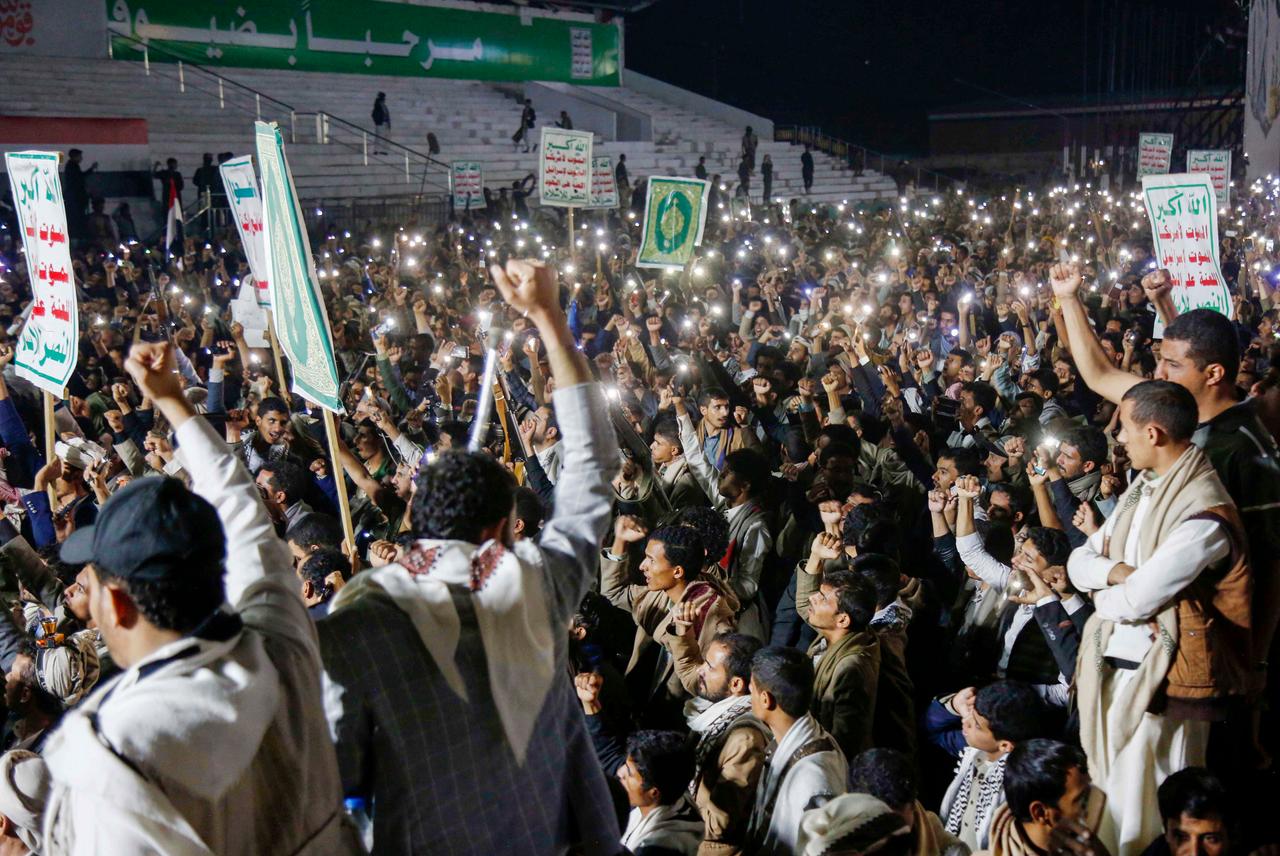
Thousands of people gathered in Sanaa in support of the decision to impose a naval blockade on Saudi Arabia, July 21, 2026 – (Anadolu Agency)
Canadian Foreign Minister Anita Anand also condemned the attack and urged the Houthis to immediately halt their strikes against commercial vessels. German Chancellor Friedrich Merz stated that the attacks jeopardized freedom of navigation and undermined regional stability, offering a message of support to Saudi Arabia.
The United Kingdom’s Foreign, Commonwealth and Development Office expressed solidarity with Saudi Arabia and called on the Houthis to stop their attacks. Chinese Ministry of Foreign Affairs Spokesperson Lin Jian called on all parties to exercise restraint and resolve disputes through dialogue. Indonesia’s Ministry of Foreign Affairs characterized the attacks as violations of international law and reiterated its call for a political solution to the Yemen issue under UN auspices and led by Yemen.
African Union (AU) Commission Chairperson Mahmud Ali Yusuf condemned the attacks, warning that they constituted a dangerous escalation for regional peace and security, and emphasized the AU’s full solidarity with Saudi Arabia.
Pakistan Prime Minister Shehbaz Sharif, during a phone call with Saudi Crown Prince Mohammed bin Salman, condemned the attacks “in the strongest terms” and affirmed Pakistan’s full solidarity with Saudi Arabia. Oman’s Ministry of Foreign Affairs announced it was coordinating with Saudi Arabia and the UN Special Envoy for Yemen to relaunch the political process and roadmap.
US President Donald Trump, in a statement following the attacks, declared that if the Houthis launch further attacks, the United States will regard them as “agents or representatives” of Iran and hold Iran accountable, imposing “severe military penalties” on Iran and the Houthis. US Secretary of State Marco Rubio also claimed the Houthis were “manipulated” by Iran into the conflict and urged the group to distance itself from the fighting.
UN Secretary-General Antonio Guterres, in a statement on 24 July, expressed “deep concern” over the Houthis’ renewed attacks on commercial vessels in the Red Sea. Through UN Spokesperson Stéphane Dujarric, it was emphasized that these attacks risked heightening regional tensions and drawing Yemen deeper into regional conflict, undermining peace prospects in Yemen and causing serious economic humanitarian and environmental consequences. Guterres called for an immediate de-escalation in line with UN Security Council Resolution 2722 (2024) and subsequent resolutions.
The Arab Coalition led by Saudi Arabia announced that on the evening of 24 July, in response to Houthi attacks on commercial vessels in the Red Sea, it had carried out a proportional military strike against “legitimate Houthi military targets” in Yemen’s Hodeidah governorate.
Coalition Spokesperson Turki al-Maliki stated that the operation was launched “in response to the cowardly and reckless attacks” by the Houthis against commercial vessels, and clarified that the strikes targeted legitimate military objectives linked to threats against maritime traffic, in accordance with international humanitarian law. Maliki emphasized that Hodeidah Port was not a target, and that all Yemeni ports including Hodeidah, Ras Isa and As-Salif remained open for maritime traffic, while the Houthis continued to block flights at Sanaa International Airport.
Houthi-affiliated Al-Masira television channel claimed the strikes targeted Kamaran Island and facilities belonging to the Communications Authority, reporting that one woman was injured in the attack on Kamaran Island. Witnesses speaking to Reuters reported explosions in Hodeidah Port, but the Coalition denied targeting the port.
The Houthi-controlled Ministry of Foreign Affairs described the attack on Hodeidah as “costly for Riyadh,” stating that “through this attack, the Saudi regime has made escalation the defining feature of the coming period.”
Houthi spokesperson Mohammed Abdul-Salam stated on social media that the group had not closed the Bab al-Mandab Strait, that the announced location was limited to a naval blockade targeting Saudi Arabia, and that this was a response to the blockade imposed on Yemen.
Saudi Arabia’s official SPA agency reported that shortly before the attack, the vessel “NCC MASA,” owned by a Saudi company, was struck while sailing in the Red Sea, sustaining minor damage to its hull, and resumed its voyage after security checks.
The Houthi Political Bureau characterized the attack on Hodeidah as a “dangerous escalation” and declared that such attacks “will not go unanswered.” The statement declared: “Blockade will be met with blockade, port with port, escalation with escalation.” It warned that continued Saudi aggression would bring “nothing but loss” to the aggressors.
Houthi Military Spokesperson Yahya Saree announced in a televised statement on 25 July that the group had conducted two separate military operations against Aramco facilities in the regions of Jizan and Yanbu using dozens of ballistic missiles, cruise missiles and drones, stating these were carried out in response to Saudi air strikes on Hodeidah. Saree affirmed that the naval blockade would continue and that attacks would intensify in the coming days.
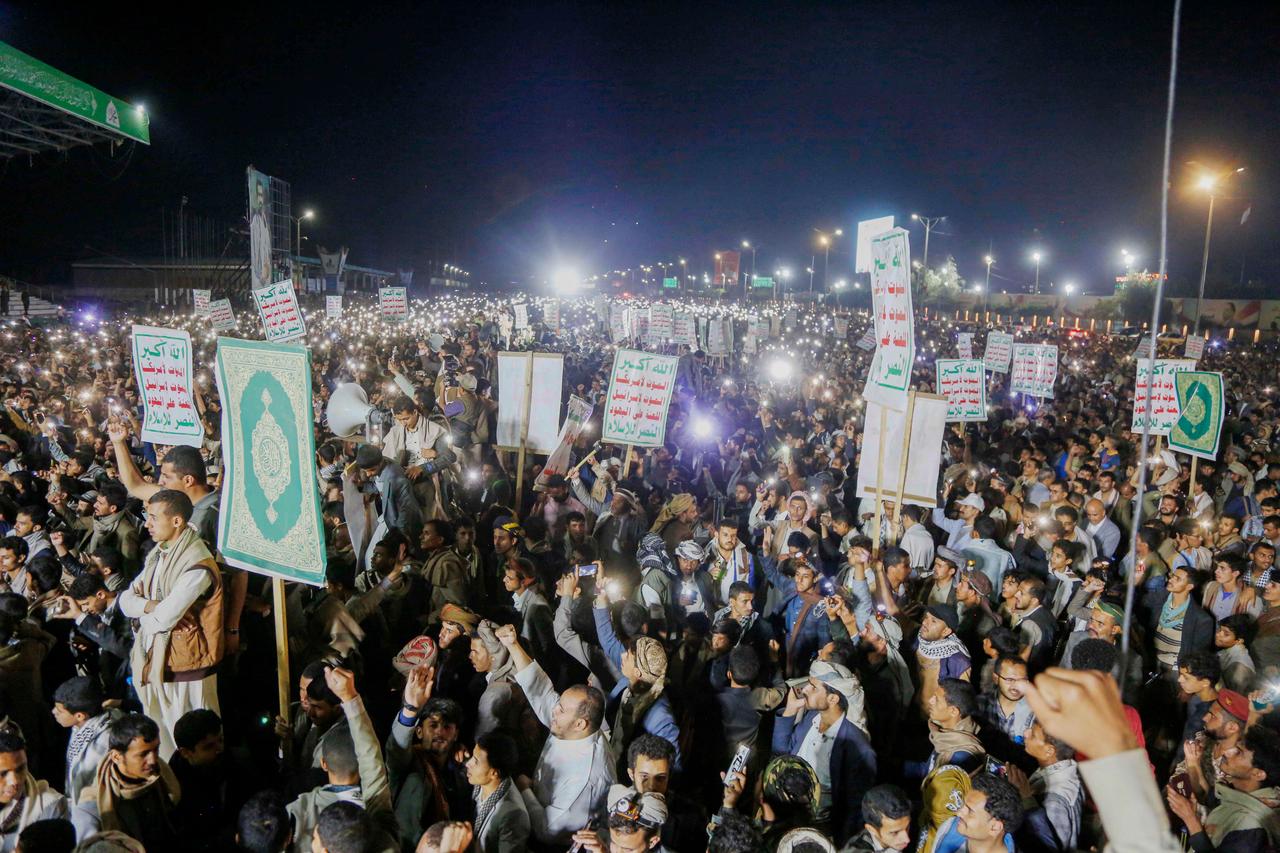
Thousands of people gathered in Sanaa in support of the decision to impose a naval blockade on Saudi Arabia, July 21, 2026 – (Anadolu Agency)
Saudi Civil Defense issued separate warnings early on 25 July for the Jizan and Yanbu regions, alerting residents to a “potential threat”; shortly thereafter, it announced the threat had passed. No casualties or damage were reported. No official statement was issued by Saudi Arabia regarding the attacks.
Yemen state television reported that on 25 July, Houthi reinforcement forces, missile launchers, a Katyusha rocket launcher base and weapons depots in Marib and Jawf governorates were targeted in air strikes, without specifying who carried out the attacks. Numerous Houthi personnel, including missile specialists, were reported killed; no statement was issued by the Houthis regarding the incident.
Yemen Presidential Council Member Sultan al-Aradah said at an expanded military meeting in Marib governorate attended by Defense Minister Tahir al-Uqayli, Chief of Staff and Joint Operations Commander Saqr bin Aziz, and Arab Coalition commander Brigadier General Fares al-Shamari that the Houthis “believe only in the option of war” and that the struggle against them amounted to a “definite confrontation.” The meeting addressed raising the level of military preparedness and implementing operational plans.
On the same day, in the city of Taiz in southwestern Yemen, the Houthis launched a shelling attack from positions in the north against a judicial complex in the Jebel Jerra neighborhood. According to the official SABA agency, no casualties occurred in the attack.
Yemen’s internationally recognized government declared it would not allow its territory to be turned into a platform threatening neighboring countries and international maritime security, labeling the Houthi tanker attack in the Red Sea as “a new terrorist act undermining regional and international de-escalation efforts.” The government affirmed that the Arab Coalition’s military response was conducted in accordance with the principles of necessity and proportionality under international law and called on the international community to cut off funding and arms supplies to the Houthis.
Yemen Presidential Council Chairman Rashad al-Alimi, in a social media statement, emphasized the government’s resolve to protect sea lanes and combat terrorism, accusing the Houthis of serving Iran’s agenda at the expense of the Yemeni people’s interests. Alimi stated that the escalatory stance would yield no result other than depleting the country’s resources and could not alter the Yemeni people’s determination to rebuild state institutions.
Saudi Arabia’s Ambassador to Yemen Muhammad al-Jabir affirmed that Saudi Arabia continued to pursue de-escalation and support the UN Special Envoy’s peace efforts, criticizing the Houthis for turning Yemen into “a pawn in the hands of foreign powers” and choosing escalation over peace.
Iran Ministry of Foreign Affairs Spokesperson Ismail Bekayi expressed concern over tensions between the Houthis and Saudi Arabia and stated that Iran would support constructive initiatives based on the agreed roadmap. Bekayi emphasized that the crisis could not be resolved through military means and must return to dialogue, arguing that Saudi Arabia’s blockade deepened the humanitarian crisis and calling for its immediate lifting.
The United Kingdom Maritime Trade Operations (UKMTO) center reported on 26 July that an unidentified projectile had fallen near a tanker in the southern Red Sea. The vessel reported seeing a splash from an unknown projectile nearby; the ship and crew were confirmed safe, with no reports of injuries or damage, and the environmental impact had not yet been verified. UKMTO urged vessels transiting the region to remain vigilant and report suspicious activity.
Al Jazeera. “Houthis Claim Saudi Drone Downed Over Northwestern Yemen.” Al Jazeera Video. Accessed July 27, 2026.https://www.aljazeera.com/video/newsfeed/2026/7/26/houthis-claim-saudi-drone-downed-over-northwestern-yemen
Al Jazeera. “New Front in US-Iran War Escalates as Houthis Fire at Saudi Oil Facilities.” Al Jazeera. Accessed July 27, 2026.https://www.aljazeera.com/news/2026/7/26/new-front-in-us-iran-war-escalates-as-houthis-fire-at-saudi-oil-facilities
Al Jazeera. “Saudi Arabia Strikes Houthi-Held Hodeidah, Yemeni Group Says.” Al Jazeera. Accessed July 27, 2026.https://www.aljazeera.com/news/2026/7/24/saudis-strike-yemens-houthi-held-hodeida-rebel-media
Al Jazeera. “Yemen’s Houthis Target Saudi Oil Facilities Along the Red Sea.” Al Jazeera Video. Accessed July 27, 2026.https://www.aljazeera.com/video/newsfeed/2026/7/26/yemens-houthis-target-saudi-oil-facilities-along-the-red-sea
Anadolu Ajansı. "Airstrikes Target Houthi Reinforcements, Missile Launchers in Yemen." Accessed July 27, 2026.https://www.aa.com.tr/en/middle-east/airstrikes-target-houthi-reinforcements-missile-launchers-in-yemen/4009157
Anadolu Ajansı. "Germany Condemns Houthi Attacks on Saudi Ships in Red Sea." Accessed July 27, 2026.https://www.aa.com.tr/en/europe/germany-condemns-houthi-attacks-on-saudi-ships-in-red-sea/4007603
Anadolu Ajansı. "London Condemns Houthi Strikes on Saudi Oil Tankers, Urges Group to Halt Hostilities." Accessed July 27, 2026.https://www.aa.com.tr/en/europe/london-condemns-houthi-strikes-on-saudi-oil-tankers-urges-group-to-halt-hostilities/4007399
Anadolu Ajansı. "Oman Says Working with Saudi Arabia, UN Envoy to Resume Yemen Road Map Amid Red Sea Tensions." Accessed July 27, 2026.https://www.aa.com.tr/en/middle-east/oman-says-working-with-saudi-arabia-un-envoy-to-resume-yemen-road-map-amid-red-sea-tensions/4006778
Anadolu Ajansı. "Saudi-Led Coalition Confirms Strikes on Houthi Military Sites in Yemen’s Hodeidah." Accessed July 27, 2026.https://www.aa.com.tr/en/middle-east/saudi-led-coalition-confirms-strikes-on-houthi-military-sites-in-yemen-s-hodeidah/4008702
Anadolu Ajansı. "US Will Hold Iran Accountable If Houthis Attack Ships: Trump." Accessed July 27, 2026.https://www.aa.com.tr/en/us-israel-iran-war/us-will-hold-iran-accountable-if-houthis-attack-ships-trump/4007032
Anadolu Ajansı. "Yemeni Government Vows Not to Let Territory Threaten Neighbors, Maritime Security." Accessed July 27, 2026.https://www.aa.com.tr/en/middle-east/yemeni-government-vows-not-to-let-territory-threaten-neighbors-maritime-security/4008792
Anadolu Ajansı. "Yemeni Presidential Council Member Says Houthis Believe Only in War." Accessed July 27, 2026.https://www.aa.com.tr/en/middle-east/yemeni-presidential-council-member-says-houthis-believe-only-in-war-/4009321
Anadolu Ajansı. "Yemen’deki İran Destekli Husiler ile Artan Gerilimin Ardından Suudi Arabistan’da Üçüncü Kez Saldırı Uyarısı Yapıldı." Accessed July 27, 2026.https://www.aa.com.tr/tr/dunya/yemen-deki-iran-destekli-husiler-ile-artan-gerilimin-ardindan-suudi-arabistan-da-ucuncu-kez-saldiri-uyarisi-yapildi/4008690
Anadolu Ajansı. "Yemen’s Houthis Call Strikes on Hodeidah Dangerous Escalation, Vow Retaliation." Accessed July 27, 2026.https://www.aa.com.tr/en/middle-east/yemen-s-houthis-call-strikes-on-hodeidah-dangerous-escalation-vow-retaliation/4008774
Anadolu Ajansı. “BM, Husilerin Kızıldeniz'de Saldırılara Yeniden Başlamasından ‘Derin Endişe’ Duyduğunu Açıkladı.” Accessed July 27, 2026.https://www.aa.com.tr/tr/dunya/bm-husilerin-kizildenizde-saldirilara-yeniden-baslamasindan-derin-endise-duydugunu-acikladi/4008457
Anadolu Ajansı. “China Urges Restraint in Red Sea Amid Houthi Embargo Attacks.” Accessed July 27, 2026.https://www.aa.com.tr/en/asia-pacific/china-urges-restraint-in-red-sea-amid-houthi-embargo-attacks/4007853
Anadolu Ajansı. “EU, Canada Calls Houthi Attack on Red Sea Oil Tanker Unacceptable, Warns Against Further Escalation.” Accessed July 27, 2026.https://www.aa.com.tr/en/europe/eu-canada-calls-houthi-attack-on-red-sea-oil-tanker-unacceptable-warns-against-further-escalation/4006958
Anadolu Ajansı. “Houthis Shell Judicial Complex in Yemen’s Taiz City, No Casualties Reported.” Accessed July 27, 2026.https://www.aa.com.tr/en/middle-east/houthis-shell-judicial-complex-in-yemen-s-taiz-city-no-casualties-reported/4009366
Anadolu Ajansı. “Indonesia Condemns Red Sea Attacks, Urges Political Process to Resolve Yemen Conflict.” Accessed July 27, 2026.https://www.aa.com.tr/en/asia-pacific/indonesia-condemns-red-sea-attacks-urges-political-process-to-resolve-yemen-conflict/4008113
Anadolu Ajansı. “Pakistani Premier Backs Saudi Arabia in Call with Crown Prince Amid Houthi Attacks.” Accessed July 27, 2026.https://www.aa.com.tr/en/asia-pacific/pakistani-premier-backs-saudi-arabia-in-call-with-crown-prince-amid-houthi-attacks/4006672
Anadolu Ajansı. “Saudi Arabia Issues Fresh Warnings in Western Regions of Yanbu, Jazan About Potential Danger.” Accessed July 27, 2026.https://www.aa.com.tr/en/world/saudi-arabia-issues-fresh-warnings-in-western-regions-of-yanbu-jazan-about-potential-danger/4008791
Anadolu Ajansı. “Several Oil Tankers Alter Course in Red Sea Following Houthi Threats.” Accessed July 27, 2026.https://www.aa.com.tr/en/us-israel-iran-war/several-oil-tankers-alter-course-in-red-sea-following-houthi-threats/4006572
Anadolu Ajansı. “UN Chief Alarmed by Renewed Houthi Attacks on Red Sea Shipping, Urges De-Escalation.” Accessed July 27, 2026.https://www.aa.com.tr/en/americas/un-chief-alarmed-by-renewed-houthi-attacks-on-red-sea-shipping-urges-de-escalation/4008384
Anadolu Ajansı. “Unidentified Projectile Lands Near Tanker in Southern Red Sea: UKMTO.” Accessed July 27, 2026.https://www.aa.com.tr/en/middle-east/unidentified-projectile-lands-near-tanker-in-southern-red-sea-ukmto/4009756
Anadolu Ajansı. “Yemen Gov’t Vows Cooperation with Saudi-Led Coalition to Protect Waterways, Deter Threats Amid Houthi Tension.” Accessed July 27, 2026.https://www.aa.com.tr/en/middle-east/yemen-gov-t-vows-cooperation-with-saudi-led-coalition-to-protect-waterways-deter-threats-amid-houthi-tension/4008886
Anadolu Ajansı. “Yemen'de Husiler: Suudi Arabistan'da Aramco Tesislerini Füze ve İHA'larla Vurduk.” Accessed July 27, 2026.https://www.aa.com.tr/tr/dunya/yemende-husiler-suudi-arabistanda-aramco-tesislerini-fuze-ve-ihalarla-vurduk/4009136
Anadolu Ajansı. “Yemen'deki Husilerden Kızıldeniz'de Suudi Arabistan Tankerlerine Saldırı.” Accessed July 27, 2026.https://www.aa.com.tr/tr/dunya/yemendeki-husilerden-kizildenizde-suudi-arabistan-tankerlerine-saldiri/4006354
Associated Press. “Iran-Backed Houthis Fire Missiles at Saudi Arabia in Response to Airstrikes in Yemen.” Associated Press. Accessed July 27, 2026.https://apnews.com/article/iran-us-hormuz-strait-war-25-july-2026-df3790320c595f3e599fb1dd69423e77
Associated Press. “Iran-Backed Houthis Fire Missiles at Saudi Arabia in Response to Airstrikes in Yemen.” Associated Press. Accessed July 27, 2026.https://apnews.com/article/iran-us-hormuz-strait-war-25-july-2026-df3790320c595f3e599fb1dd69423e77
BBC News. “Iran-Backed Houthis Claim Missile Attack on Saudi Arabia.” BBC News. Accessed July 27, 2026.https://www.bbc.com/news/articles/cj9d27v70j1o
Arab Coalition spokesperson Brigadier General Turki al-Maliki stated that coalition forces have taken necessary operational measures to ensure the safety of commercial vessels navigating the Bab al-Mandab Strait within the framework of international law and the 1982 United Nations Convention on the Law of the Sea. The statement asserted that claims regarding the closure of ports and airports in Yemen constitute a “disinformation campaign” conducted by the Houthis.
According to the coalition’s statement, more than 300 commercial vessels entered the ports of Hodeidah, Al-Salif, and Ras Isa during the first half of 2026 carrying food, fuel and construction materials. It was alleged that the Houthis have halted operations at Sanaa International Airport, destroyed aircraft belonging to Yemenia Airlines, and rejected all efforts to reopen the airport.
The Saudi Ministry of Foreign Affairs condemned statements made by Seri, whom it labeled as the “military spokesperson of terrorist Houthi militias.” It recalled that the Houthis have targeted Yemen’s infrastructure through attacks on Aden International Airport in 2020 and southern Yemen’s oil export ports in 2022. The ministry also accused the Houthis of seizing four Yemenia Airlines aircraft at Sanaa International Airport.
On 21 July, Saudi Arabia issued a statement following a meeting of the Council of Ministers chaired by King Salman bin Abdulaziz, condemning the Houthis’ “false claims,” reaffirming its support for the internationally recognized government of Yemen, and declaring that it would take “decisive measures” to safeguard its vessels and ensure security in accordance with international law and the 1982 United Nations Convention on the Law of the Sea.
United Nations spokesperson Stephane Dujarric expressed concern at a press briefing on 20 July regarding the renewed fighting in the region and the Houthis’ threats against Saudi Arabia and freedom of navigation, stating that “an urgent de-escalation step is required.” Dujarric also highlighted the potential global economic impact of the near-closure of the Hormuz Strait.
US President Donald Trump, in a statement on 21 July, said the United States has “no issues” with the Houthis since its military operations against them. In response to concerns that a Houthi blockade could open a new front in the region, Trump stated that “the necessary steps will be taken if needed,” and recalled the “very strong operation” conducted against the Houthis lasting approximately 45 days.
The Sudanese Ministry of Foreign Affairs, in a statement issued on 22 July, expressed “deep concern” over the Houthi blockade decision, noting that it endangers maritime navigation in the Red Sea and the security and economic interests of coastal states. It affirmed full support for Saudi Arabia’s right to take all necessary measures to protect its ports and national security.
The Pakistani Ministry of Foreign Affairs, in a statement issued the same day, affirmed its right to take all necessary measures, including the legitimate use of force within the framework of self-defense under the United Nations Charter and international law, to protect its maritime assets and national interests in the Red Sea. The ministry condemned the Houthis’ “ongoing” threats against Saudi Arabia and commercial vessels “unconditionally.”
A Houthi military source speaking to the Houthi-affiliated Saba News Agency reported that within 24 hours of the blockade announcement on 21 July, six vessels received warnings, altered course, and returned. The source did not identify the vessels or the regions to which they returned.
Rashad al-Alimi, Chairman of the Yemen Presidential Council, during a meeting with India’s Ambassador to Yemen, Suhel Ajaz Khan, urged the international community to view the Houthis as part of an interconnected regional threat network. Alimi stated that the Houthis are attempting to drag Yemen into a broader regional conflict serving the agenda of the Iranian regime.
Alimi emphasized that the consequences of these developments extend beyond Yemen’s borders, threatening the security of the Red Sea and Asian countries dependent on this strategic sea lane. He also accused the Houthis of collaborating with terrorist groups and armed factions in the Horn of Africa, facilitating arms and military technology smuggling, and supporting piracy and transnational crime.
Following the near-halt of commercial vessel transit through the Hormuz Strait due to US-Iran tensions, the Houthi blockade decision has shifted the tension to the Bab al-Mandab Strait. Brent crude oil prices hovered near the $90 per barrel level.
After the blockade announcement, the number of crude oil tankers passing through the Bab al-Mandab Strait decreased by 69 percent. On 20 July, 16 vessels transited the strait; this number dropped to five on 21 July and rose slightly to nine on 22 July. During the same period, no vessels transited the Hormuz Strait over the previous five days.
ING Group Senior Economist for Transport and Logistics Rico Luman noted that even though no new attacks had yet occurred, the Houthi announcement immediately increased risks for Bab al-Mandab transit, causing freight and insurance premiums to surge. He recorded that the increased utilization of Yanbu Port as an alternative export hub for Saudi Arabia has added pressure to oil markets.
According to vessel tracking data, at least seven to eight oil tankers changed course sharply near Yemen following the Houthi blockade announcement on 20 July. The tankers Rodos and Mica, along with the vehicle carrier Liu Jiang Kou, altered their routes as they approached the Bab al-Mandab Strait from the south. The European Union’s naval force Aspides advised vessels belonging to Israel, the United States or Saudi Arabia to avoid transit through the Red Sea and the Gulf of Aden until the threat level subsides.
In an email sent to shipowners, the Houthis stated that “vessels are prohibited from loading or unloading cargo at any Saudi port” and that “anywhere within the operational area may be targeted.”
Under normal conditions, approximately 7.8 to 8.8 million barrels of crude oil and refined petroleum products transit daily through the 32-kilometer-wide Bab al-Mandab Strait. Analysts describe a simultaneous closure of the Hormuz and Bab al-Mandab straits as a “double chokepoint,” forecasting that such a scenario could reduce global oil supply by 7 percent and push crude oil prices above $120 per barrel.
Yemeni authorities reported that in “intense fighting” between government forces and Houthis in the Dhalea governorate in southwestern Yemen, four government soldiers and 23 Houthi fighters—including two commanders—were killed, and seven were captured. Ten government personnel were wounded. These clashes are described as the most intense in the region since the 2022 ceasefire.
Reports indicate that recent fighting between government forces and Houthis has resumed in various governorates including Juff, Dhalea and Taiz. According to a Reuters report citing sources from last week, Iran has instructed the Houthis to prepare to close the Bab al-Mandab Strait in the event of a US strike on Iran’s power infrastructure.
Houthi military spokesperson Yahya Seri announced on 23 July 2026 that, citing violations of the transit ban, the Houthis launched ballistic missiles, cruise missiles and drones against two Saudi oil tankers, Encelia and Layla. Seri stated that the attacks achieved direct hits and forced approximately 10 other vessels to turn back.
In a warning to Saudi Arabia, Seri stated that any attack targeting the kingdom would be met with large-scale operations deep within Saudi territory.
The United Kingdom Maritime Trade Operations (UKMTO) center reported that an oil tanker approximately 70 nautical miles off the coast of Shaqiq in Saudi Arabia was struck by an unknown projectile, resulting in a fire on board.
The Saudi General Authority for Transport, in a statement issued through the official news agency SPA, confirmed that the tanker Encelia was attacked while sailing in the Red Sea, with a fire breaking out in its bow section. However, all crew members were confirmed safe. The authority stated that the attack constitutes a violation of international law that guarantees the safety of commercial vessels and their crews. The alleged attack on the Layla tanker has not been independently verified.
According to vessel tracking data, the tankers Xin Long Yang and Rodos turned back before reaching the southern entrance of the Bab al-Mandab Strait, while the vessels New Champion, Xin Tong Yang, New Prime and Desh Viraat also altered their routes. At the same time, the Xin Long Yang and Cosnew Lake vessels were observed heading back toward the Bab al-Mandab Strait, possibly testing whether the Houthis are actively enforcing their blockade.
Sanaa-based journalist Hussein al-Buhayti, in an assessment for Al Jazeera, stated that the ultimate objective of the Houthi maritime blockade is to force Riyadh to lift its own blockade on ports and airports under its control.
Al Jazeera. “Iran, Houthis Strike Tankers as US Bombing Continues: What’s the Latest?” Al Jazeera. Accessed July 23, 2026.https://www.aljazeera.com/news/2026/7/23/iran-houthis-strike-tankers-as-us-bombing-continues-whats-the-latest
Al Jazeera. “Yemen’s Houthis Claim Attack on Two Saudi Oil Tankers.” Al Jazeera. Accessed July 23, 2026.https://www.aljazeera.com/news/2026/7/22/yemens-houthis-claim-attack-on-two-saudi-oil-tankers
Anadolu Ajansı. "Mounting Tensions in Bab el-Mandeb Strait Threaten Maritime Trade." Accessed July 23, 2026.https://www.aa.com.tr/en/middle-east/mounting-tensions-in-bab-el-mandeb-strait-threaten-maritime-trade/4005589
Anadolu Ajansı. "Pakistan Warns Against Any Hostile Act on Its Vessels in Red Sea." Accessed July 23, 2026.https://www.aa.com.tr/en/asia-pacific/pakistan-warns-against-any-hostile-act-on-its-vessels-in-red-sea/4005703
Anadolu Ajansı. "Several Oil Tankers Alter Course in Red Sea Following Houthi Threats." Accessed July 23, 2026.https://www.aa.com.tr/en/us-israel-iran-war/several-oil-tankers-alter-course-in-red-sea-following-houthi-threats/4006572
Anadolu Ajansı. "Trump Says US Has No Problem with Houthis Since US Military Action." Accessed July 23, 2026.https://www.aa.com.tr/en/americas/trump-says-us-has-no-problem-with-houthis-since-us-military-action/4005010
Anadolu Ajansı. "Yemen'deki Husilerden Kızıldeniz'de Suudi Arabistan Tankerlerine Saldırı." Accessed July 23, 2026.https://www.aa.com.tr/tr/dunya/yemendeki-husilerden-kizildenizde-suudi-arabistan-tankerlerine-saldiri/4006354
Anadolu Ajansı. "Yemen'deki İran Destekli Husiler, Suudi Arabistan'a Karşı ‘Deniz Ablukası Başlattıklarını’ Açıkladı." Accessed July 23, 2026.https://www.aa.com.tr/tr/dunya/yemendeki-iran-destekli-husiler-suudi-arabistana-karsi-deniz-ablukasi-baslattiklarini-acikladi/4003708
Anadolu Ajansı. "Yemen's Houthis Say They Targeted 2 Saudi Oil Tankers with Missiles, Drones." Accessed July 23, 2026.https://www.aa.com.tr/en/middle-east/yemen-s-houthis-say-they-targeted-2-saudi-oil-tankers-with-missiles-drones/4006371
Anadolu Ajansı. “Houthis Say 6 Ships Turned Back After Navigation Ban on Saudi Arabia as Yemen's Government Seeks Global Action.” Accessed July 23, 2026.https://www.aa.com.tr/en/middle-east/houthis-say-6-ships-turned-back-after-navigation-ban-on-saudi-arabia-as-yemen-s-government-seeks-global-action/4005233
Anadolu Ajansı. “Husilerin, Suudi Arabistan'a ‘Deniz Ablukası’ Kararı, Hürmüz'den Sonra Babülmendep'te de Tansiyonu Artırdı.” Accessed July 23, 2026.https://www.aa.com.tr/tr/ekonomi/husilerin-suudi-arabistana-deniz-ablukasi-karari-hurmuz-den-sonra-babulmendepte-de-tansiyonu-artirdi/4004620
Anadolu Ajansı. “Hürmüz'ün Ardından Babülmendep'te Yükselen Tansiyon Deniz Taşımacılığını Tehdit Ediyor.” Accessed July 23, 2026.https://www.aa.com.tr/tr/ekonomi/hurmuzun-ardindan-babulmendepte-yukselen-tansiyon-deniz-tasimaciligini-tehdit-ediyor/4005489
Anadolu Ajansı. “Sudan Backs Saudi Arabia After Houthi Announcement of Maritime Blockade.” Accessed July 23, 2026.https://www.aa.com.tr/en/middle-east/sudan-backs-saudi-arabia-after-houthi-announcement-of-maritime-blockade/4005695
Anadolu Ajansı. “UN Voices Concern Over Houthi Threats as Mideast Tensions Risk Choking Red Sea Trade.” Accessed July 23, 2026.https://www.aa.com.tr/en/world/un-voices-concern-over-houthi-threats-as-mideast-tensions-risk-choking-red-sea-trade/4004012
BBC News. "Yemen's Houthis Announce ‘Maritime Embargo’ on Saudi Arabia." BBC News. Accessed July 23, 2026.https://www.bbc.com/news/articles/cm2gmddx1ldo
BBC News. “Tankers Make Sharp U-Turns After Houthi Shipping Threat.” BBC News. Accessed July 23, 2026.https://www.bbc.com/news/articles/cn0n127lpzgo
TRT World. “More Than Two Dozen Killed in Yemen Clashes as Houthis Widen Attacks in Support of Iran.” TRT World. Accessed July 23, 2026.https://www.trtworld.com/article/d4f60145b077
The Yemen-Saudi Arabia Tension and Iran Aircraft Crisis refers to the political and military crisis in July 2026 between the internationally recognized government of Yemen and the Iran-backed Houthis (Ansarullah Movement), led by Saudi Arabia. The crisis began when civilian aircraft belonging to Iran flew to Sanaa International Airport, which is under Houthi control. The situation escalated with military strikes on the airport, reciprocal missile and unmanned aerial vehicle (UAV) attacks, declarations of maritime blockades, and general mobilization calls.
Since September 2014, Iran-backed Houthis have maintained control over the capital Sanaa and large areas of northern and western Yemen. Since March 2015, the Saudi-led Coalition Forces have provided military support to the internationally recognized Yemeni government based in the temporary capital Aden. As of 2026, the ongoing civil war has claimed over 150,000 lives.
Following the ceasefire that came into effect in April 2022, the intensity of fighting decreased significantly and relative calm was achieved on many fronts. However, no comprehensive political agreement has been reached between the parties toward a lasting resolution.
The crisis began on 3 July 2026 when a plane operated by the Iranian airline Mahan Air landed at Sanaa International Airport, which is under Houthi control. The aircraft transported a Houthi delegation to Tehran to attend the funeral of Iran’s Supreme Leader Ali Khamenei, who died in February 2026 during US and Israeli attackson Iran.
Houthi Military Spokesperson Yahya Saree claimed that Saudi Arabian warplanes attempted to prevent the Iranian civilian aircraft from landing at Sanaa Airport, and that his forces responded accordingly. Saree stated that over 200 stranded, injured, and sick passengers were aboard the aircraft.
Yemeni media reported that this flight was the first direct Iranian flight to Sanaa International Airport in approximately ten years.
Turki al-Maliki, spokesperson for the Saudi-led Coalition, rejected the Houthi claims. He argued that the group’s statements about threats against Saudi Arabia were intended to divert attention from internal issues and allegations of violations against the Yemeni people.
On 4 July 2026, the Coalition issued a statement declaring that it would respond with unprecedented determination and force to any attempts targeting Saudi Arabia, its citizens, foreign residents in the country, or national assets, or violating Yemen’s sovereignty.
On 5 July, Houthis in the Hays area of Hodeidah Governorate launched attacks using artillery, unmanned aerial vehicles (UAVs), and sniper fire against government positions. According to medical and military sources, 16 government soldiers were killed and 22 others wounded.
During the same period, the British Armed Forces announced that a cargo ship off the coast of Hodeidah had been attacked, with no injuries reported. No group claimed responsibility for the attack.
On 8 July, President of the Presidential Leadership Council Rashad al-Alimi met in Riyadh with the Council’s Consultation and Reconciliation Committee to discuss national unity and security. On the same day, Council member and Commander of the Elite Brigades Abdulrahman al-Muhrimi ordered military and security units to raise their readiness levels to maximum. The official media outlet of the Houthi Ministry of Defense announced that general mobilization, war preparations, and armed tribal meetings were taking place across multiple governorates to support frontline forces.
On 9 July, tribal members in Jawf Governorate shot down a Houthi UAV reportedly conducting reconnaissance flights. On the same day, large-scale demonstrations were held in Saada, Hajjah, Jawf, Dhamar, Marib, and Hodeidah governorates under the call for “general mobilization.”
On 10 July, the planned prisoner exchange involving approximately 1,600 to 1,728 individuals scheduled for 11 July was postponed. The Yemeni government stated that the Houthis had refused to implement the agreement, while Abdulkader al-Murtada, Chairman of the Houthi Prisoners Affairs Committee, blamed the government for the delay.
On 12 July, Presidential Leadership Council member Abdullah al-Alimi argued that Mahan Air’s flight to Sanaa on 3 July violated Yemen’s sovereignty and called for an emergency meeting of the United Nations Security Council (UNSC) to address the matter.
Al-Alimi further alleged that the flight was used to secretly transport Iranian military experts and officials from Sanaa to Tehran. Iranian authorities have not issued an official statement regarding these claims.
On 13 July 2026, it was reported that a second Iranian aircraft attempted to land again at Sanaa International Airport. Yemen’s Minister of Defense Tahir al-Uqayli stated that Iranian aircraft had violated Yemen’s airspace and that military retaliation would follow.
The Yemeni military announced that it targeted the airport runway to prevent the Iranian aircraft from landing. The Houthis claimed the attack was carried out by Saudi Arabia.
Following the attack, the Iranian aircraft changed course and landed at Hodeidah Airport. Iranian authorities have not issued an official statement on the incident. Yemen’s Minister of Information Muammer al-Iryani accused the Houthis of detaining an aircraft belonging to the International Committee of the Red Cross (ICRC) at Sanaa Airport, refusing to allow it to take off, and detaining its pilot and co-pilot.
Houthi Military Spokesperson Yahya Saree declared that the attack would not go unanswered and shortly afterward announced that Abha Airport in southern Saudi Arabia had been targeted by ballistic missiles and UAVs.
Turki al-Maliki, spokesperson for the Saudi-led Coalition, stated that air defense systems had been activated against the ballistic missiles launched by the Houthis and that the threat had been neutralized. No casualties were reported in the incident.
The Houthis also warned international airlines not to use Saudi airspace until restrictions on Sanaa Airport were lifted, stating that attacks would continue until then.
President of the Presidential Leadership Council Rashad al-Alimi ordered the government, military, and security forces to raise their readiness to the highest level. Al-Alimi stated that the attempt to land the Iranian aircraft at Sanaa Airport constituted a violation of Yemen’s sovereignty and that the country would not tolerate any infringement of its airspace.
Yemen’s Civil Aviation and Meteorology Authority announced that all airports in the country were closed until a further notice following the strike on Sanaa Airport. However, shortly afterward, the Ministry of Transport declared that operations at airports were continuing normally.
In response to these developments, the United Nations Security Council (UNSC) held an emergency meeting the same day. UN Assistant Secretary-General for Political Affairs Khalid Khiari stated that Yemen and the region could not withstand another wave of tension and called on all parties to participate in negotiations under UN auspices.
UN Special Envoy for Yemen Hans Grundberg confirmed that the UN was closely monitoring developments in Yemen’s airspace and warned of the risk of broader escalation, urging all parties to engage in dialogue.
Yemen’s Permanent Representative to the UN Abdullah al-Saadi claimed that the aircraft attempting to land in Sanaa was linked to the Iranian Revolutionary Guard Corps (IRGC) and was carrying military personnel and equipment. Al-Saadi also stated that the Yemeni government had offered to provide a Yemen Airways aircraft to repatriate the Houthi delegation from Tehran.
The British Embassy in Yemen condemned the hardening rhetoric from the Houthis and called on all parties to reduce tensions. Russia’s Ambassador to Yemen Yevgeny Kudrov stated that the Tehran-Sanaa flight had been discussed during his meeting with President Rashad al-Alimi.
On 14 July, the American news platform Axios, citing two unnamed US officials, reported that US President Donald Trump had spoken by phone with Saudi Crown Prince Mohammed bin Salman and approved requested support for a potential military operation against the Houthis.
The report also stated that a US official claimed the Iranian aircraft was transporting weapons, missile components, and military experts to the Houthis. The White House responded to requests for comment by referencing a previous interview Trump gave to Fox News, while the Saudi Embassy in Washington declined to issue a statement.
On 14 July, Houthi Political Bureau member Muhammad al-Buhayti told Al Jazeera that if Saudi Arabia’s responsibility for the attack on Sanaa Airport were accepted, Yemen would have the right to target Saudi airports and impose a similar blockade. On the same day, Houthi Military Spokesperson Yahya Saree claimed that the 13 July attack had ended the “de-escalation” period that had lasted since 2014.
On 16 July, Houthi leader Abdulmalik al-Houthi stated in a televised address that the response to Sanaa Airport had been “modest,” and declared that the Houthis would apply a policy of “airports for airports, ports for ports, blockade for blockade.” He also indicated that Saudi Arabia’s oil facilities could be targeted. In the same speech, al-Houthi stated that if attacks on Yemen continued, Saudi oil infrastructure and critical facilities would become targets of missile and UAV strikes.
On 17 July, mass demonstrations under the slogan “mobilization” were held in numerous cities, beginning with Sanaa, following a call by Abdulmalik al-Houthi. After the demonstrations, the Houthis declared that the continuation of the blockade against Yemen would be regarded as a “total war.”
Houthi Minister of Defense Muhammad al-Atifi affirmed that all military units were ready to implement orders from leadership and stated that readiness levels were at their highest.
On 18 July, Presidential Leadership Council member Osman Majali told the official news agency SABA that the military option must be activated and that state institutions under Houthi control must be reclaimed.
On the same day, Council member and Commander of the Amalika Brigades Abdulrahman al-Muhrimi issued a message to civilians in Houthi-controlled areas, stating that their priority was a fair and lasting peace, but that they were prepared to resort to military action if peace proved unattainable.
On 19 July, Yemen’s Minister of Transport Muhsin al-Omari announced that a planned flight by the Iranian airline Mahan Air to Sanaa had been halted due to lack of required official permissions. Omari stated that the aircraft was denied permission to proceed to Sanaa while over Omani airspace and was forced to return. Iranian authorities and the Houthis have not issued official statements on the matter.
On 20 July 2026, Houthi Military Spokesperson Yahya Saree announced in a statement broadcast on the Al-Masirah television channel that a ban on maritime transport linked to Saudi Arabia had come into effect. Saree described the decision as part of a “blockade for blockade” response to the approximately 12-year-long blockade imposed on Yemen.
Saree stated that the Yemeni Armed Forces were prepared for all options but did not provide details on the scope or geographic areas covered by the maritime blockade.
Saudi Arabia initially did not issue an official assessment of the announcement. The development occurred as Saudi Arabia was attempting to increase oil shipments to Yanbu Port via the East-West Pipeline (Petroline).
Al Jazeera Arabic. “الحوثيون يعلنون فرض حظر على السفن الإسرائيلية في البحر الأحمر.” *الجزيرة*. Accessed July 20, 2026.https://www.aljazeera.net/news/
Al Jazeera. "What Is Going on in Yemen?" Al Jazeera. Accessed July 20, 2026.https://www.aljazeera.com/features/2026/7/11/what-is-going-on-in-yemen
Al Jazeera. “Leading Houthi Threatens ‘Siege’ on Saudi Arabia after Yemen Airport Attack.” Al Jazeera. Accessed July 20, 2026.https://www.aljazeera.com/news/2026/7/14/leading-houthi-threatens-siege-on-saudi-arabia-after-yemen-airport-attack
Al Jazeera. “Yemen’s Houthis Threaten Saudi Arabia after Alleged Airspace Intrusion.” Al Jazeera. Accessed July 20, 2026.https://www.aljazeera.com/news/2026/7/3/yemens-houthis-threaten-saudi-arabia-after-alleged-airspace-intrusion
Anadolu Ajansı. "Saudi Air Defenses Intercept Houthi Ballistic Missiles amid Yemen Tensions." Accessed July 20, 2026.https://www.aa.com.tr/en/middle-east/saudi-air-defenses-intercept-houthi-ballistic-missiles-amid-yemen-tensions/3996904
Anadolu Ajansı. "Saudi-Led Coalition Vows ‘Unprecedented’ Force against Houthi Threats." Accessed July 20, 2026.https://www.aa.com.tr/en/middle-east/saudi-led-coalition-vows-unprecedented-force-against-houthi-threats/3985817
Anadolu Ajansı. "Trump'ın Suudi Arabistan'ın Husilere Yönelik Saldırısına Destek Verdiği İddiası." Anadolu Ajansı. Accessed July 20, 2026.https://www.aa.com.tr/tr/dunya/trumpin-suudi-arabistanin-husilere-yonelik-saldirisina-destek-verdigi-iddiasi/3997165
Anadolu Ajansı. "Yemen Hükümeti, İran'a Ait Bir Uçağın Sana Havalimanı'na İnişini Engellediğini Duyurdu." Accessed July 20, 2026.https://www.aa.com.tr/tr/dunya/yemen-hukumeti-irana-ait-bir-ucagin-sana-havalimanina-inisini-engelledigini-duyurdu/4002763
Anadolu Ajansı. "Yemen'de Hükümet ile Husiler Karşılıklı Askeri Hazırlıklarını Artırıyor." Accessed July 20, 2026.https://www.aa.com.tr/tr/dunya/yemende-hukumet-ile-husiler-karsilikli-askeri-hazirliklarini-artiriyor/3990369
Anadolu Ajansı. "Yemen'deki Husiler: Suudi Arabistan'ın Abha Havalimanı'nı Balistik Füze ve İHA'larla Hedef Aldık." Accessed July 20, 2026.https://www.aa.com.tr/tr/dunya/yemendeki-husiler-suudi-arabistanin-abha-havalimanini-balistik-fuze-ve-ihalarla-hedef-aldik/3996967
Anadolu Ajansı. "Yemen’s Houthis Declare ‘Maritime Blockade’ on Saudi Arabia." Accessed July 20, 2026.https://www.aa.com.tr/en/middle-east/yemen-s-houthis-declare-maritime-blockade-on-saudi-arabia/4003795
Anadolu Ajansı. “Houthis Threaten to Attack Oil Facilities in Saudi Arabia amid Yemen Tensions.” Accessed July 20, 2026.https://www.aa.com.tr/en/middle-east/houthis-threaten-to-attack-oil-facilities-in-saudi-arabia-amid-yemen-tensions/4000598
Anadolu Ajansı. “Yemen'deki Husiler: Suudi Arabistan, Uluslararası Sana Havalimanı'nı Hedef Aldı.” Accessed July 20, 2026.https://www.aa.com.tr/tr/dunya/yemendeki-husiler-suudi-arabistan-uluslararasi-sana-havalimanini-hedef-aldi/3996488
Anadolu Ajansı. “İran Uçağı Krizi, Yemen'de Dört Yıldır Süren Ateşkesi Sarsarken Askeri Gerilimi Yeniden Tırmandırdı.” Accessed July 20, 2026.https://www.aa.com.tr/tr/dunya/iran-ucagi-krizi-yemende-dort-yildir-suren-ateskesi-sarsarken-askeri-gerilimi-yeniden-tirmandirdi/3997442
Arab News. “Saudi Arabia Says It Intercepted Houthi Missiles Fired at South.” Accessed July 20, 2026.https://www.arabnews.com/node/2650763/sa%EE%80%80udi-arabia
Associated Press. “Iran-Backed Houthi Leader in Yemen Threatens Escalation with Saudi Arabia.” Accessed July 20, 2026.https://apnews.com/article/yemen-saudi-arabia-war-houthi-iran-70a8626c44a50a4f489a0b193788fd43
Associated Press. “Yemen’s Houthis Announce a Maritime Embargo against Saudi Arabia.” Accessed July 20, 2026.https://apnews.com/article/yemen-saudi-arabia-maritime-embargo-fd7c4a3911f7eee18251483fc8af768c
Associated Press. “Yemen’s Houthis Strike Saudi Arabia’s Abha Airport with Missiles and Drones in a Sharp Escalation.” Accessed July 20, 2026.https://apnews.com/article/yemen-houthis-airport-saudi-strikes-7bddae3006304df8bf7f89e980006b33
BBC News. “Yemen's Houthis Launch Missiles at Saudi Arabia after Strikes on Sanaa Airport.” BBC News. Accessed July 20, 2026.https://www.bbc.com/news/articles/cp9ldle3d3xo
CNN Arabic. “فيديو لـ«لحظة سقوط صاروخ حوثي على مطار أبها في السعودية».. ما قصته؟” CNN Arabic. Accessed July 20, 2026.https://arabic.cnn.com/middle-east/article/2026/07/14/old-video-moment-a-houthi-missile-fell-on-abha-airport-in-saudi-arabia
Haberler.com. "Yemen'de İran Uçağı Krizi: Gerilim Yeniden Tırmanıyor." Accessed July 20, 2026.https://www.haberler.com/guncel/yemen-de-iran-ucagi-krizi-gerilim-yeniden-tirmaniyor-20033059-haberi/
Reuters. “Houthis Fire Missiles at Saudi Arabia, Breaking Years of Calm.” Reuters. Accessed July 20, 2026.https://www.reuters.com/world/middle-east/yemeni-military-targets-sanaa-airport-runway-stop-iranian-plane-landing-defence-2026-07-13/
TRT Haber. "Yemen Başkanlık Konseyi: Hava Sahamızın İhlal Edilmesine İzin Vermeyeceğiz." Accessed July 20, 2026.https://www.trthaber.com/haber/dunya/yemen-baskanlik-konseyi-hava-sahamizin-ihlal-edilmesine-izin-vermeyecegiz-951107.html
The National. "Houthis Announce ‘Maritime Ban’ on Saudi Arabia in Retaliation for Yemen Blockade." Accessed July 20, 2026.https://www.thenationalnews.com/news/2026/07/20/houthis-announce-maritime-ban-on-saudi-arabia-citing-blockade-of-yemen/

Tensions arose between the parties after an Iranian aircraft landed at Sanaa International Airport on July 3. On July 13, the Yemeni army targeted the airport runway, and in response, the Houthis struck Abha International Airport in Saudi Arabia with missiles and drones; the Saudi air defense announced it had intercepted the attack. During this period, the prisoner exchange was postponed, the parties issued mutual declarations of military preparedness and mobilization, and the UN Security Council convened an emergency meeting to address the issue. On July 20, the Houthis declared a naval blockade against Saudi Arabia.
Henüz Tartışma Girilmemiştir
"Yemen-Saudi Arabia Tension and Iran Airplane Crisis (July 2026)" maddesi için tartışma başlatın
29 Ekim 2026
General Framework
29 Ekim 2026
Attacks on Aden
29 Ekim 2026
Attacks Against Saudi Arabia
29 Ekim 2026
Coalition Operations in Yemen
29 Ekim 2026
Operation Yemen Dawn and Developments on the Fronts
29 Ekim 2026
The Siege of Taiz and the Humanitarian Situation
29 Ekim 2026
Diplomatic, Legal, and Financial Initiatives by the Yemeni Government
29 Ekim 2026
Egypt’s Military Authorization to Support Saudi Arabia
29 Ekim 2026
United Kingdom and Other Countries’ Defense Support
29 Ekim 2026
UN Security Council Presidential Statement
29 Ekim 2026
Mediation Efforts and Tehran Talks
29 Ekim 2026
International and Regional Reactions
29 Ekim 2026
Maritime Incidents in the Red Sea and Bab al-Mandab
16 Ekim 2026
Developments on 12 October 2026
16 Ekim 2026
Developments on 13 October 2026
16 Ekim 2026
Developments on 14 October 2026
12 Ekim 2026
Developments on 8 October 2026
12 Ekim 2026
Developments on 9 October 2026 – Attacks on King Khalid Airport
12 Ekim 2026
Developments on 10 October 2026 – New Attacks on King Khalid Airport
12 Ekim 2026
Developments on 11 October 2026
12 Ekim 2026
Developments on 12 October 2026
8 Ekim 2026
October 5, 2026 – Claim of Muha’s Recapture and the Mecca Collective Defense Agreement Meeting
8 Ekim 2026
October 6, 2026 – Attacks on Jizan and Najran Airports and Operation Al-Waziiyya
8 Ekim 2026
October 7, 2026 – Attack on Aden Airport and Air Attacks in Saudi Arabia
8 Ekim 2026
October 8, 2026 – Yemeni Army Announces 2,103 “Precision Strikes”
5 Ekim 2026
October 3, 2026 – Recapture of Samia Castle and Alleged Aramco Attack in Riyadh
5 Ekim 2026
October 4, 2026 – Yemen Government Launches Large-Scale Military Operation and Tarbah Falls Under Houthi Control
5 Ekim 2026
October 5, 2026 – Operation Yemen Dawn and Government Forces’ Advance Around Bab al-Mandab
3 Ekim 2026
2 October 2026 – Death of Senior Commander in Taiz and Fighting on the Frontlines
3 Ekim 2026
3 October 2026 – Intensification of Fighting in Taiz and Closure of Al-Huban Passage
2 Ekim 2026
28 September 2026 – WHO’s 838 Death Report and Approval of General Mobilization
2 Ekim 2026
29 September 2026 – WHO’s Warning on Health System and Assassination in Ibb
2 Ekim 2026
30 September 2026 – Mohammed bin Salman’s Assessment of “Chaos and Destruction” and Message of Support from Pakistan
2 Ekim 2026
1 October 2026 – Alleged Attack on Taybeh Power Plant in Medina and Fighting in Taiz
2 Ekim 2026
2 October 2026 – Reactions to the Medina Attack and Alleged Strike on Coalition Headquarters in Aden
28 Eylül 2026
September 26, 2026 – Airstrikes in Taiz and Yemen Armed Forces Warning on Civil Aviation
28 Eylül 2026
September 27, 2026 – Suspension of In-Person Schooling in Riyadh and Claims of Civilian Casualties in Taiz
28 Eylül 2026
September 28, 2026 – Attacks on Supply Lines in the Taiz Fronts
26 Eylül 2026
25 September 2026 – Yemen Armed Forces Capture Mount Numan and Call for General Mobilization
26 Eylül 2026
26 September 2026 – GCC Condemns Houthi Attacks and Saudi-Pakistan Military Meeting
25 Eylül 2026
22 September 2026 – Statement on King Salman’s Mecca Initiative and Quadrilateral Meeting
25 Eylül 2026
23 September 2026 – Yemeni Forces Retake Mount Kirfan
25 Eylül 2026
24 September 2026 – Saudi Arabia Destroys Ballistic Missiles and France Decides to Deploy Troops to Yanbu
25 Eylül 2026
25 September 2026 – Call for Saudi Troops to Prepare for Battle and Tripartite Defense Cooperation
22 Eylül 2026
21 September 2026 – Number of Displaced Persons in Yemen Exceeds 158,000
22 Eylül 2026
22 September 2026 – G7 Call for Houthi Attacks to Cease and UK Decision to Support Saudi Arabia
21 Eylül 2026
September 18, 2026 – Pro-Houthi Demonstration in Sanaa and UN Security Council Condemnation of Houthis
21 Eylül 2026
September 19, 2026 – Houthi Ballistic Missile Launch Toward Riyadh and Escalation of Fighting
21 Eylül 2026
September 20, 2026 – Approximately 147,000 Displaced in Yemen Over 18 Days
21 Eylül 2026
September 21, 2026 – Allegation That Trump Reversed Decision to Launch Air Strikes Against Houthis at the Last Minute
18 Eylül 2026
September 17, 2026 – Continuation of Conflict in Yemen and U.S. Approval of Sale of 48 F-35s to Türkiye
18 Eylül 2026
September 18, 2026 – Italian Eurofighter Hit at Taif Air Base and Ongoing Humanitarian Crisis in Yemen
17 Eylül 2026
International Reactions to the Attempted UAV Attack on Mecca on 16 September 2026
17 Eylül 2026
Houthis Claim to Have Shot Down a Saudi F-15 Aircraft
17 Eylül 2026
17 September 2026 – Shipping Traffic in Bab al-Mandab Reaches a Standstill
16 Eylül 2026
September 14, 2026 – Houthi Claim to Have Deployed Over 76,000 Fighters Along the Western Coast
16 Eylül 2026
September 15, 2026 – Over 125,000 Displaced in Yemen Since the Beginning of September
16 Eylül 2026
September 16, 2026 – Houthi Drone Intercepted Before Reaching Mecca
16 Eylül 2026
September 16, 2026 – Direct Contact Established Between the U.S. and Houthis and Mutual Accusations at the UNSC
15 Eylül 2026
Houthis Seize the Red Sea Coast and Bab al-Mandab (30 August – 14 September 2026)
15 Eylül 2026
30 August – 1 September 2026 – Naval Engagements and the Conflict Enters Its Third Month
15 Eylül 2026
3 September 2026 – Large-Scale Attack in Taiz
15 Eylül 2026
4 September 2026 – Yemeni Army’s First Air Strike Since July
15 Eylül 2026
5–6 September 2026 – Government Forces Take Control of Hays District
15 Eylül 2026
7 September 2026 – WHO Reports Death Toll in Yemen Conflict Rises to 194
15 Eylül 2026
8 September 2026 – Houthis Launch Attacks on Cities in Southern Saudi Arabia
15 Eylül 2026
9 September 2026 – Multi-Front Fighting Continues Between Government Forces and Houthis in Yemen
15 Eylül 2026
10 September 2026 – Houthis Seize Muha
15 Eylül 2026
11 September 2026 – Houthis Seize the Entire Red Sea Coast and Mayyun Island
15 Eylül 2026
12 September 2026 – Yemeni Army Launches Airstrikes on Muha Area
15 Eylül 2026
13 September 2026 – National Resistance Forces Suffer Over 500 Casualties
15 Eylül 2026
14 September 2026 – Government Forces Continue Advance in Taiz
28 Ağustos 2026
Attack on El-Muha Port (14 August 2026)
28 Ağustos 2026
$16 Million in Damage at El-Muha Port
28 Ağustos 2026
Developments on 16 August 2026
28 Ağustos 2026
Alleged Attack on Saudi Military Landing Vessel (17 August 2026)
28 Ağustos 2026
Developments on 18 August 2026
28 Ağustos 2026
One-Month Blockade Toll by the Houthis (19 August 2026)
28 Ağustos 2026
Seizure of the Seamull Tanker by Somalia (20 August 2026)
28 Ağustos 2026
Destruction of El-Muha Port Infrastructure
28 Ağustos 2026
Destruction of Vessel in Bab al-Mandab (22 August 2026)
28 Ağustos 2026
Developments on 23 August 2026
28 Ağustos 2026
Attack on the Amzan Tanker (24 August 2026)
28 Ağustos 2026
Presidential Council Deterrence Decision (25 August 2026)
28 Ağustos 2026
Naval Clash in the Red Sea and New Attack on El-Muha (26–28 August 2026)
14 Ağustos 2026
Escalation of Houthi Attacks and Targeting of the Tihame Ship (11 August 2026)
14 Ağustos 2026
Developments on 12 August 2026
14 Ağustos 2026
Expansion of Conflict and Mutual Attacks in Yemen (13 August 2026)
10 Ağustos 2026
Houthi Drone Attack on Saudi Arabian Oil Facilities (27 July 2026)
10 Ağustos 2026
Houthi Targeting of Oil Tanker and Security Measures in Aden (28 July 2026)
10 Ağustos 2026
Yemeni Army Shoots Down Houthi Drone and Seeks Naval Coalition (29 July 2026)
10 Ağustos 2026
Support for Saudi Arabia and Naval Defense Coalition Initiative (30 July 2026)
10 Ağustos 2026
Yemeni Army Thwarts Houthi Infiltration Attempt (31 July 2026)
10 Ağustos 2026
Houthi Assassination in Yemen and Establishment of Naval Coalition (1 August 2026)
10 Ağustos 2026
Yemeni Army Thwarts Houthi Infiltration Attempts (2 August 2026)
10 Ağustos 2026
Houthi Drone Attack on Najran Airport (3 August 2026)
10 Ağustos 2026
Houthi Attacks in the Red Sea and Sinking of MSV Faize Noore Oliya (4 August 2026)
10 Ağustos 2026
Houthi Attack on Saudi Oil Tanker and Targeting of Military Camps (5 August 2026)
10 Ağustos 2026
Houthi Missile and Drone Attacks on Yemeni Military Depots (6 August 2026)
10 Ağustos 2026
Military and Civilian Casualties from Houthi Attacks in Yemen (7 August 2026)
10 Ağustos 2026
Yemeni Army Retaliatory Operations Against Houthis (8 August 2026)
10 Ağustos 2026
Houthi Attacks on Aramco Facility in Jizan and al-Muha (9 August 2026)
10 Ağustos 2026
Casualties from al-Muha Attacks and Continuation of Houthi Attacks (10 August 2026)
27 Temmuz 2026
International Reactions to Tanker Attacks (23–24 July)
27 Temmuz 2026
Arab Coalition’s Counterattack Against Hodeidah (24 July)
27 Temmuz 2026
Houthi Attack and Threats Against Aramco Facilities (25 July)
27 Temmuz 2026
Fighting in Marib, Jawf and Taiz
27 Temmuz 2026
Yemen Government’s Position on Saudi Arabia and Iran
23 Temmuz 2026
Saudi Arabia and the Arab Coalition’s Response to the Blockade
23 Temmuz 2026
International Reactions
23 Temmuz 2026
Yemen Government’s Call for International Action
23 Temmuz 2026
Impact on Maritime Traffic in the Red Sea and Bab al-Mandab Strait
23 Temmuz 2026
Resumption of Fighting on the Ground
23 Temmuz 2026
Attack on Saudi Oil Tankers (22–23 July)
20 Temmuz 2026
Background of the Crisis
20 Temmuz 2026
Beginning of the Crisis: Iran Aircraft Landing in Sanaa
20 Temmuz 2026
Military Activity and Escalation of Tensions
20 Temmuz 2026
Attack on Sanaa Airport and Reciprocal Clashes (13 July 2026)
20 Temmuz 2026
Allegation that US President Donald Trump Supported Saudi Arabia
20 Temmuz 2026
Mutual Statements and Escalation of Military Tensions (14–18 July 2026)
20 Temmuz 2026
Second Aircraft Blocked and Maritime Blockade Declared (19–20 July 2026)