


Bu içerik Türkçe olarak yazılmış olup yapay zeka ile otomatik olarak İngilizceye çevrilmiştir.
Child-centered (pediarchal) family is a family structure in which primary decisions and operations are delegated to the child, who wields unchecked power while parents struggle to establish appropriate boundaries. This model signifies a shift in control and authority from parents to the child, placing the child in a dominant position within the family.
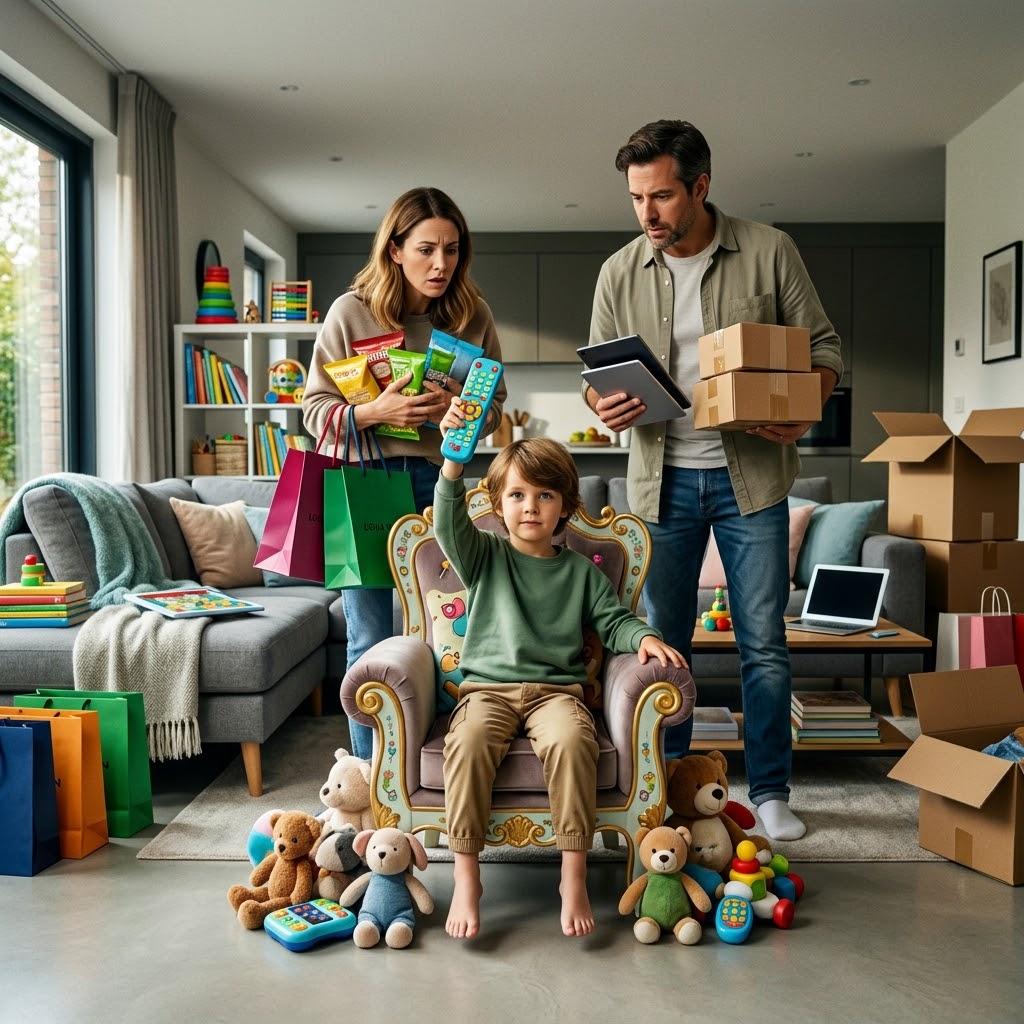
Çocukerkil Aile (Yapay Zekâ ile Oluşturulmuştur.)
In the literature, this social phenomenon is also conceptualized not only as the “child-centered family” but also as the “child-centered family.” Due to concerns that the term “child-centered” may not fully capture the weight of unchecked authority and power implied by “pediarchal,” some researchers prefer the term “child-centered family” as it better reflects the current flexible dynamics within family relationships.【1】
Historically, family authority structures have shifted from the patriarchal model, dominated by the male or father, toward a matriarchal or dual-parent authority model as women gained greater participation in social and economic life. Today, however, globalization, consumer culture, technological advances, and evolving parenting ideologies have led to authority being shared with or entirely transferred to the child.
Since the 1960s, academic literature has identified a transformation in which mothers and fathers have lost their traditional roles as authoritative figures, and the family has increasingly adopted a child-centered structure.【2】 The key factors contributing to the emergence and visibility of the child-centered family model are as follows:
Domestic Authority Vacuum: With the advent of postmodernity, the home has lost its traditional functions and retreated into the role of merely a “hotel,” weakening parental authority. Children, recognizing this authority vacuum, have infiltrated the space, either assuming authority or sharing it.
Helicopter Parenting: Parental attitudes that center children in every moment of daily life, continuously guide their activities and decisions, and exhibit excessive intervention and perfectionism sustain this structure.
The Child as a Rights-Based Subject: In line with individualization, pedagogical approaches, and advances in children’s rights, children are now positioned as autonomous individuals with equal rights to adults, altering the hierarchical balance within the family.
The child-centered family structure presents a dynamic in which the child’s demands shape all aspects of family life, from consumption preferences and living space choices to vacation planning and educational decisions.
To understand the current state of the child-centered or child-centered family structure, it is necessary to examine the historical, cultural, and ideological transformations of childhood.
In Western historical sociology, the recognition of childhood as a distinct and unique developmental stage corresponds to the modern era. Philippe Ariès’s classic thesis argues that during the Middle Ages and Early Modern period, children were not seen as having an independent developmental phase but were regarded as “little adults” in terms of clothing, posture, participation in labor, and social roles.【3】 During this period, children around the age of seven completed their play phase and integrated into the adult world through fieldwork or apprenticeships; emotional care and pedagogical development were not central to parent-child relationships.
From the 17th and 18th centuries onward, the emergence of pedagogy, combined with efforts to combat child labor and the introduction of compulsory education laws, defined childhood as a special domain requiring protection and education. In the 19th century, the notion of the “economically useful child,” who directly contributed to the family economy, was replaced in the 20th century by the view of the child as “emotionally priceless but economically valueless,” as articulated by Viviana Zelizer.【4】
With neoliberal policies of the 21st century, childhood has become a “success project” measured by its future market value, centered on the human capital concept of investing in education, talent, and potential.r As Benjamin Spock noted in his definition of “Child-Centered America,” modern parenting has transformed the child into a contradictory subject: allowed to construct life according to their own inclinations, yet burdened with intense performance and achievement pressures.【5】
In traditional Turkish culture, the concept of the child differed from today’s protective and dependent view of childhood; it referred to an active agent who ensured the continuity of the lineage, sustained the household, and formed part of the military-nation structure.
In the Orkhon Inscriptions, the term “ogul” (kız ogul, uri ogul) was used for all children without distinction of gender. The emphasis in the inscriptions on Kül Tigin assuming command of the army at age 16 and governing the state demonstrates that expectations of children were shaped toward active responsibility and valor, consistent with the conditions of the time.
Dîvânu Lugâti't-Türk and Kutadgu Bilig emphasize the guiding role of parents in the upbringing and education of children. Children were said to learn manners and virtue by imitating their parents from an early age, and parents were assigned guiding responsibilities.
The situation was similar in the Dede Korkut tales. In the story of Dirse Han’s Son Boğaç Han, having children determined social status: those with sons sat in the white tent, those with daughters in the red tent, and those without children in the black tent. In ancient Turkish tradition, the child was regarded as the most valuable element from birth; while this does not exactly mirror today’s child-centered structure, it provides a cultural foundation with “primitive child-centered” characteristics. However, in traditional Turkish societies, children’s active participation in life stemmed not from privileged child-centeredness but from the necessities of the era requiring shared responsibilities.
With the founding of the Republic of Türkiye, modernization, Westernization ideals, and legal reforms initiated a transformation in family structure. The traditional extended family gradually dissolved, giving way to the urban nuclear family model. In the early years of the Republic, the child was constructed as a “political symbol” and “social value” to be raised for the nation-state’s construction, population policies, and the regime’s future.
Over time, women’s entry into the workforce, their economic independence, urbanization, and rising education levels altered family decision-making mechanisms. As patriarchal structures weakened, the mother-father authority model emerged first, followed by the child-centered family model, which gained prominence under the influence of globalization and consumer society, prioritizing children’s desires and preferences.
The prevalence of the child-centered or child-centered family structure in contemporary societies is not attributable to a single cause. It results from the interaction of economic, social, technological, and parenting attitude transformations. Four main structural factors underlie its visibility:
The consumer culture that emerged with postmodernity has fundamentally transformed family relationships. The capitalist system and marketing sector have positioned children directly as target consumers through advertisements, mass media, and packaging design. The provision of child-friendly areas in shopping malls—such as play zones and miniature shopping carts—and the proliferation of cartoons and digital platforms have heightened children’s consumption desires. Children use the knowledge they acquire to exert pressure on their parents, shaping the family’s core dynamics through unlimited demands. Parents, motivated by the desire to raise “age-appropriate children” or to provide the comfort they themselves lacked in childhood, relegate their own basic needs to the background and prioritize their children’s consumption wishes.. Additionally, as working mothers increase, parents who feel they lack sufficient time for their children compensate for guilt by constantly giving gifts, driving the family toward a consumer-oriented child-centered structure.
In the postmodern era, the street has been coded as a dangerous space filled with threats such as kidnappers, organ traffickers, harassers, and traffic accidents, generating serious safety concerns among families. Media dramatization of crimes against children has created a societal “culture of fear” and a “paranoid parenting” atmosphere. Parents, aiming to raise children under control and surveillance, have chosen residential areas in secure gated communities. Due to the perception of streets as risky, children’s opportunities for unsupervised outdoor play in parks have been restricted, drawing them indoors or into virtual spaces. Parents, developing a constant state of vigilance, have adopted a risk-management attitude, limiting and monitoring all aspects of their children’s lives for safety.
Neoliberal ideology, by foregrounding individual success and competition, has transformed parenting into a performance domain. Contemporary parents plan their children’s care and education according to expert advice and scientific guidance to ensure their children do not fall behind others and gain social advantages. This has given rise to the concept of the “project child,” a child raised from birth along a predetermined roadmap and viewed as the family’s instrument of success.
Parents purchase services such as private schools, tutoring centers, study groups, and one-on-one home lessons to guarantee academic performance, framing child-rearing as a “success investment.” Under the “responsible parenting” narratives promoted by educational authorities and mass media, parents perceive their children’s failures as reflections of their own inadequacies and continuously design child-centered life plans under persistent anxiety. The desire to provide the highest quality conditions reinforces the trend toward having fewer children.【6】
With the rapid development of the internet and digital technologies, children born into the digital world (“digital natives” or the Millennial generation) have become more competent than their parents in mastering technological tools and accessing information. Children guiding or coaching their parents on technology has reversed the traditional hierarchy of knowledge and authority within the family. The digital information bombardment has increased children’s inclination to question, while parents who feel inadequate have weakened their ability to say “no” or set boundaries. On the other hand, parents’ desire to protect their children has led to intensive use of technological surveillance tools (smartwatches, location-tracking apps, security cameras); technology has thus become a two-way interaction space where children establish authority and parents apply excessive surveillance.
The formation of the child-centered or child-centered family structure is significantly shaped by the attitudes and parenting styles adopted by parents. Theoretical approaches and contemporary parenting models provide important insights for understanding child-centered family dynamics.
Diana Baumrind’s classification of parental attitudes into three main styles—permissive, authoritarian, and authoritative/democratic—clarifies the distribution of authority within the family:
Helicopter parenting refers to perfectionist parental attitudes characterized by excessive involvement, planning the child’s life, constant guidance, intervention, and hovering around the child like a helicopter.
Another prevalent tendency in child-centered families is for parents to attempt to establish an equal relationship with their children, viewing themselves as their “best friend.” Supported by media and some experts, this attitude leads to the misconception of equating the child’s immature thinking with adult experience. When parents withdraw from their guiding authority role and assume a friendship role, children are deprived of the boundaries and direction they need.
Parents who cannot bear to see their child upset or who struggle to say “no” create inconsistent discipline, blurring boundaries; the child, using methods such as crying, whining, or sulking, directs the family and ascends to the position of “the little ruler of the house.” Inconsistent rules between parents (one permitting what the other forbids) further reinforce the child’s sense of boundlessness and completely neutralize parental authority.
The child-centered or child-centered family structure becomes visibly apparent in family consumption practices and daily decision-making. In contemporary families, the importance accorded to children’s opinions and preferences is rapidly increasing; families now place children at the forefront in areas such as shopping, vacations, and career planning.
Changes in the retail sector—the proliferation of large shopping malls and the provision of child-friendly areas—have increased the frequency of families shopping together. Field studies show that a significant portion of families (32.8 percent) shop with both parents and children, and the presence of children during shopping generates new demands and desires.【7】
The child’s influence on family purchasing decisions begins even before the child is born and intensifies both qualitatively and quantitatively as the child grows. The child’s opinion is sought not only in products directly concerning them but also in decisions affecting the entire family:
Parents’ child-centered purchasing and decision-making behaviors vary according to demographic characteristics:
Although the child-centered or child-centered family structure may initially appear as a democratic environment recognizing children’s autonomy, the blurring of boundaries and excessive protective or permissive attitudes generate serious psychological, social, and developmental problems for both children and parents.
The rapid proliferation of digitalization and media technologies has introduced new dimensions to child-centered family structures concerning privacy, surveillance, and parent-child relationships. Digital platforms have fundamentally transformed family communication and parenting practices.
In contemporary society, the publicization of privacy and the transformation of transparency into a necessity have blurred family boundaries and eroded the private sphere. Byung-Chul Han’s concept of the “ideology of transparency” reproduces social control and family relationships. In this system, where individual privacy yields to demands for constant visibility, emotional closeness and sincerity among family members recede, replaced by outwardly observable and measurable interactions.
The boundless content and visibility sought on social media have turned parenting into a strategic presentation and object of performance.. In this process fueled by neoliberal individualism, parents publicly display their children’s development, achievements, and family moments on social platforms.
The prominent safety concerns and culture of fear in child-centered families have driven parents to intensively use technological monitoring tools (smartwatches, location-tracking apps, home and school cameras).
Alagöz, Selda Başaran. "Çocukerkil Aile Sisteminde Satın Alma Davranışı." *Selçuk Üniversitesi İktisadi ve İdari Bilimler Fakültesi Sosyal ve Ekonomik Araştırmalar Dergisi* 8, no. 16 (2009): 316–38. Accessed September 1, 2026.https://dergipark.org.tr/en/pub/susead/article/302693
Alan, Suat. "Çocuk Merkezli Aile: Görünüm ve Sorunlar." *Muhafazakâr Düşünce* 21, no. 69 (2025): 182–206. Accessed September 1, 2026.https://www.researchgate.net/profile/Suat-Alan/publication/397600862_CHILD-CENTERED_FAMILY_OUTLOOK_AND_PROBLEMS/links/6916eb857faf914d36ed1373/CHILD-CENTERED-FAMILY-OUTLOOK-AND-PROBLEMS.pdf
Eroğul, Nebile, and Haktan Kaplan. "Geleneksel Aile Dinamiklerinden Çocukerkil Aile Yapısına." *Eskişehir Osmangazi Üniversitesi Sosyal Bilimler Dergisi* 26 (2025): 2358–84.https://dergipark.org.tr/tr/pub/ogusbd/article/1710468
[1]
Suat Alan, "Çocuk Merkezli Aile: Görünüm ve Sorunlar," Muhafazakâr Düşünce 21, no. 69 (2025): 184. https://www.researchgate.net/profile/Suat-Alan/publication/397600862_CHILD-CENTERED_FAMILY_OUTLOOK_AND_PROBLEMS/links/6916eb857faf914d36ed1373/CHILD-CENTERED-FAMILY-OUTLOOK-AND-PROBLEMS.pdf
[2]
Nebile Eroğul ve Haktan Kaplan, "Geleneksel Aile Dinamiklerinden Çocukerkil Aile Yapısına," Eskişehir Osmangazi Üniversitesi Sosyal Bilimler Dergisi 26, Özel Sayı (2025): 2361. https://dergipark.org.tr/tr/pub/ogusbd/article/1710468
[3]
Eroğul ve Kaplan, "Geleneksel Aile Dinamiklerinden Çocukerkil Aile Yapısına," 2362.
[4]
Eroğul ve Kaplan, "Geleneksel Aile Dinamiklerinden Çocukerkil Aile Yapısına," 2365.
[5]
Eroğul ve Kaplan, "Geleneksel Aile Dinamiklerinden Çocukerkil Aile Yapısına," 2361.
[6]
Alan, "Çocuk Merkezli Aile: Görünüm ve Sorunlar," 195.
[7]
Başaran Alagöz, "Çocukerkil Aile Sisteminde Satın Alma Davranışı," 336.
[8]
Başaran Alagöz, "Çocukerkil Aile Sisteminde Satın Alma Davranışı," 336-337.
[9]
Alan, "Çocuk Merkezli Aile: Görünüm ve Sorunlar," 187; Başaran Alagöz, "Çocukerkil Aile Sisteminde Satın Alma Davranışı," 336-337.
[10]
Alan, "Çocuk Merkezli Aile: Görünüm ve Sorunlar," 196.
[11]
Alan, "Çocuk Merkezli Aile: Görünüm ve Sorunlar," 196.


Henüz Tartışma Girilmemiştir
"Childcare Family" maddesi için tartışma başlatın
Historical Development
Cultural Development
Changing Perception of Childhood in Western Literature
Perception and Evolution of Childhood in Turkish Culture
Modernization and Transition to the Nuclear Family in Türkiye
Causes and Structural Factors Behind the Emergence of the Child-Centered Family
Consumer-Oriented Lifestyle and Marketing Strategies
Security-Oriented Social Structure and Culture of Fear
Competitive Social Structure and Neoliberalism (“Project Child”)
Technological Advancements and New Forms of Knowledge-Based Authority
Parenting Styles and Interaction with the Child-Centered Family
Baumrind’s Parenting Classification and Its Relation to Child-Centeredness
Helicopter Parenting and Excessive Intervention
“Best Friend” Tendency and Difficulty in Setting Boundaries
Reflections in Family Decision-Making and Consumption Behavior
Shopping Budgets and Joint Shopping Practices
Product Categories and Life Areas Determined by the Child
Role of Demographic Variables (Gender, Education, and Income Status)
Problems and Negative Effects in the Child-Centered Family Model
Negative Effects on Children
Negative Effects on Parents
Reflections in Academic, Socio-Emotional, and Professional Life
Digitalization, Media Representation, and Violation of Privacy
Byung-Chul Han’s “Ideology of Transparency” and the Publicization of Privacy
Parent-Child Performance on Social Media (Performative Parenting)
Excessive Technological Surveillance and Cyber Psychological Pressure