


Bu içerik Türkçe olarak yazılmış olup yapay zeka ile otomatik olarak İngilizceye çevrilmiştir.
Europacentrism (Eurocentrism) is an ontological and epistemological ideology that imposes European history, culture, and social organization as universal standards of validity and the ultimate model of progress for the rest of the world.【1】 This concept denotes a hegemonic matrix in which Europe transcends its mere geographical boundaries, constructing a fictional past rooted in ancient Greece and Rome as the sole subject of civilization, while positioning Asia, Africa, and the Islamic world as the “Other.”【2】 As an ideology and social science paradigm, Europacentrism legitimized colonial processes, defined modernity as an exclusively European phenomenon, and imprisoned the historical realities of non-Western societies within its own conceptual framework.

Galleons as the Symbol of Overseas Expansion and the Construction of CapitalismUnsplash)
The construction of European identity was shaped through the practice of “othering” toward the world beyond its borders. This distinction, beginning in ancient Greece with the labeling of non-Greek speakers as “barbarians,” evolved into an exclusivist logic under the Roman Empire that equated the boundaries of civilization with Christian ecumenism.【3】 Following the Renaissance and Reformation movements, 18th-century Enlightenment thought granted this superiority psychology a rational and scientific legitimacy. The Enlightenment portrayed Europe as the universal representative of reason, science, and rationality, while depicting the East as emotional, despotic, static, and trapped in a “childhood stage” (Peter Pan theory).【4】
Among the most prominent theorists of Europacentric historical philosophy, G.W.F. Hegel and Karl Marx treated history as a single linear (diachronic) progression. Hegel claimed that world history moved from east to west and reached its highest level of maturity in Europe, particularly among the Germanic race. Similarly, Marx conceptualized the “Asiatic mode of production” to define Eastern societies as resistant to change and stagnant, viewing European imperialism as a historical necessity to transform them.【5】
The transformation of Europacentrism into a global system of power is directly linked to the colonial process that began with the conquest of the Americas in 1492. Aníbal Quijano’s concept of the “coloniality of power” reveals that the capitalist world-system is not merely an economic structure but is founded on a global social hierarchy organized around the concept of “race.”【6】 Europeans organized the global division of labor according to racial hierarchies, identifying the white race (Europeans) with wage labor and administrative roles, while equating non-Europeans with slavery and forms of unpaid labor.
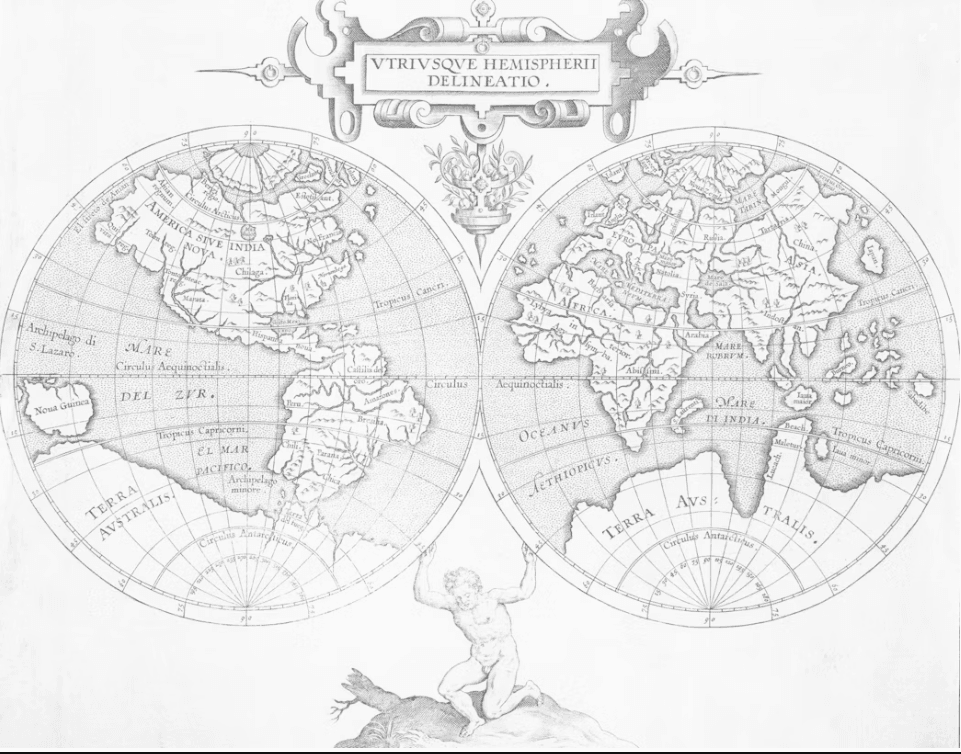
An Old Map Depicting a Eurocentric Spatial Perception and Imagining the World with the West at Its Center (Unsplash)
According to Ramón Grosfoguel and Walter Mignolo, René Descartes’ philosophical proposition “I think, therefore I am” (ego cogito) rests on an imperial arrogance that implicitly declares “I conquered, therefore I am” (ego conquistus).【7】 The rationality established by Descartes presented itself as detached from time and space, neutral, and universal—a “point zero.” In doing so, Western epistemology concealed its geopolitical and bodily positioning (geopolitics and body-politics of knowledge) while claiming to be the sole legitimate system of knowledge in the world.【8】
Europacentric ideology has remapped time and space according to its own priorities. In historical writing, time has been divided into a continuous narrative of progress based on Christian and European turning points (Ancient Age, Medieval Age, Modern Age, etc.).【9】 Independent civilizational analyses, such as those developed by non-Western thinkers like Ibn Khaldun with his science of “Umran” and his cyclical understanding of history, have been marginalized or deliberately sidelined by the Europacentric linear narrative of history.【10】
On the spatial plane, as seen in Michel Foucault’s concept of “power-knowledge” and Antonio Gramsci’s notion of “hegemony,” geography has been constructed to solidify European dominance.【11】 World maps drawn using the Mercator projection exaggerated the size of Europe, placing it at the center of the world and depicting vast landmasses such as Asia, Africa, and South America as disproportionately smaller. As a further consequence of this hegemony, terms such as “Age of Discovery,” “Near East,” “Middle East,” and “Far East” were entirely generated based on physical distances from Britain and Europe, and these terms have been universally imposed without question.【12】
In the 19th century, the institutionalization of social sciences ensured the academic codification of Europacentric assumptions. Sociology aimed to analyze Western industrial society and derive universal laws, while Anthropology and Ethnology took on the task of studying non-European “primitive” and “traditional” societies to determine how they could be “civilized.”【13】 This civilizing mission, embodied in Rudyard Kipling’s “White Man’s Burden” rhetoric, concealed colonialism and imperial exploitation behind a veil of moral responsibility and scientific necessity.【14】
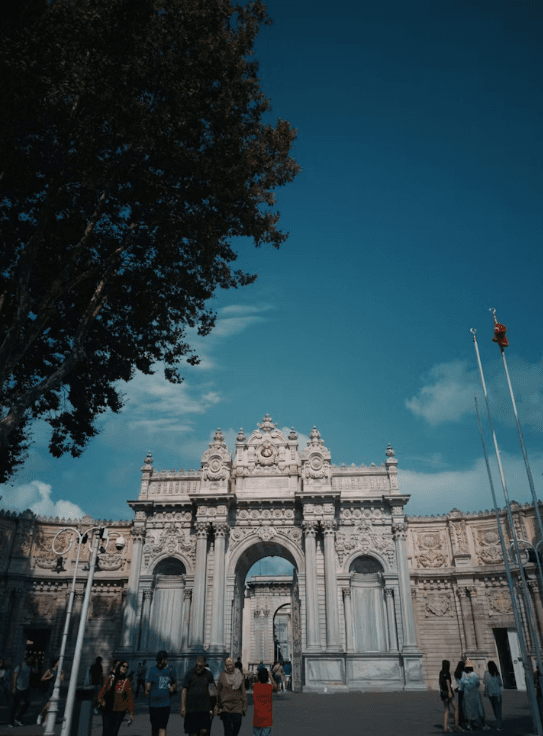
The Architectural Embodiment of European-Centered Aesthetics: Dolmabahçe SarayıUnsplash)
The Ottoman Empire underwent a profound shift in its perception of Europe over time. Until the 17th century, Ottoman ethnocentrism, which viewed Europe as “infidel” or “Frank” based on its political and military superiority, began to crumble following territorial losses after the Treaty of Karlowitz (1699) and the Tulip Era. With the Tanzimat period, Europe came to be seen not as a religious threat but as a model of “civilization” to be attained. During this process, Ottoman elites embraced the West as the sole model capable of saving the state; implicitly accepting Western paternalistic superiority, as symbolized in the “Mürebbiye” (governess) metaphor found in the novels of writer Hüseyin Rahmi Gürpınar.【15】
Turkish modernization has also been deeply influenced by Europacentrism in academic scholarship. The “Conflict Paradigm” represented by figures such as Bernard Lewis (The Emergence of Modern Turkey) and Niyazi Berkes (Modernization in Turkey) interpreted modernization exclusively as a sharp dichotomy between a “backward, dogmatic, religious East” and a “progressive, rational, secular West.” This approach assumed an absolute rupture between the Ottoman Empire and the Republic, portraying history solely as a top-down construction by elites, laws, and state institutions.【16】 The “Synthesis (Adaptation) Paradigm,” led by Erik Jan Zürcher, rejected these sharp dichotomies and emphasized historical continuities from the Ottoman Empire to the Republic. Today, thinkers such as İsmail Kara advocate a “history from below” approach, centering the experiences of ordinary people in the countryside, religious figures, and marginalized groups to challenge the hegemony of Europacentric elitist historiography.【17】
Today, Europacentrism is being deconstructed both historically and epistemologically by postcolonial and decolonial theorists. According to Walter D. Mignolo, the roots of resistance to Europe’s universalist narrative extend back to the 17th century, to Waman Puma de Ayala’s New Chronicle (Nueva Crónica), which criticized Spanish colonialism in the Andes, and to the 18th-century writings of former enslaved person Ottobah Cugoano in Thoughts and Sentiments, which dismantled the moral and economic foundations of slavery. Mignolo defines this lineage of resistance as “epistemic disobedience.”【18】
The concepts of “transmodernity” and “border thinking” developed by Ramón Grosfoguel and Enrique Dussel simultaneously reject Europacentrism and non-Western fundamentalisms. The decolonial approach moves beyond reading the world solely through the lenses of capital and class (orthodox Marxism) or culture (postcolonialism), targeting instead the “heterarchic” structures where hierarchies of race, gender, language, and belief intersect. The goal is to construct a pluralistic (pluriversal) and horizontal vision of the world, nourished by the epistemologies of the oppressed, replacing Europe’s monologic universalism.【19】
Canatan, Kadir. "Osmanlı'da Batılılaşma ve Batımerkezcilik İdeolojisinin Tarihsel Kökenleri." *Eskiyeni* 8 (Winter 2008): 12–26. Accessed September 10, 2026.https://dergipark.org.tr/tr/download/article-file/488814
Emiroğlu, Bekir. "Aydınlanma Tecrübesi Üzerinden Kurgulanan Avrupamerkezcilik ve Güç Retoriği." *İnsan ve Toplum Bilimleri Araştırmaları Dergisi* 11, no. 1 (2022): 133-153. Accessed September 10, 2026.https://dergipark.org.tr/tr/pub/itobiad/article/1052811
Grosfoguel, Ramón. "Transmodernity, border thinking, and global coloniality." *Eurozine* (July 4, 2008). Accessed September 10, 2026.https://www.eurozine.com/transmodernity-border-thinking-and-global-coloniality/.
Mignolo, Walter D. "Epistemic Disobedience and the Decolonial Option: A Manifesto." *Transmodernity* 1, no. 2 (Fall 2011): 44-66. Accessed September 10, 2026.https://escholarship.org/uc/item/62j3w283
Ortiz, Jose P. *Galleon sailing on the ocean at sunset*. Photograph. April 9, 2026. Unsplash. Accessed September 10, 2026.https://unsplash.com/photos/galleon-sailing-on-the-ocean-at-sunset-6zCMmXM_ER4
Quijano, Aníbal. "Colonialidad del poder, eurocentrismo y América Latina." *La colonialidad del saber: eurocentrismo y ciencias sociales*, edited by Edgardo Lander, pp. 778-832. Buenos Aires: CLACSO, 2000. Accessed September 10, 2026.https://biblioteca-repositorio.clacso.edu.ar/items/7f3ecb3e-ebe8-40f9-a505-2de073fb0a49
Rzayev, Rameş. "Tarihsel Düşüncede Avrupamerkezci Söylemin 'Hegemonya' İdeografisi." *Vakanüvis - Uluslararası Tarih Araştırmaları Dergisi* 6, no. 2 (Güz 2021): 786-816. Accessed September 10, 2026.https://dergipark.org.tr/tr/download/article-file/1749925
The New York Public Library. *Antique world map showing continents and oceans*. Photograph. Unsplash, August 10, 2024. Accessed September 11, 2026.https://unsplash.com/photos/antique-world-map-showing-continents-and-oceans-0VdOyuv1gL0
Uludağ, Süleyman. "İbn Haldûn." *TDV İslâm Ansiklopedisi* 19 (1999): 538-543. Accessed September 10, 2026.https://islamansiklopedisi.org.tr/ibn-haldun.
Unsplash Katkıcısı. *Dolmabahçe Palace Istanbul, Turkey*. Photograph. Unsplash, August 17, 2019. Accessed September 10, 2026.https://unsplash.com/photos/dolmabahce-palace-istanbul-turkey-yNehONgZnlI.
Çağlar, İsmail. "Türk Modernleşmesi Literatürünün Avrupamerkezcilik Penceresinden Değerlendirilmesi." *İnsan & Toplum* 3, no. 6 (2013): 135-153. Accessed September 10, 2026.https://dergipark.org.tr/tr/download/article-file/2446877
Şimşek, Ahmet. "Türkiye’de Tarih Ders Kitaplarında Avrupamerkezcilik." *İnsan & Toplum* 3, no. 6 (2013): 193-222. Accessed September 10, 2026.https://dergipark.org.tr/tr/download/article-file/2446905
[1]
Ahmet Şimşek, "Türkiye’de Tarih Ders Kitaplarında Avrupamerkezcilik," *İnsan & Toplum* 3, no. 6 (2013): 194-195, Accessed September 10, 2026,https://dergipark.org.tr/tr/download/article-file/2446905
[2]
Bekir Emiroğlu, "Aydınlanma Tecrübesi Üzerinden Kurgulanan Avrupamerkezcilik ve Güç Retoriği," *İnsan ve Toplum Bilimleri Araştırmaları Dergisi* 11, no. 1 (2022): 138-140, Accessed September 10, 2026,http://www.itobiad.com/tr/pub/issue/68190/1052811
[3]
Emiroğlu, "Aydınlanma Tecrübesi," 138.
[4]
Rameş Rzayev, "Tarihsel Düşüncede Avrupamerkezci Söylemin 'Hegemonya' İdeografisi," *Vakanüvis* 6, no. 2 (2021): 810-811, Accessed September 10, 2026,
[5]
Rzayev, "Tarihsel Düşüncede," 793–794.
[6]
Aníbal Quijano, "Colonialidad del poder, eurocentrismo y América Latina," in *La colonialidad del saber: eurocentrismo y ciencias sociales*, ed. Edgardo Lander (Buenos Aires: CLACSO, 2000), 778–782, Accessed September 10, 2026,https://biblioteca-repositorio.clacso.edu.ar/items/7f3ecb3e-ebe8-40f9-a505-2de073fb0a49
[7]
Ramón Grosfoguel, "Transmodernity, border thinking, and global coloniality," *Eurozine* (July 4, 2008), Accessed September 10, 2026,https://www.eurozine.com/transmodernity-border-thinking-and-global-coloniality/
[8]
Grosfoguel, "Transmodernity."
[9]
Şimşek, "Türkiye’de Tarih," 197–198.
[10]
Süleyman Uludağ, "İbn Haldûn," *TDV İslâm Ansiklopedisi* 19 (1999): 538-543. Accessed September 10, 2026.
[11]
Rzayev, "Tarihsel Düşüncede," 801–804.
[12]
Şimşek, "Türkiye’de Tarih," 198.
[13]
Emiroğlu, "Aydınlanma Tecrübesi," 144–145.
[14]
Rzayev, "Tarihsel Düşüncede," 810.
[15]
Kadir Canatan, "Osmanlı'da Batılılaşma ve Batımerkezcilik İdeolojisinin Tarihsel Kökenleri," *Eskiyeni* 8 (Winter 2008): 14–25, Accessed September 10, 2026.
[16]
İsmail Çağlar, "Türk Modernleşmesi Literatürünün Avrupamerkezcilik Penceresinden Değerlendirilmesi," *İnsan & Toplum* 3, no. 6 (2013): 140-146, Accessed September 10, 2026,https://dergipark.org.tr/tr/download/article-file/2446877. [^17]: Çağlar, "Türk Modernleşmesi," 146-149
[17]
Çağlar, "Türk Modernleşmesi," pp. 146–149.
[18]
Walter D. Mignolo, "Epistemic Disobedience and the Decolonial Option: A Manifesto," *Transmodernity* 1, no. 2 (Fall 2011): 47-59, Accessed September 10, 2026,https://escholarship.org/uc/item/62j3w283
[19]
Grosfoguel, "Transmodernity."

Henüz Tartışma Girilmemiştir
"Eurocentrism" maddesi için tartışma başlatın
Historical Roots, the Enlightenment, and the Construction of the “Other”
Modernity, the Coloniality of Power, and Capitalism
Epistemological Monopoly over Time and Space
Social Sciences and the Mission of Civilization
Europacentrism in the Ottoman Empire and Turkish Modernization
Decolonial Alternatives and Border Thinking