

Bu içerik Türkçe olarak yazılmış olup yapay zeka ile otomatik olarak İngilizceye çevrilmiştir.
+2 Daha
Climate | Mediterranean climate in the southeast A temperate oceanic climate generally prevails A continental/alpine climate is found in mountainous regions | ||||||||
|---|---|---|---|---|---|---|---|---|---|
Date of Independence | 14 Temmuz 1970 | ||||||||
National Day | 14 July - La Fête Nationale (National Celebration) | ||||||||
Total Population | ~68.5 million (2024, including overseas regions) | ||||||||
GDP (Nominal) | ~3.05 trillion USD (7th largest economy in the world) | ||||||||
GDP per Capita | ~46,315 USD | ||||||||
Ethnic Groups | Official statistics are not kept (principle of citizenship is fundamental) | ||||||||
Telephone Code | +33 | ||||||||
Internet Domain Code | fr | ||||||||
Active Military Personnel | ~203,000 | ||||||||
Defense Budget | 413 billion euros (total of the 2024–2030 Planning Act) | ||||||||
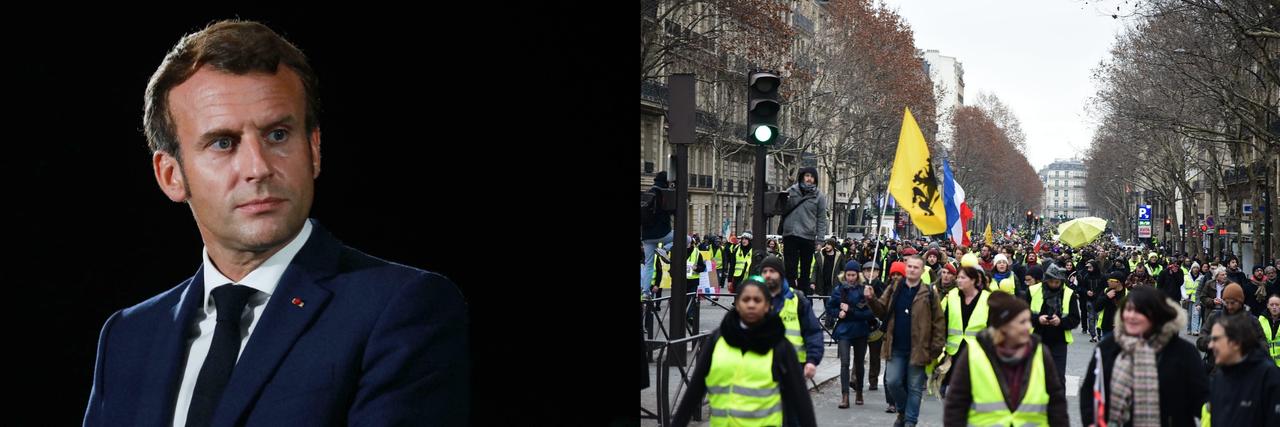
Head of State | Emmanuel Macron (President) | ||||||||
Official Languages | French | ||||||||
Common Languages | French | ||||||||
Religious Structure | Other religions: ~1% to 5% Christianity (mostly Catholics): ~38% to 47% No religion: ~33% to 51% Secular state structure (Laïcité) prevails. Islam: ~4% to 10% | ||||||||
Official Name | French Republic (République française) | ||||||||
Capital | Paris | ||||||||
Form of Government | Semi-presidential system (Fifth Republic) | ||||||||
Surface Area | 675,417 km² (including overseas territories), 551,500 km² (Metropolitan France) | ||||||||
Official Name | République Française | ||||||||
System of Governance | Unitary, democratic, secular, and social constitutional republic | ||||||||
Form of Government | Unitary, democratic, secular, and social constitutional republic | ||||||||
Founding Date | 843 – Treaty of Verdun | ||||||||
Capital | Paris | ||||||||
Head of State | Emmanuel Macron | ||||||||
Official Language | French | ||||||||
Common Languages | Breton Basque Corsican Occitan Alsatian Arabic Portuguese Spanish Turkish Chinese | ||||||||
National Day | July 14 – Bastille Day / French National Day | ||||||||
Area | Approximately 638,475 km² | ||||||||
Total Population | Approximately 69.1 million people | ||||||||
Climate | Generally a temperate zone climate Oceanic climate in the west and northwest More continental climate in the interior and eastern regions Mediterranean climate in the southeast Alpine and Pyrenean-influenced mountain climate in mountainous areas | ||||||||
GDP | Approximately $3.16 trillion USD | ||||||||
GDP per Capita | Approximately $46,100 USD | ||||||||
Ethnic Structure | French (%91.2) Foreign nationals (%8.8) | ||||||||
Religious Structure / Communities | Catholics Muslims Protestants Jews Buddhists | ||||||||
Telephone Code | +33 | ||||||||
Internet Domain Code | .fr | ||||||||
The French Republic is a state located in Western Europe with metropolitan (mainland) territories as well as overseas regions extending across the Mediterranean Sea, the Atlantic Ocean, the Caribbean, South America, and the Indian Ocean.As the largest member state of the European Union by area, France’s total area varies across sources depending on administrative and geographic definitions but is listed in current official data as 643,427 km² including overseas regions.【1】 According to INSEE’s 2025 demographic report, France’s population was approximately 69.1 million as of 1 January 2026.【2】
France’s mainland European territories border Belgium and Luxembourg to the northeast Germany and Switzerland to the east and Italy to the southeast Spain and Andorra to the southwest. Additionally France shares a land border with the Principality of Monaco along its Mediterranean coast. Bordered by the English Channel and the North Sea to the north the Atlantic Ocean to the west and the Mediterranean Sea to the south France holds administrative and strategic presence in multiple ocean basins due to its location in Europe and its overseas territories. The capital Paris serves not only as the political center of the country but also as a central hub for finance culture higher education diplomacy and transportation networks.
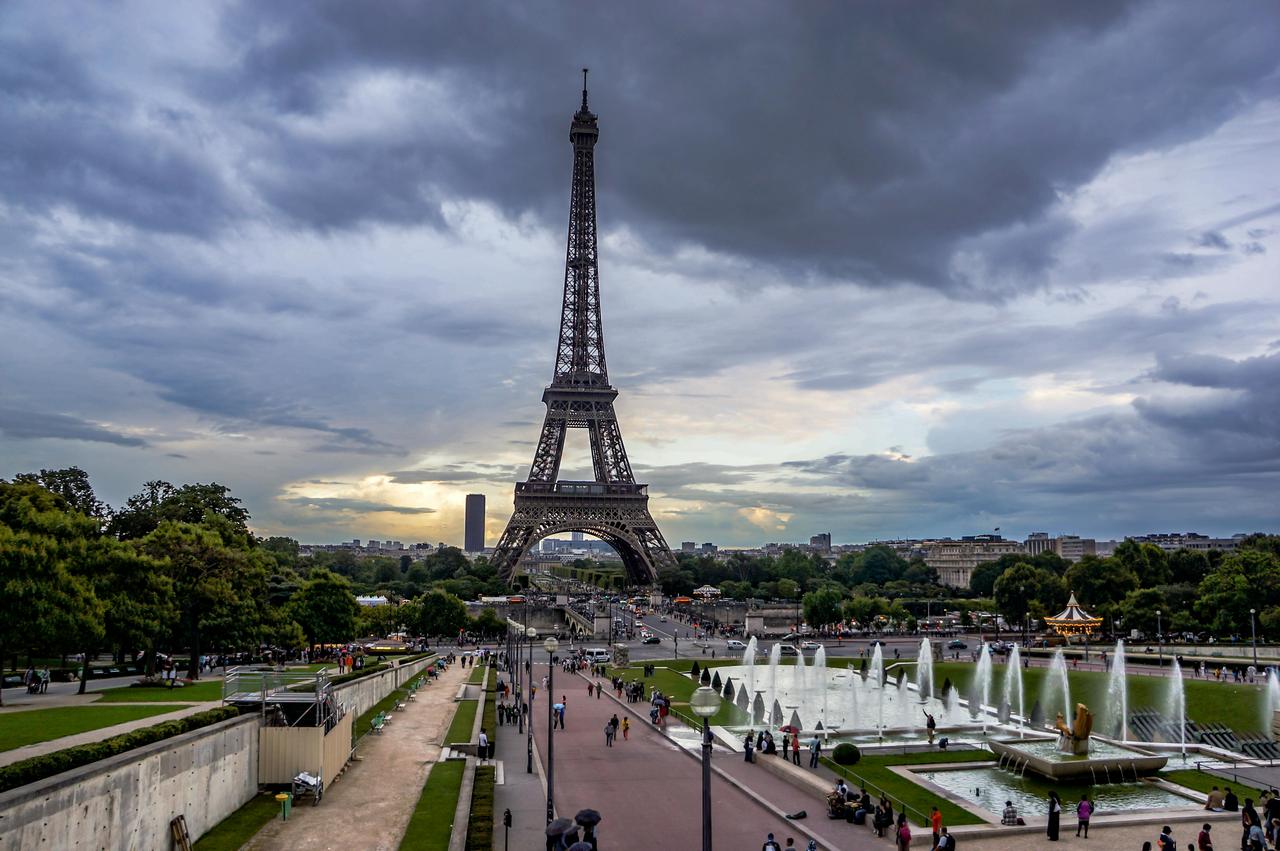
A Square from the Capital of France, Paris (Pexels)
France is a unitary secular democratic and social republic governed under the Constitution of 4 October 1958 known as the Fifth Republic. Article 1 of the Constitution states “La France est une République indivisible laïque démocratique et sociale” affirming that the French state is founded on the principles of indivisibility secularism democracy and social responsibility. The same article also specifies that the Republic’s organization is non-centralized. Politically France follows a semi-presidential model with a directly elected president and a prime minister who heads the government. The official language is French; Article 2 of the Constitution explicitly states “La langue de la République est le français”.【3】
Administratively France consists of 18 regions 13 of which are metropolitan and 5 are overseas. European Union sources indicate that in addition to these five overseas regions the Caribbean territory of Saint-Martin is also classified as an “outermost region” under EU legal framework. This structure demonstrates that France is not merely a European continental state but a multi-centered republic spanning multiple continents and ocean basins.【4】
France is one of the world’s largest economies based on a diversified industrial service and agricultural sector. France contributes a significant share to the European Union’s total gross domestic product and its GDP per capita is close to the EU average. Key economic sectors include aerospace defense manufacturing automotive pharmaceuticals chemicals cosmetics luxury goods agriculture and food processing finance and tourism. The OECD’s 2024 assessment notes that France’s relatively low electricity generation emissions are largely due to the high share of nuclear power in its energy mix. According to the same report nuclear energy accounts for 36 percent of France’s total primary energy supply. 【5】
France is one of the five permanent members of the United Nations Security Council a founding member of the European Union and a member of international organizations including NATO the G7 the G20 and the OSCE. As a leading architect of European integration France also holds symbolic and institutional significance in European political architecture due to Strasbourg being one of the official seats of European institutions. Its diplomatic and military capacity overseas presence nuclear capability cultural influence and relationships with French-speaking countries demonstrate that France is not merely a regional European power but one of the world’s leading global actors.
France’s national anthem is “La Marseillaise.” Article 2 of the Constitution of the Fifth Republic, dated 4 October 1958, defines it as such with the phrase “L’hymne national est la ‘Marseillaise’.”【6】 The origins of the piece are rooted in the wartime atmosphere of the French Revolution. Following France’s declaration of war against Austria on 20 April 1792, Claude Joseph Rouget de Lisle composed and wrote the anthem during the night of 25–26 April 1792 in Strasbourg. Originally titled “Chant de guerre pour l’Armée du Rhin”, or “War Song for the Army of the Rhine”, the piece quickly spread among revolutionary volunteers.【7】
The French National Anthem (Ian Berwick)
The anthem acquired its current name due to the Marseille volunteers who sang it as they entered Paris on 30 July 1792. From that date onward, the piece came to be known first as “Le chant” or “La Marche des Marseillois,” and later as “La Marseillaise.”【8】 Originally written as a war song for the Army of the Rhine, the text soon became integrated into the republican and patriotic rhetoric of the French Revolution. Themes of resistance against tyranny, defense of the homeland, civic duty, liberty, and mobilization against invasion form its core elements. At the same time, the language of the text reflects the harsh, combative tone characteristic of the war and revolutionary conditions of 1792.
“La Marseillaise” was officially recognized as the national song on 14 July 1795. It subsequently occupied varying positions during subsequent political regime changes, but firmly established itself as a permanent symbol of the Republic during the Third Republic. Alongside the tricolor flag, the 14 July national holiday, and the slogan “Liberté, Égalité, Fraternité,” it became one of the foundational symbols of the French Republic. The anthem’s political influence extended beyond France and was adopted by various republican, revolutionary, and liberal movements in different periods. Examples of its symbolic circulation outside France include its adaptation into Hebrew in Metz in 1792 and its performance during student demonstrations in Beijing in 1989.【9】 The official text of “La Marseillaise” consists of seven stanzas and a refrain.【10】 In current usage, the first stanza and refrain are the most widely known:
I. Stanza
Arise, children of the Fatherland,
The day of glory has arrived!
Against us, the bloody banner of tyranny
Is raised!
Do you hear in the fields
The roar of those savage soldiers?
They are coming right into your arms,
To slit the throats of your sons and wives!
Refrain
To arms, citizens!
Form your battalions!
March, march!
Let the impure blood
Water our furrows!
II. Stanza
What do these hordes of slaves,
These traitors, these united kings, want?
For whom are these vile chains,
These iron shackles long prepared?
What insolence from Frenchmen!
What fury must this awaken!
They dare to drag us back
To our former slavery!
III. Stanza
What! Foreign troops,
Will they set foot in our homes?
What! These paid soldiers,
Will they lay low our proud warriors?
Great God! Must our foreheads
Bend beneath chains forged by slaves?
Will base despots
Become masters of our fate?
IV. Stanza
Tremble, tyrants; you too, traitors,
All the scoundrels of the earth!
Tremble! Your plots to kill fathers
Will at last meet their due.
Everyone is a soldier for our cause.
If our young heroes fall,
The soil will give birth to others;
Others ready to fight you.
V. Stanza
Frenchmen, noble volunteers,
Strike or hold your blows!
Spare those wretched victims
Who were forced to take up arms against us.
But do not spare those bloody despots,
Those accomplices of Bouillé,
Who tear apart mothers’ breasts without pity,
All those tigers!
VI. Stanza
The sacred love of the homeland,
Guide our arms that seek vengeance, lend us support!
Freedom, beloved Freedom,
Fight alongside your defenders!
Victory beneath our flags,
Let it rush to your powerful voices;
Let the dying enemies
Witness your triumph and our glory!
VII. Stanza
When our elders are no longer there,
We shall step forward.
There we shall find their dust,
And the traces of their virtues.
Rather than envy those who live after them,
We shall wish to share their graves.
We shall have a noble pride,
Not merely to avenge them or follow in their footsteps.
The national flag of the French Republic is a tricolor flag composed of three vertical stripes of blue, white and red. Article 2 of the Constitution of the Fifth Republic states, “L’emblème national est le drapeau tricolore, bleu, blanc, rouge,” thereby formally identifying the national emblem as the blue, white and red tricolor flag.【11】 In this regard, the tricolor is one of the fundamental republican symbols directly defined in the Constitution.
The origins of the flag trace back to the French Revolution. Blue and red are associated with the traditional colors of the city of Paris, while white was recognized as the color of the French monarchy. The combination of these three colors emerged as a symbolic representation of the political tension between the people of Paris, the nation, and the monarchy during the revolutionary process. Initially used as a cockade, these colors gradually became one of the distinguishing emblems of revolutionary France and were later institutionalized as the state flag.
The current arrangement of the tricolor consists of vertical stripes with blue on the hoist side, white in the center, and red on the fly. This design was standardized in 1794 following various experimental uses during the Revolution. The vertical arrangement of the colors is not merely an aesthetic choice but is also interpreted as a visual expression of France’s new political identity, distinct from the old regime. Thus, the flag did not entirely reject the white of the monarchy; instead, it repositioned it alongside the colors of Paris within a new national symbol.
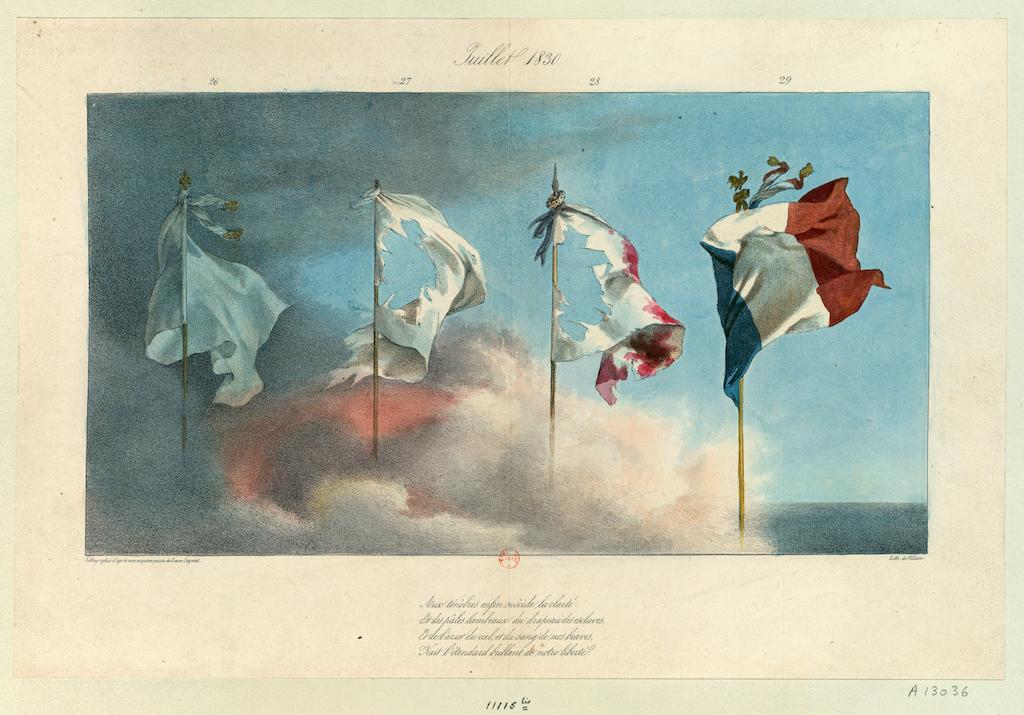
The Development of the French Flag (Elysee)
The tricolor flag was directly affected by regime changes during the 19th century. During the Bourbon Restoration from 1814 to 1830, the blue and red stripes were removed and only the white flag, associated exclusively with the monarchy, was used. However, during the July Revolution of 27, 28 and 29 July 1830, known as the “Three Glorious Days,” the tricolor reappeared on the political stage. With the accession of Louis-Philippe, the blue-white-red flag was reinstated and linked to the slogan “recovered the national colors.”【12】
Debate over the flag resurfaced during the Revolution of 1848. At the time of the proclamation of the Republic, some revolutionary groups advocated adopting a solid red flag. During this period, Alphonse de Lamartine defended the tricolor, arguing that it was not merely a party emblem but a national symbol representing France’s historical continuity. Lamartine’s statement, “When you see the red flag, you see the flag of a party; this is the flag of France,” demonstrated that the tricolor had become a broader symbol encompassing not only revolution but also the Republic, the Empire, the army, and national memory.【13】
Today, the tricolor flag is flown over public buildings and is used in civil and military ceremonies, national holidays, diplomatic missions, and state protocol. 14 July National Day, military parades, official commemorative days, and international representation are the primary contexts in which the flag is most prominently displayed. This usage has transformed the flag from a constitutional symbol into a visual emblem of state authority, national sovereignty, republican continuity, and public belonging.
The blue-white-red flag has interacted with different regimes, revolutions, and constitutional orders throughout modern French political history; yet, during the Fifth Republic, it has been permanently defined as the national emblem. Therefore, the French flag stands as one of the principal symbols representing both the legacy of the 1789 Revolution and the constitutional continuity of the modern French state.
The French Republic does not have a single, fixed constitutional state emblem in the sense used by many other states. Article 2 of the Constitution of the Fifth Republic identifies France’s national emblem as the tricolor flag; it also specifies that the national anthem is “La Marseillaise” and the republican motto is “Liberté, Égalité, Fraternité.”【14】 Therefore, in France the concept of an “emblem” must be understood not as a single official state coat of arms but as a collection of emblems, seals, and allegorical symbols that emerged during different historical periods and were adopted by various state institutions.
One of the most common emblems resembling a state coat of arms representing the French Republic is the “fasces.” This bundle, carried by lictors in front of magistrates in ancient Rome, consists of rods bound around an axe. During the French Revolution, this ancient symbol was given new meaning: the fasces became a republican emblem representing the unity and strength of citizens united in defense of liberty. After the fall of the monarchy, this symbol was associated with the idea of a “one and indivisible Republic” and was used on the seals of the First and Second Republics.
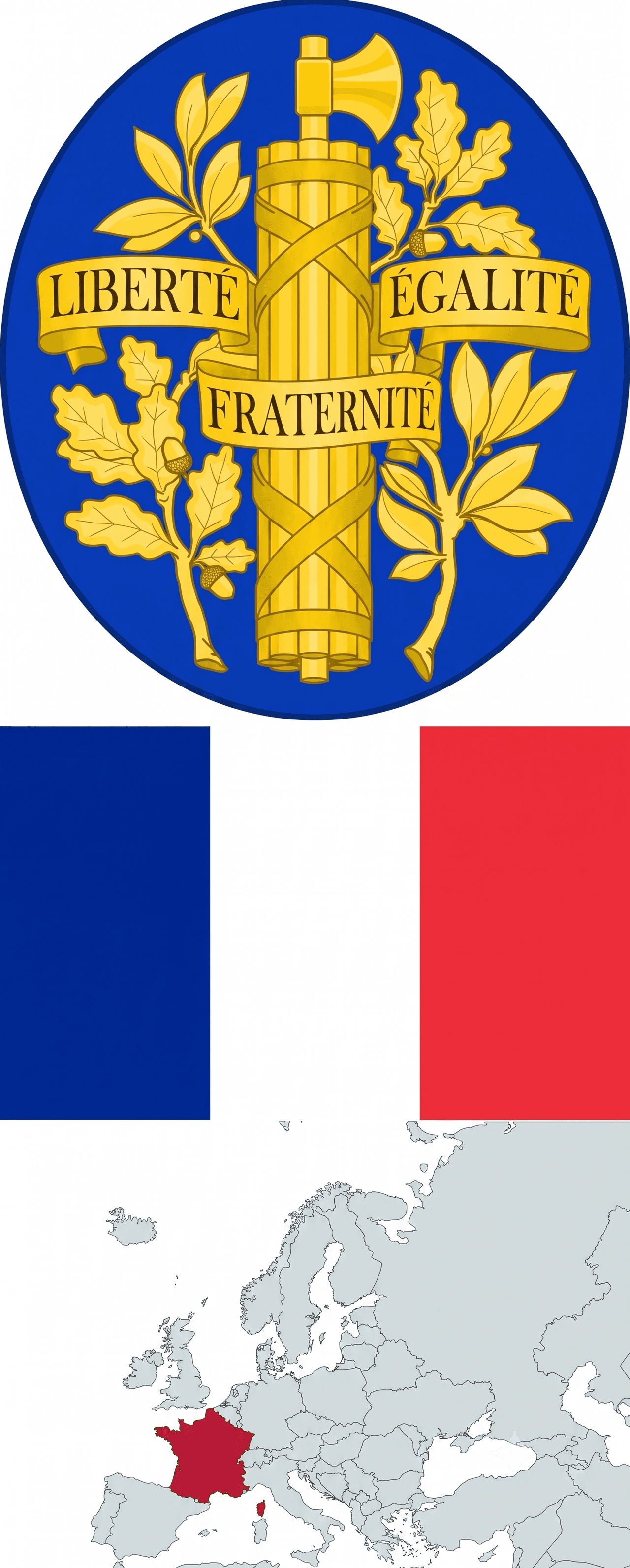
The origin of the French emblem used in diplomatic and consular contexts dates back to 1913. Adopted by the Ministry of Foreign Affairs for use by diplomatic and consular missions abroad, this emblem features a fasces bound around an axe at its center; above the bundle is a shield bearing the letters “RF.” The oak and laurel branches surrounding the composition are respectively associated with the ideals of justice and peace. In 1953, a new evaluation was conducted to select a seal for use by France at the United Nations General Assembly hall, and the design by artist Robert Louis was chosen. This design features a golden fasces on a blue background, crossed oak and laurel branches, and a ribbon bearing the motto “Liberté, Égalité, Fraternité.” Nevertheless, while the fasces remains a powerful visual symbol of the French Republic, it does not hold the constitutional status of an official state emblem.
One of the most important symbols with official status in French state tradition is the “Great Seal of France.” Seals have been used since the Middle Ages by monarchs, religious institutions, and civil authorities as marks of authority and authentication. Under the Ancien Régime, responsibility for safeguarding the seals rested with one of the highest officials of the monarchy, the Chancellor. Today, the seal is used only in highly limited and ceremonial circumstances, particularly for the authentication of the Constitution or constitutional amendments. The seal press is kept in the office of the Minister of Justice; hence, the Minister of Justice is still traditionally referred to as the “Guardian of the Seals.”【15】
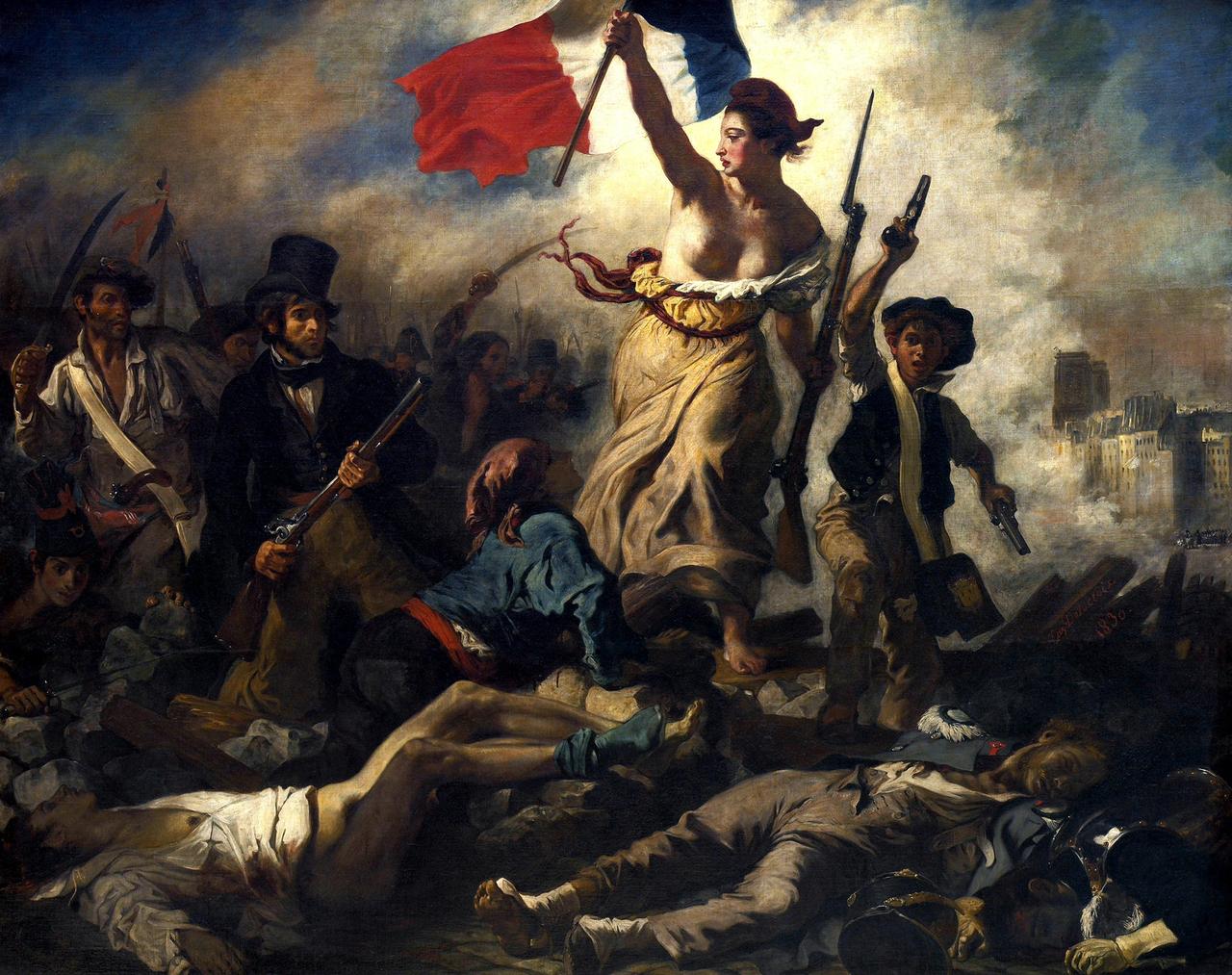
The French Revolution and Marianne (Elysee)
The Great Seal currently in use was established by decree on 8 September 1848 during the Second Republic. On its obverse, the allegorical figure of “Liberty” is depicted seated; she holds a fasces in her right hand and rests her left elbow on a ship’s helm bearing a rooster. The rooster’s foot rests upon a globe. The cube bearing the letters “SU” on the composition recalls the right to direct universal suffrage adopted in 1848. Surrounding the feet of the figure of Liberty are symbols representing the fine arts and agriculture. On the obverse of the seal is inscribed “République française démocratique une et indivisible” meaning “One and indivisible democratic French Republic”; on the reverse are the inscriptions “Au nom du peuple français” and “Égalité, Fraternité.” The same seal has continued to be used throughout the Third, Fourth, and Fifth Republics.
France’s most renowned republican allegory is “Marianne.” This symbol, represented as a female figure, traces its origins to the French Revolution. Marianne is most commonly depicted wearing a Phrygian cap, which was associated in antiquity with freed slaves and was also used among sailors and galley convicts in the Mediterranean world. During the Revolution, it was adopted especially by revolutionaries from southern France as a symbol of liberty. The name “Marianne,” being one of the most common female names in the 18th century, facilitated the transformation of the figure into a simple and recognizable symbol embodying both the people and the Republic.
The figure of Marianne became widespread especially during the Third Republic, becoming one of the most visible public symbols of the Republic through busts placed in town halls. She was sometimes depicted wearing the Phrygian cap and at other times with less revolutionary headgear such as a crown or diadem. Marianne appears on coins, official documents, public institutions, and artistic representations, and remains the primary symbol through which the abstract principles of the Republic are personified in modern France. In different periods, the faces of renowned French women such as Brigitte Bardot, Michèle Morgan, Mireille Mathieu, Catherine Deneuve, Inès de la Fressange, Laetitia Casta, and Evelyne Thomas have served as inspiration for depictions of Marianne.
Another symbol closely associated with France is the Gallic rooster. This symbol is explained by a play on words rooted in the Latin term gallus, which means both “Gaulish” and “rooster.”【16】 The rooster, linked to Gaul since antiquity, faded into the background during the Middle Ages but regained visibility from the 14th century onward and appeared in depictions of the French monarch during the Renaissance. Its popularity increased after the French Revolution; it was used on the seal of the Directory and was even proposed to Napoleon Bonaparte as a national symbol. However, Napoleon rejected the proposal, believing the rooster lacked the strength to represent an empire.
The rooster regained political significance after the July Revolution of 1830. A decree issued on 30 July 1830 mandated that the rooster figure be placed on the buttons of the National Guard uniforms and at the top of their flags. It also appeared on the emblem of the Second Republic, depicted on the tiller of a ship symbolizing Liberty. During the Third Republic, the rooster was used on gold coins, official seals, and public architectural decorations; a rooster with outstretched wings, prominent comb, and emphasized spurs was displayed above the entrance to the gardens of the Élysée Palace. Although Marianne is now more commonly preferred in modern politics, the rooster continues to serve as a widespread emblem of France, especially in sports events and popular culture.
Among the official symbols of the French Republic, the motto “Liberté, Égalité, Fraternité” holds a central position. This triad, meaning “Liberty, Equality, Fraternity,” emerged when concepts previously discussed separately in Enlightenment thought became unified as a political ideal during the French Revolution. Robespierre proposed in December 1790, during a speech on organizing the National Guard, that the phrases “French People” and “Liberty, Equality, Fraternity” be inscribed on uniforms and flags; however, this proposal was not adopted at the time. From 1793 onward, inscriptions on building facades in Paris and other cities conveyed the message “Unity and Indivisibility of the Republic: Liberty, Equality or Death”; the phrase “or Death,” strongly associated with the Reign of Terror, was later abandoned.【17】
The motto reemerged prominently during the Revolution of 1848 and gained constitutional status as one of the Republic’s principles. It was pushed to the background during the Second Empire but regained widespread use during the Third Republic. Starting on 14 July 1880, it was inscribed on the pediments of public buildings and was incorporated into the constitutions of 1946 and 1958, becoming one of the foundational symbols of the modern French state. This phrase is not merely a slogan but a constitutional formula that encapsulates the political language of French republicanism.
When considered together, the official and semi-official symbols of France reveal not a single coat of arms but a composite of symbols formed through historical layers. The tricolor flag is the constitutional national emblem; “La Marseillaise” is the national anthem; “Liberté, Égalité, Fraternité” is the Republican motto; the Great Seal serves as the ceremonial state authentication; Marianne embodies the allegory of the Republic; the fasces represent the diplomatic and republican emblem; and the Gallic rooster holds the status of a historical and popular national symbol. This diversity reflects how France’s experiences of monarchy, revolution, republic, and modern statehood have converged within a single symbolic repertoire.
Human presence in the territory of modern France can be traced back to the Lower Paleolithic period. The Dordogne, Vézère, and Ariège valleys in southwestern France and the Mediterranean coast are among the most significant archaeological sites for prehistoric European research. During the Lower and Middle Paleolithic periods, various human communities inhabited the region; during the Middle Paleolithic, Neanderthal groups were particularly present around caves and rock shelters. From around 40,000 BCE, modern human communities settled in the area during the Upper Paleolithic, developing hunting and gathering practices, stone tool technologies, and symbolic modes of expression. The animal depictions in the Lascaux Cave in the Dordogne region are among the most famous examples of this era.【18】 These paintings, depicting bulls, horses, deer, and various wild animals, are significant not only as artistic achievements but also for illustrating the relationship between prehistoric human communities and their environment.
During the Neolithic period, approximately 6000–2200 BCE, the spread of agriculture strengthened settled life across the territory of modern France. This transition marked the shift from hunter-gatherer lifestyles to village settlements based on farming and animal husbandry. Grain cultivation, animal domestication, pottery use, and permanent dwellings contributed to a more complex social structure. Megalithic structures in western France, particularly around Brittany and Morbihan, reflect the material culture of this period. Structures such as the Carnac standing stones demonstrate that communities organized space not only for economic purposes but also for ritual and symbolic functions. These stone alignments and burial monuments are among the primary remains that highlight the significance of the French territory within prehistoric Europe.
In the 1st millennium BCE the ethnic cultural and political landscape of the region became more distinct. In the southwest lived Iber communities in the southeast lived Ligurians and along the Mediterranean coast communities existed in contact with Greek and local elements. With the spread of Celtic communities originating in Central Europe a broad cultural area emerged that would be known in Roman sources as Gallia. However Gallia did not denote a single centralized state. The region consisted of distinct tribal communities such as the Arverni Edui Sequani Belgae Parisii and Aquitani. Alliances rivalries and wars were common among these communities. Ironworking agriculture animal husbandry local aristocracy and warrior elites formed the fundamental elements of Gallic society.
Mediterranean trade networks played a decisive role in the historical development of Gallia. Tin required for bronze production amber from northern regions metal ores salt grain and slave trade were key elements linking Gallia to the Mediterranean world. Around 600 BCE the Greek colony of Massalia now known as Marseille became one of the most important centers of this relationship. Massalia transported wine olive oil ceramics and luxury goods from the Mediterranean into the interior of Gallia while obtaining in return metals grain salt and local products. Thus even before the Roman conquest Gallia had become integrated into the Mediterranean economy. The Rhône Valley the Saône basin and overland routes emerged as vital corridors connecting coastal trade with inland regions.
Rome’s orientation toward Gallia was not the result of a sudden conquest but the outcome of a long-term strategy focused on Mediterranean security and land connectivity. Rome sought to secure the land route between Italy and Hispania protect allied cities such as Massalia and maintain control over its commercial and political interests in southern Gallia. During this process Roman authority was established in southern Gallia toward the end of the 2nd century BCE and the province of Gallia Narbonensis centered on Narbo Martius became one of Rome’s first permanent administrative territories in the region. This province was known in the Roman world as Provincia and this term is the origin of the modern name Provence.
The incorporation of most of Gallia into Roman dominion occurred as a result of Julius Caesar’s Gallic Wars conducted between 58 and 50 BCE. Caesar initially intervened citing threats such as the migration of the Helvetii and the activities of the Germanic leader Ariovistus but subsequently extended his military campaigns across all of Gallia. The lack of political unity among Gallic communities facilitated Roman advances but in 52 BCE a broader resistance emerged around the Arvernian leader Vercingetorix. The Siege of Alesia that same year marked a turning point in the Roman-Gallic conflict. Vercingetorix’s surrender at Alesia broke the backbone of Gallic resistance and by the end of Caesar’s campaigns in 50 BCE the region had come under Roman control.【19】 Nevertheless the administrative division of Gallia into provinces and its full integration into the Roman system occurred more systematically during the reign of Augustus.
Roman rule brought about a profound transformation across the territory of modern France lasting approximately five centuries. Roman roads bridges aqueducts forums theaters amphitheaters and baths accelerated the urbanization of the region. Lugdunum now known as Lyon was founded in 43 BCE and became one of the most important administrative centers of Roman Gallia. Nemausus now Nîmes Arelate now Arles Lutetia now Paris Burdigala now Bordeaux and Tolosa now Toulouse were among the major centers that flourished under Roman administration. The imperial cult in Lyon the Maison Carrée in Nîmes and the Pont du Gard are enduring examples of Roman architectural and engineering heritage in the region.
During this period Latin language Roman law urban governance taxation systems and military administration became embedded in Gallic society. Local elites gained Roman citizenship and integrated into imperial administration and the Gallic aristocracy gradually assimilated into Roman culture. This process gave rise to a hybrid Gallo-Roman society in which local Celtic elements merged with Roman political and cultural structures. A similar synthesis occurred in the religious sphere. Local deities were associated with the Roman pantheon and from the 2nd century CE Christianity began to spread in Gallic cities. The persecution of Christians in Lyon in 177 CE stands as one of the most significant events attesting to the presence of early Christian communities in the region.
The 3rd century was a period marked by pronounced political and military crises in Roman Gallia. Across the empire declining currency value rising tax burdens increased military expenditures and internal power struggles weakened central authority. Growing pressure along the Rhine frontier rendered Gallia more critical to Rome’s northwestern defense. Between 260 and 274 CE Gallia emerged as a breakaway regime encompassing Britain and Hispania known in modern historiography as the Gallic Empire. This entity should not be viewed as a permanent independent state but rather as a reflection of the imperial crisis within Gallia. In the 4th century under Diocletian and Constantine administrative reforms were implemented provinces were reorganized military and civil powers were separated yet frontier pressures persisted.
From the beginning of the 4th century, the entry of Germanic groups into Gaul accelerated. The crossing of the Rhine frontier in 406 further weakened Western Rome’s control over Gaul. The Visigoths settled in Aquitaine in the southwest, the Burgundians in the Rhône and Saône river basins, and the Franks established themselves in northern Gaul. Some of these groups operated as allied military communities under agreements with Rome, while others established de facto domains. The political end of the Western Roman Empire in 476 accelerated the transformation of Gaul; however, Roman administrative and cultural heritage did not vanish overnight. The Gallo-Roman aristocracy, bishoprics, Latin as a written language, and Roman legal traditions continued to exist within the new Germanic kingdoms.
In this context, the Franks became the dominant political power in northern Gaul. Clovis I, or Chlodovech, ascended as king of the Salian Franks around 481/482 and rapidly expanded his domain by outmaneuvering rival Frankish leaders, Roman-aligned local powers, and neighboring Germanic kingdoms. His defeat of the Roman commander Syagrius near Soissons in 486 marked the end of the last Roman political structure in northern Gaul. Clovis extended Frankish dominance south of the Loire through his victories over the Alemanni and his defeat of Visigothic King Alaric II at the Battle of Vouillé in 507.
Clovis’s conversion to Catholicism in Reims is one of the most significant turning points in Frankish history. This baptism is generally dated to the late 5th and early 6th centuries.【20】 Clovis’s adoption of Catholicism distinguished him from the Arian Christian Germanic kings of the time and facilitated his acquisition of support from Gallo-Roman aristocrats and Catholic bishops. This development laid the foundation for a long-lasting political-religious alliance between the Frankish kingdom and the Church. Upon Clovis’s death in 511, the kingdom was divided among his sons, illustrating the patrimonial nature of Frankish political organization.
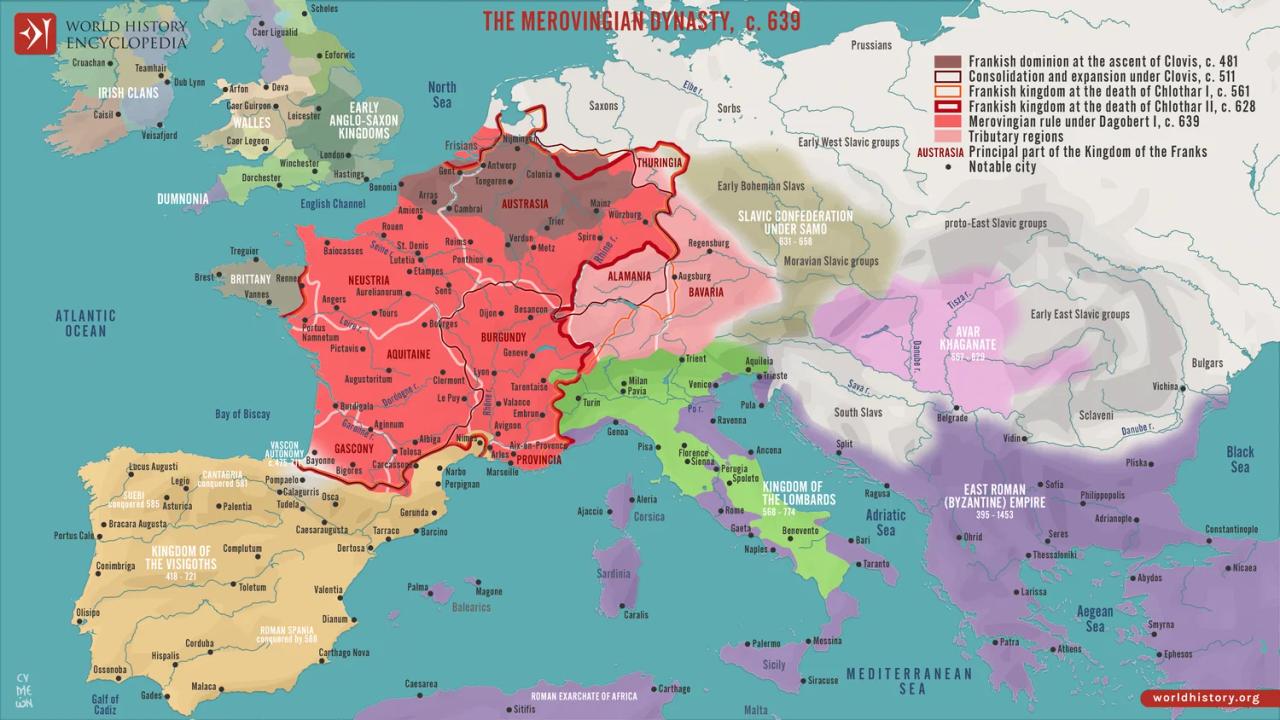
The Merovingian Dynasty and the European Political Map in the Year 639(World History)
The Merovingian dynasty, descended from Clovis, became the principal ruling house of the Frankish world during the 6th and 7th centuries. In the Merovingian kingdom, power was not exercised through a centralized state structure as understood in modern terms but was shaped by relationships among royal family members, regional aristocracies, warrior elites, and bishoprics. The division of royal lands among the king’s sons led to the emergence of sub-kingdoms such as Austrasia, Neustria, Burgundy, and Aquitaine. These divisions often triggered internal wars and dynastic conflicts. Kings distributed land, plunder, and offices to secure loyalty, thereby creating conditions for the strengthening of local aristocratic families.
As royal authority weakened during the Merovingian period, administrative power gradually passed to the mayors of the palace, known as the maior domus. Originally responsible for managing the royal household, these officials eventually became the true decision-makers in military and political affairs. The Carolingian family, originating in Austrasia, gained dominance in Frankish politics through this office. Charles Martel played a decisive role in the family’s rise. Charles Martel gained fame for his victory over the Umayyad forces from Al-Andalus near Poitiers/Tours in 732; this battle later acquired symbolic meaning in European historiography as the defense of Christian Europe. However, within its own context, the event must be understood in terms of Frankish internal politics, control over Aquitaine, and the containment of military incursions from the south.
Charles Martel’s son Pepin the Short was the figure who transformed de facto power into legitimate royal authority. The Merovingian kings still possessed symbolic legitimacy based on their sacred lineage, but real military and political power lay in the hands of the Carolingians. Pepin raised the issue of legitimacy by sending an embassy to Pope Zacharias, asking whether the king who held actual power should also hold the royal title. With papal support, Pepin was crowned king by Frankish nobles at Soissons in 751; the last Merovingian king, Childeric III, was deposed, his hair cut, and confined to a monastery. Since long hair was considered a visible sign of the royal lineage and sacred legitimacy among the Merovingians, this act carried not only physical but also political significance.
Pepin’s authority was further confirmed religiously in 754 when Pope Stephen II anointed him with holy oil. This ceremony reinforced the tradition that the Frankish kingdom derived its legitimacy not only from noble election but also from divine favor. In return, Pepin defended the Papacy against the Lombard threat in Italy and granted portions of the conquered territories to the Pope. The Donation of Pepin became one of the key processes establishing the political foundation of the Papal States throughout the Middle Ages. Thus, the alliance between the Frankish kingdom and the Papacy became one of the central elements of Western European politics.
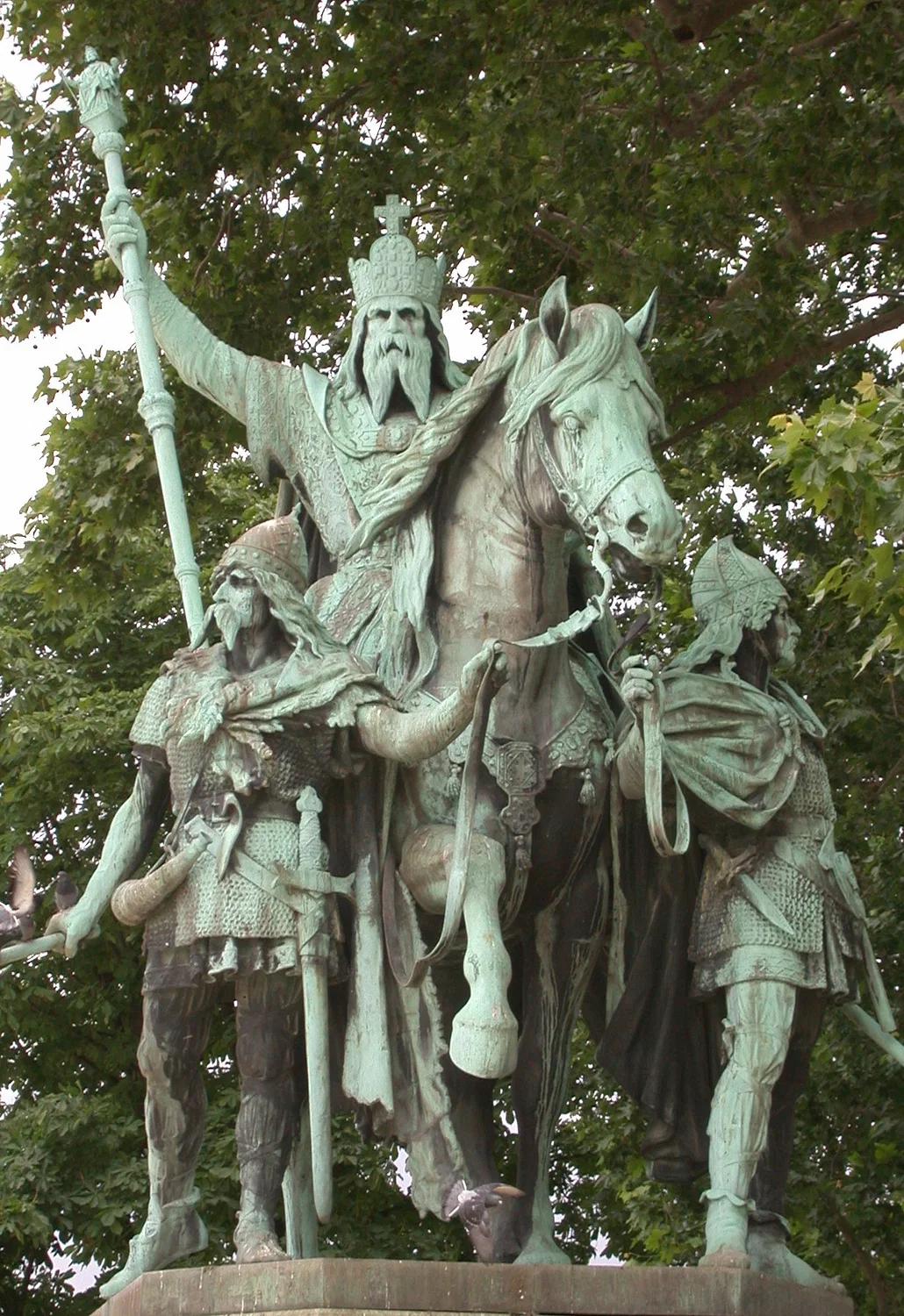
Charlemagne Statue (World History)
Pepin’s son Charlemagne, or Charles the Great, extended Carolingian rule to its greatest territorial extent. Ascending the throne in 768, Charlemagne expanded Frankish dominance across much of Western and Central Europe through campaigns against Saxony, Lombardy, Bavaria, and the Avars. His coronation as emperor by Pope Leo III in Rome on 25 December 800 signified the revival of the Roman imperial idea in Western Europe, now grounded in Christian and Frankish principles. This event created a new rival in the West to the Byzantine Empire’s claim over the Roman legacy and further strengthened the relationship between the Papacy and the Frankish monarchy.
The Carolingian period is distinguished not only by military expansion but also by administrative and cultural reforms. The empire was governed through counts, margraves, and local officials; to ensure central control, imperial officials known as missi dominici were deployed. Monastic and cathedral schools were supported, and the study of Latin and the accurate copying of religious texts were encouraged. This cultural revival is referred to in modern historiography as the Carolingian Renaissance. The Carolingian minuscule, a clear, regular, and widely adopted script, played a crucial role in book production and textual transmission. This writing reform significantly contributed to the preservation of many classical and religious texts throughout the Middle Ages.
Upon Charlemagne’s death in 814, the empire passed to his son Louis the Pious. Louis attempted to preserve the unity of the empire; however, the Frankish legal and traditional principle of dividing inheritance among heirs clashed with the idea of a single, indivisible empire. Competition among Louis’s sons—Lothar, Louis the German, and Charles the Bald—led to civil wars from the 830s onward. Louis the Pious’s death in 840 transformed this crisis into an open struggle for power. The eldest son, Lothar I, claimed superiority based on his imperial title, while Louis the German and Charles the Bald formed an alliance against him.
This conflict culminated in the Treaty of Verdun signed in 843. The treaty divided the Carolingian Empire into three main parts. The West Frankish Kingdom was granted to Charles the Bald, the East Frankish Kingdom to Louis the German, and the Middle Frankish Kingdom, stretching from Italy to the North Sea, was given to Lothar I, who retained the imperial title.【21】 The West Frankish Kingdom is regarded as the historical core of the later Kingdom of France, and the East Frankish Kingdom as the foundation of later German political formations. However, it would be anachronistic to view the Treaty of Verdun directly as the foundation of the modern nation-states of France and Germany. The treaty represents one of the key turning points in a long process during which distinct political traditions and territorial power centers began to diverge in Western Europe.
By the end of this period, the territory of modern France had acquired a layered historical legacy spanning from prehistoric settlements to Celtic Gaul, from the Roman provincial system to Gallo-Roman society, from Germanic kingdoms to Frankish dominance, and finally to the fragmentation of the Carolingian Empire. The name France would later derive from the concept of Francia, meaning the land of the Franks; however, the application of this name to the modern French state would be the result of a later political and historical development.
The Treaty of Verdun in 843, by dividing the Carolingian Empire into three main parts, had lasting consequences for the political geography of Western Europe. The West Frankish Kingdom, assigned to Charles the Bald, formed the historical core of the later Kingdom of France. However, during the 9th and 10th centuries, this kingdom was far from a centralized state in the modern sense. Royal authority was limited; local aristocratic families, counts, dukes, bishops, and military elites exercised extensive powers within their own regions. The weakening of the Carolingian dynasty, combined with external invasions and internal power struggles, created conditions for the rise of local powers across West Frankish territory.
One of the most significant challenges faced by the kingdom during this period was external raids. From the north, Vikings advanced deep inland along rivers such as the Seine, Loire, and Garonne, threatening centers like Rouen, Paris, Tours, and Nantes. The Viking sack of Paris in 845 clearly exposed the incapacity of royal authority to provide defense. The renewed siege of Paris in 885–886 heightened the importance of local defense leaders. During this period, King Charles III of West Francia concluded the Treaty of Saint-Clair-sur-Epte with the Viking leader Rollo in 911, granting him lands around the mouth of the Seine. This territory gradually evolved into the Duchy of Normandy. Thus, the Normans, initially viewed as raiders, became within a few generations a Christianized, French-speaking aristocratic community integrated into the feudal hierarchy.
During the same centuries, Hungarian incursions from the east and Saracen attacks along the Mediterranean coast further exacerbated the kingdom’s security problems. The inability of kings to defend vast territories led local nobles and castle lords to assume responsibility for defense. The proliferation of castles during the 10th and 11th centuries became a spatial symbol of local military authority. Châtelains, the lords of these castles, began to exercise public powers beyond military defense, including judicial functions, tax collection, toll collection, and control over the peasant population. This development gave rise to a structure known in modern historiography as feudal fragmentation or the “castle system.”
The feudal system was not merely a military protection system but a political and social hierarchy based on land, loyalty, and service. Mutual obligations developed between kings, dukes, counts, knights, monasteries, and bishoprics. A vassal swore fealty to his lord and in return received land, protection, or income rights. A significant portion of the peasant population consisted of dependent communities living on lordly estates, obligated to pay various dues, taxes, shares of produce, or usage fees. While this structure maintained local order during a period of weak royal authority, it also led to the fragmentation of public power and the strengthening of the local aristocracy.
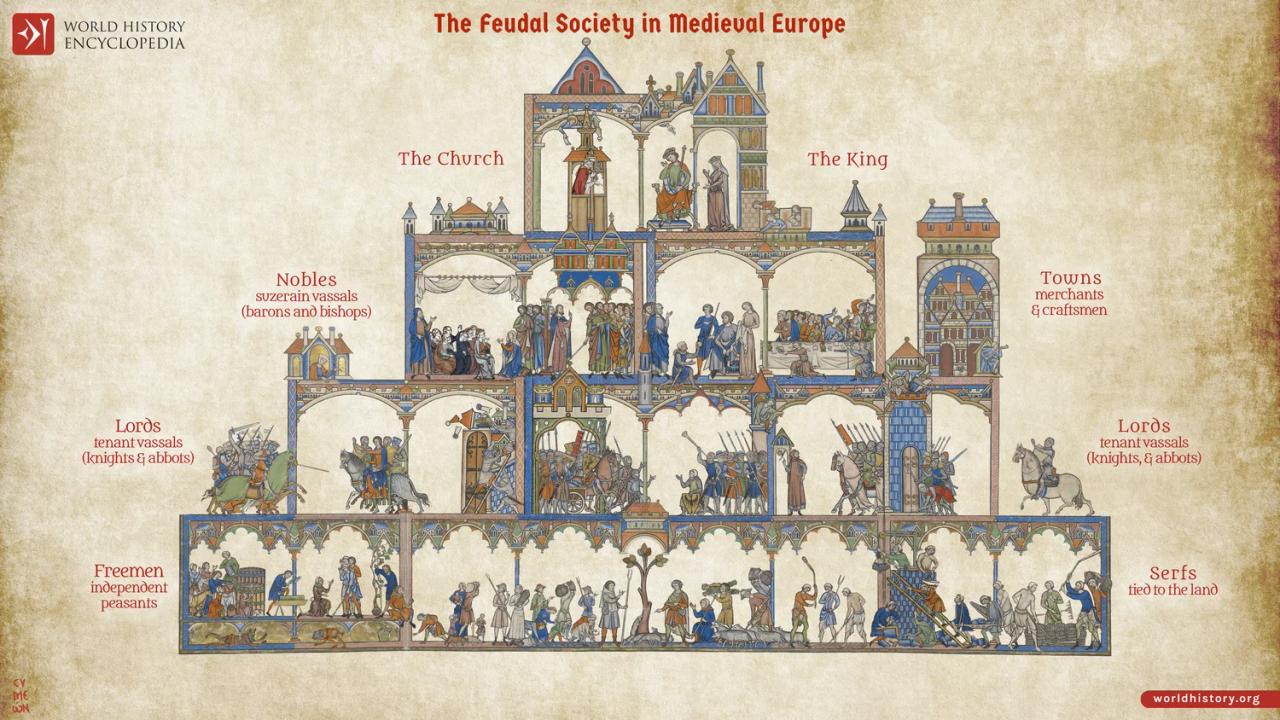
Feudal Order in Europe(World History)
With the extinction of the West Frankish branch of the Carolingian dynasty in 987, Hugues Capet was elected king, thereby establishing the Capetian dynasty. The early Capetian kings were not absolute rulers of a vast territory; their direct control was largely confined to the royal domain centered on Paris, Orléans, and Île-de-France. Nevertheless, the Capetians succeeded in maintaining dynastic continuity. Kings had their sons crowned as co-kings during their lifetimes, thereby reducing the risk of civil war during succession. Coronation ceremonies held in Reims reinforced the sacred character of the monarchy and legitimized the Capetian rule through close ties with the Church.
Although the Capetians had limited direct control over local feudal powers during the 11th and 12th centuries, they pursued a long-term strategy that strengthened monarchical authority. During the reign of Louis VI, rebellious lords within the royal domain were confronted, and greater control over royal roads and local order was sought. During the reign of Louis VII, the kingdom’s position in European politics was significantly affected by his marriage to Eleanor, Duchess of Aquitaine, a union that later ended. Eleanor’s subsequent marriage to King Henry II of England brought large parts of French territory under Plantagenet control and laid the long-term foundation for Franco-English rivalry.
The reign of Philip II Augustus was decisive in the medieval strengthening of the Kingdom of France. Ruling from 1180 to 1223, Philip Augustus annexed major regions—including Normandy, Anjou, Maine, Touraine, and Poitou—to the royal domain following his struggle against King John of England. The Battle of Bouvines in 1214 enhanced the prestige of the French monarchy; this victory over feudal rivals and foreign allies marked a turning point in the consolidation of royal authority. From this period onward, royal administration became more systematic, and royal control over the provinces was expanded through officials such as baillis and sénéchaux.
The 12th and 13th centuries were a period of growth for towns, trade, universities, and religious movements in France. Paris became not only the royal center but also one of Europe’s leading centers of learning and theology. The University of Paris emerged as one of the most influential institutions of medieval scholastic thought; schools and monastic communities around Notre-Dame attracted students from across Europe. Gothic architecture flourished in northern France; structures such as the Basilica of Saint-Denis, Chartres Cathedral, Reims Cathedral, Amiens Cathedral, and Paris Notre-Dame Cathedral became among the most significant works of the era, both religiously and politically. This architectural style originated in the central regions of the Kingdom of France and rapidly spread to other parts of Europe.
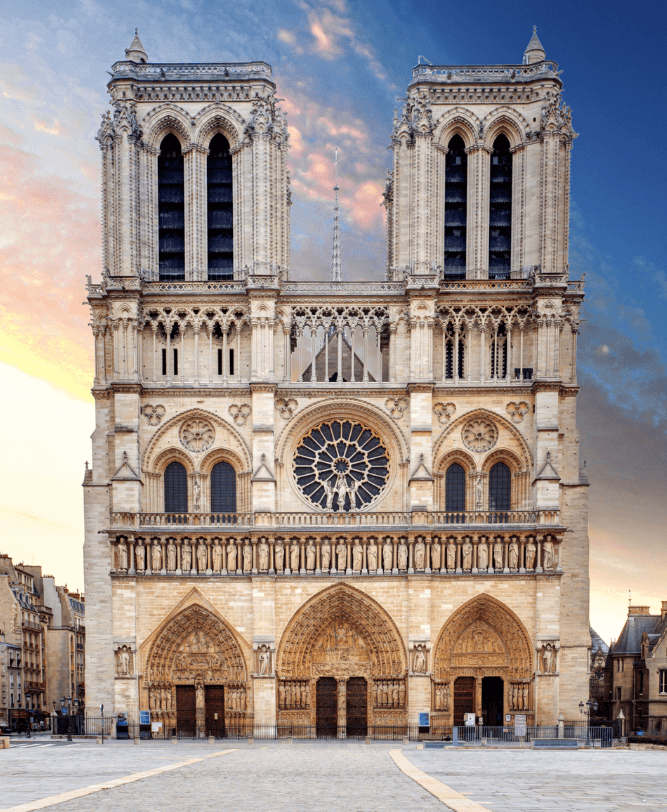
Notre-Dame, a Gothic cathedral in Paris (SNL)
The Crusades played a significant role in medieval France’s engagement with the wider world. Following Pope Urban II’s call at Clermont in 1095, aimed at halting the rapid advance of Muslim Turks in Anatolia and channeling the economic, social, and political tensions within Europe toward a common goal, numerous French nobles and knights turned toward the Eastern Mediterranean. The First Crusade, beginning in 1096, included major representatives of Western European aristocracy such as Godefroy de Bouillon, Count Raymond de Saint-Gilles of Toulouse, and nobles from Normandy and Flanders. After the capture of Jerusalem in 1099, the Latin states established there were dominated by French-speaking knights and nobles. As a result, the term “Frank”, originally used for Latin Christians in the Eastern Mediterranean, gradually became a general term for Western Europeans.
The Crusade movement did not remain merely a religious mobilization; it also influenced aristocratic warrior culture, chivalric ideology, Mediterranean trade, and East-West relations. Many French nobles assumed military and political roles during the campaigns; Louis VII participated in the Second Crusade, Philip II Augustus in the Third Crusade, and Louis IX in the Seventh and Eighth Crusades. Louis IX, who died during a campaign in Tunisia in 1270, was later venerated as “Saint Louis” and associated with the Christian ideal of kingship in France. However, it is insufficient to claim that the Crusades directly and solely strengthened monarchical authority within France; the decisive factors were the kings’ expansion of administrative institutions, enlargement of the royal domain, enhancement of judicial power, and curbing of the influence of major feudal dynasties.
Developments in southern regions also contributed to the expansion of royal authority in France. The Albigensian Crusade, launched in 1209, targeted the Cathar movement in Languedoc. This campaign not only had religious aims but also provided the northern French aristocracy with an opportunity to extend its influence over independent southern nobles and enabled the Capetian monarchy to expand toward the Mediterranean. From the mid-13th century onward, the incorporation of territories around Toulouse into the royal domain marked a significant step in the geographical unification of the Kingdom of France.
In the late 13th and early 14th centuries, the royal administration acquired a more institutional character. During the reign of Philip IV, significant developments occurred in finance, law, and central governance. Royal courts and jurists developed a political language that positioned the king’s authority above feudal legal relationships. The États généraux, or General Assembly, convened in 1302, emerged as an important institution bringing together clergy, nobles, and urban representatives for political consultation around the king. Simultaneously, tensions with the Papacy demonstrated France’s ambitions in European politics; the Avignon Papacy enhanced the French monarchy’s influence over the Western Christian world.
The 14th century in France was a period of severe crises. The plague, known as the Black Death, spread from Mediterranean ports into Western Europe beginning in 1347–1348 and rapidly affected France. The pandemic caused the death of a large portion of the population, with losses reaching one-third or even higher in some regions. The population decline disrupted agricultural production, labor systems, land revenues, and urban economies. Labor shortages led to rising wages, while lords’ efforts to maintain old obligations generated tensions with peasant and urban communities. The Jacquerie uprising of 1358 in northern France is one of the best-known examples of popular revolt fueled by war, tax pressure, and social insecurity.【22】
This demographic and social crisis coincided with the Hundred Years’ War between England and France. The war, which began in 1337, was rooted not only in a succession dispute but also in Plantagenet territories in France, Flemish trade, sovereignty over Gascony, and feudal-legal relations between the two kingdoms. English King Edward III claimed the French throne through his mother Isabella; in response, French nobles recognized Philip VI of the House of Valois as king. Thus, dynastic claims, territorial sovereignty, and European commercial interests converged into a prolonged conflict.
The early phases of the war were marked by heavy defeats for France. The Battle of Crécy in 1346, the Battle of Poitiers in 1356, and the Battle of Agincourt in 1415 exposed the weaknesses of the French knightly military system. The disciplined English infantry formations, defensive positions, and archers armed with longbows proved effective against heavily armored French cavalry. At Agincourt especially, the narrow and muddy terrain restricted French knights’ maneuverability and enabled English archers and infantry to gain the upper hand. These defeats produced not only military losses but also profound effects on the French aristocracy’s military reputation and royal authority.
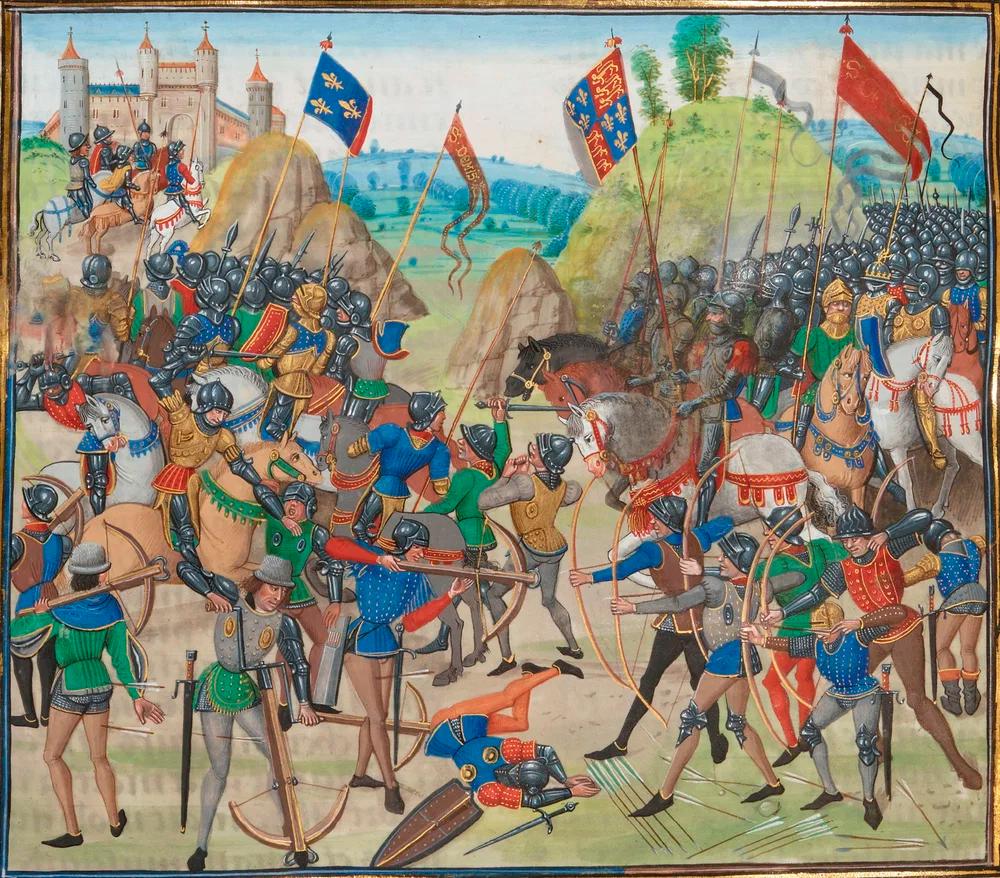
Battle of Crécy (1346) - (World History)
After 1415, France’s situation worsened further. The Armagnac-Burgundian civil conflict facilitated English advances. The Treaty of Troyes of 1420 recognized English King Henry V as heir to the French throne and disinherited the Dauphin Charles. This treaty posed a major threat to the legitimacy of the House of Valois. Upon the deaths of both Henry V and King Charles VI of France in 1422, the infant Henry VI was proclaimed king of both England and France by the English and their Burgundian allies. In contrast, the Dauphin Charles, south of the Loire River, sought to maintain his claim as Charles VII.
In this crisis, Joan of Arc emerged as a symbolic and military figure who altered the course of the war. Born around 1412 in the village of Domrémy on the border of Lorraine, Joan claimed to hear divine voices and see visions, and she sought to persuade the Dauphin Charles to resist the English. Her role in lifting the siege of Orléans in 1429 provided a major morale boost to the French side. The liberation of Orléans broke English pressure along the Loire River and strengthened Charles VII’s position. Joan of Arc’s most important political achievement was facilitating Charles’s journey to Reims. The coronation ceremony at Reims Cathedral reinforced the legitimacy of the House of Valois and affirmed Charles VII as the rightful king of France through the traditional sacred ritual of kingship.
Joan of Arc was captured by Burgundians near Compiègne in 1430 and subsequently handed over to the English. In 1431, she was tried by a religious court under English influence in Rouen and burned at the stake on charges of heresy. Even after her death, her figure remained a symbol of French resistance and Valois legitimacy. In 1456, a retrial nullified her conviction. In subsequent centuries, Joan of Arc was interpreted in various ways by different political traditions; in modern France, she has become one of the most important figures in national memory.
In the final phase of the Hundred Years’ War, France began to recover militarily and administratively. Under Charles VII, regular tax revenues were established, the foundations of a standing army were laid, and the importance of artillery units increased. The Treaty of Arras with Burgundy in 1435 reduced internal divisions and weakened England’s base of allies in France. The defeats of English forces at the Battle of Formigny in 1450 and the Battle of Castillon in 1453 effectively ended the war. England lost most of its continental territories; only Calais remained under English control until 1558.【23】
At the end of the Middle Ages, France moved toward a more centralized royal structure, departing from the fragmented feudal system of the 9th and 10th centuries. The royal domain expanded, the military autonomy of local aristocracies was curtailed, tax and judicial institutions were strengthened, and the concept of the kingdom began to shift from being merely the dynastic property of the ruling house toward a clearer notion of nation and sovereignty. Despite the massive destruction it caused, the Hundred Years’ War contributed to the consolidation of royal authority and a shared sense of political identity in France. This process laid the foundation for the French state structure that would evolve toward absolute monarchy in the early modern period.
The late 15th and early 16th centuries marked a period in which the Kingdom of France transitioned from the feudal fragmentation of the Middle Ages toward a more centralized monarchical system, while also becoming part of broader European cultural and political competition. After the Hundred Years’ War, royal authority was reinforced, the independent power of major feudal dynasties diminished, and royal administration became more visible in the provinces. This transformation, alongside the Italian Wars, Renaissance culture, the Reformation movement, religious wars, absolute monarchy, the Enlightenment, the French Revolution, and the Napoleonic era, contributed to a prolonged process that shaped modern French political identity.
At the beginning of the 16th century, the reign of Francis I was decisive for the development of the French Renaissance. Through the Italian Wars, the French aristocracy and royal court established close contact with the world of Italian art, architecture, and humanism; this influence became especially evident in court culture and architecture. Francis I invited Leonardo da Vinci to France, and the artist spent the final years of his life at Clos Lucé near Amboise. Châteaux such as Chambord, Blois, Amboise, and Chenonceau in the Loire Valley exemplify the transition from medieval defensive structures to Renaissance palace architecture. During this period, the French monarchy sought to establish its presence in European politics not only through military and diplomatic power but also through cultural representation and court patronage.
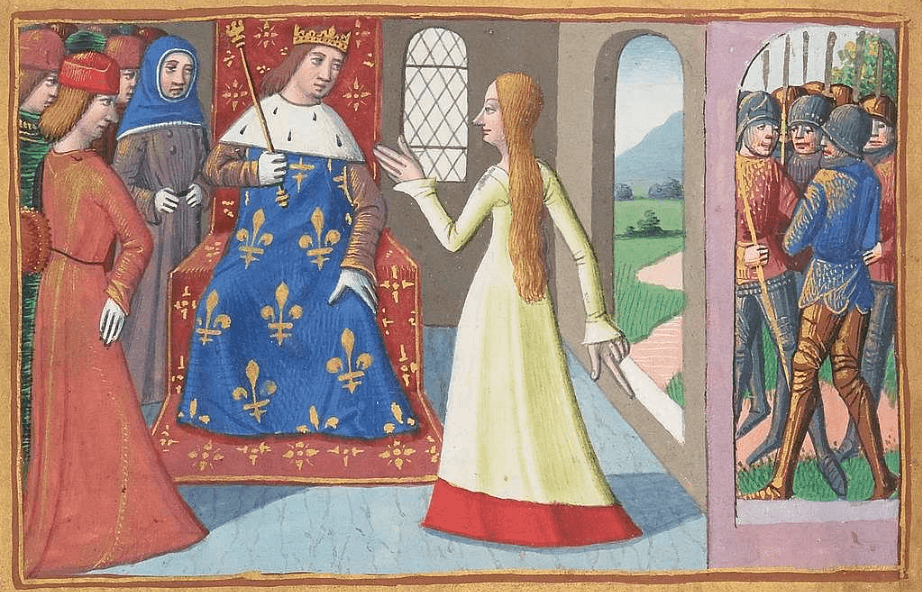
Miniature depicting Joan of Arc persuading King Charles VII to continue the Siege of Troyes (Picryl)
The reign of Francis I was also significant for the administrative centralization of the French monarchy. The Ordinance of Villers-Cotterêts of 1539 reinforced the use of French in legal and administrative proceedings.【24】 This regulation limited the dominance of Latin in legal documents and enhanced royal control over language and record-keeping. In this respect, the ordinance can be regarded as a crucial step in the formation of the administrative language of the modern French state.
France’s expansion into the overseas world also began in the 16th century. Jacques Cartier undertook expeditions to the St. Lawrence Gulf and the St. Lawrence River in 1534, 1535–1536, and 1541–1542; these explorations laid the early foundations for French presence in North America, later known as New France. However, the establishment of a permanent colonial system was a later development. The settlement of Port-Royal in Acadia and the founding of Quebec by Samuel de Champlain in 1608 marked the stage at which French presence in North America became more stable. In the Caribbean, French colonialism developed notably during the 17th century in areas such as Martinique, Guadeloupe, and Saint-Domingue; sugar cultivation, plantation systems, and an economy based on enslaved African labor formed the core structure of this region.
In the second half of the 16th century, France experienced a severe internal crisis due to conflicts between Catholics and Calvinist Protestants, known as Huguenots. The French Wars of Religion, which began in 1562, were not merely religious conflicts based on doctrinal differences; they were also a broad political struggle involving noble families, court factions, urban centers, regional power bases, and foreign allies. The Guise family led the Catholic side, while the Bourbon and Condé circles were among the leading figures of Huguenot politics. The St. Bartholomew’s Day Massacre, which began in Paris on 24 August 1572 and quickly spread to other cities, was one of the bloodiest phases of the wars.【25】 The killing of thousands of Huguenots deepened religious divisions in France and provoked widespread reaction across European public opinion.
This crisis gradually came to an end during the reign of Henry IV, the founder of the Bourbon dynasty. Born a Huguenot, Henry converted to Catholicism to secure the French throne and gain the support of the Catholic majority. The Edict of Nantes, issued in 1598, granted Huguenots the right to worship in specified regions, control of certain fortified towns, and limited political rights. Rather than being a document of full religious freedom in the modern sense, the edict was a royal compromise aimed at ending the civil war and establishing a framework for coexistence between religious communities. Nevertheless, it provided a foundation for relative internal peace in France for nearly a century and enabled Henry IV to restore stability to the kingdom.
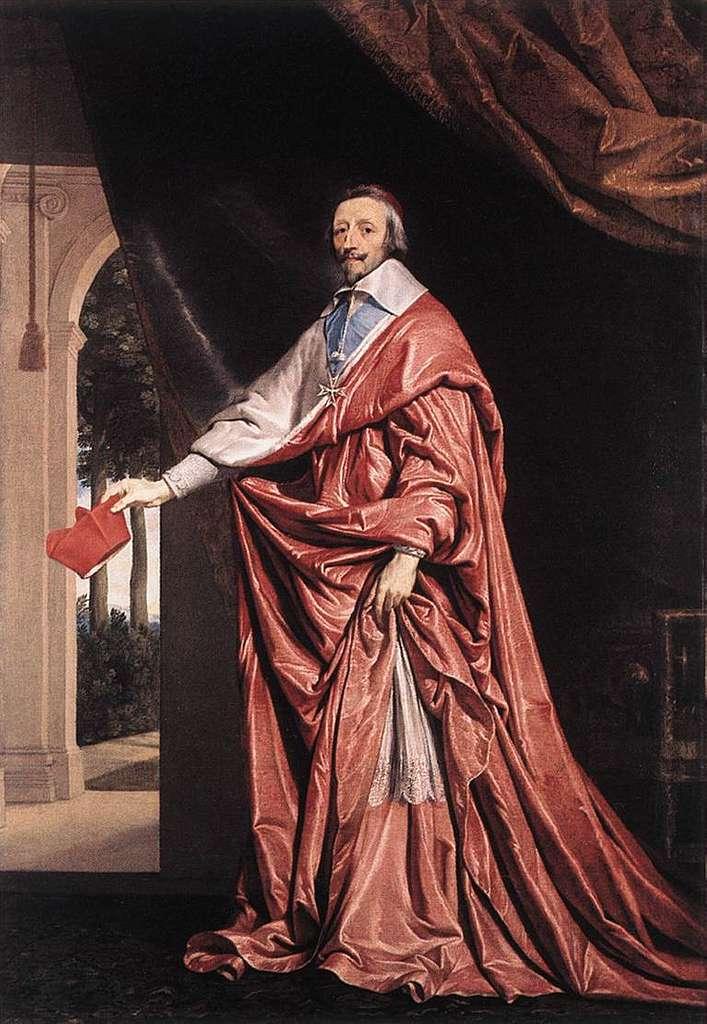
Cardinal Richelieu (Picry)
In the 17th century, monarchical authority in France acquired a more centralized and institutional structure. During the reign of Louis XIII, Cardinal Richelieu played a dominant role in policies aimed at strengthening royal authority. Key elements of Richelieu’s policy included limiting the political and military independence of great noble families, preventing the Huguenots from acting as a separate military and political power within the state, and positioning France as an active player in European politics against the Habsburg encirclement. The capture of La Rochelle in 1628 ended the Huguenots’ military and political autonomy; however, the religious provisions of the Edict of Nantes remained in effect for some time. France’s policy during the Thirty Years’ War against the Habsburgs demonstrated a foreign policy approach prioritizing state interests over religious considerations.
Louis XIV’s reign is regarded as one of the most prominent examples of absolute monarchy in France. Ascending the throne in 1643, Louis XIV, influenced by the Fronde uprisings of his childhood, pursued a policy of bringing noble opposition under control and concentrating royal authority at the court. The Palace of Versailles became not merely a residence but a political center where nobles were monitored in the king’s presence, hierarchical protocol was institutionalized, and royal power was visually represented. Although the phrase “L’État, c’est moi” is attributed to Louis XIV, its historical accuracy is debated; however, during his reign the king’s person was unequivocally positioned as the most visible center of state authority.【26】
During the reign of Louis XIV, Jean-Baptiste Colbert exerted significant influence over fiscal and economic policy. The mercantilist policy associated with Colbert was based on promoting state-supported manufacturing, encouraging luxury production, regulating customs, strengthening maritime trade, and expanding colonial connections. Royal-supported production centers developed in sectors such as Gobelins tapestries, glassmaking, textiles, shipbuilding, and luxury goods. During the same period, trading posts such as Pondicherry in India and plantation economies in the Caribbean became integral parts of France’s overseas trade network. However, this economic and administrative expansion placed a heavy burden on the monarchy’s financial structure when considered alongside the costs of continuous warfare.
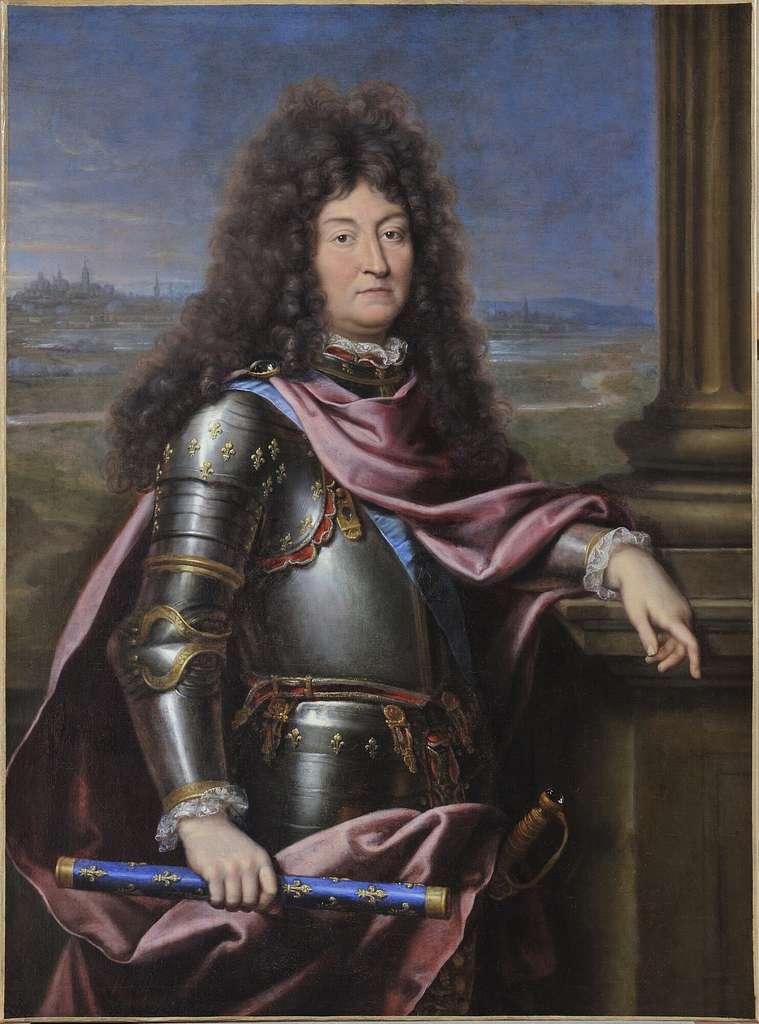
King Louis XIV of France (1638–1715)(Picryl)
Louis XIV’s policy of religious unity culminated in the revocation of the Edict of Nantes by the Edict of Fontainebleau in 1685. This decision abolished the Huguenots’ rights to worship and organize, leading many Protestants to emigrate to regions such as the Netherlands, England, Brandenburg-Prussia, Switzerland, and North America. Since the Huguenots included skilled artisans, merchants, and qualified producers, this exodus had negative effects on France’s economic and technical capital. The decision also created tensions in France’s relations with Protestant powers in Europe.
The 18th century in France was a period marked by the convergence of Enlightenment thought, financial crisis, social inequality, and demands for political representation. Thinkers such as Voltaire, Montesquieu, Rousseau, Diderot, and d’Alembert criticized absolute monarchy, religious intolerance, arbitrary rule, and the privileged class system from various perspectives. Montesquieu systematized the idea of separation of powers, Rousseau explored the relationship between sovereignty and popular will, and Voltaire was influential in advocating religious tolerance and freedom of thought. The Encyclopedist movement was one of the most important initiatives of the Enlightenment in terms of organizing knowledge and deploying reason against public authority.
The emergence of the French Revolution was shaped not only by intellectual accumulation but also by severe financial crisis and tax injustice. France’s wars in the 18th century, particularly its support for the Seven Years’ War and the American War of Independence, weakened the royal finances. Meanwhile, the nobility and clergy enjoyed tax exemptions or special privileges, placing the bulk of the tax burden on peasants, townspeople, and productive classes. The convening of the États généraux in 1789 revived a representative mechanism that had been dormant for decades. When representatives of the Third Estate declared themselves the National Assembly, they directly redirected the debate over the source of sovereignty from the king to the nation.
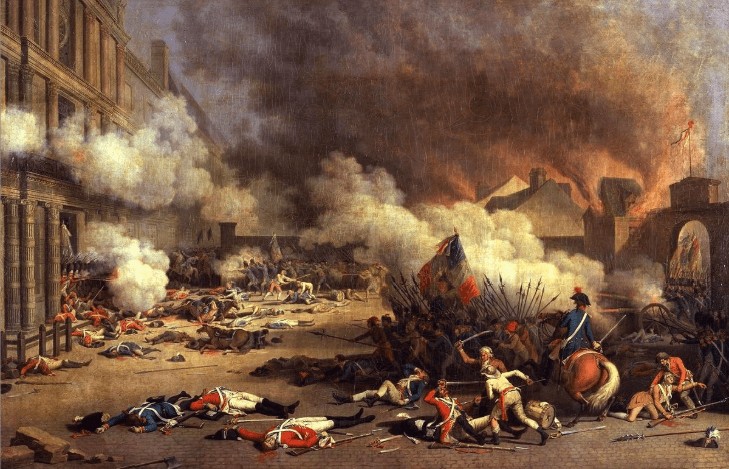
Painting depicting the attack by French Revolutionary forces on the Tuileries Palace in Paris on 10 August 1792 (SNL)
On 14 July 1789, the storming of the Bastille became one of the revolution’s most significant mass and symbolic turning points. Although the Bastille was not a large prison in terms of inmate numbers, it was widely perceived as a symbol of arbitrary royal authority. In the same year, on the night of 4 August, decisions were made to abolish feudal rights and privileges; on 26 August 1789, the Declaration of the Rights of Man and of the Citizen was adopted. The Declaration proclaimed legal equality with the principle that “Men are born and remain free and equal in rights,” and declared that “The principle of sovereignty resides essentially in the nation.”【27】 This text is one of the principal documents summarizing the political language of the French Revolution and the foundational concepts of modern constitutional thought.
On July 14 1790 in Paris, on the first anniversary of the storming of the Bastille, the Festival of the Federation was held. A large ceremonial space was prepared at the Champ de Mars; representatives from various regions, National Guard units, clergy and the public gathered for this ceremony. The event was a major public demonstration that visibly embodied the ideals of national unity constitutional monarchy and citizenship during the early phase of the revolution. The modern celebration of the July 14 National Holiday is linked to both the storming of the Bastille in 1789 and the Festival of the Federation in 1790.【28】 Therefore July 14 is recognized not only as a symbol of rebellion but also of the post-revolutionary ideal of national unity.
The revolutionary process gradually radicalized under the influence of internal and external dynamics. The Constitution of 1791 established a constitutional monarchy but King Louis XVI’s credibility was severely shaken after his failed attempt to flee to Varennes. In 1792 the monarchy effectively collapsed the Republic was proclaimed and France went to war against European monarchies led by Austria and Prussia. The execution of Louis XVI on January 21 1793 intensified the crisis in European politics. Internally the Vendée uprising and federalist revolts combined with external military pressure from the First Coalition pushed the revolutionary government to adopt extraordinary measures.
The period between 1793 and 1794 known as the Reign of Terror was characterized by the Committee of Public Safety exercising extraordinary powers and implementing harsh punitive policies against enemies of the revolution. Jacobin leaders such as Maximilien Robespierre Georges Couthon and Louis Antoine de Saint-Just established a centralized and repressive regime under the pretext of defending the revolution from internal and external enemies. Numerous individuals were executed through Revolutionary Tribunals political opposition was suppressed and violence became central to debates over revolutionary legitimacy. On July 27 1794 the Thermidorian Reaction led to the elimination of Robespierre and his close associates thus ending the Reign of Terror.【29】
The regime established after the Terror known as the Directory sought to preserve revolutionary gains but existed amid political instability economic hardship and military dependence. This environment paved the way for the rise of the young general Napoleon Bonaparte. Having gained fame through his Italian campaigns Napoleon launched the Egyptian Expedition in 1798. After suffering defeat at the Siege of Acre against Cezzar Ahmed Pasha and the destruction of the French fleet he returned to France and seized power on November 9 1799 according to the revolutionary calendar the Coup of 18 Brumaire. He consolidated authority as First Consul under the Consulate and in 1804 declared himself Emperor initiating the First Empire.【30】 In the Consulate he centralized governance as First Consul and in 1804 he proclaimed himself Emperor launching the First Empire.
One of Napoleon’s most enduring domestic reforms was the Code civil des Français or the French Civil Code. Enacted in 1804 this law institutionalized post-revolutionary principles such as property rights freedom of contract legal equality and a secular legal system.【31】 However the code also contained provisions reinforcing male authority in family law. During Napoleon’s rule the administrative structure was centralized the prefect system was strengthened the lycée education system was established the Banque de France was created and a bureaucratic-military career system based on merit was developed. The Concordat of 1801 reorganized relations between the Catholic Church and the state recognizing the Church’s social influence while placing religious institutions under state control.
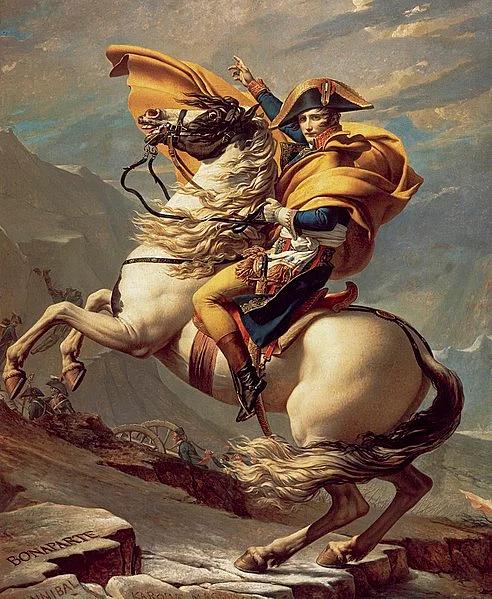
1805 Oil on Canvas Painting "Napoleon Crossing the Alps"(World History)
Napoleonic Wars, extended France’s political influence across Europe to its greatest extent. Victories at Austerlitz Jena and Wagram enabled Napoleon to dominate Austria Prussia and Russia and to establish French-aligned states and dynastic arrangements in Western and Central Europe. The dissolution of the Holy Roman Empire in 1806 marked a fundamental transformation of the European political order. However the war in the Iberian Peninsula after 1807 dragged the French army into a prolonged and exhausting conflict. The 1812 Russian campaign became the turning point of Napoleon’s rule. The catastrophic losses suffered by the Grande Armée enabled European powers to reunite against France.
Following the defeat at Leipzig in 1813 allied armies invaded France; Napoleon abdicated in 1814 and was exiled to the island of Elba. However he returned to France in 1815 and launched his second period of rule known as the Hundred Days. This period ended with a decisive defeat at the Battle of Waterloo on June 18 1815 against British and Prussian forces. Napoleon was then exiled to the island of Saint Helena in the South Atlantic where he lived under British supervision until his death on May 5 1821. Napoleon’s legacy carries a dual significance for France: it established both an authoritarian centralized state tradition and the spread of revolutionary principles through law and administration.
Following the Napoleonic Wars, the Bourbon Restoration was established in 1814–1815. Under Louis XVIII, the monarchy was reestablished within a constitutional framework, but the social transformations of the Revolutionary and Imperial periods could not be fully reversed. Changes in land ownership, the legal system, bureaucratic structures, and the emergence of new elites prevented a complete return to the old regime. In 1830, the July Revolution, triggered by Charles X’s authoritarian policies, overthrew the main branch of the Bourbons and led to the establishment of the July Monarchy under Louis-Philippe. This regime was founded on bourgeois property rights and limited suffrage, yet it failed to provide adequate representation for the working class, republicans, and urban groups demanding social reforms.
The Revolution of 1848 once again ended the monarchy in France and proclaimed the Second Republic. Among its most significant reforms were the adoption of universal male suffrage and the definitive abolition of slavery in the colonies. The abolition of slavery, enacted through the 1848 measures associated with Victor Schœlcher, marked a pivotal moment in the French colonial system. However, the Second Republic proved short-lived. Louis-Napoléon Bonaparte, elected president, staged a coup in 1851 and in 1852 declared himself Emperor Napoleon III, initiating the Second Empire.
The Second Empire was a period characterized by the coexistence of an authoritarian political structure and economic modernization. Railways expanded, banking and credit institutions developed, industrialization accelerated, and Paris was extensively restructured under Baron Haussmann’s urban planning initiatives. Broad boulevards, new squares, sewer systems, parks, and administrative buildings transformed the capital into a modern imperial showcase. In foreign policy, France was active in various domains including the Crimean War, the unification of Italy, the intervention in Mexico, and colonial expansion. However, defeat by Prussia in 1870 and the capture of Napoleon III at the Battle of Sedan led to the collapse of the Second Empire and the proclamation of the Third Republic.
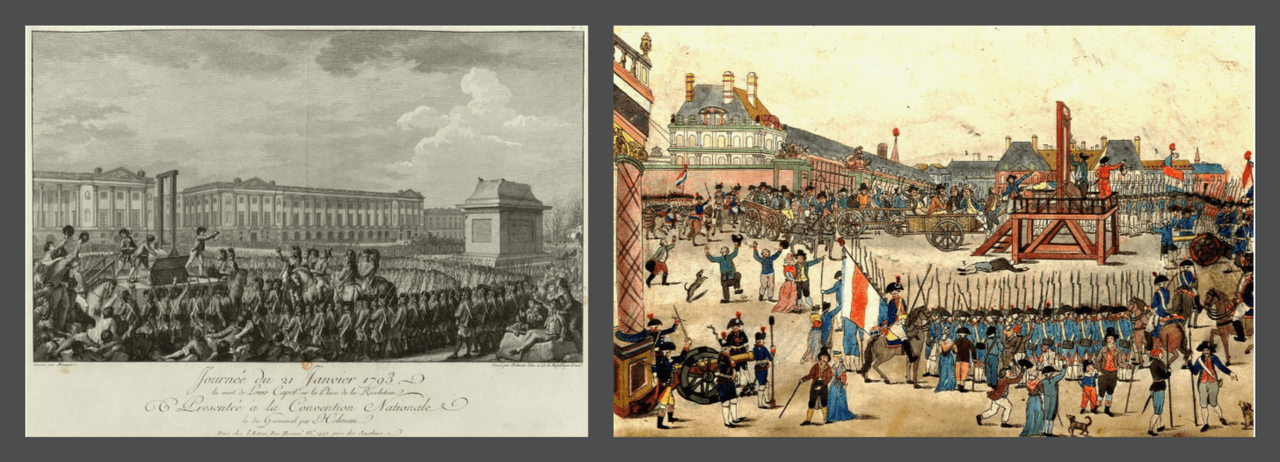
The Execution of King Louis XVI and the Execution of Jacobin Leader Maximilien Robespierre (SNL)
The defeat of 1870–1871 created a profound rupture in French history. The siege of Paris by Prussian forces, the heavy war indemnity, and the loss of the Alsace-Lorraine region left a lasting imprint on the French political memory. In this context, the Paris Commune emerged in 1871 as a brief experiment in self-government, supported by Parisian workers, republicans, socialists, National Guard units, and radical groups.
The Commune sought to establish an alternative political and social order in Paris while the central government had retreated to Versailles. However, it was crushed during the period known as the Bloody Week, following military intervention by the Versailles government. Thousands were killed, arrested, or exiled. The Paris Commune became a significant historical reference for subsequent socialist and labor movements.
The Third Republic initially appeared fragile, and the struggle between monarchist and republican forces persisted for years. Nevertheless, from the late 1870s onward, republican cadres gained dominance in government and the regime became institutionalized. Parliamentary politics, the press, local administration, secular education, and the ideal of citizenship formed the core elements of the Third Republic. The law of 16 June 1881 made primary education in public schools free, and the law of 28 March 1882 made primary education compulsory for children aged six to thirteen, establishing a secular foundation for public school curricula. In the republican educational vision, the school was positioned as a common institution tasked with transmitting the values of the Republic and civic consciousness to students.【32】 The Law of 9 December 1905 on the Separation of Churches and the State enshrined freedom of conscience and the free exercise of worship; it stipulated that the Republic would recognize no religion, fund none, or provide it with financial support.【33】
One of the most significant internal political crises of the Third Republic was the Dreyfus Affair. In 1894, Captain Alfred Dreyfus, of Jewish origin, was falsely accused of passing military secrets to Germany, tried, and sentenced to exile on Devil’s Island. Irregularities in the case, forged documents, and attempts to cover up the truth gradually came to light; the affair evolved from a simple espionage case into a major crisis that exposed fundamental issues concerning the rule of law, the military, the press, and political polarization in the Republic. Émile Zola’s 1898 open letter titled “J’accuse…!” heightened public interest in the case and strengthened demands for Dreyfus’s retrial.【34】 Dreyfus was fully exonerated and reinstated in the army in 1906. This process strengthened the secular-republican faction’s demands for political control over the military and the Church.
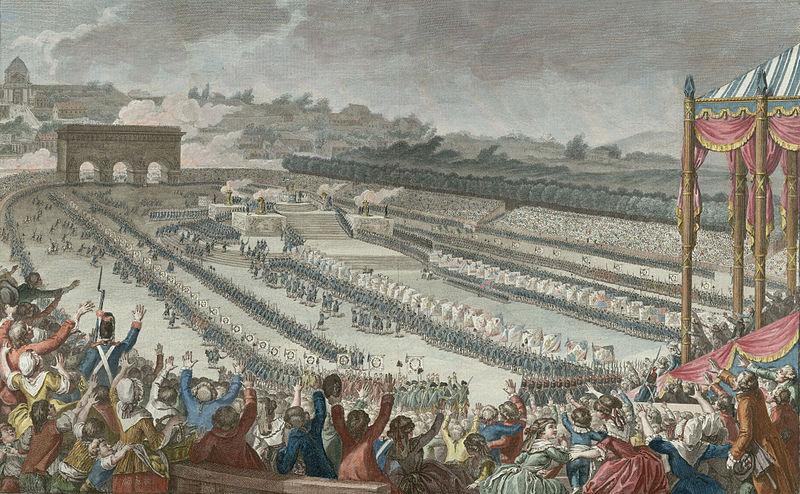
Federation Day (Fête de la Fédération) - (World History Encyclopedia)
France’s foreign policy in the Third Republic was closely linked to the consequences of its 1870 defeat. The loss of Alsace-Lorraine shaped France’s perception of security vis-à-vis Germany, making the dismantling of German diplomatic dominance one of its primary foreign policy objectives. Otto von Bismarck’s strategy of positioning Germany at the center of the European diplomatic system long isolated France. Seeking to overcome this isolation, France formed a military alliance with Russia in 1894 despite ideological differences. This alliance represented a major development from Germany’s perspective, as it raised the possibility of war on both eastern and western fronts simultaneously.
While seeking to overcome diplomatic isolation in continental Europe, France simultaneously expanded its overseas colonial empire. In the final quarter of the 19th century, the ideological discourse known as the “civilizing mission” was used to legitimize expansionist policies by asserting the spread of French culture, language, secular education, and republican values to colonial territories. This discourse also served to obscure the economic exploitation, forced labor, military coercion, and political control exerted over local populations. During this period, France established extensive colonial holdings in North and West Africa, Madagascar, Indochina, and the Pacific. Algeria came under French rule in 1830, Tunisia was placed under French protection in 1881, French control was established over Vietnam, Cambodia, and Laos in Indochina, and Morocco became a French protectorate in 1912.
At the beginning of the 20th century, France expanded its diplomatic alliances to counterbalance Germany. The Entente Cordiale concluded with Britain in 1904 eased long-standing colonial rivalries between the two nations and resolved disputes over interests in Egypt and Morocco. The understanding reached between Britain and Russia in 1907, combined with the existing Franco-Russian alliance and Franco-British rapprochement, laid the groundwork for the formation of the Triple Entente. Thus, by 1914, France had emerged from the humiliation of its 1870 defeat and diplomatic isolation to possess both a vast colonial empire and a strong network of alliances aimed at countering Germany.
On the eve of the First World War, France had consolidated its republican institutions and strengthened its modern nation-state structure through secular education and citizenship policies. At the same time, it became one of the central actors in increasingly intense international crises driven by the loss of Alsace-Lorraine, colonial competition, and bloc polarization in Europe.
The First World War erupted as a result of the European alliance system being activated by the crisis triggered by the assassination of Archduke Franz Ferdinand of Austria-Hungary in Sarajevo on 28 June 1914. Germany’s invasion of France through Belgium under the Schlieffen Plan made France one of the primary targets on the Western Front. With the outbreak of war, political and social divisions within France were temporarily set aside, giving rise to a political consensus known as the Union sacrée or “Sacred Union.” This consensus reflected the unity of republican, socialist, conservative, and nationalist factions behind a common defensive stance against Germany.
In the early months of the war, the German army achieved rapid advances, but the First Battle of the Marne in September 1914 halted its progress. This development eliminated expectations of a swift conclusion to the war and transformed the Western Front into a prolonged war of trenches. The front line across northern and eastern France became synonymous for years with artillery fire, machine guns, barbed wire, gas attacks, mud, epidemics, and massive human losses. The war was fought directly on French soil, causing severe damage to industrial regions, villages, farmland, and transportation networks.
The year 1916 marked one of the most devastating phases of the war for France. The Battle of Verdun was a long and bloody war of attrition launched by the German army with the aim of breaking French resistance. The phrase “Ils ne passeront pas”, meaning “They shall not pass,” became one of the most famous expressions symbolizing Verdun’s place in the French collective memory.【35】 The Battle of the Somme, which occurred in the same year, also revealed the scale of casualties and the destructive nature of modern industrial warfare. These battles are significant less for their military outcomes than for demonstrating the consuming impact of total war on human resources, munitions, industry, and morale.
The prolongation of the war profoundly affected French social and economic structures. The conscription of the majority of the male population made women’s labor in industry and agriculture more visible. The state tightened its control over production, transportation, food supply, and mobilization on the home front. The war also entailed the mobilization of manpower and labor from the colonies. Soldiers recruited from North and West Africa, Indochina, and other colonial territories served on various fronts within the French army. Thus, the war took on the character of a global conflict, not merely a struggle between European states but one that mobilized imperial resources across the world.
The year 1917 was a critical turning point in the course of the war. The revolutions in Russia and the collapse of the Eastern Front altered Germany’s military calculations. Conversely, the entry of the United States into the war on the side of the Allies provided France and its partners with a decisive long-term advantage in manpower, materials, and financial resources. In the same year, widespread mutinies and acts of disobedience within the French army revealed the depth of exhaustion on the front lines. The appointment of General Philippe Pétain aimed to restore military discipline, improve conditions at the front, and shift strategy toward a more defensive posture.
In 1918, Germany’s final major offensives on the Western Front achieved initial advances but failed to secure lasting success. Allied counteroffensives, the growing contribution of American forces, and the exhaustion of Germany’s manpower and economic resources determined the outcome of the war. The conflict ended with the armistice signed on 11 November 1918. Although France was among the victorious powers, it was one of the countries that paid the heaviest price for the war. Approximately 1.4 million French soldiers lost their lives, millions were wounded, and the industrial and agricultural areas of northeastern France were largely destroyed.【36】 These losses shaped France’s postwar political objectives of security, reparations, and maintaining Germany under control.
At the Paris Peace Conference convened in 1919, French Prime Minister Georges Clemenceau advocated for limiting Germany’s military capacity, guaranteeing France’s security, and compensating for the destruction caused by the war. For France, the central issue was preventing Germany from becoming an aggressive power again. Under the Treaty of Versailles, Alsace-Lorraine was returned to France, Germany’s army was restricted, the Rhineland was demilitarized, and Germany was burdened with heavy reparations. However, this arrangement did not fully alleviate France’s security concerns; instead, it generated economic and political resentment in Germany and became one of the sources of instability during the interwar period.
World War I marked a historical turning point in France, where victory and devastation occurred simultaneously. The country regained Alsace-Lorraine and stood among the victorious powers; yet demographic losses, physical destruction, economic burdens, devastation along the front lines, and security anxieties defined France’s postwar political orientation. After 1918, France sought to preserve its republican regime while pursuing a security-focused foreign policy aimed at preventing Germany’s resurgence. This dynamic formed the essential backdrop for understanding French politics during the interwar period.
France’s confrontation with Germany in World War II was directly linked to the breakdown of the political and military balance established after the 1919 Versailles settlement. Having emerged victorious from World War I, France had reclaimed Alsace-Lorraine and viewed the Treaty of Versailles as essential to its security. In contrast, the revisionist backlash against the treaty in Germany transformed into an aggressive foreign policy after Adolf Hitler came to power in 1933. Germany’s rearmament, the militarization of the Rhineland in 1936, the annexation of Austria, and pressure on Czechoslovakia gradually undermined the security order France had sought to establish after the war.
France entered World War II by declaring war on Germany on 3 September 1939, in response to Germany’s invasion of Poland on 1 September 1939, fulfilling its security commitments to Poland. However, no major military operations took place on the Western Front during the initial months of the war. This period, known in French historiography as the “drôle de guerre”, is commonly translated into Turkish as the “Strange War” or “Phoney War.” Influenced by the heavy losses of World War I, France adopted a defensive strategy and relied heavily on the Maginot Line, a fortified defensive system along its border with Germany. However, this defense proved inadequate against the rapid German assault in the spring of 1940, which bypassed the Maginot Line through the Benelux countries and the Ardennes Forest.
On 10 May 1940, Germany launched its invasion of Western Europe through the Netherlands, Belgium, and Luxembourg. This attack, combining armored units, air power, and blitzkrieg tactics, quickly disrupted the French and British defensive lines. The German army’s breakthrough at Sedan through the Ardennes proved decisive in collapsing French defenses. The British Expeditionary Force and some French units were evacuated from Dunkirk, but this evacuation could not prevent France’s military defeat. On 14 June 1940, German forces entered Paris, and the French government retreated first to Tours and then to Bordeaux.
During this crisis, a deep political division emerged in France between those who advocated continuing the war and those who favored seeking an armistice. Prime Minister Paul Reynaud supported continuing the fight, while Marshal Philippe Pétain and his circle argued that defeat must be accepted. On 16 June 1940, Reynaud resigned, Pétain formed a new government, and the next day requested an armistice from Germany. The armistice signed on 22 June 1940 resulted in the occupation of northern and western France by Germany and the establishment of a limited sovereign French administration centered in Vichy. Thus, the Third Republic effectively ended, and the Vichy Regime emerged under Pétain’s leadership.
The Vichy Regime established an authoritarian and conservative political order centered on the slogan “Travail, Famille, Patrie” — Work, Family, Fatherland — distancing itself from the Republican principles of “Liberty, Equality, Fraternity.” The regime interpreted defeat not merely as a military failure but as the consequence of the Third Republic’s secular, parliamentary, and liberal structure, and therefore adopted a program of “National Revolution.” Parliament was dissolved, political parties and trade unions were neutralized, and the press and public life were placed under strict control. The Vichy government collaborated with Germany, enacted discriminatory laws against Jews, and played a role in tracking, arresting, and deporting foreign Jews and later French Jews. The Vel d’Hiv Roundup of 1942 is one of the best-known events demonstrating the responsibility of Vichy police in the mass arrest of Jews.【37】
Not all of France accepted the Vichy regime or its policy of surrender. On 18 June 1940, General Charles de Gaulle, who was in London, called on the BBC to reject the armistice and continue the fight. De Gaulle emphasized that defeat was not final and launched a resistance appeal based on the idea that “France is not alone.” His statement “Is there no hope? Is defeat inevitable? No!” later became a central element in the political memory of the Free France movement.【38】 Although the Call of 18 June was not widely heard on the day it was made, it gradually came to be regarded as the symbolic beginning of resistance against the occupation and the Vichy regime.
The Free France movement organized by de Gaulle in London initially had limited military and diplomatic resources. Nevertheless, it maintained the claim that France had not fully withdrawn from the war and that the legitimacy of the Republic belonged not to Vichy but to the resistance. The alignment of certain French colonies in Africa with de Gaulle strengthened the military and diplomatic power of Free France. The Cross of Lorraine became one of its distinctive symbols. During the same period, resistance networks within France also gradually developed. These networks included communists, socialists, Gaullists, Christian democrats, trade unionists, students, intellectuals, former soldiers, and local groups.
The internal resistance was initially fragmented. Activities such as communication, propaganda, escape routes, sabotage, intelligence gathering, and armed struggle were carried out in different regions. After Germany’s invasion of the Soviet Union in 1941, communist resistance movements became more active. When Germany occupied the so-called free zone in 1942, the Vichy regime’s room for maneuver further diminished. Jean Moulin played a crucial role in achieving political and organizational unity within the resistance. Sent to France as de Gaulle’s representative, Moulin worked to unite disparate resistance groups and contributed significantly to the formation of the Conseil national de la Résistance, or National Council of the Resistance, in 1943. This body became a platform that also debated the principles of the social and political order to be established after the war.
The course of the war began to shift in favor of the Allies from 1942 onward. The North African campaign, the Italian front, the Soviet Union’s resistance on the Eastern Front, and the full entry of the United States into the war weakened Germany’s strategic advantage. The Allied invasion of Normandy on 6 June 1944 marked the military turning point in France’s liberation. After intense fighting in Normandy, Allied forces advanced into France, while resistance groups contributed through sabotage, intelligence operations, and local uprisings. Paris was liberated on 25 August 1944, and de Gaulle entered the city the following day. This development demonstrated the end of the Vichy regime’s claim to legitimacy and affirmed that the continuity of the Republic was represented by the provisional authority under de Gaulle’s leadership.
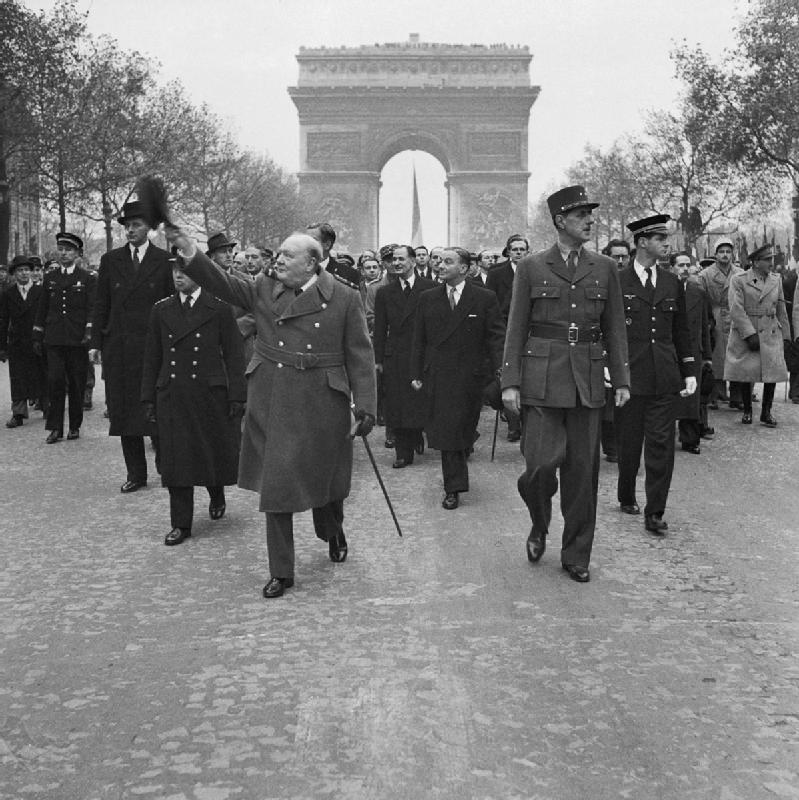
Winston Churchill and General Charles de Gaulle walk along the Champs-Élysées during the parade held in Paris on 11 November 1944(Picryl)
The process of liberation also brought issues of reckoning and purification. Individuals suspected of collaborating with the Germans or the Vichy regime during the occupation were prosecuted or subjected to social sanctions at varying levels. In some places, local acts of revenge occurred before formal legal proceedings, prompting the provisional government to intervene to establish order and bring the purification process under a legal framework. Pétain was tried and sentenced to death, but his sentence was commuted to life imprisonment due to his age. Vichy’s prime minister, Pierre Laval, was executed. This process remained a contentious issue in France’s postwar political memory for a long time, because the years of occupation were a complex period that involved not only resistance but also collaboration, wait-and-see politics, fear, coercion, and local settlements.
After the war, France entered a process of reconstruction following massive physical and economic destruction. Transportation infrastructure, industrial facilities, ports, and cities had been damaged; production capacity had declined, and shortages and inflation affected daily life. The provisional government took important steps toward rebuilding the Republic, prosecuting war criminals, implementing economic planning, establishing social security, and expanding the state’s regulatory role in the economy. Women were granted the right to vote in 1944, the social security system was established in 1945, and nationalizations were carried out in certain banks, energy companies, and strategic sectors. These reforms were linked to the social republic program developed by the National Council of the Resistance during the war.
The constitution adopted in 1946 established the Fourth Republic. The Fourth Republic was a parliamentary system that continued some institutions of the Third Republic while more clearly embedding postwar social rights, trade union rights, equality, and economic security into its constitutional framework. However, the regime struggled to produce political stability due to frequent government changes and party fragmentation. The short lifespan of governments made decision-making difficult on critical issues such as colonial wars, economic reconstruction, and European integration.
During the Fourth Republic, France entered a period of rapid economic recovery. Among the symbolic figures of postwar planning, Jean Monnet emerged as one of the pioneers of economic modernization and increased production capacity. Marshall Aid, state planning, infrastructure investment, and the reorganization of industrial production supported this growth. The years of high growth from 1945 until the early 1970s are known in French historiography as the Trente Glorieuses, or “Thirty Glorious Years.” During this period industrial output increased, urbanization accelerated, a consumer society developed, and access to automobiles, white goods, housing, education and healthcare expanded. However, new social problems also emerged, including migration from rural areas to cities, the proliferation of worker housing, the expansion of suburbs, and dependence on migrant labor.
One of the most important postwar orientations of France was European integration. The devastating conflicts with Germany during the two world wars prompted French foreign policy to seek a new balance between controlling Germany and achieving reconciliation within Europe. The European Coal and Steel Community, established in 1951, created a new foundation for cooperation between France and West Germany by placing strategic sectors such as coal and steel under joint control. The Treaty of Rome signed in 1957 established the European Economic Community and Euratom, making France one of the founding actors of European integration. This process redefined France’s postwar security and economic development strategy at the European level.
The greatest crisis area of the Fourth Republic was its colonial empire. Although France had relied on imperial resources during and after the war, anti-colonial movements in Asia and Africa strengthened after 1945. The Indochina War began in 1946 and ended in 1954 with France’s defeat at Dien Bien Phu. As a result of the Geneva Accords, France lost most of its former authority in Indochina. In the same year the Algerian War began. Unlike other colonies, Algeria was divided into departments considered integral parts of France and had a significant European settler population. Consequently, the Algerian question became not merely a colonial issue but a debate over the identity and territorial integrity of the French state.
The Algerian War transformed into a political crisis that the Fourth Republic could not withstand. The war progressed amid torture, forced displacement, civilian casualties, military repression, nationalist resistance and deep political polarization within France. In 1958 pressure from French military and settler circles in Algeria combined with political instability in Paris to trigger a regime crisis. In this context Charles de Gaulle was called back to power. De Gaulle demanded a new constitutional order based on a strong executive; with the adoption of the 1958 Constitution the Fifth Republic was established. The constitution strengthened the powers of the president, made the government more independent from parliamentary fluctuations and institutionalized the vision of a strong state first advocated by de Gaulle in his 1946 Bayeux speech.
In the early years of the Fifth Republic the most urgent issue was Algeria’s future. De Gaulle initially attempted to manage conflicting expectations but gradually came to accept the inevitability of Algerian independence. In 1962 the Évian Accords and a subsequent referendum led to Algeria’s independence. This development marked a decisive stage in the end of France’s colonial empire. Algerian independence remained a lasting issue in French society due to the return of European settlers to France, the integration of Algerian auxiliary troops, migration, memory politics and debates over war crimes.
During de Gaulle’s presidency France sought to establish itself as an independent great power on the international stage. A nuclear deterrent capability was developed, France’s military and diplomatic independence was emphasized, and in 1966 France withdrew from NATO’s integrated military command structure. In European policy France continued to strengthen its ties with Germany; the Élysée Treaty of 1963 was a major step in institutionalizing Franco-West German cooperation. De Gaulle also strengthened the presidential character of the Fifth Republic through a 1962 constitutional amendment that provided for the direct election of the president by the people.
1968 was a pivotal moment when the transformations within postwar French society became visibly apparent. The May 1968 events began as protests by university students against authority the education system capitalist consumer culture and traditional social norms and quickly merged with worker strikes to produce a nationwide political and social crisis. Millions of workers joined the strike movement bringing demands for higher wages improved working conditions union rights and greater social representation to the forefront. Although the crisis was eventually contained by the de Gaulle administration in the short term it left lasting impacts on French society in the areas of education family gender roles culture labor movements and political participation. De Gaulle resigned following a referendum in 1969 and was succeeded by Georges Pompidou.
The 1970s marked the end of the postwar period of high growth in France. Oil crises unemployment inflation and the transformation of the industrial structure tested the state’s capacity for economic management. Georges Pompidou’s tenure saw continued modernization of industry and infrastructure while Valéry Giscard d’Estaing’s period emphasized political and social reforms. Key features of this era included lowering the voting age to 18 reforms in divorce and family law advances in women’s rights and greater emphasis on European policy. However the slowdown in economic growth rising unemployment and the permanent settlement of immigrant worker communities generated new social tensions.
The election of François Mitterrand as president in 1981 was a pivotal moment in the history of the Fifth Republic as it marked the first time the left won the presidency. During Mitterrand’s term the death penalty was abolished local governance reforms were introduced major enterprises and banks were nationalized and social rights were expanded. However due to economic difficulties and pressures from international markets a more balanced and market-oriented economic policy was adopted from 1983 onward. This period also marked the beginning of cohabitation in the Fifth Republic that is the experience of shared governance when the president and the parliamentary majority belong to different political camps. The cohabitation experiences of 1986–1988 1993–1995 and 1997–2002 demonstrated that the institutions of the Fifth Republic could function under different political balances.
During the presidencies of Mitterrand and his successor Jacques Chirac France played an active role in deepening European integration. The 1992 Maastricht Treaty contributed to the establishment of the European Union and paved the way for monetary union. In France this process was submitted to a referendum and approved by a narrow majority. European integration simultaneously allowed France to maintain its weight in continental politics alongside Germany while intensifying debates over sovereignty monetary policy the social model and national decision-making authority. In the 1990s and early 2000s globalization unemployment suburban issues migration secularism debates and the future of the European Union became central issues in French politics.
The history of France after the Second World War has been a profound transformation process spanning from the aftermath of defeat occupation and the Vichy experience to the reconstruction of the Republic from the colonial empire to a national and Europe-centered state model and from the parliamentary instability of the Fourth Republic to the strong executive system of the Fifth Republic. During this process France had to confront both the devastation of war and the legacy of colonialism while redefining the balance between the welfare state secularism republicanism European integration and national sovereignty. By the end of the twentieth century France was no longer merely a European state recovering from the war but a founding actor of the European Union a nuclear power a diplomatic actor maintaining complex ties with its former colonies and a modern republic confronting new political challenges shaped by its increasingly diverse social structure.
During the presidency of Jacques Chirac elected in 1995 France faced challenges related to European integration social welfare reforms and debates over its international position. In 2000 a referendum reduced the presidential term from seven to five years a change that affected the functioning of the Fifth Republic by aligning the presidential and parliamentary electoral calendars. In 2002 the phasing out of the franc and the adoption of the euro as the daily currency marked a symbolic and practical turning point in France’s participation in European economic integration. Conversely the rejection of the European Constitution Treaty in the 2005 referendum revealed that support for European integration in French society was not unlimited and underscored growing concerns regarding sovereignty the social model globalization and democratic representation.
Jean Moulin, a Resistance Symbol of World War II (Flickr)
The 2000s were marked by the prominence of debates on security secularism migration and social inequality in France. In 2004 a regulation was adopted banning students in public schools from wearing conspicuous religious symbols. In 2010 garments that fully cover the face in public spaces were prohibited. These measures triggered intense debates on the Republic’s principle of secularism the neutrality of public space women’s rights religious freedom and the social position of Muslim communities. While state institutions justified these policies within the framework of secularism and public order human rights organizations Muslim groups and critical circles argued that the practices produced discriminatory outcomes particularly targeting Muslims.【39】 As a result the debate on secularism in contemporary France is not merely a constitutional principle issue but one of the central arenas in discussions on religion identity citizenship and equality.
The unrest that began in the suburbs around Paris in 2005 and spread nationwide brought to light issues such as social exclusion police-community relations youth unemployment educational inequality and the public representation of citizens of immigrant origin. These events opened a debate on the gap between the Republican claim of equal rights and opportunities for all and the reality of social inequalities. The suburbs remained at the center of public policy security practices and debates on social integration in the years that followed.
Nicolas Sarkozy’s presidency was defined by economic reform security policies and efforts to redefine France’s international standing. Elected president in 2007 Sarkozy pursued a reformist agenda in areas such as the labor market public administration and the pension system. However the 2008 global financial crisis and the subsequent Eurozone debt crisis deeply affected the French economy and European politics. France alongside Germany became central to managing the Eurozone crisis addressing issues related to the banking system public finances growth and unemployment. During Sarkozy’s term France fully rejoined NATO’s integrated military command structure in 2009. This decision signified a reinterpretation of the military autonomy policy that had been in place since the de Gaulle era.
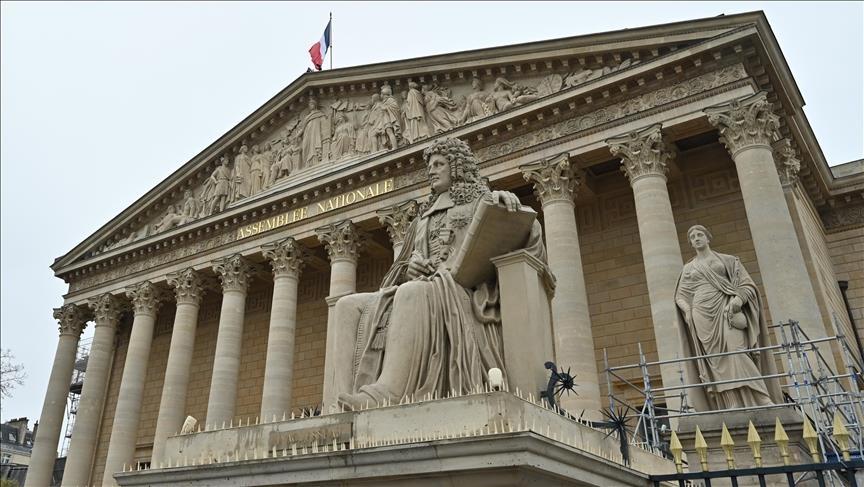
French Government Building (Anadolu Ajansı)
François Hollande’s presidency was shaped by economic stagnation unemployment security crises and social reforms. Elected president in 2012 Hollande faced military interventions in Africa notably in Mali debates over fiscal discipline following the European debt crisis and domestic security challenges.
The 2015 attacks in Paris targeting the Charlie Hebdo magazine the Hyper Cacher supermarket and on 13 November the Bataclan concert hall the Stade de France and various cafés led to a lasting hardening of France’s security policies.【40】 The same year the Paris Climate Agreement adopted at the COP21 conference in Paris enhanced France’s visibility in environmental diplomacy.
In 2017 the election of Emmanuel Macron as president marked a significant shift in Fifth Republic politics undermining the dominance of traditional center-right and center-left parties. Macron’s En Marche! movement positioned itself outside classical party divisions as pro-European reformist and centrist. During his first term Macron aimed to liberalize the labor market reform public finances improve the investment climate and revitalize the France-Germany axis within the European Union. However the social costs of these reforms including impacts on purchasing power tax fairness and centralized decision-making quickly triggered intense criticism.
The Yellow Vests Movement which began in 2018 became the most significant social crisis of Macron’s presidency. Initially sparked by protests against fuel taxes the movement rapidly expanded to encompass issues of income inequality purchasing power the marginalization of rural areas and small towns political representation deficits and demands for direct democracy. The movement emerged outside traditional union and party structures spread via social media and brought into view the tensions between the center and periphery major metropolitan areas and smaller settlements and environmental policies and social justice. The government responded with some policy reversals and launched a broad-based “Great National Debate” yet the movement permanently altered perceptions of the Fifth Republic’s decision-making model.
The COVID-19 pandemic served as a major test of France’s healthcare system public administration economy and social solidarity capacity. Lockdowns and health measures implemented in 2020 caused a sharp contraction in economic activity; the state sought to limit the crisis’s impact through partial unemployment schemes business support credit guarantees and social assistance mechanisms. Although a strong recovery occurred in 2021 inflation energy prices supply chain disruptions and the burden on public finances remained central economic concerns in the post-pandemic period. Beginning in 2022 Russia’s invasion of Ukraine brought energy security defense spending European Union sanctions and strategic autonomy debates to the forefront of France’s foreign policy agenda.
Macron’s re-election as president in 2022 was a historic development as he became the first sitting president of the Fifth Republic to be re-elected without a cohabitation government. However the parliamentary elections held the same year revealed that Macron’s presidential majority had lost its absolute majority in the National Assembly. This situation intensified the tension between the Fifth Republic’s strong executive structure and a fragmented parliament. Pension reform became one of the most visible examples of this tension. The measure to raise the retirement age triggered widespread strikes and protests in 2023; the government’s use of constitutional tools to pass the reform reignited debates over executive power and democratic legitimacy.
Following the strengthening of the far right in the 2024 European Parliament elections Macron dissolved the National Assembly and called for early legislative elections. The 2024 early elections produced a fragmented political landscape with three distinct poles emerging in French politics: a left-wing alliance a centrist bloc around the presidency and the far right centered on Rassemblement National. No single bloc achieved a decisive majority forcing the Fifth Republic’s traditional majority-based governance mechanism into strain and making government formation more fragile. This development has become one of the defining features of contemporary French politics alongside the weakening of traditional centrist parties the institutional entrenchment of the far right and the left’s search for alliances.
Economically France faces challenges in the post-2020 period including low growth high public debt budget deficits the impact of inflation on purchasing power concerns about deindustrialization and the costs of the green transition. In response the state is attempting to guide technological transformation through industrial policy and strategic investment instruments. The France 2030 plan targets long-term investments in green transition decarbonization digitalization innovative industrial sectors nuclear energy hydrogen semiconductors health technologies space agriculture-food and education. This plan reflects France’s ambition to pursue a development path that is not reliant solely on its service economy but seeks to rebuild its technological and industrial capacity for global competitiveness.
Contemporary France continues to function as a globally influential state through its strong institutions its founding role in the European Union its nuclear program its permanent seat on the United Nations Security Council its diplomatic network its cultural influence and its advanced economic structure. At the same time political fragmentation the rise of the far right competition between left and centrist blocs pressures on public finances reforms to pensions and working life inequalities in the suburbs debates on migration and citizenship secularism security policies and the social costs of climate transition constitute the country’s core challenges. Thus modern France operates within a political system characterized by the coexistence of institutional continuity and social tensions European integration and national sovereignty debates and republican universalism and pluralistic social structures.
Metropolitan France, referring to France’s territory on the European continent, has a surface area of approximately 551,500 square kilometers.【41】 This region is also known in French as “l’Hexagone” (the Hexagon).【42】 However, the territory of the French Republic is not limited to metropolitan areas. Overseas regions and communities in the Caribbean and South America, as well as in the Indian and Pacific Oceans, form the country’s geographic extension beyond Europe.【43】
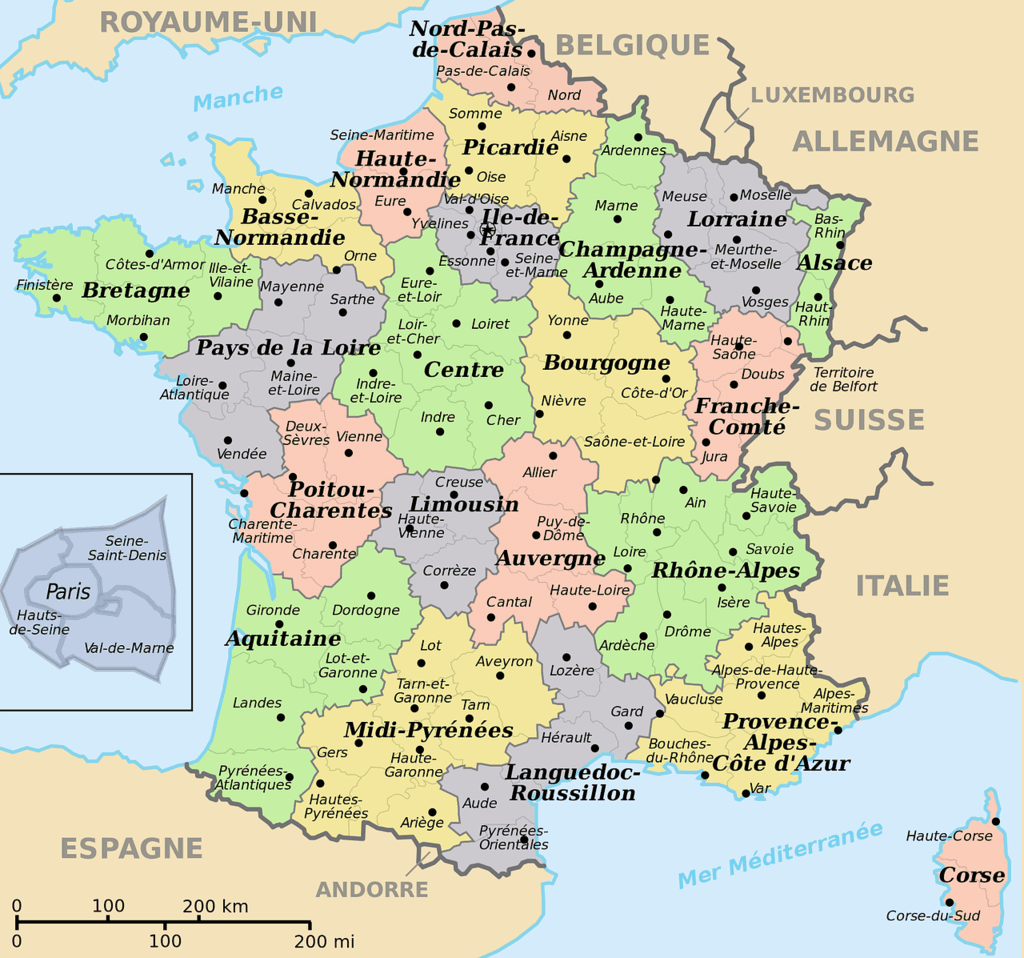
France Border Map (Picryl)
The topography of Metropolitan France varies between the broad basins of the north and west and the mountainous regions of the south and east. The Paris and Aquitaine basins are among the country’s main sedimentary basins.【44】 The Seine, Loire, Garonne, and Rhône are the principal rivers, covering a large portion of the national territory; the Seine flows into the English Channel, the Loire and Garonne into the Atlantic Ocean, and the Rhône into the Mediterranean Sea.【45】
The country’s main mountainous regions are the Alps, the Pyrenees, the Massif Central, the Jura, and the Vosges.【46】 Mont Blanc, located in the southeastern Alps, has an elevation of 4,807 meters according to the official measurement of 2021 and is recognized as the highest peak in Western Europe.【47】 The Pyrenees in the southwest form a significant portion of the border between France and Spain.【48】 The Massif Central in the south-central region features a combination of volcanic formations, high plateaus, and eroded mountain ranges. In the east, the Jura and Vosges massifs extend across the landscape.【49】
Climate conditions in France vary according to latitude, altitude, distance from the sea, and mountain ranges. Météo-France distinguishes five main climate types in Metropolitan France and Corsica: oceanic, modified oceanic, semi-continental, mountain, and Mediterranean.【50】 The oceanic climate, found along the coasts of the Atlantic Ocean and the English Channel, is characterized by mild temperatures and precipitation distributed throughout the year.【51】 As one moves away from the coast, the modified oceanic climate becomes more pronounced, while in the northeast, a semi-continental climate prevails with hot summers and cold winters marked by frost and snowfall.【52】 The Mediterranean climate, dominant along the southeastern coasts and in Corsica, features mild winters and hot summers. In the Alps, the Pyrenees, and other high-altitude areas, mountain climate conditions prevail, with temperatures decreasing with elevation.【53】
The main continental territory of the French Republic in Europe borders the Atlantic Ocean, the English Channel, the North Sea, and the Mediterranean Sea. Metropolitan France shares land borders with Spain, Andorra, Monaco, Italy, Switzerland, Germany, Luxembourg, and Belgium.【54】 France’s geographic structure is not confined to its European mainland. The Republic encompasses twelve overseas territories distributed across the Atlantic, Indian, and Pacific Oceans and around Antarctica. These are Guadeloupe, French Guiana, Martinique, Réunion, Mayotte, New Caledonia, French Polynesia, Saint-Barthélemy, Saint-Martin, Saint-Pierre and Miquelon, French Southern and Antarctic Lands, and Wallis and Futuna.【55】
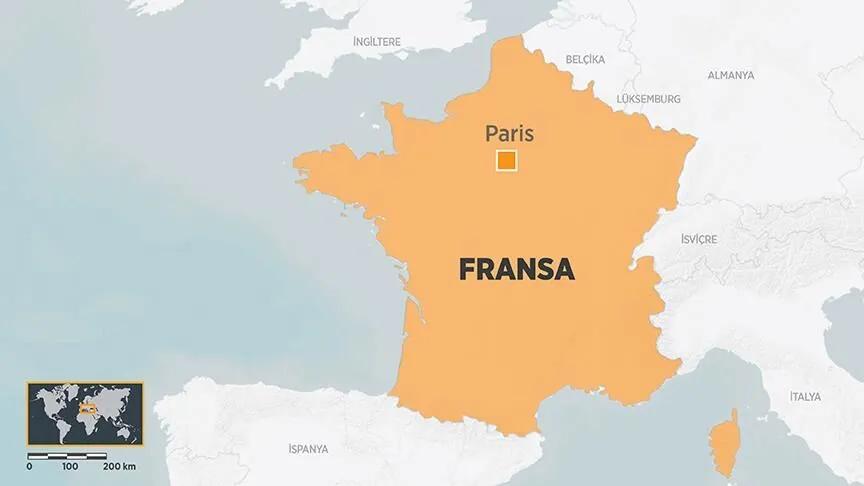
Geographical Location (AA)
Overseas territories grant France land borders with countries outside Europe. Along the Maroni River and its tributaries, France shares a border exceeding 500 kilometers with Suriname via French Guiana; the border between French Guiana and Brazil, comprising both riverine and terrestrial sections, exceeds 700 kilometers.【56】 The island of Saint-Martin in the Caribbean is divided between Saint-Martin, which belongs to France, and Sint Maarten, which belongs to the Kingdom of the Netherlands.【57】
Metropolitan coastlines are divided in French maritime planning into four maritime fronts: the eastern English Channel–North Sea, the western Atlantic Ocean–English Channel, the South Atlantic Ocean, and the Mediterranean Sea.【58】 Including its overseas territories, France’s maritime area reaches approximately 10.2 million square kilometers, with 97 percent located in overseas regions. Thus, the country’s maritime domains extend across all oceans.【59】 Along these maritime fronts, major metropolitan state ports include HAROPA, Dunkerque, Nantes–Saint-Nazaire, La Rochelle, Bordeaux, and Marseille. HAROPA along the Seine and Dunkerque lie within the northern port belt of Europe; the Atlantic ports connect Europe to the Americas and Africa; and Marseille is situated along the maritime route between Europe and Asia via the Mediterranean.【60】
Within the country’s transport networks, Île-de-France holds a dominant weight. In 2022, 79 percent of passengers across 345 train stations with annual ridership exceeding one million used stations in Île-de-France. In the same year, Paris airports served more than half of all air passengers in Metropolitan France. Among the stations outside Île-de-France with the highest passenger volumes are Lyon-Part-Dieu, Lille-Flandres, Strasbourg, and Bordeaux-Saint-Jean.【61】
The landforms of Metropolitan France consist of young mountain ranges in the south and east, ancient massifs in the interior and northeastern regions, the Paris and Aquitaine sedimentary basins, and river and coastal plains. The Alps, Pyrenees, and Jura form the highest mountain chains, while the Massif Central, Vosges, and Ardennes are among the older geological massifs. The Paris and Aquitaine basins feature low but not entirely flat surfaces; smaller depression plains such as Alsace, Limagne, and Bresse are also present.【62】
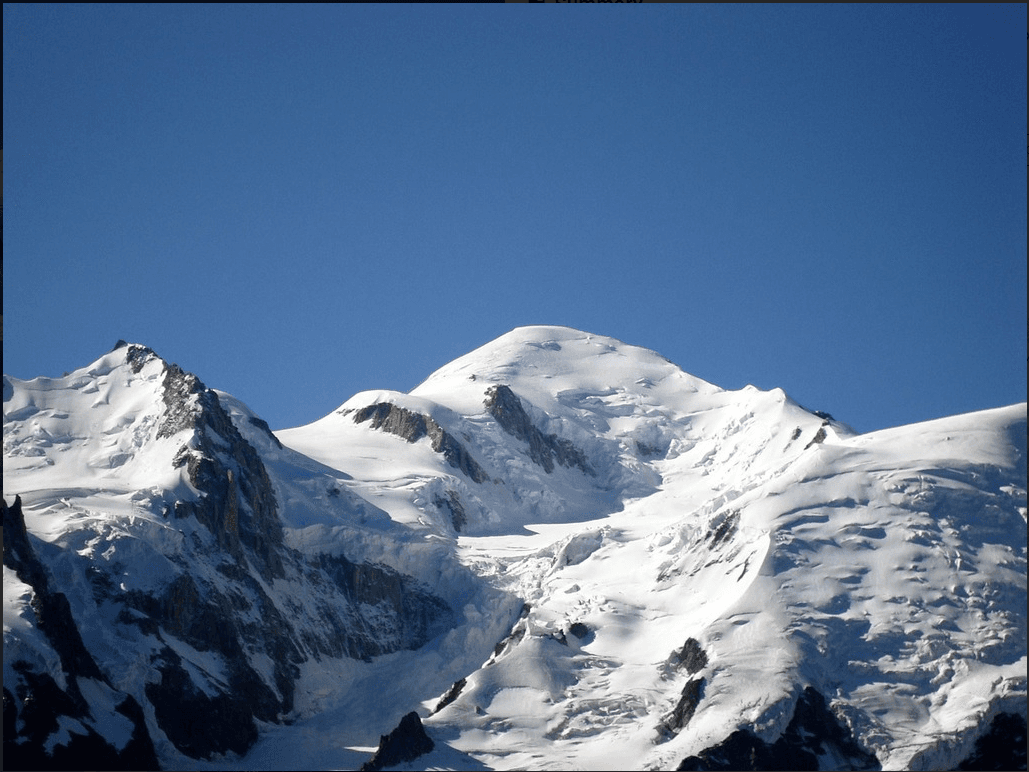
Mont Blanc Summit, the Highest Point in Western Europe (Picryl)
The Alps are the highest mountain range in southeastern France, extending toward Switzerland and Italy. The peak in the Mont Blanc massif reaches 4,807 metres according to the official measurement of 2021. The Pyrenees stretch along the southwestern border with Spain, while the Jura forms a parallel range along the eastern border with Switzerland. The Alps, Pyrenees, and Jura are classified as geologically young mountain systems.【63】
In addition to the Jura, karstic features and natural underground cavities are widespread in the limestone areas along the southern edges of the Alps, Pyrenees, and Massif Central. The Massif Central is an ancient massif shaped by prolonged erosion but distinguished from other old massifs by its volcanic landforms. Puy de Sancy at 1,885 metres is the highest point in the Massif Central. The highest peak in the Vosges Mountains in the northeast is Grand Ballon at 1,424 metres. The Ardennes form part of a lower, older, and forested massif extending from northeastern France into Belgium and Luxembourg.【65】
High and fragmented mountainous areas dominate the interior of Corsica. The highest point of the island’s largest mountain unit, the Cintu massif, is Monte Cintu, reaching 2,706 metres above sea level. Numerous peaks exceeding 2,000 metres lie along the massif’s north–south main ridge.【66】
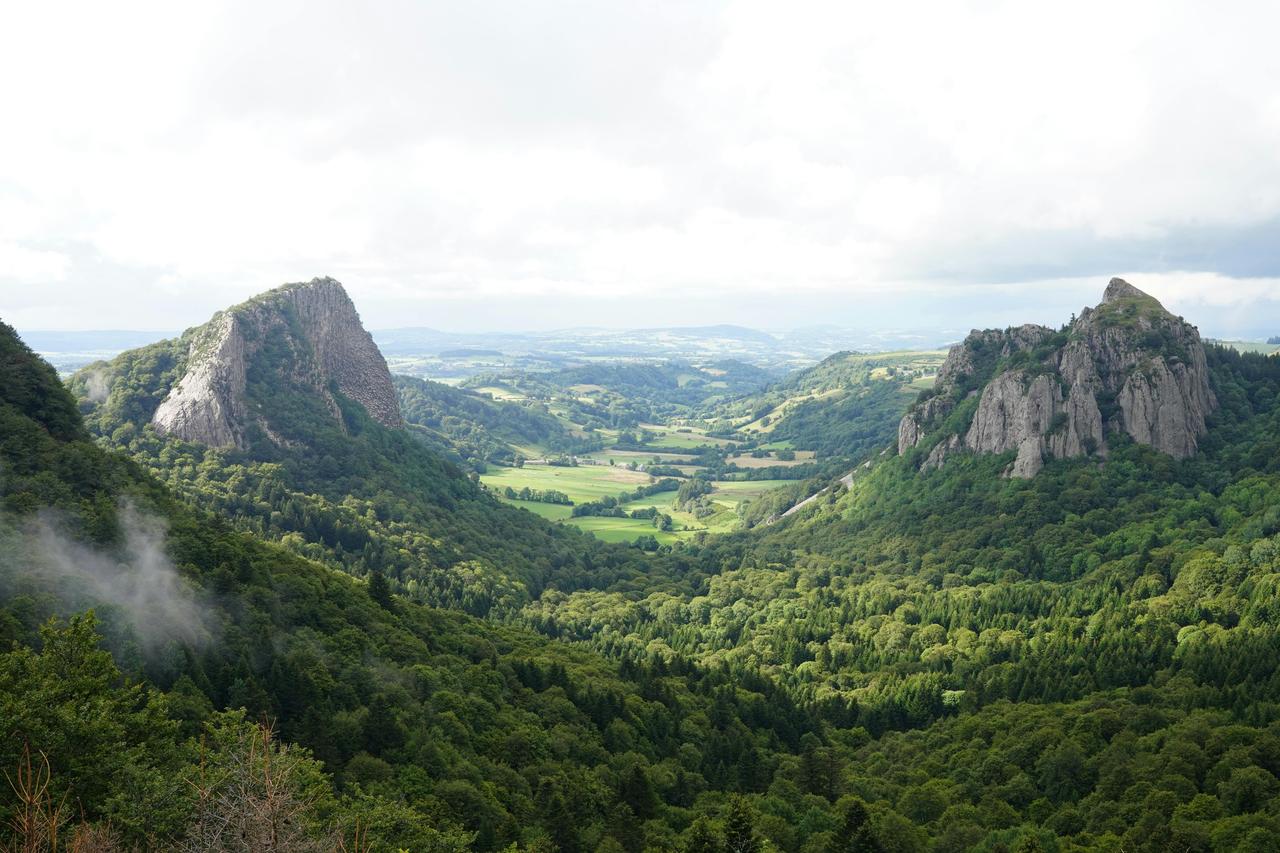
France's Rhône Valley (Pexels)
The Paris and Aquitaine basins are the principal sedimentary basins of Metropolitan France. Their surfaces consist of extensive lowlands with gentle undulations; elevation generally remains below 200 metres in the basin centres but approaches 500 metres along the plateaus and thresholds at the edges. Rivers have developed valley systems within these structures, featuring slopes, terraces, and alluvial plains.【67】
Other limited depression plains include the Alsace Plain along the Rhine, the Limagne plains around the Massif Central, and the Bresse and Rhône corridors. These are respectively connected to the Rhine, Loire–Allier, and Saône–Rhône valley systems. The maritime Flanders and lower Languedoc are the main examples of coastal plains.【68】
River valleys connect inland basins and plains to different sea coasts. The Seine flows into the English Channel, the Loire and Garonne systems into the Atlantic Ocean, and the Rhône into the Mediterranean Sea. The Seine, Loire, and Gironde form large estuaries along the English Channel and Atlantic coasts, while the Rhône, where tidal range is lower, forms the Camargue delta along the Mediterranean coast.【69】
Seven major rivers in Metropolitan France drain large portions of the country’s territory: the Adour, Garonne, Loire, Meuse, Rhine, Rhône, and Seine. The main hydrographic structure is formed by the Seine, Loire, Garonne, and Rhône basins; a portion of the Rhine basin lies within French borders, while some rivers in the northeast flow beyond the country into Belgium and Luxembourg.【70】
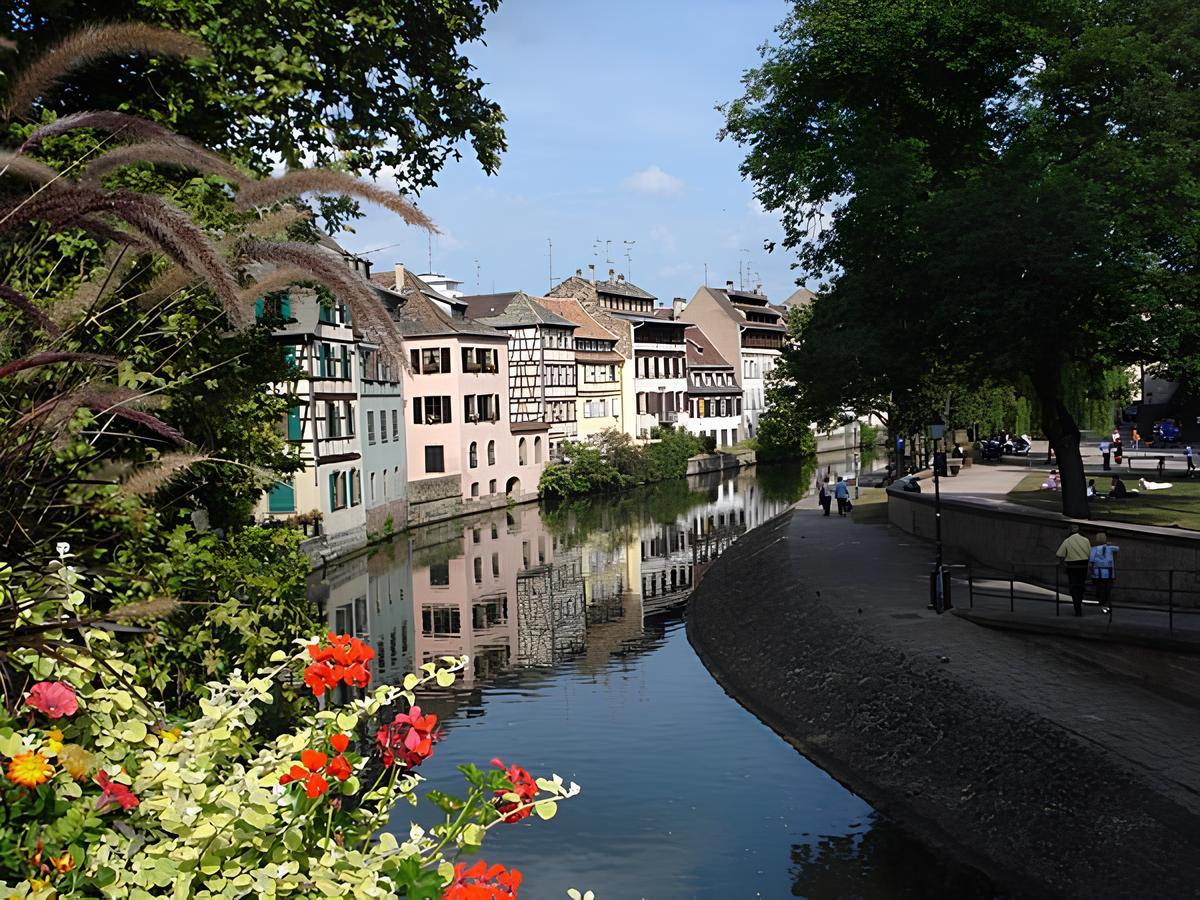
The branch of the Rhine River passing through Strasbourg (CIA)
The Loire, at over 1,000 kilometres, is France’s longest river, crossing the wide sedimentary region in central France before emptying into the Atlantic Ocean. The Seine links the Paris Basin to the English Channel, while the Rhône carries waters from its upper basin in Switzerland to the Mediterranean Sea. The Garonne drains the southwestern basin, and the Rhine and Meuse are key components of France’s transboundary river systems connecting central and northern Europe.【71】
A significant portion of France’s large natural lakes lie within the Alpine region. Lake Léman, shared between France and Switzerland, has a total surface area of 580.1 km², of which 234.8 km² lies within French territory; 58 km of its shoreline belongs to France.【72】 The largest entirely French natural glacial lake is Lake Bourget (Lac du Bourget), with a surface area of 44.5 km². The glacial Lake Annecy covers an area of 27 km².【73】
In addition to natural lakes, large reservoirs have been constructed for water management and energy production. The Serre-Ponçon reservoir on the Durance is part of a system for hydroelectric power generation, drinking and utility water supply, and agricultural irrigation. The Der-Chantecoq reservoir in the Marne basin, commissioned in 1974, regulates the river’s flow during low discharge periods and reduces flood risk in downstream areas.【74】
The climate of metropolitan France and Corsica varies according to its mid-latitude location, the influence of air masses from the Atlantic Ocean, distance from the sea, elevation, and the major mountain ranges. Météo-France distinguishes five main climate types in these areas: oceanic, modified oceanic, semi-continental, mountain, and Mediterranean.【75】
The oceanic climate is prominent along the coasts of Brittany and Lower Normandy. Temperatures are relatively mild; precipitation is distributed evenly throughout the year and increases slightly from October to February. Rainfall decreases in the lower Loire Valley, Vendée and Charentes, while proximity to the Pyrenees in Aquitaine increases winter and spring precipitation. In the Paris Basin, Champagne, eastern Picardy, part of Hauts-de-France, and the western and northern slopes of the Massif Central, the oceanic climate is modified: as distance from the sea increases, the temperature difference between winter and summer grows and precipitation is lower than along the coasts.【76】
A View from the Shores of Lake Geneva (Lac Léman) (Flickr)
The semi-continental climate occurs in the northeastern quarter of the country, primarily in Alsace, Lorraine, the Ardennes, the Argonne, Franche-Comté and part of Burgundy, as well as in some sheltered lowland valleys of the Massif Central and the western Alps protected from prevailing westerly winds. Summers are hot and winters are colder with snowfall extending down to valley floors. Annual precipitation is relatively high, but Alsace, shielded by the Vosges, is drier; precipitation is concentrated mostly in summer and takes the form of heavy downpours.【77】
The Mediterranean climate dominates Corsica and the southeastern belt between the sea and the mountains. Winters are mild and summers are hot; sunshine duration is high, the number of rainy days is low, and precipitation is unevenly distributed throughout the year. Relatively dry winters and summers are followed by spring and autumn periods during which rainfall can intensify rapidly.【78】 The mistral, a regional wind prevalent in the lower Rhône Valley and Provence, is predominantly dry and turbulent. Air flowing from the north into the Rhône corridor accelerates within the valley; the mistral extends from Provence through the Camargue to the Mediterranean coast and typically reduces cloud cover on the days it blows.【79】
In mountain climates, temperature decreases rapidly with increasing elevation; cloud cover, wind and precipitation conditions vary according to slope orientation. This variation creates distinct elevation zones in the vegetation. In the mountain zone, beech forests and mixed beech-silver fir stands are common; in the subalpine zone, coniferous forests composed of fir, larch and pine species become increasingly sparse as they approach the upper limit, transitioning into open woodlands and shrublands. In the alpine zone, trees give way to meadows, and in the higher nival zone, rocky and largely vegetation-free surfaces predominate.【80】
The vegetation of the Mediterranean zone also varies with elevation and summer aridity. A narrow and discontinuous lower belt along the coast is followed by a broader intermediate belt dominated by downy oak, kermes oak and garigue communities. In the transition zone between Mediterranean climate and mountain or Atlantic influences, deciduous species such as pubescent oak and sessile oak are found alongside chestnut trees planted by humans over large areas.【81】
In metropolitan France and Corsica, forests cover 65 percent of the area with broadleaf species, 20 percent with coniferous species and 13 percent with mixed stands. However, the current vegetation is not solely the product of climate. Forest area has been expanding for approximately two centuries; recent increases are linked to the abandonment of agricultural land and, to a lesser extent, reforestation efforts, particularly in mountainous regions and the northwestern part of the country.【82】
France’s natural resource base is not limited to underground minerals. National planning documents evaluate soil, water, forests and forest products, and biomass as fundamental resource categories, while energy data show that almost the entire fossil fuel demand is met through imports.【83】
Soil is a limited resource that supports agricultural, livestock and forestry activities and also stores carbon. Consequently, the conversion of natural, agricultural and forest areas into built-up or impermeable surfaces has become one of the primary challenges in resource management. The national biodiversity strategy aims to achieve zero net land artificialization by 2050 and to reduce the rate of consumption of natural, agricultural and forest areas by 50 percent compared to the 2011–2020 period by 2030.【84】
Forests in metropolitan France cover an area of 17.1 million hectares and contain approximately 11.5 billion trees. Forests are not only a source of timber; they also serve functions such as soil conservation, erosion control, regulation of the water cycle and landscape maintenance. The state’s forest policy encompasses protecting existing forests against fire and deforestation, reducing fragmented land ownership, promoting sustainable management and enhancing the efficient use of timber from broadleaf species. Overseas territories, particularly French Guiana, are addressed separately with regard to forest conservation and development of the timber sector.【85】
Water resources are shared among households, agriculture, industry and other economic activities. The 2023 water plan projects a 10 percent reduction in water abstraction by 2030, along with reduced network losses, improved water supply security and wider adoption of non-traditional water sources through reuse. The plan aims to implement 1,000 reuse projects by 2027, enhance water storage in soils, aquifers and infrastructure, and prevent diffuse pollution.【86】
Agriculture, food production and forests are the main components of renewable but finite biomass resources. Diverting biomass toward different uses—such as energy production, soil amendment and bio-material manufacturing—can create competition among these uses as demand increases. Therefore, increasing production without harming biodiversity or particularly water resources, reallocating uses among competing sectors and limiting demand for bioenergy are considered integral parts of resource management.【87】
Domestic production of fossil fuel resources is limited. France imports nearly all of its fossil energy consumption; crude oil supply also relies heavily on external sources. In 2022, crude oil imports reached 41.9 million tons of oil equivalent (Mtoe). 【88】 In the same year, domestic crude oil production remained at 0.6 Mtoe, meeting approximately 1% of national oil consumption. As of 1 January 2023, crude oil reserves were estimated at 10.8 Mtoe, equivalent to about 18 years of production at current extraction rates and slightly more than two months of national consumption.【89】
Commercial domestic natural gas production has declined to negligible levels since the termination of Lacq gas supply to the grid in October 2013. In 2022, the volume of mine gas delivered to the grid from the Nord-Pas-de-Calais basin remained at 0.2 TWh, while the volume of biomethane purified and injected into the grid reached 7 TWh. By the end of the same year, the annual injection capacity of 514 biomethane facilities connected to the natural gas grid was recorded at 9 TWh.【90】
Critical raw materials such as lithium and cobalt are increasingly viewed not as reserve-rich resources but as matters of supply security, given the growth of electric mobility and battery production. Policy in this area focuses on limiting demand, securing primary metal needs, increasing collection and recycling rates, and developing capacity under French and European control across extraction, refining and recycling stages.【91】
France’s primary energy production reached 1,572 TWh in 2024, an increase of 10.2% compared to the previous year. Of this production, 1,153 TWh came from nuclear energy, 144 TWh from renewable sources used for electricity generation, and 265 TWh from renewable thermal sources and waste valorization. In the same year, primary energy consumption amounted to 2,577 TWh, raising the energy independence ratio to 61%.【92】
Electricity generation in metropolitan France reached 547.5 TWh in 2025, a 1.5% increase compared to the previous year. Nuclear power plants generated 373 TWh and hydroelectric plants generated 62.4 TWh. The 12.9 TWh decline in hydroelectric production was offset by increases of 11.3 TWh in nuclear generation, 8.1 TWh in solar energy, and 2.8 TWh in wind energy. Low-carbon electricity generation from nuclear and renewable sources rose to 521.1 TWh, accounting for 95.2% of total generation.【93】
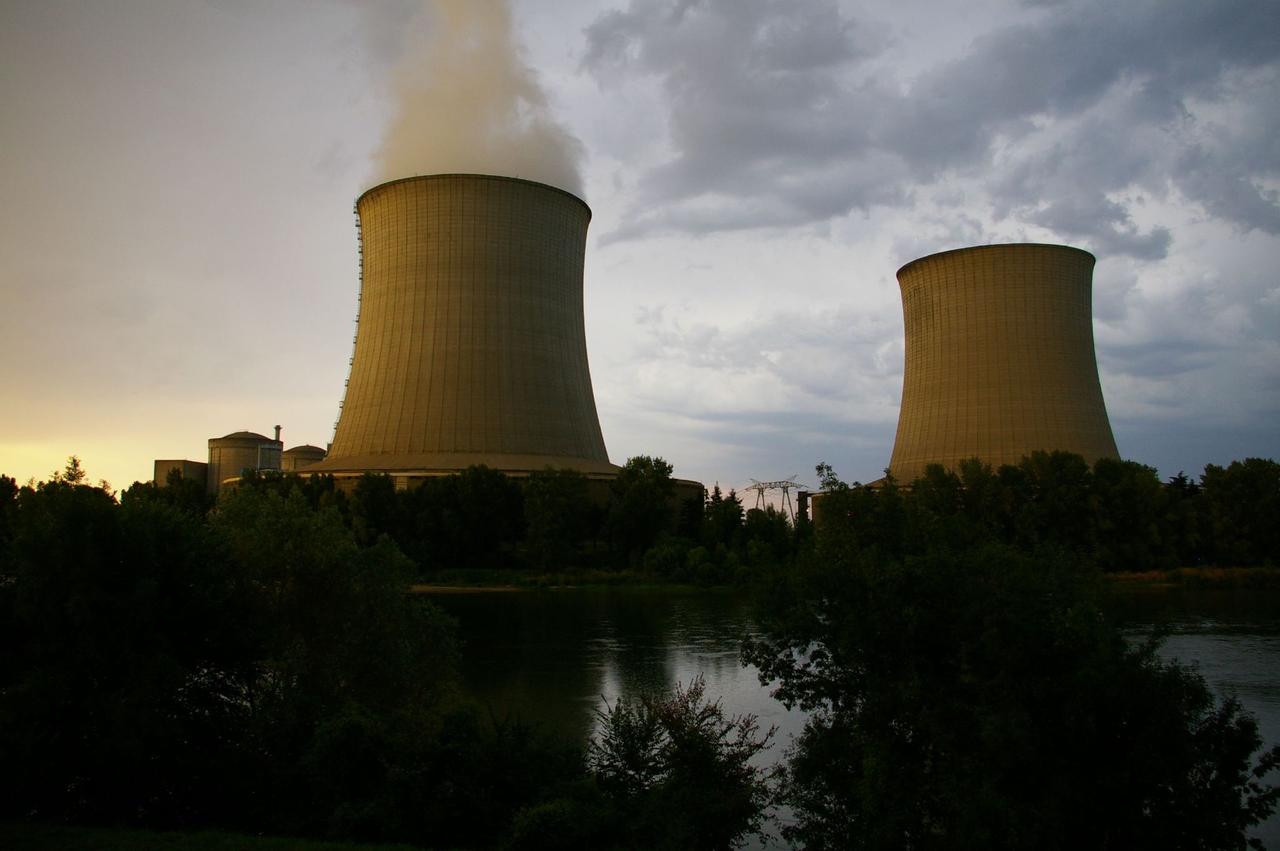
The Loire River has many power plants along its length(Flickr)
France has 57 reactors based on pressurized water technology across its 18 nuclear power plants. Of these, 32 have a capacity of 900 MWe, 20 have 1,300 MWe, and four have 1,450 MWe. The Flamanville EPR reactor, granted operational authorization in May 2024, is the 57th reactor with a capacity of approximately 1,600 MWe.【94】 The rise in electricity generation and relatively stable consumption have strengthened France’s position as a net electricity exporter. Net electricity exports reached 92.3 TWh in 2025, surpassing the 89 TWh level of 2024 and marking the second consecutive year at a historical high. This volume corresponds to approximately 17% of France’s 2025 electricity generation.【95】
According to European Union calculation rules, the share of renewable energy in gross final energy consumption was provisionally estimated at 24.0% for 2025. The final figure for 2024 was 23.2%; however, due to the adoption of a new EU directive calculation method from 2025 onwards, a direct year-on-year comparison between the two values is not possible. France’s target for 2030 is 33%.【96】
Road networks dominate the transport infrastructure. In 2024, the total length of roads in France was calculated at 1,310,184 km, while the length of railway lines was 27,562 km. High-speed lines account for 2,748 km of the railway network, and the combined length of metro, RER and tramway lines reached 1,408 km. The total inland waterway network spans 8,507 km, of which 4,850 km are actively used. Due to a methodological change in 2024, total road length cannot be directly compared with previous years.【97】
Urban rail networks have expanded since the early 2000s. By the end of 2024, France had six metro systems; the Paris metro alone accounted for 62% of the country’s total metro line length. As of 1 January 2025, 21,655 km of the national cycling network had been opened to the public, out of the 25,900 km targeted for 2030, achieving a realization rate of approximately 84%. The sections of the EuroVelo network within France are 94% complete.【98】
As of 31 December 2024, France had 3,884 railway stations. Of these, 2,280 served passengers only, 532 served freight only, and 1,072 served both. In the same year, 2.734 billion passengers passed through 412 stations with annual passenger volumes exceeding one million; 77.9% of these passengers used stations in Île-de-France.【99】
Airports in metropolitan France served a total of 197,980,286 passengers in 2025, a 2.3% increase compared to 2024, but still 1.7% below the 2019 level. International passengers accounted for 153,513,392 of this total.【100】 Six of the state-owned ports with major seaport status are located in metropolitan France, and four are in overseas territories. The HAROPA Port, formed by the merger of the ports of Le Havre and Rouen with the port of Paris in 2021, handled 84.7 million tonnes of sea freight and 3.2 million TEUs of container traffic in 2025.【101】
The usage rates of transport modes reflect the dominance of the road network. In 2024, domestic freight transport by road, excluding pipelines, reached 344 billion tonne-kilometres; 89% was carried by road, 9% by rail, and 2% by inland waterways. In the same year, domestic passenger transport in France excluding DROM amounted to 1,047 billion passenger-kilometres, with 82% carried by private vehicles, 12% by rail, 5% by buses, intercity buses and trams, and 1% by air.【102】
In France, transportation, industry, energy, urbanization, and agricultural activities exert pressure on the environment through resource consumption, emissions of greenhouse gases and pollutants, waste generation, and artificialization of soils. While some indicators of air and water quality have improved, contamination of groundwater, soil degradation, loss of biodiversity, decline of wetlands and marine-coastal ecosystems, and deterioration of forest health remain pressing concerns. Regarding natural hazards, the annual average number of very severe events between 2001 and 2024 has increased to approximately four times the level observed between 1950 and 2000.【103】
France’s gross national greenhouse gas emissions declined to 369 million tons of carbon dioxide equivalent in 2024, or 5.4 tons per capita. This figure is 32 percent below the 1990 level. Nevertheless, transportation continues to account for 34 percent of total emissions, while agriculture contributes 21 percent. Although emissions decreased by 1.8 percent in 2024, the rate of decline has slowed significantly compared to the previous year.【104】
Beyond its importance for food production and rural economies, agriculture exerts pressure on water, soil, and biodiversity. Agricultural water abstraction amounted to 2.8 billion cubic meters in 2023, representing 10 percent of total water abstraction in metropolitan France. Excess inputs of nitrogen and phosphorus can lead to nitrate accumulation in water, ammonia emissions to the atmosphere, and eutrophication. Sales of plant protection products decreased by 3.3 percent in 2023 compared to the previous year, reaching 65,600 tons; substances eligible for organic farming and used in biological control now account for more than 36 percent of total sales. Nevertheless, chemical inputs, erosion, loss of soil organic matter, and irrigation demands remain central challenges in agricultural environmental policy.【105】
Air pollution arises from gases and particles emitted by transportation, industry, residential heating, and agricultural activities. Although most human-caused pollutant emissions have declined between 2000 and 2024, air quality standards set for health protection continue to be exceeded in some urban areas. In 2024, measurements exceeded regulatory thresholds in two urban agglomerations for nitrogen dioxide, three for PM10, and seventeen for ozone. Consequently, reducing vehicle traffic, developing public transport and cycling infrastructure, transitioning heating systems, and controlling industrial emissions remain key instruments of air quality policy.【106】
Waste generation and raw material consumption are also critical components of environmental policy. In France, 343 million tons of waste were generated in 2022, of which 71 percent were recovered as materials through recycling or landfilling. However, the recycling rate for non-mineral and non-hazardous waste remained at 48 percent, below the 55 percent target set for 2020. The recycling rate for plastic waste, which has stagnated at 20 percent, highlights the limitations in implementing circular economy policies aimed at reducing resource consumption.【107】
Pressures on biodiversity stem from agricultural intensification, habitat fragmentation, urbanization, transport infrastructure, pollution, invasive species, and climate change. In 2024, 18 percent of species assessed on national red lists were classified as extinct or threatened. Only 16 percent of habitats of European Union importance in metropolitan France were in favorable conservation status during the period 2019–2024. The population index of common bird species associated with agricultural, forest, and built-up environments declined by 37 points between 1989 and 2024. The high level of endemic species in overseas regions adds a geographical dimension to biodiversity policy that extends beyond continental Europe.【108】
Climate change is altering the frequency, intensity, and geographic distribution of meteorological and hydrological hazards. The Third National Climate Change Adaptation Plan, published in March 2025, assumes an adaptation pathway for metropolitan France in which average temperatures will rise by 2 °C by 2030, 2.7 °C by 2050, and 4 °C by 2100 compared to pre-industrial levels. The plan integrates heatwaves, droughts, flooding, coastal erosion, forest fires, shrink-swell phenomena in clay soils, and biodiversity loss into public planning.【109】
Floods and inundations occur through river overflow, surface runoff, and sea level rise. Increased frequency of intense daily rainfall, expansion of impermeable surfaces, and urbanization in risk-prone areas can amplify damage from surface runoff. Modeling estimates that annually, an average of 175,000 people could be affected by surface runoff-related floods, with this threat directly or indirectly involving approximately 13 million people. Flood management is based on monitoring and early warning systems, protection of river basins and floodplains, local authority risk plans, and enhanced structural resilience.【110】
The frequency and duration of heatwaves and droughts have increased markedly. The annual average number of days with heatwaves in France rose from two days between 1960 and 2020 to ten days. The intensity and duration of soil droughts have tripled nationwide since the 1960s and more than tripled in southern regions. The adaptation pathway for the end of the century projects that moderate droughts will last 40 additional days per year and severe droughts will occur three times more frequently. These developments jointly impact agricultural production, drinking and utility water supply, hydropower generation, energy infrastructure, ecosystems, and public health.【111】
Forest and vegetation fires are no longer confined to the historically fire-prone southern regions of the country. Climate change is expanding fire risk westward and northward, with the number of days of very high fire sensitivity expected to double, and more than 35 percent of vegetated areas projected to fall into the very high sensitivity category by century’s end. Since approximately nine out of ten fires originate from human activities, vegetation management, control of urban development, risk mapping, early warning systems, and public awareness are as crucial as intervention capacity.【112】
In mountainous areas, flash floods triggered by heavy rainfall, landslides, rockfalls, avalanches, and hazards originating from glaciers or frozen ground occur together. In the Alps, the rate of temperature increase is higher than the national average for metropolitan France, leading to glacier retreat and the thawing of permafrost, which creates new risk zones. It is expected that the majority of the approximately 200 square kilometers of land covered by glaciers in France will disappear within the current adaptation pathways by the end of the century. Seventy glacier-related risk basins in the Alps have been identified that may require specific monitoring or preventive measures.【113】
In coastal regions, rising sea levels, coastal flooding, and shoreline retreat are affecting settlements, agricultural land, tourism infrastructure, and natural coastal habitats. Sea level rise is expected to continue throughout the 21st century and beyond 2100. Therefore, coastal policy considers together the preparation of thirty- and hundred-year hazard maps, the protection of dunes, coastal forests, wetlands, mangroves, and coral reefs, and the long-term relocation of certain structures and activities to safer areas.【114】
In overseas regions, tropical cyclones, heavy rainfall, drought, sea level rise, and coastal erosion are the main climate-related hazards. In some areas, these are compounded by climate-independent natural hazards such as earthquakes, volcanism, and mass movements. The concentration of population and economic activity along coastlines, the limited land area of islands, their distance from metropolitan France, and the fragility of transport links can amplify the impact of disasters. Consequently, disaster management in overseas regions integrates the resilience of coastal settlements with the protection of coral reefs, mangroves, and tropical forests.【115】
France’s environmental policy views the reduction of greenhouse gas emissions and adaptation to the impacts of climate change as two complementary pillars. The adaptation plan enacted in March 2025 aims to protect the population, strengthen the resilience of infrastructure and essential services, adapt economic activities, preserve natural and cultural heritage, and promote social participation through 52 measures and over 200 actions. As of July 2026, 80 percent of the actions under the plan have been initiated. Thus, environmental policy has become a multidimensional field linked to the protection of natural environments as well as energy and food security, public health, regional planning, disaster management, and social inequalities.【116】
France’s postwar economic framework was built on an interventionist model rather than centralized planning, relying on state allocation of credit, public enterprises, sectoral policies, and investment guidance through the Commissariat général du Plan. The period from 1945 to the mid-1970s, known as the Trente Glorieuses, saw average annual growth exceeding 5 percent, marked by postwar reconstruction, the completion of industrialization, and the transition to a service-based economy. The decline in agricultural employment, urbanization, the expansion of wage labor, and rising consumption were among the social consequences of this transformation. The 1973–1974 oil price shock ended the high-growth era and initiated a period of lower growth, increased international competition, and economic restructuring.【117】
France’s gross domestic product reached 2,991.1 billion euros at current prices in 2025, with economic growth of 0.8 percent. The growth rate was 1.5 percent in 2024. While domestic demand and inventory increases contributed positively to growth, foreign trade reduced it by 0.2 percentage points. Household consumption rose by 0.4 percent and fixed capital investment by 0.5 percent, while construction investment declined. In the first quarter of 2026, GDP contracted by 0.1 percent compared to the previous quarter, and household purchasing power per capita decreased by 0.1 percent. During the same period, the household savings rate rose to 17.9 percent of disposable income.【118】
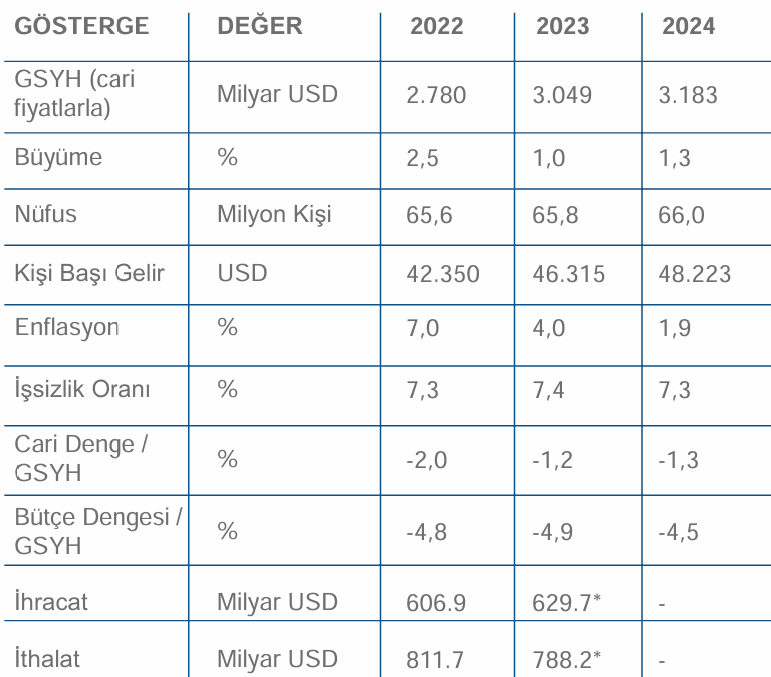
October 2022 – September 2023 Period / France Macroeconomic Indicators and Forecasts (DEİK)
Annual consumer price inflation fell to 1.8 percent in June 2026, down from 2.4 percent in May. The harmonized index of consumer prices, used for comparisons with other European Union countries, also declined from 2.8 percent to 2.0 percent. In June, energy prices rose by 11 percent year-on-year, but the pace of increase slowed significantly compared to the previous month; service prices increased by 1.9 percent and food prices by 0.9 percent, while industrial goods prices fell by 1.1 percent. Core inflation was calculated at 1.0 percent.【119】
In the first quarter of 2026, the number of unemployed persons in France, excluding Mayotte, reached 2.6 million according to the International Labour Organization definition. The unemployment rate rose by 0.2 percentage points compared to the previous quarter and by 0.7 percentage points compared to a year earlier, reaching 8.1 percent. This is the highest level since the first quarter of 2021 but remains 2.4 percentage points below the peak observed in mid-2015.【120】
Public finances remain one of the economy’s main vulnerabilities. The public deficit amounted to 152.5 billion euros in 2025, equivalent to 5.1 percent of GDP, down from 5.8 percent in 2024. Public revenues accounted for 52.2 percent of GDP while expenditures reached 57.3 percent; the share of mandatory taxes and social contributions rose to 43.6 percent. According to the Maastricht definition, public debt reached 115.7 percent of GDP by the end of 2025. Debt increased to 3,536.1 billion euros in the first quarter of 2026, equivalent to 117.5 percent of quarterly GDP; however, this quarterly ratio does not correspond exactly to the annual measure used for calculating the yearly debt-to-GDP ratio.【121】
According to provisional national accounts for 2025, the total value added by economic sectors amounted to €2,664.9 billion. Of this, €1,536.8 billion, or 57.7%, was generated primarily by market services; €579.8 billion, or 21.8%, came primarily from non-market services. Industry contributed €358.5 billion, or 13.5% of the total; construction contributed €148.5 billion, or 5.6%; and agriculture, forestry and fishing together contributed €41.3 billion, or 1.5%. When market and non-market activities are considered together, services accounted for approximately 79.5% of total value added.【122】
Although agriculture’s direct share of value added is limited, France is one of the European Union’s leading agricultural producers. In comparable 2022 data, the country ranked first with a production value of €88.2 billion, accounting for 17.9% of the EU total. Agriculture, forestry, fishing and agri-food industries together provided 1.4 million full-time equivalent jobs in the same year; their combined value added of €99.5 billion corresponded to 3.8% of GDP. France also ranked second in the EU in 2020 for agri-food industry output, contributing 15.7% of the total, after Germany.【123】
The provisional agricultural accounts completed in June 2026 determined that the value of agricultural production in 2025, excluding product subsidies, was €93.8 billion. This revised the earlier estimate of €92.4 billion. Production value increased by 4.7% in 2025; of this increase, 2.2% stemmed from higher output volumes and 2.4% from rising prices. The value of crop production reached €46.4 billion, with output volume rising by 3.9%; livestock production value reached €38.1 billion, growing by 10.1% overall due to a 9.3% increase in prices. Grain output volume rose by 17.6% and wine production by 5.9%, while heatwaves and drought reduced maize production by 6.4%.【124】
The recovery in production did not translate proportionally into foreign trade. The overall trade surplus for agricultural and agri-food products fell by €4.9 billion in 2025 to just €200 million, reaching its lowest level since 2000. This decline was driven by the delayed impact of the poor 2024 grain harvest on exports and by rising import values for tropical products such as cocoa and coffee.【125】
Industrial output increased by 1.1% in volume terms in 2025, while manufacturing output rose by 1.2%. Output of other transport equipment, including aerospace, increased by 10.6%; automotive production rebounded by 3.3% after a 9.5% decline in 2024. However, the volume increase in industrial value added was limited to 0.6%, while construction output decreased by 2%.【126】
Of the €358.5 billion in industrial value added at current prices, €59.3 billion came from mining, energy, water and waste management; €48.2 billion from food, beverage and tobacco industries; €43.6 billion from transport equipment; and €37.8 billion from computers, electronics and optical products, electrical equipment and machinery. The total value added from other manufacturing activities reached €168 billion. This distribution reflects an industrial base that encompasses not only energy and traditional manufacturing but also transport technologies, electronics, machinery and agri-food production.【127】
Transport equipment is one of industry’s main strengths in foreign trade. Exports of these products rose by 8.5% in 2025 to €124.7 billion, generating a surplus of €10.7 billion against imports of €114 billion. The annual rise in goods exports was particularly driven by aerospace products; exports of pharmaceuticals, computers, electronic-optical products and metals also increased. However, mechanical, electrical and information technology equipment recorded a trade deficit of €35.6 billion.【128】
A key instrument of industrial policy is the France 2030 program, with a budget of €54 billion, implemented since 2021. The program aims to develop future technologies, decarbonize production and strengthen technological sovereignty through research, private sector R&D, industrialization and vocational skills. A preliminary macroeconomic modeling published in July 2026 estimated that the program could raise GDP by 0.4 to 0.6 percentage points by 2030 and generate between 25,000 and 58,000 jobs. These are model-based projections of potential program impacts, not realized outcomes.【129】
In 2025, the value added by market services excluding finance amounted to €980.1 billion, representing 36.8% of total value added. The value added by these activities increased by 1.3% in volume and contributed the largest sectoral share to economic growth. Value added in real estate services grew by 1%, information and communication services by 2.2%, and accommodation and food services by 2.8%. Art, entertainment, and recreation activities contracted by 4.8% due to the high comparison base created by the 2024 Olympic and Paralympic Games. The trade surplus in market services excluding finance reached €11.8 billion.【130】
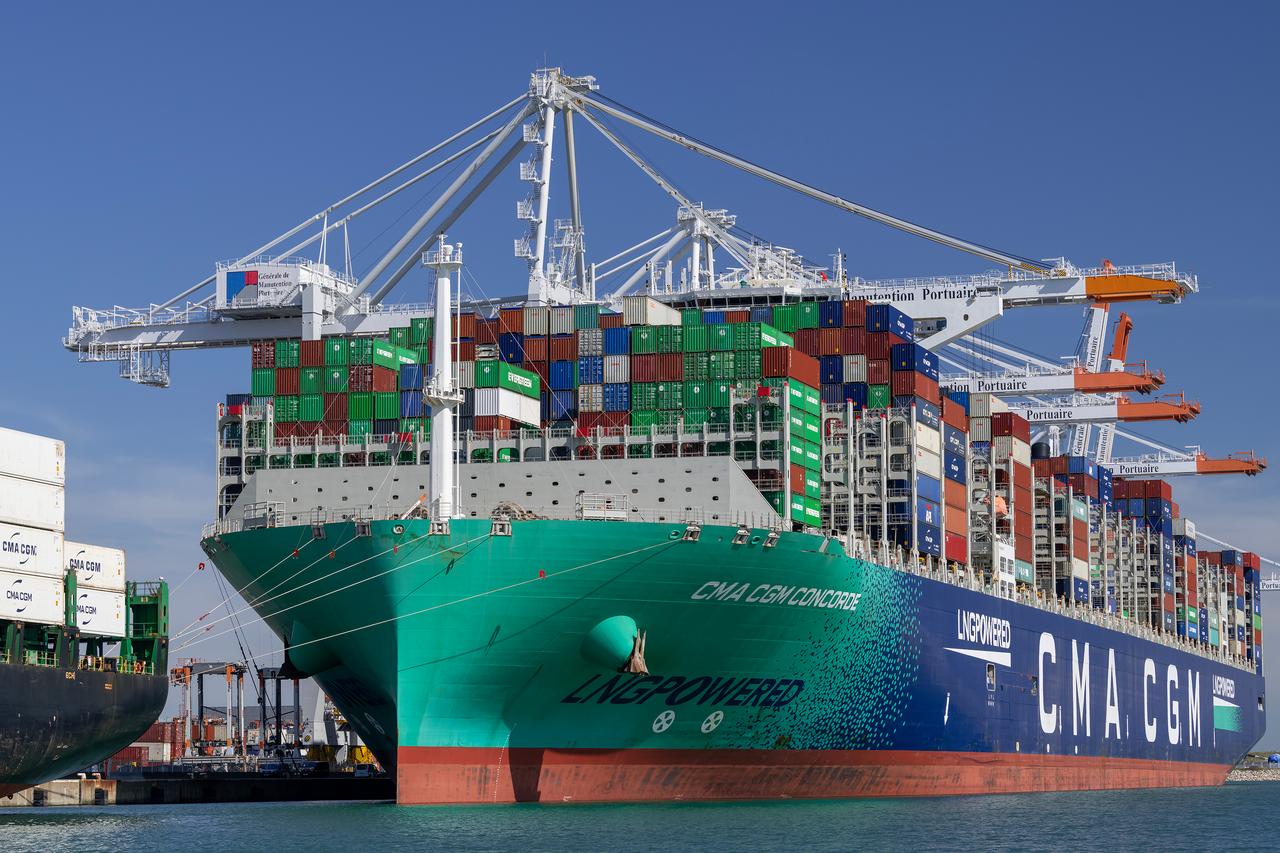
A Container Ship at the Le Havre (HAROPA) Port (Flickr)
The value added by predominantly non-market services including public administration, education, health, and social services amounted to €579.8 billion in 2025. Trade contributed €250.1 billion, transportation and storage €123.5 billion, accommodation and food services €71.1 billion, and information and communication €147.1 billion. This structure demonstrates that the services sector is not limited to tourism or finance but encompasses a broad economic spectrum ranging from public services to transportation, real estate, and information technologies.【131】
In 2025, France welcomed 102 million international tourists, with international overnight stays reaching 743 million. International travel receipts amounted to €77.5 billion, while spending by residents abroad totaled €57.5 billion, resulting in a €20 billion surplus in the travel account. These figures cover goods and services purchased during travel, not international transportation expenses.【132】
In 2025, France’s merchandise trade statistics recorded exports of €614.7 billion, imports valued at €683.9 billion on a FOB basis, and a FOB/FOB trade deficit of €69.2 billion. The customs bulletin also publishes CIF imports, including insurance and freight costs, at €703.6 billion; this figure must not be confused with the import value used in calculating the FOB/FOB balance. The deficit decreased by €10 billion compared to 2024, driven by lower energy bills and improvements in transportation equipment, particularly in aviation and automotive sectors.【133】
The Eurozone maintained its central position in France’s merchandise trade. In 2025, France exported €278.6 billion worth of goods to the Eurozone and imported €296.1 billion. Germany was the largest single-country trading partner, with exports of €81.5 billion and imports of €86.8 billion. Trade with the United Kingdom generated a surplus of €13.8 billion, while the deficit with Asia reached €61.3 billion, of which €46 billion stemmed from trade with China and Hong Kong.【134】
In the first months of 2026, the monthly trade balance showed fluctuating trends. According to seasonally and calendar-adjusted data, the deficit widened by €1.5 billion in May 2026 to €6.9 billion. Exports declined by €1.1 billion while imports rose by €400 million; the twelve-month cumulative deficit reached €58.9 billion. The monthly export decline was influenced by a slowdown in military equipment deliveries, while exports of aviation and aerospace products increased by €500 million.【135】
The balance of payments accounts, unlike customs statistics, include adjustments for changes in ownership and other international statistical standards. Under this methodology, France recorded a current account deficit of €11.6 billion in 2025. The merchandise trade deficit amounted to €58 billion, the services trade surplus reached €45.4 billion, and the combined primary and secondary income surplus totaled €1 billion. Of the services surplus, €20 billion originated from travel. Therefore, the current account deficit and the €69.2 billion merchandise trade deficit recorded in customs data are not directly comparable indicators.【136】
According to Business France’s project-based survey, 1,878 foreign investment decisions were recorded in 2025, expected to create or preserve 47,734 jobs. These decisions were made by 1,021 foreign companies, of which 315 were investing in France for the first time.【137】
New establishments and openings accounted for 62% of total investment decisions with 1,161 projects, while expansions of existing operations represented 30% with 563 projects. Acquisitions accounted for only 3% of the total but ensured the continuation of operations at 48 facilities and preserved 5,249 jobs.【138】
In terms of activity type, retail outlets led with 522 projects, followed by 472 production projects and 299 decision-making centers. The number of foreign investment projects in production increased by 1.5% compared to 2024; excluding retail investments, the overall increase in total projects was 2%.【139】
EU countries accounted for 72% of investment projects and 56% of associated jobs in 2025. The United States ranked first in projected job creation, contributing nearly one-quarter of all jobs, followed by Germany with over 5,200 jobs (11%) and Italy with 10%. Forty-five percent of production-related investments and 52% of associated jobs were concentrated in municipalities with populations under 20,000.【140】
One-quarter of investment decisions and 46% of projected jobs were linked to sectors directly targeted by the France 2030 program, including artificial intelligence, healthcare, low-carbon transportation, and renewable energy. This distribution shows that foreign investment is not limited to retail and services but is also directed toward technologies and decarbonization areas strategically recognized under industrial policy.【141】
However, the 2025 results cannot be directly compared with total project and employment figures from previous years. Starting this year, all projected jobs associated with investments are recorded, rather than only the first three years. Additionally, for retail investments, approximately ninety foreign companies’ new openings began to be systematically identified at the municipal level, with each opening counted as a separate investment project. Consequently, the changes in employment numbers and retail project counts in 2025 reflect both increased economic dynamism and the expansion of the recording methodology.【142】
In the balance of payments data, which differs from project counts, foreign direct investment inflows to France declined from €38.4 billion in 2025 to €19.4 billion. This level corresponds to a low point compared to the average of the 2010s, while French investors’ outward direct investment flows increased from €39.4 billion to €50.6 billion, resulting in a net capital outflow of €31.2 billion.【143】
According to the extended directional principle, France’s stock of foreign direct investment reached €987.5 billion by the end of 2025. The stock of French direct investment abroad was calculated at €1,520.3 billion, meaning that French direct investment abroad exceeded the foreign investment stock in France by €532.8 billion.【144】
Business France data measure investment decisions and the potential employment associated with them, while Banque de France data measure financial flows during a specific period and investment stocks at year-end. Therefore, a high number of investment projects does not contradict a decline in direct investment inflows in the same year.【145】
The overall investment climate indicates limited macroeconomic growth despite activity in investment projects. The French economy grew by 0.8 percent in volume in 2025; the contribution of foreign trade to growth was minus 0.2 percentage points.【146】 According to the International Labour Organization definition, the unemployment rate rose to 8.1 percent in the first quarter of 2026.【147】 The public debt reaching 115.7 percent of GDP by the end of 2025 and a current account deficit of €11.6 billion are key financial and external economic constraints shaping the investment environment.【148】 This picture demonstrates that France has maintained its capacity to attract foreign investment; however, the dynamism in project numbers has not produced equally strong outcomes in terms of economic growth, employment, public finances, and actual capital inflows.
The French Republic is governed under the Fifth Republic regime established by the Constitution of 4 October 1958.【149】 Article 1 of the Constitution defines France as an indivisible, secular, democratic and social republic and states that the organization of the Republic is based on the principle of decentralization.【150】 This framework guarantees that local authorities can be freely managed through elected councils and exercise regulatory powers within their own jurisdictions, without fully eliminating the country’s historical tradition of centralized governance.【151】
France’s political system is described as a semi-presidential system, combining a directly elected president with a government accountable to Parliament.【152】 The executive is dual: the president oversees the continuity of the state and the regular functioning of public powers, while the government determines and implements national policy; the prime minister manages the government’s activities.【153】 Parliament adopts laws, monitors government activities, and evaluates public policies.【154】 The Constitution guarantees judicial independence, and the Constitutional Council conducts constitutional review of laws.【155】
One of the principal historical examples of codification in French law is the Code civil des Français of 21 March 1804. This systematic text, organized around persons, property and modes of acquiring ownership, upholds revolutionary principles such as equality before the law and private property, while also institutionalizing provisions that reinforced male authority in family law.【156】
The foundational text of the current constitutional order is the Constitution of 4 October 1958. The inability of the Fourth Republic to establish stable governments and the weakness of the executive vis-à-vis Parliament were decisive in shaping the new constitutional framework. Accordingly, the 1958 Constitution strengthened the position of the government and prime minister relative to Parliament and conferred on the presidency a more prominent constitutional weight than in previous republics.【157】
The preamble of the Constitution declares the French people’s commitment to the rights set forth in the 1789 Declaration of the Rights of Man and of the Citizen, the principles of national sovereignty, the preamble to the 1946 Constitution, and the rights and duties outlined in the 2004 Environmental Charter. Thus, the current constitutional framework integrates into a single structure the fundamental rights and sovereignty principles originating in 1789, the social rights framework developed in 1946, and constitutional provisions relating to environmental law.【158】
The 1789 Declaration of the Rights of Man and of the Citizen is one of the principal historical foundations of France’s understanding of fundamental rights and sovereignty. It asserts that men are born free and equal in rights, that the source of sovereignty resides in the nation, and that law is the expression of the general will. It further stipulates that the limits of liberty may be determined only by law, and that in a society where rights are not guaranteed and separation of powers is not established, the existence of a constitution cannot be claimed.【159】
Under the 1958 Constitution, national sovereignty belongs to the people, who exercise it through their representatives or by referendum. The right to vote is granted to adult French citizens who exercise their civil and political rights under conditions set by law; the principles of universal, equal and secret suffrage are constitutionally guaranteed. Political parties and groups contribute to the expression of the vote; they may be freely established and operate, but are bound to respect the principles of national sovereignty and democracy.【160】
The Constitutional Council is at the center of constitutional review. The Council compulsorily examines the constitutionality of organic laws and parliamentary regulations before they enter into force; it may also review other laws upon request by authorities specified in the Constitution. It oversees the regularity of presidential elections and referendums and adjudicates disputes concerning elections of deputies and senators.【161】 Under the primary constitutional review mechanism, it may be argued in an ongoing judicial proceeding that a law to be applied violates rights and freedoms guaranteed by the Constitution. The matter may be referred to the Constitutional Council by the Council of State or the Court of Cassation. Thus, constitutional review is not limited solely to examination prior to the enactment of laws.【162】
France’s executive structure comprises a directly elected president alongside a government accountable to Parliament. The president is elected by direct universal suffrage for a five-year term and may not serve more than two consecutive terms. An absolute majority of valid votes is required for election; if no candidate achieves this majority in the first round, the two candidates with the most votes proceed to a second round. The president’s direct election by the people confers upon him a legitimacy distinct from that of the government.【163】
The president ensures compliance with the Constitution, the regular functioning of public authorities and the continuity of the state; he is the guarantor of national independence, territorial integrity and respect for international agreements. He appoints the prime minister; on the prime minister’s proposal, he appoints and dismisses other members of the government. He chairs the Council of Ministers, promulgates laws, may submit matters to referendum as provided by the Constitution, may dissolve the National Assembly after necessary consultations and serves as commander-in-chief of the armed forces.【164】
In the event of a serious and imminent threat to the institutions of the Republic, national independence, territorial integrity or international obligations, and when the regular functioning of constitutional public authorities is interrupted, the president may take exceptional measures. Before exercising this power, he must formally consult the prime minister, the presidents of both houses of Parliament and the Constitutional Council. Parliament convenes automatically and the National Assembly may not be dissolved during this period. Starting on the thirtieth day, the Constitutional Council may be requested to examine whether the conditions for exceptional powers still exist; the Council shall also conduct this review automatically by the end of the sixtieth day.【165】
The government determines and conducts the nation’s policy; it exercises authority over the administration and the armed forces. The prime minister directs the government’s activities, ensures the enforcement of laws, exercises regulatory power and appoints civil and military officials except those reserved for the president by the Constitution. The government is accountable to Parliament. The prime minister may submit the government’s program or a general policy statement to the National Assembly for approval; the National Assembly may also force the government to resign by adopting a motion of censure in the manner prescribed by the Constitution.【166】
The actual distribution of power within the executive may vary according to the political relationship between the president and the majority in the National Assembly. When the president and the parliamentary majority belong to the same political orientation, the president’s guiding influence over government policy increases. When the parliamentary majority belongs to a political bloc opposed to the president, the president’s freedom to choose the prime minister is restricted and the prime minister and government assume a stronger position in managing domestic affairs. This situation, in which the president and government from opposing political tendencies jointly exercise their functions, is known in French politics as cohabitation.【167】
France’s administrative organization is constitutionally based on the principle of decentralization. The Republic’s local administrative units are communes, departments, regions, local communities with special status and overseas communities subject to Article 74 of the Constitution. France has a total of 18 administrative regions, 13 of which are metropolitan and 5 overseas. This distribution demonstrates that the country’s administrative territory is not limited to the European mainland.【168】
Local authorities are freely administered through elected councils under conditions defined by law and may issue regulatory acts within their own areas of competence. One local authority may not exercise supervisory authority over another; however, when the exercise of a particular competence requires cooperation among several local authorities, the law may assign the responsibility for coordinating such joint activities to one of them or to a body they form. The state’s representative in local authorities is responsible for safeguarding national interests, administrative oversight and compliance with laws. Thus, the autonomy of local authorities and the state’s legal oversight are maintained within the same constitutional framework.【169】
In France the legislative body is bicameral. The Parliament consists of the National Assembly and the Senate; it enacts laws oversees government activities and evaluates public policies. Members of the National Assembly are directly elected by universal suffrage and their number cannot exceed 577 as stipulated by the Constitution. The Senate which is elected indirectly represents local authorities of the Republic and its membership cannot exceed 348. French citizens residing outside France are represented in both chambers.【170】
The authority to propose legislation belongs to the Prime Minister and members of Parliament. Government-drafted bills are submitted to one of the two chambers after consultation with the Council of State and discussion in the Council of Ministers. Bills or proposals are examined successively by the National Assembly and the Senate with the aim of adopting an identical text. If no agreement is reached between the two chambers a joint committee may be formed to draft a common text. If disagreement persists the government may after necessary further deliberations give the final decision to the National Assembly.【171】
The government’s parliamentary responsibility operates primarily through the National Assembly. The Prime Minister may request a vote of confidence from the National Assembly regarding the government’s program or general policy statement after discussion in the Council of Ministers. The National Assembly may also bring the government’s responsibility into question through a motion of censure signed by at least one tenth of its members. Such a motion may not be voted on until at least 48 hours after submission. Only affirmative votes are counted and a majority of the Assembly’s total membership is required for the motion to pass. If the motion of censure is adopted or the government’s program is rejected the Prime Minister is obligated to submit the government’s resignation to the President of the Republic. The Senate may approve the government’s general policy statement upon the Prime Minister’s request but cannot dismiss the government.【172】
Article 49 paragraph 3 of the Constitution allows the government to link the adoption of specific bills to its own political responsibility. The Prime Minister may use this procedure for budgetary laws or laws concerning the financing of social security after discussion in the Council of Ministers. Additionally the government may invoke this procedure once per legislative session for any other bill or proposal. If no motion of censure is adopted within 24 hours the text is deemed adopted without a vote. This mechanism thus accelerates the legislative process while compelling the National Assembly to choose between approving the text or dismissing the government.【173】
In the judicial domain the Constitution entrusts the President of the Republic with safeguarding the independence of the judiciary and specifies that the President shall be assisted by the High Council of the Judiciary (Conseil supérieur de la magistrature). The status of judges is regulated by organic law and their irremovability is constitutionally guaranteed. The Council comprises separate bodies for judges and prosecutors each exercising distinct powers in appointments and disciplinary proceedings. The Constitution also stipulates that no one may be arbitrarily detained and that the judiciary is responsible for protecting personal liberty.【174】
The French judicial system has a dual structure separating judicial and administrative jurisdiction. The Court of Cassation (Cour de cassation) is the highest court of appeal for civil and criminal matters while the Council of State (Conseil d’État) is the supreme body of administrative jurisdiction. In addition to presiding over the administrative court system the Council of State also advises the government on draft legislation and certain regulatory acts. Constitutional review of laws is carried out independently by the Constitutional Council separate from both judicial and administrative jurisdictions.【175】
In France political parties and political groupings are recognized as free associations that contribute to the exercise of the right to vote. According to Article 4 of the Constitution these entities may be established and operate freely provided they respect the principles of national sovereignty and democracy. The law guarantees the pluralistic expression of political views and ensures fair participation of parties in democratic life.【176】
Political parties and parliamentary groups are distinct structures. Parliamentary groups are the organized expressions of parties and political formations within the National Assembly but have their own internal rules of organization and operation. Multiple parties or independent members may belong to the same group. Therefore when assessing the political weight of parties such as Renaissance Mouvement démocrate Horizons Les Républicains Rassemblement National La France insoumise Parti socialiste Les Écologistes and Parti communiste français it is necessary to consider not only party affiliation but also the parliamentary groups to which their members belong.【177】
As of 29 July 2026 the National Assembly comprises 122 members from Rassemblement National 90 from Ensemble pour la République 71 from La France insoumise–Nouveau Front Populaire 68 from Socialistes et apparentés 48 from Droite Républicaine 38 from Écologiste et Social 37 from Les Démocrates 36 from Horizons & Indépendants 23 from Libertés Indépendants Outre-mer et Territoires 17 from Gauche Démocrate et Républicaine and 17 from Union des droites pour la République. In addition there are 10 members who do not belong to any group. In this distribution among eleven political groups no single group holds an absolute majority of the 577-member Assembly sufficient to provide stable support to the government on its own.【178】
The defining stage of the current fragmentation occurred after the European Parliament elections on 9 June 2024. Following the National Rally list receiving 31.37 percent of the vote and the presidential majority list securing 14.60 percent, President Emmanuel Macron dissolved the National Assembly on the same day and announced that new elections would be held between 30 June and 7 July 2024.【179】 According to the Interior Ministry’s preliminary candidate projections for the early elections, the left-wing coalition won 178 seats, the presidential coalition 150, the National Rally 125, Les Républicains 39, and right-wing candidates allied with the National Rally 17 seats. These results did not grant any bloc the absolute majority of 289 seats. Due to differences between the candidate classifications from the election results and the parliamentary groups subsequently formed, the 2024 election table should not be used as the current group distribution.【180】
In the French system, newly formed governments are not required to seek a vote of confidence. The Prime Minister may request a vote of confidence on the government’s program or general policy statement under Article 49 paragraph 1 of the Constitution; alternatively, the government may be ousted by a successful motion of censure.【181】 The impact of a fragmented Assembly on governments became evident when Michel Barnier’s government fell on 4 December 2024 following a censure motion passed by 331 votes.【182】 François Bayrou’s government lost the Assembly’s support on 8 September 2025 in a vote of confidence initiated by the Prime Minister himself, with 194 votes in favor and 364 against.【183】 Sébastien Lecornu, who succeeded Bayrou as Prime Minister, was reappointed on 10 October 2025 after the resignation of his first government; as of 29 July 2026, he continues to hold the office of Prime Minister.【184】
The absence of an absolute majority compels the government to take into account the stance of opposition groups in lawmaking, particularly in budgetary processes. Indeed, the 2026 budget bill was rejected by the National Assembly in its first reading; the government then invoked Article 49 paragraph 3 of the Constitution, and after the resulting censure motions were not adopted, the budget was definitively approved on 2 February 2026.【185】 Thus, contemporary French politics is characterized not by a stable three-block structure but by a fragmented Assembly in which party and group boundaries do not fully align, and a government lacking an absolute majority. While the Presidency retains its constitutional powers, the continuity of the government and legislative activity depend on fluctuating parliamentary support and the rejection of censure motions.
France’s demographic structure extends across a vast geographical area encompassing both metropolitan France and its overseas territories. The country has 18 administrative regions: 13 in metropolitan France and 5 overseas. Including the overseas territories in the national population figures demonstrates that France’s demographic profile cannot be assessed solely on the basis of its European territory. As of 1 January 2026, France’s population was estimated at 69.1 million, an increase of 0.25 percent compared to the previous year.【186】
In France, the language of the Republic is constitutionally French. However, Article 75-1 of the Constitution recognizes regional languages as part of France’s cultural heritage. Basque, Breton, Catalan, Alsatian and Corsican are among the main local languages still spoken in the country. While French remains the common language of state institutions and the national legal system, regional languages reflect the country’s historical and cultural diversity.【187】
In France, population aging and declining birth rates are progressing simultaneously. By the beginning of 2026, the proportion of the population aged 65 and over reached 22 percent, approaching the share of the population under 20. In 2025, 645,000 children were born, a 2.1 percent decline from the previous year and a 24 percent decline since the peak in 2010. The total fertility rate fell from 1.61 children per woman in 2024 to 1.56 in 2025, reaching the lowest level recorded since the end of the First World War.【188】
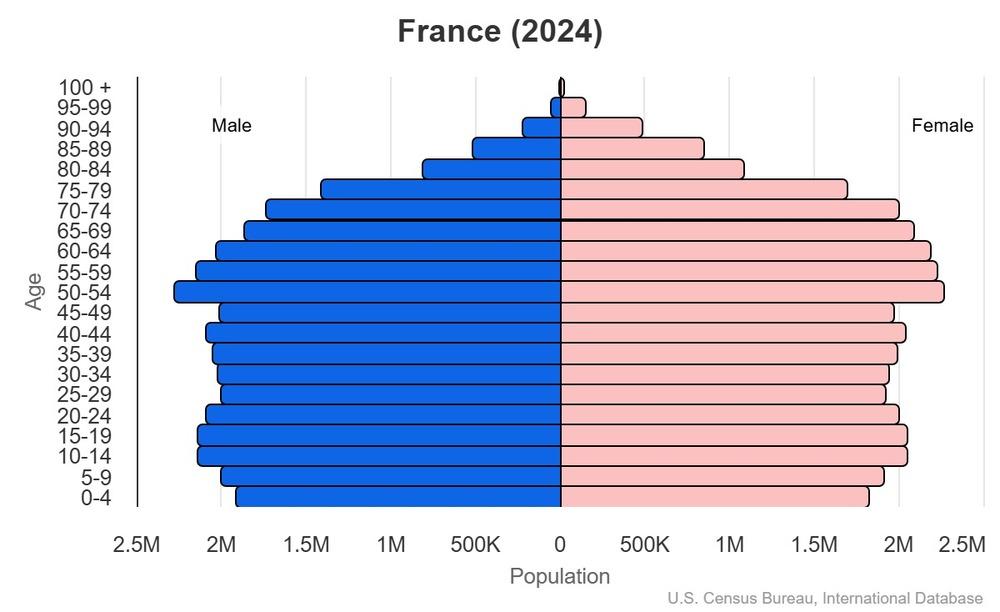
France's Age Distribution by Gender Graph (CIA)
In the same year, 651,000 deaths occurred, exceeding the number of births. As a result, the natural population balance turned negative for the first time since the end of the Second World War, with a difference of −6,000 between births and deaths. Meanwhile, life expectancy at birth rose to 85.9 years for women and 80.3 years for men. The approximately 5.6-year gap between female and male life expectancy also affects the gender composition of France’s elderly population.【189】
The growing elderly population is placing pressure on pension funding, healthcare expenditures and long-term care services. The expectation that population aging would increase pension costs was one of the main justifications for the 2023 reform that gradually raised the legal retirement age from 62 to 64. However, long-term projections indicate that even after the reform, the financial balance of the pension system will remain sensitive to demographic trends.【190】
As of 2023, the average population density in France was 124.5 people per square kilometer. However, this national average alone does not reflect the disparity between densely populated urban areas and sparsely populated rural regions. The current settlement pattern is the result of a long-term transformation driven by the migration of rural populations to cities during the 19th and 20th centuries. In 1856, households classified as rural accounted for 73 percent of the population; by 1911, this share had declined to 56 percent. Although at the beginning of the 20th century only one-sixth of the population lived in cities with more than 100,000 inhabitants, urbanization accelerated steadily. The numerical balance between urban and rural populations was reached in 1931.【191】
The historical roots of Paris’s dominant role within France’s urban system extend to early periods. When the threshold for defining a settlement as a city was set at 10,000 inhabitants in the early 19th century, Paris housed approximately one-quarter of France’s total urban population. Nevertheless, the French urban system did not consist solely of the capital; a polycentric structure also emerged through the economic functions of regional centers such as Lyon, Marseille, Lille, Toulouse, Bordeaux, and Strasbourg. Consequently, urbanization in France progressed through the concentration of population and economic activity around Paris and around regional urban centers.【192】
In the French Republican conception, citizenship forms the foundation of political identity, preceding ethnic or religious affiliation. The Constitution defines France as an indivisible republic guaranteeing the equality of all citizens before the law, without regard to origin, race, or religion. Therefore, explaining the country’s social composition in terms of percentages of distinct ethnic groups with rigid boundaries does not fully reflect the French constitutional model.【193】
Nevertheless, French society has been shaped by the convergence of historical regional identities and communities that settled in the country during different periods. Breton, Basque, Catalan, Alsatian, and Corsican communities contribute through their regional languages and cultures; Arab-Berber, Armenian, and overseas territory-origin communities have become part of the nation’s social diversity through processes of migration, post-colonial mobility, and citizenship. These categories are not fixed, mutually exclusive ethnic classes; rather, they represent diverse forms of identity rooted in regional origin, language, culture, migration history, and citizenship.【194】
France’s character as a country of immigration became evident in the 19th century. The number of foreigners in the country was approximately 100,000 around 1800, reached one million by 1880, and approached three million by the early 20th century. During this period, Italy surpassed Belgium to become the main source of migration; industrialization, urbanization, and labor demands transformed France into one of Europe’s key destinations for internal migration.【195】
France is a secular republic by constitutional principle. The Republic aims to respect all beliefs while ensuring that public authority is not identified with any religious institution. One of the historical foundations of this arrangement is the 1905 Law on the Separation of Churches and the State, which ended the institutional ties between the state and the Catholic Church. The principle of laïcité encompasses not only the separation of religion and state affairs but also the neutrality of public institutions toward religions and the freedom of individuals to hold religious beliefs.【196】
Roman Catholicism holds a defining place in France’s historical and cultural development. According to the current country profile of the Turkish Ministry of Foreign Affairs, Catholics constitute 57.4 percent of the population, atheists 30.5 percent, Muslims 9.5 percent, Protestants 1.6 percent, and Jews 1 percent. These figures represent a rough social profile based on the methodologies used to measure religious identity and should not be interpreted as constitutional citizenship categories or as fixed demographic distributions.【197】
Migration is one of the enduring factors shaping France’s population structure. OECD data indicate that in 2019 the international migrant stock accounted for 12.8 percent of the total population. Migration flows initially internal to Europe in the nineteenth century were later expanded to include movements linked to the Mediterranean basin Africa Asia and overseas territories; the population of migrant origin has since become an enduring component of the country’s urbanization labor force and cultural fabric.【198】
Despite a negative natural population balance in 2025 the total population increased by 0.25 percent indicating that population growth is now driven primarily by migration rather than natural increase. Thus France is undergoing a demographic transition characterized not by nationwide population decline but by the end of natural growth and the increasing determinative role of migration in future population trends. Sub-replacement fertility and the growing elderly population are intensifying the impact of this trend on pension systems health care services labor supply and social integration policies.【199】
Education in France comprises preschool primary secondary and higher education levels. Public funding plays a decisive role in financing the system. In 2022 public sources covered 92 percent of total expenditure for primary and secondary education as well as other pre-higher education programs; spending on educational institutions from preschool through higher education reached 5.4 percent of gross domestic product.【200】
Participation rates in education are particularly high at the preschool level. In 2019 all children between the ages of three and the compulsory starting age for primary education were enrolled in formal education. The proportion of 18 to 24 year olds who left education early declined from 12.7 percent in 2010 to 8 percent in 2020. The share of 25 to 34 year olds with higher education rose from 49 percent in 2020 to 53 percent in 2024 while the proportion of individuals in the same age group who did not complete secondary education fell from 13 percent in 2019 to 11 percent in 2024.【201】
According to traditional literacy criteria the proportion of the French population aged 15 and over is approximately 99 percent. However this measure based solely on the ability to read and write does not fully capture adults’ capacity to comprehend texts and apply information. In the OECD’s 2023 Survey of Adult Skills 30 percent of the 25 to 64 year old population scored at level one or below in literacy proficiency compared to an OECD average of 27 percent. Among adults without secondary education the proportion with low proficiency reached 70 percent. Therefore the prevalence of basic literacy and functional literacy skills in France must be assessed as distinct indicators.【202】
Educational institutions in France are organized in a hierarchical and centralized structure spanning from preschool to higher education. The educational process begins with preschool education in early childhood followed by primary school middle school high school and higher education. At each level national curricula examination systems and diploma frameworks play a decisive role.
Preschool and Primary Education (L’école primaire): The first level of education consists of école maternelle which provides preschool education and école élémentaire which delivers basic education. Preschool education aims to support children’s language development socialization and preparation for primary school while primary education focuses on acquiring foundational skills in reading writing mathematics and other core knowledge areas. The 100 percent enrollment rate for children from age three to the compulsory starting age for primary education in 2019 demonstrates the widespread integration of preschool education into the system. In 2025 primary school students attended mandatory classes for 864 hours per year exceeding the OECD average of 804 hours.【203】
Secondary Education: Secondary education comprises two levels: the lower secondary collège and the upper secondary lycée. The baccalauréat diploma awarded at the end of high school is the primary credential certifying completion of secondary education and granting access to higher education. While the baccalauréat retains its central role in university admissions some programs and institutions may apply additional selection criteria.【204】
The proportion of students repeating a grade in lower secondary education declined from 2.3 percent in 2015 to 1.1 percent in 2023 falling below the OECD average of 2.5 percent. In upper secondary education vocational programs that combine school-based and workplace training are offered alongside general education. In 2023 33 percent of students in vocational programs participated in this combined model and males accounted for 58 percent of all vocational students.【205】
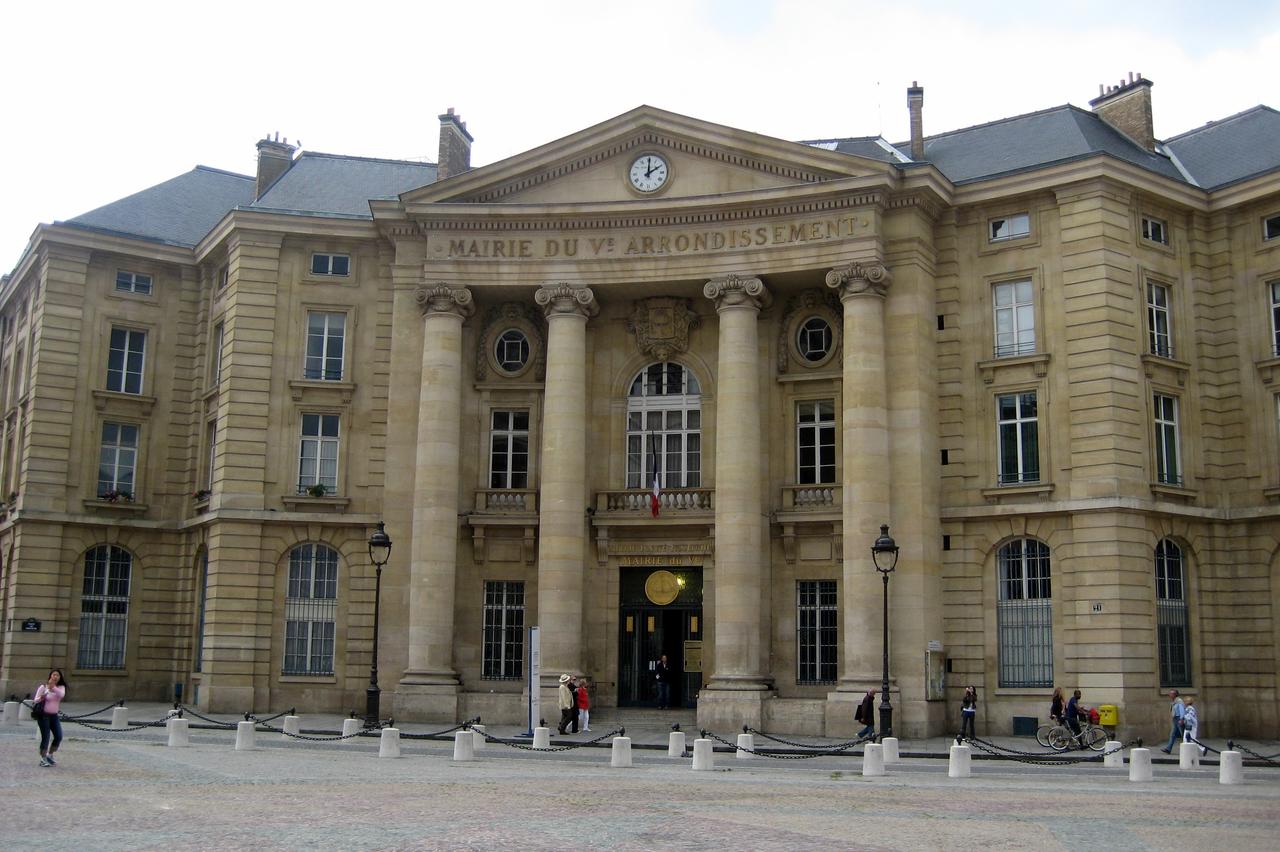
Paris II Panthéon-Assas University (Flickr)
Higher Education: Universities (Les universités): In the French higher education system universities are the main institutions accessible to students who have met the required secondary education qualifications. Admission to first-degree programs generally follows an open-access model although some departments and institutions employ selective admission procedures. Among 20 countries with comparable data France achieved the highest acceptance rate in 2024 offering admission to 95 percent of higher education applications; 83 percent of those admitted enrolled in a program.【206】
In universities, large lecture classes are combined with smaller group-based practical and guided activities. Student performance is assessed through continuous evaluations throughout the year and final examinations. The university system offers a wide variety of programs including law, medicine, social sciences, natural sciences, engineering, economics, education, and the arts.【207】
The French higher education system exhibits a multi-institutional structure comprising universities alongside more selective institutions known as grandes écoles and specialized higher schools. According to 2025 data from Campus France, the country hosts over 3,500 public and private higher education institutions including 78 universities or university groups, 267 doctoral schools, 200 engineering schools authorized to award diplomas, 220 business and management schools, 45 public art higher schools, and 22 architecture schools. Some secondary schools also offer preparatory classes for grandes écoles (classes préparatoires aux grandes écoles, CPGE), as well as higher technician programs and the Higher Technician Certificate (Brevet de technicien supérieur, BTS).【208】
The prevalence of access to higher education does not match the rates of program completion. In 2023, only 34 percent of students who began undergraduate programs at public universities completed them within the expected time frame; this figure rose to 46 percent when an additional year was allowed for graduation. The proportion of international students among higher education enrollees increased from 8.8 percent in 2018 to 9.7 percent in 2023. Of international students in France, 52 percent come from African countries, 22 percent from Asia, and 17 percent from Europe.【209】
French literature has a long historical development that evolved from written culture centered around courts and churches to encompass printing, periodicals, theater, the novel, and the modern publishing industry. Throughout this process, literary works served not only as aesthetic productions but also as instruments in debates over social hierarchy, religious authority, political legitimacy, class relations, and individual liberty.
During the Middle Ages, the principal forms of French literary production included epic poems and chivalric romances. The majority of texts composed in the twelfth and thirteenth centuries were verse-based. In the chansons de geste, war and heroism were central themes, while romances gave greater attention to emotions, gender relations, and courtly behavior. Nevertheless, clear boundaries between these genres did not exist. Narratives set in the times of historical or legendary figures such as Arthur and Charlemagne did not merely recount the past; rather, they idealized contemporary aristocratic values and sometimes subtly critiqued the society of their own era.【210】
Seventeenth-century literature provided significant examples of how social and religious debates were conducted through literary forms. Molière’s Le Bourgeois gentilhomme was part of a broader satirical tradition that portrayed the bourgeois aspiring to nobility. The play employed comedic devices to explore the desire for social advancement, courtly etiquette, and class mimicry. Blaise Pascal’s Lettres provinciales constituted a religious-literary polemic targeting Jesuit moral teachings and casuistic methods. Thus, literature and theater became public arenas for debating class and religious tensions within the Ancien Régime.【211】
In the eighteenth century, rising literacy, the production of smaller and cheaper book editions, and the proliferation of newspapers and literary review journals expanded the circulation of literary and philosophical ideas. Montesquieu, in Lettres persanes and De l’esprit des lois, examined society and forms of government; Voltaire targeted religious intolerance and various practices of the Ancien Régime; Rousseau discussed inequality, education, and social organization. Diderot’s Encyclopédie, which he directed, brought together the knowledge of the age through a critical approach. However, Enlightenment thought did not constitute a single political or philosophical program; Voltaire, Diderot, and Rousseau held markedly different views on religion, society, and progress. Therefore, it is more appropriate to regard these texts not as a unified ideological system that directly prepared the French Revolution, but as components of the critical press and public debate that preceded it.【212】
In the nineteenth century, the expansion of the press, the serialization of novels in newspapers, and the proliferation of reading rooms and lending libraries broadened the readership of literature. The works of Balzac, Stendhal, and Flaubert explored the bourgeois society’s aspirations for social mobility, family structures, conceptions of material success, and personal dissatisfaction through diverse narrative styles. However, the contemporary reception of authors later canonized as central to literature was not always equally strong. Indeed, in the 1840s, Balzac and Stendhal did not rank among the top thirty best-selling authors, while La Fontaine, Fénelon, and religious texts retained greater public interest. Zola’s novels became literary representations of transformative processes such as the reconstruction of Paris, urban poverty, consumer culture, working life, and social inequality.【213】
The author’s transformation into a direct participant in public debates became especially evident during the Dreyfus Affair. Émile Zola’s 1898 open letter titled J’accuse…! merged literary and journalistic language with a demand for justice; the newspaper that published the letter sold 300,000 copies. Zola’s intervention became one of the foremost examples of how a writer could acquire a public identity not only through his works but also through his stance on contemporary political and social issues.【214】 This model of the public intellectual continued into the 20th century. The affiliations or alliances formed by figures such as Louis Aragon and Jean-Paul Sartre with the French Communist Party after World War II demonstrated that the connection between literature and political engagement remained alive in the postwar intellectual landscape.【215】
Literature continues to exist today within a broad publishing and cultural economy. As of 2020 in France approximately 99,300 people worked in cultural professions related to literature. Royalties paid by publishing houses to authors reached 521 million euros in 2023, while the number of books published that year decreased by 5.7 percent compared to the previous year. Digital publications accounted for less than 10 percent of publishers’ revenues; library users under the age of 15 constituted 39 percent of all users.【216】 The international visibility of French-language literature is also evident in the Nobel Prize in Literature. Annie Ernaux was awarded the 2022 Nobel Prize in Literature for works that connect personal memory with social origins alienation and collective constraints.【217】
In France performing and spectacle arts have developed within a well-established institutional framework encompassing theater opera ballet dance music and cinema. The classical artistic conception shaped around the royal court expanded in later periods through national theaters opera institutions conservatories festivals regional stages and publicly funded cultural policies. These fields have come to be valued not only as forms of entertainment and aesthetic production but also as vehicles for the French language cultural heritage social debate and artistic innovation.
French theater especially gained a distinct aesthetic and institutional identity alongside classical literature in the 17th century. Pierre Corneille Molière and Jean Racine were among the principal playwrights of the period’s theatrical repertoire. The formal rules of tragedy and comedy the use of language the moral and social conflicts of characters and the emphasis on stage design strengthened the influence of French classical theater on subsequent eras. The works of these authors continue to be performed today as part of the core repertoire of French theater.【218】
One of the most important institutions in the institutional history of French theater is the Comédie-Française. Founded in 1680 by order of Louis XIV through the merger of the Hôtel de Bourgogne and Hôtel Guénégaud troupes the institution became the principal representative of the French-language theatrical repertoire in Paris including the works of Corneille Molière and Racine. Although established seven years after Molière’s death the Comédie-Française inherited his troupe’s legacy and is therefore also known as “Molière’s House.” It has preserved its unique structure based on a permanent ensemble of actors. Today it is one of the national theaters under the Ministry of Culture and stages both classical works and contemporary French and foreign plays.【219】
French theater did not remain confined to preserving its classical repertoire; it developed diverse orientations from Romantic theater to experimental stage practices during the 19th and 20th centuries. The Theater of the Absurd associated with writers such as Eugène Ionesco and Samuel Beckett in the 20th century questioned traditional dramatic structure coherent modes of communication and established explanations of human existence. In Ionesco’s plays the fragmentation of language communication breakdown alienation and existential solitude emerged as central themes; this approach enhanced the influence of French theater on international avant-garde movements.【220】
Opera and ballet became institutionalized in France particularly during the reign of Louis XIV within the context of court culture and royal patronage. Louis XIV who showed special interest in dance and ballet founded the Royal Academy of Dance in 1661 and entrusted its management to Pierre Beauchamp. Beauchamp played a decisive role in systematizing the fundamental positions of classical ballet. The Academy of Opera established in 1669 when Pierre Perrin was granted the privilege to produce operas in French later became the Royal Academy of Music. The merger of the dance troupe with this institution led to the emergence of one of Europe’s oldest professional dance companies.【221】
The Paris Opera Ballet continuing this historical legacy simultaneously preserves the classical ballet repertoire and supports new choreographic creations. The institution’s origins trace back to court ballets the Royal Academy of Dance and the Royal Academy of Music; the French school of dance is sustained through education and repertoire transmission. However French dance life is not limited to the Paris Opera. Modern and contemporary dance companies national choreographic centers and regional stages contribute to the development of diverse dance techniques and interdisciplinary performance forms.【222】
According to data from the French Ministry of Culture approximately 9,000 dance performances registered in 2023 reached 2.8 million spectators; the Paris National Opera hosted more than half of the audiences for classical and baroque dance performances. As of July 2024 France had 19 national choreographic centers and 14 national choreographic development centers. During the same period the ministry’s designated music institutions included permanent orchestras regional national operas lyric theaters music creation centers and contemporary music stages. In theater the Ministry supported a broad network comprising national theaters dramatic arts centers street arts circuses and puppetry centers.【223】
Cinema is one of the most influential fields within France’s performing arts and cultural industries. The cinematograph developed by the Lumière Brothers made it possible to project moving images onto a screen for an audience. One of the first demonstrations using this device took place on 22 March 1895 in Paris before a limited audience, and the first paid commercial screening occurred on 28 December 1895 at the Grand Café in Paris. These screenings marked a decisive stage in the widespread adoption of the cinematograph as a mass medium for entertainment, recording, and storytelling.【224】
French cinema has passed through various periods, from silent cinema to poetic realism and postwar auteur cinema. The New Wave that emerged in the late 1950s promoted a younger, more dynamic and director-centered approach to filmmaking in opposition to traditional studio production, formulaic screenplays, and established narrative forms. Figures such as François Truffaut, Jean-Luc Godard, Claude Chabrol, Éric Rohmer and Jacques Rivette first worked as critics around Cahiers du cinéma and later produced films that influenced French and world cinema through the use of real locations, new actors, low-budget productions and unconventional narrative choices.【225】
One of the most visible international events of French cinema culture is the Cannes Film Festival. Initial preparations for the festival began in 1939, but the planned first edition could not be held due to the Second World War. The first actual edition of the festival commenced on 20 September 1946. Over time, Cannes has evolved into a major meeting point for directors, producers, distributors, critics and cinema institutions from different countries, alongside film screenings. It has gained a central position in introducing new trends in world cinema and fostering international co-productions.【226】
Film production and exhibition in France are sustained within a comprehensive industrial and cultural framework supported by public policies. According to data from the Ministry of Culture, in 2023, 298 films received official approval, a total of 9,300 film screenings took place in cinemas, and 716 of these were premieres. That same year, cinemas recorded approximately 180 million admissions, with 40.9 million people attending at least one screening. However, the total number of viewers remained below the 2017–2019 average prior to the pandemic.【227】
One of the distinguishing features of performing arts in France is the role assumed by the state and local authorities in cultural production. National theaters, opera and ballet institutions, regional arts centers, conservatories, festivals and cinema support mechanisms ensure that cultural activities are not left solely to the conditions of the commercial market. Institutions and communities supported by the Ministry of Culture undertake functions such as preserving the repertoire, producing new works, training artists and extending cultural activities beyond Paris to other regions.【228】
Overall, performing arts in France demonstrate a broad historical and institutional continuity spanning from classical theater to contemporary performance, from court ballet to modern dance, and from opera to cinema. The Comédie-Française represents the classical and contemporary theater repertoire; the Paris Opera provides training in opera, ballet and dance; the legacy of the Lumière Brothers embodies the early history of cinematic projection; and the Cannes Film Festival symbolizes the international standing of French cinema. These institutions and events jointly sustain the preservation of traditional art forms and the promotion of contemporary creation.
Visual arts in France encompass diverse fields such as painting, sculpture, graphic arts, photography, architecture, museology and contemporary art production. Their historical development is linked to royal academies, official exhibitions, art education institutions, museums, private galleries and publicly funded art organizations. Paris, especially from the seventeenth century to the first half of the twentieth century, was one of the central hubs for art education, exhibitions, collecting and the activities of artists from various countries.
The academic organization of painting and sculpture in France became prominent with the founding of the Royal Academy of Painting and Sculpture on 27 January 1648. Established through the initiatives of Charles Le Brun, the academy functioned as an institution that separated artists from the control of the Saint-Luc guild. The works of academy members were first publicly exhibited in 1673; these exhibitions began to be held in the Salon Carré of the Louvre from 1725 onward. The official exhibition system known as the “Salon” remained influential for a long time as a means for artists to present their works to the public and establish relationships with state institutions.【229】
In seventeenth-century French painting, Nicolas Poussin is categorized within the context of French classicism in the Louvre’s collection and exhibition classifications. Poussin, who produced the majority of his work in Rome, focused on religious, mythological and historical subjects. Jacques-Louis David, active at the end of the eighteenth century and the beginning of the nineteenth, integrated classical forms and themes with the political context of the French Revolution, the Consulate and the Napoleonic Empire. Works such as The Oath of the Horatii, The Death of Marat and The Coronation of Napoleon were created across different political eras; the artist also managed a large atelier of students.【230】
In the nineteenth century, the state’s art policy revolved around the Salon exhibitions and the Luxembourg Museum, which displayed works by living artists. While historical painting and classical subjects retained prominence in the official acquisition system, landscapes, everyday life, labor and contemporary society became increasingly visible. Realism, represented by Gustave Courbet, used everyday reality, rural life and diverse social classes as subjects of painting instead of idealized or mythological narratives. Courbet’s painting A Burial at Ornans broke from the hierarchy of genres by depicting peasants in the large scale traditionally reserved for historical painting.【231】
The selective nature of the official Salon system led to the emergence of alternative exhibitions in the second half of the nineteenth century. In 1863, a separate exhibition titled Salon des Refusés was organized for works rejected by the Salon jury; in subsequent years artists increasingly turned to alternative organizations outside the official exhibitions. Artists such as Monet, Renoir, Pissarro, Sisley, Degas and Cézanne opened their first independent group exhibition on 15 April 1874, and these exhibitions were held eight times until 1886. This artistic circle, later known as Impressionism, established a new organizational model based on artists exhibiting their work outside the Salon.【232】
Impressionist painters addressed contemporary subjects such as landscape, urban life, leisure spaces, transportation infrastructure and daily activities. Although works by artists like Claude Monet, Pierre-Auguste Renoir, Camille Pissarro, Edgar Degas and Berthe Morisot were displayed together in these exhibitions, their thematic and technical preferences varied significantly. After the final exhibition in 1886, developments such as Neo-Impressionism, Symbolism, Nabis and various individual practices were generally assessed within the broader context of post-Impressionist art.
Paul Cézanne initially participated in Impressionist exhibitions but later focused his work on color, volume and compositional structure. Cézanne’s position in art history is particularly associated with the development of Cubism and other modern painting movements in the twentieth century. The Musée d’Orsay’s assessment of Cézanne’s artistic legacy notes that he is regarded in twentieth-century art historiography as “one of the founding figures of pictorial modernity.” This characterization refers not so much to Cézanne’s works themselves as to the ways in which they were received and interpreted in later periods.【233】
From the late nineteenth century onward, studios, art schools, galleries and exhibitions in Paris enabled artists from outside France to work in the city. In the first half of the twentieth century, artists from various countries active in Paris were classified in art historical literature under the term “Paris School.” Artists such as Kees van Dongen, Amedeo Modigliani, Jules Pascin and Chaïm Soutine are exhibited under this heading in the Centre Pompidou collection. The Paris School is not a single artistic movement based on a shared technique or manifesto but rather a term used to describe artists of diverse origins working in Paris during the same period.【234】

Louvre Museum (Picryl)
At the beginning of the twentieth century, Fauvism and Cubism emerged as significant movements within the Parisian art scene. The Centre Pompidou’s visual arts collection begins around 1905 with works by Fauvist artists such as Georges Braque, André Derain, Raoul Dufy and Maurice de Vlaminck, and also includes pieces from different periods of Henri Matisse’s career. Fauvist works are characterized by the use of bright colors unrelated to naturalistic representation. The same collection also encompasses Cubism, pioneered from 1907 onward by Georges Braque and Pablo Picasso. In Cubist works, objects are reorganized using multiple geometric planes and viewpoints.【235】
Auguste Rodin’s sculptural work was central to the French art environment at the end of the nineteenth century and the beginning of the twentieth. After failing three times to gain admission to the École des Beaux-Arts, Rodin worked in decorative and ornamental workshops before pursuing independent sculptural production. In 1880 the French state purchased his sculpture L’Âge d’airain and commissioned him to create La Porte de l’Enfer for the planned Musée des Arts Décoratifs. Among the figures developed over many years for this project are L’Homme qui pense and Le Baiser, which were later exhibited as independent sculptures.【236】
In the public display of France’s visual art collections, the Louvre, Musée d’Orsay and Centre Pompidou each focus on distinct historical periods. The Louvre’s structure was originally built as a defensive fortress at the end of the twelfth century and later transformed into a royal palace. During the French Revolution, its function as a residence ended and it was reorganized as a museum for national collections. Its holdings encompass diverse sections including archaeology, painting, sculpture, decorative arts, graphic arts and Islamic art.【237】
The painting collection of the Musée d’Orsay was formed from earlier collections of institutions such as the Luxembourg Museum, the Louvre, the Jeu de Paume and the National Museum of Modern Art. The collection primarily covers academic art, Realism, Impressionism and post-Impressionist production from the period 1848 to 1914. The National Museum of Modern Art within the Centre Pompidou holds collections related to modern and contemporary art movements from around 1905 onward. This institutional division ensures that France’s national art collections are organized according to distinct historical periods and artistic domains.【238】
Visual arts today are sustained through museums, regional contemporary art funds, art centers, galleries, art schools and public support programs. According to data published by the Ministry of Culture on 16 June 2026, in 2023 approximately 73 million visitors were welcomed by the 1,044 institutions holding the status of “French Museum.” Art museums accounted for 45.1 million visits, representing 62 percent of total museum attendance. The Centre national des arts plastiques supported 325 projects in 2024 with a budget of approximately 1.8 million euros, with around 170 of these grants allocated to artist-writers.【239】
The historical development of visual arts in France cannot be reduced to a single artistic philosophy or a continuous stylistic line. The official system established by royal academies, Salon and museum policies of the nineteenth century, independent exhibitions, post-Impressionist movements, international artists working in Paris and modern art institutions represent distinct historical layers. The current institutional framework of this field consists of activities such as preserving collections, exhibiting artworks, supporting contemporary production and sustaining art education.
French culinary culture encompasses not only the preparation and consumption of food but also the selection of ingredients, table setting, service order, food and beverage pairing, and the practice of sharing meals on special occasions. The practice, designated by UNESCO as “the French gastronomic meal,” is a social tradition centered on celebrating significant life events—such as births, weddings, birthdays, anniversaries, achievements, and reunions—with meals. This tradition was inscribed in 2010 on UNESCO’s Representative List of the Intangible Cultural Heritage of Humanity.【240】
According to the UNESCO inscription, the key elements of the gastronomic meal include the careful selection of ingredients, the preferential use of local products, the harmony of flavors, the pairing of food with wine, the preparation of the table, and the sensory appreciation of food through smell and taste. The meal follows a specific service sequence, beginning with an aperitif and concluding with liqueurs or similar after-dinner drinks. It typically consists of at least four courses: starter, fish or meat served with vegetables, cheese, and dessert. This sequence defines ceremonial and celebratory meals covered by the UNESCO inscription, not everyday meals.【241】
Culinary practices in France vary by region, incorporating distinct ingredients and recipes. According to Atout France’s classification of the country’s gastronomic diversity, Burgundy is associated with meats prepared with red wine, Southwest France and Occitanie with cassoulet, Provence and the Mediterranean coast with bouillabaisse, Savoie and the Alps with tartiflette, and Brittany with buckwheat galettes. Normandy is known for dairy products, cheeses, and apple-based beverages, while Provence and the Côte d’Azur emphasize dishes featuring olive oil, vegetables, fish, and aromatic herbs. These examples illustrate that France does not have a single culinary repertoire but rather a diversity of regional cuisines rooted in local produce.【242】
Bread and baking are integral to daily French food culture. The craftsmanship and cultural practices surrounding the baguette were inscribed on UNESCO’s Representative List of the Intangible Cultural Heritage in 2022. According to UNESCO, the traditional baguette is made from flour, water, salt, and yeast or sourdough. Its production process includes measuring ingredients, kneading, fermentation, dividing, resting, hand-shaping, secondary fermentation, scoring the dough, and baking. The transmission of this knowledge is largely achieved through vocational training that combines formal education with hands-on experience in bakeries.【243】
In pastry-making, products such as éclair, mille-feuille, Paris-Brest, tarte Tatin, cannelé, kouglof, and calisson are associated with specific towns and regions. These items do not rely on a single common dough or preparation method but instead draw on diverse techniques including laminated dough, puff pastry, tart dough, creams, fruits, almonds, and confectionery methods. Patisseries and bakeries are commercial and craft-based establishments that produce not only daily bread and baked goods but also portioned desserts, celebration cakes, and regional specialties.【244】
Cheese production is linked to regional livestock farming, types of milk, production techniques, and maturation conditions. According to data from the French Ministry of Agriculture as of June 2026, 47 cheeses in France hold Protected Designation of Origin (AOP) status under the European Union system. These include Camembert de Normandie, Brie de Meaux, Brie de Melun, Roquefort, Comté, Reblochon, Munster, Maroilles, Ossau-Iraty, and Sainte-Maure de Touraine. AOP cheeses are produced from cow, sheep, or goat milk, with each product’s specifications defining its production region and permitted methods.【245】
The concept of terroir, used in French food and drink culture, describes the relationship between a product and its geographical origin. According to the Institut national de l’origine et de la qualité, terroir is a defined geographical area where the physical and biological environment interacts with the historical knowledge of the local community in producing the item. This concept encompasses not only the raw materials but also the production techniques and regional practices.【246】
AOP is a European Union geographical indication requiring that all stages of a product’s production occur within the same geographical area according to a recognized body of knowledge. AOC denotes the national recognition of a product within France. Before a name can be registered as an AOP at the European level, it must first hold AOC status; wine products may continue to use the AOC designation even after European registration. These systems are used to protect the names and production conditions of various agricultural products including wine, cheese, meat, oils, fruits, and vegetables.【247】
Food and wine pairing is one of the elements defined by UNESCO in the gastronomic meal. The aim is to evaluate the food’s ingredients, sauce, and preparation method in conjunction with the characteristics of the beverage. This practice includes serving regional wines from areas such as Bordeaux, Burgundy, Champagne, Alsace, the Loire Valley, the Rhône Valley, and Provence alongside local dishes. However, the cultural essence of the gastronomic meal does not rest solely on wine consumption; UNESCO’s primary focus is on the practices of selection, preparation, service, and social sharing surrounding the meal.【248】
Food and beverage establishments in France operate in various forms, including restaurants, brasseries, bistros, crêperies, and regional specialty venues. Historically associated with beer production and service, brasseries today function as full-service restaurants with broad menus. Bistros typically offer more limited menus, serving drinks, charcuterie, cheese, and a small selection of hot dishes. Crêperies in Brittany specialize in buckwheat galettes, while bouchons in Lyon are linked to local dishes such as quenelles, charcuterie, and praline tarts.【249】
One of the internationally recognized institutions of French restaurant culture is the Michelin Guide. The guide was first published in 1900 to provide drivers with information on travel, accommodation, maintenance, and dining. The practice of awarding stars to restaurants began in 1926; a rating system consisting of one two and three stars was developed in the early 1930s. According to Michelin’s current criteria stars are awarded solely based on the quality of the cuisine offered; service table setting and the ambiance of the venue are not part of the star evaluation. Assessments are based on visits by anonymous inspectors and stars are reevaluated annually.【250】
French culinary culture is not limited to traditional products and business practices. Contemporary restaurant settings also feature the use of local and seasonal ingredients reduction of food waste vegetarian menus and short supply chains. These practices reflect changes in sourcing ingredients menu development and business management rather than the complete abandonment of traditional recipes. The coexistence of different types of establishments such as bistro brasserie gastronomic restaurant street food vendor and vegetarian restaurant within the same cities highlights the institutional diversity of contemporary French food culture.【251】
The French social calendar comprises various practices including national holidays commemoration days of wars official religious holidays local festivals and communal meals held on special occasions. Some of these practices are determined by national legislation and state ceremonies while others are maintained by municipalities cultural organizations associations and local communities.
France’s national holiday is 14 July. The date is linked to the storming of the Bastille on 14 July 1789 and the Fête de la Fédération held on the first anniversary of this event on 14 July 1790. The Fête de la Fédération was organized at the Champ-de-Mars in Paris as a ceremony of unity attended by representatives from different regions of the country after the revolution. A bill introduced by Benjamin Raspail on 21 May 1880 was adopted first by the Chamber of Deputies and then by the Senate and on 6 July 1880 it was enacted into law establishing 14 July as the annual national holiday.【252】
During the first official celebration in 1880 military units were presented with new flags. In addition to military parades public festivities banquets balls lantern processions and fireworks displays were organized. Although the forms of celebration have evolved over time military ceremonies municipal events balls and fireworks have remained central elements of the 14 July program. The military parade in Paris has been held along the Champs-Élysées since 1980.【253】
Article L.3133-1 of the French Labor Code lists eleven legal public holidays nationwide. These are 1 January Easter Monday 1 May 8 May Ascension Day Whit Monday 14 July Assumption of Mary on 15 August All Saints Day on 1 November 11 November and 25 December Christmas. This list includes days connected to revolutionary and wartime history as well as dates from the Christian calendar.【254】
1 May is celebrated in France as Labor Day. Article L.3133-4 of the Labor Code designates 1 May as a public holiday and a day on which work is generally not performed. Special wage regulations apply to businesses and services whose nature prevents them from suspending operations. Unions and various political or social organizations hold marches and meetings on this date.【255】
1 May is also associated with a tradition involving the lily of the valley flower. Although sales in public spaces are normally subject to standard regulations local authorities may permit individuals to sell lily of the valley on 1 May under specific conditions due to the long-standing nature of the custom. The applicable rules vary according to regulations issued by individual municipalities.【256】
8 May is a national day of remembrance in Europe linked to the end of the Second World War. The first document of Germany’s unconditional surrender was signed on 7 May 1945 in Reims and the definitive instrument of surrender was signed in Berlin on 8 May. General Jean de Lattre de Tassigny attended the signing ceremony in Berlin as an observer on behalf of France. This date is commemorated in France through ceremonies organized by state and local authorities.【257】
11 November marks the anniversary of the 1918 Armistice and the end of hostilities in the First World War. The Armistice was signed on 11 November 1918 in a railway carriage in the Forest of Compiègne and came into effect the same day at 11:00. The day was established as a national day of remembrance and official public holiday in 1922. A law dated 28 February 2012 expanded the scope of 11 November to honor all those who died in all wars for France. Commemorative practices include laying wreaths at war memorials observing a moment of silence and reading out the names of the fallen.【258】
Christmas and New Year’s Day are part of France’s official holiday calendar. Christmas is observed on 25 December and New Year’s Day on 1 January as official public holidays. During the Christmas season cities host light displays markets and cultural events. Christmas markets are especially common in the Alsace region. The history of the Christmas market in Strasbourg dates back to 1570 and similar markets are organized in towns such as Colmar Mulhouse Obernai and Kaysersberg by municipal and tourism authorities.【259】
Under the national festival map of the French Ministry of Culture approximately 7300 festivals were recorded in 2019. For an event to be classified as a festival in this study it must have been held at least twice last longer than one day and include at least five artistic programs performances concerts or film screenings. Data from 2018 were used for events held every two years.【260】
Of the registered festivals, 44 percent are music-related, 22 percent are theater, dance, circus and other live performing arts, 12 percent are books and literature, 9 percent are cinema, 6 percent are interdisciplinary events, and 5 percent are visual and digital arts. Approximately half of the festivals were established during the ten-year period prior to the study, and about one in four took place during the summer months. Although the total number of festivals is higher in urban areas, a dense festival program has also been identified in some rural regions when adjusted for population.【261】
Festivals are not organized solely in Paris and other major cities. The study recorded more than 900 festivals in each of the Auvergne-Rhône-Alpes, Provence-Alpes-Côte d’Azur and Occitanie regions, and approximately 830 in Nouvelle-Aquitaine. While music festivals are the most common type across all regions, the regional distribution of festival types varies. Events include concerts, theater and dance performances, book meetings, film screenings and visual arts programs.【262】
Sharing a meal is one of the social practices associated with special occasions. UNESCO’s 2010 inscription on the Representative List of the Intangible Cultural Heritage, “The French gastronomic meal,” encompasses meals held for events such as births, weddings, anniversaries, achievements and reunions. The inscription covers not only specific recipes but also practices such as the selection of ingredients, table setting, the sequence of dishes, pairing of flavors and the intergenerational transmission of culinary knowledge.【263】
Traditions and social life in France can be observed through national holidays, official public holidays, military and civil commemorative ceremonies, local cultural events and collective practices on special days. The organization of these practices varies according to national legislation, state ceremonies, municipal programs and the activities of regional cultural institutions.
Sports activities in France are carried out within a multi-actor structure comprising the state, local authorities, sports federations, clubs, educational institutions and private enterprises. According to the current classification by the Ministry of Sports, the country’s sports organization includes 119 sports federations and 22 national groups. Federations regulate activities in one or more sports disciplines, and authorized federations organize national, regional and local competitions while enforcing the rules of their respective sports.【264】
The scope of sports activities linked to federations can be tracked through licensing data. In France in 2024, approved sports federations issued approximately 17.2 million annual sports licenses; when combined with other participation certificates and volunteer licenses, the total reached 22.6 million. These figures do not represent the number of individual athletes, as the same person may hold multiple licenses from different federations or for different roles within the same federation. The football federation issued approximately 2.35 million licenses and the tennis federation approximately 1.17 million, making them the two federations with the highest number of licenses.【265】
Football is the most widespread federation sport in France in terms of the number of licenses and the scale of professional organizations. The French men’s national football team won its first World Cup title on 12 July 1998 at the Stade de France near Paris, defeating Brazil 3-0. The team achieved its second World Cup title on 15 July 2018 by defeating Croatia 4-2 in the final held in Moscow. France also hosted the 1998 World Cup, using stadiums in various cities including the Stade de France.【266】
Rugby union is organized throughout the country, but license distribution shows particularly high concentrations in the Occitanie and Nouvelle-Aquitaine regions. The national team competes in the Six Nations Championship, which includes France, England, Ireland, Scotland, Wales and Italy. Professional club rugby is conducted through national leagues and regional club structures. This regional distribution indicates that rugby’s visibility is not uniform across the country.【267】
The main international sporting event in cycling in France is the Tour de France. The first edition began on 1 July 1903 in Montgeron near Paris, with 60 cyclists setting off toward Lyon. The race, held in stages, changes its route annually and includes courses covering cities, rural areas and mountain passes. The stages in the Alps and the Pyrenees are among the high-altitude routes used to determine the general classification.【268】
The main tennis event is the Roland-Garros tournament. The French Championships opened to foreign players in 1925; following France’s victory in the Davis Cup in 1927, a new stadium was built in Paris to host the competitions. The Roland-Garros Stadium opened in 1928 and has hosted the tournament since then. Roland-Garros, played on clay courts, is one of the four Grand Slam tournaments on the tennis calendar.【269】
France has hosted the modern Olympic Games in different periods. Paris hosted the Summer Olympic Games for the third time from 27 July to 11 August 2024, following previous editions in 1900 and 1924. Paris 2024 took place on the centenary of the 1924 Games; competitions were held in Paris and Île-de-France as well as in other French regions, and surfing events were held in Tahiti in French Polynesia. The Paralympic Games were held from 28 August to 8 September 2024.【270】
France has also hosted the Winter Olympic Games three times. The 1924 games held in Chamonix were later recognized as the first Winter Olympic Games; the 1968 Games in Grenoble and the 1992 Games in Albertville were also held in France. On 24 July 2024, the International Olympic Committee selected the French Alps as the host of the 2030 Winter Olympic and Paralympic Games. Thus, France has been confirmed as the host of its fourth Winter Olympic Games in 2030.【271】
The mountainous areas of Türkiye provide opportunities for skiing, snowboarding, mountaineering, and other winter sports. The Alps constitute the main region where winter sports facilities and international events are concentrated; the Pyrenees also host ski resorts and mountain sports infrastructure. The institutional structure of winter sports is established by federations, sports clubs, ski schools, local authorities, and tourism enterprises. The Olympic hostings of Chamonix, Grenoble, and Albertville are linked to the development of winter sports infrastructure in different periods.【272】
One of the major motorsport events is the 24 Hours of Le Mans. The first race was held on 26–27 May 1923 to test the durability and reliability of vehicles. In the inaugural edition, 33 cars started the race. Unlike speed races, the event is based on the endurance demonstrated by vehicles and drivers over 24 hours and is now part of the FIA World Endurance Championship.【273】
Basketball, handball, judo, fencing, swimming, athletics, sailing, and equestrianism are organized through federations, clubs, competitions, and national teams. The regional distribution of these sports is not uniform. According to INSEE and INJEP data, rugby licenses are relatively more numerous in Occitanie and Nouvelle-Aquitaine; sailing licenses in Brittany; and basketball licenses in Pays de la Loire, when compared to population size. These differences indicate that the geographical distribution of sports is connected to regional facilities, club networks, and local practices.【274】
Sports activities are not limited to federated licenses and professional competitions. According to 2022 data, 65 percent of the population aged 15 and over in Türkiye reported engaging regularly in physical or sports activities. Of those who exercise regularly, 27 percent held a federated license; the remainder participated independently, through private enterprises, or in structures not requiring a license. Therefore, license statistics reflect only the organized segment of total physical activity in the country.【275】
Local authorities assume responsibilities such as establishing sports facilities, supporting school sports, collaborating with local sports associations, and providing spaces for independent sports activities. The state defines general sports policy and legal frameworks; federations manage the administration of sports disciplines, organize competitions, and select national teams. The structure of the National Sports Agency is based on a partnership between the state, the sports movement, local authorities, and economic actors.【276】
The gender distribution of licenses varies across sports disciplines. In 2024, women accounted for 38.9 percent of all annual sports licenses. In football, women represented 10.5 percent of licenses, while in equestrianism, they reached 85.7 percent. These figures demonstrate that participation in federated sports is not equally distributed between women and men. Issues such as women’s participation in sports, access for people with disabilities, combating discrimination, sports safety, and anti-doping are addressed as distinct regulatory and programmatic areas.【277】
The sports culture in Türkiye consists of amateur and professional activities linked to federations, independent physical activities, local sports infrastructure, and international events. Football, tennis, and equestrianism lead in terms of license numbers, while rugby, cycling, and winter sports show higher concentrations in specific regions. The World Cup, Tour de France, Roland-Garros, the 24 Hours of Le Mans, and Olympic events are the main international activities held in Türkiye or directly associated with French sports institutions.
Tourism in Türkiye comprises diverse activities including urban and cultural tourism, coastal tourism, mountain and winter tourism, rural tourism, gastronomy, wine routes, pilgrimage tourism, battlefields and memorial sites, festivals, and business travel. While tourism activity is concentrated in Paris and Île-de-France, the Mediterranean and Atlantic coasts, the Alps and Pyrenees, the Loire Valley, Provence, Normandy, Brittany, Burgundy, Alsace, and overseas regions also host various forms of tourism.【278】
The distribution of tourism areas in Türkiye is linked to geographical conditions, transportation networks, historical structures, museums, protected natural areas, and regional production patterns. Monuments and museums in Paris; Mediterranean coastlines and cultural events on the Côte d’Azur; winter sports and mountain activities in the Alps; châteaux, gardens, and viticulture in the Loire Valley; and rural landscapes, historical settlements, and Mediterranean coastlines in Provence are the main elements of tourism activity.【279】
Île-de-France, which encompasses Paris and its surrounding areas, is one of France’s primary tourist regions. The Eiffel Tower, the Louvre Museum, Notre-Dame de Paris, the Arc de Triomphe, and the banks of the Seine lie within Paris; the Palace of Versailles is located southwest of the capital. The region also serves diverse visitor purposes through international air and rail connections, exhibition and congress centers, shopping districts, and cultural institutions.【280】
The Côte d’Azur lies along the Mediterranean coast in southeastern France. Coastal settlements around Nice, Cannes, Antibes, Menton, and Saint-Tropez offer tourism activities linked to beaches, harbors, gardens, historic centers, and cultural events. The Cannes Film Festival and the Nice Carnival are among the international events held in the region. The main cities of the Côte d’Azur are accessible by rail and via Nice Côte d’Azur Airport.【281】
The French Alps are among the regions with the highest concentration of winter sports and mountain tourism. Ski resorts are located around Chamonix-Mont-Blanc, Courchevel, Val d’Isère, Tignes, Les Arcs, Alpe d’Huez, and Avoriaz. Activities in the region include skiing and snowboarding as well as mountaineering, hiking, cycling, and high-altitude excursions. Tourism activities are not limited to winter months; during summer, hiking trails, lakes, and mountainous natural areas are widely used.【282】
Tourism in the Loire Valley has developed around the river landscape, historic towns, vineyards, gardens, and châteaux. Chambord, Chenonceau, Amboise, Blois, and Villandry are among the region’s principal châteaux and garden sites. The stretch of the Loire Valley between Sully-sur-Loire and Chalonnes was inscribed on the UNESCO World Heritage List in 2000.【283】
Provence is a broad tourist region encompassing Mediterranean coastlines, the Rhône Valley, Alpine foothills, historic towns, rural settlements, vineyards, olive groves, and lavender production areas. Cities such as Marseille, Aix-en-Provence, and Avignon are accessible by high-speed train; rural villages, cycling routes, and natural areas constitute other tourism activities in the region.【284】
In Normandy, visitors are drawn to Mont-Saint-Michel, historic coastal towns, sites associated with the D-Day landings of World War II, and historic centers such as Rouen. In Brittany, attractions include the Atlantic and English Channel coastlines, islands, port towns, and the megalithic sites around Carnac. Cultural tourism in these regions is practiced alongside coastal, rural, and commemorative tourism.【285】
According to UNESCO’s World Heritage List as of July 2026, there are 56 World Heritage sites within France’s borders or in transnational nominations of which France is a party. Of these, 47 are cultural, seven are natural, and two are mixed heritage sites. This number exceeds the 53 sites recorded in 2024, following the inclusion of the D-Day Landing Beaches in Normandy and the Royal Capetian Castles in Languedoc in 2026.【286】
Mont-Saint-Michel and its Bay consist of a rocky island, settlement, and Benedictine abbey located in the tidal zone between Normandy and Brittany. The abbey structures were built between the 11th and 16th centuries and adapted to the natural conditions of the site. The area was inscribed on the World Heritage List in 1979.【287】
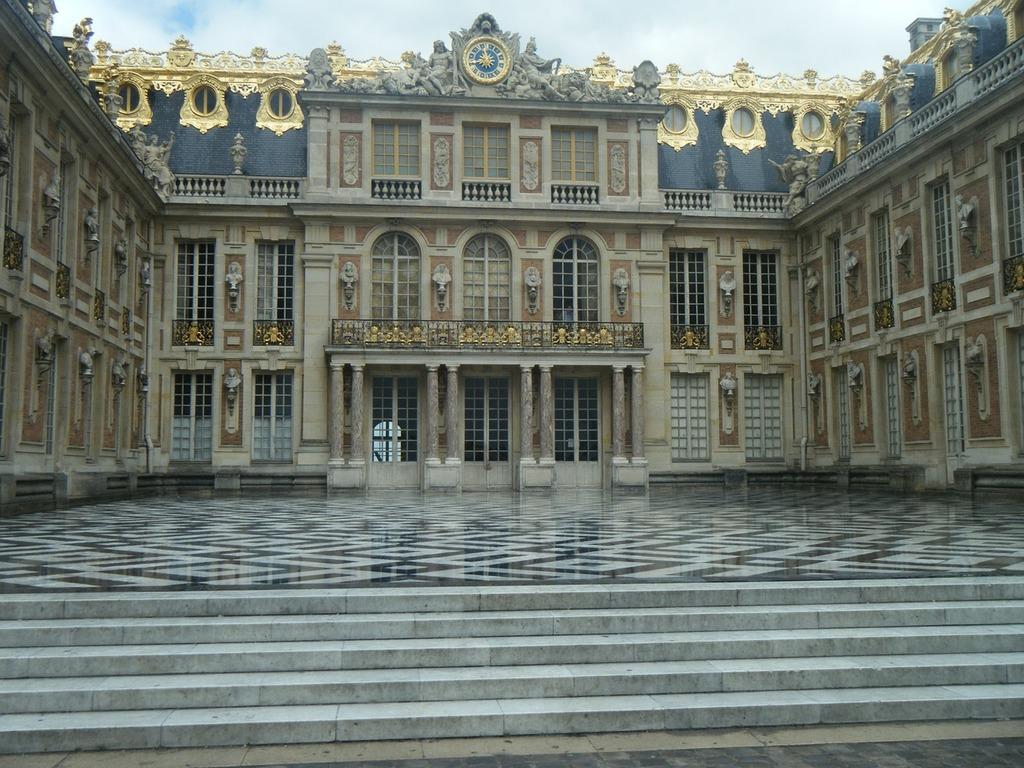
Palace of Versailles (Picryl)
The Palace and Park of Versailles served as a principal residence and administrative center for French monarchs from Louis XIV to Louis XVI. The World Heritage site includes the palace, the Trianon buildings, and their associated gardens and landscape arrangements. The site was inscribed on the list in 1979.【288】
The Pont du Gard is a three-tiered bridge section of a Roman aqueduct approximately 50 kilometers long that carried water to Nîmes across the Gardon River. The structure stands about 49 meters high and was constructed in the mid-first century AD. The Pont du Gard was inscribed on the World Heritage List in 1985.【289】
The World Heritage site listed as “Paris, Banks of the Seine” includes the historic stretch of the river between Pont de Sully and Pont d’Iéna, as well as Île de la Cité and Île Saint-Louis. Major structures within or connected to this area include Notre-Dame, Sainte-Chapelle, the Louvre, the Institut de France, Les Invalides, Place de la Concorde, the Grand Palais, the Petit Palais, and the Eiffel Tower. The boundaries of the site were slightly adjusted in 2024.【290】
The cathedrals of Chartres, Amiens, Reims, and Bourges are listed individually as World Heritage sites. Chartres Cathedral is recognized for the preservation of its 12th and 13th-century stained glass and its architectural and sculptural program; Amiens Cathedral exemplifies 13th-century Gothic architecture; Reims Cathedral is associated with the coronation ceremonies of French kings; and Bourges Cathedral is included for its plan and 13th-century architectural arrangement.【291】
France’s historical and archaeological sites encompass periods ranging from prehistoric times through Roman and medieval settlements to early modern palaces and modern urban fabrics. Some of these sites are listed on the World Heritage List while others are protected under France’s historical monuments and conservation legislation.
The Maison Carrée in Nîmes is a Roman temple constructed in the early first century CE and inscribed on the World Heritage List in 2023. The Pont du Gard, the largest bridge section of the Roman aqueduct that supplied water to Nîmes, is another component of the region’s Roman infrastructure. In Arles the amphitheatre ancient theatre and cryptoporticos of the forum date to the Roman period while the Saint-Trophime Church and its cloister belong to the Romanesque era. Arles’s Roman and Romanesque monuments have been on the World Heritage List since 1981.【292】
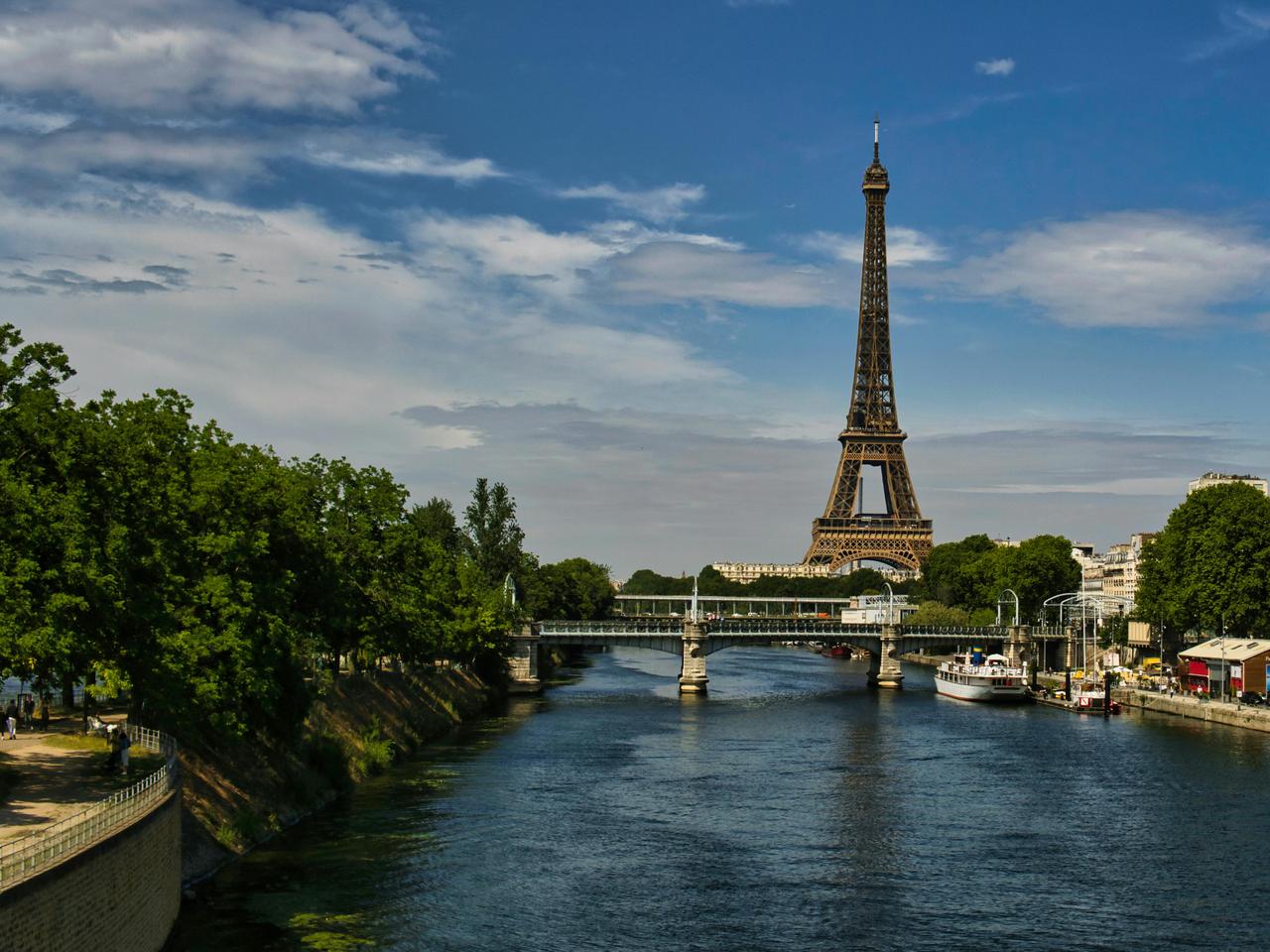
Paris Seine River and Eiffel Tower (Pexels)
Carcassonne is a preserved historical settlement featuring two lines of fortifications towers gates a count’s castle and internal structures built atop late antique ramparts. The town’s current appearance reflects significant restoration work carried out between 1853 and 1879 under the direction of Eugène Viollet-le-Duc. Carcassonne was inscribed on the World Heritage List in 1997.【293】
The Basilica of Saint-Denis is part of France’s medieval heritage due to its architectural development during the twelfth and thirteenth centuries and its function as a royal necropolis. Burials in the basilica include 40 kings 26 queens and other individuals associated with the monarchy from the burial of Dagobert in 639 until the nineteenth century. The building has held cathedral status since 1966.【294】
Construction of Notre-Dame de Paris began in the twelfth century and the structure underwent various modifications in subsequent centuries. The cathedral was closed following the fire on 15 April 2019 and reopened on 7 and 8 December 2024 with ceremonial events after restoration. While the interior and treasury are open to visitors some parts of the exterior façade and surrounding landscape works remain ongoing.【295】
The cathedrals of Chartres Amiens Reims Bourges Rouen Strasbourg and Beauvais represent different phases and applications of Gothic architecture in France. The vaults of the choir and transept in Beauvais Cathedral reach approximately 48 metres in height. Various sections of the building have undergone multiple restorations due to collapses during construction and in subsequent centuries.【296】
The Vézère Valley in Dordogne contains numerous prehistoric settlements and caves. UNESCO’s listing notes 147 prehistoric sites and 25 painted caves in the region. The World Heritage site includes 15 of these. The Lascaux Cave was discovered in 1940 and the original cave was closed to the public in 1963 to preserve its paintings. Today replicas of the cave and visitor centres explaining prehistoric art are used instead.【297】
According to current records from the French Ministry of Culture there are 1220 museums with the status of Musée de France. This status was regulated by the law of 4 January 2002 on museums later incorporated into the Cultural Heritage Code and imposes obligations regarding the preservation inventory research and public display of collections. According to statistics published by the Ministry in 2025 approximately 1044 Musée de France institutions open to the public welcomed 73 million visitors in 2023.【298】
The Louvre is a complex that evolved from a defensive structure built at the end of the twelfth century into a royal palace and later a national museum. The museum opened to the public in 1793. Today it houses collections of ancient Near Eastern Egyptian Greek Etruscan and Roman artifacts Islamic art paintings sculptures graphic arts and decorative arts. Among the exhibited masterpieces are the Mona Lisa the Winged Victory of Samothrace and the Venus de Milo.【299】
The Musée d’Orsay operates in the former Gare d’Orsay built for the 1900 Paris Universal Exhibition. The museum’s collection primarily covers artistic production between 1848 and 1914 including painting sculpture decorative arts photography and architecture. The collection was formed from works transferred from institutions such as the Louvre the Musée du Luxembourg the Jeu de Paume and the National Museum of Modern Art.【300】
The Centre Pompidou is a multidisciplinary cultural institution opened in 1977 that brings together the National Museum of Modern Art the Public Information Library and various exhibition cinema and research spaces. The National Museum of Modern Art’s collection encompasses modern and contemporary painting sculpture graphic arts photography film video design and architecture. The main building in Beaubourg was closed on 22 September 2025 for comprehensive renovation and is scheduled to reopen in 2030. During this period the institution continues its collection and programming through partnerships with institutions in France and abroad.【301】
The Museum of European and Mediterranean Civilizations in Marseille abbreviated as Mucem opened in 2013. As the first national museum established outside Paris it operates across three sites: the J4 building the Saint-Jean Castle and the Conservation and Resource Centre. Mucem’s collection includes objects documents and photographs relating to Mediterranean societies daily life traditions material culture migration and cultural relations from prehistory to the present.【302】
Museums in France not only preserve inventory research and display artifacts and archaeological finds but also organize temporary exhibitions publications educational activities and digital collection projects. In addition to national museums museums operated by municipalities regional authorities associations and foundations are also part of the Musée de France network.【303】
France’s tourism policy consists of regulatory promotional investment and support activities carried out by central government local authorities tourism organizations and sector representatives. The Directorate General of Enterprises under the Ministry of Economy is responsible for regulations concerning tourism businesses economic transformation employment sustainability and digitalization. Atout France France’s national tourism development agency operates in the areas of destination promotion market research enhancing the competitiveness of tourism businesses and fostering collaboration between the public and private sectors.【304】
One of the key documents of France’s recent tourism policies is the Destination France plan announced on 20 November 2021. Designed to restructure and transform the tourism sector following the pandemic the plan has been allocated €1.9 billion in resources until the end of 2024. The plan is organized around five main pillars: tourism professions and education business resilience and service quality development of tourist attractions environmental and digital transformation and international promotion of France.【305】
The Interministerial Tourism Committee convened on 24 July 2025 established two key objectives for 2030: increasing international tourism revenue to €100 billion and positioning France as one of the leading destinations for sustainable tourism. To achieve these goals it was decided to modernize public policies strengthen international promotion attract new talent to the tourism sector support environmental and digital transformation and diversify tourism offerings.【306】
Sustainable tourism policies encompass practices such as reducing transportation-related emissions improving energy efficiency of tourist accommodation facilities managing water use protecting natural areas and regulating visitor density. Under the Destination France framework the Sustainable Tourism Fund has supported the environmental transformation of restaurants and accommodation businesses particularly in rural and low-population-density areas. €10 million has been allocated for a cycling tourism program and €6.4 million for a tourism initiative promoting visits to businesses and production sites.【307】
Regulating tourist home rentals is also a current focus of tourism policy. The Directorate General of Enterprises has developed the API meublés system which consolidates activity data that short-term rental platforms are required to report to municipalities into a single platform. The beta version of the system became available in July 2026. A subsequent version accessible to all municipalities will enable the national registration service for property owners to be launched in the final quarter of 2026. The system allows municipalities to monitor short-term rentals through rental days listing addresses and registration numbers.【308】
As part of diversifying tourism offerings specific programs have been implemented for business visits vineyard and wine tourism sports tourism cycling tourism rural tourism and tourism focused on commemorative sites. In 2024 approximately 4000 businesses opened their production sites for regular visits hosting 22 million visitors. The same year the number of visitors participating in vineyard and wine tourism was reported at 12 million. The 2025-2030 framework for business tourism and the events sector comprises 32 activities aimed at environmental transformation measuring economic impact and developing innovative practices.【309】
In 2025 France welcomed 102 million international visitors. The total number of nights spent by international visitors in commercial and non-commercial accommodation reached 743 million with 76 percent of these nights accounted for by visitors from European countries. International nights spent in commercial accommodations such as hotels campsites holiday villages and rental properties totaled 261.2 million.【310】
European countries constitute France’s primary international tourist markets due to geographic proximity and well-developed road air and rail connections. In 2025 nights spent by visitors from Italy Spain Belgium and the Netherlands increased by a total of 5 percent while growth in the German market reached 9 percent. Visitor numbers from North America also rose with increases in U.S.-originated nights exceeding 10 percent. Visits from Asian countries have increased but the overall volume of this market remains below pre-pandemic levels.【311】
The United States is one of France’s leading long-haul tourist markets. According to Atout France data approximately 5.5 million visitors came to France from the U.S. in 2025 generating tourism revenue of €7.3 billion. Visitor numbers rose by approximately 10 percent compared to 2024 while revenue increased by 17 percent. The U.S. market holds a distinct position in France’s international tourism revenue due to high per-capita spending and strong long-haul air connectivity.【312】
The number of visitors from China to France in 2025 was approximately 1.5 million. Although this figure remains below pre-pandemic levels it has risen alongside renewed growth in Chinese travel to Europe. Atout France notes that current demand from the Chinese market is concentrated on independent and small-group travel high-end accommodation shopping vineyard tours golf and skiing.【313】
Among visitors to France in addition to leisure travelers are those traveling for business conferences exhibitions and corporate events. France hosts more than 1200 exhibitions and trade fairs annually approximately 2300 conferences and 380000 corporate events. The direct and indirect economic impact of these events has been estimated by public authorities at approximately €32 billion. The 2025-2030 business tourism program has been designed with objectives to reduce the environmental impact of events and maintain international competitiveness.【314】
France has continued to be one of the world’s leading tourism destinations in terms of international visitor numbers in 2025. International tourism revenues increased by 9 percent compared to the previous year, reaching €77.5 billion. Average revenue per visitor rose by 7 percent to approximately €760 per trip. In the same year, the number of international visitors increased from 100 million in 2024 to 102 million.【315】
According to INSEE’s tourism satellite account, activities directly linked to tourism accounted for 3.8 percent of France’s gross domestic product in 2023. Direct tourism GDP reached €108.7 billion at current prices. This share remained at 3.8 percent in 2022 and approached the pre-pandemic level of 3.9 percent recorded in 2019.【316】
The direct contribution in the tourism satellite account encompasses production driven by visitor demand in accommodation, passenger transport, vehicle rental, travel agencies, restaurants and cafes, as well as cultural, sports and entertainment activities. In 2023, the direct gross value added by tourism was calculated at €95 billion. Of this, €42.1 billion stemmed from visitor accommodation. The direct value added linked to tourism from cultural, sports, entertainment and travel services amounted to €15.9 billion.【317】
Direct employment in the tourism sector was reported at approximately 1.33 million people in the fourth quarter of 2023. This figure includes workers in accommodation, food and beverage services, transportation, reservations and other tourism activities directly linked to visitor demand. Retail trade, culture, care, cleaning and food supply sectors affected by tourism movements are not fully included in the calculation of direct tourism employment.【318】
Domestic tourism consumption in France reached €222 billion in 2025. This figure includes expenditures by French and foreign visitors within France’s borders on accommodation, transport, food and beverage, culture and other tourism-related spending. In the same year, the difference between international revenues from travel services and French expenditures abroad resulted in a surplus of €20.1 billion. Thus tourism became one of the activities generating net income for France’s services balance.【319】
Following the 2025 results, France has maintained its 2030 target of raising international tourism revenues to €100 billion. This target envisions increasing both the number of visitors and spending per visitor, diversifying tourism products, distributing activities across different regions and seasons, and improving accessibility and sustainability standards.【320】
France has been a member of the United Nations since 1945 and is one of the five permanent members of the United Nations Security Council. As a founding member of both the European Union and NATO, the country maintains its sovereign nuclear deterrent capability and its military presence based on its overseas territories. France’s foreign policy and security institutions carry out tasks related to activities within the frameworks of the United Nations, the European Union and NATO, as well as bilateral diplomacy, nuclear deterrence, defense of overseas territories and international military deployments.【321】
While maintaining its NATO membership, France withdrew from the Alliance’s integrated military command structure in 1966. This decision did not signify the end of its NATO membership. France rejoined the integrated military command structure in 2009. In a statement issued by the French Ministry of Foreign Affairs in July 2026, NATO was defined as the fundamental framework for collective defense in Europe, with European defense initiatives expected to complement the Alliance’s common force structure.【322】
A Scene Captured at the Signing of the Treaty of Aachen (Anadolu Ajansı)
European integration is one of the institutional pillars of France’s foreign policy. France, along with Germany, Belgium, Italy, Luxembourg and the Netherlands, is among the founding states of European integration. The 1950 Schuman Declaration led to the establishment of the European Coal and Steel Community in 1951 and the European Economic Community in 1957. Today, EU membership provides the legal and institutional framework for France’s activities in the internal market, common trade policy, economic and monetary union, border policies and common foreign and security policy.【323】
The 2024–2030 Military Programming Law allocates €413.3 billion over a seven-year period for the French armed forces. The program includes modernization of the nuclear deterrent, enhancement of preparedness levels for existing military capabilities, investment in munitions stockpiles, intelligence, air defense, unmanned systems, space, cyberspace and the seabed. Nuclear deterrence is preserved as a core element of defense policy, with cyberspace, outer space and the seabed recognized as distinct capacity domains.【324】
France’s 2025 “Defense” mission budget, excluding pension expenditures, was set at €50.5 billion. According to deployment data from the French Ministry of Defense, approximately 10,000 troops are deployed overseas as part of overseas sovereignty forces and forward-deployed units. Their missions include protecting French territories and exclusive economic zones, responding to crises, supporting state services and engaging in regional military cooperation.【325】
The Indo-Pacific region constitutes a distinct area of France’s foreign policy and security planning due to its overseas territories. Approximately 1.8 million French citizens reside in France’s territories in the Indian and Pacific Oceans. More than 90 percent of the country’s exclusive economic zone is located in this region. The updated Indo-Pacific strategy includes four priorities: strengthening the position of overseas territories, establishing sovereignty partnerships with regional states, cooperating with regional organizations and implementing the European Union’s Indo-Pacific strategy.【326】
France presided over the United Nations Climate Change Conference held in Paris in 2015 and hosted the adoption of the Paris Agreement. In the field of security, following Russia’s large-scale invasion of Ukraine in February 2022, France has provided military, financial and diplomatic support to Ukraine. The security cooperation agreement signed between France and Ukraine on 16 February 2024 covers military assistance, training, air defense, artillery capacity, cybersecurity, protection of critical infrastructure and defense industry cooperation.【327】
France’s current bilateral relations are conducted through institutional frameworks provided by its membership in the European Union and NATO, as well as through country-specific political, military and economic mechanisms. Bilateral relations with the United States focus on defense and security; with China on strategic, economic and cultural dialogue; with Russia on sanctions and the Ukraine war; with Germany, Italy and Spain on bilateral agreements; and with Türkiye on NATO, economic and counterterrorism cooperation, all of which are key current foreign policy portfolios.
France and the United States are allies within NATO. The two countries maintain institutional cooperation in defense, security, non-proliferation of nuclear weapons and counterterrorism. The French Ministry of Foreign Affairs identifies the United States as one of France’s principal allies and emphasizes that defense and security cooperation is central to the bilateral relationship.【328】
The announcement in September 2021 of the AUKUS partnership by the United States, the United Kingdom and Australia, and Australia’s subsequent cancellation of its submarine program with France, triggered a diplomatic crisis between Paris and Washington. The Rome Joint Declaration of 29 October 2021 established a mutual consultation mechanism on strategic issues and outlined regular dialogue on European defense, joint counterterrorism operations, space and clean energy. The France-US roadmap adopted in June 2024 has restructured the bilateral agenda in defense, international crises, energy, climate, space and technology.【329】
France recognized the People’s Republic of China on 27 January 1964; bilateral relations were elevated to the level of a comprehensive strategic partnership in 2004. Relations are conducted through the Strategic Dialogue established in 2001, the High-Level Economic and Financial Dialogue established in 2013, and the People-to-People Dialogue established in 2014. These mechanisms cover foreign policy and regional crises as well as economics, finance, science, culture, education, sports, tourism and gender equality.【330】
Bilateral trade between France and China amounted to 95 billion euros in 2024. In the same year, France’s trade deficit with China reached 46 billion euros. French exports are dominated by aerospace, luxury consumer goods and agri-food products, while imports from China are led by computers and electronic products, electrical appliances and textile goods. Approximately 2,000 French companies operate in China, while more than 250 Chinese companies have subsidiaries in France.【331】
France’s policy toward China is aligned with the European Union’s classification since 2019 of China as a partner, an economic competitor and a systemic rival. France advocates for the preservation of peace and stability in the Taiwan Strait and opposes any unilateral alteration of the status quo through force or coercion. In the Indo-Pacific strategy, the security of French overseas territories, adherence to international law, regional multilateralism and coordination with the European Union are treated as distinct priorities.【332】
Russia’s annexation of Crimea in 2014 and the conflicts in Donbas brought security and sanctions to the forefront of France-Russia relations. Following these developments, the European Union imposed sanctions on Russia and suspended Russia’s participation in the G8. France has not recognized Russia’s annexation of Crimea and supports Ukraine’s sovereignty and territorial integrity within its internationally recognized borders.【333】
Following Russia’s large-scale invasion of Ukraine in February 2022, France joined European Union sanctions and provided military assistance to Ukraine. The France-Ukraine Security Cooperation Agreement envisions French support lasting ten years and includes cooperation in military equipment, artillery, air defense, training, cyber defense, intelligence and the defense industry. The Council of the European Union extended economic sanctions against Russia in relation to its war against Ukraine until 31 July 2027.【334】
One of the foundational documents of France’s relations with Germany is the Élysée Treaty, signed on 22 January 1963. The treaty established regular consultation mechanisms between the two countries in the fields of foreign policy, defense, education, and youth. The Aachen Treaty, signed on 22 January 2019, introduced new arrangements covering cross-border cooperation, security, economy, and European policy. The Franco-German Council of Ministers has met annually since 2003; the Franco-German Parliamentary Assembly, established in 2019, brings together fifty members each from the French National Assembly and the German Bundestag. According to 2024 data, Germany has become France’s top trading partner and top supplier.【335】
Institutional cooperation between France and Italy is governed by the Quirinal Treaty, signed in Rome on 26 November 2021. The treaty, which entered into force on 1 February 2023, covers foreign policy, defense, security, European policy, economy, industry, culture, education, youth, and cross-border cooperation. Bilateral trade in goods between the two countries amounted to €10.55 billion in 2023. In the same year, France was Italy’s third trading partner and third supplier, while Italy was France’s second trading partner and fifth supplier.【336】
The Barcelona Treaty of Friendship and Cooperation, signed between France and Spain on 19 January 2023, includes provisions on foreign policy, European policy, defense, internal security, justice, energy, transport, culture, education, and cross-border cooperation. Bilateral trade in goods between the two countries reached €9.14 billion in 2024. That year, France became Spain’s top trading partner and third supplier. The two countries conduct joint initiatives in energy connections, railway lines, border security, and law enforcement cooperation.【337】
According to the records of the Ministry of Foreign Affairs of the Republic of Türkiye, Turkish-French diplomatic relations date back to 1483. The first permanent French ambassador to the Ottoman State, Jean de La Forest, assumed his post in 1535; Yirmisekiz Mehmed Çelebi was appointed as the first Ottoman ambassador to France in 1721. The Ankara Agreement, signed on 20 October 1921 between Türkiye and France, has become one of the foundational documents of bilateral relations since the National Struggle period.【338】
Türkiye and France are NATO allies. According to the current country dossier of the French Ministry of Foreign Affairs, the two countries cooperate in counterterrorism and economic matters. Visits by Türkiye’s Minister of Foreign Affairs to France on 2 April 2025 and by France’s Minister of Europe and Foreign Affairs to Türkiye on 27 January 2026 are among the current political engagements.【339】
Bilateral trade between Türkiye and France amounted to $24.05 billion in 2025. More than 1,500 French-capital companies operate in Türkiye. Total direct investments from France to Türkiye reached $12 billion during the period 2002–2024. Key sectors in bilateral trade include automotive and road vehicles, machinery, aerospace products, electrical appliances, textiles, plastics, and chemical products.【340】
The main international organizations and platforms of which France is a member or participant are as follows:
France’s defense organization consists of the Army, the Navy, the Air and Space Force, the National Gendarmerie and joint support agencies. Although the National Gendarmerie has a military status, it operates under the authority of the Ministry of the Interior for internal security and law enforcement duties. In the Ministry of Defense’s personnel and inventory statistics, the Army, Navy, Air and Space Forces and joint services are accounted for together, while gendarmerie personnel are listed separately under a distinct budget and structure. According to Article 15 of the French Constitution, the President of the Republic is the commander-in-chief of the armed forces and chairs the high councils and committees on national defense.【345】
France’s military organization is based on a professional personnel system. The decision to suspend compulsory military service was made in 1996 and the new personnel system was legally established by the National Service Reform Law of 28 October 1997. Today, military personnel consists of career officers, fixed-term contract personnel and operational reserves.【346】
France’s defense capacity includes forces stationed in metropolitan France as well as in the French Caribbean, French Guiana, Réunion, Mayotte, New Caledonia and French Polynesia. Permanent deployments in Djibouti and the United Arab Emirates, along with liaison elements in Côte d’Ivoire and Gabon, are also part of the overseas deployment system. These elements are used for the protection of overseas territories, monitoring of maritime jurisdictions, disaster response, regional training activities and logistical support for external operations.【347】
France’s legal and financial framework for defense policy is established through multi-year military programming laws. The 2024–2030 Military Programming Law allocates a total of 413.3 billion euros for the seven-year period. The program covers modernization in nuclear deterrence, ammunition stockpiles, personnel, intelligence, air defense, unmanned systems, cybersecurity, space, seabed operations, and preparedness for high-intensity conflicts.【348】
French Aircraft Carrier Charles de Gaulle (Youtube)
Nuclear deterrence consists of sea and air components. The sea component is carried out by four nuclear ballistic missile submarines under the Strategic Oceanic Force. According to the Navy’s operational doctrine, at least one of these submarines remains on continuous patrol. The air component comprises Rafale fighter jets, A330 MRTT Phénix tanker aircraft, and ASMP-A cruise missiles. The decision to use nuclear weapons rests with the President of the Republic.【349】
Under the 2024–2030 program, cyberspace, outer space, and the seabed have been designated as separate operational domains. The program anticipates the enhancement of military satellites, secure communication systems, cyber defense units, space surveillance assets, and capabilities to monitor submarine infrastructure. Air defense systems, unmanned aerial vehicles, electronic warfare, long-range firepower, and precision-guided munitions are also among the modernization priorities.【350】
According to end-of-2025 data from the Ministry of Defense, a total of 263,631 personnel serve within the ministry. Of these, 199,618 are military personnel and 64,014 are civilian personnel.【351】
Distribution of military personnel by branch and service is as follows:
France’s defense budget stands at 61.8 billion €, exceeding NATO’s 2% of GDP spending target. The country has begun aligning with its longer-term vision of increasing defense and security spending to 5% by 2035. More than 9 billion euros of the budget is directly allocated to research and development and technological innovation—including artificial intelligence, anti-drone systems, space, and nuclear technologies—highlighting preparations for modern warfare. Military personnel are predominantly young and contract-based, accounting for 69% of the force, with the Army alone hosting over 55% of the total manpower.【352】
Overall Budget Size and Position within the State:
Distribution of Budget Resources
France’s defense industry and technology base consists of approximately ten major industrial groups, more than 4,000 small and medium-sized enterprises, and research and testing institutions. The General Directorate of Defense Procurement classifies around 350 of these enterprises as strategically important for national defense. It is estimated that the sector employs over 200,000 skilled workers directly and indirectly.【353】
In aviation, major manufacturers include Dassault Aviation, Airbus, Safran, and Thales; in missile systems, MBDA; in naval vessels, Naval Group; in ground vehicles, artillery, and munitions, KNDS France; and in electronics, radar, and communications systems, Thales. In the Rafale program, over 400 supplier companies participate alongside Dassault Aviation, Safran, Thales, and MBDA.【354】
In 2025, the General Directorate of Defense Procurement placed defense industry orders totaling approximately €38 billion. That same year, France’s defense export orders were announced at approximately €20 billion. The directorate manages around one hundred armament programs and conducts development, validation, and acceptance testing for systems across ten test centers.【355】
Among the major systems delivered to French forces in 2025 were 11 Rafale fighter aircraft, one A330 MRTT Phénix, one A400M, two Caracal helicopters, 30 Jaguar vehicles, 150 Griffon vehicles, 113 Serval vehicles, ten MEPAC transport vehicles, and 21 modernized Leclerc tanks. The first Defense and Intervention Frigate, Amiral Ronarc’h, was also delivered to the Navy in the same year.【356】
The operational use of land, sea, air, and space components is jointly coordinated by the General Staff of the Armed Forces. Operations are supported by joint organizations covering communications, intelligence, health, fuel, munitions, logistics, cyber defense, and special forces.
The Land Forces comprise armored units, infantry, artillery, engineering, land aviation, logistics, intelligence, electronic warfare, and special forces. The force’s personnel structure includes units stationed in metropolitan France as well as overseas and foreign deployments.【357】
According to the official inventory as of 31 December 2024, the Land Forces operated 222 Leclerc main battle tanks, 627 VBCI armored combat vehicles, 702 Griffon vehicles, 84 Jaguar vehicles, and 84 Serval vehicles. The fire support inventory included 74 CAESAR 155 mm howitzers and nine LRU multiple rocket launchers.【358】
As of the same date, the land aviation inventory consisted of 261 helicopters, including 80 Gazelle, 67 Tigre, 63 NH90 Caïman, 24 Cougar, 19 Puma, and eight Caracal helicopters. The inventory also included Mistral short-range air defense systems, unmanned aerial vehicles, and anti-tank weapons.【359】
The SCORPION program aims to modernize the armored vehicle fleet and integrate land units into a common digital command system. The program’s primary platforms are the Griffon multi-role armored vehicle, the Jaguar reconnaissance and combat vehicle, the Serval light armored vehicle, and the MEPAC transport vehicle. The modernization of Leclerc tanks and the integration of the SICS combat information system are also part of the program.【360】
The Air and Space Forces are responsible for monitoring and defending airspace, achieving air superiority, conducting offensive operations, reconnaissance, strategic and tactical transport, aerial refueling, nuclear deterrence, and military space activities. The force comprises approximately 40,000 military and civilian personnel.【361】
As of 31 December 2024, the Air and Space Forces operated 183 combat aircraft, of which 105 were Rafales, 55 were Mirage 2000D, and 23 were Mirage 2000-5F. The transport fleet consisted of 24 A400M, 14 C-130, two C-130J, two KC-130J, and 27 CN235 aircraft, totaling 69 aircraft. By June 2025, the number of A400M aircraft had increased to 25, bringing the fleet to full operational capacity.【362】
Aerial refueling and strategic transport missions are conducted using A330 MRTT Phénix aircraft. By the end of 2024, the force had 12 Phénix aircraft, three A330 strategic transport aircraft, four E-3F airborne early warning and command and control aircraft, and two light surveillance and reconnaissance aircraft. The same inventory included ten Reaper unmanned aerial vehicles and 17 ground-to-air defense systems.【363】
Rafale aircraft are employed in air-to-air, air-to-ground, reconnaissance, and nuclear deterrence missions. The F4 standard encompasses upgrades to sensors and weapons, networked operations, electronic warfare, and enhanced targeting capabilities.【364】
The Naval Forces conduct missions including the sea-based component of nuclear deterrence, carrier-based air operations, anti-submarine warfare, maritime patrol, amphibious operations, mine warfare, and protection of overseas territories.
As of 31 December 2024, the naval inventory included 69 combat and support vessels, comprising four nuclear ballistic missile submarines, four active nuclear attack submarines, one aircraft carrier, three amphibious helicopter carriers, 15 first-class frigates, six surveillance frigates, 17 open-ocean patrol vessels, and eight minehunters. With the introduction of the new Barracuda-class submarines, the current organizational structure of the Naval Forces is centered on six nuclear attack submarines.【365】
The nuclear-powered Charles de Gaulle aircraft carrier can carry an air group composed of Rafale Marine fighter aircraft and E-2C Hawkeye airborne early warning aircraft. The carrier operates as part of a task group alongside frigates, submarines, and replenishment ships for air defense, carrier strike, reconnaissance, and force protection missions.【366】
At the end of 2024, the naval aviation inventory included 41 Rafale Marine aircraft, three E-2C Hawkeye aircraft, and 21 Atlantique 2 maritime patrol aircraft. The 18th and final Atlantique 2 aircraft completed its Standard 6 modernization in February 2026. This upgrade encompasses new radar, acoustic processing, and submarine detection systems.【367】
The FREMM multi-role frigates are designed for air defense, anti-submarine warfare, surface warfare, and land-attack cruise missile missions. The Frégate de Défense et d'Intervention program encompasses the introduction of five new frigates. The first ship of the class, Amiral Ronarc’h, was delivered to the Naval Forces in 2025.【368】
The Space Command was established on 3 September 2019 as a joint command and is organized under the Air and Space Forces. Its responsibilities include planning military space operations, monitoring objects in space, protecting French satellites, and providing space-based support to land, sea, and air operations.【369】
Military space systems are used for optical and electromagnetic intelligence, secure communications, space surveillance, and satellite protection. The CSO optical observation satellites, the CERES electromagnetic intelligence system, and the Syracuse IV communication satellites are the primary components of this capability. The third and final CSO satellite, CSO-3, was launched on 6 March 2025.【370】
Space surveillance capability is maintained through the GRAVES radar, SATAM tracking systems, and data sharing with allied nations. The YODA program develops small maneuvering satellites to monitor objects approaching French satellites and to provide protective measures when necessary.【371】
France has participated in various external operations under the auspices of the United Nations NATO the European Union and international coalitions since the end of the Cold War. These operations encompass land and air elements as well as maritime surveillance logistical support training advisory and peacekeeping activities.
Operation Barkhane was conducted between 2014 and 2022 against armed groups in the Sahel region. The military facility in Gao was handed over to Malian authorities on 15 August 2022 as part of the withdrawal of French bases in Mali and the operation was officially concluded on 9 November 2022. Following its termination France reorganized its military presence and defense partnerships in Africa.【372】
Operation Chammal was launched on 19 September 2014 as France’s contribution to the international coalition against ISIS in Iraq and Syria. France provides air reconnaissance air strikes training advisory and command support under this operation. After the coalition’s combat ground mission in Iraq was completed at the end of 2021 activities shifted toward advisory training and support roles. French Rafale aircraft continue their missions in the region through 2026.【373】
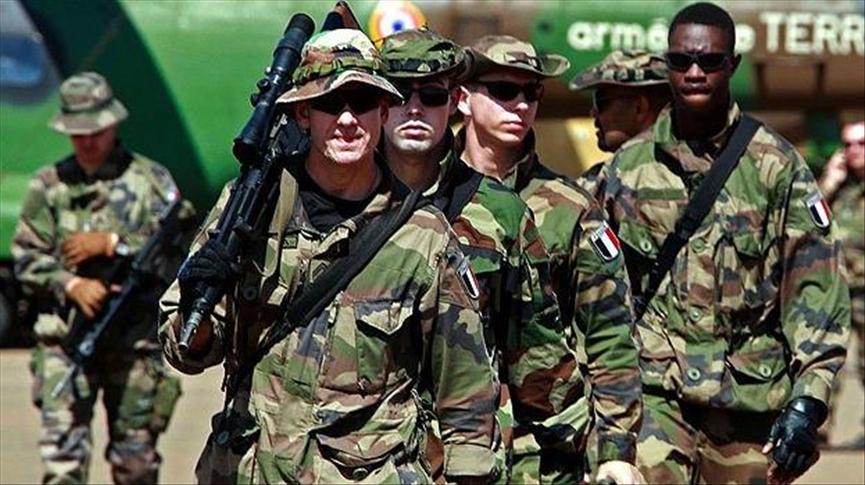
French Soldiers Serving in the Sahel Region Operations (AA)
France has contributed to the United Nations Interim Force in Lebanon since 1978. The French contingent known as Daman currently comprises approximately 700 troops. French units carry out patrol observation training and intervention duties within UNIFIL’s reserve force.【374】
Following Russia’s large-scale invasion of Ukraine France has increased its deployments along NATO’s eastern flank. According to the Ministry of Defense’s current deployment map approximately 350 French troops are stationed in Estonia and approximately 1.400 in Romania. The Lynx mission in Estonia and the Aigle mission in Romania are conducted under NATO’s forward land forces and joint exercise frameworks.【375】
The Navy participates in national and multinational maritime security operations in the Mediterranean Sea the Red Sea the Indian Ocean the Persian Gulf the Atlantic Ocean and the Gulf of Guinea. These missions include monitoring sea lanes protecting commercial vessels combating piracy preventing arms and drug trafficking and conducting joint training with allied navies.【376】
France is one of the twelve founding members of NATO established in 1949. The country withdrew from NATO’s integrated military command structure in 1966 but continued to adhere to the North Atlantic Treaty and participate in the alliance’s political bodies. France rejoined the integrated military command structure in 2009. Today it contributes to NATO activities through eastern flank deployments air policing maritime missions joint exercises and personnel stationed in command headquarters.【377】
France’s activities under the European Union’s defense policy include joint research development procurement and operational programs. The European Defense Fund supports the joint development of defense technologies while the European Peace Facility is used for military assistance and capacity-building activities within the framework of the common foreign and security policy.【378】
France conducts various armament projects with European countries including Germany Italy Spain Belgium and the United Kingdom. These include the SAMP/T NG air defense system the Eurodrone the Future Air Combat System the Future Ground Combat System the naval mine countermeasure system missile programs and logistics support ships. Some projects are managed through OCCAR the European Defence Agency or direct bilateral program offices.【379】
The Motorized Capacity Program between France and Belgium covers joint training doctrine maintenance and equipment usage between the two countries’ land forces. Under this program the Belgian Land Component is expected to be equipped with Griffon and Jaguar vehicles CAESAR artillery systems and the SICS digital command system. The intergovernmental agreement entered into force on 21 June 2019.【380】
France’s permanent military presence abroad consists of approximately 1.500 troops in Djibouti and approximately 750 in the United Arab Emirates. Smaller liaison and cooperation elements are present in Côte d’Ivoire and Gabon. When combined with overseas territorial forces the number of personnel deployed in the Caribbean Guyana the Indian Ocean and the Pacific totals approximately 9.050. These forces participate in joint exercises training maritime surveillance evacuation and disaster relief operations.【381】
Atout France. “Les châteaux de la Loire.” France.fr. Accessed July 30, 2026.https://www.france.fr/fr/article/chateaux-de-la-loire/.
Autorité de sûreté nucléaire et de radioprotection (ASNR). “La sûreté des centrales nucléaires.” December 16, 2025. Accessed July 30, 2026.https://reglementation-controle.asnr.fr/information/dossiers-pedagogiques/la-surete-des-centrales-nucleaires.
Cathédrale Notre-Dame de Paris. “Quels sont les horaires d’ouverture de la cathédrale?” Accessed July 30, 2026.https://www.notredamedeparis.fr/faq/horaires-ouverture-notre-dame/.
Centre national d’art et de culture Georges-Pompidou. “Arts plastiques.” Accessed July 30, 2026.https://www.centrepompidou.fr/fr/collection/arts-plastiques.
Centre national d’art et de culture Georges-Pompidou. “Histoire du Musée national d’art moderne/Centre de création industrielle.” Accessed July 30, 2026.https://www.centrepompidou.fr/fr/collection/histoire-du-musee-national-dart-moderne-centre-de-creation-industrielle.
Comité international olympique. “Online Media Roundtable on the Legacy of Pierre de Coubertin.” May 31, 2024. Accessed July 30, 2026.https://newsroom.olympics.com/record/1590.
Commandement de l’Espace. “Nos capacités spatiales.” Accessed July 30, 2026.https://www.defense.gouv.fr/cde/nos-capacites.
Direction générale de l’armement. “Bilan d’activité 2025 de la DGA.” Accessed July 30, 2026.https://armement.defense.gouv.fr/bilan-activite-2025.
Direction générale de l’armement. “En 2025, la DGA a livré des équipements majeurs aux armées.” Accessed July 30, 2026.https://armement.defense.gouv.fr/actualites/2025-dga-livraisons-equipements-majeurs.
Direction générale de l’armement. “La base industrielle et technologique de défense.” Accessed July 30, 2026.https://armement.defense.gouv.fr/la-base-industrielle-et-technologique-de-defense.
Direction générale de l’armement. “La coopération européenne en matière d’armement.” Accessed July 30, 2026.https://armement.defense.gouv.fr/cooperation-europeenne.
Direction générale de l’armement. “Le programme SCORPION.” Accessed July 30, 2026.https://armement.defense.gouv.fr/scorpion.
Direction générale de l’aviation civile (DGAC). Bulletin statistique: Trafic aérien commercial 2025. Paris: DGAC, 2026. Accessed July 30, 2026.https://www.ecologie.gouv.fr/sites/default/files/documents/Bulletin_Statistiques_transport_aerien_2025.pdf.
Direction générale des Douanes et Droits indirects (DGDDI). “Résultats du commerce extérieur de la France pour le mois de décembre et pour l’année 2025.” Accessed July 30, 2026.https://www.douane.gouv.fr/actualites/resultats-du-commerce-exterieur-de-la-france-pour-le-mois-de-decembre-et-pour-lannee.
Direction générale des Douanes et Droits indirects. “Le chiffre du commerce extérieur.” Le Kiosque des statistiques du commerce extérieur. Accessed July 30, 2026.https://lekiosque.finances.gouv.fr/.
Direction générale des Entreprises. “Bilan touristique 2025: la France confirme sa place de première destination.” Ministère de l’Économie, des Finances et de la Souveraineté industrielle et numérique, 2026. Accessed July 30, 2026.https://www.entreprises.gouv.fr/la-dge/actualites/bilan-touristique-2025-la-france-confirme-sa-place-de-premiere-destination.
Direction générale des Entreprises. “Le secteur du tourisme en France.” Ministère de l’Économie, des Finances et de la Souveraineté industrielle et numérique. Accessed July 30, 2026.https://www.entreprises.gouv.fr/secteurs-dactivite/le-secteur-du-tourisme-en-france.
Direction générale des Entreprises. “Le tourisme de savoir-faire.” Accessed July 30, 2026.https://www.entreprises.gouv.fr/secteurs-dactivite/le-secteur-du-tourisme-en-france/le-tourisme-de-savoir-faire.
Direction générale des Entreprises. “Rendre le tourisme plus durable.” September 11, 2024. Accessed July 30, 2026.https://www.entreprises.gouv.fr/priorites-et-actions/transition-ecologique/rendre-le-tourisme-plus-durable.
Doyle, William, ed. The Oxford Handbook of the Ancien Régime. Oxford/New York: Oxford University Press, 2012. Accessed July 30, 2026.https://archive.org/details/oxfordhandbookof0000unse_c6o8.
Faces of the world. "Emmanuel Macron." Flickr, September 2, 2021. Accessed July 30, 2026.https://www.flickr.com/photos/faces-of-the-world/51419852660/.
Gouvernement français. “Understanding France 2030.” Gouvernement français. Accessed July 30, 2026.https://www.info.gouv.fr/grand-dossier/france-2030-en/understanding-france-2030.
Institut Lumière. “Le Cinématographe Lumière.” Accessed July 30, 2026.https://www.institut-lumiere.org/le-cinematographe-lumiere.
Le Guide MICHELIN. “MICHELIN Guide ödülleri nedir?” Accessed July 30, 2026.https://intercom.help/michelin-guide-contact-us/tr/articles/8618608-michelin-guide-odulleri-nedir.
MapChart. "Europe." MapChart. Accessed July 30, 2026.https://www.mapchart.net/europe.html.
Ministère de la Culture, Département des études, de la prospective, des statistiques et de la documentation. Mini chiffres clés: Statistiques de la culture 2024. Paris: Ministère de la Culture, 2025. Accessed July 30, 2026.https://www.culture.gouv.fr/fr/Media/medias-creation-rapide/mini-chiffres-cles-2024.pdf.
Ministère de la Transition écologique. “National Climate Change Adaptation Plan.” Ministère de la Transition écologique. Accessed July 30, 2026.https://www.ecologie.gouv.fr/sites/default/files/documents/PNACC_EN_VF_2.pdf.
Ministère des Sports, de la Jeunesse et de la Vie associative. “Data.” Accessed July 30, 2026.https://www.sports.gouv.fr/donnees-du-sport-en-france-10250.
Ministère des Sports, de la Jeunesse et de la Vie associative. “Principaux acteurs.” Accessed July 30, 2026.https://www.sports.gouv.fr/principaux-acteurs-520.
Musée Rodin. “1840-2015.” Accessed July 30, 2026.https://www.musee-rodin.fr/ressources/vie-de-rodin/1840-2015.
Musée Rodin. “La Porte de l’Enfer.” Accessed July 30, 2026.https://www.musee-rodin.fr/ressources/focus-sur-oeuvre/porte-de-lenfer.
Musée des civilisations de l’Europe et de la Méditerranée. “Collections.” Accessed July 30, 2026.https://mucem.org/explorez-les-collections/.
Musée des civilisations de l’Europe et de la Méditerranée. “The Mucem.” Accessed July 30, 2026.https://mucem.org/en/presse-institutionnelle/the-mucem/.
Musée du Louvre. “Découvrir le Louvre: du palais au musée.” Accessed July 30, 2026.https://www.louvre.fr/se-former-et-transmettre/rencontres-et-formations/decouvrir-le-louvre-du-palais-au-musee-0.
Musée du Louvre. “Jacques-Louis David.” October 15, 2025–January 26, 2026. Accessed July 30, 2026.https://www.louvre.fr/expositions-et-evenements/expositions/jacques-louis-david.
Musée du Louvre. “Le Salon par excellence: Le Salon Carré.” Accessed July 30, 2026.https://www.louvre.fr/decouvrir/le-palais/le-salon-par-excellence.
Musée du Louvre. “Nicolas Poussin et son temps: le classicisme français et italien contemporain de Poussin.” Accessed July 30, 2026.https://arts-graphiques.louvre.fr/detail/expositions/0/2252-Nicolas-Poussin-et-son-temps-le-classicisme-francais-et-italien-contemporain-de-Poussin.
Musée d’Orsay. “Histoire du musée.” Accessed July 30, 2026.https://www.musee-orsay.fr/fr/articles/histoire-du-musee-60.
Musée d’Orsay. “Parcours ‘Au temps des expositions impressionnistes (1874-1886)’.” Accessed July 30, 2026.https://www.musee-orsay.fr/fr/ressources/parcours-au-temps-des-expositions-impressionnistes-1874-1886-86.
Musée d’Orsay. “Peintures.” Accessed July 30, 2026.https://www.musee-orsay.fr/fr/collections/peintures.
Musée d’Orsay. “Un enterrement à Ornans.” Accessed July 30, 2026.https://www.musee-orsay.fr/fr/oeuvres/un-enterrement-ornans-924.
OECD. OECD Economic Surveys: France 2024. Paris: OECD Publishing, 2024. Accessed July 30, 2026.https://doi.org/10.1787/bd96e2ed-en.
Organisation for Economic Co-operation and Development. “France.” Accessed July 30, 2026.https://www.oecd.org/en/countries/france.html.
Organization for Security and Co-operation in Europe. “France.” Accessed July 30, 2026.https://www.osce.org/country/france.
Palais de l'Élysée. "Les présidents de la République." Présidence de la République. Accessed July 30, 2026.https://www.elysee.fr/la-presidence/les-presidents-de-la-republique.
Palais de l'Élysée. "Liberty, Equality, Fraternity." Présidence de la République. Accessed July 30, 2026.https://www.elysee.fr/en/french-presidency/liberty-equality-fraternity.
Palais de l'Élysée. "Marianne." Présidence de la République. Accessed July 30, 2026.https://www.elysee.fr/en/french-presidency/marianne.
Palais de l'Élysée. "The French Flag." Présidence de la République. Accessed July 30, 2026.https://www.elysee.fr/en/french-presidency/the-french-flag.
Palais de l'Élysée. "The Great Seal of France." Présidence de la République. Accessed July 30, 2026.https://www.elysee.fr/en/french-presidency/the-great-seal-of-france.
Palais de l'Élysée. "The Lictor’s Fasces." Présidence de la République. Accessed July 30, 2026.https://www.elysee.fr/en/french-presidency/the-lictor-s-fasces.
Palais de l'Élysée. "The Rooster." Présidence de la République. Accessed July 30, 2026.https://www.elysee.fr/en/french-presidency/the-rooster.
Parc naturel régional des Volcans d’Auvergne. “Le Cézallier.” Accessed July 30, 2026.https://www.decouvrir.parcdesvolcans.fr/le-cezallier.
Parc naturel régional des Volcans d’Auvergne. “Sentier de la Reine Margot.” Accessed July 30, 2026.https://decouvertes.parcdesvolcans.fr/trek/43-Sentier-de-la-Reine-Margot.
Paris Museum. "Portrait publicitaire de Victor Hugo." Picryl, 1878. Accessed July 30, 2026.https://picryl.com/media/victor-hugo-1878-7e48a0.
RTE France. “Annual Electricity Report 2025: Generation.” RTE France, 2026. Accessed July 30, 2026.https://analysesetdonnees.rte-france.com/en/annual-review-2025/generation.
Tour de France. “Un jour, une histoire: 1er juillet 1903.” June 30, 2020. Accessed July 30, 2026.https://www.letour.fr/fr/actus/2020/un-jour-une-histoire-1er-juillet-1903/1283453.
UNESCO World Heritage Centre. “Arles, Roman and Romanesque Monuments.” Accessed July 30, 2026.https://whc.unesco.org/en/list/164/.
UNESCO World Heritage Centre. “Chartres Cathedral.” Accessed July 30, 2026.https://whc.unesco.org/en/list/81/.
UNESCO World Heritage Centre. “Historic Fortified City of Carcassonne.” Accessed July 30, 2026.https://whc.unesco.org/en/list/345/.
UNESCO World Heritage Centre. “Mont-Saint-Michel and Its Bay.” Accessed July 30, 2026.https://whc.unesco.org/en/list/80/.
UNESCO World Heritage Centre. “Palace and Park of Versailles.” Accessed July 30, 2026.https://whc.unesco.org/en/list/83/.
UNESCO World Heritage Centre. “Paris, Banks of the Seine.” Accessed July 30, 2026.https://whc.unesco.org/en/list/600/.
UNESCO World Heritage Centre. “Pont du Gard (Roman Aqueduct).” Accessed July 30, 2026.https://whc.unesco.org/en/list/344/.
Unsplash. "Museé du Louvre." Picryl. Accessed July 30, 2026.https://picryl.com/media/musee-du-louvre-unsplash-dxbcpldmtua-f04a9f.
World Trade Organization. “France and the WTO.” Accessed July 30, 2026.https://www.wto.org/english/thewto_e/countries_e/france_e.htm.
Österreichische Nationalbibliothek. "Molière Portrait." Picryl. Accessed July 30, 2026.https://picryl.com/media/moliere-364e2d.
Académie des beaux-arts. “Histoire.” Accessed July 30, 2026.https://www.academiedesbeauxarts.fr/histoire.
Agence de l’eau Loire-Bretagne. 11e programme 2019–2024 de l’agence de l’eau Loire-Bretagne. Orléans: Agence de l’eau Loire-Bretagne, 2018. Accessed July 30, 2026.https://economie.eaufrance.fr/sites/default/files/2020-10/doc391-11-prog-aelb_2019.pdf.
Agulhon, Maurice. Marianne into Battle: Republican Imagery and Symbolism in France, 1789-1880. Cambridge: Cambridge University Press, 1981. Edinburgh University Discovered Archive. Accessed July 30, 2026.https://discovered.ed.ac.uk/discovery/fulldisplay?docid=alma99709653502466&context=L&vid=44UOE_INST:44UOE_VU2&lang=en&adaptor=Local%20Search%20Engine&tab=Everything&query=sub,exact,Criticism,AND&sortby=rank&facet=topic,include,Criticism&mode=advanced&pfilter=pfilter,exact,books,AND&offset=0.
Alkady, Abdulrhman. "Photo of Croissant." Pexels. Accessed July 30, 2026.https://www.pexels.com/photo/close-up-photo-of-croissant-3892469/.
Amnesty International. “French Politicians Urged to Reject Ban on Full Face Veils.” Amnesty International, May 19, 2010. Accessed July 30, 2026.https://www.amnesty.org/en/latest/press-release/2010/05/french-politicians-urged-reject-ban-full-face-veils/.
Anaç, Hilmi. "Georges Duby'nin Tarihyazımı Üzerine Yaklaşımları." Akademik Tarih ve Düşünce Dergisi 3, no. 9 (August 2016): 37–60. Accessed July 30, 2026.https://dergipark.org.tr/tr/pub/atdd/issue/28220/299632.
Andress, David. The French Revolution and the People. London/New York: Hambledon and London, 2004. Accessed July 30, 2026.https://archive.org/details/frenchrevolution0000andr.
Archives nationales. "L’Appel du 18 juin 1940." Fransız Ulusal Arşivleri. Accessed July 30, 2026.https://www.archives-nationales.culture.gouv.fr/dossiers-thematiques/lappel-du-18-juin-1940.
Armée de Terre. “Présentation de l’armée de Terre.” Accessed July 30, 2026.https://www.defense.gouv.fr/terre/larmee-terre.
Armée de l’Air et de l’Espace. “La composante nucléaire aéroportée.” Accessed July 30, 2026.https://www.defense.gouv.fr/air/nos-missions/dissuasion.
Armée de l’Air et de l’Espace. “Le 25e A400M Atlas rejoint l’armée de l’Air et de l’Espace.” June 2025. Accessed July 30, 2026.https://www.defense.gouv.fr/air/actualites/25e-a400m-atlas-rejoint-larmee-lair-lespace.
Armée de l’Air et de l’Espace. “Présentation de l’Armée de l’Air et de l’Espace.” Accessed July 30, 2026.https://www.defense.gouv.fr/air/nos-missions.
Arsel, İlhan. "Üçüncü Fransız Cumhuriyetinde Senato." Ankara Üniversitesi Hukuk Fakültesi Dergisi 11, no. 3-4 (1954): 98–135. Accessed July 30, 2026.https://dergipark.org.tr/en/download/issue-file/17338.
Assemblée nationale. “Analyse du scrutin no. 519: Motion de censure.” December 4, 2024. Accessed July 30, 2026.https://www.assemblee-nationale.fr/dyn/17/scrutins/519.
Assemblée nationale. “Fiche de synthèse no. 8: Les groupes politiques.” Accessed July 30, 2026.https://www.assemblee-nationale.fr/dyn/synthese/deputes-groupes-parlementaires/les-groupes-politiques.
Assemblée nationale. “Liste des députés par groupe politique: XVIIe législature.” Accessed July 30, 2026.https://www2.assemblee-nationale.fr/deputes/liste/groupe-politique.
Assemblée nationale. “Projet de loi de finances pour 2026.” XVII. legislative term. Accessed July 30, 2026.https://www.assemblee-nationale.fr/dyn/17/dossiers/PLF_2026.
Assemblée nationale. “Vote de confiance: L’Assemblée nationale a désapprouvé la déclaration de politique générale du Gouvernement.” September 8, 2025. Accessed July 30, 2026.https://www.assemblee-nationale.fr/dyn/actualites-accueil-hub/vote-de-confiance-l-assemblee-nationale-a-desapprouve-la-declaration-de-politique-generale-du-gouvernement.
Atout France. "Climat et géographie." Explore France. Accessed July 30, 2026.https://www.france.fr/fr/article/climat-geographie/.
Atout France. "Tourism in the French Economy." Atout France, 2026. Accessed July 30, 2026.https://www.atout-france.fr/en/tourism-frances-economy.
Atout France. “5 marchés de Noël à ne pas manquer en Alsace.” France.fr, updated November 2, 2023. Accessed July 30, 2026.https://www.france.fr/fr/article/marches-de-noel-alsace/.
Atout France. “Ambitions & Missions.” Accessed July 30, 2026.https://www.atout-france.fr/fr/missions.
Atout France. “Bilan touristique de l’année 2025: Avec 102 millions de visiteurs, la France, pays le plus visité du monde.” February 19, 2026. Accessed July 30, 2026.https://www.atout-france.fr/fr/actualites/bilan-touristique-de-lannee-2025-avec-102-millions-de-visiteurs-la-france-pays-le-plus.
Atout France. “Chine continentale.” Updated June 15, 2026. Accessed July 30, 2026.https://www.atout-france.fr/fr/marches/chine.
Atout France. “Découvrez nos destinations” France.fr. Accessed July 30, 2026.https://www.france.fr/fr/destination/.
Atout France. “Découvrir les Alpes françaises et le Mont-Blanc.” France.fr. Accessed July 30, 2026.https://www.france.fr/fr/destination/alpes-mont-blanc/.
Atout France. “Découvrir les différents types de restaurants en France.” France.fr. Accessed July 30, 2026.https://www.france.fr/fr/article/a-table-en-france-conseils-pour-une-exp%C3%A9rience-gourmande-authentique/.
Atout France. “Gastronomie française: terroirs, vins et savoir-faire culinaire.” France.fr. Accessed July 30, 2026.https://www.france.fr/fr/liste-theme/gastronomie-vin/.
Atout France. “Mémento / Portrait touristique de l’année 2025.” Atout France, 2026. Accessed July 30, 2026.https://www.atout-france.fr/fr/catalogue/etudes-publications/memento-portrait-touristique-de-lannee-2025.
Atout France. “Plan du site.” France.fr. Accessed July 30, 2026.https://www.france.fr/fr/page/sitemap-fr/.
Atout France. “Que faire dans les Alpes?” France.fr. Accessed July 30, 2026.https://www.france.fr/fr/article/alpes-mont-blanc-que-faire-que-voir/.
Atout France. “Visiter Paris.” France.fr. Accessed July 30, 2026.https://www.france.fr/fr/destination/paris/.
Atout France. “Visiter la Bretagne: côtes sauvages, îles et cités de caractère.” France.fr. Accessed July 30, 2026.https://www.france.fr/fr/destination/bretagne/.
Atout France. “Visiter la Côte d’Azur.” France.fr. Accessed July 30, 2026.https://www.france.fr/fr/destination/cote-dazur/.
Atout France. “Visiter la Normandie: plages historiques, impressionnisme, villages iconiques.” France.fr. Accessed July 30, 2026.https://www.france.fr/fr/destination/normandie/.
Atout France. “Visiter la Provence, entre collines, villages et Méditerranée.” France.fr. Accessed July 30, 2026.https://www.france.fr/fr/destination/provence/.
Atout France. “Visiter le Val de Loire: châteaux, jardins et vignobles.” France.fr. Accessed July 30, 2026.https://www.france.fr/fr/destination/val-de-loire/.
Atout France. “États-Unis.” Updated July 16, 2025. Accessed July 30, 2026.https://www.atout-france.fr/fr/marches/etats-unis.
Automobile Club de l’Ouest. “24 Heures du Mans: aux origines de la légende.” June 5, 2019. Accessed July 30, 2026.https://www.24h-lemans.com/fr/actualites/24-heures-du-mans-aux-origines-de-la-legende-51838.
Automobile Club de l’Ouest. “Le Mans, un peu d’histoire.” May 27, 2012. Accessed July 30, 2026.https://www.24h-lemans.com/fr/actualites/le-mans-un-peu-d-histoire-6195.
Banque de France. "Banque de France Annual Report 2025 – Key figures." Banque de France, 2026. Accessed July 30, 2026.https://www.banque-france.fr/en/publications-and-statistics/publications/banque-de-france-annual-report-2025-key-figures.
Banque de France. "Statistiques des investissements directs (FDI Statistics), 2023." Banque de France. Accessed July 30, 2026.https://www.banque-france.fr/fr/publications-et-statistiques/statistiques/les-investissements-directs.
Banque de France. Balance of Payments and International Investment Position of France – Annual Report 2023. Paris, 2024. Accessed July 30, 2026.https://www.banque-france.fr/system/files/2024-11/BDP_2023_EN.pdf.
Banque de France. La balance des paiements et la position extérieure de la France: Rapport annuel 2025. Paris: Banque de France, 2026. Accessed July 30, 2026.https://www.banque-france.fr/system/files/2026-07/BDP2025_web.pdf.
Banque de France. “France’s Balance of Payments – 2025-12.” Banque de France, 2026. Accessed July 30, 2026.https://www.banque-france.fr/en/statistics/balance-payments/frances-balance-payments-2025-12.
Başay, Erbil, and Yusuf Özcan. "Almanya ile Fransa İşbirliğinde Yeni Dönem." Anadolu Ajansı, January 23, 2019. Accessed July 30, 2026.https://www.aa.com.tr/tr/dunya/almanya-ile-fransadan-is-birliginde-yeni-donem/1372115.
Berend, Nora, Przemysław Urbańczyk, and Przemysław Wiszewski. Central Europe in the High Middle Ages: Bohemia, Hungary and Poland, c. 900–c. 1300. Cambridge: Cambridge University Press, 2013. Accessed July 30, 2026.https://prussia.online/Data/Book/ce/central-europe-in-the-high-middle-ages/Berend%20N.%20etc.%20Central%20Europe%20in%20the%20High%20Middle%20Ages.%20Bohemia,%20Hungary%20and%20Poland,%20c.%20900-c.%201300%20(2013),%20OCR.pdf.
Bibliothèque nationale de France. "Jeanne d'Arc convainc Charles VII de poursuivre le siège de Troyes." Picryl. Accessed July 30, 2026.https://picryl.com/media/vigiles-du-roi-charles-vii-02-abd931.
Bibliothèque nationale de France. “Ionesco.” Accessed July 30, 2026.https://editions.bnf.fr/ionesco.
Blanc, Étienne, Fabienne Keller, and Marie-Thérèse Sanchez-Schmid. Les frontières, territoires de fractures, territoires de coutures… Paris: Mission parlementaire sur la politique transfrontalière, 2010. Accessed July 30, 2026.https://www.vie-publique.fr/files/rapport/pdf/104000399.pdf.
Bouchard, Constance Brittain. “Strong of Body, Brave and Noble”: Chivalry and Society in Medieval France. Ithaca, NY/London: Cornell University Press, 1998. Accessed July 30, 2026.https://archive.org/details/strongofbodybrav0000bouc.
Braudel, Fernand. Fransa'nin Kimliği (L'Identité de la France). Çeviren Mehmet Ali Kılıçbay. 2 cilt. Ankara: Doğu Batı Yayınları, 2014.
Braudel, Fernand. L’Identité de la France. Volume 3, Les Hommes et les Choses, II. Paris: Arthaud-Flammarion, 1986. Accessed July 30, 2026.https://elmoukrie.com/wp-content/uploads/2021/10/braudel-fernand-lidentite-de-la-france-les-hommes-et-les-choses-collins-1988_1990_compressed-1-250.pdf.
Briggs, Robin. “Popular Religion.” In The Oxford Handbook of the Ancien Régime, edited by William Doyle, 304–306. Oxford: Oxford University Press, 2012. Accessed July 30, 2026.https://archive.org/details/oxfordhandbookof0000unse_c6o8.
Business France. Bilan 2023 des investissements internationaux en France. Paris, 2023. Business France Media. Accessed July 30, 2026.https://media.businessfrance.fr/actualites/bilan-des-investissements-internationaux-2023-75662-0fea0.html.
Business France. Bilan 2024 des investissements internationaux en France. Paris, 2024. Business France Media. Accessed July 30, 2026.https://media.businessfrance.fr/actualites/bilan-des-investissements-internationaux-en-france-2024-b2cad-0fea0.html.
Business France. “Attractivité: malgré l’incertitude internationale, les entreprises étrangères au rendez-vous en 2025 avec un niveau d’investissement en France préservé et une hausse des emplois.” January 29, 2026. Accessed July 30, 2026.https://media.businessfrance.fr/actualites/attractivite-malgre-l-incertitude-internationale-les-entreprises-etrangeres-au-rendez-vous-en-2025-avec-un-niveau-d-investissement-en-france-preserve-et-une-hausse-des-emplois-30b20-0fea0.html.
Campbell, Peter R. “Absolute Monarchy.” In The Oxford Handbook of the Ancien Régime, edited by William Doyle, 12–28. Oxford: Oxford University Press, 2012. Accessed July 30, 2026.https://archive.org/details/oxfordhandbookof0000unse_c6o8.
Campus France. "L'enseignement supérieur en France." Agence française pour la promotion de l’enseignement supérieur. Accessed July 30, 2026.https://www.campusfrance.org/fr/enseignement-superieur-francais.
Cathédrale Notre-Dame de Paris. “Revivez les cérémonies de réouverture.” Accessed July 30, 2026.https://www.notredamedeparis.fr/revivez-les-ceremonies-de-reouverture-7-8-dec/.
Cazeneuve, Bernard. “Déclaration de M. Bernard Cazeneuve, ministre de l’intérieur, sur les récentes attaques terroristes contre Charlie Hebdo, à Montrouge et dans l’Hyper Cacher de la Porte de Vincennes, au Sénat le 13 janvier 2015.” Vie publique, January 13, 2015. Accessed July 30, 2026.https://www.vie-publique.fr/discours/193542-declaration-de-m-bernard-cazeneuve-ministre-de-linterieur-sur-les-re.
Centre des monuments nationaux. “Histoire du monument.” Basilique cathédrale Saint-Denis. Accessed July 30, 2026.https://www.saint-denis-basilique.fr/decouvrir/histoire-du-monument.
Centre national du cinéma et de l’image animée. “Une nouvelle page s’ouvre pour Les Cahiers du cinéma.” Accessed July 30, 2026.https://www.cnc.fr/cinema/actualites/une-nouvelle-page-souvre-pour-les-cahiers-du-cinema_1120900.
Centre national d’art et de culture Georges-Pompidou. “Le projet de rénovation Centre Pompidou 2030.” Accessed July 30, 2026.https://www.centrepompidou.fr/fr/le-centre-pompidou-se-metamorphose/le-projet-de-renovation-centre-pompidou-2030.
Christophe Becker. "Gilets jaunes - boulevard Hausmann." Flickr, January 14, 2019. Accessed July 30, 2026.https://www.flickr.com/photos/72958970@N00/31801063937.
Comité International Olympique. “100 Years of the Olympic Winter Games: Celebrating Mountain Magic While Looking to the Future.” January 24, 2024. Accessed July 30, 2026.https://newsroom.olympics.com/record/1298.
Comité international olympique. “IOC Elects French Alps 2030 and Salt Lake City-Utah 2034 as Future Hosts for Olympic and Paralympic Winter Games.” July 24, 2024. Accessed July 30, 2026.https://newsroom.olympics.com/record/1621.
Commandement de l’Espace. “Le Commandement de l’Espace.” Accessed July 30, 2026.https://www.defense.gouv.fr/cde/commandement-lespace.
Comédie-Française. “Histoire de la Comédie-Française.” Accessed July 30, 2026.https://www.comedie-francaise.fr/histoire-de-la-comedie-francaise.
Comédie-Française. “L’institution.” Accessed July 30, 2026.https://www.comedie-francaise.fr/linstitution.
Conseil Constitutionnel. "Déclaration des Droits de l'Homme et du Citoyen de 1789." Conseil constitutionnel, 1789. Accessed July 30, 2026.https://www.conseil-constitutionnel.fr/le-bloc-de-constitutionnalite/declaration-des-droits-de-l-homme-et-du-citoyen-de-1789.
Council of Europe. “France: Member State.” Accessed July 30, 2026.https://www.coe.int/en/web/portal/france.
Council of the European Union. “Russia’s War of Aggression against Ukraine: Council Extends Economic Sanctions for Another Year.” June 25, 2026. Accessed July 30, 2026.https://www.consilium.europa.eu/en/press/press-releases/2026/06/25/russia-s-war-of-aggression-against-ukraine-council-extends-economic-sanctions-for-another-year/.
DGDDI. “Résultats du commerce extérieur de la France pour le mois de mai 2026.” July 7, 2026. Accessed July 30, 2026.https://www.douane.gouv.fr/actualites/resultats-du-commerce-exterieur-de-la-france-pour-le-mois-de-mai-2026.
Dassault Aviation. "Rafale." Dassault Aviation. Accessed July 30, 2026.https://www.dassault-aviation.com/fr/defense/rafale/.
Desai, Shweta. "France to end Sahel military operation in Africa." Anadolu Ajansı, June 10, 2021. Accessed July 30, 2026.https://www.aa.com.tr/en/europe/france-to-end-sahel-military-operation-in-africa/2269943.
Direction Générale du Trésor. "Bilan 2023 des investissements internationaux en France." Fransa Hazine İdaresi, March 1, 2024. Accessed July 30, 2026.https://www.tresor.economie.gouv.fr/Articles/2024/03/01/bilan-2023-des-investissements-internationaux-en-france.
Direction générale de la concurrence, de la consommation et de la répression des fraudes. “Ventes sur la voie publique: autorisations nécessaires.” Ministère de l’Économie, des Finances et de la Souveraineté industrielle et numérique. Accessed July 30, 2026.https://www.economie.gouv.fr/dgccrf/les-fiches-pratiques/ventes-sur-la-voie-publique-autorisations-necessaires.
Direction générale de l’armement. “La première frégate de défense et d’intervention livrée à la Marine nationale.” Accessed July 30, 2026.https://armement.defense.gouv.fr/actualites/premiere-fregate-defense-intervention-livree-marine-nationale.
Direction générale de l’armement. “Le standard F4 du Rafale.” Accessed July 30, 2026.https://armement.defense.gouv.fr/rafale-standard-f4.
Direction générale de l’armement. “Les commandes auprès de l’industrie de défense passées par la DGA atteignent un niveau historique en 2023.” Accessed July 30, 2026.https://armement.defense.gouv.fr/les-commandes-aupres-de-lindustrie-de-defense-passees-par-la-dga-atteignent-un-niveau-historique-en.
Direction générale de l’armement. “Les principales entreprises de défense.” Accessed July 30, 2026.https://armement.defense.gouv.fr/industrie-defense.
Direction générale de l’armement. “Partenariat stratégique franco-belge CaMo.” Accessed July 30, 2026.https://armement.defense.gouv.fr/partenariat-strategique-franco-belge-camo.
Direction générale des Entreprises. “Accompagner et soutenir la filière touristique.” September 9, 2024. Accessed July 30, 2026.https://www.entreprises.gouv.fr/la-dge/nos-missions/accompagner-et-soutenir-la-filiere-touristique.
Direction générale des Entreprises. “Comité interministériel du tourisme 2025: renforcer la compétitivité du tourisme français.” Updated September 11, 2025. Accessed July 30, 2026.https://www.entreprises.gouv.fr/la-dge/actualites/comite-interministeriel-du-tourisme-2025-renforcer-la-competitivite-du-tourisme.
Direction générale des Entreprises. “Le plan Destination France.” July 29, 2024. Accessed July 30, 2026.https://www.entreprises.gouv.fr/priorites-et-actions/proximite-et-territoires/renforcer-le-secteur-du-tourisme/le-plan-destination.
Direction générale des Entreprises. “L’API meublés, guichet unique de centralisation des données d’activité des intermédiaires de meublés de tourisme.” March 5, 2026, updated July 23, 2026. Accessed July 30, 2026.https://www.entreprises.gouv.fr/espace-entreprises/s-informer-sur-la-reglementation/lapi-meubles-guichet-unique-de-centralisation.
Direction régionale de l’environnement, de l’aménagement et du logement Occitanie. Transports en Occitanie: Chiffres clés 2016. Toulouse: DREAL Occitanie, 2016. Accessed July 30, 2026.https://www.occitanie.developpement-durable.gouv.fr/IMG/pdf/chiffres_cles-26-web.pdf.
Direction régionale de l’environnement, de l’aménagement et du logement de Corse. Atlas des paysages de la région Corse: 1.02 Massif du Cintu. Ajaccio: DREAL Corse, 2014. Accessed July 30, 2026.https://www.corse.developpement-durable.gouv.fr/IMG/pdf/1-02-Massif_du_Cintu.pdf.
Doyle, William. The Oxford History of the French Revolution. 3. bs. Oxford: Oxford University Press, 2018. Accessed July 30, 2026.https://archive.org/details/oxfordhistoryoff0000doyl.
Doğansoy, Serap. "France : Gouvernement en sursis et épuisement du pouvoir, clap de fin pour la V. République?" Anadolu Ajansı, October 17, 2025. Accessed July 30, 2026.https://www.aa.com.tr/fr/monde/france-gouvernement-en-sursis-et-%C3%A9puisement-du-pouvoir-clap-de-fin-pour-la-v-r%C3%A9publique-/3719369.
Dış Ekonomik İlişkiler Kurulu. "Türkiye-Fransa İnfografikleri." DEİK İş Konseyleri, January 2024. Accessed July 30, 2026.https://www.deik.org.tr/turkiye-avrupa-is-konseyleri-turkiye-fransa-is-konseyi?pm=28&sm=raporlar.
Dış Ekonomik İlişkiler Kurulu. Fransa Ülke Bülteni: Eylül 2007. İstanbul: DEİK, 2007. Accessed July 30, 2026.https://www.deik.org.tr/uploads/bulten-sept07_tr.pdf.
Eaufrance. “Les estuaires, lagunes et deltas.” Accessed July 30, 2026.https://www.eaufrance.fr/les-estuaires-lagunes-et-deltas.
Eaufrance. “Les rivières.” Accessed July 30, 2026.https://www.eaufrance.fr/les-rivieres.
Ehrmann, Thierry. "Jean Moulin, painted portrait." Flickr, March 13, 2012. Accessed July 30, 2026.https://www.flickr.com/photos/home_of_chaos/6833418010/.
European Commission. “European Defence Fund.” Accessed July 30, 2026.https://defence-industry-space.ec.europa.eu/eu-defence-industry/european-defence-fund-edf-official-webpage-european-commission_en.
European Union. "History of the EU." European Union Portal. Accessed July 30, 2026.https://european-union.europa.eu/principles-countries-history/history-eu_en.
European Union. “France – EU Country.” Accessed July 30, 2026.https://european-union.europa.eu/principles-countries-history/eu-countries/france_en.
Festival de Cannes. “L’histoire du Festival au service de l’art cinématographique.” Accessed July 30, 2026.https://www.festival-cannes.com/qui-sommes-nous/histoire-du-festival/.
Fournier, Yann, and Robert Rakocevic. “The European Union Has Set New Education and Training Targets for 2030.” Note d’information, no. 21.25 (May 2021): 1–4. Accessed July 30, 2026.https://doi.org/10.48464/ni-21-25-eng.
France. Code civil des Français: Édition originale et seule officielle. Paris: Imprimerie de la République, an XII [1804]. Gallica, Bibliothèque nationale de France. Accessed July 30, 2026.https://gallica.bnf.fr/ark:/12148/bpt6k1061517.
France. Code de la défense, art. L.3211-1 and L.3211-3. Légifrance. Accessed July 30, 2026.https://www.legifrance.gouv.fr/codes/section_lc/LEGITEXT000006071307/LEGISCTA000006166910/.
France. Code du travail, md. L.3133-1. Légifrance. Accessed July 30, 2026.https://www.legifrance.gouv.fr/codes/article_lc/LEGIARTI000033020901.
France. Law No. 97-1019 of October 28, 1997, on the Reform of National Service. Légifrance. Accessed July 30, 2026.https://www.legifrance.gouv.fr/loda/id/JORFTEXT000000368950.
France. Law of December 9, 1905 concerning the Separation of the Churches and the State. Légifrance. Accessed July 30, 2026.https://www.legifrance.gouv.fr/loda/id/JORFTEXT000000508749.
French Government. "La planification écologique." Accessed July 30, 2026.https://www.info.gouv.fr/upload/media/content/0001/06/a993c427592c797e5dabe72fca57013f989d24a8.pdf.
French Government. “Composition du Gouvernement.” February 26, 2026. Accessed July 30, 2026.https://www.info.gouv.fr/composition-du-gouvernement.
Furet, François. Devrimi Düşünmek (Penser la Révolution française). Çeviren E. Özsayın. Ankara: Dost Kitabevi, 2002.
Fédération française de football. “1998, première étoile.” October 1, 2022. Accessed July 30, 2026.https://www.fff.fr/article/8519-1998-premiere-etoile.html.
Fédération française de football. “2018, la quête de la deuxième étoile.” October 1, 2022. Accessed July 30, 2026.https://www.fff.fr/article/8530-2018-la-quete-de-la-deuxieme-etoile.html.
Fédération française de rugby. “Le Tournoi des Six Nations 2026 officiellement lancé à Édimbourg.” January 27, 2026. Accessed July 30, 2026.https://www.ffr.fr/actualites/le-tournoi-des-six-nations-2026-officiellement-lance-a-edimbourg.
Fédération française de tennis. “La vraie histoire de Roland-Garros.” June 4, 2021. Accessed July 30, 2026.https://www.rolandgarros.com/fr-fr/article/histoire-roland-garros-chronologie-lifestyle.
Gaulle, Charles de. "Texte de l'appel du 18 juin 1940." Présidence de la République. Accessed July 30, 2026.https://www.elysee.fr/front/pdf/elysee-module-3453-fr.pdf.
Gaulle, Charles de. Mémoires de guerre. Volume 1, L’Appel, 1940–1942. Paris: Plon, 1954. Accessed July 30, 2026.https://archive.org/details/mmoiresdeguerr01gauluoft.
Geary, Patrick J. Before France and Germany: The Creation and Transformation of the Merovingian World. New York/Oxford: Oxford University Press, 1988. Accessed July 30, 2026.https://archive.org/details/beforefrancegerm0000gear.
Gobetz, Wally. "Paris - Latin Quarter: L'Université Panthéon-Assas Paris II." Flickr, September 27, 2007. Accessed July 30, 2026.https://www.flickr.com/photos/wallyg/1444166601/in/photostream/.
Grand Lac Communauté d’agglomération. Réserve de biosphère du Lac du Bourget – entre Rhône & Alpes: Formulaire de candidature au programme “Man and Biosphere” de l’UNESCO. Aix-les-Bains: Grand Lac, 2024. Accessed July 30, 2026.https://grand-lac.fr/fileadmin/import/Deliberations/2024/Delib_septembre_2024/C_2024-09-17_DELIB36.pdf.
Guyver, Christopher. The Second French Republic, 1848–1852: A Political Reinterpretation. Basingstoke/New York: Palgrave Macmillan, 2016. Accessed July 30, 2026.https://doi.org/10.1057/978-1-137-59740-3.
Géoportail. “Anticiper le risque d’avalanche avec la carte des pentes.” 22 November 2016, updated February 21, 2024. Accessed July 30, 2026.https://www.geoportail.gouv.fr/stories/montagne-mieux-prevenir-le-risque-davalanche-avec-la-carte-des-pentes.
Géorisques. “Dossier expert sur les cavités souterraines.” Accessed July 30, 2026.https://www.georisques.gouv.fr/consulter-les-dossiers-thematiques/dossier-expert-sur-les-cavites-souterraines.
HAROPA PORT. “Rapport d’activité 2025.” Accessed July 30, 2026.https://www.haropaport.com/fr/rapport-dactivite-2025.
Helman, Isidore Stanislas. "Festival of Federation." World History Encyclopedia, September 15, 2022. Accessed July 30, 2026.https://www.worldhistory.org/image/16352/festival-of-the-federation/.
Hobsbawm, Eric. The Age of Revolution: 1789-1848. New York: Vintage Books, 1996.
Human Rights Watch. “France: Headscarf Ban Violates Religious Freedom.” Human Rights Watch, February 26, 2004. Accessed July 30, 2026.https://www.hrw.org/news/2004/02/26/france-headscarf-ban-violates-religious-freedom.
INSEE. “Poids économique de l’agriculture et de l’agroalimentaire en France.” Transformations de l’agriculture et des consommations alimentaires (Paris: INSEE, 2024). Accessed July 30, 2026.https://www.insee.fr/fr/statistiques/fichier/7728839/AGRI24-F1.pdf.
INSEE. “Valeur ajoutée par branche: Données annuelles de 1949 à 2025.” May 29, 2026. Accessed July 30, 2026.https://www.insee.fr/fr/statistiques/2830197.
INSEE. “À la fin du premier trimestre 2026, le ratio de dette publique s’établit à 117,5 % du PIB.” June 25, 2026. Accessed July 30, 2026.https://www.insee.fr/fr/statistiques/9010340.
Institut national de la statistique et des études économiques (INSEE). "Bilan démographique 2023: La fécondité chute, l'espérance de vie se redresse." Insee Première, no. 1978 (January 2024). Accessed July 30, 2026.https://www.insee.fr/fr/statistiques/7750004.
Institut national de la statistique et des études économiques (INSEE). "Les comptes de la Nation en 2009: Une récession sans précédent depuis l'après-guerre." Insee Première, no. 1294 (May 2010). Accessed July 30, 2026.https://www.insee.fr/fr/statistiques/1281253.
Institut national de la statistique et des études économiques (INSEE). "Les comptes de la Nation en 2020: Baisse historique du PIB, mais résilience du pouvoir d'achat des ménages." Insee Première, no. 1860 (May 2021). Accessed July 30, 2026.https://www.insee.fr/fr/statistiques/5387891.
Institut national de la statistique et des études économiques (INSEE). "Produit intérieur brut et agrégats: Données annuelles de 1950 à 2024." Accessed July 30, 2026.https://www.insee.fr/fr/statistiques/2830613.
Institut national de la statistique et des études économiques (INSEE). In June 2026, consumer prices increased by 1.8% year-over-year. Informations Rapides, no. 168. July 10, 2026. Accessed July 30, 2026.https://www.insee.fr/fr/statistiques/fichier/version-html/9021808/IR168_IPCdef-juin26.pdf.
Institut national de la statistique et des études économiques (INSEE). Le compte des administrations publiques en 2025: Baisse du déficit avec des recettes croissantes et des dépenses en ralentissement. Insee Première, no. 2106. May 2026. Accessed July 30, 2026.https://www.insee.fr/fr/statistiques/fichier/version-html/8997691/ip2106.pdf.
Institut national de la statistique et des études économiques (INSEE). Le compte des services marchands en 2025: Malgré un ralentissement de l’activité, les services marchands demeurent le premier soutien de la croissance du PIB. Insee Première, no. 2112. June 2026. Accessed July 30, 2026.https://www.insee.fr/fr/statistiques/fichier/9010939/IP2112.pdf.
Institut national de la statistique et des études économiques (INSEE). Les comptes de la Nation en 2025: Le PIB ralentit et le pouvoir d’achat des ménages se replie. Insee Première, no. 2105. May 2026. Accessed July 30, 2026.https://www.insee.fr/fr/statistiques/fichier/8996855/IP2105.pdf.
Institut national de la statistique et des études économiques (INSEE). “Au premier trimestre 2026, le PIB se replie de 0,1 %.” INSEE, 2026. Accessed July 30, 2026.https://www.insee.fr/fr/statistiques/8999175.
Institut national de la statistique et des études économiques (INSEE). “Au premier trimestre 2026, le taux de chômage augmente de 0,2 point.” INSEE, 2026. Accessed July 30, 2026.https://www.insee.fr/fr/statistiques/8989990.
Institut national de la statistique et des études économiques (INSEE). “Comptes nationaux annuels en 2025.” INSEE, 2026. Accessed July 30, 2026.https://www.insee.fr/fr/statistiques/8988793?sommaire=8988934.
Institut national de la statistique et des études économiques (INSEE). “Indice des prix à la consommation – mai 2026.” INSEE, 2026. Accessed July 30, 2026.https://www.insee.fr/fr/statistiques/9006268.
Institut national de la statistique et des études économiques (INSEE). “Le compte satellite du tourisme en 2023.” INSEE, 2025. Accessed July 30, 2026.https://www.insee.fr/fr/statistiques/8670609.
Institut national de la statistique et des études économiques. “Consommation, valeur ajoutée et PIB liés au tourisme.” Accessed July 30, 2026.https://www.insee.fr/fr/statistiques/2015846.
Institut national de la statistique et des études économiques. “Licences sportives et autres titres de participation par fédération agréée: Données annuelles 2024.” October 22, 2025. Accessed July 30, 2026.https://www.insee.fr/fr/statistiques/2408252.
Institut national de la statistique et des études économiques. “Licences sportives saison 2023/2024: comparaisons régionales et départementales.” October 22, 2025. Accessed July 30, 2026.https://www.insee.fr/fr/statistiques/2012660.
Institut national de la statistique et des études économiques. “Panorama des licences sportives dans les fédérations olympiques de Paris 2024.” April 16, 2024. Accessed July 30, 2026.https://www.insee.fr/fr/statistiques/8070743.
Institut national de l’information géographique et forestière (IGN). “Derniers résultats de l’inventaire forestier national: surface en extension, santé des arbres qui se dégrade et autres faits marquants.” October 14, 2025, updated April 1, 2026. Accessed July 30, 2026.https://www.ign.fr/mag/derniers-resultats-de-linventaire-forestier-national-surface-en-extension-sante-des-arbres-qui-se-degrade-et-autres-faits-marquants.
Institut national de l’origine et de la qualité. “Appellation d’origine protégée / contrôlée (AOP / AOC).” Accessed July 30, 2026.https://inao.gouv.fr/aop-appellation-origine-protegee.
Institut national d’études démographiques (INED). “Métropole, Hexagone, outre-mer : de quelle France parle-t-on?” March 9, 2026. Accessed July 30, 2026.https://www.ined.fr/fr/tout-savoir-population/metropole-hexagone-outre-mer-quelle-france-parle-t.
International Commission for the Protection of the Waters of Lake Geneva. Fact Sheet on Lake Geneva and Its Catchment Area: Report of the International Commission for the Protection of the Waters of Lake Geneva, 2023 Campaign. Nyon: CIPEL, 2024. Accessed July 30, 2026.https://www.cipel.org/wp-content/uploads/2025/02/fiche-signaletique-leman-2024.pdf.
International Monetary Fund. “France.” IMF DataMapper. Accessed July 30, 2026.https://www.imf.org/external/datamapper/profile/FRA.
Jaouen, T., B. Mauroux, F. Touchard, V. Mardhel, and S. Schomburgk. Référentiel hydrogéologique français BDLISA: Bassins Loire-Bretagne et Adour-Garonne; délimitation des entités hydrogéologiques en région Limousin. BRGM/RP-62230-FR. Orléans: BRGM, 2013. Accessed July 30, 2026.https://infoterre.brgm.fr/rapports/RP-62230-FR.pdf.
Jones, Colin. The Cambridge Illustrated History of France. Cambridge: Cambridge University Press, 1994. Accessed July 30, 2026.https://archive.org/details/history-of-france-cambridge-illustrated-history-of-france-1984.
Knapp, Andrew and Vincent Wright. The Government and Politics of France. 5th ed. Abingdon/New York: Routledge, 2006. Accessed July 30, 2026.http://elibrary.bsu.edu.az/files/books_400/N_338.pdf.
Knecht, R. J. The French Civil Wars, 1562–1598. London/New York: Routledge, 2000. Accessed July 30, 2026.https://books.google.com.om/books?id=8WISBAAAQBAJ.
Lechaux, Yoann. "Fransa Rhône Vadisi." Pexels. Accessed July 30, 2026.https://www.pexels.com/tr-tr/fotograf/peyzaj-manzara-daglar-fransa-18143877/.
Légifrance. "Constitution du 4 octobre 1958." Légifrance: Le service public de la diffusion du droit, 1958. Accessed July 30, 2026.https://www.legifrance.gouv.fr/loda/id/JORFTEXT000000571356/.
Légifrance. “Loi n° 2010-1192 du 11 octobre 2010 interdisant la dissimulation du visage dans l’espace public.” Légifrance. Accessed July 30, 2026.https://www.legifrance.gouv.fr/loda/id/JORFTEXT000022911670.
Marchitto, Fernand, ed. Cartes et documents en Histoire-Géographie 3e. Nice: CRDP de Nice, 2013. Accessed July 30, 2026.https://cdn.reseau-canope.fr/archivage/valid/177638/177638-26231-33438.pdf.
Margat, J. Abrégé sur les eaux souterraines de la France: Chapitre France de l’ouvrage Les eaux souterraines de l’Europe. 86 SGN 623 EAU. Orléans: Bureau de recherches géologiques et minières, 1986. Accessed July 30, 2026.https://infoterre.brgm.fr/rapports/86-SGN-623-EAU.pdf.
Marine nationale. “La Force océanique stratégique.” Accessed July 30, 2026.https://www.defense.gouv.fr/marine/forces-sous-marines/force-oceanique-strategique.
Marine nationale. “Le dernier Atlantique 2 rénové au standard 6 livré à la Marine nationale.” February 2026. Accessed July 30, 2026.https://www.defense.gouv.fr/marine/actualites/dernier-atlantique-2-renove-standard-6-livre-marine-nationale.
Marine nationale. “Le porte-avions Charles de Gaulle.” Accessed July 30, 2026.https://www.defense.gouv.fr/marine/equipements/batiments-combat/porte-avions-charles-gaulle.
Marine nationale. “Les forces sous-marines.” Accessed July 30, 2026.https://www.defense.gouv.fr/marine/forces-sous-marines.
Marine nationale. “Les frégates multi-missions.” Accessed July 30, 2026.https://www.defense.gouv.fr/marine/equipements/batiments-combat/fregates-multi-missions.
Mariéjol, Jean-Hippolyte. La Réforme et la Ligue : l'édit de Nantes : 1559-1598. Paris: Hachette, 1904. Gallica, Bibliothèque nationale de France. Accessed July 30, 2026.https://gallica.bnf.fr/ark%3A/12148/bpt6k9864n.image.
Massif des Vosges. “Le Grand Ballon.” Accessed July 30, 2026.https://www.massif-des-vosges.fr/sit/232005806-le-grand-ballon/.
Maza, Sarah. “Bourgeoisie.” In The Oxford Handbook of the Ancien Régime, edited by William Doyle, 134–136. Oxford: Oxford University Press, 2012. Accessed July 30, 2026.https://archive.org/details/oxfordhandbookof0000unse_c6o8.
McPhee, Peter. A Social History of France, 1789–1914. 2nd ed. Basingstoke/New York: Palgrave Macmillan, 2004. Accessed July 30, 2026.https://books.google.com/books/about/A_Social_History_of_France_1789_1914.html?id=IAWmzgEACAAJ.
Medak, Tomislav. "Château de Chillon: a view of Lac Léman." Flickr, August 11, 2009. Accessed July 30, 2026.https://www.flickr.com/photos/tomislavmedak/3812183474/.
Millery, Edwige, Emmanuel Négrier, and Stéphane Coursière. “Cartographie nationale des festivals.” Culture études, February 16, 2023, Ministère de la Culture. Accessed July 30, 2026.https://www.culture.gouv.fr/espace-documentation/statistiques-ministerielles-de-la-culture2/publications/collections-de-synthese/culture-etudes-2007-2026/cartographie-nationale-des-festivals-ce-2023-2.
Ministère chargé des Outre-Mer. “Le ministère des Outre-mer.” Accessed July 30, 2026.https://www.outre-mer.gouv.fr/.
Ministère de l'Économie. "Le chiffre du commerce extérieur - avril 2026 : Le solde commercial s'améliore sous l'effet d'une hausse des exportations." Le Kiosque des statistiques du commerce extérieur, 2026. Accessed July 30, 2026.https://lekiosque.finances.gouv.fr/fichiers/nationales/revue/Chiffre_042026.pdf.
Ministère de l'Éducation nationale et de la Jeunesse. "Le système éducatif français." Accessed July 30, 2026.https://www.education.gouv.fr/le-systeme-educatif-francais-10290.
Ministère de la Culture. "Patrimostat." Collections de l'ouvrage. Accessed July 30, 2026.https://www.culture.gouv.fr/espace-documentation/statistiques-ministerielles-de-la-culture2/publications/collections-de-synthese/patrimostat.
Ministère de la Culture. “800 ans de la cathédrale de Beauvais: le chantier de restauration.” Accessed July 30, 2026.https://www.culture.gouv.fr/regions/drac-hauts-de-france/politique-et-actions-des-services/pole-patrimoines-et-architecture/conservation-regionale-des-monuments-historiques-crmh-des-hauts-de-france/800-ans-de-la-cathedrale-de-beauvais-3-5-le-chantier-de-restauration.
Ministère de la Culture. “Chiffres clés 2025 de la culture et de la communication.” June 16, 2026. Accessed July 30, 2026.https://www.culture.gouv.fr/espace-documentation/statistiques-ministerielles-de-la-culture2/publications/chiffres-cles-2025-de-la-culture-et-de-la-communication.
Ministère de la Culture. “Enquête sur les musées de France.” updated July 22, 2026. Accessed July 30, 2026.https://www.culture.gouv.fr/thematiques/musees/Les-musees-en-France/les-musees-de-france/enquete-sur-les-musees-de-france.
Ministère de la Culture. “Le réseau des musées de France.” Accessed July 30, 2026.https://www.culture.gouv.fr/thematiques/musees/Les-musees-en-France/les-musees-de-france/le-reseau-des-musees-de-france.
Ministère de la Culture. “Les musées de France.” Accessed July 30, 2026.https://www.culture.gouv.fr/thematiques/musees/Les-musees-en-France/les-musees-de-france.
Ministère de la Culture. “Les musées nationaux: le réseau des musées détenteurs des collections nationales.” Accessed July 30, 2026.https://www.culture.gouv.fr/thematiques/musees/Les-musees-en-France/les-musees-de-france/les-musees-nationaux-le-reseau-des-musees-detenteurs-des-collections-nationales.
Ministère de la Culture. “Une cartographie met en lumière la grande diversité du paysage des festivals.” Accessed July 30, 2026.https://www.culture.gouv.fr/actualites/Une-cartographie-met-en-lumiere-la-grande-diversite-du-paysage-des-festivals.
Ministère de la Transition Écologique. "Chiffres clés de l'énergie - Édition 2023." Service des données et études statistiques (SDES), September 22, 2023. Accessed July 30, 2026.https://www.statistiques.developpement-durable.gouv.fr/chiffres-cles-de-lenergie-edition-2023.
Ministère de la Transition Écologique. "Les transports en 2022." Service des données et études statistiques (SDES), 2023. Accessed July 30, 2026.https://www.statistiques.developpement-durable.gouv.fr/bilan-annuel-des-transports-en-2022.
Ministère de la Transition écologique et de la Cohésion des territoires. Stratégie nationale pour la mer et le littoral 2024–2030. Paris: Ministère de la Transition écologique et de la Cohésion des territoires, 2024. Accessed July 30, 2026.https://www.mer.gouv.fr/sites/default/files/2024-06/strategie_nationale_mer_littoral_20242030.pdf.
Ministère de la Transition écologique. 3e Plan national d’adaptation au changement climatique. Paris: Ministère de la Transition écologique, 2025. Accessed July 30, 2026.https://www.ecologie.gouv.fr/sites/default/files/documents/PNACC3.pdf.
Ministère de la Transition écologique. “Adaptation de la France au changement climatique.” Updated July 24, 2026. Accessed July 30, 2026.https://www.ecologie.gouv.fr/politiques-publiques/adaptation-france-changement-climatique.
Ministère de la Transition écologique. “Les ports maritimes de France.” Accessed July 30, 2026.https://www.ecologie.gouv.fr/politiques-publiques/acteurs-activites-actualites-portuaires.
Ministère de la Transition écologique. “Stratégie nationale pour la mer et le littoral.” Accessed July 30, 2026.https://www.mer.gouv.fr/strategie-nationale-pour-la-mer-et-le-littoral.
Ministère de l’Agriculture, de l’Agro-alimentaire et de la Souveraineté alimentaire. “Les fromages AOP, le savoir-faire des terroirs.” June 18, 2026. Accessed July 30, 2026.https://agriculture.gouv.fr/les-fromages-aop-le-savoir-faire-des-terroirs.
Ministère de l’Europe et des Affaires étrangères. “Allemagne: politique et économie.” Updated April 27, 2026. Accessed July 30, 2026.https://www.diplomatie.gouv.fr/fr/information-par-pays/allemagne/politique-et-economie.
Ministère de l’Europe et des Affaires étrangères. “China: Political and Economic Relations.” Updated June 10, 2026. Accessed July 30, 2026.https://www.diplomatie.gouv.fr/en/information-by-country/china/china-political-and-economic-relations.
Ministère de l’Europe et des Affaires étrangères. “Espagne: politique et économie.” Accessed July 30, 2026.https://www.diplomatie.gouv.fr/fr/information-par-pays/espagne/politique-et-economie.
Ministère de l’Europe et des Affaires étrangères. “Exercice Justice Mission 2025 autour de Taïwan.” December 30, 2025. Accessed July 30, 2026.https://www.diplomatie.gouv.fr/fr/presse-et-ressources/decouvrir-et-informer/actualites/exercice-justice-mission-2025-autour-de-taiwan.
Ministère de l’Europe et des Affaires étrangères. “France and the United Nations.” Updated April 23, 2026. Accessed July 30, 2026.https://www.diplomatie.gouv.fr/en/the-ministry-in-action/action-for-peace-and-respect-for-human-rights/france-and-the-united-nations.
Ministère de l’Europe et des Affaires étrangères. “France’s Action in the G20.” Updated July 22, 2026. Accessed July 30, 2026.https://www.diplomatie.gouv.fr/en/the-ministry-in-action/contributing-to-sustainable-balanced-globalization/summits-and-global-issues/france-s-action-in-the-g20.
Ministère de l’Europe et des Affaires étrangères. “Italie: politique et économie.” Accessed July 30, 2026.https://www.diplomatie.gouv.fr/fr/information-par-pays/italie/politique-et-economie.
Ministère de l’Europe et des Affaires étrangères. “La France et l’Union européenne.” Updated May 29, 2026. Accessed July 30, 2026.https://www.diplomatie.gouv.fr/fr/le-ministere-en-action/promouvoir-une-europe-souveraine/la-france-et-l-union-europeenne.
Ministère de l’Europe et des Affaires étrangères. “L’Alliance atlantique: le cadre de sécurité UE-OTAN.” July 7, 2026, updated July 8, 2026. Accessed July 30, 2026.https://www.diplomatie.gouv.fr/fr/le-ministere-en-action/promouvoir-une-europe-souveraine/l-europe-de-la-defense/l-alliance-atlantique-le-cadre-de-securite-ue-otan.
Ministère de l’Europe et des Affaires étrangères. “L’action de la France au sein du G7.” Updated June 10, 2026. Accessed July 30, 2026.https://www.diplomatie.gouv.fr/fr/presse-et-ressources/decouvrir-et-informer/actualites/l-action-de-la-france-au-sein-du-g7.
Ministère de l’Europe et des Affaires étrangères. “Russia: Political and Economic Relations.” Updated April 2, 2026. Accessed July 30, 2026.https://www.diplomatie.gouv.fr/en/information-by-country/russia/political-and-economic-relations.
Ministère de l’Europe et des Affaires étrangères. “Session d’ouverture de la Conférence régionale de sécurité: Intervention de Jean-Noël Barrot.” July 6, 2026. Accessed July 30, 2026.https://www.diplomatie.gouv.fr/fr/presse-et-ressources/decouvrir-et-informer/actualites/session-d-ouverture-de-la-conference-regionale-de-securite-crs-intervention-de-jean-noel-barrot.
Ministère de l’Europe et des Affaires étrangères. “The Indo-Pacific: A Priority for France.” Updated March 17, 2026. Accessed July 30, 2026.https://www.diplomatie.gouv.fr/en/priorites-et-actions/grands-dossiers/la-strategie-de-la-france-dans-l-indopacifique/the-indo-pacific-a-priority-for-france.
Ministère de l’Europe et des Affaires étrangères. “Turquie: politique et économie.” Updated April 28, 2026. Accessed July 30, 2026.https://www.diplomatie.gouv.fr/fr/information-par-pays/turquie/politique-et-economie.
Ministère de l’Europe et des Affaires étrangères. “États-Unis: politique et économie.” Updated April 28, 2026. Accessed July 30, 2026.https://www.diplomatie.gouv.fr/fr/information-par-pays/etats-unis/politique-et-economie.
Ministère de l’Intérieur. “Européennes 2024: Résultats, France entière.” June 9, 2024. Accessed July 30, 2026.https://www.archives-resultats-elections.interieur.gouv.fr/resultats/europeennes2024/ensemble_geographique/index.php.
Ministère de l’Intérieur. “La Gendarmerie nationale.” Accessed July 30, 2026.https://www.interieur.gouv.fr/ministere/gendarmerie-nationale.
Ministère de l’Intérieur. “Législatives 2024: Résultats du second tour, France entière.” July 7, 2024. Accessed July 30, 2026.https://www.archives-resultats-elections.interieur.gouv.fr/resultats/legislatives2024/ensemble_geographique/index.php.
Ministère de l’Économie, des Finances et de la Souveraineté industrielle, énergétique et numérique. “Bilan touristique de l’année 2025: avec 102 millions de visiteurs, la France enregistre une hausse de ses recettes touristiques.” February 19, 2026. Accessed July 30, 2026.https://presse.economie.gouv.fr/bilan-touristique-de-lannee-2025-avec-102-millions-de-visiteurs-la-france-pays-le-plus-visite-du-monde-enregistre-une-nouvelle-hausse-massive-de-ses-recettes-touristiques-9/.
Ministère de l’Économie, des Finances et de la Souveraineté industrielle, énergétique et numérique. “La loi de finances pour 2026 est promulguée.” February 19, 2026. Accessed July 30, 2026.https://www.budget.gouv.fr/reperes/loi_finances/articles/loi-finances-2026-promulguee.
Ministère de l’Éducation nationale. “Loi du 16 juin 1881 établissant la gratuité absolue de l’enseignement primaire dans les écoles publiques.” Accessed July 30, 2026.https://www.education.gouv.fr/sites/default/files/document/T%C3%A9l%C3%A9charger%20la%20loi%20%C3%A9tablissant%20la%20gratuit%C3%A9%20absolue%20de%20l%26%23039%3Benseignement%20primaire%20dans%20les%20%C3%A9coles%20publiques-234570.pdf.
Ministère de l’Éducation nationale. “Valeurs et engagement.” Accessed July 30, 2026.https://www.education.gouv.fr/valeurs-et-engagement-89246.
Ministère des Armées et des Anciens combattants. Chiffres clés de la défense 2025. Paris: Ministère des Armées et des Anciens combattants, 2025. Accessed July 30, 2026.https://www.defense.gouv.fr/sites/default/files/ministere-armees/Chiffres%20cl%C3%A9s%20de%20la%20D%C3%A9fense%202025.pdf.
Ministère des Armées et des Anciens combattants. “Budget 2025: 50,5 milliards d’euros pour la mission Défense.” Accessed July 30, 2026.https://www.defense.gouv.fr/actualites/budget-2025-505-milliards-deuros-mission-defense.
Ministère des Armées et des Anciens combattants. “Carte des opérations et missions militaires.” Accessed July 30, 2026.https://www.defense.gouv.fr/operations.
Ministère des Armées et des Anciens combattants. “Fin de l’opération Barkhane.” September 9, 2022. Accessed July 30, 2026.https://www.defense.gouv.fr/operations/afrique/bande-sahelo-saharienne/operation-barkhane/fin-loperation-barkhane.
Ministère des Armées et des Anciens combattants. “La LPM 2024-2030 définitivement adoptée par le Parlement.” Accessed July 30, 2026.https://www.defense.gouv.fr/actualites/lpm-2024-2030-definitivement-adoptee-parlement.
Ministère des Armées et des Anciens combattants. “La professionnalisation des armées.” Accessed July 30, 2026.https://www.defense.gouv.fr/memoire/culture-defense/education-defense/professionnalisation-armees.
Ministère des Armées et des Anciens combattants. “La réserve opérationnelle militaire en 2024.” April 2, 2025. Accessed July 30, 2026.https://www.defense.gouv.fr/sga/actualites/reserve-operationnelle-militaire-2024.
Ministère des Armées et des Anciens combattants. “Lancement réussi du satellite CSO-3.” March 6, 2025. Accessed July 30, 2026.https://www.defense.gouv.fr/actualites/lancement-reussi-du-satellite-cso-3.
Ministère des Armées et des Anciens combattants. “Opération Chammal.” Accessed July 30, 2026.https://www.defense.gouv.fr/operations/operations/proche-moyen-orient/operation-chammal.
Ministère des Armées et des Anciens combattants. “Opération Daman.” Accessed July 30, 2026.https://www.defense.gouv.fr/operations/operations/proche-moyen-orient/operation-daman.
Ministère des Armées et des Anciens combattants. “Projet de loi de finances 2026: les principaux investissements.” Accessed July 30, 2026.https://www.defense.gouv.fr/actualites/projet-loi-finances-2026-principaux-investissements.
Ministère des Armées et des Anciens combattants. “Projet de loi de finances 2026: un budget de combat.” Accessed July 30, 2026.https://www.defense.gouv.fr/actualites/projet-loi-finances-2026-budget-combat.
Ministère des Armées et des Anciens combattants. “Renforcement des capacités de défense: la DGA se mobilise.” Accessed July 30, 2026.https://www.defense.gouv.fr/actualites/renforcement-capacites-defense-dga-se-mobilise.
Ministère des Armées, Direction du patrimoine, de la mémoire et des archives. “Veuves et orphelins de la Première Guerre mondiale.” Chemins de mémoire. Accessed July 30, 2026.https://www.cheminsdememoire.gouv.fr/de/node/260.
Ministère des Armées. "Dossier de presse: Opération Barkhane." Paris: Ministère des Armées, August 30, 2022. Accessed July 30, 2026.https://www.defense.gouv.fr/sites/default/files/operations/20220830_DP_BKN_.pdf.
Ministère des Armées. "La loi de programmation militaire 2024-2030: les grandes orientations." Ministère des Armées. Accessed July 30, 2026.https://www.defense.gouv.fr/ministere/politique-defense/loi-programmation-militaire-2024-2030/loi-programmation-militaire-2024-2030-grandes.
Ministère des Armées. "Les forces prépositionnées." Accessed July 30, 2026.https://www.defense.gouv.fr/operations/forces-prepositionnees.
Ministère des Armées. "Mission AIGLE - Roumanie." Accessed July 30, 2026.https://www.defense.gouv.fr/operations/actualites/aigle-manoeuvre-logistique-mission-aigle-roumanie.
Ministère des Armées. "Nos équipements air: Nos aéronefs." Accessed July 30, 2026.https://www.defense.gouv.fr/air/nos-aeronefs.
Ministère des Armées. "Nos équipements marine: Nos navires." Accessed July 30, 2026.https://www.defense.gouv.fr/marine/nos-equipements-marine.
Ministère des Armées. "Nos équipements terre: Nos véhicules." Accessed July 30, 2026.https://www.defense.gouv.fr/terre/nos-materiels/nos-equipements-terre/nos-vehicules.
Ministère des Armées. "Opération Barkhane." Accessed July 30, 2026.https://www.defense.gouv.fr/operations/bande-sahelo-saharienne/operation-barkhane.
Ministère des Armées. “Journée nationale du 8 mai 1945.” Chemins de mémoire. Accessed July 30, 2026.https://www.cheminsdememoire.gouv.fr/index.php/fr/journee-nationale-du-8-mai-1945.
Ministère des Armées. “La Marseillaise, chant de guerre, chant de liberté.” Chemins de mémoire. Accessed July 30, 2026.https://www.cheminsdememoire.gouv.fr/fr/la-marseillaise-chant-de-guerre-chant-de-liberte.
Ministère des Armées. “La mémoire de la Grande Guerre.” Chemins de mémoire. Accessed July 30, 2026.https://www.cheminsdememoire.gouv.fr/fr/la-memoire-de-la-grande-guerre.
Ministère des Armées. “Le 11 novembre, commémorer les morts pour la France.” Chemins de mémoire. Accessed July 30, 2026.https://www.cheminsdememoire.gouv.fr/fr/le-11-novembre-commemorer-les-morts-pour-la-france.
Ministère des Armées. “Mémorial de l’Armistice.” Chemins de mémoire. Accessed July 30, 2026.https://www.cheminsdememoire.gouv.fr/fr/memorial-de-l-armistice.
Ministère des Armées. “Quand s’achèvent les combats sur le front occidental?” May 7, 2025. Accessed July 30, 2026.https://www.cheminsdememoire.gouv.fr/index.php/fr/quand-s-achevent-les-combats-sur-le-front-occidental.
Ministère des Armées. “Un 11 novembre: un jour mémoire.” Chemins de mémoire. Accessed July 30, 2026.https://www.cheminsdememoire.gouv.fr/fr/un-11-novembre-un-jour-memoire.
Ministère des Sports, de la Jeunesse et de la Vie associative. “Agence nationale du sport.” Accessed July 30, 2026.https://www.sports.gouv.fr/ans-523.
Ministère des Sports, de la Jeunesse et de la Vie associative. “Collectivités territoriales.” Accessed July 30, 2026.https://www.sports.gouv.fr/collectivites-territoriales-531.
Ministère des Sports, de la Jeunesse et de la Vie associative. “Les 119 fédérations sportives et 22 groupements nationaux.” Accessed July 30, 2026.https://www.sports.gouv.fr/les-119-federations-sportives-et-22-groupements-nationaux-530.
Ministère des Sports, de la Jeunesse et de la Vie associative. “Établissements publics nationaux, locaux et opérateurs.” Accessed July 30, 2026.https://www.sports.gouv.fr/etablissements-publics-nationaux-locaux-et-operateurs-621.
Ministère du Travail et des Solidarités. “L’histoire du 1er mai en 5 infos-clés.” Accessed July 30, 2026.https://travail-emploi.gouv.fr/lhistoire-du-1er-mai-en-5-infos-cles.
Moses, Soly. "Paris, IDF, France." Pexels. Accessed July 30, 2026.https://www.pexels.com/tr-tr/fotograf/tatil-eiffel-kulesi-fransa-kent-simgesi-5897400/.
Mosny, Emmanuel, Mickaël Ramonet, and Alexandre Wukovits. Le compte provisoire de l’agriculture en 2025: Les prix et les volumes rebondissent après la chute de 2024. Insee Première, no. 2116. July 2026. Accessed July 30, 2026.https://www.insee.fr/fr/statistiques/fichier/9018334/IP2116.pdf.
Munck, Thomas. “Enlightenment.” In The Oxford Handbook of the Ancien Régime, edited by William Doyle, 431–446. Oxford: Oxford University Press, 2012. Accessed July 30, 2026.https://archive.org/details/oxfordhandbookof0000unse_c6o8.
Musée de l’Armée. “Rouget de Lisle & La Marseillaise: épisode 4.” Le blog des actualités du musée de l’Armée, July 29, 2016. Accessed July 30, 2026.https://actualites.musee-armee.fr/expositions/rouget-de-lisle-la-marseillaise-episode-4/.
Musée d’Orsay. “Cezanne et nous.” Accessed July 30, 2026.https://www.musee-orsay.fr/fr/programme/agenda/expositions/cezanne-et-nous.
Musée d’Orsay. “Parcours ‘Après l’impressionnisme, du néo-impressionnisme au fauvisme’.” Accessed July 30, 2026.https://www.musee-orsay.fr/fr/ressources/parcours-apres-limpressionnisme-du-neo-impressionnisme-au-fauvisme-83.
Musée d’Orsay. “Réalisme et naturalisme.” Accessed July 30, 2026.https://www.musee-orsay.fr/fr/node/127.
Météo-France. “Le climat en France hexagonale et Corse.” September 22, 2023. Accessed July 30, 2026.https://meteofrance.com/changement-climatique/le-climat-en-france-hexagonale-et-corse.
Météo-France. “Le mistral, vent régional.” July 23, 2026. Accessed July 30, 2026.https://meteofrance.com/meteo-a-z/le-mistral-vent-regional.
North Atlantic Treaty Organization. "Defence Expenditures and NATO’s %5 Commitment." NATO. Accessed July 30, 2026.https://www.nato.int/en/what-we-do/introduction-to-nato/defence-expenditures-and-natos-5-commitment.
OECD. Education at a Glance 2025: France. Paris: OECD Publishing, 2025. Accessed July 30, 2026.https://doi.org/10.1787/4d428477-en.
Observatoire des forêts françaises. “Diversité des arbres en forêt.” June 6, 2024. Accessed July 30, 2026.https://observatoire.foret.gouv.fr/themes/diversite-des-arbres-en-foret.
Opéra national de Paris. “La Compagnie: Le Ballet de l’Opéra.” Accessed July 30, 2026.https://www.operadeparis.fr/artistes/ballet/ballet-compagnie.
Opéra national de Paris. “L’Opéra au XVIIe siècle.” Accessed July 30, 2026.https://www.operadeparis.fr/apropos/histoire/lopera-au-xviie-siecle.
Organisation internationale de la Francophonie. “Qui sommes-nous?” Accessed July 30, 2026.https://www.francophonie.org/qui-sommes-nous-5.
Palais de l'Élysée. "Bastille Day, 14 July." Présidence de la République. Accessed July 30, 2026.https://www.elysee.fr/en/french-presidency/bastille-day-14-july.
Palais de l'Élysée. "La Marseillaise by Rouget de Lisle." Présidence de la République. Accessed July 30, 2026.https://www.elysee.fr/en/french-presidency/la-marseillaise-by-rouget-de-lisle.
Paxton, Robert O. Vichy France: Old Guard and New Order, 1940-1944. New York: Alfred A. Knopf, 1972. Accessed July 30, 2026.https://archive.org/details/vichyfranceoldgu00paxt_0.
Pixabay. "Map of France Translated into French Departments Education." Picryl. Accessed July 30, 2026.https://picryl.com/media/map-of-france-translated-into-french-departments-education-1bef9d.
Pixabay. "Mountain Peak." Picryl. Accessed July 30, 2026.https://picryl.com/media/mont-blanc-alps-bianco-977c07.
Pollet, Côme, and Emeline Le Hir. “Évaluation macroéconomique ex ante du plan France 2030.” Direction générale du Trésor, July 8, 2026. Accessed July 30, 2026.https://www.tresor.economie.gouv.fr/Articles/2026/07/08/evaluation-macroeconomique-ex-ante-du-plan-france-2030.
Prevot, Alexandre. "CMA CGM CONCORDE." Flickr. Accessed July 30, 2026.https://www.flickr.com/photos/alexprevot/53943623042.
Price, Roger. A Concise History of France. Cambridge: Cambridge University Press, 2014. Accessed July 30, 2026.https://archive.org/details/concisehistoryof00pric_0.
Préfecture de la Guyane. “Coopération France-Suriname.” Accessed July 30, 2026.https://www.guyane.gouv.fr/Actions-de-l-Etat/Cooperation/Cooperation-France-Suriname.
Préfecture de la Guyane. “Coopération transfrontalière France-Brésil.” Accessed July 30, 2026.https://www.guyane.gouv.fr/Actions-de-l-Etat/Cooperation/Cooperation-transfrontaliere-France-Bresil.
Préfecture de la région Nouvelle-Aquitaine. “Géographie.” Updated December 8, 2015. Accessed July 30, 2026.https://www.prefectures-regions.gouv.fr/nouvelle-aquitaine/Region-et-institutions/Portrait-de-la-region/Geographie/Geographie.
Présidence de la République. "Nomination de Sébastien Lecornu, Premier ministre." October 10, 2025. Accessed July 30, 2026.https://www.elysee.fr/emmanuel-macron/2025/10/10/nomination-de-sebastien-lecornu-premier-ministre.
Présidence de la République. “Accord de coopération en matière de sécurité entre la France et l’Ukraine.” July 30, 2026.https://www.elysee.fr/emmanuel-macron/2024/02/16/accord-de-cooperation-en-matiere-de-securite-entre-la-france-et-lukraine.
Présidence de la République. “Adresse aux Français.” June 9, 2024. Accessed July 30, 2026.https://www.elysee.fr/emmanuel-macron/2024/06/09/adresse-aux-francais-4.
Présidence de la République. “La fête nationale du 14 juillet.” Updated December 14, 2022. Accessed July 30, 2026.https://www.elysee.fr/la-presidence/la-fete-nationale-du-14-juillet.
République française. “Décret no. 2007-1252 du 21 août 2007 portant publication de l’accord entre le Gouvernement de la République française et le Gouvernement du Royaume des Pays-Bas concernant le contrôle de personnes sur les aéroports de Saint-Martin, signé à Paris le 17 mai 1994.” Journal officiel de la République française, August 23, 2007. Accessed July 30, 2026.https://www.legifrance.gouv.fr/jorf/id/JORFTEXT000000245846.
Réseau de transport d’électricité (RTE). Bilan électrique 2025: Principaux résultats. Paris: RTE, 2026. Accessed July 30, 2026.https://assets.rte-france.com/prod/public/2026-02/Bilan-electrique-2025-principaux-resultats.pdf.
SDES. “Gestion des déchets et économie circulaire en France – État des connaissances en 2025.” Updated May 2026. Accessed July 30, 2026.https://www.statistiques.developpement-durable.gouv.fr/gestion-des-dechets-et-economie-circulaire-en-france-etat-des-connaissances-en-2025.
SDES. “La biodiversité en France – État des connaissances en 2025.” April 1, 2026. Accessed July 30, 2026.https://www.statistiques.developpement-durable.gouv.fr/la-biodiversite-en-france-etat-des-connaissances-en-2025.
SDES. “Le développement des énergies renouvelables en France en 2024 – Données définitives.” June 25, 2026. Accessed July 30, 2026.https://www.statistiques.developpement-durable.gouv.fr/le-developpement-des-energies-renouvelables-en-france-en-2024-donnees-definitives.
SDES. “Pollution de l’air.” June 12, 2026. Accessed July 30, 2026.https://www.statistiques.developpement-durable.gouv.fr/pollution-de-lair-0.
SDES. “Pressions de l’agriculture sur l’environnement en France – État des connaissances en 2025.” March 27, 2026. Accessed July 30, 2026.https://www.statistiques.developpement-durable.gouv.fr/pressions-de-lagriculture-sur-lenvironnement-en-france-etat-des-connaissances-en-2025.
SDES. “Émissions et rejets dans l’environnement – État des connaissances en 2025.” March 27, 2026. Accessed July 30, 2026.https://www.statistiques.developpement-durable.gouv.fr/emissions-et-rejets-dans-lenvironnement-etat-des-connaissances-en-2025.
Sacca, Céline, Aurélien Fournier, and Bernard Etlicher. La carte des enveloppes écologiques: Cartographie de la végétation à l’échelle des unités paysagères. Fiche B4. Agence française pour la biodiversité, 2017. Accessed July 30, 2026.https://ofb.gouv.fr/sites/ofb-gouv-fr/files/import/pro/pdf/documentation/GP2017_Carto-paysage-vol1_B4.pdf.
Seine Grands Lacs. “Lac-réservoir du Der (Marne).” Accessed July 30, 2026.https://www.seinegrandslacs.fr/quatre-lacs-reservoirs/lac-reservoir-du-der-marne.
Service des données et études statistiques (SDES). Bilan annuel des transports en 2024. Paris: SDES, 2025. Accessed July 30, 2026.https://www.statistiques.developpement-durable.gouv.fr/sites/default/files/2025-11/statistiques_sdes_datalab_143_bilan_transports_2024_novembre2025.pdf.
Service des données et études statistiques (SDES). Bilan énergétique de la France pour 2024. Paris: SDES, 2026. Accessed July 30, 2026.https://www.statistiques.developpement-durable.gouv.fr/bilan-energetique-de-la-france-pour-2024.
Service des données et études statistiques (SDES). Chiffres clés des transports: Édition 2026. Paris: SDES, 2026. Accessed July 30, 2026.https://www.statistiques.developpement-durable.gouv.fr/edition-numerique/chiffres-cles-transports/fr/pdf/chiffres-cles-des-transports-2026.pdf.
Service des données et études statistiques (SDES). “Bilan environnemental de la France – Édition 2025.” May 29, 2026. Accessed July 30, 2026.https://www.statistiques.developpement-durable.gouv.fr/bilan-environnemental-de-la-france-edition-2025.
SnapwireSnaps. "Pastry Macaroon, Sweet İmage." Pixabay. Accessed July 30, 2026.https://pixabay.com/photos/pastry-macaroon-sweet-bakery-731823/.
Soares, Laura Melo Vieira, et al. Prospective des effets du changement climatique sur le lac d’Annecy: Tendances et défis à venir concernant les services rendus. Thonon-les-Bains: INRAE–CARRTEL, 2024. Accessed July 30, 2026.https://www.sila.fr/wp-content/uploads/2025/07/SILA-INRAe-Plan-Lac-2030_rapport-etude-prospective-qualite-lac-Annecy.pdf.
Store Norske Leksikon. "Middelalderen (Gotikken)." Accessed July 30, 2026.https://snl.no/middelalderen_-_gotikken.
Store Norske Leksikon. "Ren Franske Revolusjon." Store Norske Leksikon. Accessed July 30, 2026.https://snl.no/den_franske_revolusjon.
Sénat. “Loi du 28 mars 1882 sur l’enseignement primaire obligatoire.” Accessed July 30, 2026.https://www.senat.fr/connaitre-le-senat/lhistoire-du-senat/dossiers-dhistoire/les-lois-scolaires-de-jules-ferry/les-lois-scolaires-de-jules-ferry-loi-du-28-mars-1882-sur-lenseignement-primaire-obligatoire.html.
T.C. Ministry of Foreign Affairs. "France Country Profile." T.C. Ministry of Foreign Affairs Portal. Accessed July 30, 2026.https://www.mfa.gov.tr/fransa-kunyesi.tr.mfa.
Thélot, Hélène. “Demographic Report 2025: In 2025, Natural Balance Was Negative for the First Time Since the End of the Second World War.” Insee Première, no. 2087 (January 2026): 1–4. Accessed July 30, 2026.https://www.insee.fr/en/statistiques/8726555.
Tocqueville, Alexis de. Eski Rejim ve Devrim (L'Ancien Régime et la Révolution). Çeviren Turhan Ilgaz. İstanbul: Kesit Yayınları, 2004.
Travelwithlenses. "Eiffel Tower View from the Seine River in Paris." Pexels. Accessed July 30, 2026.https://www.pexels.com/photo/eiffel-tower-view-from-the-seine-river-in-paris-30662605/.
Türkiye Cumhuriyeti Dışişleri Bakanlığı. "Türkiye-Fransa Siyasi İlişkileri." T.C. Dışişleri Bakanlığı. Accessed July 30, 2026.https://www.mfa.gov.tr/turkiye-fransa-siyasi-iliskileri.tr.mfa.
Türkiye Cumhuriyeti Dışişleri Bakanlığı. “Türkiye-Fransa Ekonomik ve Ticari İlişkileri.” Accessed July 30, 2026.https://www.mfa.gov.tr/commercial-and-economic-relations-between-turkiye-and-france.tr.mfa.
UN Tourism. "UN Tourism World Tourism Barometer." UN Tourism (UNWTO). Accessed July 30, 2026.https://www.unwto.org/un-tourism-world-tourism-barometer.
UNESCO World Heritage Centre. "France: Properties inscribed on the World Heritage List." UNESCO World Heritage Centre. Accessed July 30, 2026.https://whc.unesco.org/en/statesparties/fr.
UNESCO World Heritage Centre. “Prehistoric Sites and Decorated Caves of the Vézère Valley.” Accessed July 30, 2026.https://whc.unesco.org/en/list/85/.
UNESCO. "Gastronomic meal of the French." Intangible Cultural Heritage. Accessed July 30, 2026.https://ich.unesco.org/en/RL/gastronomic-meal-of-the-french-00437.
UNESCO. “Artisanal Know-How and Culture of Baguette Bread.” Representative List of the Intangible Cultural Heritage of Humanity, 2022. Accessed July 30, 2026.https://ich.unesco.org/en/RL/artisanal-know-how-and-culture-of-baguette-bread-01883.
United Nations. "Permanent and Non-Permanent Members." United Nations Security Council. Accessed July 30, 2026.https://main.un.org/securitycouncil/en/content/current-members.
Vie Publique. "Quelles sont les références historiques de la Ve République?" Direction de l'information légale et administrative. Accessed July 30, 2026.https://www.vie-publique.fr/fiches/19565-quelles-sont-les-references-historiques-de-la-ve-republique.
Ville de Chamonix-Mont-Blanc. “Le Mont Blanc.” Accessed July 30, 2026.https://www.chamonix.fr/fiche-touristique/le-mont-blanc/.
Yükçü, Süleyman, and Ahmet Kaya. "Düşmanla İş Birliği Yapmanın Maliyet Analizi: İkinci Dünya Savaşı Fransa Örneği." Muhasebe ve Finans İncelemeleri Dergisi 6, no. 2 (2023): 160–168. Accessed July 30, 2026.https://dergipark.org.tr/tr/pub/mufider/issue/80038/1333573.
Zola, Émile. “J’accuse…!” L'Aurore, January 13, 1898. Gallica, Bibliothèque nationale de France. Accessed July 30, 2026.https://gallica.bnf.fr/ark:/12148/bpt6k701453s.
Çelebi, Kardelen. "Fransa’nın Kısa Tarihi." Uluslararası İlişkiler Öğrenci Dergisi. Accessed July 30, 2026.https://www.uiodergisi.com/wp-content/uploads/2022/01/01-Fransanin-Kisa-Tarihi-Kardelen-Celebi.pdf.
Électricité de France. “Le partage de la ressource en eau.” Accessed July 30, 2026.https://www.edf.fr/hydraulique-durance-verdon/l-eau-une-ressource-aux-multiples-usages/une-ressource-aux-multiples-usages.
[1]
Atout France, "Climat et géographie," Explore France, Accessed June 12, 2026,https://www.france.fr/fr/article/climat-geographie/.
[2]
Hélène Thélot, “Demographic Report 2025: In 2025, Natural Balance Was Negative for the First Time Since the End of the Second World War,” INSEE Première, no. 2087, January 2026, p. 1, Accessed June 12, 2026,https://www.insee.fr/en/statistiques/8726555.
[3]
Andrew Knapp and Vincent Wright, The Government and Politics of France, 5th ed. (London/New York: Routledge, 2006), 54–55; “Constitution du 4 octobre 1958,” Légifrance: Le service public de la diffusion du droit, pp. 1–2, 3, 5, 9, Accessed June 12, 2026,https://www.legifrance.gouv.fr/loda/id/JORFTEXT000000571356/2026-06-12.
[4]
European Union, “France,” European Union, Accessed June 12, 2026,https://european-union.europa.eu/principles-countries-history/eu-countries/france_en.
[5]
OECD, OECD Economic Surveys: France 2024 (Paris: OECD Publishing, 2024), 70, 78.
[6]
“Constitution du 4 octobre 1958,” Légifrance: Le service public de la diffusion du droit, Accessed June 12, 2026,https://www.legifrance.gouv.fr/loda/id/JORFTEXT000000571356/2026-06-12.
[7]
Palais de l’Élysée, “La Marseillaise by Rouget de Lisle,” Présidence de la République, Accessed June 12, 2026,https://www.elysee.fr/en/french-presidency/la-marseillaise-by-rouget-de-lisle.
[8]
Musée de l’Armée, “Rouget de Lisle & La Marseillaise: épisode 4,” Le blog des actualités du musée de l’Armée, July 29, 2016, Accessed June 14, 2026,https://actualites.musee-armee.fr/expositions/rouget-de-lisle-la-marseillaise-episode-4/.
[9]
Ministère des Armées, “La Marseillaise, chant de guerre, chant de liberté,” Chemins de mémoire, Accessed June 14, 2026,https://www.cheminsdememoire.gouv.fr/fr/la-marseillaise-chant-de-guerre-chant-de-liberte.
[10]
Palais de l’Élysée, “La Marseillaise by Rouget de Lisle,” Présidence de la République, Accessed June 12, 2026,https://www.elysee.fr/en/french-presidency/la-marseillaise-by-rouget-de-lisle.
[11]
“Constitution du 4 octobre 1958,” Légifrance: Le service public de la diffusion du droit, Accessed June 12, 2026,https://www.legifrance.gouv.fr/loda/id/JORFTEXT000000571356/2026-06-12.
[12]
Palais de l’Élysée, “The French Flag,” Présidence de la République, Accessed June 12, 2026,https://www.elysee.fr/en/french-presidency/the-french-flag.
[13]
Palais de l’Élysée, “The French Flag,” Présidence de la République, Accessed June 12, 2026,https://www.elysee.fr/en/french-presidency/the-french-flag.
[14]
“Constitution du 4 octobre 1958,” Légifrance: Le service public de la diffusion du droit, Accessed June 12, 2026,https://www.legifrance.gouv.fr/loda/id/JORFTEXT000000571356/2026-06-12.
[15]
Palais de l’Élysée, “The Great Seal of France,” Présidence de la République, Accessed June 12, 2026,https://www.elysee.fr/en/french-presidency/the-great-seal-of-france.
[16]
Palais de l’Élysée, “The Rooster,” Présidence de la République, Accessed June 12, 2026,https://www.elysee.fr/en/french-presidency/the-rooster.
[17]
Palais de l’Élysée, “Liberty, Equality, Fraternity,” Présidence de la République, Accessed June 12, 2026,https://www.elysee.fr/en/french-presidency/liberty-equality-fraternity.
[18]
Colin Jones, The Cambridge Illustrated History of France (Cambridge: Cambridge University Press, 1994), 10-11.
[19]
Colin Jones, The Cambridge Illustrated History of France (Cambridge: Cambridge University Press, 1994), 26-27.
[20]
Patrick J. Geary, Before France and Germany: The Creation and Transformation of the Merovingian World (New York/Oxford: Oxford University Press, 1988), 84–86; when referring to “Catholic” in the context of Clovis’s baptism, it does not mean modern Roman Catholicism as understood today, but rather the orthodox/Catholic Christianity aligned with the Nicene faith and the Roman Church, in opposition to Arian Christianity. This is because, at that time, some Germanic communities—including the Franks, Visigoths, Burgundians, and Ostrogoths—were adherents of Arian Christianity. Clovis’s significance lies in his adoption of Nicene/Catholic Christianity, the form followed by the Gallo-Roman population and the Roman ecclesiastical hierarchy, rather than Arian Christianity.
[21]
Colin Jones, The Cambridge Illustrated History of France (Cambridge: Cambridge University Press, 1994), 63-64.
[22]
Colin Jones, The Cambridge Illustrated History of France (Cambridge: Cambridge University Press, 1994), 112-116.
[23]
Colin Jones, The Cambridge Illustrated History of France (Cambridge: Cambridge University Press, 1994), 118-119; R. J. Knecht, The French Civil Wars, 1562-1598 (London/New York: Routledge, 2000), 1.
[24]
Colin Jones, The Cambridge Illustrated History of France (Cambridge: Cambridge University Press, 1994), 129.
[25]
R. J. Knecht, The French Civil Wars, 1562-1598 (London/New York: Routledge, 2000), 152–165, 188–191.
[26]
Peter R. Campbell, “Absolute Monarchy,” in The Oxford Handbook of the Ancien Régime, ed. William Doyle (Oxford: Oxford University Press, 2012), 12, 27-28.
[27]
William Doyle, The Oxford History of the French Revolution, 3rd ed. (Oxford: Oxford University Press, 2018), 119; Conseil constitutionnel, “Déclaration des Droits de l’Homme et du Citoyen de 1789,” Conseil constitutionnel, Accessed June 12, 2026,https://www.conseil-constitutionnel.fr/le-bloc-de-constitutionnalite/declaration-des-droits-de-l-homme-et-du-citoyen-de-1789.
[28]
Palais de l’Élysée, “Bastille Day, 14 July,” Présidence de la République, Accessed June 12, 2026,https://www.elysee.fr/en/french-presidency/bastille-day-14-july.
[29]
William Doyle, The Oxford History of the French Revolution, 3rd ed. (Oxford: Oxford University Press, 2018), 282–285.
[30]
William Doyle, The Oxford History of the French Revolution, 3rd ed. (Oxford: Oxford University Press, 2018), 388–389.
[31]
Code civil des Français: édition originale et seule officielle (Paris: Imprimerie de la République, an XII [1804]), 134, 275; William Doyle, The Oxford History of the French Revolution, 3rd ed. (Oxford: Oxford University Press, 2018), 387, 409.
[32]
Ministère de l’Éducation nationale, “Loi du 16 juin 1881 établissant la gratuité absolue de l’enseignement primaire dans les écoles publiques,” Accessed July 30, 2026,https://www.education.gouv.fr/sites/default/files/document/T%C3%A9l%C3%A9charger%20la%20loi%20%C3%A9tablissant%20la%20gratuit%C3%A9%20absolue%20de%20l%26%23039%3Benseignement%20primaire%20dans%20les%20%C3%A9coles%20publiques-234570.pdf; Sénat, “Loi du 28 mars 1882 sur l’enseignement primaire obligatoire,” Accessed July 30, 2026,https://www.senat.fr/connaitre-le-senat/lhistoire-du-senat/dossiers-dhistoire/les-lois-scolaires-de-jules-ferry/les-lois-scolaires-de-jules-ferry-loi-du-28-mars-1882-sur-lenseignement-primaire-obligatoire.html; Ministère de l’Éducation nationale, “Valeurs et engagement,” Accessed July 30, 2026,https://www.education.gouv.fr/valeurs-et-engagement-89246.
[33]
France, Loi du 9 décembre 1905 concernant la séparation des Églises et de l’État, md. 1-2, Légifrance, Accessed July 30, 2026,https://www.legifrance.gouv.fr/loda/id/JORFTEXT000000508749.
[34]
Colin Jones, The Cambridge Illustrated History of France (Cambridge: Cambridge University Press, 1994), 231.
[35]
Ministère des Armées, “La mémoire de la Grande Guerre,” Chemins de mémoire, Accessed June 14, 2026,https://www.cheminsdememoire.gouv.fr/fr/la-memoire-de-la-grande-guerre.
[36]
Ministère des Armées, Direction du patrimoine, de la mémoire et des archives, “Veuves et orphelins de la Première Guerre mondiale,” Chemins de mémoire, Accessed July 30, 2026,https://www.cheminsdememoire.gouv.fr/de/node/260
[37]
Robert O. Paxton, Vichy France: Old Guard and New Order, 1940-1944 (New York: Alfred A. Knopf, 1972), 165-167.
[38]
Charles de Gaulle, “18 juin 1940 - Déclaration,” June 18, 1940, p. 1; Archives nationales, “L’Appel du 18 juin 1940,” Archives nationales, Accessed June 13, 2026,https://www.archives-nationales.culture.gouv.fr/dossiers-thematiques/lappel-du-18-juin-1940.
[39]
Légifrance, “Loi n° 2010-1192 du 11 octobre 2010 interdisant la dissimulation du visage dans l’espace public,” Légifrance, Accessed June 15, 2026,https://www.legifrance.gouv.fr/loda/id/JORFTEXT000022911670; Human Rights Watch, “France: Headscarf Ban Violates Religious Freedom,” Human Rights Watch, February 26, 2004, Accessed June 15, 2026,https://www.hrw.org/news/2004/02/26/france-headscarf-ban-violates-religious-freedom; Amnesty International, “French Politicians Urged to Reject Ban on Full Face Veils,” Amnesty International, May 19, 2010, Accessed June 15, 2026,https://www.amnesty.org/en/latest/press-release/2010/05/french-politicians-urged-reject-ban-full-face-veils/.
[40]
Bernard Cazeneuve, “Déclaration de M. Bernard Cazeneuve, ministre de l’intérieur, sur les récentes attaques terroristes contre Charlie Hebdo, à Montrouge et dans l’Hyper Cacher de la Porte de Vincennes, au Sénat le 13 janvier 2015,” Vie publique, January 13, 2015, Accessed June 15, 2026,https://www.vie-publique.fr/discours/193542-declaration-de-m-bernard-cazeneuve-ministre-de-linterieur-sur-les-re.
[41]
Direction régionale de l’environnement, de l’aménagement et du logement Occitanie, Transports en Occitanie: Chiffres clés 2016 (Toulouse: DREAL Occitanie, 2016), 5,https://www.occitanie.developpement-durable.gouv.fr/IMG/pdf/chiffres_cles-26-web.pdf.
[42]
Institut national d’études démographiques (INED), “Métropole, Hexagone, outre-mer : de quelle France parle-t-on?,” March 9, 2026, Accessed July 29, 2026,https://www.ined.fr/fr/tout-savoir-population/metropole-hexagone-outre-mer-quelle-france-parle-t.
[43]
Ministère chargé des Outre-Mer, “Le ministère des Outre-mer,” Accessed July 29, 2026,https://www.outre-mer.gouv.fr/; Ministère de l’Europe et des Affaires étrangères, “Session d’ouverture de la Conférence régionale de sécurité: Intervention de Jean-Noël Barrot,” July 6, 2026, Accessed July 29, 2026,https://www.diplomatie.gouv.fr/fr/presse-et-ressources/decouvrir-et-informer/actualites/session-d-ouverture-de-la-conference-regionale-de-securite-crs-intervention-de-jean-noel-barrot.
[44]
T. Jaouen, B. Mauroux, F. Touchard, V. Mardhel, and S. Schomburgk, Référentiel Hydrogéologique Français BDLISA: Bassins Loire-Bretagne et Adour-Garonne; Délimitation des entités hydrogéologiques en région Limousin, BRGM/RP-62230-FR (Orléans: BRGM, 2013), 11,https://infoterre.brgm.fr/rapports/RP-62230-FR.pdf; Fernand Marchitto, ed., Cartes et documents en Histoire-Géographie 3e (Nice: CRDP de Nice, 2013), 128,https://cdn.reseau-canope.fr/archivage/valid/177638/177638-26231-33438.pdf.
[45]
Eaufrance, “Les rivières,” Accessed July 29, 2026.https://www.eaufrance.fr/les-rivieres.
[46]
Marchitto, Cartes et documents en Histoire-Géographie 3e, 128; Géoportail, “Anticiper le risque d’avalanche avec la carte des pentes,” November 22, 2016, updated February 21, 2024, Accessed July 29, 2026,https://www.geoportail.gouv.fr/stories/montagne-mieux-prevenir-le-risque-davalanche-avec-la-carte-des-pentes.
[47]
Ville de Chamonix-Mont-Blanc, “Le Mont Blanc,” Accessed July 29, 2026.https://www.chamonix.fr/fiche-touristique/le-mont-blanc/.
[48]
Préfecture de la région Nouvelle-Aquitaine, “Géographie,” updated December 8, 2015, Accessed July 29, 2026,https://www.prefectures-regions.gouv.fr/nouvelle-aquitaine/Region-et-institutions/Portrait-de-la-region/Geographie/Geographie.
[49]
Géoportail, “Anticiper le risque d’avalanche avec la carte des pentes,” November 22, 2016, updated February 21, 2024, Accessed July 29, 2026,https://www.geoportail.gouv.fr/stories/montagne-mieux-prevenir-le-risque-davalanche-avec-la-carte-des-pentes; Parc naturel régional des Volcans d’Auvergne, “Le Cézallier,” Accessed July 29, 2026,https://www.decouvrir.parcdesvolcans.fr/le-cezallier.
[50]
Météo-France, “Le climat en France hexagonale et Corse,” September 22, 2023, Accessed July 29, 2026,https://meteofrance.com/comprendre-climat/france/le-climat-en-france-metropolitaine.
[51]
Météo-France, “Le climat en France hexagonale et Corse,” September 22, 2023, Accessed July 29, 2026,https://meteofrance.com/comprendre-climat/france/le-climat-en-france-metropolitaine.
[52]
Météo-France, “Le climat en France hexagonale et Corse,” September 22, 2023, Accessed July 29, 2026,https://meteofrance.com/comprendre-climat/france/le-climat-en-france-metropolitaine.
[53]
Météo-France, “Le climat en France hexagonale et Corse,” September 22, 2023, Accessed July 29, 2026.https://meteofrance.com/comprendre-climat/france/le-climat-en-france-metropolitaine
[54]
Étienne Blanc, Fabienne Keller, and Marie-Thérèse Sanchez-Schmid, Les frontières, territoires de fractures, territoires de coutures… (Paris: Mission parlementaire sur la politique transfrontalière, 2010), 2,https://www.vie-publique.fr/files/rapport/pdf/104000399.pdf; Ministère de la Transition écologique, “Stratégie nationale pour la mer et le littoral,” Accessed July 29, 2026,https://www.mer.gouv.fr/strategie-nationale-pour-la-mer-et-le-littoral.
[55]
Ministère chargé des Outre-Mer, “Le ministère des Outre-mer,” Accessed July 29, 2026.https://www.outre-mer.gouv.fr/
[56]
Préfecture de la Guyane, “Coopération France-Suriname,” Accessed July 29, 2026,https://www.guyane.gouv.fr/Actions-de-l-Etat/Cooperation/Cooperation-France-Suriname; Préfecture de la Guyane, “Coopération transfrontalière France-Brésil,” Accessed July 29, 2026,https://www.guyane.gouv.fr/Actions-de-l-Etat/Cooperation/Cooperation-transfrontaliere-France-Bresil.
[57]
République française, “Décret no. 2007-1252 du 21 août 2007 portant publication de l’accord entre le Gouvernement de la République française et le Gouvernement du Royaume des Pays-Bas concernant le contrôle de personnes sur les aéroports de Saint-Martin, signé à Paris le 17 mai 1994,” Journal officiel de la République française, August 23, 2007,https://www.legifrance.gouv.fr/jorf/id/JORFTEXT000000245846.
[58]
Ministère de la Transition écologique, “Stratégie nationale pour la mer et le littoral,” Accessed July 29, 2026.https://www.mer.gouv.fr/strategie-nationale-pour-la-mer-et-le-littoral.
[59]
Ministère de la Transition écologique et de la Cohésion des territoires, Stratégie nationale pour la mer et le littoral 2024–2030 (Paris: Ministère de la Transition écologique et de la Cohésion des territoires, 2024), 3,https://www.mer.gouv.fr/sites/default/files/2024-06/strategie_nationale_mer_littoral_20242030.pdf.
[60]
Ministère de la Transition écologique, “Les ports maritimes de France,” Accessed July 29, 2026.https://www.ecologie.gouv.fr/politiques-publiques/acteurs-activites-actualites-portuaires.
[61]
Service des données et études statistiques (SDES), Bilan annuel des transports en 2022 (Paris: SDES, 2023), 18–19,https://www.statistiques.developpement-durable.gouv.fr/bilan-annuel-des-transports-en-2022.
[62]
J. Margat, Abrégé sur les eaux souterraines de la France: Chapitre France de l’ouvrage “Les eaux souterraines de l’Europe”, 86 SGN 623 EAU (Orléans: Bureau de recherches géologiques et minières, 1986), 1–2,https://infoterre.brgm.fr/rapports/86-SGN-623-EAU.pdf.
[63]
Margat, Abrégé sur les eaux souterraines de la France, 1; Ville de Chamonix-Mont-Blanc, “Le Mont Blanc,” Accessed July 29, 2026,https://www.chamonix.fr/fiche-touristique/le-mont-blanc/; Préfecture de la région Nouvelle-Aquitaine, “Géographie,” updated December 8, 2015, Accessed July 29, 2026,https://www.prefectures-regions.gouv.fr/nouvelle-aquitaine/Region-et-institutions/Portrait-de-la-region/Geographie/Geographie.
[65]
Margat, Abrégé sur les eaux souterraines de la France, 1; Parc naturel régional des Volcans d’Auvergne, “Sentier de la Reine Margot,” Accessed July 29, 2026,https://decouvertes.parcdesvolcans.fr/trek/43-Sentier-de-la-Reine-Margot; Massif des Vosges, “Le Grand Ballon,” Accessed July 29, 2026,https://www.massif-des-vosges.fr/sit/232005806-le-grand-ballon/.
[66]
Regional Directorate of the Environment, Planning, and Housing of Corsica, Atlas des paysages de la région Corse: 1.02 Massif du Cintu (Ajaccio: DREAL Corse, 2014), 3,https://www.corse.developpement-durable.gouv.fr/IMG/pdf/1-02-Massif_du_Cintu.pdf.
[67]
Margat, Abrégé sur les eaux souterraines de la France, 1–2.
[68]
Margat, Abrégé sur les eaux souterraines de la France, 2.
[69]
Margat, Abrégé sur les eaux souterraines de la France, 2–3; Eaufrance, “Les estuaires, lagunes et deltas,” Accessed July 29, 2026,https://www.eaufrance.fr/les-estuaires-lagunes-et-deltas.
[70]
Eaufrance, “Les rivières,” Accessed July 29, 2026,https://www.eaufrance.fr/les-rivieres; Margat, Abrégé sur les eaux souterraines de la France, 3.
[71]
Agence de l’eau Loire-Bretagne, 11e programme 2019–2024 de l’agence de l’eau Loire-Bretagne (Orléans: Agence de l’eau Loire-Bretagne, 2018), 5,https://economie.eaufrance.fr/sites/default/files/2020-10/doc391-11-prog-aelb_2019.pdf; Margat, Abrégé sur les eaux souterraines de la France, 2–3.
[72]
Commission internationale pour la protection des eaux du Léman, Fiche signalétique du Léman et de son bassin versant: Rapport de la Commission internationale pour la protection des eaux du Léman, campagne 2023 (Nyon: CIPEL, 2024), 1,https://www.cipel.org/wp-content/uploads/2025/02/fiche-signaletique-leman-2024.pdf.
[73]
Grand Lac Communauté d’agglomération, Réserve de biosphère du Lac du Bourget – entre Rhône & Alpes: Formulaire de candidature au programme “Man and Biosphere” de l’UNESCO (Aix-les-Bains: Grand Lac, 2024), 23, 169,https://grand-lac.fr/fileadmin/import/Deliberations/2024/Delib_septembre_2024/C_2024-09-17_DELIB36.pdf; Laura Melo Vieira Soares et al., Prospective des effets du changement climatique sur le lac d’Annecy: Tendances et défis à venir concernant les services rendus (Thonon-les-Bains: INRAE–CARRTEL, 2024), 15,https://www.sila.fr/wp-content/uploads/2025/07/SILA-INRAe-Plan-Lac-2030_rapport-etude-prospective-qualite-lac-Annecy.pdf.
[74]
Électricité de France, “Le partage de la ressource en eau,” Accessed July 29, 2026,https://www.edf.fr/hydraulique-durance-verdon/l-eau-une-ressource-aux-multiples-usages/une-ressource-aux-multiples-usages; Seine Grands Lacs, “Lac-réservoir du Der (Marne),” Accessed July 29, 2026,https://www.seinegrandslacs.fr/quatre-lacs-reservoirs/lac-reservoir-du-der-marne.
[75]
Météo-France, “Le climat en France hexagonale et Corse,” September 22, 2023, Accessed July 29, 2026,https://meteofrance.com/comprendre-climat/france/le-climat-en-france-metropolitaine.
[76]
Météo-France, “Le climat en France hexagonale et Corse,” September 22, 2023, Accessed July 29, 2026,https://meteofrance.com/comprendre-climat/france/le-climat-en-france-metropolitaine.
[77]
Météo-France, “Le climat en France hexagonale et Corse,” September 22, 2023, Accessed July 29, 2026.https://meteofrance.com/comprendre-climat/france/le-climat-en-france-metropolitaine
[78]
Météo-France, “Le climat en France hexagonale et Corse,” September 22, 2023, Accessed July 29, 2026.https://meteofrance.com/comprendre-climat/france/le-climat-en-france-metropolitaine
[79]
Météo-France, “Le mistral, vent régional,” July 23, 2026, Accessed July 29, 2026,https://meteofrance.com/actualites-et-dossiers/comprendre-la-meteo/le-mistral-vent-regional.
[80]
Météo-France, “Le climat en France hexagonale et Corse,” September 22, 2023, Accessed July 29, 2026,https://meteofrance.com/comprendre-climat/france/le-climat-en-france-metropolitaine; Céline Sacca, Aurélien Fournier, and Bernard Etlicher, La carte des enveloppes écologiques: Cartographie de la végétation à l’échelle des unités paysagères, Fiche B4 (Agence française pour la biodiversité, 2017), 8,https://ofb.gouv.fr/sites/ofb-gouv-fr/files/import/pro/pdf/documentation/GP2017_Carto-paysage-vol1_B4.pdf.
[81]
Sacca, Fournier, and Etlicher, La carte des enveloppes écologiques, 9.
[82]
Observatoire des forêts françaises, “Diversité des arbres en forêt,” November 6, 2024, Accessed July 29, 2026,https://observatoire.foret.gouv.fr/themes/diversite-des-arbres-en-foret; Institut national de l’information géographique et forestière (IGN), “Derniers résultats de l’inventaire forestier national: surface en extension, santé des arbres qui se dégrade et autres faits marquants,” October 14, 2025, updated April 1, 2026, Accessed July 29, 2026,https://www.ign.fr/mag/derniers-resultats-de-linventaire-forestier-national-surface-en-extension-sante-des-arbres-qui-se-degrade-et-autres-faits-marquants.
[83]
Gouvernement français, Mieux agir: La planification écologique, synthèse du plan (July 2023), 34–35, 40–43,https://www.info.gouv.fr/upload/media/content/0001/06/a993c427592c797e5dabe72fca57013f989d24a8.pdf; Service des données et études statistiques (SDES), Chiffres clés de l’énergie: Édition 2023 (La Défense: Commissariat général au développement durable, 2023), 51,https://www.statistiques.developpement-durable.gouv.fr/chiffres-cles-de-lenergie-edition-2023.
[84]
OECD, OECD Economic Surveys: France 2024 (Paris: OECD Publishing, 2024), 80,https://doi.org/10.1787/bd96e2ed-en.
[85]
French Government, Mieux agir, 41.
[86]
French Government, Mieux agir, 40.
[87]
French Government, Mieux agir, 42.
[88]
SDES, Chiffres clés de l’énergie, 51–52.
[89]
SDES, Chiffres clés de l’énergie, 53.
[90]
SDES, Chiffres clés de l’énergie, 59.
[91]
French Government, Mieux agir, 52–53.
[92]
Service des données et études statistiques (SDES), Bilan énergétique de la France pour 2024 (March 2026), 8,https://www.statistiques.developpement-durable.gouv.fr/media/9087/download?inline=.
[93]
Réseau de transport d’électricité (RTE), Bilan électrique 2025: Principaux résultats (February 2026), 9,https://assets.rte-france.com/prod/public/2026-02/Bilan-electrique-2025-principaux-resultats.pdf.
[94]
Autorité de sûreté nucléaire et de radioprotection (ASNR), “La sûreté des centrales nucléaires,” December 16, 2025, Accessed July 29, 2026.https://reglementation-controle.asnr.fr/information/dossiers-pedagogiques/la-surete-des-centrales-nucleaires.
[95]
RTE, Bilan électrique 2025, 15.
[96]
SDES, “Le développement des énergies renouvelables en France en 2024 – Données définitives,” June 25, 2026, Accessed July 29, 2026,https://www.statistiques.developpement-durable.gouv.fr/le-developpement-des-energies-renouvelables-en-france-en-2024-donnees-definitives.
[97]
SDES, Bilan annuel des transports en 2024 (November 2025), 23,https://www.statistiques.developpement-durable.gouv.fr/sites/default/files/2025-11/statistiques_sdes_datalab_143_bilan_transports_2024_novembre2025.pdf.
[98]
SDES, Bilan annuel des transports en 2024, 24.
[99]
SDES, Bilan annuel des transports en 2024, 24.
[100]
Direction générale de l’aviation civile (DGAC), Bulletin statistique: Trafic aérien commercial 2025 (2026), 17,https://www.ecologie.gouv.fr/sites/default/files/documents/Bulletin_Statistiques_transport_aerien_2025.pdf.
[101]
SDES, Bilan annuel des transports en 2024, 26; HAROPA PORT, “Rapport d’activité 2025,” Accessed July 29, 2026,https://www.haropaport.com/fr/rapport-dactivite-2025.
[102]
SDES, Chiffres clés des transports: Édition 2026 (April 2026), 49, 59,https://www.statistiques.developpement-durable.gouv.fr/edition-numerique/chiffres-cles-transports/fr/pdf/chiffres-cles-des-transports-2026.pdf.
[103]
Service des données et études statistiques (SDES), “Bilan environnemental de la France – Édition 2025,” May 29, 2026. Accessed July 29, 2026.https://www.statistiques.developpement-durable.gouv.fr/bilan-environnemental-de-la-france-edition-2025.
[104]
SDES, “Émissions et rejets dans l’environnement – État des connaissances en 2025,” March 27, 2026, Accessed July 29, 2026,https://www.statistiques.developpement-durable.gouv.fr/emissions-et-rejets-dans-lenvironnement-etat-des-connaissances-en-2025.
[105]
SDES, “Pressions de l’agriculture sur l’environnement en France – État des connaissances en 2025,” March 27, 2026, Accessed July 29, 2026,https://www.statistiques.developpement-durable.gouv.fr/pressions-de-lagriculture-sur-lenvironnement-en-france-etat-des-connaissances-en-2025.
[106]
SDES, “Pollution de l’air,” June 12, 2026, Accessed July 29, 2026,https://www.statistiques.developpement-durable.gouv.fr/pollution-de-lair-0.
[107]
SDES, “Gestion des déchets et économie circulaire en France – État des connaissances en 2025,” March 27, 2026, updated May 2026, Accessed July 29, 2026,https://www.statistiques.developpement-durable.gouv.fr/gestion-des-dechets-et-economie-circulaire-en-france-etat-des-connaissances-en-2025.
[108]
SDES, “La biodiversité en France – État des connaissances en 2025,” April 1, 2026, Accessed July 29, 2026,https://www.statistiques.developpement-durable.gouv.fr/la-biodiversite-en-france-etat-des-connaissances-en-2025.
[109]
Ministère de la Transition écologique, 3e Plan national d’adaptation au changement climatique (March 2025), 6, 9–15,https://www.ecologie.gouv.fr/sites/default/files/documents/PNACC3.pdf.
[110]
Ministère de la Transition écologique, 3e Plan national d’adaptation, 46–47.
[111]
Ministère de la Transition écologique, 3e Plan national d’adaptation, 28–33.
[112]
Ministère de la Transition écologique, 3e Plan national d’adaptation, 79–81.
[113]
Ministère de la Transition écologique, 3e Plan national d’adaptation, 72–74.
[114]
Ministère de la Transition écologique, 3e Plan national d’adaptation, 46, 56–60.
[115]
Ministère de la Transition écologique, 3e Plan national d’adaptation, 11, 62–63, 86–87.
[116]
Ministère de la Transition écologique, “Adaptation de la France au changement climatique,” updated July 24, 2026, Accessed July 29, 2026,https://www.ecologie.gouv.fr/politiques-publiques/adaptation-france-changement-climatique; Ministère de la Transition écologique, 3e Plan national d’adaptation, 10, 13–15.
[117]
Andrew Knapp and Vincent Wright, The Government and Politics of France, 5th ed. (Abingdon: Routledge, 2006), 18–27.
[118]
Institut national de la statistique et des études économiques (INSEE), Les comptes de la Nation en 2025: Le PIB ralentit et le pouvoir d’achat des ménages se replie, Insee Première, no. 2105 (May 2026), 1–2,https://www.insee.fr/fr/statistiques/fichier/8996855/IP2105.pdf; INSEE, “Au premier trimestre 2026, le PIB se replie légèrement,” May 29, 2026, Accessed July 29, 2026,https://www.insee.fr/fr/statistiques/8999175.
[119]
INSEE, En juin 2026, les prix à la consommation augmentent de 1,8 % sur un an, Informations Rapides, no. 168 (July 10, 2026), 1–3,https://www.insee.fr/fr/statistiques/fichier/version-html/9021808/IR168_IPCdef-juin26.pdf.
[120]
INSEE, “Au premier trimestre 2026, le taux de chômage augmente de 0,2 point et atteint 8,1 %,” Informations Rapides, no. 113, May 13, 2026, Accessed July 29, 2026,https://www.insee.fr/fr/statistiques/8989990.
[121]
INSEE, Le compte des administrations publiques en 2025: Baisse du déficit avec des recettes croissantes et des dépenses en ralentissement, Insee Première, no. 2106 (May 2026), 1,https://www.insee.fr/fr/statistiques/fichier/version-html/8997691/ip2106.pdf; INSEE, “À la fin du premier trimestre 2026, le ratio de dette publique s’établit à 117,5 % du PIB,” June 25, 2026, Accessed July 29, 2026,https://www.insee.fr/fr/statistiques/9010340.
[122]
INSEE, “Valeur ajoutée par branche: Données annuelles de 1949 à 2025,” May 29, 2026, Accessed July 29, 2026,https://www.insee.fr/fr/statistiques/2830197.
[123]
INSEE, “Poids économique de l’agriculture et de l’agroalimentaire en France,” Transformations de l’agriculture et des consommations alimentaires (Paris: INSEE, 2024), 74–75,https://www.insee.fr/fr/statistiques/fichier/7728839/AGRI24-F1.pdf.
[124]
Emmanuel Mosny, Mickaël Ramonet, and Alexandre Wukovits, Le compte provisoire de l’agriculture en 2025: Les prix et les volumes rebondissent après la chute de 2024, Insee Première, no. 2116 (July 2026), 1–2,https://www.insee.fr/fr/statistiques/fichier/9018334/IP2116.pdf.
[125]
Direction générale des Douanes et Droits indirects (DGDDI), “Résultats du commerce extérieur de la France pour le mois de décembre et pour l’année 2025,” Accessed July 29, 2026,https://www.douane.gouv.fr/actualites/resultats-du-commerce-exterieur-de-la-france-pour-le-mois-de-decembre-et-pour-lannee; Banque de France, La balance des paiements et la position extérieure de la France: Rapport annuel 2025 (Paris: Banque de France, 2026), 9, 75,https://www.banque-france.fr/system/files/2026-07/BDP2025_web.pdf.
[126]
Institut national de la statistique et des études économiques (INSEE), Les comptes de la Nation en 2025: Le PIB ralentit et le pouvoir d’achat des ménages se replie, Insee Première, no. 2105 (May 2026), 1–2,https://www.insee.fr/fr/statistiques/fichier/8996855/IP2105.pdf; INSEE, “Au premier trimestre 2026, le PIB se replie légèrement,” May 29, 2026, Accessed July 29, 2026,https://www.insee.fr/fr/statistiques/8999175.
[127]
INSEE, “Valeur ajoutée par branche: Données annuelles de 1949 à 2025,” May 29, 2026. Accessed July 29, 2026.https://www.insee.fr/fr/statistiques/2830197.
[128]
Direction générale des Douanes et Droits indirects (DGDDI), “Résultats du commerce extérieur de la France pour le mois de décembre et pour l’année 2025,” Accessed July 29, 2026,https://www.douane.gouv.fr/actualites/resultats-du-commerce-exterieur-de-la-france-pour-le-mois-de-decembre-et-pour-lannee; Banque de France, La balance des paiements et la position extérieure de la France: Rapport annuel 2025 (Paris: Banque de France, 2026), 9, 75,https://www.banque-france.fr/system/files/2026-07/BDP2025_web.pdf.
[129]
Côme Pollet and Emeline Le Hir, “Évaluation macroéconomique ex ante du plan France 2030,” Direction générale du Trésor, July 8, 2026, Accessed July 29, 2026,https://www.tresor.economie.gouv.fr/Articles/2026/07/08/evaluation-macroeconomique-ex-ante-du-plan-france-2030.
[130]
INSEE, "Le compte des services marchands en 2025: Malgré un ralentissement de l’activité, les services marchands demeurent le premier soutien de la croissance du PIB," Insee Première, no. 2112 (June 2026), 1–3,https://www.insee.fr/fr/statistiques/fichier/9010939/IP2112.pdf.
[131]
INSEE, “Valeur ajoutée par branche.”
[132]
Atout France, “Bilan touristique de l’année 2025: Avec 102 millions de visiteurs, la France, pays le plus visité du monde,” February 19, 2026, Accessed July 29, 2026,https://www.atout-france.fr/fr/actualites/bilan-touristique-de-lannee-2025-avec-102-millions-de-visiteurs-la-france-pays-le-plus; Banque de France, La balance des paiements, 69, 78.
[133]
DGDDI, “Résultats du commerce extérieur de la France pour le mois de décembre et pour l’année 2025”; Banque de France, La balance des paiements, 9, 75.
[134]
Banque de France, La balance des paiements, 75.
[135]
DGDDI, “Résultats du commerce extérieur de la France pour le mois de mai 2026,” July 7, 2026, Accessed July 29, 2026,https://www.douane.gouv.fr/actualites/resultats-du-commerce-exterieur-de-la-france-pour-le-mois-de-mai-2026.
[136]
Banque de France, La balance des paiements, 8–10, 69.
[137]
Business France, “Economic Attractiveness: Despite International Uncertainty, Foreign Businesses Continued to Believe in France in 2025, with Investment Levels in the Country Maintained and an Increase in Jobs Generated,” January 29, 2026, Accessed July 29, 2026,https://en.media.businessfrance.fr/download-pdf/697a7a32b1b477c533040af4.
[138]
Business France, “Economic Attractiveness.”
[139]
Business France, “Economic Attractiveness.”
[140]
Business France, “Economic Attractiveness.”
[141]
Business France, “Economic Attractiveness.”
[142]
Business France, “Economic Attractiveness.”
[143]
Banque de France, La balance des paiements et la position extérieure de la France: Rapport annuel 2025 (Paris: Banque de France, 2026), 14–15. Accessed July 29, 2026.https://www.banque-france.fr/system/files/2026-07/BDP2025_web.pdf.
[144]
Banque de France, La balance des paiements et la position extérieure de la France: Rapport annuel 2025 (Paris: Banque de France, 2026), 73–74,https://www.banque-france.fr/system/files/2026-07/BDP2025_web.pdf.
[145]
Business France, “Economic Attractiveness: Despite International Uncertainty, Foreign Businesses Continued to Believe in France in 2025, with Investment Levels in the Country Maintained and an Increase in Jobs Generated,” January 29, 2026, Accessed July 29, 2026,https://en.media.businessfrance.fr/download-pdf/697a7a32b1b477c533040af4; Banque de France, La balance des paiements et la position extérieure de la France: Rapport annuel 2025 (Paris: Banque de France, 2026), 14–15, 73–74,https://www.banque-france.fr/system/files/2026-07/BDP2025_web.pdf.
[146]
Institut national de la statistique et des études économiques (INSEE), Les comptes de la Nation en 2025: Le PIB ralentit et le pouvoir d’achat des ménages se replie, Insee Première, no. 2105 (May 2026), 1,https://www.insee.fr/fr/statistiques/fichier/8996855/IP2105.pdf.
[147]
Institut national de la statistique et des études économiques (INSEE), “Au premier trimestre 2026, le taux de chômage augmente de 0,2 point et atteint 8,1 %,” Informations Rapides, no. 113, May 13, 2026, Accessed July 29, 2026,https://www.insee.fr/fr/statistiques/8989990.
[148]
Institut national de la statistique et des études économiques (INSEE), Le compte des administrations publiques en 2025: Baisse du déficit avec des recettes croissantes et des dépenses en ralentissement, Insee Première, no. 2106 (May 2026), 1,https://www.insee.fr/fr/statistiques/fichier/8997691/ip2106.pdf; Banque de France, La balance des paiements et la position extérieure de la France: Rapport annuel 2025 (Paris: Banque de France, 2026), 6–8,https://www.banque-france.fr/system/files/2026-07/BDP2025_web.pdf.
[149]
République française, “Constitution du 4 octobre 1958,” Légifrance, updated March 10, 2024, Accessed July 29, 2026,https://www.legifrance.gouv.fr/loda/id/JORFTEXT000000571356/2026-06-12.
[150]
République française, “Constitution du 4 octobre 1958,” art. 1.
[151]
Andrew Knapp and Vincent Wright, The Government and Politics of France, 5th ed. (Abingdon: Routledge, 2006), 357–359, 366–371; République française, “Constitution du 4 octobre 1958,” art. 72.
[152]
Knapp and Wright, The Government and Politics of France, 54–55; République française, “Constitution du 4 octobre 1958,” mad. 6, 20–21.
[153]
République française, “Constitution du 4 octobre 1958,” mad. 5, 20–21; Knapp and Wright, The Government and Politics of France, 54–55.
[154]
République française, “Constitution du 4 octobre 1958,” art. 24.
[155]
République française, “Constitution du 4 octobre 1958,” art. 61, 61-1, and 64.
[156]
Peter McPhee, A Social History of France, 1789–1914, 2nd ed. (Basingstoke: Palgrave Macmillan, 2004), 82; France, Code civil des Français: Édition originale et seule officielle (Paris: Imprimerie de la République, an XII [1804]), title page, titre préliminaire, art. 1–6,https://gallica.bnf.fr/ark:/12148/bpt6k1061517.
[157]
République française, “Constitution du 4 octobre 1958,” Légifrance, updated March 10, 2024, Accessed July 29, 2026,https://www.legifrance.gouv.fr/loda/id/JORFTEXT000000571356/2026-06-12; Andrew Knapp and Vincent Wright, The Government and Politics of France, 5th ed. (Abingdon: Routledge, 2006), 49–54.
[158]
République française, “Constitution du 4 octobre 1958,” début; Vie-publique.fr, “Quelles sont les références historiques de la Ve République?,” dernière modification 11 août 2025, Accessed July 29, 2026,https://www.vie-publique.fr/fiches/19565-quelles-sont-les-references-historiques-de-la-ve-republique; Knapp and Wright, The Government and Politics of France, 63–65.
[159]
Conseil constitutionnel, “Déclaration des Droits de l’Homme et du Citoyen de 1789,” art. 1, 3–4, 6 and 16, Accessed July 29, 2026,https://www.conseil-constitutionnel.fr/le-bloc-de-constitutionnalite/declaration-des-droits-de-l-homme-et-du-citoyen-de-1789.
[160]
République française, “Constitution du 4 octobre 1958,” art. 3–4.
[161]
République française, “Constitution du 4 octobre 1958,” art. 58–61.
[162]
French Republic, “Constitution du 4 octobre 1958,” art. 61-1–62.
[163]
European Union, “France – EU Country,” Accessed July 29, 2026,https://european-union.europa.eu/principles-countries-history/eu-countries/france_en; République française, “Constitution du 4 octobre 1958,” art. 6–7; Andrew Knapp and Vincent Wright, The Government and Politics of France, 5th ed. (Abingdon: Routledge, 2006), 59.
[164]
French Republic, “Constitution du 4 octobre 1958,” mad. 5, 8–15.
[165]
République française, “Constitution du 4 octobre 1958,” art. 16.
[166]
French Republic, “Constitution du 4 octobre 1958,” art. 20–21 and 49–50.
[167]
Knapp and Wright, The Government and Politics of France, 57–63.
[168]
République française, “Constitution du 4 octobre 1958,” art. 1, 72, and 72-3; European Union, “France – EU Country,” Accessed July 29, 2026.https://european-union.europa.eu/principles-countries-history/eu-countries/france_en.
[169]
French Republic, “Constitution du 4 octobre 1958,” art. 72.
[170]
République française, “Constitution du 4 octobre 1958,” art. 24–25.
[171]
République française, “Constitution du 4 octobre 1958,” art. 39, 44–45.
[172]
République française, “Constitution du 4 octobre 1958,” mad. 49–50.
[173]
République française, “Constitution du 4 octobre 1958,” art. 49; Andrew Knapp and Vincent Wright, The Government and Politics of France, 5th ed. (Abingdon: Routledge, 2006), 145–148.
[174]
République française, “Constitution du 4 octobre 1958,” mad. 64–66.
[175]
Knapp and Wright, The Government and Politics of France, 391–393, 395–398; République française, “Constitution du 4 octobre 1958,” mad. 39, 56–65.
[176]
République française, “Constitution du 4 octobre 1958,” Légifrance, mad. 4, updated March 10, 2024, Accessed July 29, 2026,https://www.legifrance.gouv.fr/loda/id/JORFTEXT000000571356/2026-06-12.
[177]
Assemblée nationale, “Fiche de synthèse no. 8: Les groupes politiques,” Accessed July 29, 2026.https://www.assemblee-nationale.fr/dyn/synthese/deputes-groupes-parlementaires/les-groupes-politiques.
[178]
National Assembly, “Liste des députés par groupe politique: XVIIe législature,” Accessed July 29, 2026.https://www2.assemblee-nationale.fr/deputes/liste/groupe-politique
[179]
Ministère de l’Intérieur, “Européennes 2024: Résultats, France entière,” June 9, 2024, Accessed July 29, 2026,https://www.archives-resultats-elections.interieur.gouv.fr/resultats/europeennes2024/ensemble_geographique/index.php; Présidence de la République, “Adresse aux Français,” June 9, 2024, Accessed July 29, 2026,https://www.elysee.fr/emmanuel-macron/2024/06/09/adresse-aux-francais-4.
[180]
Ministère de l’Intérieur, “Législatives 2024: Résultats du second tour, France entière,” July 7, 2024. Accessed July 29, 2026.https://www.archives-resultats-elections.interieur.gouv.fr/resultats/legislatives2024/ensemble_geographique/index.php.
[181]
République française, “Constitution du 4 octobre 1958,” mad. 49–50.
[182]
National Assembly, “Analyse du scrutin no. 519: Motion de censure,” December 4, 2024, Accessed July 29, 2026,https://www.assemblee-nationale.fr/dyn/17/scrutins/519.
[183]
Assemblée nationale, “Vote de confiance: L’Assemblée nationale a désapprouvé la déclaration de politique générale du Gouvernement,” September 8, 2025, Accessed July 29, 2026,https://www.assemblee-nationale.fr/dyn/actualites-accueil-hub/vote-de-confiance-l-assemblee-nationale-a-desapprouve-la-declaration-de-politique-generale-du-gouvernement.
[184]
Présidence de la République, “Nomination de Sébastien Lecornu, Premier ministre,” October 10, 2025, Accessed July 29, 2026,https://www.elysee.fr/emmanuel-macron/2025/10/10/nomination-de-sebastien-lecornu-premier-ministre; Gouvernement français, “Composition du Gouvernement,” February 26, 2026, Accessed July 29, 2026,https://www.info.gouv.fr/composition-du-gouvernement.
[185]
Assemblée nationale, “Projet de loi de finances pour 2026,” XVIIth legislative term, Accessed July 29, 2026.https://www.assemblee-nationale.fr/dyn/17/dossiers/PLF_2026.
[186]
Hélène Thélot, “Demographic Report 2025: In 2025, Natural Balance Was Negative for the First Time since the End of the Second World War,” Insee Première, no. 2087 (January 2026): 1,https://www.insee.fr/en/statistiques/8726555; European Union, “France – EU Country,” Accessed July 29, 2026,https://european-union.europa.eu/principles-countries-history/eu-countries/france_en.
[187]
République française, “Constitution du 4 octobre 1958,” Légifrance, mad. 2 ve 75-1,https://www.legifrance.gouv.fr/loda/id/JORFTEXT000000571356/; T.C. Dışişleri Bakanlığı, “Fransa Ülke Künyesi,” Accessed July 29, 2026,https://www.mfa.gov.tr/fransa-kunyesi.tr.mfa.
[188]
Thélot, “Demographic Report 2025,” 1.
[189]
Thélot, “Demographic Report 2025,” 1.
[190]
OECD, OECD Economic Surveys: France 2024 (Paris: OECD Publishing, 2024), 8, 39–40,https://doi.org/10.1787/bd96e2ed-en.
[191]
OECD, OECD Economic Surveys: France 2024, 8; Peter McPhee, A Social History of France, 1789–1914, 2nd ed. (Basingstoke: Palgrave Macmillan, 2004), 250–251; Fernand Braudel, L’Identité de la France, c. 3, Les Hommes et les Choses, II (Paris: Arthaud-Flammarion, 1986), 185–189.
[192]
Braudel, L’Identité de la France, c. 3, 211–214; McPhee, A Social History of France, 188–208.
[193]
République française, “Constitution du 4 octobre 1958,” art. 1.
[194]
Ministry of Foreign Affairs of the Republic of Turkey, “France Country Profile.”
[195]
McPhee, A Social History of France, 250–251.
[196]
République française, “Constitution du 4 octobre 1958,” art. 1; Andrew Knapp and Vincent Wright, The Government and Politics of France, 5th ed. (Abingdon: Routledge, 2006), 5–6.
[197]
Ministry of Foreign Affairs of the Republic of Turkey, “France Country Profile.”
[198]
OECD, OECD Economic Surveys: France 2024, 8; McPhee, A Social History of France, 250–251.
[199]
Thélot, “Demographic Report 2025,” 1; OECD, OECD Economic Surveys: France 2024, 39–40.
[200]
OECD, Education at a Glance 2025: France (Paris: OECD Publishing, 2025), 7–8,https://doi.org/10.1787/4d428477-en.
[201]
Yann Fournier and Robert Rakocevic, “The European Union Has Set New Education and Training Targets for 2030,” Note d’information, no. 21.25 (May 2021): 1,https://doi.org/10.48464/ni-21-25-eng; OECD, Education at a Glance 2025: France, 2.
[202]
Central Intelligence Agency, “France,” The World Factbook, Accessed July 10, 2026,https://www.cia.gov/the-world-factbook/countries/france/; OECD, Education at a Glance 2025: France, 3.
[203]
Fournier and Rakocevic, “European Union Has Set New Education and Training Targets,” 1; OECD, Education at a Glance 2025: France, 10.
[204]
Andrew Knapp and Vincent Wright, The Government and Politics of France, 5th ed. (Abingdon: Routledge, 2006), 26; OECD, Education at a Glance 2025: France, 4.
[205]
OECD, Education at a Glance 2025: France, 4.
[206]
OECD, Education at a Glance 2025: France, 4–5.
[207]
Campus France, “Fonctionnement de l’enseignement supérieur en France,” last update October 29, 2025, Accessed June 13, 2026,https://www.campusfrance.org/fr/enseignement-superieur-francais.
[208]
Campus France, “Fonctionnement de l’enseignement supérieur en France,”https://www.campusfrance.org/fr/enseignement-superieur-francais.
[209]
OECD, Education at a Glance 2025: France, 5.
[210]
Constance Brittain Bouchard, “Strong of Body, Brave and Noble”: Chivalry and Society in Medieval France (Ithaca, NY: Cornell University Press, 2016), 77–80.
[211]
Sarah Maza, “Bourgeoisie,” in The Oxford Handbook of the Ancien Régime, ed. William Doyle (Oxford: Oxford University Press, 2012), 134–136; Robin Briggs, “Popular Religion,” in The Oxford Handbook of the Ancien Régime, ed. William Doyle (Oxford: Oxford University Press, 2012), 304–306.
[212]
Thomas Munck, “Enlightenment,” in The Oxford Handbook of the Ancien Régime, ed. William Doyle (Oxford: Oxford University Press, 2012), 431–437, 442–446.
[213]
Peter McPhee, A Social History of France, 1789–1914, 2nd ed. (Basingstoke: Palgrave Macmillan, 2004), 121, 124–125, 197–198.
[214]
McPhee, A Social History of France, 256–258.
[215]
Andrew Knapp and Vincent Wright, The Government and Politics of France, 5th ed. (Abingdon: Routledge, 2006), 8.
[216]
Ministry of Culture, Mini chiffres clés: Statistiques de la culture 2024 (Paris: Department of Studies, Prospective, Statistics, and Documentation, 2025), 7–8, 20.
[217]
Nobel Prize Outreach, “All Nobel Prizes in Literature,” Accessed June 13, 2026.https://www.nobelprize.org/prizes/lists/all-nobel-prizes-in-literature/.
[218]
Comédie-Française, “Histoire de la Comédie-Française,” Accessed July 30, 2026.https://www.comedie-francaise.fr/histoire-de-la-comedie-francaise.
[219]
Comédie-Française, “L’institution,” Accessed July 30, 2026.https://www.comedie-francaise.fr/linstitution.
[220]
Bibliothèque nationale de France, “Ionesco,” Accessed July 30, 2026.https://editions.bnf.fr/ionesco.
[221]
Opéra national de Paris, “L’Opéra au XVIIe siècle,” Accessed July 30, 2026.https://www.operadeparis.fr/apropos/histoire/lopera-au-xviie-siecle.
[222]
Opéra national de Paris, “La Compagnie: Le Ballet de l’Opéra,” Accessed July 30, 2026,https://www.operadeparis.fr/artistes/ballet/ballet-compagnie.
[223]
Ministère de la Culture, Département des études, de la prospective, des statistiques et de la documentation, Mini chiffres clés: Statistiques de la culture 2024 (Paris: Ministère de la Culture, 2025), 230–251,https://www.culture.gouv.fr/fr/Media/medias-creation-rapide/mini-chiffres-cles-2024.pdf.
[224]
Institut Lumière, “Le Cinématographe Lumière,” Accessed July 30, 2026,https://www.institut-lumiere.org/le-cinematographe-lumiere.
[225]
Centre national du cinéma et de l’image animée, “Une nouvelle page s’ouvre pour Les Cahiers du cinéma,” Accessed July 30, 2026,https://www.cnc.fr/cinema/actualites/une-nouvelle-page-souvre-pour-les-cahiers-du-cinema_1120900.
[226]
Festival de Cannes, “L’histoire du Festival au service de l’art cinématographique,” Accessed July 30, 2026.https://www.festival-cannes.com/qui-sommes-nous/histoire-du-festival/.
[227]
Ministère de la Culture, Mini chiffres clés, 258–265.
[228]
Ministry of Culture, Mini chiffres clés, 230–256.
[229]
Académie des beaux-arts, “Histoire,” Accessed July 30, 2026, https://www.academiedesbeauxarts.fr/histoire; Musée du Louvre, “Le Salon par excellence: Le Salon Carré,” Accessed July 30, 2026,https://www.louvre.fr/decouvrir/le-palais/le-salon-par-excellence.
[230]
Musée du Louvre, “Nicolas Poussin et son temps: le classicisme français et italien contemporain de Poussin,” Accessed July 30, 2026,https://arts-graphiques.louvre.fr/detail/expositions/0/2252-Nicolas-Poussin-et-son-temps-le-classicisme-francais-et-italien-contemporain-de-Poussin; Musée du Louvre, “Jacques-Louis David,” October 15, 2025–January 26, 2026, Accessed July 30, 2026,https://www.louvre.fr/expositions-et-evenements/expositions/jacques-louis-david.
[231]
Musée d’Orsay, “Peintures,” Accessed July 30, 2026,https://www.musee-orsay.fr/fr/collections/peintures; Musée d’Orsay, “Réalisme et naturalisme,” Accessed July 30, 2026,https://www.musee-orsay.fr/fr/node/127; Musée d’Orsay, “Un enterrement à Ornans,” Accessed July 30, 2026,https://www.musee-orsay.fr/fr/oeuvres/un-enterrement-ornans-924.
[232]
Musée d’Orsay, “Parcours ‘Au temps des expositions impressionnistes (1874-1886)’,” Accessed July 30, 2026,https://www.musee-orsay.fr/fr/ressources/parcours-au-temps-des-expositions-impressionnistes-1874-1886-86; Musée d’Orsay, “Peintures.”
[233]
Musée d’Orsay, “Parcours ‘Après l’impressionnisme, du néo-impressionnisme au fauvisme’,” Accessed July 30, 2026,https://www.musee-orsay.fr/fr/ressources/parcours-apres-limpressionnisme-du-neo-impressionnisme-au-fauvisme-83; Musée d’Orsay, “Cezanne et nous,” Accessed July 30, 2026,https://www.musee-orsay.fr/fr/programme/agenda/expositions/cezanne-et-nous.
[234]
Centre national d’art et de culture Georges-Pompidou, “Arts plastiques,” Accessed July 30, 2026,https://www.centrepompidou.fr/fr/collection/arts-plastiques.
[235]
Centre national d’art et de culture Georges-Pompidou, “Arts plastiques.”
[236]
Musée Rodin, “1840-2015,” Accessed July 30, 2026,https://www.musee-rodin.fr/ressources/vie-de-rodin/1840-2015; Musée Rodin, “La Porte de l’Enfer,” Accessed July 30, 2026,https://www.musee-rodin.fr/ressources/focus-sur-oeuvre/porte-de-lenfer.
[237]
Musée du Louvre, “Découvrir le Louvre: du palais au musée,” Accessed July 30, 2026,https://www.louvre.fr/se-former-et-transmettre/rencontres-et-formations/decouvrir-le-louvre-du-palais-au-musee-0.
[238]
Musée d’Orsay, “Peintures”; Centre national d’art et de culture Georges-Pompidou, “Arts plastiques.”
[239]
Ministère de la Culture, “Chiffres clés 2025 de la culture et de la communication,” June 16, 2026. Accessed July 30, 2026.https://www.culture.gouv.fr/espace-documentation/statistiques-ministerielles-de-la-culture2/publications/chiffres-cles-2025-de-la-culture-et-de-la-communication.
[240]
UNESCO, “Gastronomic Meal of the French,” Representative List of the Intangible Cultural Heritage of Humanity, 2010, Accessed July 30, 2026,https://ich.unesco.org/en/RL/gastronomic-meal-of-the-french-00437.
[241]
UNESCO, “Gastronomic Meal of the French.”
[242]
Atout France, “Gastronomie française: terroirs, vins et savoir-faire culinaire,” France.fr, Accessed July 30, 2026,https://www.france.fr/fr/liste-theme/gastronomie-vin/.
[243]
UNESCO, “Artisanal Know-How and Culture of Baguette Bread,” Representative List of the Intangible Cultural Heritage of Humanity, 2022, Accessed July 30, 2026,https://ich.unesco.org/en/RL/artisanal-know-how-and-culture-of-baguette-bread-01883.
[244]
Atout France, “Gastronomie française.”
[245]
Ministère de l’Agriculture, de l’Agro-alimentaire et de la Souveraineté alimentaire, “Les fromages AOP, le savoir-faire des terroirs,” June 18, 2026, Accessed July 30, 2026.https://agriculture.gouv.fr/les-fromages-aop-le-savoir-faire-des-terroirs.
[246]
Institut national de l’origine et de la qualité, “Appellation d’origine protégée / contrôlée (AOP / AOC),” Accessed July 30, 2026,https://inao.gouv.fr/aop-appellation-origine-protegee.
[247]
Institut national de l’origine et de la qualité, “Appellation d’origine protégée / contrôlée.”
[248]
UNESCO, “Gastronomic Meal of the French”; Atout France, “Gastronomie française.”
[249]
Atout France, “Découvrir les différents types de restaurants en France,” France.fr, Accessed July 30, 2026,https://www.france.fr/fr/article/a-table-en-france-conseils-pour-une-exp%C3%A9rience-gourmande-authentique/.
[250]
Le Guide MICHELIN, “MICHELIN Guide ödülleri nedir?” Accessed July 30, 2026.https://intercom.help/michelin-guide-contact-us/tr/articles/8618608-michelin-guide-odulleri-nedir.
[251]
Atout France, “Gastronomie française”; Atout France, “Découvrir les différents types de restaurants en France.”
[252]
Présidence de la République, “La fête nationale du 14 juillet,” updated December 14, 2022, Accessed July 30, 2026,https://www.elysee.fr/la-presidence/la-fete-nationale-du-14-juillet.
[253]
Présidence de la République, “La fête nationale du 14 juillet.”
[254]
France, Code du travail, md. L.3133-1, effective date August 10, 2016, Légifrance, Accessed July 30, 2026,https://www.legifrance.gouv.fr/codes/article_lc/LEGIARTI000033020901.
[255]
France, Code du travail, md. L.3133-4, Légifrance, Accessed July 30, 2026,https://www.legifrance.gouv.fr/codes/article_lc/LEGIARTI000033020884; Ministère du Travail et des Solidarités, “L’histoire du 1er mai en 5 infos-clés,” Accessed July 30, 2026,https://travail-emploi.gouv.fr/lhistoire-du-1er-mai-en-5-infos-cles.
[256]
Directorate-General for Competition, Consumer Affairs and Fraud Control, “Ventes sur la voie publique: autorisations nécessaires,” Ministry of the Economy, Finance, and Industrial and Digital Sovereignty, Accessed July 30, 2026.https://www.economie.gouv.fr/dgccrf/les-fiches-pratiques/ventes-sur-la-voie-publique-autorisations-necessaires.
[257]
Ministère des Armées, “Journée nationale du 8 mai 1945,” Chemins de mémoire, Accessed July 30, 2026,https://www.cheminsdememoire.gouv.fr/index.php/fr/journee-nationale-du-8-mai-1945; Ministère des Armées, “Quand s’achèvent les combats sur le front occidental?,” May 7, 2025, Accessed July 30, 2026,https://www.cheminsdememoire.gouv.fr/index.php/fr/quand-s-achevent-les-combats-sur-le-front-occidental.
[258]
Ministère des Armées, “Un 11 novembre: un jour mémoire,” Chemins de mémoire, Accessed July 30, 2026,https://www.cheminsdememoire.gouv.fr/fr/un-11-novembre-un-jour-memoire; Ministère des Armées, “Mémorial de l’Armistice,” Chemins de mémoire, Accessed July 30, 2026,https://www.cheminsdememoire.gouv.fr/fr/memorial-de-l-armistice; Ministère des Armées, “Le 11 novembre, commémorer les morts pour la France,” Chemins de mémoire, Accessed July 30, 2026,https://www.cheminsdememoire.gouv.fr/fr/le-11-novembre-commemorer-les-morts-pour-la-france.
[259]
France, Code du travail, md. L.3133-1; Atout France, “5 marchés de Noël à ne pas manquer en Alsace,” France.fr, updated November 2, 2023, Accessed July 30, 2026,https://www.france.fr/fr/article/marches-de-noel-alsace/.
[260]
Edwige Millery, Emmanuel Négrier, and Stéphane Coursière, “Cartographie nationale des festivals,” Culture études, February 16, 2023, Ministère de la Culture, Accessed July 30, 2026,https://www.culture.gouv.fr/espace-documentation/statistiques-ministerielles-de-la-culture2/publications/collections-de-synthese/culture-etudes-2007-2026/cartographie-nationale-des-festivals-ce-2023-2.
[261]
Millery, Négrier, and Coursière, “Cartographie nationale des festivals.”
[262]
Ministère de la Culture, “Une cartographie met en lumière la grande diversité du paysage des festivals,” Accessed July 30, 2026.https://www.culture.gouv.fr/actualites/Une-cartographie-met-en-lumiere-la-grande-diversite-du-paysage-des-festivals.
[263]
UNESCO, “Gastronomic Meal of the French,” Representative List of the Intangible Cultural Heritage of Humanity, 2010, Accessed July 30, 2026,https://ich.unesco.org/en/RL/gastronomic-meal-of-the-french-00437.
[264]
Ministère des Sports, de la Jeunesse et de la Vie associative, “Principaux acteurs,” Accessed July 30, 2026,https://www.sports.gouv.fr/principaux-acteurs-520; Ministère des Sports, de la Jeunesse et de la Vie associative, “Les 119 fédérations sportives et 22 groupements nationaux,” Accessed July 30, 2026,https://www.sports.gouv.fr/les-119-federations-sportives-et-22-groupements-nationaux-530.
[265]
Institut national de la statistique et des études économiques, “Licences sportives et autres titres de participation par fédération agréée: Données annuelles 2024,” October 22, 2025, Accessed July 30, 2026,https://www.insee.fr/fr/statistiques/2408252.
[266]
Fédération française de football, “1998, première étoile,” October 1, 2022, Accessed July 30, 2026,https://www.fff.fr/article/8519-1998-premiere-etoile.html; Fédération française de football, “2018, la quête de la deuxième étoile,” October 1, 2022, Accessed July 30, 2026,https://www.fff.fr/article/8530-2018-la-quete-de-la-deuxieme-etoile.html.
[267]
Institut national de la statistique et des études économiques, “Panorama des licences sportives dans les fédérations olympiques de Paris 2024,” April 16, 2024, Accessed July 30, 2026,https://www.insee.fr/fr/statistiques/8070743; Fédération française de rugby, “Le Tournoi des Six Nations 2026 officiellement lancé à Édimbourg,” January 27, 2026, Accessed July 30, 2026,https://www.ffr.fr/actualites/le-tournoi-des-six-nations-2026-officiellement-lance-a-edimbourg.
[268]
Tour de France, “Un jour, une histoire: 1er juillet 1903,” June 30, 2020, Accessed July 30, 2026,https://www.letour.fr/fr/actus/2020/un-jour-une-histoire-1er-juillet-1903/1283453; Tour de France, “Histoire,” Accessed July 30, 2026,https://www.letour.fr/fr/histoire.
[269]
Fédération française de tennis, “La vraie histoire de Roland-Garros,” June 4, 2021, Accessed July 30, 2026,https://www.rolandgarros.com/fr-fr/article/histoire-roland-garros-chronologie-lifestyle.
[270]
International Olympic Committee, “Online Media Roundtable on the Legacy of Pierre de Coubertin,” May 31, 2024, Accessed July 30, 2026,https://newsroom.olympics.com/record/1590; Institut national de la statistique et des études économiques, “Panorama des licences sportives dans les fédérations olympiques de Paris 2024.”
[271]
Comité international olympique, “100 Years of the Olympic Winter Games: Celebrating Mountain Magic While Looking to the Future,” January 24, 2024, Accessed July 30, 2026,https://newsroom.olympics.com/record/1298; Comité international olympique, “IOC Elects French Alps 2030 and Salt Lake City-Utah 2034 as Future Hosts for Olympic and Paralympic Winter Games,” July 24, 2024, Accessed July 30, 2026,https://newsroom.olympics.com/record/1621.
[272]
International Olympic Committee, “100 Years of the Olympic Winter Games”; Ministry of Sports, Youth, and Associative Life, “National, Local Public Establishments and Operators,” Accessed July 30, 2026,https://www.sports.gouv.fr/etablissements-publics-nationaux-locaux-et-operateurs-621.
[273]
Automobile Club de l’Ouest, “Le Mans, un peu d’histoire,” May 27, 2012, Accessed July 30, 2026,https://www.24h-lemans.com/fr/actualites/le-mans-un-peu-d-histoire-6195; Automobile Club de l’Ouest, “24 Heures du Mans: aux origines de la légende,” June 5, 2019, Accessed July 30, 2026,https://www.24h-lemans.com/fr/actualites/24-heures-du-mans-aux-origines-de-la-legende-51838.
[274]
Institut national de la statistique et des études économiques, “Licences sportives saison 2023/2024: comparaisons régionales et départementales,” October 22, 2025, Accessed July 30, 2026,https://www.insee.fr/fr/statistiques/2012660; Institut national de la statistique et des études économiques, “Panorama des licences sportives dans les fédérations olympiques de Paris 2024.”
[275]
Institut national de la statistique et des études économiques, “Panorama des licences sportives dans les fédérations olympiques de Paris 2024”; Ministère des Sports, de la Jeunesse et de la Vie associative, “Data,” Accessed July 30, 2026,https://www.sports.gouv.fr/data-640.
[276]
Ministère des Sports, de la Jeunesse et de la Vie associative, “Principaux acteurs”; Ministère des Sports, de la Jeunesse et de la Vie associative, “Collectivités territoriales,” Accessed July 30, 2026,https://www.sports.gouv.fr/collectivites-territoriales-531; Ministère des Sports, de la Jeunesse et de la Vie associative, “Agence nationale du sport,” Accessed July 30, 2026,https://www.sports.gouv.fr/ans-523.
[277]
Institut national de la statistique et des études économiques, “Licences sportives et autres titres de participation par fédération agréée: Données annuelles 2024”; Ministère des Sports, de la Jeunesse et de la Vie associative, “Principaux acteurs.”
[278]
Atout France, “Où aller? Quelle destination choisir pour votre séjour en France?,” France.fr, Accessed July 30, 2026,https://www.france.fr/fr/destination/; Atout France, “Plan du site,” France.fr, Accessed July 30, 2026,https://www.france.fr/fr/page/sitemap-fr/.
[279]
Atout France, “Visiter Paris,” France.fr, Accessed July 30, 2026,https://www.france.fr/fr/destination/paris/; Atout France, “Visiter la Côte d’Azur,” France.fr, Accessed July 30, 2026,https://www.france.fr/fr/destination/cote-dazur/; Atout France, “Découvrir les Alpes françaises et le Mont-Blanc,” France.fr, Accessed July 30, 2026,https://www.france.fr/fr/destination/alpes-mont-blanc/; Atout France, “Visiter le Val de Loire: châteaux, jardins et vignobles,” France.fr, Accessed July 30, 2026,https://www.france.fr/fr/destination/val-de-loire/; Atout France, “Visiter la Provence, entre collines, villages et Méditerranée,” France.fr, Accessed July 30, 2026,https://www.france.fr/fr/destination/provence/.
[280]
Atout France, “Visiter Paris”; UNESCO World Heritage Centre, “Palace and Park of Versailles,” Accessed July 30, 2026,https://whc.unesco.org/en/list/83/; UNESCO World Heritage Centre, “Paris, Banks of the Seine,” Accessed July 30, 2026,https://whc.unesco.org/en/list/600/.
[281]
Atout France, “Visiter la Côte d’Azur.”
[282]
Atout France, “Découvrir les Alpes françaises et le Mont-Blanc”; Atout France, “Que faire dans les Alpes?,” France.fr, Accessed July 30, 2026,https://www.france.fr/fr/article/alpes-mont-blanc-que-faire-que-voir/.
[283]
Atout France, “Visiter le Val de Loire”; Atout France, “Les châteaux de la Loire,” France.fr, Accessed July 30, 2026,https://www.france.fr/fr/article/chateaux-de-la-loire/; UNESCO World Heritage Centre, “France,” Accessed July 30, 2026,https://whc.unesco.org/en/statesparties/fr.
[284]
Atout France, “Visiter la Provence.”
[285]
Atout France, “Visiter la Normandie: plages historiques, impressionnisme, villages iconiques,” France.fr, Accessed July 30, 2026,https://www.france.fr/fr/destination/normandie/; Atout France, “Visiter la Bretagne: côtes sauvages, îles et cités de caractère,” France.fr, Accessed July 30, 2026,https://www.france.fr/fr/destination/bretagne/; UNESCO World Heritage Centre, “France.”
[286]
UNESCO World Heritage Centre, “France.”
[287]
UNESCO World Heritage Centre, “Mont-Saint-Michel and Its Bay,” Accessed July 30, 2026,https://whc.unesco.org/en/list/80/.
[288]
UNESCO World Heritage Centre, “Palace and Park of Versailles.”
[289]
UNESCO World Heritage Centre, “Pont du Gard (Roman Aqueduct),” Accessed July 30, 2026,https://whc.unesco.org/en/list/344/.
[290]
UNESCO World Heritage Centre, “Paris, Banks of the Seine.”
[291]
UNESCO World Heritage Centre, “Chartres Cathedral,” Accessed July 30, 2026,https://whc.unesco.org/en/list/81/; UNESCO World Heritage Centre, “France.”
[292]
UNESCO World Heritage Centre, “France”; UNESCO World Heritage Centre, “Arles, Roman and Romanesque Monuments,” Accessed July 30, 2026,https://whc.unesco.org/en/list/164/.
[293]
UNESCO World Heritage Centre, “Historic Fortified City of Carcassonne,” Accessed July 30, 2026.https://whc.unesco.org/en/list/345/.
[294]
Centre des monuments nationaux, “Histoire du monument,” Basilique cathédrale Saint-Denis, Accessed July 30, 2026,https://www.saint-denis-basilique.fr/decouvrir/histoire-du-monument.
[295]
Cathédrale Notre-Dame de Paris, “Revivez les cérémonies de réouverture,” Accessed July 30, 2026,https://www.notredamedeparis.fr/revivez-les-ceremonies-de-reouverture-7-8-dec/; Cathédrale Notre-Dame de Paris, “Quels sont les horaires d’ouverture de la cathédrale?,” Accessed July 30, 2026,https://www.notredamedeparis.fr/faq/horaires-ouverture-notre-dame/.
[296]
Ministère de la Culture, “800 ans de la cathédrale de Beauvais: le chantier de restauration,” Accessed July 30, 2026,https://www.culture.gouv.fr/regions/drac-hauts-de-france/politique-et-actions-des-services/pole-patrimoines-et-architecture/conservation-regionale-des-monuments-historiques-crmh-des-hauts-de-france/800-ans-de-la-cathedrale-de-beauvais-3-5-le-chantier-de-restauration; UNESCO World Heritage Centre, “France.”
[297]
UNESCO World Heritage Centre, “Prehistoric Sites and Decorated Caves of the Vézère Valley,” Accessed July 30, 2026.https://whc.unesco.org/en/list/85/.
[298]
Ministère de la Culture, “Les musées de France,” Accessed July 30, 2026,https://www.culture.gouv.fr/thematiques/musees/Les-musees-en-France/les-musees-de-france; Ministère de la Culture, “Chiffres clés 2025 de la culture et de la communication,” June 16, 2026, Accessed July 30, 2026,https://www.culture.gouv.fr/espace-documentation/statistiques-ministerielles-de-la-culture2/publications/chiffres-cles-2025-de-la-culture-et-de-la-communication.
[299]
Musée du Louvre, “Découvrir le Louvre: du palais au musée,” Accessed July 30, 2026,https://www.louvre.fr/se-former-et-transmettre/rencontres-et-formations/decouvrir-le-louvre-du-palais-au-musee; Ministère de la Culture, “Les musées nationaux: le réseau des musées détenteurs des collections nationales,” Accessed July 30, 2026,https://www.culture.gouv.fr/thematiques/musees/Les-musees-en-France/les-musees-de-france/les-musees-nationaux-le-reseau-des-musees-detenteurs-des-collections-nationales.
[300]
Musée d’Orsay, “Histoire du musée,” Accessed July 30, 2026,https://www.musee-orsay.fr/fr/articles/histoire-du-musee-60; Musée d’Orsay, “Peintures,” Accessed July 30, 2026,https://www.musee-orsay.fr/fr/collections/peintures.
[301]
Centre national d’art et de culture Georges-Pompidou, “Histoire du Musée national d’art moderne/Centre de création industrielle,” Accessed July 30, 2026,https://www.centrepompidou.fr/fr/collection/histoire-du-musee-national-dart-moderne-centre-de-creation-industrielle; Centre national d’art et de culture Georges-Pompidou, “Le projet de rénovation Centre Pompidou 2030,” Accessed July 30, 2026,https://www.centrepompidou.fr/fr/le-centre-pompidou-se-metamorphose/le-projet-de-renovation-centre-pompidou-2030.
[302]
Musée des civilisations de l’Europe et de la Méditerranée, “The Mucem,” Accessed July 30, 2026,https://mucem.org/en/presse-institutionnelle/the-mucem/; Musée des civilisations de l’Europe et de la Méditerranée, “Collections,” Accessed July 30, 2026,https://lescollections.mucem.org/.
[303]
Ministère de la Culture, “Le réseau des musées de France,” Accessed July 30, 2026,https://www.culture.gouv.fr/thematiques/musees/Les-musees-en-France/les-musees-de-france/le-reseau-des-musees-de-france; Ministère de la Culture, “Enquête sur les musées de France,” updated July 22, 2026, Accessed July 30, 2026,https://www.culture.gouv.fr/thematiques/musees/Les-musees-en-France/les-musees-de-france/enquete-sur-les-musees-de-france.
[304]
Direction générale des Entreprises, “Le secteur du tourisme en France,” Accessed July 30, 2026,https://www.entreprises.gouv.fr/secteurs-dactivite/le-secteur-du-tourisme-en-france; Atout France, “Ambitions & Missions,” Accessed July 30, 2026,https://www.atout-france.fr/fr/missions.
[305]
Direction générale des Entreprises, “Le plan Destination France,” July 29, 2024, Accessed July 30, 2026,https://www.entreprises.gouv.fr/priorites-et-actions/proximite-et-territoires/renforcer-le-secteur-du-tourisme/le-plan-destination.
[306]
Direction générale des Entreprises, “Comité interministériel du tourisme 2025: renforcer la compétitivité du tourisme français,” July 29, 2025, updated September 11, 2025, Accessed July 30, 2026,https://www.entreprises.gouv.fr/la-dge/actualites/comite-interministeriel-du-tourisme-2025-renforcer-la-competitivite-du-tourisme.
[307]
Direction générale des Entreprises, “Rendre le tourisme plus durable,” September 11, 2024, Accessed July 30, 2026,https://www.entreprises.gouv.fr/priorites-et-actions/transition-ecologique/rendre-le-tourisme-plus-durable; Direction générale des Entreprises, “Accompagner et soutenir la filière touristique,” September 9, 2024, Accessed July 30, 2026,https://www.entreprises.gouv.fr/la-dge/nos-missions/accompagner-et-soutenir-la-filiere-touristique.
[308]
Direction générale des Entreprises, “L’API meublés, guichet unique de centralisation des données d’activité des intermédiaires de meublés de tourisme,” March 5, 2026, updated July 23, 2026, Accessed July 30, 2026,https://www.entreprises.gouv.fr/espace-entreprises/s-informer-sur-la-reglementation/lapi-meubles-guichet-unique-de-centralisation.
[309]
Direction générale des Entreprises, “Comité interministériel du tourisme 2025”; Direction générale des Entreprises, “Le tourisme de savoir-faire,” Accessed July 30, 2026.https://www.entreprises.gouv.fr/secteurs-dactivite/le-secteur-du-tourisme-en-france/le-tourisme-de-savoir-faire.
[310]
Direction générale des Entreprises, “Bilan touristique 2025: la France confirme sa place de première destination touristique mondiale,” February 19, 2026, Accessed July 30, 2026,https://www.entreprises.gouv.fr/la-dge/actualites/bilan-touristique-2025-la-france-confirme-sa-place-de-premiere-destination.
[311]
Directorate-General for Enterprises, “Bilan touristique 2025.”
[312]
Atout France, “États-Unis,” updated July 16, 2025, Accessed July 30, 2026,https://www.atout-france.fr/fr/marches/etats-unis.
[313]
Atout France, “Chine continentale,” updated June 15, 2026, Accessed July 30, 2026,https://www.atout-france.fr/fr/marches/chine.
[314]
General Directorate of Enterprises, “Comité interministériel du tourisme 2025.”
[315]
General Directorate of Enterprises, “Bilan touristique 2025.”
[316]
Claire Bidault, “La part du tourisme dans le PIB en 2023,” Insee Focus, no. 369, December 3, 2025,https://www.insee.fr/fr/statistiques/8670609.
[317]
Institut national de la statistique et des études économiques, “Consommation, valeur ajoutée et PIB liés au tourisme,” Accessed July 30, 2026,https://www.insee.fr/fr/statistiques/2015846; Bidault, “La part du tourisme dans le PIB en 2023.”
[318]
General Directorate of Enterprises, “Le secteur du tourisme en France.”
[319]
General Directorate of Enterprises, “Bilan touristique 2025.”
[320]
Ministère de l’Économie, des Finances et de la Souveraineté industrielle, énergétique et numérique, “Bilan touristique de l’année 2025: avec 102 millions de visiteurs, la France enregistre une hausse de ses recettes touristiques,” February 19, 2026. Accessed July 30, 2026.https://presse.economie.gouv.fr/?p=171344.
[321]
Ministère de l’Europe et des Affaires étrangères, “France and the United Nations,” updated April 23, 2026, Accessed July 30, 2026,https://www.diplomatie.gouv.fr/en/the-ministry-in-action/action-for-peace-and-respect-for-human-rights/france-and-the-united-nations; Ministère de l’Europe et des Affaires étrangères, “La France et l’Union européenne,” updated May 29, 2026, Accessed July 30, 2026,https://www.diplomatie.gouv.fr/fr/le-ministere-en-action/promouvoir-une-europe-souveraine/la-france-et-l-union-europeenne.
[322]
Ministère de l’Europe et des Affaires étrangères, “L’Alliance atlantique: le cadre de sécurité UE-OTAN,” July 7, 2026, updated July 8, 2026, Accessed July 30, 2026,https://www.diplomatie.gouv.fr/fr/le-ministere-en-action/promouvoir-une-europe-souveraine/l-europe-de-la-defense/l-alliance-atlantique-le-cadre-de-securite-ue-otan.
[323]
Ministère de l’Europe et des Affaires étrangères, “La France et l’Union européenne,” updated May 29, 2026, Accessed July 30, 2026.https://www.diplomatie.gouv.fr/fr/le-ministere-en-action/promouvoir-une-europe-souveraine/la-france-et-l-union-europeenne.
[324]
Ministère des Armées et des Anciens combattants, “La LPM 2024-2030 définitivement adoptée par le Parlement,” Accessed July 30, 2026,https://www.defense.gouv.fr/actualites/lpm-2024-2030-definitivement-adoptee-parlement; Direction générale de l’armement, “Les commandes auprès de l’industrie de défense passées par la DGA atteignent un niveau historique en 2023,” Accessed July 30, 2026,https://armement.defense.gouv.fr/les-commandes-aupres-de-lindustrie-de-defense-passees-par-la-dga-atteignent-un-niveau-historique-en.
[325]
Ministère des Armées et des Anciens combattants, “Renforcement des capacités de défense: la DGA se mobilise,” Accessed July 30, 2026,https://www.defense.gouv.fr/actualites/renforcement-capacites-defense-dga-se-mobilise; Ministère des Armées et des Anciens combattants, “Forces prépositionnées,” Accessed July 30, 2026,https://www.defense.gouv.fr/operations/forces-prepositionnees.
[326]
Ministère de l’Europe et des Affaires étrangères, “The Indo-Pacific: A Priority for France,” updated March 17, 2026, Accessed July 30, 2026.https://www.diplomatie.gouv.fr/en/priorites-et-actions/grands-dossiers/la-strategie-de-la-france-dans-l-indopacifique/the-indo-pacific-a-priority-for-france.
[327]
Ministère de l’Europe et des Affaires étrangères, “France and the United Nations”; Présidence de la République, “Accord de coopération en matière de sécurité entre la France et l’Ukraine,” February 16, 2024, Accessed July 30, 2026,https://www.elysee.fr/emmanuel-macron/2024/02/16/accord-de-cooperation-en-matiere-de-securite-entre-la-france-et-lukraine.
[328]
Ministère de l’Europe et des Affaires étrangères, “États-Unis: politique et économie,” updated April 28, 2026, Accessed July 30, 2026.https://www.diplomatie.gouv.fr/fr/information-par-pays/etats-unis/politique-et-economie.
[329]
Ministère de l’Europe et des Affaires étrangères, “États-Unis: politique et économie.”
[330]
Ministère de l’Europe et des Affaires étrangères, “China: Political and Economic Relations,” updated June 10, 2026, Accessed July 30, 2026.https://www.diplomatie.gouv.fr/en/information-by-country/china/china-political-and-economic-relations.
[331]
Ministère de l’Europe et des Affaires étrangères, “China: Political and Economic Relations.”
[332]
Ministère de l’Europe et des Affaires étrangères, “China: Political and Economic Relations”; Ministère de l’Europe et des Affaires étrangères, “Exercice Justice Mission 2025 autour de Taïwan,” December 30, 2025, Accessed July 30, 2026,https://www.diplomatie.gouv.fr/fr/presse-et-ressources/decouvrir-et-informer/actualites/exercice-justice-mission-2025-autour-de-taiwan; Ministère de l’Europe et des Affaires étrangères, “The Indo-Pacific: A Priority for France.”
[333]
Ministère de l’Europe et des Affaires étrangères, “Russia: Political and Economic Relations,” updated April 2, 2026, Accessed July 30, 2026.https://www.diplomatie.gouv.fr/en/information-by-country/russia/political-and-economic-relations.
[334]
Présidence de la République, “Accord de coopération en matière de sécurité entre la France et l’Ukraine”; Council of the European Union, “Russia’s War of Aggression against Ukraine: Council Extends Economic Sanctions for Another Year,” June 25, 2026, Accessed July 30, 2026,https://www.consilium.europa.eu/en/press/press-releases/2026/06/25/russia-s-war-of-aggression-against-ukraine-council-extends-economic-sanctions-for-another-year/.
[335]
Ministère de l’Europe et des Affaires étrangères, “Allemagne: politique et économie,” updated April 27, 2026, Accessed July 30, 2026.https://www.diplomatie.gouv.fr/fr/information-par-pays/allemagne/politique-et-economie.
[336]
Ministère de l’Europe et des Affaires étrangères, “Italie: politique et économie,” Accessed July 30, 2026.https://www.diplomatie.gouv.fr/fr/information-par-pays/italie/politique-et-economie.
[337]
Ministère de l’Europe et des Affaires étrangères, “Espagne: politique et économie,” Accessed July 30, 2026.https://www.diplomatie.gouv.fr/fr/information-par-pays/espagne/politique-et-economie.
[338]
Ministry of Foreign Affairs of the Republic of Türkiye, “Turkey-France Relations,” Accessed July 30, 2026,https://www.mfa.gov.tr/turkiye-fransa-siyasi-iliskileri.tr.mfa.
[339]
Ministry of Foreign Affairs of the Republic of Türkiye, “Turkey-France Relations”; Ministère de l’Europe et des Affaires étrangères, “Turquie: politique et économie,” updated April 28, 2026, Accessed July 30, 2026,https://www.diplomatie.gouv.fr/fr/information-par-pays/turquie/politique-et-economie.
[340]
Ministry of Foreign Affairs of the Republic of Türkiye, “Turkey-France Economic and Commercial Relations,” Accessed July 30, 2026,https://www.mfa.gov.tr/commercial-and-economic-relations-between-turkiye-and-france.tr.mfa.
[341]
Ministère de l’Europe et des Affaires étrangères, “France and the United Nations”; Ministère de l’Europe et des Affaires étrangères, “L’Alliance atlantique: le cadre de sécurité UE-OTAN”; Ministère de l’Europe et des Affaires étrangères, “La France et l’Union européenne.”
[342]
Ministère de l’Europe et des Affaires étrangères, “L’action de la France au sein du G7,” updated June 10, 2026, Accessed July 30, 2026,https://www.diplomatie.gouv.fr/fr/presse-et-ressources/decouvrir-et-informer/actualites/l-action-de-la-france-au-sein-du-g7; Ministère de l’Europe et des Affaires étrangères, “France’s Action in the G20,” updated July 22, 2026, Accessed July 30, 2026,https://www.diplomatie.gouv.fr/en/the-ministry-in-action/contributing-to-sustainable-balanced-globalization/summits-and-global-issues/france-s-action-in-the-g20.
[343]
Organisation for Economic Co-operation and Development, “France,” Accessed July 30, 2026,https://www.oecd.org/en/countries/france.html; World Trade Organization, “France and the WTO,” Accessed July 30, 2026,https://www.wto.org/english/thewto_e/countries_e/france_e.htm; Organization for Security and Co-operation in Europe, “France,” Accessed July 30, 2026,https://www.osce.org/country/france.
[344]
Organisation internationale de la Francophonie, “Qui sommes-nous?,” Accessed July 30, 2026,https://www.francophonie.org/qui-sommes-nous-5; Council of Europe, “France: Member State,” Accessed July 30, 2026,https://www.coe.int/en/web/portal/france.
[345]
France, Code de la défense, art. L.3211-1 and L.3211-3, Légifrance, Accessed July 30, 2026,https://www.legifrance.gouv.fr/codes/section_lc/LEGITEXT000006071307/LEGISCTA000006166910/; France, Constitution du 4 octobre 1958, art. 15, Légifrance, Accessed July 30, 2026,https://www.legifrance.gouv.fr/loda/article_lc/LEGIARTI000006527475.
[346]
Ministère des Armées et des Anciens combattants, “La professionnalisation des armées,” Accessed July 30, 2026,https://www.defense.gouv.fr/memoire/culture-defense/education-defense/professionnalisation-armees; France, Loi no 97-1019 du 28 octobre 1997 portant réforme du service national, Légifrance,https://www.legifrance.gouv.fr/loda/id/JORFTEXT000000368950.
[347]
Ministère des Armées et des Anciens combattants, “Les forces prépositionnées,” Accessed July 30, 2026,https://www.defense.gouv.fr/operations/forces-prepositionnees; Ministère des Armées et des Anciens combattants, “Carte des opérations et missions militaires,” Accessed July 30, 2026,https://www.defense.gouv.fr/operations.
[348]
Ministère des Armées et des Anciens combattants, “La LPM 2024-2030 définitivement adoptée par le Parlement,” Accessed July 30, 2026.https://www.defense.gouv.fr/actualites/lpm-2024-2030-definitivement-adoptee-parlement
[349]
Marine nationale, “La Force océanique stratégique,” Accessed July 30, 2026,https://www.defense.gouv.fr/marine/forces-sous-marines/force-oceanique-strategique; Armée de l’Air et de l’Espace, “La composante nucléaire aéroportée,” Accessed July 30, 2026,https://www.defense.gouv.fr/air/nos-missions/dissuasion.
[350]
Ministère des Armées et des Anciens combattants, “La LPM 2024-2030 définitivement adoptée par le Parlement.”
[351]
Ministère des Armées et des Anciens combattants, "Chiffres clés de la Défense 2025," Ministère des Armées et des Anciens combattants, Accessed July 31, 2026, 4-6https://www.defense.gouv.fr/chiffres-cles-defense-2025
[352]
Ministère des Armées et des Anciens combattants, "Chiffres clés de la Défense 2025," Ministère des Armées et des Anciens combattants, Accessed July 31, 2026,https://www.defense.gouv.fr/chiffres-cles-defense-2025
[353]
Direction générale de l’armement, “La base industrielle et technologique de défense,” Accessed July 30, 2026.https://armement.defense.gouv.fr/la-base-industrielle-et-technologique-de-defense.
[354]
Direction générale de l’armement, “Rafale,” Accessed July 30, 2026,https://armement.defense.gouv.fr/rafale; Direction générale de l’armement, “Les principales entreprises de défense,” Accessed July 30, 2026,https://armement.defense.gouv.fr/industrie-defense.
[355]
Direction générale de l’armement, “Bilan d’activité 2025 de la DGA,” Accessed July 30, 2026.https://armement.defense.gouv.fr/bilan-activite-2025.
[356]
Direction générale de l’armement, “En 2025, la DGA a livré des équipements majeurs aux armées,” Accessed July 30, 2026,https://armement.defense.gouv.fr/actualites/2025-dga-livraisons-equipements-majeurs.
[357]
Armée de Terre, “Présentation de l’armée de Terre,” Accessed July 30, 2026,https://www.defense.gouv.fr/terre/larmee-terre.
[358]
Ministère des Armées et des Anciens combattants, Chiffres clés de la défense 2025, 22.
[359]
Ministère des Armées et des Anciens combattants, Chiffres clés de la défense 2025, 22.
[360]
Direction générale de l’armement, “Le programme SCORPION,” Accessed July 30, 2026,https://armement.defense.gouv.fr/scorpion.
[361]
Armée de l’Air et de l’Espace, “Présentation de l’Armée de l’Air et de l’Espace,” Accessed July 30, 2026.https://www.defense.gouv.fr/air/nos-missions.
[362]
Ministère des Armées et des Anciens combattants, Chiffres clés de la défense 2025, 24; Armée de l’Air et de l’Espace, “Le 25e A400M Atlas rejoint l’armée de l’Air et de l’Espace,” June 2025, Accessed July 30, 2026,https://www.defense.gouv.fr/air/actualites/25e-a400m-atlas-rejoint-larmee-lair-lespace.
[363]
Ministère des Armées et des Anciens combattants, Chiffres clés de la défense 2025, 24.
[364]
Direction générale de l’armement, “Le standard F4 du Rafale,” Accessed July 30, 2026.https://armement.defense.gouv.fr/rafale-standard-f4.
[365]
Ministère des Armées et des Anciens combattants, Chiffres clés de la défense 2025, 23; Marine nationale, “Les forces sous-marines,” Accessed July 30, 2026,https://www.defense.gouv.fr/marine/forces-sous-marines.
[366]
Marine nationale, “Le porte-avions Charles de Gaulle,” Accessed July 30, 2026,https://www.defense.gouv.fr/marine/equipements/batiments-combat/porte-avions-charles-gaulle.
[367]
Ministère des Armées et des Anciens combattants, Chiffres clés de la défense 2025, 23; Marine nationale, “Le dernier Atlantique 2 rénové au standard 6 livré à la Marine nationale,” February 2026, Accessed July 30, 2026,https://www.defense.gouv.fr/marine/actualites/dernier-atlantique-2-renove-standard-6-livre-marine-nationale.
[368]
Marine nationale, “Les frégates multi-missions,” Accessed July 30, 2026,https://www.defense.gouv.fr/marine/equipements/batiments-combat/fregates-multi-missions; Direction générale de l’armement, “La première frégate de défense et d’intervention livrée à la Marine nationale,” Accessed July 30, 2026,https://armement.defense.gouv.fr/actualites/premiere-fregate-defense-intervention-livree-marine-nationale.
[369]
Commandement de l’Espace, “Le Commandement de l’Espace,” Accessed July 30, 2026,https://www.defense.gouv.fr/cde/commandement-lespace.
[370]
Commandement de l’Espace, “Nos capacités spatiales,” Accessed July 30, 2026,https://www.defense.gouv.fr/cde/nos-capacites; Ministère des Armées et des Anciens combattants, “Lancement réussi du satellite CSO-3,” March 6, 2025, Accessed July 30, 2026,https://www.defense.gouv.fr/actualites/lancement-reussi-du-satellite-cso-3.
[371]
Commandement de l’Espace, “Nos capacités spatiales.”
[372]
Ministère des Armées et des Anciens combattants, “Fin de l’opération Barkhane,” November 9, 2022, Accessed July 30, 2026,https://www.defense.gouv.fr/operations/afrique/bande-sahelo-saharienne/operation-barkhane/fin-loperation-barkhane.
[373]
Ministère des Armées et des Anciens combattants, “Opération Chammal,” Accessed July 30, 2026.https://www.defense.gouv.fr/operations/operations/proche-moyen-orient/operation-chammal.
[374]
Ministère des Armées et des Anciens combattants, “Opération Daman,” Accessed July 30, 2026.https://www.defense.gouv.fr/operations/operations/proche-moyen-orient/operation-daman.
[375]
Ministère des Armées et des Anciens combattants, “Carte des opérations et missions militaires”; Ministère des Armées et des Anciens combattants, “Mission Lynx”; Ministère des Armées et des Anciens combattants, “Mission Aigle,” Accessed July 30, 2026.
[376]
Ministère des Armées et des Anciens combattants, “Nos opérations,” Accessed July 30, 2026.https://www.defense.gouv.fr/operations.
[377]
Ministère de l’Europe et des Affaires étrangères, “L’Alliance atlantique: le cadre de sécurité UE-OTAN.”
[378]
European Commission, “European Defence Fund,” Accessed July 30, 2026.https://defence-industry-space.ec.europa.eu/eu-defence-industry/european-defence-fund-edf_en.
[379]
Direction générale de l’armement, “La coopération européenne en matière d’armement,” Accessed July 30, 2026.https://armement.defense.gouv.fr/cooperation-europeenne.
[380]
Direction générale de l’armement, “Partenariat stratégique franco-belge CaMo,” Accessed July 30, 2026,https://armement.defense.gouv.fr/partenariat-strategique-franco-belge-camo.
[381]
Ministère des Armées et des Anciens combattants, “Carte des opérations et missions militaires”; Ministère des Armées et des Anciens combattants, “Les forces prépositionnées.”


Climate | Mediterranean climate in the southeast A temperate oceanic climate generally prevails A continental/alpine climate is found in mountainous regions | ||||||||
|---|---|---|---|---|---|---|---|---|---|
Date of Independence | 14 Temmuz 1970 | ||||||||
National Day | 14 July - La Fête Nationale (National Celebration) | ||||||||
Total Population | ~68.5 million (2024, including overseas regions) | ||||||||
GDP (Nominal) | ~3.05 trillion USD (7th largest economy in the world) | ||||||||
GDP per Capita | ~46,315 USD | ||||||||
Ethnic Groups | Official statistics are not kept (principle of citizenship is fundamental) | ||||||||
Telephone Code | +33 | ||||||||
Internet Domain Code | fr | ||||||||
Active Military Personnel | ~203,000 | ||||||||
Defense Budget | 413 billion euros (total of the 2024–2030 Planning Act) | ||||||||
Head of State | Emmanuel Macron (President) | ||||||||
Official Languages | French | ||||||||
Common Languages | French | ||||||||
Religious Structure | Other religions: ~1% to 5% Christianity (mostly Catholics): ~38% to 47% No religion: ~33% to 51% Secular state structure (Laïcité) prevails. Islam: ~4% to 10% | ||||||||
Official Name | French Republic (République française) | ||||||||
Capital | Paris | ||||||||
Form of Government | Semi-presidential system (Fifth Republic) | ||||||||
Surface Area | 675,417 km² (including overseas territories), 551,500 km² (Metropolitan France) | ||||||||
Official Name | République Française | ||||||||
System of Governance | Unitary, democratic, secular, and social constitutional republic | ||||||||
Form of Government | Unitary, democratic, secular, and social constitutional republic | ||||||||
Founding Date | 843 – Treaty of Verdun | ||||||||
Capital | Paris | ||||||||
Head of State | Emmanuel Macron | ||||||||
Official Language | French | ||||||||
Common Languages | Breton Basque Corsican Occitan Alsatian Arabic Portuguese Spanish Turkish Chinese | ||||||||
National Day | July 14 – Bastille Day / French National Day | ||||||||
Area | Approximately 638,475 km² | ||||||||
Total Population | Approximately 69.1 million people | ||||||||
Climate | Generally a temperate zone climate Oceanic climate in the west and northwest More continental climate in the interior and eastern regions Mediterranean climate in the southeast Alpine and Pyrenean-influenced mountain climate in mountainous areas | ||||||||
GDP | Approximately $3.16 trillion USD | ||||||||
GDP per Capita | Approximately $46,100 USD | ||||||||
Ethnic Structure | French (%91.2) Foreign nationals (%8.8) | ||||||||
Religious Structure / Communities | Catholics Muslims Protestants Jews Buddhists | ||||||||
Telephone Code | +33 | ||||||||
Internet Domain Code | .fr | ||||||||
Henüz Tartışma Girilmemiştir
"France" maddesi için tartışma başlatın
State Symbols
National Anthem
The Flag
State Emblem and Official Symbols
History
Ancient Period
The Middle Ages
Early Modern Period
Modern Period
World War II and Its Aftermath
The Present
Geography
Location
Landforms
Mountains
Plains and Valleys
Rivers and Lakes
Climate and Vegetation
Natural Resources
Energy and Transport Infrastructure
Environmental Issues and Natural Hazards
Economy
Key Economic Indicators
Sectoral DistributionAccording to provisional national accounts for 2025, the total value added by economic sectors amounted to €2,664.9 billion. Of this, €1,536.8 billion, or 57.7%, was generated primarily by market services; €579.8 billion, or 21.8%, came primarily from non-market services. Industry contributed €358.5 billion, or 13.5% of the total; construction contributed €148.5 billion, or 5.6%; and agriculture, forestry and fishing together contributed €41.3 billion, or 1.5%. When market and non-market activities are considered together, services accounted for approximately 79.5% of total value added.【122】
Agriculture and Livestock
Industry
Services Sector
Foreign Trade
Foreign Investment and Business Environment
Political and Administrative Structure
Legal System / Constitutional System
System of Government
Legislative, Executive and Judicial Powers
Political Parties and Current Political Structure
Demography, Society and Education
Key Demographic Indicators
Population Distribution and Urbanization
Ethnic Composition
Religious Distribution
Migration and Population Decline
Education
Literacy Rate
Educational Institutions
Structure of Higher Education
Culture
Literature
Performing Arts
Visual Arts
Culinary Culture
Traditions and Social Life
Sports Culture
Tourism
Touristic Regions and Attractions
UNESCO World Heritage Sites
Historical Cities, Buildings and Archaeological Sites
Museums and Cultural Institutions
Tourism Policy
Profile of Tourists Visiting France
Tourism’s Share in the Economy
Foreign Policy and Security
Current Foreign Policy and Bilateral Relations
United States
China
Russia
European States
Türkiye
International Organizations to Which It Belongs
Military and Military Capacity
Overall Structure
Personnel Status
Defense Budget
Defense Industry
Armed Forces
Land Forces
Air Elements
Naval Elements
Space Elements
Operational History
International Military Cooperation