


Bu içerik Türkçe olarak yazılmış olup yapay zeka ile otomatik olarak İngilizceye çevrilmiştir.
+2 Daha
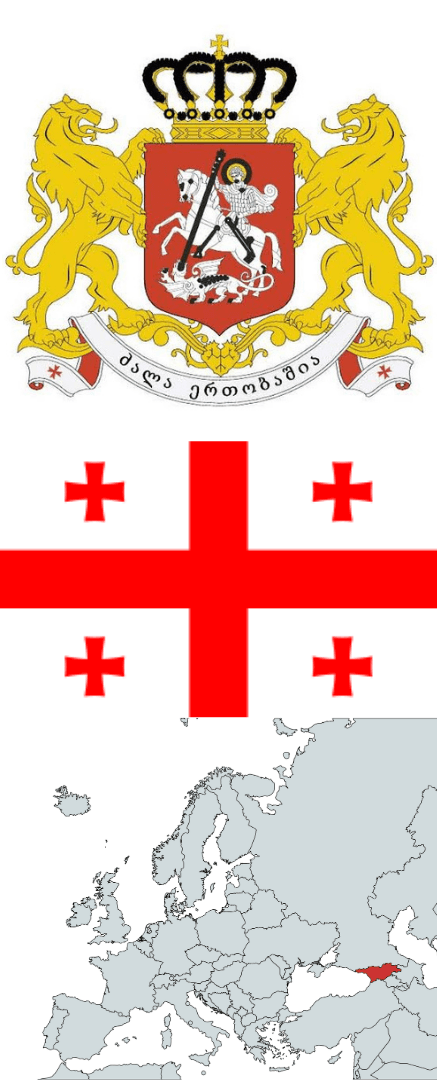
Georgia
Official Name | Republic of Georgia (Sakartvelos Respublika) | ||||||||
|---|---|---|---|---|---|---|---|---|---|
Surface Area | 69,700 km² | ||||||||
System of Government | Democratic Republic | ||||||||
Ethnic Composition | Other: 1.7% Russians: 0.7% Armenians: 4.5% Azerbaijani Turks: 6.3% Georgians: 86.8% | ||||||||
Head of State | President / Head of State (Current: Mikheil Kavelashvili) | ||||||||
Head of Government | Prime Minister (Current: Irakli Kobakhidze) | ||||||||
Capital | Tbilisi | ||||||||
Total Population | 3,941,100 (2025 estimate) | ||||||||
Currency | Lari (GEL) | ||||||||
Official Languages | Georgian Abkhaz (in the Autonomous Republic of Abkhazia) | ||||||||
Date of Independence | 9 April 1991 (regaining independence from the Soviet Union) | ||||||||
National Holidays | 26 May (1918 - First Independence Day) 9 April (1991 - Restoration of Independence / National Awakening Day) | ||||||||
Climate | Humid subtropical climate (Black Sea coast and Colchis Lowland), continental climate (Kartli and Kakheti Highlands) | ||||||||
Ethnic Composition | Georgian (86.8%) Azerbaijani Turks (6.3%) Armenian (4.5%) Russian (0.7%) Other (1.7%) | ||||||||
Religious Composition | Orthodox Christian: Majoritarian Muslim: Significant minority (particularly in the Adjara Autonomous Republic and southern regions) Jewish/Other: Small communities | ||||||||
GDP per Capita (Nominal) | 10,296 dollars (2025 data) | ||||||||
GDP (Nominal) | 38.14 billion dollars | ||||||||
Telephone Code | +995 | ||||||||
Official Languages | Georgian (Abkhaz also has official status in the Abkhazia Autonomous Republic) | ||||||||
Internet Domain Code | .ge | ||||||||
Georgia (Georgian: Sakartvelo) is a Caucasus country located south of the Greater Caucasus Mountains, bordered by the Russian Federation to the north, Armenia and Türkiye to the south, Azerbaijan to the east and southeast, and the Black Sea to the west. The country's official name is the Republic of Georgia, its capital is Tbilisi, and its area is 69,700 square kilometers.【1】
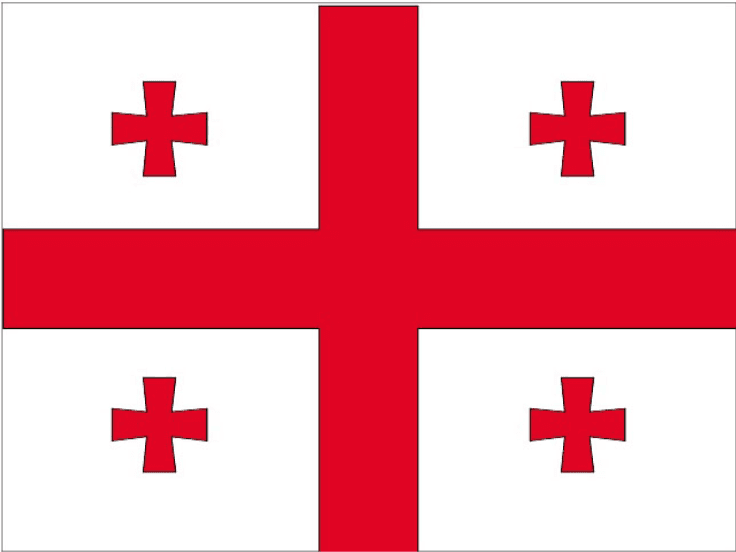
Gürcistan Bayrağı (VectorPortal)
Georgia's topography features a mountainous and rugged structure that divides the country into three distinct geographical regions. The Greater Caucasus region, forming a natural border with the Russian Federation to the north, contains the country's highest peaks including Shara (5,068 m), Kazbek (5,047 m), Rustavi (4,960 m), and Ushba (4,700 m). The Lesser Caucasus massif to the south consists of the Adjara-Imereti, Trialeti, and Ahalsthe mountain ranges, reaching up to Didi Abuli at 3,301 meters. Between these two major mountain ranges lies a depression area; to the west is the Colchis Lowland along the Black Sea coast, and to the east are the Kartli and Kakheti plateaus, dissected by tributaries of the Kura River.【2】
The climate varies significantly across regions. The Colchis Lowland exhibits subtropical characteristics due to the barrier effect of the Caucasus Mountains against northern winds and the moderating influence of the Black Sea. Annual average rainfall in this region ranges from 1,600 to 2,000 mm, but as one moves eastward toward the Kartli and Kakheti plateaus, the continental climate becomes dominant and rainfall decreases to as low as 508 mm.【3】
Georgia is also hydrologically rich; the Bzipi, Kodori, Enguri, and Rioni rivers flow into the Black Sea, the Kura River drains into the Caspian Sea, and the Çoruh River, which originates in Türkiye, empties into the Black Sea near Batumi. Nearly all of the country's electricity generation comes from hydroelectric power plants built along its rivers.【4】
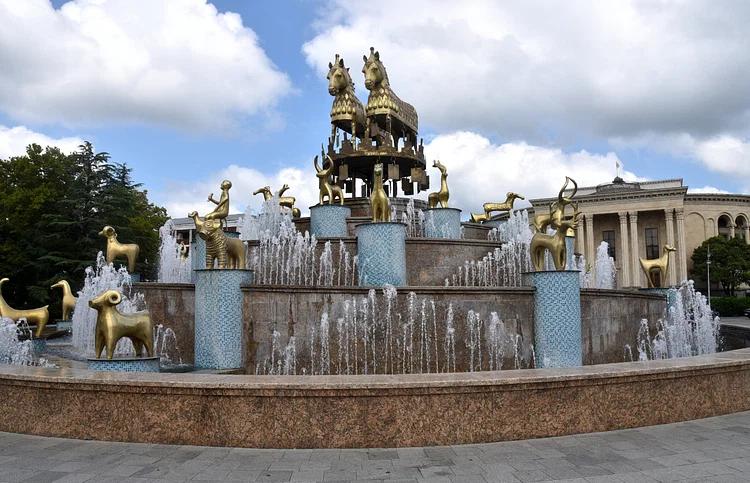
Kolhis Fountain in Kutaisi (World History Encyclopedia)
According to 2025 data, Georgia's population is estimated between 3,935,000 and 3,941,100.【5】 The country's ethnic composition has undergone significant changes over the years. Alongside declining other ethnic groups, Georgians constitute 86.8% of the population according to 2025 data. The remaining minority population consists of Azerbaijanis (6.3%), Armenians (4.5%), Russians (0.7%), and other groups (1.7%).【6】
Religiously, the vast majority of the population are Orthodox Christians, following the adoption of Christianity as the state religion in 337 AD. Georgia also has a significant Muslim population. The region became familiar with Islam from the 7th century onward, and Islamic faith is particularly prevalent in certain areas of Adjara Autonomous Republic, as well as parts of South Ossetia and Abkhazia. Although religious life suffered severe damage during the Soviet era due to strict atheist policies including the destruction of places of worship and the banning of religious education, religious freedom has been constitutionally guaranteed since independence. In 2011, the Presidency of Georgian Muslims was established to organize worship and religious education for Muslims.【7】
The earliest settlement traces in Georgia extend back to the Neolithic period. The ancestors of the Georgians, the Colchians and Iberians, completed their state formation process by the 4th century BC. The region came under Roman influence in the 1st century AD and Persian imperial influence in the 3rd century AD, and from the time of Caliph Umar onward, it became a target of Islamic armies. In 645, forces under the command of Habib ibn Maslama captured Tbilisi and signed an agreement with the Georgians guaranteeing their safety of life and property. During the Abbasid period, the Islamic Emirate of Tbilisi (833–852) became one of the important centers of Islamic authority in the Caucasus.【8】
In the late 10th century, Bagrat III of the Bagrationi dynasty (975–1014) united the kingdoms of Abkhazia and Kartli-Iberia to form the unified Kingdom of Georgia. In the 11th century, the Byzantine Empire was the most important actor in Georgia's foreign policy. King George I (1014–1027) attempted to counter Byzantine expansionist policies by allying with the Fatimids of Egypt but was defeated in 1021. During the reign of his son Bagrat IV, the Georgian aristocrat Liparit of the Baghvashi family, with Byzantine support, claimed authority over the kingdom and triggered civil wars. In 1049, armies under the Seljuk commanders Ibrahim Yinal and Kutalmish inflicted a heavy defeat on the combined Byzantine-Georgian force led by Liparit at the Battle of Kaputru.【9】 Sultan Alp Arslan's campaign into Georgia in 1064 established Seljuk dominance in the region.【10】Sultan Alp Arslan's 1064 campaign established Seljuk rule in the region.
From the mid-15th century, the Ottoman navy gained control of the Sohum region along the Black Sea coast, bringing it into contact with Georgia. After the Battle of Chaldiran in 1514, Eastern Georgia came under Ottoman administration but soon passed to the Safavids. The Treaty of Amasya in 1555 divided Georgia: Western Georgia (Imereti, Mingrelia, Guria) remained under Ottoman control, while Eastern Georgia (Kartli and Kakheti) came under Safavid rule.【11】 In the 1578 Caucasus campaign, Ottoman forces under Lala Mustafa Pasha captured Tbilisi without a battle, established the eyalets of Chıldır, Tbilisi, and Gori, and implemented the timar system by preparing land registers. In the late 18th century, the kingdoms of Kartli and Kakheti united but accepted Russian protection in 1783. In 1801, by order of Tsar Paul I, Georgia lost its independence entirely and was annexed by the Russian Empire.【12】
Following the Bolshevik Revolution of 1917, the Social Democratic (Menshevik) government declared independence on 26 May 1918 by establishing the Democratic Republic of Georgia. This new state began diplomatic relations with the Ankara Government in 1920. The visit of Ankara Government's representative, Colonel Kâzım Bey, to Tbilisi in November 1920 and the opening of the Georgian Embassy in Ankara on 8 February 1921 laid the foundation for bilateral relations. According to the diaries of Dimitri Shalikashvili of the Georgian delegation, Mustafa Kemal Paşa told the Georgian delegation that "Turkey and Georgia would work together for the independence of the Caucasus with common goals."【13】 However, this democratic process ended on 25 February 1921 with the Red Army's occupation of Tbilisi and the establishment of Soviet rule.
Under Soviet rule, especially after the 1924 nationalist uprisings, thousands of Georgians were exiled to Siberia. Repressions and harsh policies during the periods of Georgian-origin Josef Stalin and Lavrenti Beria suppressed Georgian nationalism for decades. In the 1980s, with Mikhail Gorbachev's Glasnost and Perestroika policies, Georgian nationalism regained strength under the leadership of Zviad Gamsakhurdia. The April 9, 1989 events in Tbilisi, in which Soviet troops intervened and 20 demonstrators were killed, accelerated the path to independence.【14】
Georgia declared its independence from the Soviet Union on 9 April 1991 following a referendum on 31 March 1991. The first president, Gamsakhurdia, was overthrown in early 1992 after his authoritarian policies triggered armed conflict. He was succeeded by Eduard Shevardnadze, who was invited to lead the country. Shevardnadze's tenure (1992–2003) saw efforts to demobilize armed militias and integrate with the West, but separatist conflicts in Abkhazia and South Ossetia and economic crises remained unresolved. Allegations of fraud in the parliamentary elections of 2 November 2003 triggered protests led by Mikheil Saakashvili, resulting in the Rose Revolution (also known as the Velvet Revolution), which forced Shevardnadze to resign. In January 2004, Saakashvili was elected president with 96% of the vote.【15】
Georgia's current domestic politics are shaped by debates over European integration and internal stability. In the parliamentary elections held on 26 October 2024, the Georgian Dream party retained power by winning 53.9% of the vote and securing 89 of the 150 parliamentary seats. The new cabinet, led by Prime Minister Irakli Kobakhidze, assumed office on 28 November, and on 14 December 2024, Mikheil Kavelashvili, the sole candidate, was elected president by parliament.【16】
Since independence, Georgia has transitioned from a centrally planned economy to a market-based one, exhibiting dynamic growth based on agriculture, tourism, and manufacturing (particularly food and beverage, and textiles). According to the World Bank's 2025 data, Georgia's GDP is $38.14 billion, per capita national income is $9,691, and the economic growth rate is 7.5%. Inflation stands at 3.9%, while unemployment is at 12.1%. Remittances from Georgians living abroad constitute 11.2% of GDP.【17】
Additionally, according to the United Nations Development Programme (UNDP) 2025 report, significant steps have been taken toward sustainable development. The Georgian Climate Services for Agriculture (GECSA) system has reached over 1,000 producers by providing smart farming and climate data; blockchain-based electronic waste recycling models such as "Trash to Tokens" have been implemented in cities like Poti and Khobi.【18】 Microgrants provided to over 60 businesses established by Ukrainian refugees have also contributed to economic integration.【19】
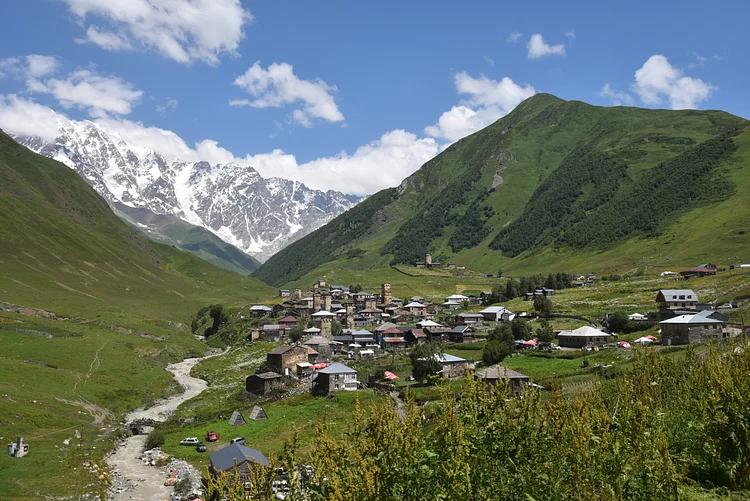
View of the Caucasus Mountains in the Svaneti Region of Georgia (World History Encyclopedia)
Georgian, belonging to the South Caucasian (Kartvelian) group of languages, is written in a unique 33-letter alphabet traditionally attributed to Saint Mesrop in the 5th century.【20】 The golden age of Georgian literature was the 11th and 12th centuries. Shota Rustaveli's epic Vepkhistkaosani (The Knight in the Panther's Skin), which shows influences from Persian culture, is the greatest work of Georgian literature. During the Ottoman period, many classical works written in Georgian emerged under the influence of Turkish-Islamic literature, including translations of Leyla and Majnun and Yusuf and Zulaykha, as well as the ashugi (minstrel) tradition.【21】
Georgia's historical diversity and natural heritage are inscribed on the UNESCO World Heritage List. These include the Gelati Monastery and the Historic Monuments of Mtskheta, inscribed in 1994 as major examples of medieval Georgian architecture; the Upper Svaneti region, listed in 1996 for its distinctive defensive towers; and the Colchis Rainforests and Wetlands, inscribed in 2021 for their exceptional biodiversity. Fourteen other historical and natural sites in Georgia are on the UNESCO Tentative List.【22】 Today, events such as the annual DataFest Tbilisi and the Tbilisi International Film Festival contribute to the country's cultural and digital diplomacy.【23】
Georgia's foreign policy is built on preserving territorial integrity, balancing Russian influence, and integrating with Western (European-Atlantic) institutions. In this context, membership in the European Union (EU) is a primary strategic goal.
Diplomatic and commercial relations between Türkiye and Georgia have developed rapidly since independence, building on their shared historical heritage. Türkiye was among the first countries to recognize Georgia on 16 December 1991, and the Agreement on Friendship, Cooperation and Good Neighborliness was signed on 30 July 1992. In Türkiye's Caucasus policy, Georgia holds a key strategic position (the "Eastern Thrace of the East") as the only gateway to Azerbaijan and Central Asia.【25】
Since 2008, Türkiye has been Georgia's largest trading partner. According to 2025 data, bilateral trade reached $3.07 billion (Türkiye's exports amounted to $2.7 billion). Over 2,800 Turkish-capital companies operate actively in Georgia, and Türkiye's direct investment stock in the country stands at $2.5 billion. Turkish construction firms have undertaken 304 major infrastructure projects worth $5.6 billion to date.【26】 The Baku-Tbilisi-Ceyhan (BTC) oil and Baku-Tbilisi-Erzurum (BTE) natural gas pipelines, which transport energy resources from the Caspian Basin to the West, and the Baku-Tbilisi-Kars (BTK) railway project have strengthened the pivotal roles of both countries in regional integration.【27】
Visa requirements between the two countries have been fully abolished, and since 2011, travel using national ID cards has been permitted. In 2025, approximately 1.2 to 1.3 million tourists traveled between the two countries. Türkiye also provides military training support to help Georgia's armed forces meet NATO standards and firmly supports the peaceful resolution of the Abkhazia and South Ossetia issues within the framework of Georgia's territorial integrity and sovereignty.【28】
Bilge, Sadık Müfit. "Gürcüler." *TDV İslâm Ansiklopedisi*, EK-1 (2020): 490-493. Accessed September 8, 2026.https://islamansiklopedisi.org.tr/gurculer
Challoumis, Constantinos. "Index of the Cycle of Money - The case of Georgia." *Economic Profile* 19, no. 2 (2024): 43-65. Accessed September 8, 2026.https://www.researchgate.net/profile/Constantinos-Challoumis-Konstantinos-Challoumes/publication/387601418_Index_of_the_Cycle_of_Money_-_The_case_of_Georgia/links/6775263a117f340ec3ea7677/Index-of-the-Cycle-of-Money-The-case-of-Georgia.pdf
Dursun, Davut. "Gürcistan (1/3)." *TDV İslâm Ansiklopedisi* 14 (1996): 310-311. Accessed September 8, 2026.https://islamansiklopedisi.org.tr/gurcistan
Ercan, Ayşe Beyza. "The Byzantine Empire in the Kingdom of Georgia’s Foreign Policy in the 11th Century." *Karadeniz Araştırmaları Enstitüsü Dergisi* 6, no. 11 (2020): 331-344. Accessed September 8, 2026.https://dergipark.org.tr/tr/download/article-file/1330404
European Commission. "Georgia." Enlargement and Eastern Neighbourhood. Accessed September 8, 2026.https://enlargement.ec.europa.eu/countries/georgia_en#further-information
Karamanlı, Hüsamettin M. "Gürcistan (2/3)." *TDV İslâm Ansiklopedisi* 14 (1996): 311-313. Accessed September 8, 2026.https://islamansiklopedisi.org.tr/gurcistan
Karamanlı, Hüsamettin M. "Gürcistan (3/3)." *TDV İslâm Ansiklopedisi* 14 (1996): 314-316. Accessed September 8, 2026.https://islamansiklopedisi.org.tr/gurcistan
Kavrelişvili, Roin. "Türkiye-Gürcistan İlişkileri (1921 Sonrası Tarihî Süreç)." Ordu Üniversitesi Sosyal Bilimler Enstitüsü Sosyal Bilimler Araştırmaları Dergisi 1, no. 1 (2010): 93-100. Accessed September 8, 2026.https://dergipark.org.tr/tr/download/article-file/273524
Modebadze, Valeri, Fatih Mehmet Sayın, and Reha Yılmaz. "Georgian – Turkish Relations since the Breakdown of Soviet Union." *Çankırı Karatekin Üniversitesi İktisadi ve İdari Bilimler Fakültesi Dergisi* 4, no. 1 (2014): 359-369. Accessed September 8, 2026.https://dergipark.org.tr/tr/download/article-file/382303
Raddato, Carole. "View of the Caucasus Mountains in Svaneti, Georgia." Translated by Şüheda Bulut. *World History Encyclopedia*. December 1, 2023. Accessed September 8, 2026.https://www.worldhistory.org/image/18207/view-of-the-caucasus-mountains-in-svaneti-georgia/
T.C. Ministry of Foreign Affairs. "Georgia Country Profile." Türkiye Cumhuriyeti Dışişleri Bakanlığı, 2022. Accessed September 8, 2026.https://www.mfa.gov.tr/gurcistan-kunyesi.tr.mfa
T.C. Ministry of Foreign Affairs. "Gürcistan'ın Siyasi Görünümü." Türkiye Cumhuriyeti Dışişleri Bakanlığı, 2022. Accessed October 12, 2026.https://www.mfa.gov.tr/gurcistan-siyasi-gorunumu.tr.mfa
T.C. Ministry of Foreign Affairs. "The Economy of Georgia." Türkiye Cumhuriyeti Dışişleri Bakanlığı, 2022. Accessed October 12, 2026.https://www.mfa.gov.tr/gurcistan-ekonomisi.tr.mfa
United Nations Development Programme in Georgia. "Annual Report 2025." 2026. Accessed September 8, 2026.https://www.undp.org/georgia/publications/annual-report-2025
Ural, Selçuk, and İrfan Tokgöz. "Bağımsızlıktan Kadife Devrime Gürcistan Dış Politikasında Türkiye’nin Yeri (1991 - 2004)." *Sosyal Bilimler Enstitüsü Dergisi* 7, (2011): 115-135. Accessed September 8, 2026.https://dergipark.org.tr/tr/download/article-file/116147
Vectorportal. "Georgia.eps Arması." Accessed October 9, 2026.
Vectorportal. "Gürcistan Ücretsiz Vektör Bayrağı." Accessed September 8, 2026.https://vectorportal.com/tr/vector/g%C3%BCrcistan-%C3%BCcretsiz-vekt%C3%B6r-bayra%C4%9F%C4%B1/11176
World Bank Group. "Georgia." DataBank. Accessed September 8, 2026.
[1]
Davut Dursun "Gürcistan (1/3)," TDV İslâm Ansiklopedisi 14 (1996): 310, erişim tarihi 8 Eylül 2026, https://islamansiklopedisi.org.tr/gurcistan
[2]
Dursun, "Gürcistan (1/3)," 310-311.
[3]
Dursun, "Gürcistan (1/3)," 310.
[4]
World Bank Group, "Georgia," DataBank, erişim tarihi 8 Eylül 2026, https://data.worldbank.org/country/georgia
[5]
World Bank Group, "Georgia"; T.C. Dışişleri Bakanlığı, "Gürcistan Ülke Künyesi."
[6]
T.C. Dışişleri Bakanlığı, "Gürcistan Ülke Künyesi."
[7]
Sadık Müfit Bilge, "Gürcüler," TDV İslâm Ansiklopedisi EK-1 (2020): 490-491, erişim tarihi 8 Eylül 2026, https://islamansiklopedisi.org.tr/gurculer
[8]
Hüsamettin M. Karamanlı, "Gürcistan (2/3)," TDV İslâm Ansiklopedisi 14 (1996): 311.
[9]
Ayşe Beyza Ercan, "The Byzantine Empire in the Kingdom of Georgia’s Foreign Policy in the 11th Century," Karadeniz Araştırmaları Enstitüsü Dergisi 6, no. 11 (2020): 332-333, erişim tarihi 8 Eylül 2026, https://dergipark.org.tr/tr/download/article-file/1330404
[10]
Ercan, "The Byzantine Empire," 338-339.
[11]
Bilge, "Gürcüler," 490.
[12]
Hüsamettin M. Karamanlı, "Gürcistan (3/3)," TDV İslâm Ansiklopedisi 14 (1996): 314-315.
[13]
Roin Kavrelişvili, "Türkiye-Gürcistan İlişkileri (1921 Sonrası Tarihî Süreç)," Sosyal Bilimler Araştırmaları Dergisi 1, no. 1 (2010): 94-96, erişim tarihi 8 Eylül 2026, https://dergipark.org.tr/tr/download/article-file/273524
[14]
Selçuk Ural ve İrfan Tokgöz, "Bağımsızlıktan Kadife Devrime Gürcistan Dış Politikasında Türkiye’nin Yeri (1991 - 2004)," Sosyal Bilimler Enstitüsü Dergisi 7, (2011): 116-118, erişim tarihi 8 Eylül 2026, https://dergipark.org.tr/tr/download/article-file/116147
[15]
Ural ve Tokgöz, "Bağımsızlıktan Kadife Devrime," 122-131.
[16]
T.C. Ministry of Foreign Affairs. "Gürcistan'ın Siyasi Görünümü." Accessed October 12, 2026.https://www.mfa.gov.tr/gurcistan-siyasi-gorunumu.tr.mfa
[17]
World Bank Group, "Georgia."
[18]
United Nations Development Programme in Georgia, "Annual Report 2025," (2026): 7, erişim tarihi 8 Eylül 2026, https://www.undp.org/georgia/publications/annual-report-2025
[19]
United Nations Development Programme in Georgia, "Annual Report 2025," 11, 15.
[20]
Bilge, "Gürcüler," 492.
[21]
Bilge, "Gürcüler," 493.
[22]
UNESCO World Heritage Centre, "Georgia," World Heritage Convention, erişim tarihi 8 Eylül 2026, https://whc.unesco.org/en/statesparties/ge
[23]
United Nations Development Programme in Georgia, "Annual Report 2025," 42-43.
[24]
European Commission, "Georgia," Enlargement and Eastern Neighbourhood, erişim tarihi 8 Eylül 2026, https://enlargement.ec.europa.eu/countries/georgia_en#further-information
[25]
Ural ve Tokgöz, "Bağımsızlıktan Kadife Devrime," 119-121.
[26]
Ministry of Foreign Affairs of the Republic of Turkey. "Gürcistan'ın Ekonomisi." Accessed October 12, 2026.https://www.mfa.gov.tr/gurcistan-ekonomisi.tr.mfa
[27]
Valeri Modebadze, Fatih Mehmet Sayın, ve Reha Yılmaz, "Georgian – Turkish Relations since the Breakdown of Soviet Union," Çankırı Karatekin Üniversitesi İktisadi ve İdari Bilimler Fakültesi Dergisi 4, no. 1 (2014): 360-362, erişim tarihi 8 Eylül 2026, https://dergipark.org.tr/tr/download/article-file/382303
[28]
Modebadze, Sayın ve Yılmaz, "Georgian – Turkish Relations," 364-367.
Georgia
Official Name | Republic of Georgia (Sakartvelos Respublika) | ||||||||
|---|---|---|---|---|---|---|---|---|---|
Surface Area | 69,700 km² | ||||||||
System of Government | Democratic Republic | ||||||||
Ethnic Composition | Other: 1.7% Russians: 0.7% Armenians: 4.5% Azerbaijani Turks: 6.3% Georgians: 86.8% | ||||||||
Head of State | President / Head of State (Current: Mikheil Kavelashvili) | ||||||||
Head of Government | Prime Minister (Current: Irakli Kobakhidze) | ||||||||
Capital | Tbilisi | ||||||||
Total Population | 3,941,100 (2025 estimate) | ||||||||
Currency | Lari (GEL) | ||||||||
Official Languages | Georgian Abkhaz (in the Autonomous Republic of Abkhazia) | ||||||||
Date of Independence | 9 April 1991 (regaining independence from the Soviet Union) | ||||||||
National Holidays | 26 May (1918 - First Independence Day) 9 April (1991 - Restoration of Independence / National Awakening Day) | ||||||||
Climate | Humid subtropical climate (Black Sea coast and Colchis Lowland), continental climate (Kartli and Kakheti Highlands) | ||||||||
Ethnic Composition | Georgian (86.8%) Azerbaijani Turks (6.3%) Armenian (4.5%) Russian (0.7%) Other (1.7%) | ||||||||
Religious Composition | Orthodox Christian: Majoritarian Muslim: Significant minority (particularly in the Adjara Autonomous Republic and southern regions) Jewish/Other: Small communities | ||||||||
GDP per Capita (Nominal) | 10,296 dollars (2025 data) | ||||||||
GDP (Nominal) | 38.14 billion dollars | ||||||||
Telephone Code | +995 | ||||||||
Official Languages | Georgian (Abkhaz also has official status in the Abkhazia Autonomous Republic) | ||||||||
Internet Domain Code | .ge | ||||||||
Henüz Tartışma Girilmemiştir
"Georgia" maddesi için tartışma başlatın
Geography
Climate and Natural Structure
Population and Society
History
Ancient Times, Middle Ages, and Islamic Period
Ottoman and Safavid Period
Democratic Republic (1918–1921)
Soviet Era and Re-Independence (1991–2004)
Political Structure
Economy
Culture, Language, and Literature
Foreign Relations
Türkiye-Georgia Relations