

Bu içerik Türkçe olarak yazılmış olup yapay zeka ile otomatik olarak İngilizceye çevrilmiştir.
Imagine standing in front of a stone. Carved into its surface is a relief made thousands of years ago. This stone has been seen by countless people before you; seasons changed, societies evolved, technologies transformed—but the stone remained in place. Now you pick up your phone. The moment you point the camera at the stone, another world appears on your screen. The stone’s possible appearance in the past, a three-dimensional model of the structure, and archaeological data converge on the display.
As artificial intelligence explains different interpretations of the structure, it clearly distinguishes between what it knows for certain and what remains scientific speculation. Then it asks you a question: “Why do you think people built this 12,000 years ago?” This is how Göbeklitepe 2.0 begins in my vision. It is not about reconstructing Göbeklitepe; it is about reinterpreting Göbeklitepe with the technologies of the future.
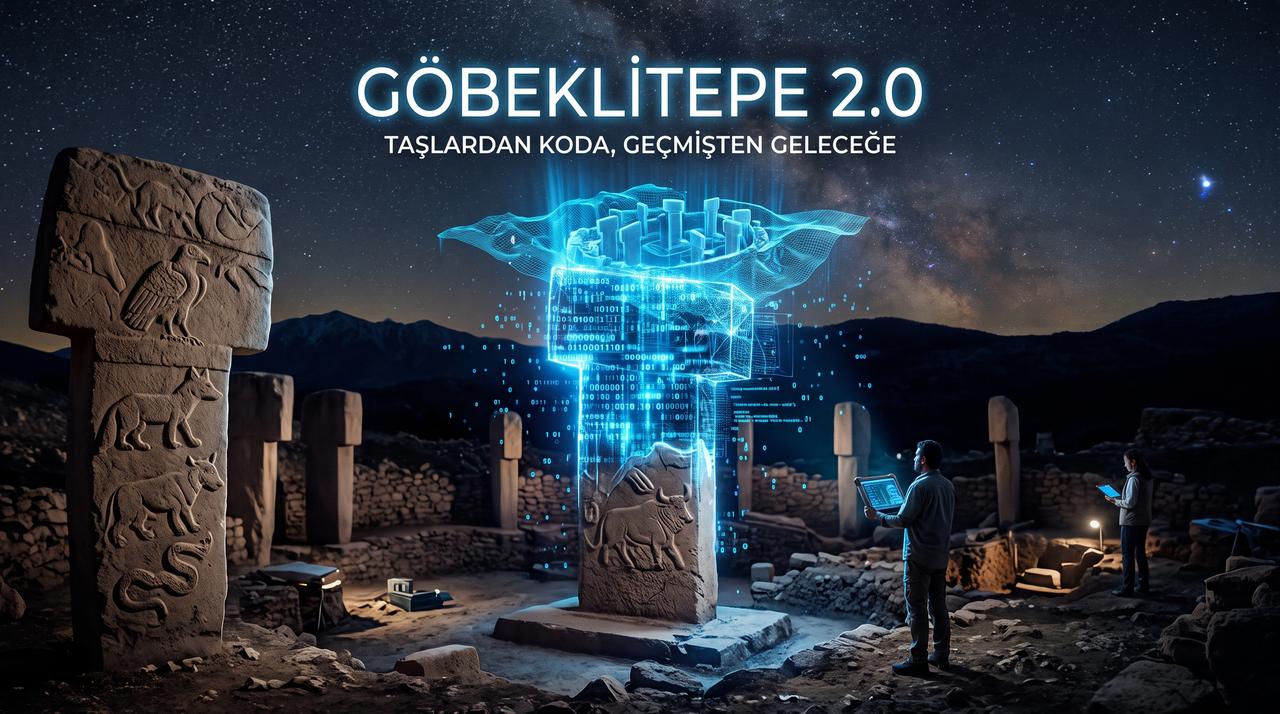
Göbeklitepe 2.0: Taşlardan Koda Geçmişten Geleceğe (Yapay Zeka ile Oluşturulmuştur.)
Göbeklitepe is one of the most remarkable archaeological sites in human history. UNESCO’s World Heritage Centre defines the site as a cultural heritage area located in the Germuş Mountains of Southeastern Anatolia, containing monumental structures built by hunter-gatherer communities.【1】The site’s monumental structures and T-shaped standing stones raise important questions about the organizational and construction capabilities of prehistoric societies.
But one of our greatest advantages today is having technologies that can help us better understand the past without physically altering it. Therefore, when thinking about Göbeklitepe’s future, our first goal should not be to “modernize” it. What needs modernization is not Göbeklitepe itself, but the way we understand it. The Göbeklitepe 2.0 model I propose is built precisely on this principle: the site is preserved physically as much as possible, while technology serves the visitor experience, scientific research, education, and the documentation of cultural heritage.
At the heart of Göbeklitepe 2.0 lies a digital twin. Using 3D scanning, photogrammetry, and digital modeling techniques, a detailed virtual model of the archaeological site can be created. This model should not be limited to a virtual tour for visitors. It can become a living digital archive—updated as new archaeological data emerges, accessible to researchers, and usable by students for educational purposes.
One of the most important advantages of such a system is its relationship with time. A model built today from current data can be revised as new discoveries are made in the future. Thus, Göbeklitepe’s digital counterpart need not be a fixed and final model; instead, it can evolve as scientific knowledge advances. Here, technology does not replace the past—it helps preserve it.
One of the most powerful technologies capable of transforming the visitor experience at Göbeklitepe 2.0 is augmented reality. Today, a visitor looks at the stones; in the future, the same visitor may look at the same stones and see digital information through a device. But a crucial principle must be observed: digital reconstructions must not be confused with historical reality.
If the past appearance of a structure is not known with certainty, the system must not present it as definitive fact. For example, it could present three different scientific possibilities to the visitor: “First interpretation…”, “Second interpretation…”, “No conclusive evidence exists on this matter yet…” In this way, augmented reality does not become merely a visual entertainment tool—it teaches visitors how scientific thinking works. Because science does not always provide answers; sometimes the most scientific answer is “We do not yet know.”
The second key element of Göbeklitepe 2.0 could be artificial intelligence. However, AI’s role should not be to provide visitors with definitive answers on every topic. On the contrary, it should encourage them to ask more questions. When a student asks an AI-powered guide, “What does this symbol mean?”, the system should not offer a single interpretation. Instead, it could explain the range of current scholarly approaches.
Then it might ask the student: “Which of these interpretations do you find more compelling? Why?” At that moment, technology moves beyond simply delivering information and becomes part of the learning process. This approach is especially important for young people, because Türkiye’s future needs young people who can create technology—not just consume it. Teaching a child to ask questions, rather than simply giving them ready-made answers, may be one of the most important technologies we can develop.
Here lies an even greater lesson Göbeklitepe can teach us. Today, when we say “technology,” we think of computers, artificial intelligence, robots, satellites, and high-tech products. But what was technology 12,000 years ago? It was shaping stone, moving heavy materials, planning structures, organizing people around a common goal, and transforming an idea into a physical reality. The tools were different, but the core idea was the same: humans encountered a problem, devised a solution, and turned that solution into reality.
Therefore, instead of viewing Göbeklitepe merely as an archaeological relic from the past, we can also see it as part of humanity’s ongoing story of creation and problem-solving. The person who shaped stone 12,000 years ago now codes. Tomorrow, someone may create with technologies we have not yet named.
The connection between Göbeklitepe and the National Technology Initiative emerges precisely here. The National Technology Initiative should not be seen merely as a project to produce new devices; it also embodies the idea of building a society capable of developing its own technologies, solving its own problems, and passing on the knowledge it creates to future generations. The concept of Göbeklitepe 2.0 can be seen as a cultural heritage manifestation of this same understanding.
Why not develop our own digital solutions for our cultural heritage? Why not turn Göbeklitepe’s 3D digital model, educational system, and AI-powered visitor experience into a collaborative project designed by Türkiye’s young engineers, programmers, designers, and archaeologists? Such a project would be more than a tourism application—it would bring engineering and archaeology, software and history, artificial intelligence and cultural heritage together at the same table. And perhaps one of the most meaningful outcomes of the National Technology Initiative will be this: using technology not only to build the future, but also to preserve our past.
When we visit Göbeklitepe, we do not need to see massive screens, bright lights, or technological displays. In fact, perhaps technology should be as invisible as possible. Smart sensors can monitor environmental conditions, 3D scans can document cultural heritage in fine detail, and digital systems can help manage visitor flow.
Throughout all this, what the visitor should feel is not technology itself, but history. What should remain in the mind of someone who visits Göbeklitepe is not “What a wonderful technology,” but “People lived here thousands of years ago.” When technology performs its role correctly, it does not draw attention to itself—it reveals what it preserves.
Now let us return to the future. The year is 2040. A student arrives at Göbeklitepe, puts on their glasses, and sees the digital model of the site before them. The system does not give them a test—it gives them a problem: “Based on the evidence we have, there are different interpretations of this structure’s purpose. Examine the evidence and form your own hypothesis.”
The student thinks, compares data, examines different interpretations, and forms their own conclusion. Perhaps when they return home, they begin to take an interest in archaeology. Perhaps they study software engineering. Perhaps they develop artificial intelligence. Or perhaps they design a technology we cannot yet imagine to preserve cultural heritage. At that moment, technology has truly invested in the future. Because the first step in producing future technologies is cultivating people who can imagine the future.
The stones of Göbeklitepe carry a message from thousands of years ago. Today, we too leave messages for the future, but our medium has changed. Alongside stones, we now have our code, our digital models, our AI systems, our satellite technologies, our robots, and many other technologies yet to be developed. Thousands of years ago, a person picked up a stone and left a mark, unaware they were reaching far into the future. Today, we have a similar responsibility. We can no longer be content merely to preserve the heritage we inherited from the past—we must also create technologies that transmit our own legacy to the future.
Perhaps one day, in the year 2126, a student will open Göbeklitepe’s digital twin, examine the stones from millennia ago, and then study the technologies we developed. And they will ask themselves: “Why did they work so hard to preserve their past?” Perhaps the answer will be this: Because a society that forgets its past diminishes not only its history, but also its future.
That is why Göbeklitepe 2.0 is more than a technology project for me—it is a bridge between past and future. On one side are 12,000-year-old stones; on the other, the technologies of tomorrow. In the middle stands humanity—the person who left marks in stone 12,000 years ago, the person who creates with code today, and the person who will shape the future with their own technologies tomorrow. Perhaps our task is not to carry Göbeklitepe’s stones into the future, but to carry forward the courage to create that those stones represent. Because 12,000 years ago, people did not know the future, yet they built anyway. Now it is our turn.
UNESCO. "Göbekli Tepe." UNESCO World Heritage Convention. Accessed September 10, 2026.https://whc.unesco.org/en/list/1572
[1]
UNESCO, “Göbekli Tepe,” UNESCO World Heritage Convention, erişim 10 Eylül 2026, https://whc.unesco.org/en/list/1572
Carrying the Past into the Future Without Altering It
The Digital Twin of an Archaeological Site
Going Back 12,000 Years Through a Lens
Artificial Intelligence Should Be a Curiosity Machine, Not an Answer Machine
There Was Technology 12,000 Years Ago Too
Here Is Where the National Technology Initiative Comes In
The Invisible Technology May Be the Most Valuable
The Student of the Future at Göbeklitepe
From Stones to Code