

 Son Eklenen:

Bu içerik Türkçe olarak yazılmış olup yapay zeka ile otomatik olarak İngilizceye çevrilmiştir.
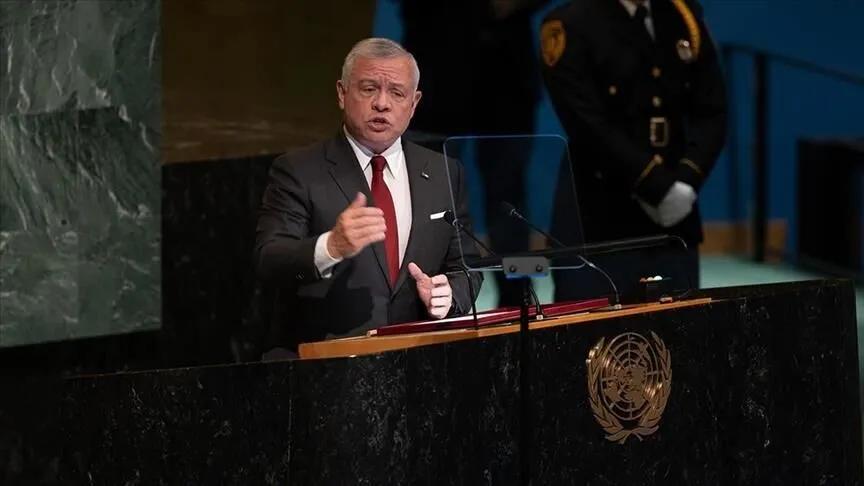
King Abdullah II of Jordan, in his address to the 81st Session of the United Nations General Assembly, focused on the Israeli-Palestinian issue, developments in Gaza and the West Bank, Israel’s regional policies, the implementation of international law, developments in Syria, and other conflicts in the Middle East. While placing the Palestinian issue at the center of his speech, Abdullah argued that the international community has long settled for managing ongoing crises rather than resolving them.
At the outset of his speech, King Abdullah noted that the world is entering a period in which the pace of information and change has reached unprecedented levels. He stated that every day brings a new crisis, tragedy, or emergency to the international agenda, and in this environment, global “attention” has become a limited and precious resource. He argued that which conflicts receive sustained diplomatic effort, which ceasefires endure after international public interest wanes, and which humanitarian crises remain on the agenda are all shaped by this attention.
Abdullah expressed this reality with the words: “Every day brings another crisis, another tragedy, another emergency demanding our attention.” The King emphasized that instability in the Middle East affects more than just regional countries, pointing to the impact of conflict in Iran on trade, investment, and the cost of living. He added: “If anyone doubts that a crisis in our region stays confined there, let them look at the energy and food bills of ordinary families from Mumbai to Madrid and Minnesota.”
Devoting a major portion of his speech to the Palestinian issue, Abdullah noted that he has repeatedly warned from the podium of the UN General Assembly about the consequences of allowing the Israeli-Palestinian conflict to remain unresolved. He argued that the international community has preferred to manage the problem rather than achieve a lasting solution, and questioned the effectiveness of international law under prolonged occupation.
In this context, Abdullah asked: “If international law can be ignored for decades, then what is its true value?” He maintained that the application of international law becomes impossible when violations are not clearly and explicitly named.
According to King Abdullah, some Israeli practices once considered temporary have over time become permanent policies. He did not treat developments in Gaza and the West Bank as separate processes, asserting that the situation in both regions has made the establishment of a viable Palestinian state impossible.
In his assessment of the situation in Gaza, Abdullah acknowledged U.S. President Donald Trump’s efforts to end the war and advance the peace process. However, he accused the Israeli government of continuing its attacks and destroying civilian infrastructure, refusing to withdraw from Gaza, and confining Palestinians to just one-third of the territory.
Abdullah stated: “President Trump made intense efforts for peace and a way to end this war. But this Israeli government keeps changing its targets; it continues its attacks and the destruction of civilian infrastructure, refuses to withdraw, and confines Palestinians to only one-third of Gaza.”
The King also noted that during the first 300 days following the hostage-ceasefire agreement brokered by the United States with Hamas, at least 300 Palestinian children were killed. He argued that developments in Gaza can no longer be dismissed as merely “temporary military measures” or the outcome of war.
At this point, Abdullah criticized the Israeli government, saying: “Accountability begins when we name what is happening for what it is: an effort to erase Palestinian life and impose a new regional reality in Gaza.”
While international attention has largely focused on Gaza, King Abdullah argued that significant changes have also occurred in the occupied West Bank. He listed settler violence, the destruction of Palestinian land and property, the expansion of illegal settlements, and the displacement of Palestinians as the main elements of this process.
Abdullah said: “This is a fundamental transformation. What was once a slow-moving process has become far more aggressive.”
The King also noted that Israeli soldiers have sometimes protected or even participated in attacks by settlers, blocked ambulances from reaching the wounded, and targeted international journalists.
Abdullah rejected the notion that these incidents are isolated events, stating: “When soldiers observe violence against civilians, enable it, and sometimes participate in it directly, this is no longer a matter of ‘a handful of extremists.’”
Emphasizing that developments in Gaza and the West Bank must be understood within the same political context, Abdullah declared: “The reality on the ground is being reshaped: Gaza through destruction, the West Bank through de facto annexation. The goal is the same: to make a viable Palestinian state impossible.”
King Abdullah also rejected the notion that the Arab world rejects peace with Israel. He recalled the Arab Peace Initiative, proposed in 2002 under Saudi leadership, which offers full normalization of relations between Israel and 57 Arab and Muslim states in exchange for the establishment of a Palestinian state.
Abdullah said: “This proposal has been on the table for over twenty years. The obstacle is not the lack of a peace partner, but the absence of an Israeli government willing to accept it.”
Abdullah argued that the international community’s political inaction does not stem from a lack of available tools. He listed sanctions, asset freezes, embargoes, and diplomatic isolation as instruments at its disposal.
Nevertheless, he asserted that international decisions regarding Israel remain unimplemented, stating: “Decisions end where they begin — on paper.” He contended that this has led Israel to become detached from accountability, adding: “The sense of impunity of this government has reached terrifying levels.”
Abdullah further criticized the international community’s stance toward Israel, saying: “The world’s political inaction is not due to a lack of options. So let us call it what it is: This is a choice.”
In one of the most prominent parts of his speech, Abdullah argued that Israel’s policies cannot be assessed solely in terms of their impact on Palestinian territories. He stated that Israel’s “expansionist appetite” constitutes a regional threat to the Middle East, adding: “No one in this room should assume that Israel’s ambitions end in Palestine.”
Regarding the Israeli government, Abdullah declared: “This Israeli government’s expansionist appetite is now a regional threat.”
In this context, he also addressed developments in Syria, stating: “Today, Syria is a warning that the international community has chosen to ignore.” He claimed that Israel has been testing, through calculated steps, how far it can go. The King argued that each time the international community fails to respond, it sends Israel a message that it can further exceed its boundaries and legal constraints.
King Abdullah affirmed Jordan’s commitment to a just peace, its continued support for the rights of the Palestinian people, and its determination to safeguard the historical and legal status quo of Muslim and Christian holy sites in Jerusalem.
During a meeting with UN Secretary-General António Guterres within the framework of the UN General Assembly, Abdullah reiterated that lasting stability in the Middle East cannot be achieved without guaranteeing the legitimate rights of the Palestinian people and establishing an independent Palestinian state based on the two-state solution.
Abdullah described Jordan as a state firmly committed to its principles and promises, ready to engage with all parties and work with actors seeking peace. He stated that Jordan aims to be “a country the world can trust.”
Listing Gaza, Sudan, and Ukraine as regions where war and displacement are occurring, Abdullah said: “Whether a crisis began weeks ago or has lasted for decades, our principles cannot change with the world’s attention.”
Returning to the central theme of attention, Abdullah concluded his speech by summarizing its core message: “The future is shaped not only by what we do, but also by what we choose to ignore.”
Arab News. "‘Terrifying impunity’: Israel is a regional threat, Jordan’s king tells UN General Assembly." Accessed September 23, 2026.https://www.arabnews.com/middle-east/terrifying-impunity-israel-is-a-regional-threat-jordans-king-tells-un-general-assembly-3002702
Euronews. "Türkiye, Katar ve Ürdün'den Tahran ile diyalog ve İsrail'e karşı uluslararası baskı çağrısı." Accessed September 23, 2026.https://tr.euronews.com/2026/09/23/turkiye-katar-ve-urdunden-tahran-ile-diyalog-ve-israile-karsi-uluslararasi-baski-cagrisi
King Abdullah II Official Website. "King delivers Jordan’s address at 81st UNGA." Accessed September 23, 2026.https://kingabdullah.jo/en/news/king-delivers-jordans-address-at-81st-unga-1
Middle East Eye. "Jordan's king tells UN Israel's 'expansionist appetite' is a regional threat." Accessed September 23, 2026.https://www.middleeasteye.net/live-blog/live-blog-update/jordans-king-tells-un-israels-expansionist-appetite-regional-threat
SANA. "Jordan’s king: Palestinian rights essential to lasting regional stability." Accessed September 23, 2026.https://sana.sy/en/international/2345239/
The Times of Israel. "At UN, Jordan’s Abdullah says Israeli policies in Gaza, West Bank aim to make Palestinian state ‘impossible’." Accessed September 23, 2026.https://www.timesofisrael.com/liveblog_entry/at-un-jordans-abdullah-says-israeli-policies-in-gaza-west-bank-aim-to-make-palestinian-state-impossible/

King Abdullah II of Jordan, in his speech at the 81st session of the UN General Assembly, criticized the Israeli government’s policies in Gaza and the West Bank, stating that Israel’s “expansionist appetite” now constitutes a regional threat. Abdullah argued that the destruction in Gaza and the implementation of “de facto annexation” in the West Bank aim to make a viable Palestinian state impossible, and he characterized the international community’s political inaction toward Israel as a “choice”.
Henüz Tartışma Girilmemiştir
"King Abdullah II of Jordan's 81st Session of the United Nations General Assembly Address" maddesi için tartışma başlatın
23 Eylül 2026
The International Community and the Emphasis on “Attention”
23 Eylül 2026
The Israeli-Palestinian Issue
23 Eylül 2026
Statements on Developments in Gaza
23 Eylül 2026
The West Bank and the Concept of “De Facto Annexation”
23 Eylül 2026
The Arab Peace Initiative
23 Eylül 2026
Call to the International Community for Accountability
23 Eylül 2026
Labeling Israel as a “Regional Threat”
23 Eylül 2026
Jerusalem and the Palestinian State
23 Eylül 2026
Jordan’s Regional Role and the Final Message of the Speech