

Bu içerik Türkçe olarak yazılmış olup yapay zeka ile otomatik olarak İngilizceye çevrilmiştir.
+1 Daha
Construction date | 1490–1491 | ||||||||
|---|---|---|---|---|---|---|---|---|---|
Patron | Sultan II. Bayezid | ||||||||
Architect | Abdülula b. Puladşah | ||||||||
Location | Bursa, Hanlar Region | ||||||||
Other name | İpek Hanı | ||||||||
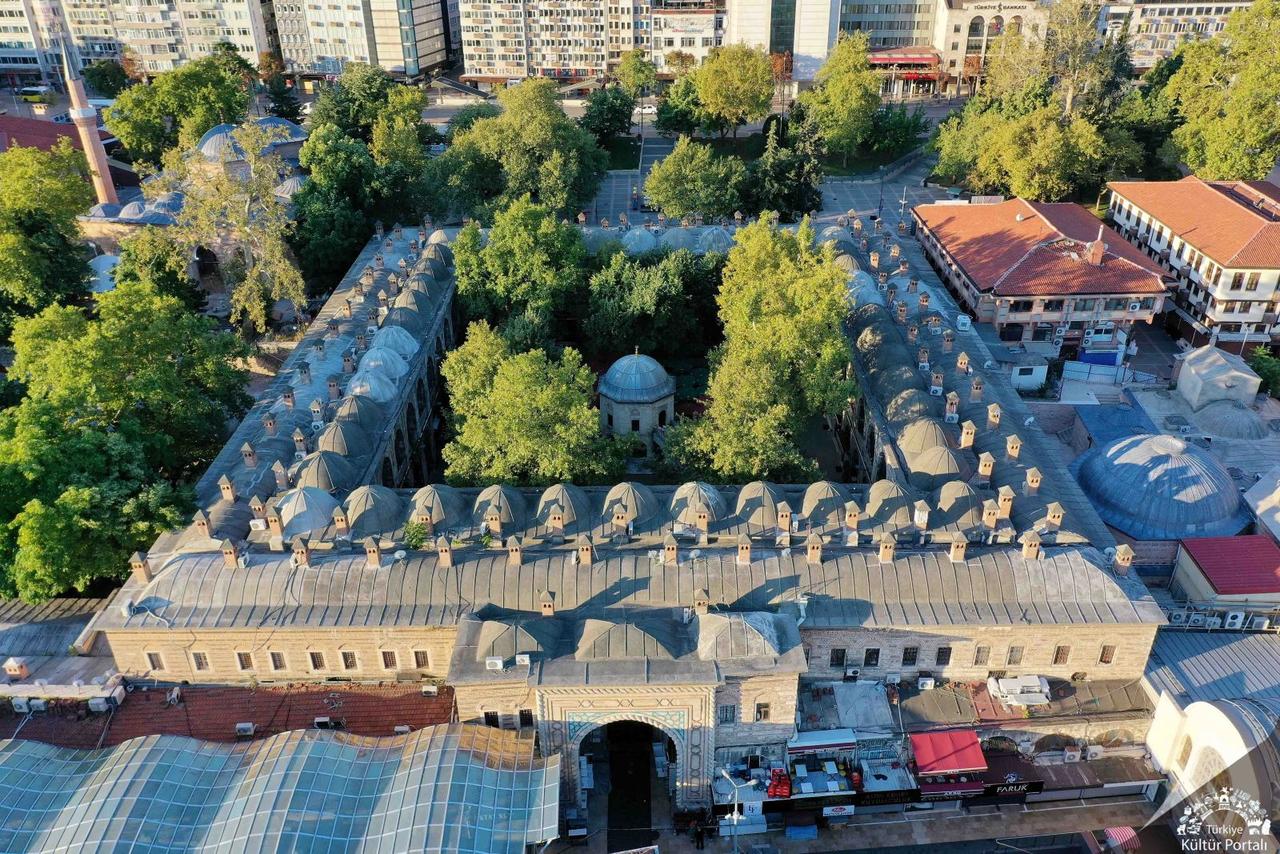
Koza Han is a two-story, courtyard-style historical Ottoman caravanserai built in 1490–1491 by Sultan Bayezid II to generate income for the mosque and madrasa of his complex in Istanbul.
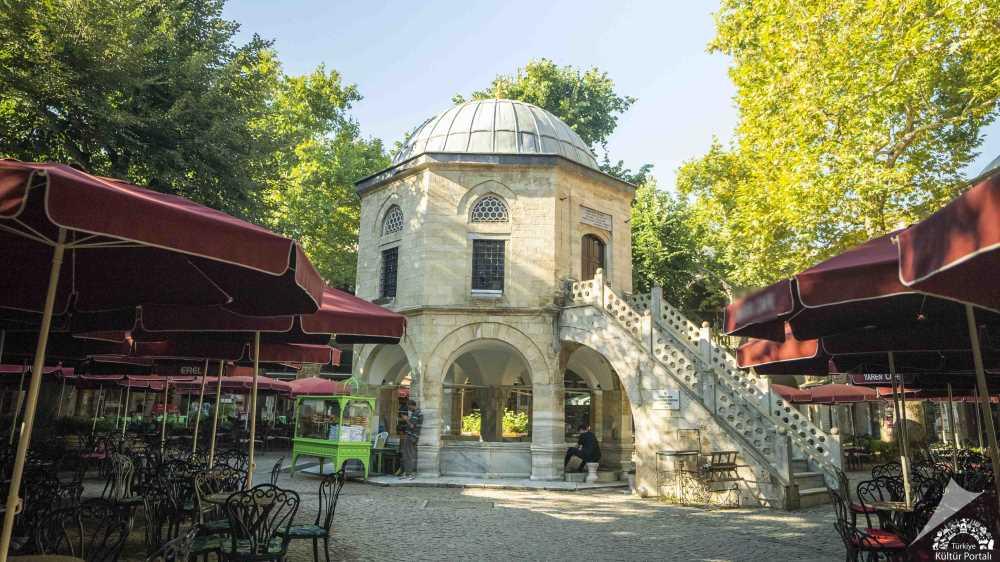
Koza Han (Kültür Portalı)
Throughout its history, the building has been referred to in official records and archival documents by various names including Yeni Han, Beylik Hanı, Beylik Han-ı Cedid-i Âmire, Han-ı Cedid-i Evvel, Simkeş, Sırmakeş, Beylik Kervansarayı, Simkeş Han, Sırmakeş Han, Han-ı Cedid, Simşek Hanı, Yeni Kervansaray, and Eski-Yeni Han. In Evliya Çelebi’s Seyahatnâme, it is recorded as “Acem Hanı”; during the nineteenth century, as silk trade intensified, it also came to be known as “İpek Hanı”.【1】
Located in the heart of Bursa city center within the Hanlar District, between Ulu Camii and Orhan Gazi İmareti, it occupies the central point of the enclosed and open bazaar system. In official tourism classification, it is categorized under “Cultural Tourism”.
Koza Han was constructed as a waqf property by Ottoman Sultan Bayezid II to generate revenue for his complex in Istanbul, which included a mosque and madrasa. Construction began in March 1490 (Hijri Rabi al-Akhir 895) and was completed with its opening on 25 September 1491 (Hijri 25 Dhu al-Qi’dah 896). The architect of the han was Abdülalî b. Puladşah.【2】 The master builder was Şuca Bin Karaca.【3】
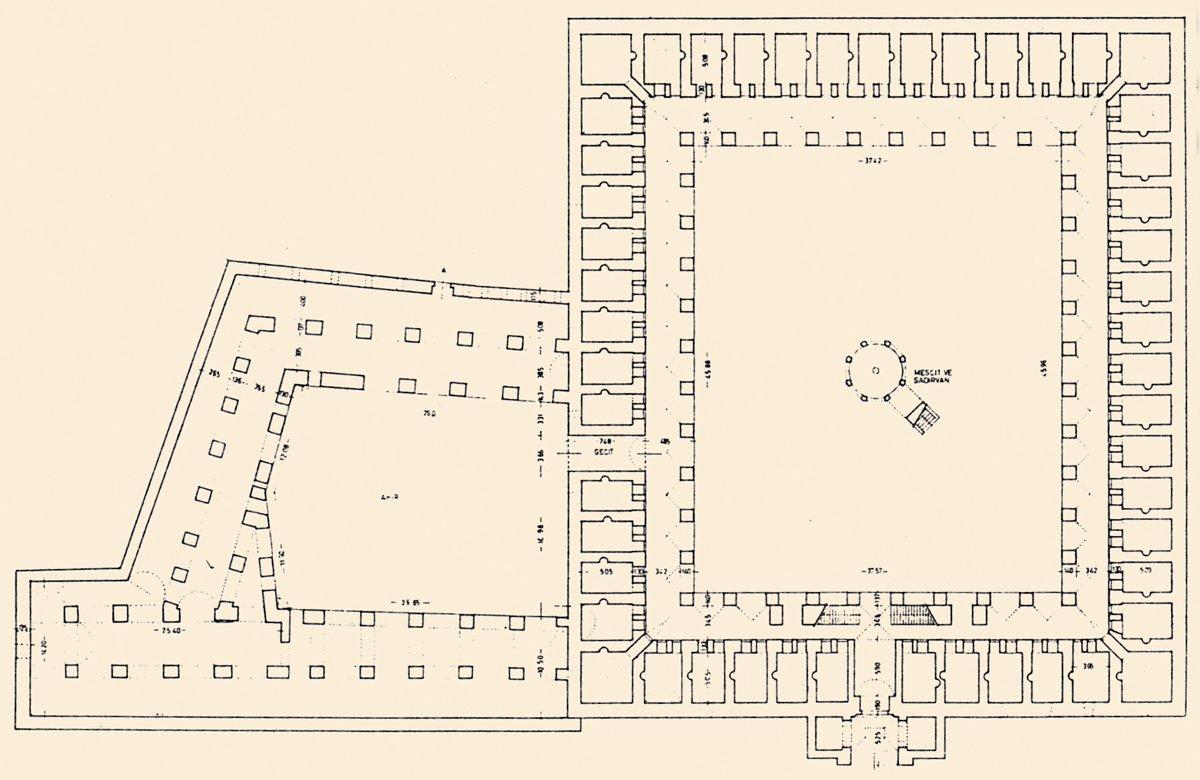
Koza Han (TDV İslam Ansiklopedisi)
Koza Han is one of the important examples of classical Ottoman urban caravanserai architecture. The two-story structure is arranged around a large courtyard and features rooms, arcades, a mosque, a fountain, and an ornate portal. On the eastern side lies an outer section used for housing animals and storage.
Since its construction, Koza Han has served as the primary center for the silk cocoon market and the trade of raw silk and silk fabrics. Silk and valuable goods brought by caravans from the east were sold here, transforming the han into an international trading hub frequented by Asian, European, and local merchants. Silk traders used the ground-floor rooms for storage and warehousing and the upper-floor rooms for lodging and negotiation. After the 1855 Bursa earthquake damaged the building, its function as lodging diminished; the arcades were repurposed as silk production workshops (devdahane) and storage warehouses.【9】
The han underwent repairs in 1630, 1671–1672 (Hijri 1082), 1784, 1795 (Hijri 1199), and during the 1950s; the mosque in the courtyard was restored in the 1940s/1946 and in 2007.【10】 【11】 At the request of the Koza Han Association, conservation and restoration projects were prepared in 2011. As part of the Hanlar District, Koza Han was inscribed on the UNESCO World Heritage List in 2014.【12】 Today, shops on the upper floor sell silk fabrics, scarves, shawls, bridal trousseaus, ready-to-wear garments, and souvenirs. The ground-floor rooms and courtyard are operated as a café, tea garden, and resting area. Additionally, in 2008, Queen Elizabeth II of the United Kingdom visited the building.【13】
Bursa Büyükşehir Directorate. "Koza Han (Yeni Han, Han-ı Cedid, Simkeş Han, Sırmakeş Han, Acem Han, Beylik Han, Yeni Kervansaray)." Bursa Metropolitan Municipality. Accessed September 22, 2026.https://alanbaskanligi.bursa.bel.tr/koza-han-yeni-han-han-i-cedid-simkes-han-sirmakes-han-acem-han-beylik-han-yeni-kervansaray/
Eyice, Semavi. “Koza Hanı.” TDV İslâm Ansiklopedisi. Accessed September 22, 2026.https://islamansiklopedisi.org.tr/koza-hani
Kültür Portalı. "Koza Han – Bursa." T.C. Kültür ve Turizm Bakanlığı. Accessed September 22, 2026.https://www.kulturportali.gov.tr/turkiye/bursa/gezilecekyer/koza-han
Osmangazi Belediyesi. "Koza Han." Accessed September 22, 2026.https://www.osmangazi.bel.tr/tarihi/default/koza-han
Soykök Ede, Burcu. “Yeni Han (Bursa) (Koza Han).” Türkiye Turizm Ansiklopedisi. Accessed September 22, 2026.https://turkiyeturizmansiklopedisi.com/yeni-han-bursa-koza-han
T.C. Bursa Valiliği. "Kozahan." Accessed September 22, 2026.https://www.bursa.gov.tr/kozahan
TRT Türk. “Bursa'nın incisi: Kozahan.” Accessed September 22, 2026.https://www.trtturk.com.tr/yasam/bursanin-incisi-kozahan_820
[1]
Semavi Eyice. “Koza Hanı.” TDV İslâm Ansiklopedisi. Son erişim: 22 Eylül 2026. https://islamansiklopedisi.org.tr/koza-hani
[2]
Semavi Eyice. “Koza Hanı.”
[3]
T.C. Bursa Valiliği. “Kozahan.” Son erişim: 22 Eylül 2026. https://www.bursa.gov.tr/kozahan
[4]
Semavi Eyice. “Koza Hanı.”
[5]
Bursa Alan Başkanlığı. “Koza Han (Yeni Han, Han-ı Cedid, Simkeş Han, Sırmakeş Han, Acem Han, Beylik Han, Yeni Kervansaray).” Bursa Büyükşehir Belediyesi. Son erişim: 22 Eylül 2026. https://alanbaskanligi.bursa.bel.tr/koza-han-yeni-han-han-i-cedid-simkes-han-sirmakes-han-acem-han-beylik-han-yeni-kervansaray/
[6]
Semavi Eyice. “Koza Hanı.”
[7]
Semavi Eyice. “Koza Hanı.”
[8]
T.C. Bursa Valiliği. “Kozahan.”
[9]
Osmangazi Belediyesi. “Koza Han.” Son erişim: 22 Eylül 2026. https://www.osmangazi.bel.tr/tarihi/default/koza-han
[10]
TRT Türk. “Bursa'nın incisi: Kozahan.” Accessed September 22, 2026.
[11]
Semavi Eyice. “Koza Hanı.”
[12]
Bursa Alan Başkanlığı. “Koza Han (Yeni Han, Han-ı Cedid, Simkeş Han, Sırmakeş Han, Acem Han, Beylik Han, Yeni Kervansaray).”
[13]
TRT Türk. “Bursa'nın incisi: Kozahan.”
Construction date | 1490–1491 | ||||||||
|---|---|---|---|---|---|---|---|---|---|
Patron | Sultan II. Bayezid | ||||||||
Architect | Abdülula b. Puladşah | ||||||||
Location | Bursa, Hanlar Region | ||||||||
Other name | İpek Hanı | ||||||||
Henüz Tartışma Girilmemiştir
"Koza Han" maddesi için tartışma başlatın
Naming and Location
History and Construction
Architectural Features and Structural Components
Commercial Function and Role in Silk Trade History
Restorations and Current Use