


Bu içerik Türkçe olarak yazılmış olup yapay zeka ile otomatik olarak İngilizceye çevrilmiştir.

When a country looks up at its sky and sees an unmanned aerial vehicle it has produced itself, or when it spots the signature of its own engineers on the deck of a warship anchored in its port… this picture reveals the decisive role of technological production capacity and engineering expertise in a nation’s future. Today, this transformation is frequently reflected in news reports, social media, and platforms such as “Millî Teknoloji Hamlesi”.
But what does this concept truly signify, which areas does it encompass, and why does it appear so frequently in public discourse? The answer lies not only in the technological products themselves but in a comprehensive vision that shapes the underlying production capacity, human resources, and goal of technological independence.
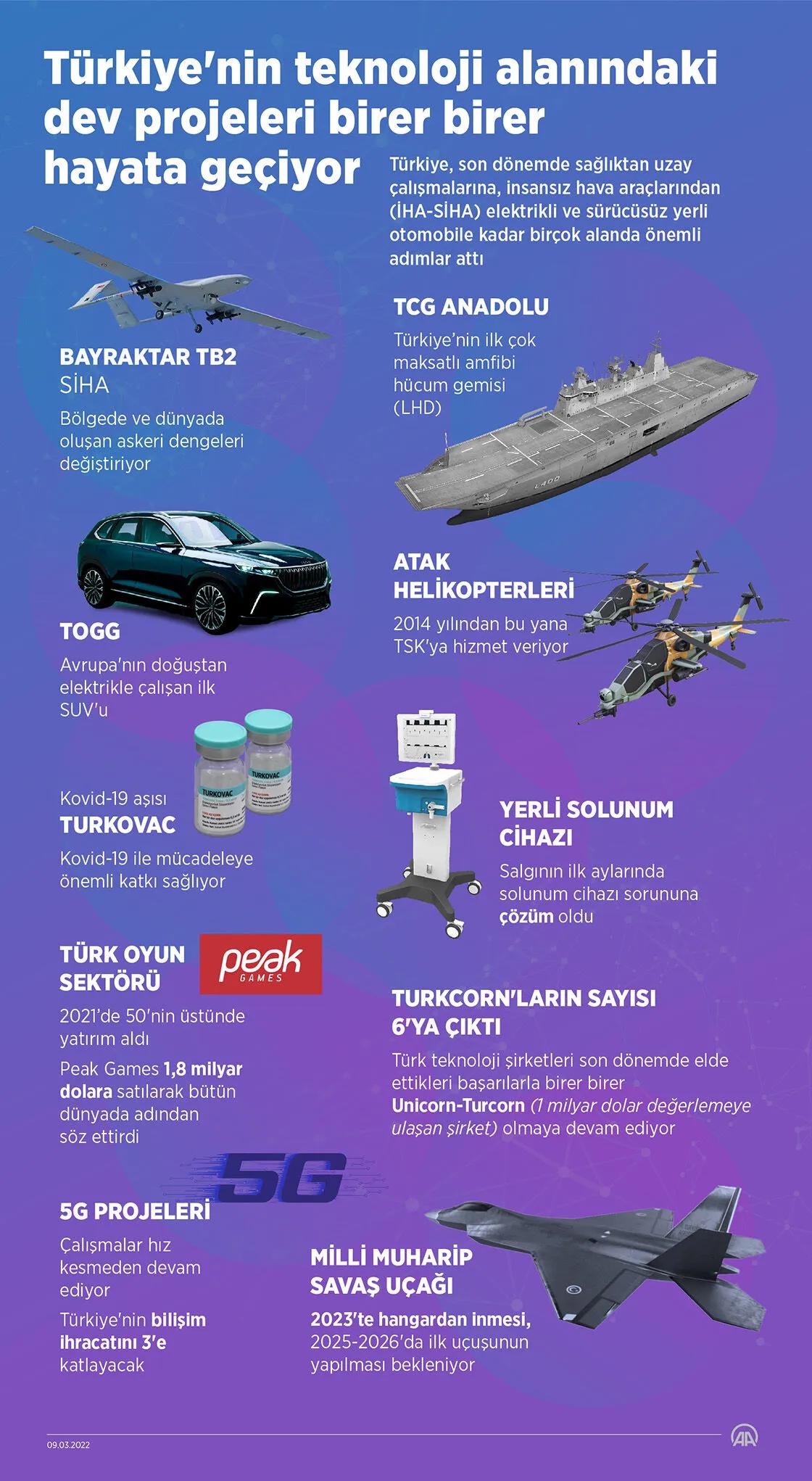
Infographic Showing Türkiye's Projects in the Field of Technology (Anadolu Ajansı)
The National Technology Initiative is defined, in its simplest terms, as a comprehensive strategy aimed at strengthening Türkiye’s technological and economic independence, promoting the development of indigenous and national technologies, and fostering public awareness of this process.【1】The Türkiye Technology Team Foundation (T3 Foundation), which serves as the institutional pioneer of this vision, describes the initiative not merely as a technical matter but as a multidimensional perspective extending from education and international relations to development and social sciences.
Interestingly, the first tangible outcomes of this vision emerged in the aerospace and defense industries. Over time, this core has evolved into a broad network spanning fields as diverse as healthcare, transportation, industry, and space. Academic circles regard this expansion as a multidimensional map of Türkiye’s technological leap.【2】You are likely familiar with TEKNOFEST, the most visible landmark on this map, recognized as the world’s largest aerospace, space, and technology festival.
On the institutional side, a dedicated framework has been established to support this vision. The General Directorate of National Technology and Artificial Intelligence under the Ministry of Industry and Technology of the Republic of Türkiye is tasked with implementing high-impact programs and projects under the National Technology Initiative, promoting digital transformation, and building societal awareness.【3】Thus, we witness a rare alignment in which both civil society and the state pursue the same goal through different channels.【4】
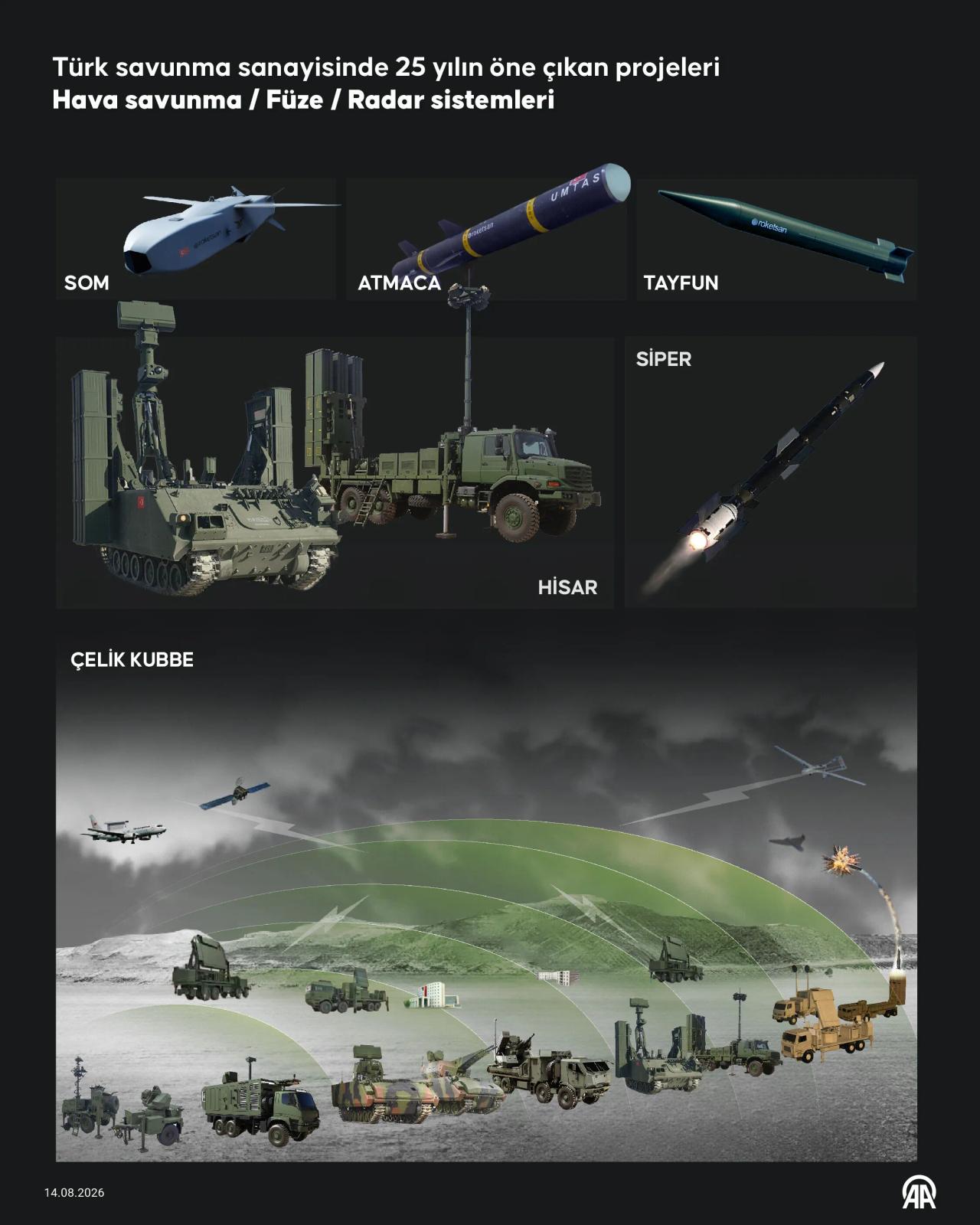
Türk Savunma Sanayisinde 25 Yılın Öne Çıkan Hava Savunma, Füze ve Radar Sistemleri (Anadolu Ajansı)
It is impossible to summarize the National Technology Initiative under a single heading. However, when viewed through three main axes, the full picture becomes much clearer.
The defense industry is regarded as both the starting point and the most concrete outcome area of this initiative. In academic literature, external dependency is not merely an economic vulnerability but also a strategic risk to national security, which is why domestic production has become central to state policy.【5】A broad ecosystem comprising major contractors such as ASELSAN, TUSAŞ, ROKETSAN, HAVELSAN, and the Machine and Chemical Industry Corporation, alongside universities, R&D centers, and technology parks, has elevated the defense industry to a critical position—not only for security but also for development and international competitiveness.【6】
Statistics can make the scale of this transformation more tangible. According to data compiled by the Anadolu Agency, the number of companies operating in this sector has grown from 56 in 2002 to over 4,500 today, while the number of projects has surpassed 1,400.【7】During the same period, annual R&D expenditures have risen from approximately 49 million dollars to over 3.5 billion dollars, and the rate of domestic content has increased from the low 20s to over 80 percent. Direct employment has exceeded 100,000 people.【8】
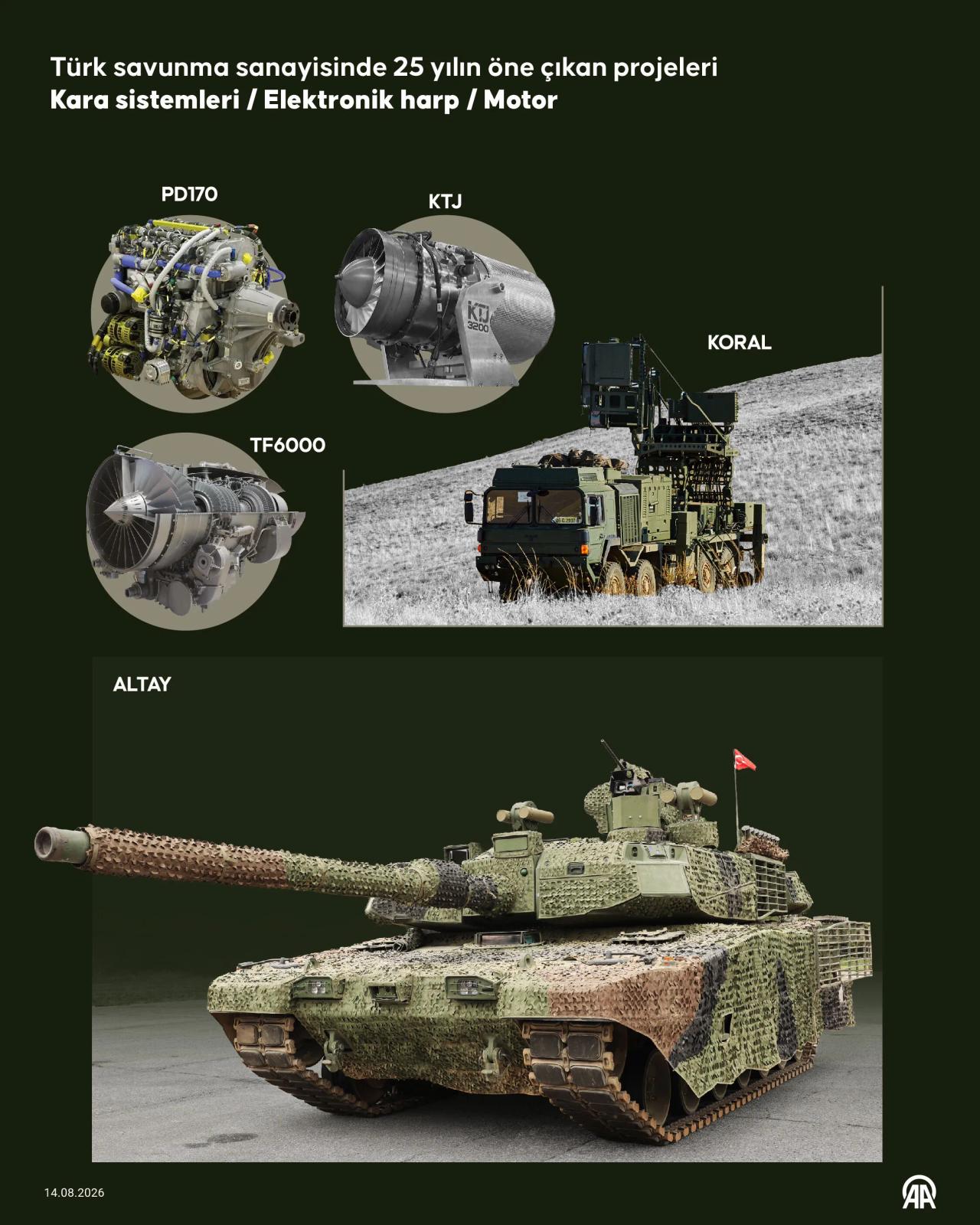
Türk Savunma Sanayisinde 25 Yılın Öne Çıkan Kara Sistemleri, Elektronik Harp ve Motor Teknolojileri (Anadolu Ajansı)
The intelligence and security dimensions of this picture must not be overlooked. Defense Industry President Haluk Görgün has emphasized that advancements in artificial intelligence, robotics, autonomous vehicles, nanotechnology, and quantum computing will shape both new threats and the solutions to counter them.【9】Capabilities ranging from radar systems and electronic warfare to sensor networks and command-and-control software point to a technological intelligence capacity far beyond traditional military power.
The second front is engineering itself. The transformation in defense and aerospace reflects a deepening of engineering disciplines: the system has shifted from one based on ready-made imports and licensed production to one centered on original platform and system design.【10】Concrete examples familiar to you include the KAAN fighter jet, the HÜRJET trainer aircraft, the ALTAY main battle tank, the MILGEM-class warships, and the T625 GÖKBEY helicopter.【11】
What is truly remarkable here is that not only the final product but every single subcomponent behind it has been localized. The capabilities developed in areas such as engines, radar, sensors, command-and-control software, and advanced materials demonstrate that engineering expertise is no longer confined to a single sector but can be transferred across the broader industrial landscape.【12】Indeed, it is emphasized that gains from defense industry projects serve as models for civilian technological applications.【13】
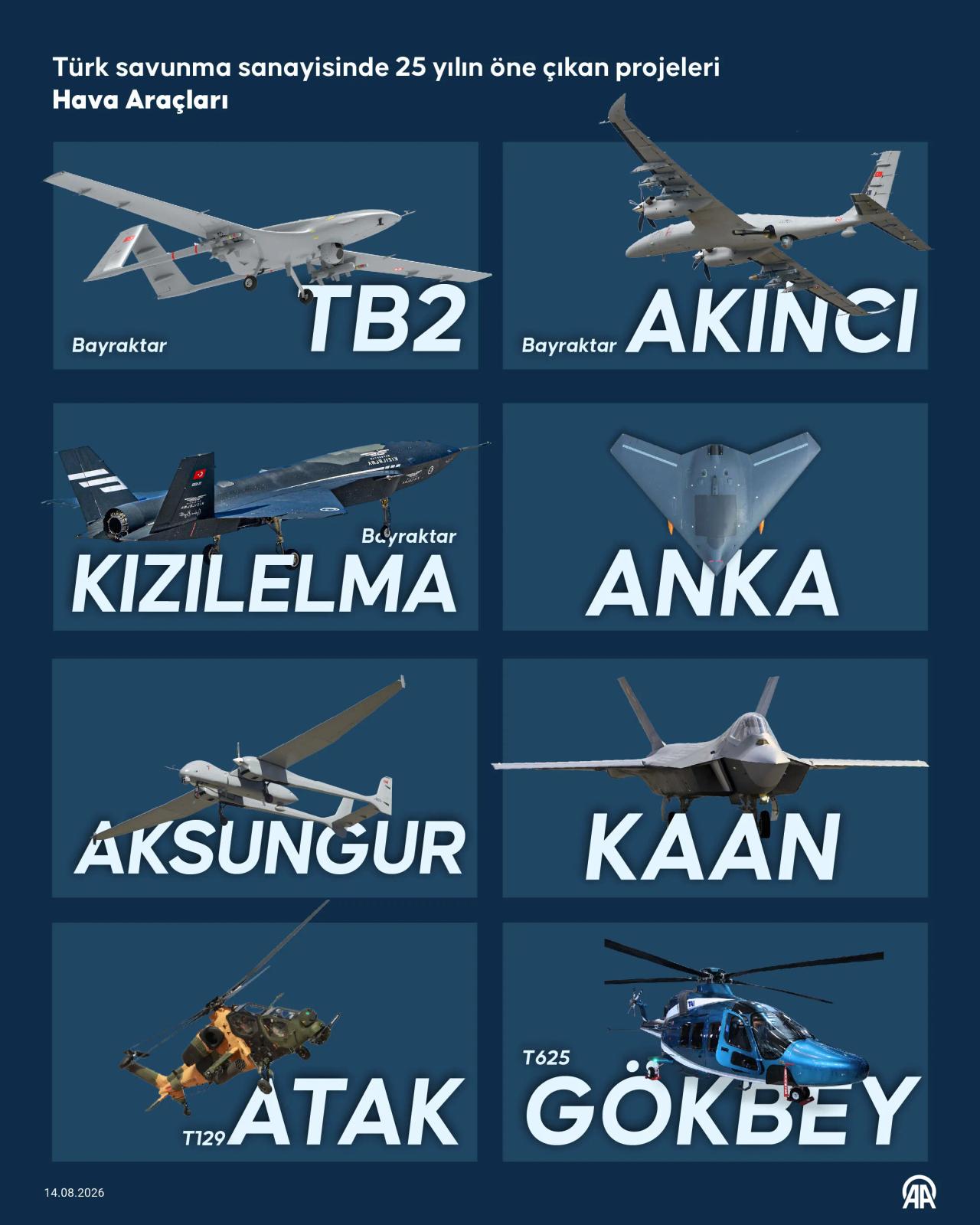
Türk Savunma Sanayisinde Son 25 Yılda Öne Çıkan Hava Platformları (Anadolu Ajansı)
The third front encompasses a broader technology and innovation ecosystem. Globally, structures such as Silicon Valley in the United States, Germany’s engineering hubs, and China’s high-tech parks play decisive roles in their countries’ global competitiveness.【14】Türkiye’s counterpart in this domain consists of entrepreneurship and innovation programs led by the T3 Foundation, designed to support young entrepreneurs and bring technology-focused projects to life.【15】
One of the vital arteries of this ecosystem is artificial intelligence. Academic circles note that the priorities of the National Artificial Intelligence Strategy are aligned with the “Digital Türkiye” vision and the National Technology Initiative.【16】This demonstrates that the initiative is not limited to hardware production but also pursues independence at the software and algorithmic level. The establishment of DENEYAP Technology Workshops in all 81 provinces, alongside the continued opening of new workshops in universities under the National Technology Workshops Project Support funded by TÜBİTAK, are concrete evidence of how deeply this ecosystem has taken root locally.【17】【18】
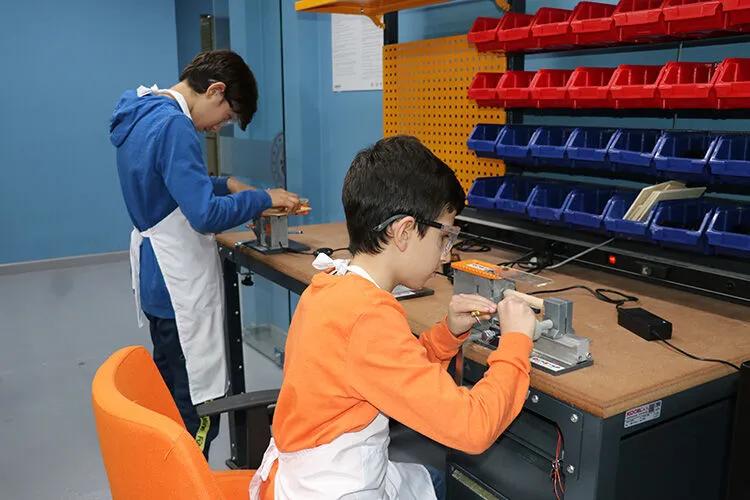
Deneyap Teknoloji Atölyesinde Proje Ve Üretim Çalışması Yapan Öğrenciler (Anadolu Ajansı)
The importance of the National Technology Initiative is most starkly conveyed by export figures. According to the Anadolu Agency, defense and aerospace exports reached $7.1 billion in 2024 and surged by approximately 48 percent in 2025 to reach $10.05 billion.【19】This category, which stood at only $248 million in 2002, has grown nearly fortyfold since then.【20】This is a striking indicator of how an abstract goal has been transformed into tangible economic value.
The strategic dimension goes far beyond numbers. In a world where external dependency is recognized not only as a commercial risk but also as a security threat, establishing domestic capacity in critical technologies directly affects a country’s maneuverability in foreign policy.【21】The fact that Turkish defense products are now exported to 185 countries demonstrates that this maneuverability has become not only a defense tool but also a diplomatic instrument.【22】
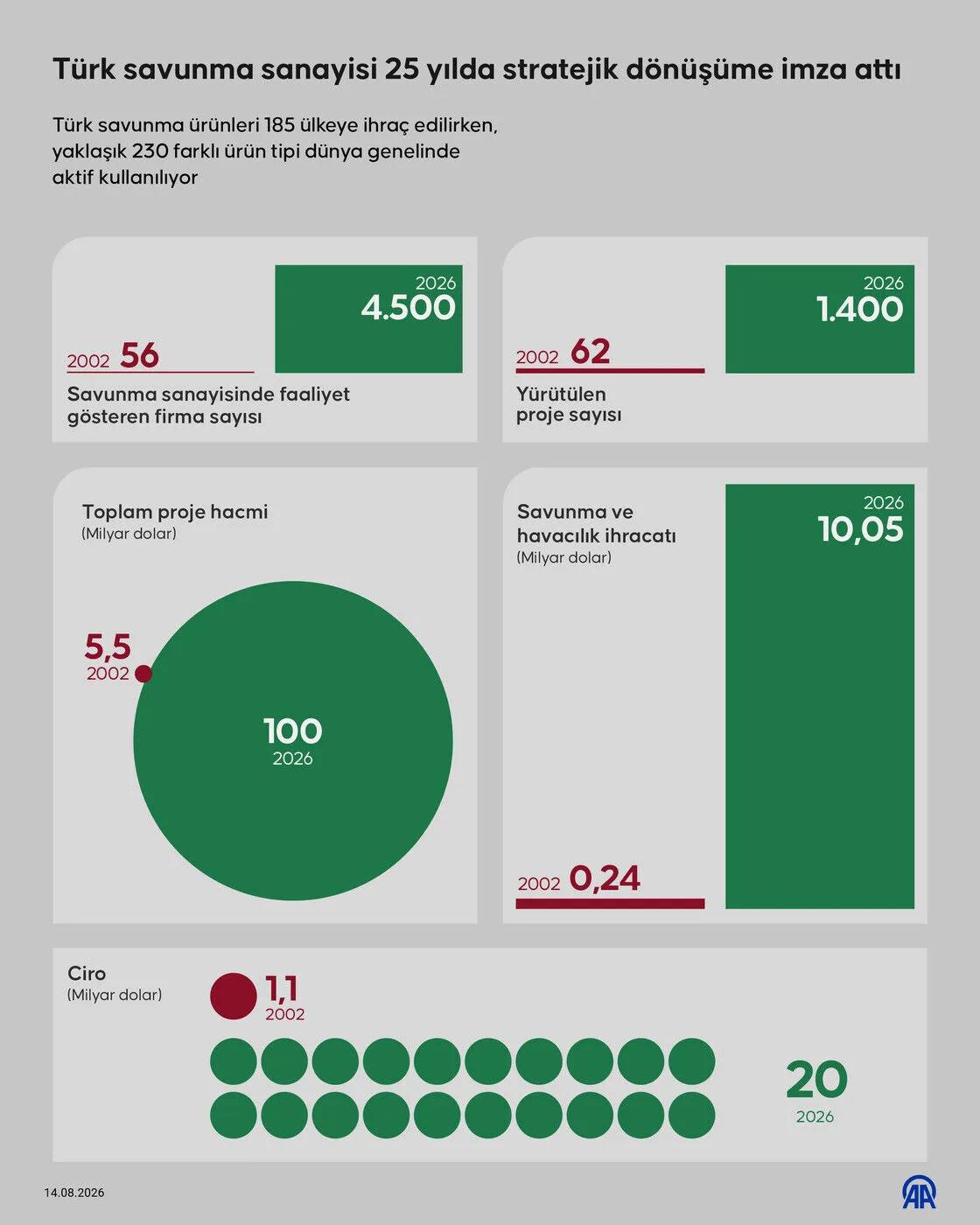
25 Years of Growth Data of Türkiye's Defense Industry from 2002 to the Present(Anadolu Ajansı)
The sustainability of this vision largely depends on the cultivation of qualified human resources. The Özdemir Bayraktar National Technology Scholarship Program, launched with this awareness, has been active since 2018 and aims to provide scholarships to 5,000 students across all 81 provinces by 2026.【23】Elvan Kuzucu Hıdır, Chair of the Board of the T3 Foundation, emphasizes that the program is not merely a financial support but ensures that scholarship recipients actively participate in the foundation’s projects through workshops, camps, and training programs.【24】
Perhaps the most striking point is this: many young participants in TEKNOFEST go on to join this scholarship program, DENEYAP workshops, or the T3 Foundation’s entrepreneurship ecosystem after the festival.【25】Today, attempting to understand this vision means more than addressing a single issue—it means becoming part of this bridge that connects youthful energy to institutional vision.
Compared to a decade ago, the National Technology Initiative has become far more concrete and measurable. Export figures, domestic content rates, and the scale of institutional ecosystems demonstrate that this vision has progressed from an abstract rhetoric to a practical strategy. Yet, as with any long-term national strategy, the real test will lie in continuity: increasing domestic content is as critical as ensuring that each new generation reproduces the qualified human resources needed to sustain it.
Perhaps that is why the role of platforms like TEKNOFEST and scholarship programs is so vital—not only in producing today’s technological outputs but in shaping tomorrow’s engineers and decision-makers. The future of the National Technology Initiative depends not only on preserving today’s technological gains but on permanently establishing the qualified human resources and a self-sustaining ecosystem capable of continuous technological innovation.
Bulut Kartal, Firdevs. "Türk Savunma Sanayisi 25 Yılda Stratejik Dönüşüme İmza Attı." *Anadolu Ajansı*, August 14, 2026. Accessed August 31, 2026.https://www.aa.com.tr/tr/ekonomi/turk-savunma-sanayisi-25-yilda-stratejik-donusume-imza-atti/4027249.
Bulut, Mehmet Akın, Bengi Birgili, Merve Koçoğlu, Oksana Gülünay, and Fatma Rüveyda Baş. "Teknoloji ve Bilim Merkezlerinin Millî Teknoloji Hamlesine Katkıları ve T3 Vakfı Örneği." *BABUR Research* 3, no. 2 (2024): 117–132. Accessed August 31, 2026.https://dergipark.org.tr/tr/pub/babur/article/1599720
Günyol, Abdulkadir. "Savunma Sanayii Başkanı Görgün: SAHA EXPO Millî Teknoloji Hamlesi'ne Önemli Katkılar Sağlıyor." *Anadolu Ajansı*, October 22, 2024. Accessed August 31, 2026.https://www.aa.com.tr/tr/bilim-teknoloji/savunma-sanayii-baskani-gorgun-saha-expo-milli-teknoloji-hamlesine-onemli-katkilar-sagliyor/3370114
Günyol, Abdulkadir. "Türkiye'nin teknoloji alanındaki dev projeleri birer birer hayata geçiyor." Anadolu Ajansı, March 8, 2022. Accessed September 10, 2026.https://www.aa.com.tr/tr/bilim-teknoloji/turkiyenin-teknoloji-alanindaki-dev-projeleri-birer-birer-hayata-geciyor/2527493
Kalkan, Duhan. "Savunma Sanayisinde Millî Teknoloji Hamlesi: Ankara İli Örneği." *Dumlupınar Üniversitesi Sosyal Bilimler Dergisi*, no. 86 (2025): 582–596. Accessed August 31, 2026.https://dergipark.org.tr/tr/pub/dpusbe/article/1768309.
Kuzu, Orhan. "Karabük'te Gençler, DENEYAP Teknoloji Atölyeleri ile Geleceğe Hazırlanıyor." Anadolu Ajansı, January 19, 2023. Accessed August 31, 2026.https://www.aa.com.tr/tr/bilim-teknoloji/karabukte-gencler-deneyap-teknoloji-atolyeleri-ile-gelecege-hazirlaniyor/2791439.
Ministry of Industry and Technology, Republic of Turkey. "General Directorate of National Technology and Artificial Intelligence." Accessed August 31, 2026.
T3 Vakfı. "Millî Teknoloji Hamlesi." Accessed August 31, 2026.https://www.t3vakfi.org/tr/hakkimizda/mth/.
TÜBİTAK. "Millî Teknoloji Atölyeleri Proje Desteği." Accessed August 31, 2026.https://tubitak.gov.tr/tr/destekler/bilim-toplum/ulusal-destek-programlari/milli-teknoloji-atolyeleri-proje-destegi.
Yanık, Tolga. "Millî Teknoloji Hamlesi'ne Güç Katacak Gençlere Burs Desteği." Anadolu Ajansı, October 8, 2025. Accessed August 31, 2026.https://www.aa.com.tr/tr/bilim-teknoloji/milli-teknoloji-hamlesine-guc-katacak-genclere-burs-destegi/3710814.
Yanık, Tolga. "Savunma ve Havacılık İhracatta 10 Milyar Dolar Eşiğini Aştı." *Anadolu Ajansı*, January 3, 2026. Accessed August 31, 2026.https://www.aa.com.tr/tr/ekonomi/savunma-ve-havacilik-ihracatta-10-milyar-dolar-esigini-asti/3788818
Yumlu, Onur. "İzmir, Türkiye'de açık mavi gökyüzüne karşı dalgalanan canlı Türk bayrağı." Pexels. Accessed September 10, 2026.https://www.pexels.com/tr-tr/fotograf/turkiye-bayragi-15846491/.
İyigün, Necla Öykü. "Yapay Zekâ ve Stratejik Yönetim." *TRT Akademi* 6, no. 13 (2021): 675–679. Accessed August 31, 2026.https://dergipark.org.tr/tr/pub/trta/article/1002518
[1]
T3 Vakfı, "Millî Teknoloji Hamlesi," erişim tarihi 31 Ağustos 2026, https://www.t3vakfi.org/tr/hakkimizda/mth/.
[2]
Mehmet Akın Bulut vd., "Teknoloji ve Bilim Merkezlerinin Millî Teknoloji Hamlesine Katkıları ve T3 Vakfı Örneği," BABUR Research 3, no. 2 (2024): 121, erişim tarihi 31 Ağustos 2026, https://dergipark.org.tr/tr/pub/babur/article/1599720.
[3]
T.C. Sanayi ve Teknoloji Bakanlığı, "Millî Teknoloji ve Yapay Zekâ Genel Müdürlüğü," erişim tarihi 31 Ağustos 2026, https://sanayi.gov.tr/merkez-birimi/c03f1f3bae27/hakkimizda.
[4]
T.C. Sanayi ve Teknoloji Bakanlığı, "Millî Teknoloji ve Yapay Zekâ Genel Müdürlüğü."
[5]
Duhan Kalkan, "Savunma Sanayisinde Millî Teknoloji Hamlesi: Ankara İli Örneği," Dumlupınar Üniversitesi Sosyal Bilimler Dergisi, no. 86 (2025): 587, erişim tarihi 31 Ağustos 2026, https://dergipark.org.tr/tr/pub/dpusbe/article/1768309.
[6]
Kalkan, "Savunma Sanayisinde Millî Teknoloji Hamlesi," 582.
[7]
Firdevs Bulut Kartal, "Türk Savunma Sanayisi 25 Yılda Stratejik Dönüşüme İmza Attı," Anadolu Ajansı, 14 Ağustos 2026, erişim tarihi 31 Ağustos 2026, https://www.aa.com.tr/tr/ekonomi/turk-savunma-sanayisi-25-yilda-stratejik-donusume-imza-atti/4027249.
[8]
Bulut Kartal, "Türk Savunma Sanayisi."
[9]
Abdulkadir Günyol, "Savunma Sanayii Başkanı Görgün: SAHA EXPO Millî Teknoloji Hamlesi'ne Önemli Katkılar Sağlıyor," Anadolu Ajansı, October 22, 2024, Accessed August 31, 2026,https://www.aa.com.tr/tr/bilim-teknoloji/savunma-sanayii-baskani-gorgun-saha-expo-milli-teknoloji-hamlesine-onemli-katkilar-sagliyor/3370114.
[10]
Bulut Kartal, "Türk Savunma Sanayisi."
[11]
Bulut Kartal, "Türk Savunma Sanayisi."
[12]
Bulut Kartal, "Türk Savunma Sanayisi."
[13]
T3 Vakfı, "Millî Teknoloji Hamlesi."
[14]
Bulut vd., "Teknoloji ve Bilim Merkezlerinin Millî Teknoloji Hamlesine Katkıları," 118.
[15]
Bulut vd., "Teknoloji ve Bilim Merkezlerinin Millî Teknoloji Hamlesine Katkıları," 118.
[16]
Necla Öykü İyigün, "Yapay Zekâ ve Stratejik Yönetim," TRT Akademi 6, no. 13 (2021): 676, erişim tarihi 31 Ağustos 2026, https://dergipark.org.tr/tr/pub/trta/article/1002518.
[17]
T3 Vakfı, "Millî Teknoloji Hamlesi."
[18]
TÜBİTAK, "Millî Teknoloji Atölyeleri Proje Desteği," erişim tarihi 31 Ağustos 2026, https://tubitak.gov.tr/tr/destekler/bilim-toplum/ulusal-destek-programlari/milli-teknoloji-atolyeleri-proje-destegi.
[19]
Tolga Yanık, "Savunma ve Havacılık İhracatta 10 Milyar Dolar Eşiğini Aştı," Anadolu Ajansı, 3 Ocak 2026, erişim tarihi 31 Ağustos 2026, https://www.aa.com.tr/tr/ekonomi/savunma-ve-havacilik-ihracatta-10-milyar-dolar-esigini-asti/3788818.
[20]
Bulut Kartal, "Türk Savunma Sanayisi."
[21]
Kalkan, "Savunma Sanayisinde Millî Teknoloji Hamlesi," 588.
[22]
Bulut Kartal, "Türk Savunma Sanayisi."
[23]
Tolga Yanık, "Millî Teknoloji Hamlesi'ne Güç Katacak Gençlere Burs Desteği," Anadolu Ajansı, October 8, 2025, Accessed August 31, 2026.https://www.aa.com.tr/tr/bilim-teknoloji/milli-teknoloji-hamlesine-guc-katacak-genclere-burs-destegi/3710814
[24]
Yanık, "Scholarship Support for Youth Who Will Strengthen the National Technology Initiative."
[25]
Yanık, "Scholarship Support for Youth Who Will Strengthen the National Technology Initiative."
The Birth of a Vision: What Is the National Technology Initiative?
The Three Strategic Dimensions of the Initiative
Intelligence, Security, and Defense: The New Language of Deterrence
Engineering: From Component to System, from Idea to Platform
Technology and Innovation: The Heart of the Ecosystem
What Do the Numbers Reveal?
Human Resources: The Sustainability of the Technology Initiative
Final Thoughts: A Sustainable Vision?