

Bu içerik Türkçe olarak yazılmış olup yapay zeka ile otomatik olarak İngilizceye çevrilmiştir.
Maritime Jurisdiction Claims in Blue Homeland | Greece claims exclusive economic zone and continental shelf rights for the islands in the Aegean and Mediterranean by granting them full effect, while Türkiye argues that this right cannot be asserted against Greece, which violates the non-military status of the islands | ||||||||
|---|---|---|---|---|---|---|---|---|---|
Maritime Jurisdiction Claims in Blue Homeland | Türkiye argues that granting full effect to the islands reduces maritime jurisdiction areas, while Greece contends that the islands are entitled to full maritime jurisdiction | ||||||||
International law regime | Status is based on the 1914 Six Powers Decision, the 1923 Treaty of Lausanne and the 1947 Paris Peace Treaty | ||||||||
Legal Basis | 1914 Six Powers Decision; 1923 Treaty of Lausanne; 1947 Paris Peace Treaty | ||||||||
Scope | Eastern Aegean islands and the Dodecanese | ||||||||
Type | International legal regime | ||||||||
Related States | Türkiye and Greece | ||||||||
The Non-Military Status of the Eastern Aegean Islands is an international legal regime that restricts fortification, establishment of military bases, and stationing of armed forces on certain islands in the eastern Aegean Sea. The regime was established by the Six Powers Decision of 13 February 1914, the Convention concerning the Dardanelles signed on the same day as the Treaty of Lausanne of 24 July 1923 and linked to Article 23 of that Treaty, and the Paris Peace Treaty of 10 February 1947. Greece has established a military presence on the islands since the 1960s, justifying it as a legitimate right of self-defense; Turkey maintains that the treaty obligations remain in force and has registered the issue with the United Nations.【1】
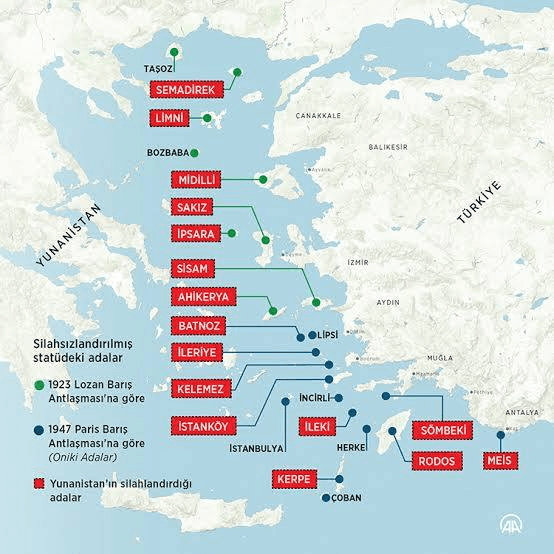
The regime is based on two distinct legal foundations for two separate groups of islands. The first group consists of nine Eastern Aegean islands under Greek sovereignty, whose non-military status was preserved under the 1923 Treaty of Lausanne: Taşoz, Semadirek, Limni, Bozbaba, Midilli, Sakız, İpsara, Sisam, and Ahikerya. In Turkish doctrine, these nine islands are subdivided into two subgroups according to their geographical location: Taşoz, Semadirek, Limni, and Bozbaba, located at the entrance to the Dardanelles, are called the “Dardanelles Front Islands”; Midilli, Sakız, İpsara, Sisam, and Ahikerya, off the western coast of Anatolia, are known as the “Saruhan Islands”.【2】
The second group comprises fourteen islands transferred from Italy to Greece under Article 14 of the 1947 Paris Peace Treaty, which stipulated their demilitarization. Contrary to their common name, this group includes fourteen islands: Batnoz, Lipsi, İleriye, Kelemez, İstanköy, İncirli, İstanbulya, İleki, Herke, Kerpe, Çoban, Sömbeki, Rodos, and Meis. In Turkish sources, this group is also referred to as the “Menteşe Islands”.【3】
Italy occupied the Dodecanese during the Italo-Turkish War. Article 2 of the 1912 Treaty of Ushi provided for the withdrawal of Italian forces from the Aegean islands they had occupied; however, this withdrawal did not occur. Turkey formally renounced all rights and claims over the islands in favor of Italy under Article 15 of the 1923 Treaty of Lausanne; Italy subsequently transferred the islands to Greece under the 1947 Paris Peace Treaty.【4】 The Greek equivalents of the Turkish names of the islands are as follows:【5】
The fundamental rationale for subjecting the islands to a non-military status is their proximity to the Anatolian coast. According to the Anatolia Agency compilation, Sisam is 3 kilometers, Midilli 10 kilometers, Sakız 9 kilometers, İstanköy 3 kilometers, and Sömbeki 5 kilometers from the Anatolian coast. Meis, located in the Mediterranean, is approximately 2.1 kilometers from Kaş district of Antalya and 582 kilometers from the Greek mainland, with an area of about 10 square kilometers.【6】
The 1913 Treaty of London, which ended the First Balkan War, delegated to Austria-Hungary, Britain, France, Russia, Italy, and Germany the authority to determine the future of the Aegean islands. The Six Powers’ decision of 13 February 1914, communicated to the Turkish and Greek governments, stated that the islands would pass under Greek sovereignty; it further stipulated that Greece must provide sufficient guarantees to the Six Powers and Turkey that it would not fortify the islands or use them for naval or military purposes.【7】
Article 12 of the Treaty of Lausanne confirmed Greek sovereignty over the Eastern Mediterranean islands, excluding Imroz, Bozcaada, and Tavşan Islands. The article is based on the decisions of the London Conference of 13 February 1914, as established by the London and Athens agreements of 17/30 May 1913 and 1/14 October 1913 respectively; the text specifically names Limni, Semendirek, Midilli, Sakız, Sisam, and Nikarya islands. The final sentence of the article stipulates that islands located less than three nautical miles from the Asian coast shall remain under Turkish sovereignty unless otherwise explicitly provided in the Treaty.【8】
The demilitarization obligation is regulated in Article 13. The article imposes three obligations for the preservation of peace: no naval base or fortification shall be established on Midilli, Sakız, Sisam, and Nikarya; Greek military aircraft shall be prohibited from flying over the Anatolian coast; in return, the Turkish Government shall also prohibit its military aircraft from flying over these islands.【9】
Under Article 15 of the Treaty, Turkey formally renounced all rights and claims over thirteen islands then under Italian occupation, their associated islets, and Meis in favor of Italy; under Article 16, Turkey relinquished all rights over territories and islands not specified in the Treaty.【10】
The Convention concerning the Dardanelles, annexed to the Treaty of Lausanne, established a separate non-military regime in the Dardanelles region to guarantee free passage through the straits. Article 4 of the Convention lists Semadirek, Limni, Imroz, Bozcaada, and Tavşan Islands among the areas to be demilitarized.
According to Article 6 of the Convention, no fortifications, permanent artillery installations, military aviation facilities, or naval bases may be maintained in non-military zones and islands. Armed forces, except for police and gendarmerie necessary for public order, may not be stationed there; their weapons are restricted to light arms as specified in the article. The deployment of underwater warfare vessels, other than submarines, is also prohibited in the territorial waters of non-military zones and islands.【11】
However, the article grants Turkey the right to transit its armed forces through non-military zones and islands under Turkish sovereignty, and permits the Turkish Navy to anchor in these waters. The Greek Navy is permitted to visit the territorial waters of non-military islands under Greek sovereignty, provided these waters are not used as operational bases or force concentration areas against Turkey.【12】
The Montreux Convention concerning the Dardanelles of 20 July 1936 reorganized the regime for passage through the Turkish Straits. Article 1 of the Protocol annexed to the Convention allows Turkey to immediately remilitarize the Dardanelles region as defined in the preamble; the preamble also states that the 1923 Convention concerning the Dardanelles is superseded by this Convention.【13】
According to Turkish doctrine, the term “Dardanelles” in the preamble encompasses the Dardanelles, the Sea of Marmara, and the Bosporus; therefore, the lifted restrictions pertain to Turkey’s national sovereignty, and the status of the Dardanelles Front Islands under Greek sovereignty remains unchanged. Greece, however, interprets the same preamble to mean that the Montreux Convention terminated the previous status of Limni and Semadirek. The positions of the two parties on this issue are discussed further below.【14】
Article 14, paragraph one, of the Paris Peace Treaty signed on 10 February 1947 between the Allied Powers and Italy provides that Italy transfers full sovereignty over the Dodecanese Islands to Greece and lists them by name. Paragraph two stipulates that these islands shall be demilitarized and remain so.【15】
Part D of Annex XIII of the Treaty contains the most detailed definition of the non-military status at the treaty level: all maritime, land, and air installations, fortifications, artificial obstacles, and weapons, as well as the use of these islands as bases or permanent or temporary stations for land, sea, or air forces, and any form of military training or production of war materiel are prohibited; the prohibition does not apply to a limited number of internal security personnel and their training.【16】
In Turkish doctrine, the term “demilitarized” in the treaties is rendered as “non-military status,” “demilitarized status,” “disarmed status,” or “demilitarized status.” Yüksel and Singil prefer the term “non-military status,” arguing that “disarmed status” is too narrow and may lead to interpretations that exclude non-weaponized military assets.【17】
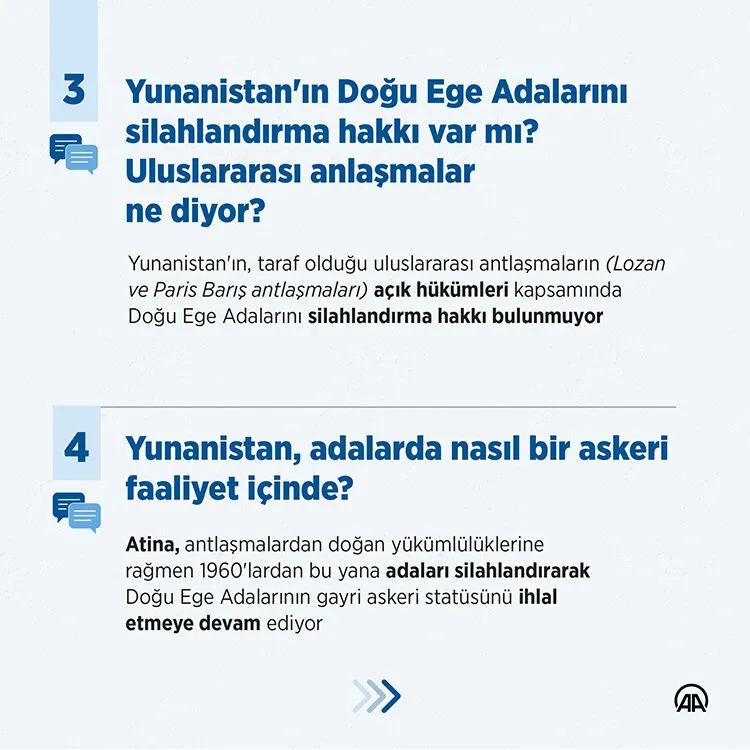
Doğu Ege Adalarının Silahlandırılmasına İlişkin Değerlendirmeler (Anadolu Ajansı)
Greece began establishing a military presence on the islands from the 1960s onward. According to Turkey’s letter to the United Nations dated 13 July 2021, this process has progressed unilaterally and cumulatively through the establishment of military garrisons, permanent military installations, and various military activities on the islands; Greece denied these facts until 1975, after which it acknowledged its failure to fulfill obligations but sought to justify them.【18】
According to the Anatolia Agency’s 2022 compilation, military elements are reported to be present on seven of the nine islands covered by the Treaty of Lausanne — Semadirek, Limni, Midilli, Sisam, Sakız, İpsara, and Ahikerya — and on nine of the fourteen islands covered by the Paris Treaty — Batnoz, İleriye, Kelemez, İstanköy, İleki, Kerpe, Sömbeki, Rodos, and Meis — totaling sixteen islands under this scope.【19】
The dispute was documented in 2021–2022 through a series of letters exchanged between the parties and addressed to the UN Secretary-General, published as General Assembly and Security Council documents.【20】
Signed by Permanent Representative Feridun H. Sinirlioğlu, the letter recalls that the islands transferred to Greek sovereignty were subject to the condition of continued demilitarization. The legal core of the letter is this: Greece, by violating the fundamental provisions of the treaties recognizing its sovereignty over the islands, cannot invoke rights derived from those same treaties, including maritime boundary delimitation; a state failing to fulfill its obligations cannot be recognized as entitled to rights arising from the same treaties.【21】
Greece’s letter of 27 July 2021 rejected the Turkish position, asserting that sovereignty over the islands was transferred unconditionally and definitively under the Treaties of Lausanne and Paris. According to the letter, Article 13 of the Treaty of Lausanne does not establish a general demilitarization regime but imposes specific military restrictions only on Midilli, Sakız, Sisam, and Ahikerya. Greece further argues that the Montreux Convention terminated the previous status of Limni and Semadirek, that Turkey cannot invoke the 1947 Paris Treaty since it is not a party, and that the islands’ maritime entitlements are independent of the non-military status debate. The letter concludes by asserting that Greece is entitled to take necessary measures under its right of legitimate self-defense under Article 51 of the UN Charter against Turkey’s military activities.【22】
Turkey’s letter of 30 September 2021 rejected Greece’s arguments under six legal headings. Turkey contends that Article 12 of the Treaty of Lausanne explicitly references the 1914 decision, establishing a direct link between the transfer of sovereignty and the non-military status; that the Montreux Convention established a new regime only for the Turkish Straits and did not terminate Greece’s obligations; and that the 1947 Paris Treaty created an objective regime, which Turkey, although not a party, may demand compliance with as a concerned state, and that Greece cannot invoke rights derived from the treaties against Turkey in the event of violations.【23】
The response letter signed by Permanent Representative Ambassador Maria Theofili fully rejects the Turkish position. The main arguments presented are:【24】
According to Greece, the primary purpose of the Treaties of Lausanne and Paris was to establish permanent borders and national title for the respective states, and this was not linked to other obligations. The letter bases its view on the principle of stability and finality in boundary treaties on the International Court of Justice’s rulings in the Preah Vihear Temple (1962) and Libya–Chad (1994) cases.【25】
Second, maritime entitlements are inherent to national sovereignty: Greece asserts that all the islands are entitled to territorial waters, exclusive economic zones, and continental shelves under Article 121(2) of the United Nations Convention on the Law of the Sea. Since sovereignty is legally undisputed, these rights are unrelated to the issue of demilitarization.【26】
Third, the 1936 Montreux Convention terminated the 1923 Convention concerning the Dardanelles and its provisions concerning Limni and Semadirek.【27】
Fourth, the 1947 Paris Treaty did not establish a demilitarization regime; the demilitarization clause in Article 14 is an independent and ancillary provision and cannot be compared to the 1856 Åland Convention. The treaty’s provisions were agreed upon among other parties, and Turkey, as a non-party, cannot invoke them.【28】
The letter continues by addressing Turkey’s claims regarding its military capacity and the Turkish Grand National Assembly resolution of 8 June 1995, concluding that the only remaining dispute between the two countries concerns the delimitation of continental shelves and exclusive economic zones.【29】
Turkey’s reply letter addresses five of Greece’s arguments individually.【30】 Regarding the purpose of the treaties, the letter states that both treaties’ titles and preambles clearly indicate their general aim was to end the state of war and restore peace, and that demilitarization was among the essential elements serving this purpose.【31】
On the principle of stability of boundaries, Turkey argues that the jurisprudence cited by Greece applies specifically to bilateral boundary treaties; the fundamental principle is that the territorial regime established by a treaty acquires permanence independent of the treaty itself, and this permanence belongs to the entire regime. Thus, the transfer of sovereignty was linked to a fundamental restriction — demilitarization — and the demilitarized status shares the same permanence as the transfer.【32】
On Montreux, the letter provides a multi-layered response: The status of Limni and Semadirek was established by the 1914 decision and confirmed by Article 12 of Lausanne and Article 4(3) of the Convention concerning the Dardanelles; Article 1 of the Protocol annexed to Montreux limits the geographical scope of remilitarization exclusively to the Turkish Straits and contains no provisions regarding any other state or area; during the conference, Greek delegate Mavroudis publicly stated that Montreux did not seek a similar status for the Eastern Aegean islands. The letter also refers to state practice: Greece did not militarize Limni until the 1960s and, in its official explanations following subsequent protests, explicitly confirmed the existence of its obligations.【33】
Regarding the Paris Treaty, Turkey argues that it is a leading example of a treaty establishing an “objective regime” in international law; in light of the 1856 Åland Convention and the League of Nations’ Åland decision, such regimes allow non-party states with a legitimate interest to demand compliance with their provisions. Article 89 applies only to states mentioned in the preamble but not yet parties, and thus has no effect on Turkey.【34】
The letter concludes by asserting that violations have affected the legal regime governing sovereignty over the islands, and that Turkey, as a directly injured state, has the right to challenge Greece’s sovereignty title and associated maritime rights; it ends with an expression of commitment to resolving the Aegean disputes through the means provided under Article 33 of the UN Charter.【35】
The letter exchange reveals three points where both parties rely on the same legal material but draw opposing conclusions. First, both parties invoke the International Court of Justice’s rulings in Preah Vihear (1962) and Libya–Chad (1994); Greece concludes from this jurisprudence that the finality of boundaries is independent of demilitarization, while Turkey concludes that permanence belongs to the entire territorial regime. Third, both parties invoke the flight prohibition clause in Article 13 of Lausanne; the official Turkish text of the Treaty confirms this reciprocity.【36】
The Kardak issue is a sovereignty dispute distinct from the non-military status of the islands. The legal status of the 1932 Turkish-Italian documents invoked in the dispute is separate. The Treaty of 4 January 1932 between Turkey and Italy, which regulated the归属 of Meis and surrounding islets and their territorial waters, was ratified on 25 April 1933 and registered with the League of Nations. The document concerning the Kardak rocks is a technical record/protocol dated 28 December 1932. Turkey argues that this second document lacks the necessary legal formalities and was not registered with the League of Nations, and therefore is not binding; Greece contends that it constitutes a valid supplement to the 4 January Treaty.【37】
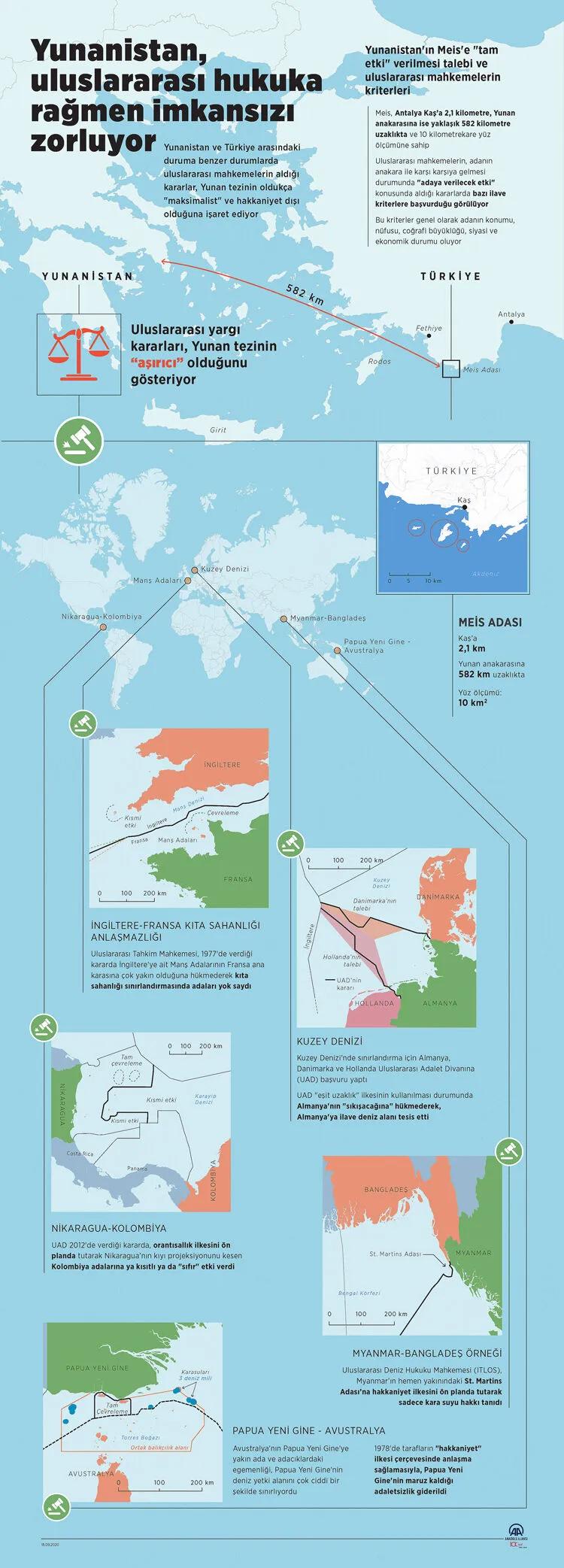
Meis Adası’nın Konumu ve Benzer Deniz Yetki Alanı Uyuşmazlıkları (Anadolu Ajansı)
The entitlement of islands to maritime zones and the delimitation of such zones between states are distinct legal issues. The dispute focuses not on whether the islands generate maritime zones, but on whether they are granted full, reduced, or zero effect in the delimitation between opposing coasts. Turkey argues that granting full effect to Greek islands would disproportionately restrict Anatolia’s access to the sea (principle of proportionality); Greece asserts that the islands are entitled to territorial waters, exclusive economic zones, and continental shelves. This disagreement is reflected in debates surrounding the Blue Homeland doctrine.【38】
Meis is central to this debate. According to the Turkish assessment, granting full maritime effect to the 10-square-kilometer island located approximately 2.1 kilometers from Kaş would allow it to cut off Turkey’s coastal projection by an area roughly four thousand times its own size. The cartographic representation of this approach, prepared in the 2000s by two academics from the University of Seville (Suárez de Vivero and Rodríguez Mateos), is known as the “Seville map,” which confines Turkey’s jurisdictional area in the Eastern Mediterranean to a narrow zone off the Antalya Gulf; European Union officials have clarified that the map has no official legal status.【39】
International courts and arbitral tribunals have assessed maritime delimitation according to the geographical characteristics of each dispute; in some cases, islands close to the opposing coast or disproportionately affecting the delimitation line have been granted reduced or zero effect. Examples include the 1977 UK–France arbitration, the 1992 Canada–France Saint Pierre and Miquelon decision, and the 2009 Romania–Ukraine Snake Island ruling. The Nicaragua–Colombia judgment (2012) is also cited in the same context.【40】
The Greek Ministry of Foreign Affairs has published a series of maps illustrating Turkish claims from 1972 to 2022. The indicator legend of the 2022 map No. 15 includes “Blue Homeland” as a separate layer; the same legend also depicts the 1932 Turkish-Italian treaty and protocol as a delimitation line. The opposing interpretations assigned by the parties to this line — drawn as a boundary on one map and dismissed as invalid by the other — concretely illustrate the nature of the dispute.【41】
Ballı, Ali. “Kardak Kayalıkları Önlerinde Hareketli Anlar.” Anadolu Ajansı, February 19, 2017. Accessed August 11, 2026.https://www.aa.com.tr/tr/turkiye/kardak-kayaliklari-onlerinde-hareketli-anlar/753761.
Doğan, Cabir. “Fethinden Kaybına Rodos (1522–1912).” *SDÜ Fen Edebiyat Fakültesi Sosyal Bilimler Dergisi*, no. 30 (2013): 67–88. Accessed August 13, 2026.https://dergipark.org.tr/tr/download/article-file/117760
Durul, Tevfik. “5 Soruda Yunanistan’ın Doğu Ege Adalarını Silahlandırması.” Anadolu Ajansı, June 17, 2022. Accessed August 11, 2026.https://www.aa.com.tr/tr/gundem/5-soruda-yunanistanin-dogu-ege-adalarini-silahlandirmasi/2615986
Erbaş, Fatih. “Kardak Krizi ve Yunanistan’ın Ege’deki Mesnetsiz İddiaları.” Anadolu Ajansı, February 9, 2017. Accessed August 11, 2026.https://www.aa.com.tr/tr/analiz-haber/kardak-krizi-ve-yunanistanin-egedeki-mesnetsiz-iddialari/744722
Greece. “Letter dated 25 May 2022 from the Permanent Representative of Greece to the United Nations addressed to the Secretary-General.” United Nations Document A/76/846–S/2022/432, May 25, 2022. Accessed August 11, 2026.
Greece. “Letter dated 27 July 2021 from the Permanent Representative of Greece to the United Nations addressed to the Secretary-General.” United Nations Document A/75/976–S/2021/684, July 27, 2021. Accessed August 13, 2026.
Hellenic Republic Ministry of Foreign Affairs. “Map 15 — Overall Depiction of Turkish Claims Today (2022).” *Presentation of Turkish Illegal Claims Through Maps*. Accessed August 11, 2026.https://www.mfa.gr/images/docs/maps/en/map15.pdf.
Hellenic Republic Ministry of Foreign Affairs. “Turkish Claims.” Accessed August 13, 2026.https://www.mfa.gr/en/foreign-policy/foreign-policy-issues/issues-of-greek-turkish-relations/turkish-claims/.
Lozan Sulh Muahedenamesi. Düstur, 3. tertip, c. 5. İstanbul: Necmi İstikbal Matbaası, 1924.
Türkiye Cumhuriyeti Dışişleri Bakanlığı. "Background Note on Aegean Disputes." Accessed August 13, 2026.https://www.mfa.gov.tr/background-note-on-aegean-disputes.en.mfa
Türkiye. “Letter dated 13 July 2021 from the Permanent Representative of Turkey to the United Nations addressed to the Secretary-General.” United Nations Document A/75/961–S/2021/651, July 14, 2021. Accessed August 11, 2026.
Türkiye. “Letter dated 17 September 2022 from the Permanent Representative of Türkiye to the United Nations addressed to the Secretary-General.” United Nations Document A/77/354–S/2022/703, September 19, 2022. Accessed August 11, 2026.
Türkiye. “Letter dated 30 September 2021 from the Permanent Representative of Turkey to the United Nations addressed to the Secretary-General.” United Nations Document A/76/379–S/2021/841, September 30, 2021. Accessed August 13, 2026.
United Nations, Division for Ocean Affairs and the Law of the Sea. “Türkiye.” Legislation and Treaties. Accessed August 11, 2026.https://www.un.org/depts/los/LEGISLATIONANDTREATIES/STATEFILES/TUR.htm.
United Nations. *Recueil des Traités et des Engagements internationaux enregistrés par le Secrétariat de la Société des Nations.* January 4, 1932. *League of Nations Treaty Series* 138: 243–249. Accessed August 13, 2026.
United Nations. *Treaties and international agreements registered or filed and recorded with the Secretariat of the United Nations.* Birleşmiş Milletler Antlaşmalar Serisi 49 (1950). Accessed August 13, 2026.https://treaties.un.org/doc/publication/UNTS/Volume%2049/v49.pdf.
Yaycı, Cihat. “Doğu Akdeniz’de Deniz Yetki Alanlarının Paylaşılması Sorunu ve Türkiye.” *Bilge Strateji* 4, no. 6 (2012): 1–70. Accessed August 11, 2026.https://dergipark.org.tr/tr/pub/bs/issue/3804/51021.
Yüksel, Cüneyt, and Nesrin Singil. “Uluslararası Hukukta Gayri Askeri Statü ve Doğu Ege Adaları’nın Askerileştirilmesi Sorunu.” *Public and Private International Law Bulletin* 43, no. 2 (2023): 447–489. Accessed August 11, 2026.https://doi.org/10.26650/ppil.2023.43.2.1204391
Çetin, Şerife. “Yunanistan Uluslararası Hukuka Rağmen İmkansızı Zorluyor.” Anadolu Ajansı, September 17, 2020. Accessed August 11, 2026.https://www.aa.com.tr/tr/dunya/yunanistan-uluslararasi-hukuka-ragmen-imkansizi-zorluyor/1976274
[1]
Tevfik Durul, “5 Soruda Yunanistan’ın Doğu Ege Adalarını Silahlandırması,” Anadolu Ajansı, 17 Haziran 2022, erişim tarihi: 11 Ağustos 2026, https://www.aa.com.tr/tr/gundem/5-soruda-yunanistanin-dogu-ege-adalarini-silahlandirmasi/2615986.
[2]
Durul, “5 Soruda Yunanistan’ın Doğu Ege Adalarını Silahlandırması.”
[3]
İtalya ile Barış Antlaşması, md. 14 ve Ek XIII/D, Birleşmiş Milletler Antlaşmalar Serisi 49 (1950), erişim tarihi: 13 Ağustos 2026, https://treaties.un.org/doc/publication/UNTS/Volume%2049/v49.pdf.
[4]
Cabir Doğan, “Fethinden Kaybına Rodos (1522–1912),” SDÜ Fen Edebiyat Fakültesi Sosyal Bilimler Dergisi, sy. 30 (2013): 83–84, erişim tarihi: 13 Ağustos 2026, https://dergipark.org.tr/tr/download/article-file/117760; Lozan Sulh Muahedenamesi, md. 15, Düstur, 3. tertip, c. 5 (İstanbul: Necmi İstikbal Matbaası, [1924]), 27; İtalya ile Barış Antlaşması, md. 14, Birleşmiş Milletler Antlaşmalar Serisi 49 (1950), erişim tarihi: 13 Ağustos 2026, https://treaties.un.org/doc/publication/UNTS/Volume%2049/v49.pdf.
[5]
Durul, “5 Soruda Yunanistan’ın Doğu Ege Adalarını Silahlandırması.”
[6]
Şerife Çetin, “Yunanistan Uluslararası Hukuka Rağmen İmkânsızı Zorluyor,” Anadolu Ajansı, 17 Eylül 2020, erişim tarihi: 11 Ağustos 2026, https://www.aa.com.tr/tr/dunya/yunanistan-uluslararasi-hukuka-ragmen-imkansizi-zorluyor/1976274.
[7]
Durul, “5 Soruda Yunanistan’ın Doğu Ege Adalarını Silahlandırması.”
[8]
Lozan Sulh Muahedenamesi, md. 12, Düstur, 3. tertip, c. 5 (İstanbul: Necmi İstikbal Matbaası, [1924]), 25.
[9]
Lozan Sulh Muahedenamesi, md. 13, 25–26.
[10]
Lozan Sulh Muahedenamesi, md. 15–16, Düstur, 3. tertip, c. 5 (İstanbul: Necmi İstikbal Matbaası, [1924]), 27.
[11]
Boğazlar Rejimine İlişkin Lozan Sözleşmesi, md. 4 ve 6, aktaran Cüneyt Yüksel ve Nesrin Singil, “Uluslararası Hukukta Gayri Askerî Statü ve Doğu Ege Adaları’nın Askerileştirilmesi Sorunu,” Public and Private International Law Bulletin 43, no. 2 (2023): 461–462, erişim tarihi: 11 Ağustos 2026, https://doi.org/10.26650/ppil.2023.43.2.1204391.
[12]
Boğazlar Rejimine İlişkin Lozan Sözleşmesi, md. 6, aktaran Yüksel ve Singil, “Gayri Askerî Statü,” 462.
[13]
Yüksel ve Singil, “Gayri Askeri Statü,” 462, 467.
[14]
Yüksel ve Singil, “Gayri Askeri Statü,” 467–468.
[15]
Paris Barış Antlaşması, md. 14, aktaran Yüksel ve Singil, “Gayri Askeri Statü,” 462–463.
[16]
Paris Barış Antlaşması, XIII numaralı ek, D kısmı, aktaran Yüksel ve Singil, “Gayri Askeri Statü,” 463.
[17]
Yüksel ve Singil, “Gayri Askeri Statü,” 457–458, 477.
[18]
Türkiye, “Letter dated 13 July 2021 from the Permanent Representative of Turkey to the United Nations addressed to the Secretary-General,” Birleşmiş Milletler Belgesi A/75/961–S/2021/651, 14 Temmuz 2021, 1–2, erişim tarihi: 11 Ağustos 2026, https://digitallibrary.un.org/record/3932460.
[19]
Durul, “5 Soruda Yunanistan’ın Doğu Ege Adalarını Silahlandırması.”
[20]
United Nations, Division for Ocean Affairs and the Law of the Sea, “Türkiye,” Legislation and Treaties, erişim tarihi: 11 Ağustos 2026, https://www.un.org/depts/los/LEGISLATIONANDTREATIES/STATEFILES/TUR.htm.
[21]
Türkiye, Birleşmiş Milletler Belgesi A/75/961–S/2021/651, 2.
[22]
Yunanistan, “Letter dated 27 July 2021 from the Permanent Representative of Greece to the United Nations addressed to the Secretary-General,” BM Belgesi A/75/976–S/2021/684, 27 Temmuz 2021, erişim tarihi: 13 Ağustos 2026, https://digitallibrary.un.org/record/3934372.
[23]
Türkiye, “Letter dated 30 September 2021 from the Permanent Representative of Turkey to the United Nations addressed to the Secretary-General,” BM Belgesi A/76/379–S/2021/841, 30 Eylül 2021, erişim tarihi: 13 Ağustos 2026, https://digitallibrary.un.org/record/3943483.
[24]
Yunanistan, “Letter dated 25 May 2022 from the Permanent Representative of Greece to the United Nations addressed to the Secretary-General,” Birleşmiş Milletler Belgesi A/76/846–S/2022/432, 25 Mayıs 2022, 1, erişim tarihi: 11 Ağustos 2026, https://digitallibrary.un.org/record/3976160/files/A_76_846--S_2022_432-EN.pdf.
[25]
Yunanistan, Birleşmiş Milletler Belgesi A/76/846–S/2022/432, par. 3–5, 1–2.
[26]
Yunanistan, Birleşmiş Milletler Belgesi A/76/846–S/2022/432, par. 6–7, 2.
[27]
Yunanistan, Birleşmiş Milletler Belgesi A/76/846–S/2022/432, par. 8, 2–3.
[28]
Yunanistan, Birleşmiş Milletler Belgesi A/76/846–S/2022/432, par. 9, 3.
[29]
Yunanistan, Birleşmiş Milletler Belgesi A/76/846–S/2022/432, par. 11–12, 3–4.
[30]
Türkiye, “Letter dated 17 September 2022 from the Permanent Representative of Türkiye to the United Nations addressed to the Secretary-General,” Birleşmiş Milletler Belgesi A/77/354–S/2022/703, 19 Eylül 2022, 1, erişim tarihi: 11 Ağustos 2026, https://digitallibrary.un.org/record/3989129.
[31]
Türkiye, Birleşmiş Milletler Belgesi A/77/354–S/2022/703, 1–2.
[32]
Türkiye, Birleşmiş Milletler Belgesi A/77/354–S/2022/703, 2–3.
[33]
Türkiye, Birleşmiş Milletler Belgesi A/77/354–S/2022/703, 3–4.
[34]
Türkiye, Birleşmiş Milletler Belgesi A/77/354–S/2022/703, 4–5.
[35]
Türkiye, Birleşmiş Milletler Belgesi A/77/354–S/2022/703, 5.
[36]
Yunanistan, Birleşmiş Milletler Belgesi A/76/846–S/2022/432, 2–3; Türkiye, Birleşmiş Milletler Belgesi A/77/354–S/2022/703, 2–4; Lozan Sulh Muahedenamesi, md. 13, 25–26.
[37]
Türkiye ile İtalya Arasında Anadolu Kıyıları ile Meis Adası Arasındaki Karasularının Sınırlandırılmasına İlişkin Sözleşme, 4 Ocak 1932, League of Nations Treaty Series 138: 243–249, erişim tarihi: 13 Ağustos 2026, https://treaties.un.org/doc/Publication/UNTS/LON/Volume%20138/v138.pdf; Türkiye Cumhuriyeti Dışişleri Bakanlığı, “Background Note on Aegean Disputes,” erişim tarihi: 13 Ağustos 2026, https://www.mfa.gov.tr/background-note-on-aegean-disputes.en.mfa; Hellenic Republic Ministry of Foreign Affairs, “Turkish Claims,” erişim tarihi: 13 Ağustos 2026, https://www.mfa.gr/en/foreign-policy/foreign-policy-issues/issues-of-greek-turkish-relations/turkish-claims/.
[38]
Türkiye, BM Belgesi A/77/354–S/2022/703, 19 Eylül 2022, erişim tarihi: 13 Ağustos 2026, https://digitallibrary.un.org/record/3989129; Yunanistan, BM Belgesi A/76/846–S/2022/432, 25 Mayıs 2022, erişim tarihi: 13 Ağustos 2026, https://digitallibrary.un.org/record/3989129.
[39]
Çetin, “Yunanistan Uluslararası Hukuka Rağmen İmkansızı Zorluyor.”
[40]
Cihat Yaycı, “Doğu Akdeniz’de Deniz Yetki Alanlarının Paylaşılması Sorunu ve Türkiye,” Bilge Strateji 4, no. 6 (2012): 39, erişim tarihi: 11 Ağustos 2026, https://dergipark.org.tr/tr/pub/bs/issue/3804/51021; Çetin, “Yunanistan Uluslararası Hukuka Rağmen İmkansızı Zorluyor.”
[41]
Hellenic Republic Ministry of Foreign Affairs, “Map 15 — Overall Depiction of Turkish Claims Today (2022),” Presentation of Turkish Illegal Claims Through Maps, erişim tarihi: 11 Ağustos 2026, https://www.mfa.gr/images/docs/maps/en/map15.pdf.

Maritime Jurisdiction Claims in Blue Homeland | Greece claims exclusive economic zone and continental shelf rights for the islands in the Aegean and Mediterranean by granting them full effect, while Türkiye argues that this right cannot be asserted against Greece, which violates the non-military status of the islands | ||||||||
|---|---|---|---|---|---|---|---|---|---|
Maritime Jurisdiction Claims in Blue Homeland | Türkiye argues that granting full effect to the islands reduces maritime jurisdiction areas, while Greece contends that the islands are entitled to full maritime jurisdiction | ||||||||
International law regime | Status is based on the 1914 Six Powers Decision, the 1923 Treaty of Lausanne and the 1947 Paris Peace Treaty | ||||||||
Legal Basis | 1914 Six Powers Decision; 1923 Treaty of Lausanne; 1947 Paris Peace Treaty | ||||||||
Scope | Eastern Aegean islands and the Dodecanese | ||||||||
Type | International legal regime | ||||||||
Related States | Türkiye and Greece | ||||||||
Henüz Tartışma Girilmemiştir
"Non-Military Status of the Eastern Aegean Islands" maddesi için tartışma başlatın
Islands Covered by the Status
Legal Foundations
The Six Powers Decision of 1914
Treaty of Lausanne (1923)
Convention concerning the Dardanelles (1923)
Montreux Convention concerning the Dardanelles (1936)
Paris Peace Treaty (1947)
Terminology
Developments Regarding Violations of the Status
Legal Positions of the Parties and UN Correspondence
Turkey’s Position: Letter of 13 July 2021
Greece’s Response: Letter of 27 July 2021
Turkey’s Reply: Letter of 30 September 2021
Greece’s Response: Letter of 25 May 2022
Turkey’s Counter-Reply: Letter of 17 September 2022
Points of Convergence Between the Positions
Relation to the Kardak Crisis
Delimitation of Maritime Zones and Relation to the Blue Homeland Doctrine