
Bu içerik Türkçe olarak yazılmış olup yapay zeka ile otomatik olarak İngilizceye çevrilmiştir.
Foundation Year | 29 April 1997 | ||||||||
|---|---|---|---|---|---|---|---|---|---|
Basic Organs | Conference of Contracting States, Executive Council and Technical Secretariat | ||||||||
Awards and Achievements | Nobel Peace Prize 2013 | ||||||||
Number of Member Countries | 193 | ||||||||
Organisation for the Prohibition of Chemical Weapons (OPCW) is an international organization established to ensure the implementation of the Chemical Weapons Convention (CWC). The OPCW became operational upon the entry into force of the Chemical Weapons Convention on 29 April 1997. The organization’s core mission is to create a world free of chemical weapons and the threat of their use, and to support the peaceful use of chemistry for progress and prosperity.【1】
International efforts to limit chemical weapons date back to the 17th century. The 1675 Strasbourg Agreement is recognized as the first international regulation prohibiting the use of poison bullets. This was followed by the 1874 Brussels Declaration and the 1899 and 1907 Hague Conventions. However, these measures failed to fully prevent the use of chemical weapons. The widespread use of chemical weapons during World War I intensified efforts to strengthen international legal frameworks in this area. The 1925 Geneva Protocol banned the use of chemical and biological weapons in warfare but did not cover their development, production or stockpiling.
Negotiations toward a Chemical Weapons Convention began in 1968 within the framework of the Geneva Conference on Disarmament and gained momentum with the establishment of a working group in 1980. The draft convention was adopted in 1992 and opened for signature in Paris on 13 January 1993. Within the first two days, 130 states signed the convention. To prepare for its implementation, the Preparatory Commission was established in 1993, along with an Interim Technical Secretariat. After Hungary submitted its 65th instrument of ratification on 31 October 1996, the 180-day countdown began, culminating in the entry into force of the Chemical Weapons Convention on 29 April 1997 and the formal operationalization of the OPCW.【2】
The OPCW’s primary objective is to eliminate the development, production, stockpiling, transfer and use of chemical weapons by implementing the provisions of the Chemical Weapons Convention, ensuring the destruction of existing chemical weapons stockpiles, and preventing their re-emergence. The organization also promotes the development of protection and assistance mechanisms against chemical weapons, supports international cooperation for the peaceful use of chemistry, and encourages universal adherence to the Convention.
The OPCW conducts its activities in accordance with two fundamental principles: preserving the multilateral nature of the Chemical Weapons Convention and ensuring its provisions are applied equally to all state parties. Its work is carried out in line with the principles of integrity, effectiveness, competence and cost-efficiency. The ultimate goal is to establish a world permanently free of chemical weapons and to contribute to international security, stability, general disarmament and global economic development.【3】
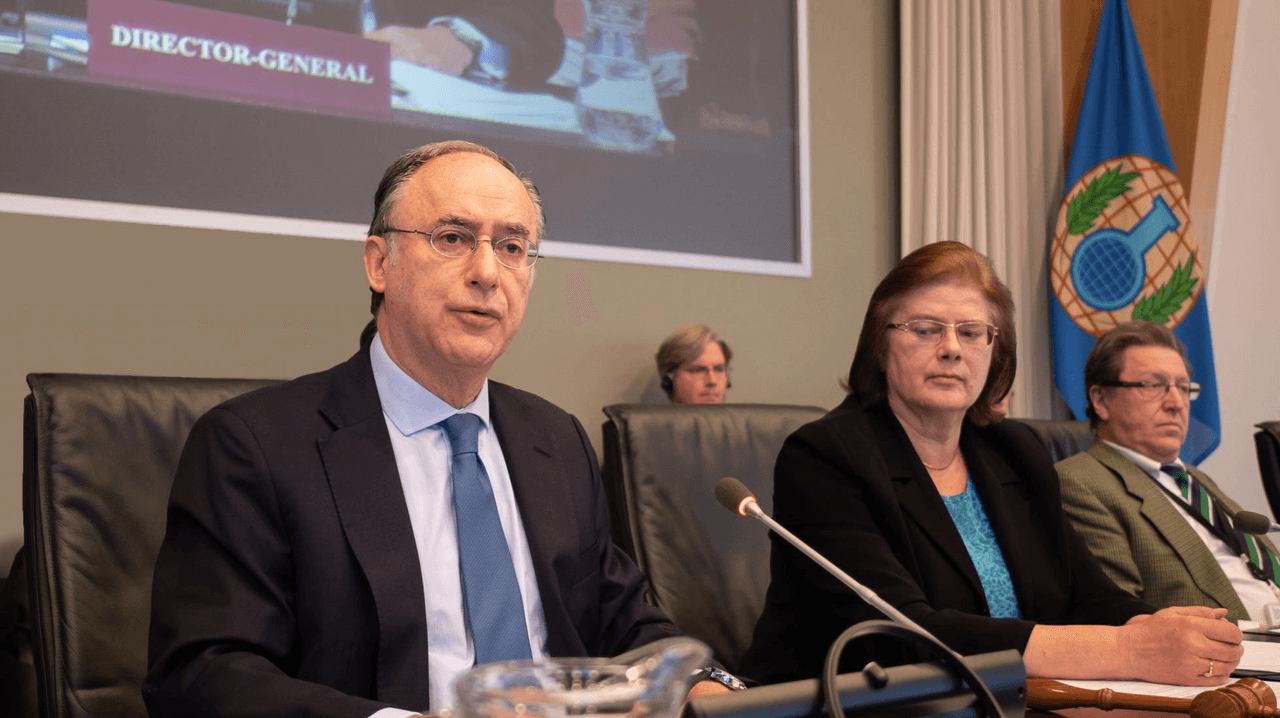
Yürütme Konseyi Toplantısında Genel Direktör Fernando Arias (OPCW)
The Chemical Weapons Convention was opened for signature in 1993 and entered into force in 1997. Under the Convention, the development, production and use of chemical weapons are prohibited. The OPCW is responsible for ensuring the implementation of the Convention and verifying whether state parties fulfill their obligations.
The OPCW consists of three main organs:
- Conference of the States Parties,
- Executive Council,
- Technical Secretariat.
The Conference of the States Parties is the highest decision-making body, representing all states that are party to the Convention. The Executive Council comprises 41 member states elected by the Conference for two-year terms. Membership is determined with consideration for geographic balance, the importance of the chemical industry, and political and security interests. The Council oversees the activities of the Technical Secretariat and promotes the effective implementation of the Convention. Its principal duties include evaluating state parties’ compliance with obligations, reviewing draft programs and budgets, submitting implementation reports to the Conference, and recommending the appointment of the Director-General. The Council also approves agreements related to verification activities, oversees processes for investigating allegations of chemical weapons use, coordinates assistance and protection mechanisms, and contributes to the resolution of disputes among state parties.【4】
The Executive Council makes decisions largely by consensus. A two-thirds majority is required on substantive matters and a simple majority on procedural issues. A three-quarters majority is needed for decisions to suspend challenge inspections. The Council holds three regular sessions annually and convenes special meetings as necessary. The Technical Secretariat implements activities related to the Convention’s implementation, carries out verification processes, plans inspections, and provides technical assistance to state parties. It also develops policy recommendations regarding the implementation of the Chemical Weapons Convention and manages relevant programs.
One of the OPCW’s core functions is to implement the verification regime under the Chemical Weapons Convention. This includes examining declarations submitted by state parties and conducting inspections at industrial facilities associated with chemical weapons. On-site inspections serve as the primary tool for verifying compliance with state party obligations. Information obtained is shared with state parties in accordance with the Convention’s confidentiality provisions, aiming to enhance the transparency and credibility of the verification system. In addition to verifying the destruction of chemical weapons, the OPCW conducts activities to protect against chemical weapons and provide assistance, supports international cooperation for the peaceful use of chemistry, and helps strengthen national capacities of state parties.【5】
The organization also promotes universal adherence to the Convention and implements various programs to help state parties effectively meet their obligations. According to its membership data, the OPCW has 193 member states, and approximately 98 percent of the world’s population lives under the protection of the Chemical Weapons Convention.【6】 Under OPCW supervision, all declared global chemical weapons stockpiles have been destroyed. For its efforts in eliminating chemical weapons, the OPCW was awarded the 2013 Nobel Peace Prize.
OPCW awarded the 2013 Nobel Peace Prize (OPCW)
Türkiye became a party to the Chemical Weapons Convention by ratifying it in 1997. Türkiye supports the prohibition of the production and use of chemical weapons under the Convention and condemns their use regardless of where, by whom or under what circumstances they are employed. Türkiye has also served on the OPCW Executive Council during specific periods, most recently from 2022 to 2024.【7】
Ministry of Foreign Affairs of the Republic of Turkey. "Silahların Kontrolü ve Silahsızlanma." Accessed July 30, 2026.https://www.mfa.gov.tr/silahlarin-kontrolu-ve-silahsizlanma.tr.mfa
Organisation for the Prohibition of Chemical Weapons. “Executive Council.” Accessed July 30, 2026.https://www.opcw.org/about-us/executive-council
Organisation for the Prohibition of Chemical Weapons. “History.” Accessed July 30, 2026.https://www.opcw.org/about-us/history
Organisation for the Prohibition of Chemical Weapons. “Mission.” Accessed July 30, 2026.https://www.opcw.org/about-us/mission
Organisation for the Prohibition of Chemical Weapons. “OPCW Basics.” Accessed July 30, 2026.https://www.opcw.org/about-us/opcw-basics
Organisation for the Prohibition of Chemical Weapons. “OPCW Basics.” YouTube video. Accessed July 30, 2026.https://www.youtube.com/watch?v=n18WrZCXwgE&t=2s
T.C. Ministry of Trade. "Kimyasal Silahların Geliştirilmesi, Üretimi, Stoklanması ve Kullanımının Yasaklanması ve Bunların İmhası ile İlgili Sözleşme." Accessed July 30, 2026.https://ticaret.gov.tr/data/5b9b964513b8761cc09f9c21/Kimyasal_Silahlarin_Gelistirilmesi.pdf
[1]
Organisation for the Prohibition of Chemical Weapons. “History.” Erişim 30 Temmuz 2026. https://www.opcw.org/about-us/history
[2]
Organisation for the Prohibition of Chemical Weapons. “History.” Erişim 30 Temmuz 2026. https://www.opcw.org/about-us/history
[3]
Organisation for the Prohibition of Chemical Weapons. “Mission.” Erişim 30 Temmuz 2026. https://www.opcw.org/about-us/mission
[4]
Organisation for the Prohibition of Chemical Weapons. “Executive Council.” Erişim 30 Temmuz 2026. https://www.opcw.org/about-us/executive-council
[5]
Organisation for the Prohibition of Chemical Weapons. “Executive Council.” Erişim 30 Temmuz 2026. https://www.opcw.org/about-us/executive-council
[6]
Organisation for the Prohibition of Chemical Weapons. “Executive Council.” Erişim 30 Temmuz 2026. https://www.opcw.org/about-us/executive-council
[7]
T.C. Dışişleri Bakanlığı. “Silahların Kontrolü ve Silahsızlanma.” Erişim 30 Temmuz 2026. https://www.mfa.gov.tr/silahlarin-kontrolu-ve-silahsizlanma.tr.mfa

Foundation Year | 29 April 1997 | ||||||||
|---|---|---|---|---|---|---|---|---|---|
Basic Organs | Conference of Contracting States, Executive Council and Technical Secretariat | ||||||||
Awards and Achievements | Nobel Peace Prize 2013 | ||||||||
Number of Member Countries | 193 | ||||||||
Henüz Tartışma Girilmemiştir
"Organization for the Prohibition of Chemical Weapons" maddesi için tartışma başlatın
History
Objectives and Functions
Chemical Weapons Convention
Institutional Structure
Verification Activities
Türkiye and the OPCW