Bu içerik Türkçe olarak yazılmış olup yapay zeka ile otomatik olarak İngilizceye çevrilmiştir.
+1 Daha
Scope | Main line Urban rail systems Onboard signaling | ||||||||
|---|---|---|---|---|---|---|---|---|---|
First field application | Mithatpaşa Station, 2012 | ||||||||
Main systems | YERLİSİNYAL-ANK YERLİSİNYAL-TKM YERLİSİNYAL-CBTC | ||||||||
Related systems and technologies | ETCS ERTMS CBTC FRMCS | ||||||||
Safety level | Up to SIL4 | ||||||||
Related standards | EN 50126 EN 50128 EN 50129 EN 50159 IEC 62290-3 | ||||||||
Main institutions | TÜBİTAK RUTE TCDD Taşımacılık TÜBİTAK BİLGEM ASELSAN İTÜ | ||||||||
Main applications | Afyon–Denizli–Isparta Gayrettepe–Istanbul Havalimanı–Halkalı Torbalı–Tire–Ödemiş Malatya–Elazığ Ortaklar–Denizli | ||||||||
On-vehicle project | Equipping 99 diesel-electric mainline locomotives with domestic systems | ||||||||
Signalized network as of 2026 | 8.419 km | ||||||||
Signalized network ratio | %61 | ||||||||
Railway Signaling is the comprehensive system and equipment that ensures the safe management of train movements. In Türkiye, this structure consists of interrelated components such as the traffic control center, field equipment, and interlocking systems. Train movements along the track, switch positions, and signal indications are managed through this structure.【1】
What Are Railway Signaling Systems (Ministry of Transport and Infrastructure of the Republic of Türkiye)
Efforts to develop railway signaling in Türkiye have expanded over time to encompass main lines, urban rail systems, and onboard signaling applications. Among the solutions developed in Türkiye are interlocking systems, traffic control centers, and urban signaling systems based on Communications-Based Train Control (CBTC). As of 2024, the development of metro signaling systems has been included among the initiatives under the National Technology Initiative.【2】
Efforts to develop railway signaling in Türkiye have progressed through a process spanning research and development activities to field applications. The field acceptance tests for the system developed under the National Railway Signaling Project were conducted and completed by TCDD in January 2012 at Mithatpaşa Station in Sakarya. Tests were carried out to verify the compatibility of interlocking software developed by different teams with control and field components.【3】
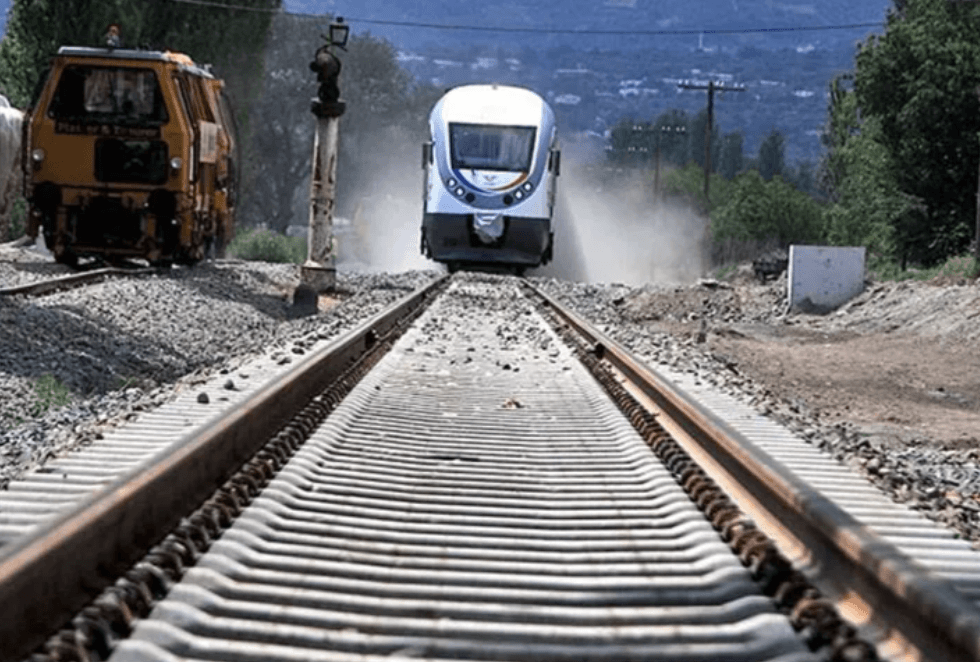
Ulusal Demiryolu Sinyalizasyon Sistemi çalışmalarına ilişkin görsel, 2013 (AA)
In 2017, the project transitioned from prototype stage to full-scale line implementations. Prototype work was carried out in collaboration between TÜBİTAK BİLGEM and Istanbul Technical University; efforts were initiated to install the developed system on the Afyon–Denizli–Isparta/Burdur and Denizli–Ortaklar lines.【4】
Domestic signaling systems have since been implemented on various lines and stations. In 2024, the acceptance tests for the YERLİSİNYAL system at Sarayköy and Üzerlik stations were completed.【5】 In the same year, a CBTC-based domestic signaling system was commissioned on the Gayrettepe–Istanbul Airport metro line.【6】
Work on YERLİSİNYAL continued in 2025 and 2026. In 2026, a cooperation protocol on YERLİSİNYAL was signed between TÜBİTAK and TCDD.【7】
A railway signaling system consists of interconnected control and field components that enable the safe management of train traffic. The key elements of a centrally controlled system are the traffic control center, interlocking system, and field equipment. The traffic control center monitors and manages train movements, while the interlocking system evaluates route requests against safety conditions. Field equipment such as track circuits, switches, and signals are used to detect and direct train movements along the line.
The traffic control center is the central structure where train traffic is monitored and managed by operators. Information from field equipment is displayed at the center; route requests generated by operators are transmitted to the interlocking system via SCADA (Supervisory Control and Data Acquisition) software. The interlocking system evaluates the compliance of the request with safety conditions and reports the result back to the traffic control center.【8】
The Traffic Control Center system developed under YERLİSİNYAL is designed for centralized, regional, or local monitoring and management of railway traffic. The system is capable of operating alongside interlocking systems from different manufacturers and provides operators with visual presentation of traffic information.【9】
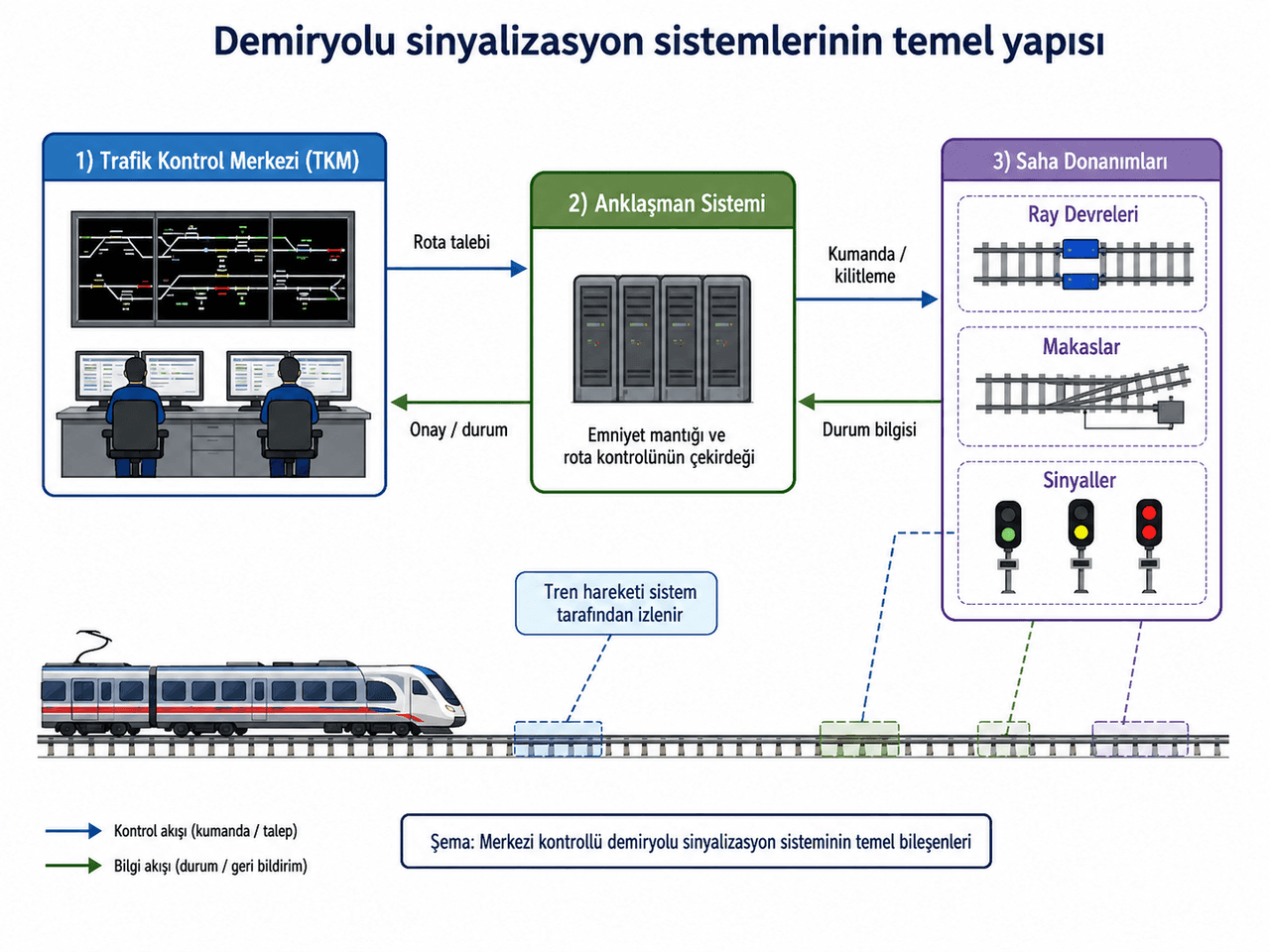
Merkezi Kontrollü Demiryolu Sinyalizasyon Sisteminin Temel Bileşenleri (Yapay Zekâ ile Oluşturulmuştur)
The interlocking system is the control unit in railway signaling that evaluates route requests against safety conditions. It checks whether the relevant track circuits are clear, the positions and locking states of switches, and whether the requested route conflicts with any other route. If any condition is not met, the route request is rejected.【10】
When all required conditions are satisfied, switches are moved to the correct position and locked. Once it is confirmed that the track circuits are clear, the switches are in the correct position, and no conflict exists with other routes, the route is established and the appropriate signal indication is displayed. When the train reaches the last track circuit of the route, the route is terminated and the associated locks are released.【11】 This structure prevents conflicting train movements from occurring simultaneously and ensures the safe coordinated operation of field elements.
Field equipment in railway signaling systems consists of components operating along the track, such as track circuits, switches, and signals. These elements are monitored and controlled by the interlocking system.【12】
Track circuits detect the presence or absence of a train on a specific section of track. Switches direct trains from one rail to another, with their position and locking status monitored by the signaling system. Signals provide the driver with information regarding the status of the track and the established route.
Field equipment operates in conjunction with the interlocking system. A route cannot be established if a switch is not in the required position or if the relevant track section is occupied.【13】
In railway signaling systems, safety encompasses not only correct operation under normal conditions but also the prevention of hazardous outcomes in the event of failures or errors. Therefore, a holistic approach that integrates reliability, availability, maintainability, and safety (RAMS) is applied during system development and operation.【14】
Identifying risks and reducing them to an acceptable level is a fundamental step in RAMS management. EN 50126 addresses the general framework for RAMS management, EN 50128 specifies requirements for software used in signaling and communication systems, and EN 50129 outlines safety requirements for electronic hardware in signaling systems.【15】
In a fail-safe design approach, the system is engineered to transition to a safe state rather than continue a hazardous operation when it cannot make a safe decision. In the Mescidi Selam signaling system, if none of the defined operating modes can be activated, the system enters a safety mode and ceases to perform control and command functions.【16】
YERLİSİNYAL encompasses signaling solutions developed by TÜBİTAK RUTE for use on main lines and urban rail systems. For main line applications, the system includes an interlocking system, ETCS Level 1 trackside system, and Traffic Control Center; for urban applications, it includes CBTC-based trackside systems.【17】
These systems are based on the EN 50126, EN 50128, EN 50129, and EN 50159 standards for railway safety and secure communication. Major components include YERLİSİNYAL-ANK, YERLİSİNYAL-TKM, and YERLİSİNYAL-CBTC.
YERLİSİNYAL-ANK is an interlocking system that ensures route safety in main line railway signaling. It evaluates information from field equipment to ensure the safe coordinated operation of components such as switches, signals, and track circuits. The system has been developed in a modular and scalable architecture capable of communicating with diverse field equipment.【19】
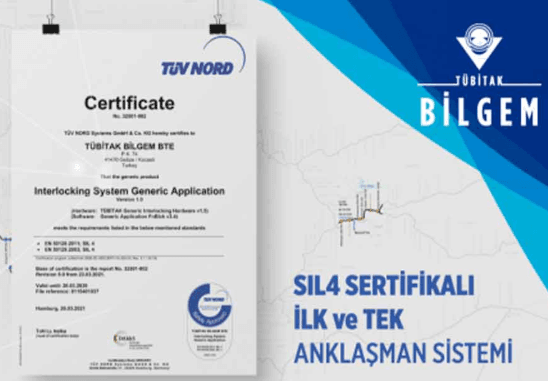
YERLİSİNYAL Anklaşman Sisteminin SIL4 Sertifikasyonuna İlişkin Görsel, 2021 (Tübitak Bilgem)
YERLİSİNYAL-ANK has SIL4 safety integrity level and has been developed in accordance with the EN 50126, EN 50128, and EN 50129 standards. The system is compatible with ETCS Level 1 and can interface with field components such as signals, track circuits, axle counters, switch motors, and level crossing protection systems.【20】
The system is used to signalize lines without existing signaling and to replace interlocking systems that have reached the end of their economic life. YERLİSİNYAL-ANK is being deployed across approximately 850 kilometers of track.【21】
YERLİSİNYAL-TKM is the Traffic Control Center system developed for monitoring and managing railway traffic. Train movements and field information are displayed on operator screens, and traffic flow can be tracked and controlled through the system.【22】
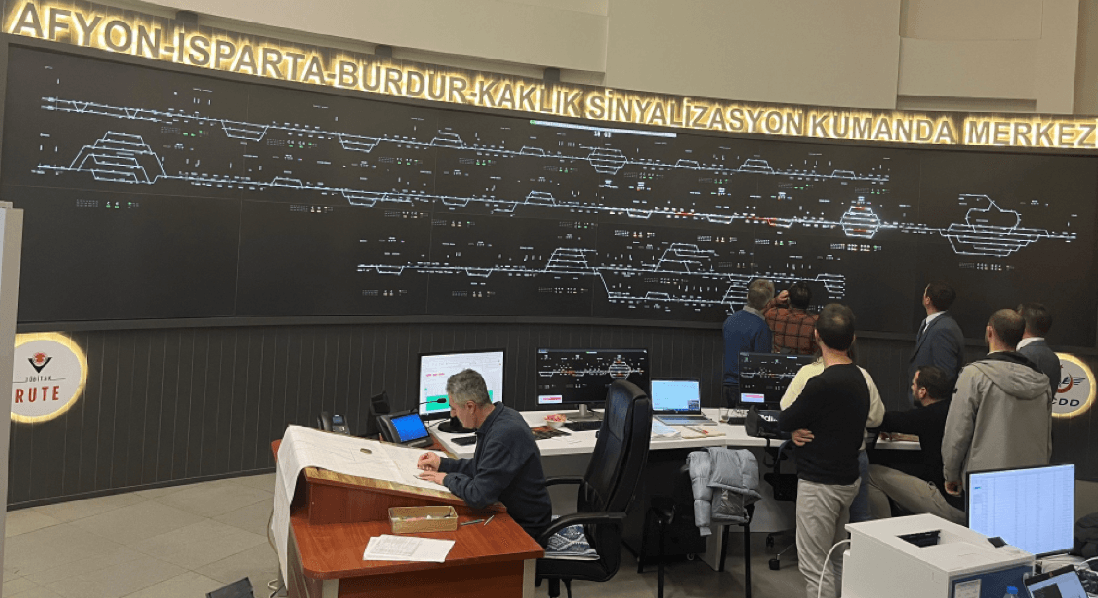
Afyon–Isparta–Burdur–Kaklık Sinyalizasyon Kumanda Merkezinde Trafik Kontrol Ekranları (Tübitak Rute)
YERLİSİNYAL-TKM has been designed to be usable on railway lines of varying sizes and to operate alongside interlocking systems from different manufacturers. The system can be deployed in centralized, regional, and local control structures. It includes interfaces for the visual presentation of traffic information to operators and for data exchange with external systems.【23】
Traffic Control Center applications include projects covering the 191-kilometer section between İskenderun and Narlı with 20 stations, and the 167-kilometer section between Lalabel and Yerköy with 16 stations.【24】
The European Rail Traffic Management System (ERTMS) is a common framework designed to ensure interoperability among different national systems and manufacturers in railway operations.【25】 The European Train Control System (ETCS) is the subsystem of ERTMS related to train control. In Türkiye, efforts have been made to align new lines and existing signaling infrastructure with ERTMS/ETCS standards.
ETCS is a train control system that monitors and regulates train movement authority and speed. Different levels of the system are distinguished based on the communication method between the track and the train and the infrastructure used. In Türkiye, ETCS Level 1 trackside implementations and onboard solutions compatible with ETCS Level 2 have been developed.
ETCS Level 1 is a train control level where communication between the train and the track is achieved through balises installed at specific points along the line. The system is designed to allow the addition of necessary hardware and software to existing national signaling infrastructure.【26】
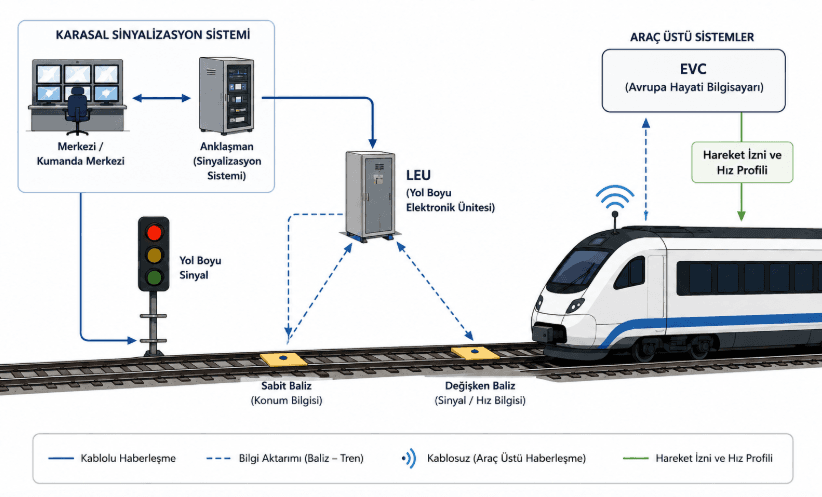
ETCS Seviye 1 Çalışma Şeması (Yapay Zekâ ile Oluşturulmuştur)
Signal information along the track is transferred to balises via the Line-side Electronic Unit (LEU). Variable balises transmit information based on signal status, while fixed balises provide location data to the train. The European Vital Computer (EVC) onboard the train uses this information to evaluate train movement and permissible speed limits.【27】
At ETCS Level 1, train speed is continuously monitored to prevent exceeding the permitted limit. A dynamic speed profile is generated based on the train’s movement and braking characteristics. Level 1 relies on point-to-point communication and continues to use trackside signals.【28】
One of the field implementations of Türkiye’s domestically developed ETCS Level 1 trackside signaling system is the Torbalı–Tire–Ödemiş line. This implementation covers a 70-kilometer section with 11 stations.【29】
At ETCS Level 2, continuous communication is established between the train and the track, and dynamic operational data is continuously transmitted to the train. This communication utilizes a GSM-based infrastructure specific to railway operations.【30】
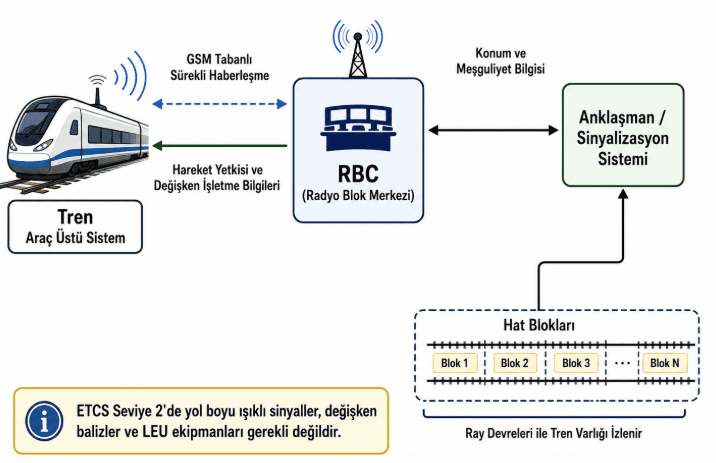
ETCS Seviye 2 ve RBC Şeması (Yapay Zekâ ile Oluşturulmuştur)
One of the key components of this level is the Radio Block Centre (RBC). The RBC evaluates information regarding train movements within its area of responsibility and ensures that necessary movement instructions are transmitted to the onboard system. The RBC continuously tracks the position of trains within its coverage area. The presence of trains on the track and train integrity are monitored via track circuits.【31】
The onboard ETCS solution developed in Türkiye, COBALT MAINLINE ONBOARD, has been designed to be compatible with both ETCS Level 1 and Level 2. The GSM-R data radio used in the system supports functions required for communication with the Radio Block Centre under ETCS Level 2.【32】
At ETCS Level 2, there is no need to use trackside color-light signals, variable balises, or LEU equipment. The track continues to be divided into blocks, and train occupancy information is provided through detection infrastructure along the line.【33】
ERTMS compatibility refers to the ability of onboard and trackside railway systems to operate together under common technical rules. Interoperability involves the capability of systems from different manufacturers to communicate independently of their origin and operate within the same operational framework.
In Türkiye, aligning YERLİSİNYAL with ERTMS and promoting its widespread use were included among the objectives of the cooperation protocol signed in 2026 between TÜBİTAK RUTE and TCDD. YERLİSİNYAL-ANK is compatible with ETCS Level 1. In this context, efforts are underway to further enhance YERLİSİNYAL’s compatibility within the broader ERTMS framework.【34】
The development of railway signaling in Türkiye has expanded over time to include urban rail systems. Among the solutions developed by TÜBİTAK RUTE for urban lines are CBTC-based trackside systems, Automatic Train Protection (ATP), and Automatic Train Operation (ATO) functions. The CBTC-based Automatic Train Control (ATC) system is used in metro signaling and supports GOA4-level fully automatic, driverless operation.【35】
Urban signaling solutions incorporate Automatic Train Protection and Automatic Train Operation functions; secure communication requirements are addressed under the EN 50159 standard, and safety integrity is assessed at SIL4 level.【36】
YERLİSİNYAL-CBTC is a trackside automatic train control system developed for use in urban rail systems. It has been designed to communicate with diverse field equipment.
YERLİSİNYAL-CBTC has SIL4 safety integrity level and has been developed in accordance with the EN 50126, EN 50128, and EN 50129 standards. Secure communication on the track follows the EN 50159 standard, and the system features interfaces compliant with the IEC 62290-3 standard. It can interface with field components such as switch motors, platform screen doors, and emergency equipment.【37】
One of the field implementations of YERLİSİNYAL-CBTC is the Gayrettepe–Istanbul Airport–Halkalı metro line. A domestically developed signaling system, created through collaboration between TÜBİTAK RUTE and ASELSAN, is used on the Kağıthane–Istanbul Airport section.【38】
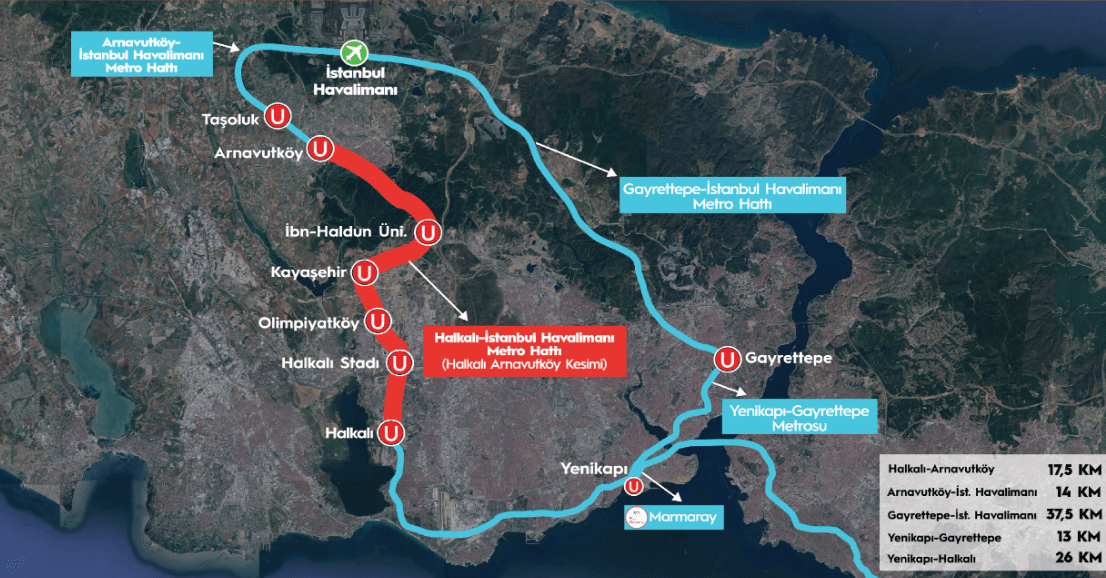
Halkalı–Arnavutköy Metro Kesimi Güzergâhı, 2025 (UAB)
The nine stations on the Gayrettepe–Istanbul Airport section and the seven stations plus one depot on the Istanbul Airport–Halkalı section are covered by a CBTC-based signaling infrastructure.【39】
With the commissioning of the Halkalı–Arnavutköy section in 2026, the Gayrettepe–Istanbul Airport–Halkalı Metro Project reached a total length of 69 kilometers and 16 stations. The project consists of the 37.5-kilometer Gayrettepe–Istanbul Airport section and the 31.5-kilometer Halkalı–Istanbul Airport section. Five new stations—İbn Haldun University, Kayaşehir, Olimpiyatköy, Halkalı Stadium, and Halkalı—were opened on the Halkalı–Arnavutköy section.【40】
The development of railway signaling in Türkiye includes not only trackside systems but also onboard signaling systems. In this context, a project between TCDD Transportation and ASELSAN plans to equip 99 diesel-electric mainline locomotives lacking onboard signaling systems with domestically developed systems.【41】
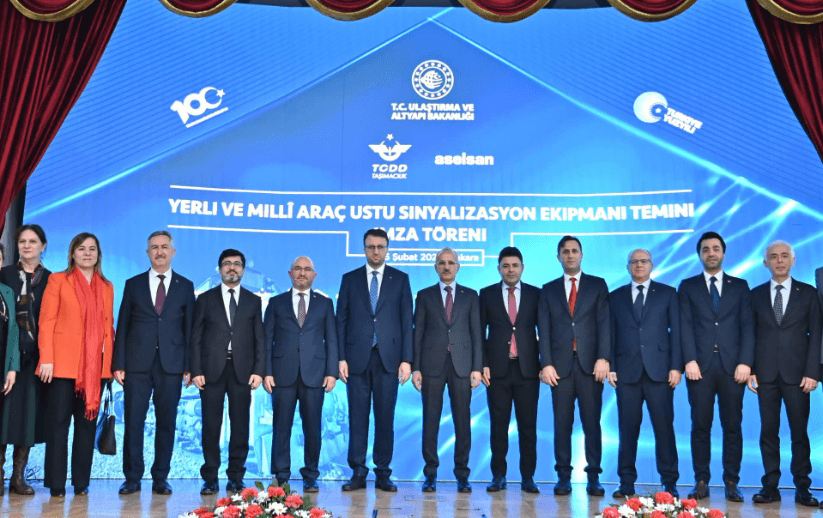
Yerli ve Millî Araç Üstü Sinyalizasyon Ekipmanı Temini İmza Töreni, 2024 (UAB)
The project encompasses not only the installation of equipment on existing locomotives but also the development, manufacturing, and integration of the onboard signaling system. Additionally, training, technical documentation, spare parts supply, and warranty services are included in the project scope. The contract value was announced as 1.69 billion TL, with an implementation period of 57 months.【42】
The installation of onboard systems on locomotives is planned to be carried out progressively between 2026 and 2028. Accordingly, 17 locomotives are scheduled for equipment in 2026, 48 in 2027, and 34 in 2028. Thus, the installation process for all 99 locomotives under the project is targeted for completion within a three-year timeline.【43】
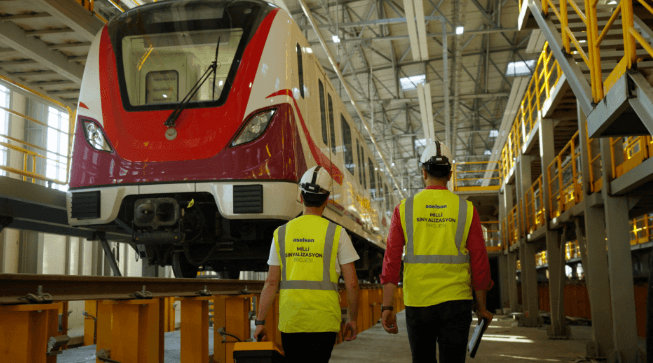
COBALT MAINLINE ONBOARD (Aselsan)
Producing the onboard signaling system to be compatible with ERTMS and certifying it according to European standards is among the project’s objectives.【44】
The COBALT MAINLINE ONBOARD onboard train protection system developed by ASELSAN has been designed to be compatible with ETCS Level 1 and Level 2. The system includes the European Vital Computer (EVC), Balise Transmission Module (BTM), GSM-R data radio, Driver-Machine Interface (DMI), recording unit, and odometer subsystems.【45】
Following development and validation processes, YERLİSİNYAL systems have been implemented across various main line sections and stations. Routes where domestic main line signaling systems have been deployed include the Afyonkarahisar–Denizli–Isparta, Ortaklar–Denizli, Malatya–Elazığ, and Gezin–Kürk sections.【46】
In 2024, nine stations and open track sections along the approximately 102-kilometer stretch between Köşk and Sarayköy were brought under the domestic signaling system.【47】 In December 2024, with the commissioning of six additional stations on the Lalabel–Yerköy and Afyon–Denizli–Isparta lines, the number of stations using YERLİSİNYAL reached 36 as of January 2025.【48】
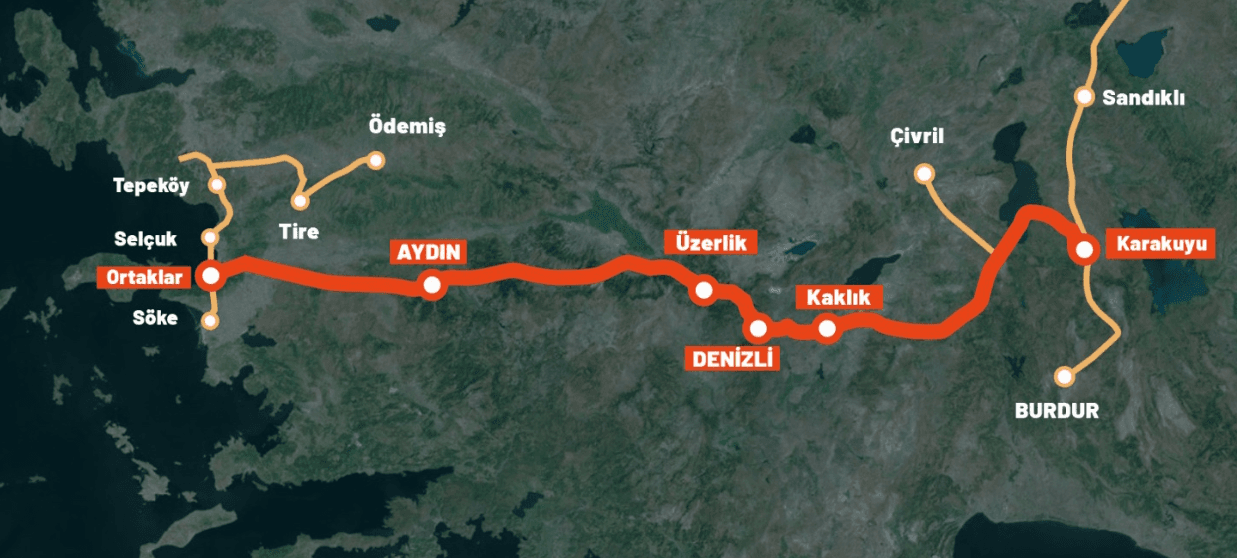
Ortaklar–Aydın–Denizli–Karakuyu Yerli Sinyalizasyon Projesi Güzergâhı, 2026 (UAB)
The domestic signaling system has been implemented on the Ortaklar–Aydın–Denizli–Karakuyu line, and efforts toward its commissioning are ongoing. As of 2026, this line is among the main line projects where domestic signaling systems have been applied.【49】
As of 24 January 2026, the length of signaled railway in Türkiye increased from 2,505 kilometers to 8,419 kilometers, bringing approximately 61% of the total railway network under signaling coverage. During the same period, signaling work was ongoing on approximately 800 kilometers of track, with domestic signaling systems deployed on 409 kilometers of that length.【50】
As of 2026, domestic signaling work is ongoing on the Karaman–Ulukışla, Afyonkarahisar–Karakuyu, Karakuyu–Bozanönü–Isparta–Burdur, Malatya–Elazığ, and Alayunt–Afyonkarahisar sections.【51】
The development of railway signaling in Türkiye has advanced through collaborations among public institutions, research organizations, universities, and industry entities. In the early stages of the National Railway Signaling Project, TCDD, TÜBİTAK BİLGEM, and Istanbul Technical University assumed different roles. Teams within Istanbul Technical University participated in developing and testing interlocking software, TCDD was responsible for defining system requirements and conducting acceptance tests, and TÜBİTAK BİLGEM contributed to the development of interlocking and traffic control center software.【52】
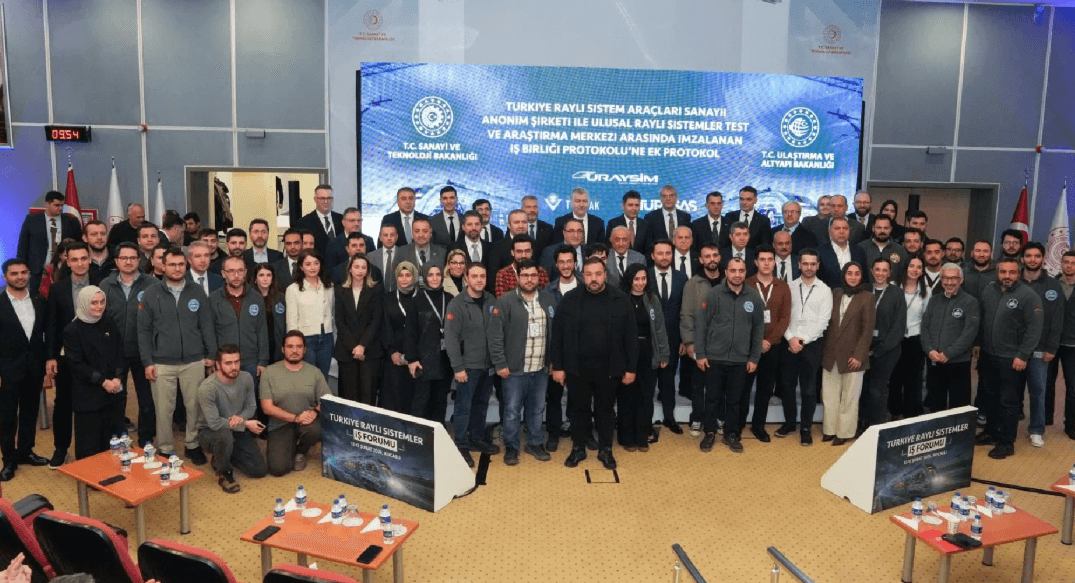
Türkiye Raylı Sistemler İş Forumu 2026 Kapsamındaki Kurumsal İş Birliği Buluşması (UAB)
Domestic CBTC-based signaling systems for urban rail systems were developed through collaboration between ASELSAN and TÜBİTAK RUTE and implemented on the Gayrettepe–Istanbul Airport metro line. For the localization of onboard signaling systems, TCDD Transportation and ASELSAN work together.【53】
Sectoral structuring has also occurred within Türkiye’s domestic rail system production ecosystem. The Anatolian Rail Transit Systems Cluster (ARUS), established in 2012, brings together institutions and organizations active in areas such as train control and management systems, signaling, infrastructure, and critical components.【54】
Current initiatives in railway signaling in Türkiye focus on expanding existing systems and enhancing compatibility with international railway standards. Work on YERLİSİNYAL continued in 2026.【55】 As of 2026, approximately 4,000 kilometers of high-speed rail lines under construction are being equipped with ETCS signaling systems.【56】
Collaborations are ongoing to expand the use of domestic signaling solutions in urban rail systems. Under the 2026 Türkiye Rail Systems Industry Forum, a protocol signed between AYGM, ASELSAN, and TÜBİTAK RUTE aims to promote wider adoption of domestic signaling systems on metro lines.【57】
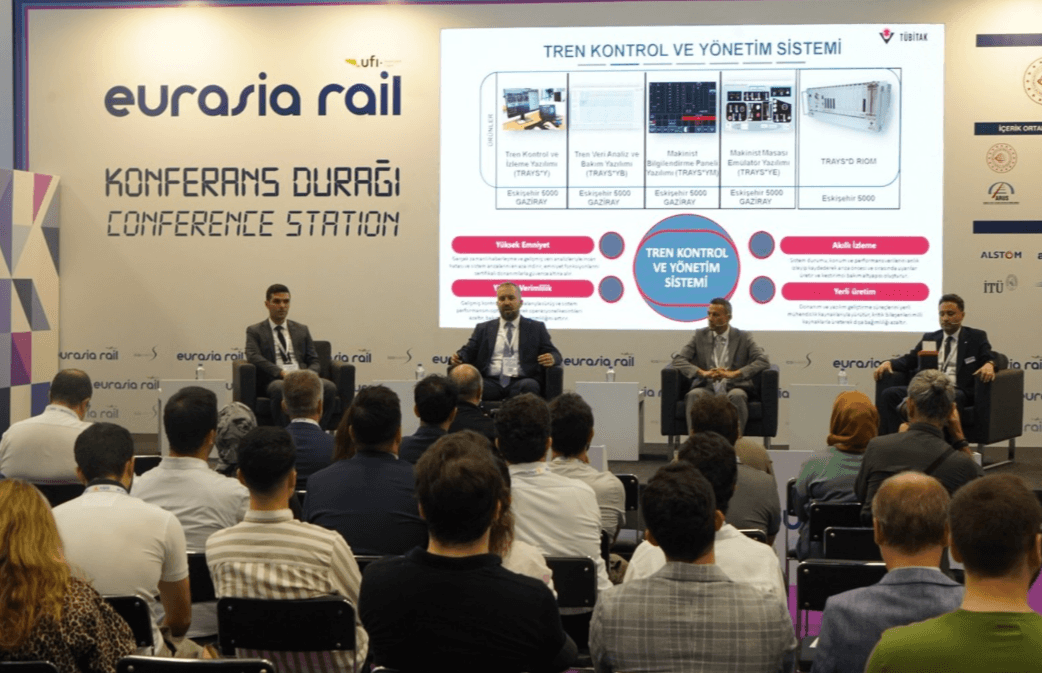
Presentation of the Train Control and Management System at Eurasia Rail 2025 (TÜBİTAK RUTE)
Efforts are underway to adapt the communication infrastructure used in railway signaling to next-generation technologies. 5G-based Future Railway Mobile Communication System (FRMCS) is one of the next-generation communication technologies expected to replace GSM-R. In Türkiye, work is ongoing to localize the signaling and communication infrastructure of rail systems and to integrate FRMCS technology into this infrastructure.【58】
In the R&D initiatives announced in 2025, traffic optimization, decision support systems, predictive maintenance, and data analytics are among the key research areas in signaling.【59】 These initiatives cover current development areas focused on data-driven methods for traffic management as well as operational and maintenance processes within signaling systems.
ASELSAN. "COBALT MAINLINE ONBOARD: Araç Üstü Sinyalizasyon Sistemi." ASELSAN. Accessed September 2, 2026.https://www.aselsan.com/tr/savunma/urun/cobalt-onboard
Anadolu Ajansı. "Demiryollarına Milli Sinyalizasyon." Anadolu Ajansı, June 16, 2014. Accessed September 2, 2026.https://www.aa.com.tr/tr/ekonomi/demiryollarina-milli-sinyalizasyon/277582
Binay, İlyas. "Avrupa Tren Kontrol Sisteminin (ETCS) Türkiye’deki Demiryoluna Uygulamasının İncelenmesi." Master's thesis, Marmara Üniversitesi, 2013. Accessed September 1, 2026.https://katalog.marmara.edu.tr/veriler/yordambt/cokluortam/1A/BCDF4E66-9AC3-794C-8E44-44FCE0160DEB.pdf
Durmuş, Mustafa Seçkin, Uğur Yıldırım, and Mehmet Turan Söylemez. “The Application of Automation Theory to Railway Signaling Systems: The Turkish National Railway Signaling Project.” *Pamukkale Üniversitesi Mühendislik Bilimleri Dergisi* 19, no. 5 (2013): 216–223. Accessed September 1, 2026.https://dergipark.org.tr/en/download/article-file/190797
Eryılmaz, Ercan, Yasemin Yeltekin, and Melih Işıkel. “Geleceğin Demir Yolu Mobil Haberleşme Sistemi: Raylı Sistemlerde Haberleşme.” *ASELSAN Dergi*, no. 122 (February 2026): 66–75. Accessed September 2, 2026.https://wwwcdn.aselsan.com/api/file/aselsan-dergi-122.sayı.pdf
Kaymakçı, Özgür, Turay İsmail Yakın, and Mehmet Turan Söylemez. "Demiryolu Sinyalizasyon Sistemi İçin Hibrit Bir RAMS Değerlendirme Yöntemi." Demiryolu Mühendisliği, no. 17 (January 2023): 145–160. Accessed September 1, 2026.https://dergipark.org.tr/tr/download/article-file/2821297
Mecitoğlu, Fatih. "Demiryolu Sinyalizasyon Sistemi Simülatörü ve SCADA Sistemi." Master's thesis, İstanbul Teknik Üniversitesi, 2013. Accessed August 31, 2026.https://polen.itu.edu.tr/server/api/core/bitstreams/ecab923c-c8d6-4b46-9603-6dec415d41e2/content
Pektaş, İlhami. *Raylı Sistemlerde Sanayi, Yerli Üretim ile Bölgesel, Ulusal ve Uluslararası Oluşumlar.* Ankara: ARUS Yayınları, 2021. Accessed September 1, 2026.https://www.ilhamipektas.com/wp-content/uploads/2025/08/raylı-sistem-oluşumlat-makale.pdf
T.C. Ministry of Transport and Infrastructure. "#Nedir #Demiryolu Sinyalizasyon Sistemleri." YouTube video, 2:06. June 12, 2025. Accessed September 2, 2026.https://youtu.be/fOODGFuzGmk?si=v7kivCG3I1Zkz56t
T.C. Ministry of Transport and Infrastructure. "Demir Ağlar Yerli ve Milli Sinyalizasyon Sistemiyle Donatılıyor." uab.gov.tr. January 24, 2026. Accessed September 1, 2026.https://www.uab.gov.tr/haberler/demir-aglar-yerli-ve-milli-sinyalizasyon-sistemiyle-donatiliyor
T.C. Ministry of Transport and Infrastructure. "Demiryollarında 'Yerli ve Milli' Sinyalizasyon." uab.gov.tr, February 15, 2024. Accessed September 1, 2026.https://www.uab.gov.tr/haberler/demiryollarinda-yerli-ve-milli-sinyalizasyon
T.C. Ministry of Transport and Infrastructure. "Halkalı-Arnavutköy Hattı Free Until July 31!" uab.gov.tr. June 19, 2026. Accessed September 2, 2026.
T.C. Ministry of Transport and Infrastructure. "Halkalı–İstanbul Havalimanı Metrosunda Sona Doğru." uab.gov.tr. October 30, 2025. Accessed September 2, 2026.https://www.uab.gov.tr/haberler/halkali-istanbul-havalimani-metrosunda-sona-dogru
TCDD. "Birdal: Demiryollarında Yeni Dönem Başladı." *tcdd.gov.tr*. May 26, 2017. Accessed September 1, 2026.https://www.tcdd.gov.tr/haberler/birdal-demiryollarinda-yeni-donem-basladi
TCDD. "Milli Sinyalizasyon Sistemi Uluslararası Sertifika Aldı." tcdd.gov.tr. April 7, 2021. Accessed September 2, 2026.https://www.tcdd.gov.tr/haberler/milli-sinyalizasyon-sistemi-uluslararasi-sertifika-aldi
TÜBİTAK BİLGEM. "TÜBİTAK BİLGEM YERLİSİNYAL." Accessed September 2, 2026.https://en.bilgem.tubitak.gov.tr/en/tubitak-bilgem-yerlisinyal/
TÜBİTAK RUTE. "Demir Yolu Anklaşman Sistemleri." TÜBİTAK RUTE. Accessed September 1, 2026.https://rute.tubitak.gov.tr/sinyalizasyon-urunleri/demir-yolu-anklasman-sistemleri/
TÜBİTAK RUTE. "Hat Boyu ATC Sistemi." Accessed September 1, 2026.https://rute.tubitak.gov.tr/sinyalizasyon-urunleri/hat-boyu-atc-sistemi/
TÜBİTAK RUTE. "Sarayköy ve Üzerlik İstasyonlarının YERLİSİNYAL Kabul Testleri Tamamlandı." TÜBİTAK RUTE. May 14, 2024. Accessed September 1, 2026.https://rute.tubitak.gov.tr/saraykoy-ve-uzerlik-istasyonlarinin-yerlisinyal-kabul-testleri-tamamlandi/
TÜBİTAK RUTE. "Sinyalizasyon Sistemleri Bölümü." TÜBİTAK RUTE. Accessed September 1, 2026.https://rute.tubitak.gov.tr/ar-ge-bolumleri/sinyalizasyon-sistemleri-bolumu/
TÜBİTAK RUTE. "Trafik Kontrol Merkezi." TÜBİTAK RUTE. Accessed September 1, 2026.https://rute.tubitak.gov.tr/sinyalizasyon-urunleri/trafik-kontrol-merkezi/
TÜBİTAK RUTE. "TÜBİTAK RUTE Eurasia Rail 2025'te Göz Doldurdu." TÜBİTAK RUTE. June 18, 2025. Accessed September 1, 2026.https://rute.tubitak.gov.tr/tubitak-rute-eurasia-rail-2025te-goz-doldurdu/
TÜBİTAK RUTE. "TÜBİTAK RUTE Teknolojileri Gayrettepe–İstanbul Havalimanı–Halkalı Metro Hattında." TÜBİTAK RUTE. March 25, 2024. Accessed September 1, 2026.https://rute.tubitak.gov.tr/tubitak-rute-teknolojileri-gayrettepe-istanbul-havalimani-halkali-metro-hattinda/
TÜBİTAK RUTE. "TÜBİTAK RUTE, Türkiye Raylı Sistemler İş Forumu 2026'da Stratejik İş Birliği Protokollerine İmza Attı." TÜBİTAK RUTE. March 11, 2026. Accessed September 1, 2026.https://rute.tubitak.gov.tr/tubitak-rute-turkiye-rayli-sistemler-is-forumu-2026da-stratejik-is-birligi-protokollerine-imza-atti/
TÜBİTAK RUTE. "YERLİSİNYAL Projesi’nde 6 Yeni İstasyon Daha Devreye Alındı." TÜBİTAK RUTE. January 14, 2025. Accessed September 1, 2026.https://rute.tubitak.gov.tr/yerlisinyal-projesinde-6-yeni-istasyon-daha-devreye-alindi/
TÜBİTAK. "TÜBİTAK RUTE'nin Sinyalizasyon Sistemlerinin Kullanıldığı Gayrettepe-İstanbul Havalimanı Metro Hattı Açıldı." TÜBİTAK. January 29, 2024. Accessed September 1, 2026.https://tubitak.gov.tr/tr/haber/tubitak-rutenin-sinyalizasyon-sistemlerinin-kullanildigi-gayrettepe-istanbul-havalimani-metro-hatti-acildi
[1]
Fatih Mecitoğlu, "Demiryolu Sinyalizasyon Sistemi Simülatörü ve SCADA Sistemi" (Yüksek Lisans Tezi, İstanbul Teknik Üniversitesi, 2013), 5–7, erişim tarihi 31 Ağustos 2026. https://polen.itu.edu.tr/server/api/core/bitstreams/ecab923c-c8d6-4b46-9603-6dec415d41e2/content
[2]
TÜBİTAK. "TÜBİTAK RUTE'nin Sinyalizasyon Sistemlerinin Kullanıldığı Gayrettepe-İstanbul Havalimanı Metro Hattı Açıldı." Accessed September 1, 2026.
[3]
Mustafa Seçkin Durmuş, Uğur Yıldırım ve Mehmet Turan Söylemez, "The Application of Automation Theory to Railway Signaling Systems: The Turkish National Railway Signaling Project," Pamukkale Üniversitesi Mühendislik Bilimleri Dergisi 19, sy. 5 (2013): 222, erişim tarihi 1 Eylül 2026.https://dergipark.org.tr/en/download/article-file/190797
[4]
TCDD, "Birdal: Demiryollarında Yeni Dönem Başladı," 26 Mayıs 2017, erişim tarihi 1 Eylül 2026. https://www.tcdd.gov.tr/haberler/birdal-demiryollarinda-yeni-donem-basladi
[5]
TÜBİTAK RUTE, "Sarayköy ve Üzerlik İstasyonlarının YERLİSİNYAL Kabul Testleri Tamamlandı," 14 Mayıs 2024, erişim tarihi 1 Eylül 2026. https://rute.tubitak.gov.tr/saraykoy-ve-uzerlik-istasyonlarinin-yerlisinyal-kabul-testleri-tamamlandi/
[6]
TÜBİTAK. "TÜBİTAK RUTE'nin Sinyalizasyon Sistemlerinin Kullanıldığı Gayrettepe-İstanbul Havalimanı Metro Hattı Açıldı." Accessed September 1, 2026.
[7]
TÜBİTAK RUTE. "TÜBİTAK RUTE, Türkiye Raylı Sistemler İş Forumu 2026'da Stratejik İş Birliği Protokollerine İmza Attı." March 11, 2026. Accessed September 1, 2026.
[8]
Mecitoğlu, "Demiryolu Sinyalizasyon Sistemi Simülatörü," 5.
[9]
TÜBİTAK RUTE, "Trafik Kontrol Merkezi," TÜBİTAK RUTE, erişim tarihi 1 Eylül 2026. https://rute.tubitak.gov.tr/sinyalizasyon-urunleri/trafik-kontrol-merkezi/
[10]
Mecitoğlu, "Demiryolu Sinyalizasyon Sistemi Simülatörü," 7.
[11]
Mecitoğlu, "Demiryolu Sinyalizasyon Sistemi Simülatörü," 9-10.
[12]
Mecitoğlu, "Demiryolu Sinyalizasyon Sistemi Simülatörü," 6.
[13]
Mecitoğlu, "Demiryolu Sinyalizasyon Sistemi Simülatörü," 9-10.
[14]
Özgür Turay Kaymakçı, İsmail Yakın ve Mehmet Turan Söylemez, "Demiryolu Sinyalizasyon Sistemi İçin Hibrit Bir RAMS Değerlendirme Yöntemi," Demiryolu Mühendisliği, sy. 17 (Ocak 2023): 145-146, erişim tarihi 1 Eylül 2026. https://dergipark.org.tr/tr/download/article-file/2821297
[15]
Kaymakçı, Yakın ve Söylemez, "Hibrit Bir RAMS Değerlendirme Yöntemi," 146.
[16]
Kaymakçı, Yakın ve Söylemez, "Hibrit Bir RAMS Değerlendirme Yöntemi," 152.
[17]
TÜBİTAK RUTE, "Sinyalizasyon Sistemleri Bölümü," TÜBİTAK RUTE, erişim tarihi 1 Eylül 2026. https://rute.tubitak.gov.tr/ar-ge-bolumleri/sinyalizasyon-sistemleri-bolumu/
[19]
TÜBİTAK RUTE, "Demir Yolu Anklaşman Sistemleri."
[20]
TÜBİTAK RUTE, "Demir Yolu Anklaşman Sistemleri."
[21]
TÜBİTAK RUTE, "Demir Yolu Anklaşman Sistemleri."
[22]
TÜBİTAK RUTE, "Trafik Kontrol Merkezi," TÜBİTAK RUTE, erişim tarihi 1 Eylül 2026. https://rute.tubitak.gov.tr/sinyalizasyon-urunleri/trafik-kontrol-merkezi/
[23]
TÜBİTAK RUTE, "Trafik Kontrol Merkezi."
[24]
TÜBİTAK RUTE, "Sinyalizasyon Sistemleri Bölümü," TÜBİTAK RUTE, erişim tarihi 1 Eylül 2026. https://rute.tubitak.gov.tr/ar-ge-bolumleri/sinyalizasyon-sistemleri-bolumu/
[25]
İlyas Binay, "Avrupa Tren Kontrol Sisteminin (ETCS) Türkiye’deki Demiryoluna Uygulamasının İncelenmesi" (Yüksek Lisans Tezi, Marmara Üniversitesi, 2013), 15, erişim tarihi 1 Eylül 2026. https://katalog.marmara.edu.tr/veriler/yordambt/cokluortam/1A/BCDF4E66-9AC3-794C-8E44-44FCE0160DEB.pdf
[26]
Binay, "Avrupa Tren Kontrol Sisteminin Uygulanması," 15.
[27]
Binay, "Avrupa Tren Kontrol Sisteminin Uygulanması," 16.
[28]
Binay, "Avrupa Tren Kontrol Sisteminin Uygulanması," 17.
[29]
TÜBİTAK RUTE, "Sinyalizasyon Sistemleri Bölümü," TÜBİTAK RUTE, erişim tarihi 1 Eylül 2026. https://rute.tubitak.gov.tr/ar-ge-bolumleri/sinyalizasyon-sistemleri-bolumu/
[30]
Binay, "Avrupa Tren Kontrol Sisteminin Uygulanması," 17.
[31]
Binay, "Avrupa Tren Kontrol Sisteminin Uygulanması," 17-18.
[32]
ASELSAN, "COBALT MAINLINE ONBOARD: Araç Üstü Sinyalizasyon Sistemi."
[33]
Binay, "Avrupa Tren Kontrol Sisteminin Uygulanması," 18.
[34]
TÜBİTAK RUTE. "TÜBİTAK RUTE, Türkiye Raylı Sistemler İş Forumu 2026'da Stratejik İş Birliği Protokollerine İmza Attı." March 11, 2026. Accessed September 1, 2026.
[35]
TÜBİTAK RUTE, "Sinyalizasyon Sistemleri Bölümü," TÜBİTAK RUTE, erişim tarihi 1 Eylül 2026. https://rute.tubitak.gov.tr/ar-ge-bolumleri/sinyalizasyon-sistemleri-bolumu/
[36]
TÜBİTAK RUTE, "Sinyalizasyon Sistemleri Bölümü."
[37]
TÜBİTAK RUTE, "Hat Boyu ATC Sistemi," TÜBİTAK RUTE, erişim tarihi 1 Eylül 2026. https://rute.tubitak.gov.tr/sinyalizasyon-urunleri/hat-boyu-atc-sistemi/
[38]
TÜBİTAK RUTE, "TÜBİTAK RUTE Teknolojileri Gayrettepe – İstanbul Havalimanı – Halkalı Metro Hattında," 25 Mart 2024, erişim tarihi 1 Eylül 2026. https://rute.tubitak.gov.tr/tubitak-rute-teknolojileri-gayrettepe-istanbul-havalimani-halkali-metro-hattinda/
[39]
TÜBİTAK. "TÜBİTAK RUTE'nin Sinyalizasyon Sistemlerinin Kullanıldığı Gayrettepe-İstanbul Havalimanı Metro Hattı Açıldı." Accessed September 1, 2026.
[40]
T.C. Ministry of Transport and Infrastructure. "Halkalı-Arnavutköy Line Free Until July 31." June 19, 2026. Accessed September 2, 2026.
[41]
T.C. Ministry of Transport and Infrastructure. "Demiryollarında 'Yerli ve Milli' Sinyalizasyon." Accessed September 1, 2026.
[42]
Ministry of Transport and Infrastructure of the Republic of Türkiye, "Local and National Signaling in Railways."
[43]
Ministry of Transport and Infrastructure of the Republic of Türkiye, "Local and National Signaling in Railways."
[44]
Ministry of Transport and Infrastructure of the Republic of Türkiye, "Local and National Signaling in Railways."
[45]
ASELSAN, "COBALT MAINLINE ONBOARD: Araç Üstü Sinyalizasyon Sistemi," ASELSAN, erişim tarihi 2 Eylül 2026. https://www.aselsan.com/tr/savunma/urun/cobalt-onboard
[46]
TÜBİTAK RUTE, "Sinyalizasyon Sistemleri Bölümü," TÜBİTAK RUTE, erişim tarihi 1 Eylül 2026. https://rute.tubitak.gov.tr/ar-ge-bolumleri/sinyalizasyon-sistemleri-bolumu/
[47]
TÜBİTAK RUTE, "Sarayköy ve Üzerlik İstasyonlarının YERLİSİNYAL Kabul Testleri Tamamlandı," 14 Mayıs 2024, erişim tarihi 1 Eylül 2026. https://rute.tubitak.gov.tr/saraykoy-ve-uzerlik-istasyonlarinin-yerlisinyal-kabul-testleri-tamamlandi/
[48]
TÜBİTAK RUTE, "YERLİSİNYAL Projesi'nde 6 Yeni İstasyon Daha Devreye Alındı," January 14, 2025. Accessed September 1, 2026.
[49]
T.C. Ulaştırma ve Altyapı Bakanlığı, "Demir Ağlar Yerli ve Milli Sinyalizasyon Sistemiyle Donatılıyor," 24 Ocak 2026, erişim tarihi 1 Eylül 2026. https://www.uab.gov.tr/haberler/demir-aglar-yerli-ve-milli-sinyalizasyon-sistemiyle-donatiliyor
[50]
T.C. Ulaştırma ve Altyapı Bakanlığı, "Demir Ağlar Yerli ve Milli Sinyalizasyon Sistemiyle Donatılıyor."
[51]
T.C. Ulaştırma ve Altyapı Bakanlığı, "Demir Ağlar Yerli ve Milli Sinyalizasyon Sistemiyle Donatılıyor."
[52]
Durmuş, Yıldırım ve Söylemez, "Application of Automation Theory," 218-222.
[53]
T.C. Ministry of Transport and Infrastructure. "Demiryollarında 'Yerli ve Milli' Sinyalizasyon." Accessed September 1, 2026.
[54]
İlhami Pektaş, Raylı Sistemlerde Sanayi, Yerli Üretim ile Bölgesel, Ulusal ve Uluslararası Oluşumlar (Ankara: ARUS Yayınları, 2021), 13, erişim tarihi 1 Eylül 2026. https://www.ilhamipektas.com/wp-content/uploads/2025/08/raylı-sistem-oluşumlat-makale.pdf
[55]
TÜBİTAK RUTE. "TÜBİTAK RUTE, Türkiye Raylı Sistemler İş Forumu 2026'da Stratejik İş Birliği Protokollerine İmza Attı." March 11, 2026. Accessed September 1, 2026.
[56]
T.C. Ulaştırma ve Altyapı Bakanlığı, "Demir Ağlar Yerli ve Milli Sinyalizasyon Sistemiyle Donatılıyor."
[57]
TÜBİTAK RUTE. "TÜBİTAK RUTE, Türkiye Raylı Sistemler İş Forumu 2026'da Stratejik İş Birliği Protokollerine İmza Attı." March 11, 2026. Accessed September 1, 2026.
[58]
Ercan Eryılmaz, Yasemin Yeltekin ve Melih Işıkel, "Geleceğin Demiryolu Mobil Haberleşme Sistemi: Raylı Sistemlerde Haberleşme," ASELSAN Dergi, sy. 122 (Şubat 2026): 66-67, erişim tarihi 2 Eylül 2026. https://wwwcdn.aselsan.com/api/file/aselsan-dergi-122.sayı.pdf
[59]
TÜBİTAK RUTE. "TÜBİTAK RUTE Eurasia Rail 2025'te Göz Doldurdu." Accessed September 1, 2026.

Scope | Main line Urban rail systems Onboard signaling | ||||||||
|---|---|---|---|---|---|---|---|---|---|
First field application | Mithatpaşa Station, 2012 | ||||||||
Main systems | YERLİSİNYAL-ANK YERLİSİNYAL-TKM YERLİSİNYAL-CBTC | ||||||||
Related systems and technologies | ETCS ERTMS CBTC FRMCS | ||||||||
Safety level | Up to SIL4 | ||||||||
Related standards | EN 50126 EN 50128 EN 50129 EN 50159 IEC 62290-3 | ||||||||
Main institutions | TÜBİTAK RUTE TCDD Taşımacılık TÜBİTAK BİLGEM ASELSAN İTÜ | ||||||||
Main applications | Afyon–Denizli–Isparta Gayrettepe–Istanbul Havalimanı–Halkalı Torbalı–Tire–Ödemiş Malatya–Elazığ Ortaklar–Denizli | ||||||||
On-vehicle project | Equipping 99 diesel-electric mainline locomotives with domestic systems | ||||||||
Signalized network as of 2026 | 8.419 km | ||||||||
Signalized network ratio | %61 | ||||||||
Henüz Tartışma Girilmemiştir
"Railway Signaling in Türkiye" maddesi için tartışma başlatın
History
Fundamental Structure of Railway Signaling Systems
Traffic Control Center
Interlocking System
Field Equipment
Safety and RAMS
YERLİSİNYAL System
YERLİSİNYAL-ANK
YERLİSİNYAL-TKM
Interoperability with ETCS and ERTMS
ETCS Level 1
ETCS Level 2 and RBC
ERTMS Compatibility
Domestic Signaling in Urban Rail Systems
YERLİSİNYAL-CBTC
Gayrettepe–Istanbul Airport–Halkalı Implementation
Localization of Onboard Signaling Systems
Field Implementations and Widening Adoption
Corporate Collaborations and Technological Ecosystem
Current Initiatives and Future Directions