

Bu içerik Türkçe olarak yazılmış olup yapay zeka ile otomatik olarak İngilizceye çevrilmiştir.
+2 Daha
(Generated by Artificial Intelligence)
Suez Canal
Opening Date | 17 November 1869 | ||||||||
|---|---|---|---|---|---|---|---|---|---|
Location | Egypt (west of the Sinai Peninsula) | ||||||||
Channel Type | Sea-level canal | ||||||||
Length | Approximately 193 kilometers (120 miles) | ||||||||
Depth | Approximately 24 meters | ||||||||
Width | Approximately 205–345 meters | ||||||||
Density | More than 20,000 ships annually on average | ||||||||
Seas Connected | Mediterranean Sea and Red Sea | ||||||||
Suez Canal is an artificial sea route connecting the Mediterranean Sea with the Red Sea through the Isthmus of Suez in Egypt. Construction of the canal began on 25 April 1859 and it was opened to traffic on 17 November 1869 with a ceremonial event.【1】 The canal, which forms the shortest maritime route between Asia and Europe, gained significance as a shipping lane carrying approximately 7.5 percent of global trade by the end of the 2000s; according to studies based on 2020 data this figure is estimated at approximately 12 percent. Since 1956 the canal has been operated by the Suez Canal Authority, an entity under the Egyptian state.【2】
The canal derives its name from the port city of Suez, located south of the ancient city known in history as Kulzum on the northern coast of the Red Sea. Suez became an important stopover on the pilgrimage route from Cairo; goods arriving by ship from Asia and Africa were unloaded here and transported overland to the ports of Damietta, Rashid and Alexandria. When opened in 1869 the canal was 163 km long with a width ranging between 75 and 125 meters.【3】
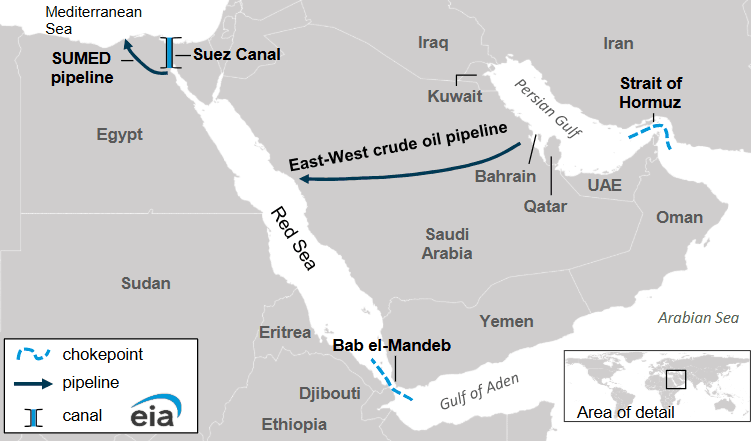
Location of the Suez Canal (EİA)
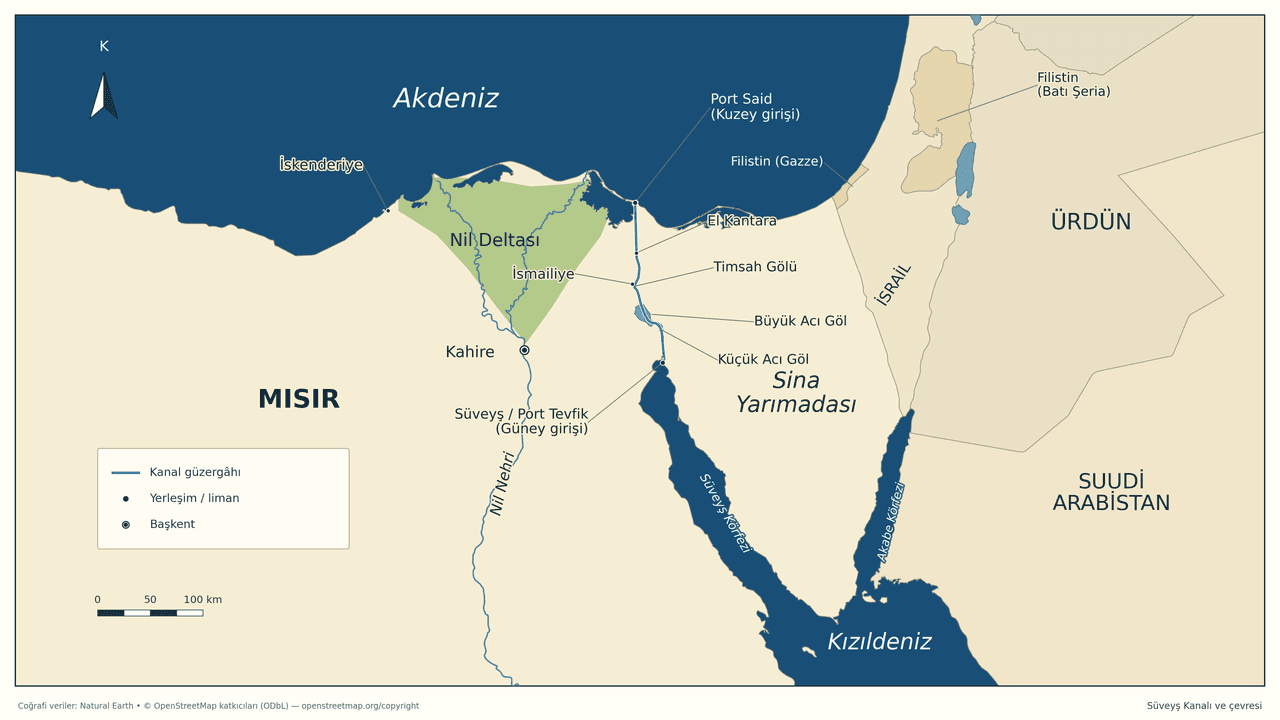
The canal begins at Port Said on the Mediterranean coast in the north and ends at the port of Suez in the south. Along its route lie the Great Bitter Lake and the Little Bitter Lakes; the city of Ismailia, established during the canal’s construction, is also located along this route.【4】
According to the Suez Canal Authority, when the canal opened in 1869 it had a depth of approximately 8 meters and a wet cross-sectional area of 304 square meters; the largest vessel it could accommodate carried a cargo of 5,000 tons. In subsequent periods the canal was gradually widened and deepened, and the maximum allowable draft was increased to 66 feet in January 2010. The Authority states that with this upgrade, 61.2 percent of fully loaded tankers, 92.7 percent of bulk carriers, and all container ships and other vessel types can now transit the canal. 【5】 The developmental stages are summarized in the table below:
The idea of connecting the Mediterranean Sea with the Red Sea dates back to antiquity. According to the historical narrative provided by the Suez Canal Authority, the first person to propose this concept was Pharaoh Senusret III of the Twelfth Dynasty; during this period, ships navigated along the Nile and its tributaries to reach the Red Sea via the Bitter Lakes. The main phases of development are as follows:【6】
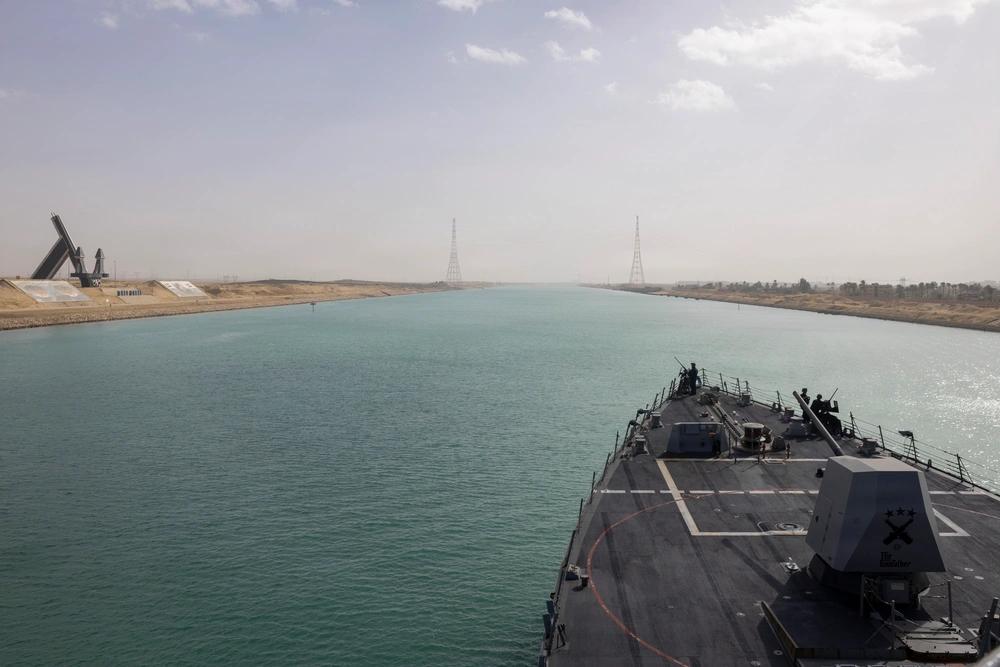
View of the Suez Canal from an American Ship (DVIDS)
Dating of the canal’s early history varies among sources. Some accounts associate its initial construction with Pharaoh Ramses II, who ruled in the 13th century BCE, while Roman-era restoration efforts are attributed to Emperor Hadrian (117–138 CE). The canal was reopened for use by Amr ibn al-As in the 7th century and remained operational until the 8th century.【7】
The Ottomans expanded the Suez Shipyard, inherited from the Mamluks, and in 1560 established Suez as a district with an independent captaincy. The fleet for the 1538 expedition to India was constructed at this shipyard by Hadım Süleyman Pasha, the Governor of Egypt. However, the fleet prepared in Suez could not receive support from the Mediterranean fleet due to the absence of a continuous canal, limiting the success of these campaigns. Consequently, in a decree issued on 13 January 1568 to the Governor of Egypt, Suleiman II ordered the opening of a passage from the Mediterranean to the Red Sea. No significant effort to link the two seas was made until Napoleon Bonaparte’s invasion of Egypt in 1798; only minor waterways capable of accommodating small vessels were maintained.【8】
1798–1801 The French campaign during these years produced the first modern proposal for a canal. During the campaign, engineers working on the project concluded that the Red Sea was approximately 30 feet higher than the Mediterranean Sea and abandoned the plan due to concerns that the Nile Delta might be submerged.
This observation of a level difference was later rejected by Laplace and Fourier. The Egyptian governor Mehmed Ali Pasha adopted a cautious stance toward the canal project, fearing the region could become a battleground among Western powers. In 1834 he approved a railway project but did not complete it. The British diplomat David Urquhart argued in his 1853 London-published work Progress of Russia in the West, North, and South that steamship technology had made the canal feasible.【9】
The project’s leader, French diplomat Ferdinand de Lesseps, was born on 19 November 1805 in Versailles. He served as vice-consul in Alexandria in 1832 and became consul general in 1835, during which time he oversaw the education of the future Egyptian governor Said Pasha. Lesseps presented his canal plan, which he had been developing since the 1830s, to Said Pasha after the latter assumed governorship in 1854.【10】
The first concession granting Lesseps the authority to establish a company to dig the canal was issued on 30 November 1854.【11】 Under this concession, the company’s president was to be appointed by the Egyptian government, the concession period was to last ninety-nine years from the canal’s opening, the Egyptian government was to receive fifteen percent of the company’s annual net profits, tolls were to be set by agreement between the khedive and the company, and all nations were to be treated equally; at the end of the term, the canal and its facilities were to be transferred to the Egyptian government. The second concession, dated 5 January 1856, consisted of twenty-three articles, and Article 14 stipulated that the canal would remain permanently open as a neutral passage for all commercial vessels.【12】
The Suez Canal project, opposed by Britain, was supported by France under the rule of Napoleon III. This disagreement between the two powers led to diplomatic tensions at the Sublime Porte. Mustafa Reşid Pasha, who opposed the project, was dismissed as grand vizier on 2 May 1855, partly due to French pressure.【13】 The second concession granted by Egyptian governor Said Pasha to Lesseps on 5 January 1856 required the approval of the Sublime Porte before construction could begin.
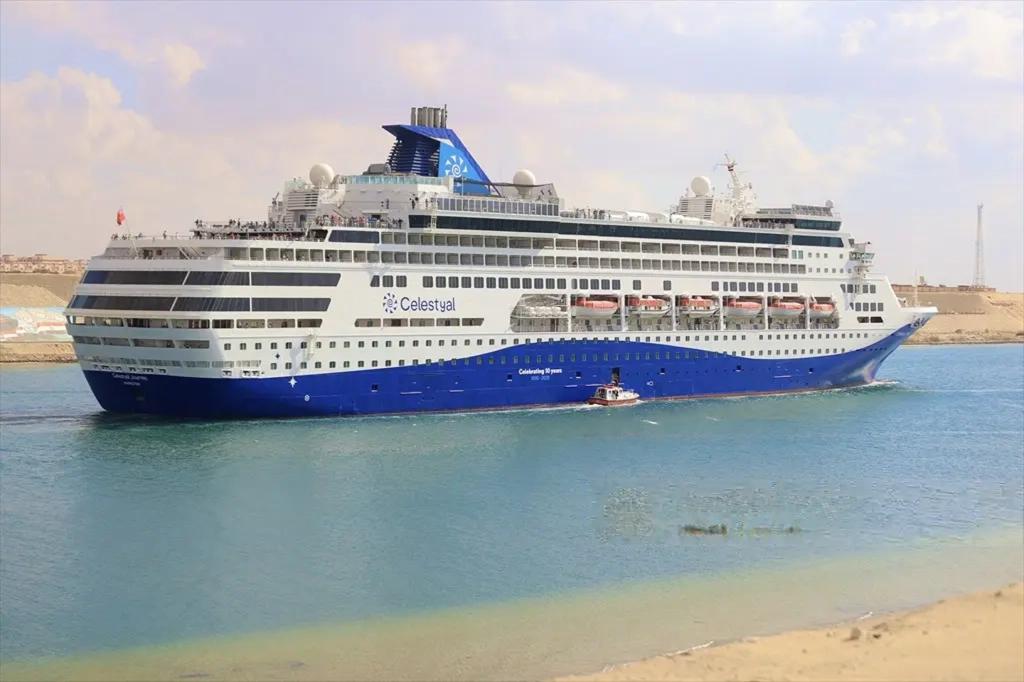
Suez Canal (Anadolu Ajansı)
The diplomatic struggle surrounding the project continued in Istanbul between 1855 and 1857.【14】 Britain, fearing that its route to India would be threatened, sought to halt the canal project through the Sublime Porte and proposed an alternative railway from Alexandria to Suez. The British ambassador Lord Stratford exerted pressure on Reşid Pasha, while the French ambassador Antoine Thouvenel supported Lesseps. In 1857 Britain occupied Perim Island; later, Henry Bulwer, who succeeded Stratford as ambassador, maintained a firm opposition to the canal project.
The Ottoman Empire’s official approval of the project was granted by Sultan Abdülaziz in a firman dated 19 March 1866.【15】 During debates on the canal project, British Prime Minister Lord Palmerston favored the Euphrates route for access to India. David Urquhart argued that Russia opposed the canal project in order to prevent Britain from gaining a shorter route to India.【16】
Compagnie Universelle du Canal Maritime de Suez (Universal Company of the Maritime Suez Canal) was established on 5 December 1858 with a capital of 200 million francs, divided into 400,000 shares of 500 francs each. Initially, 92,136 shares were allocated to Egypt; when the United Kingdom, the United States, Austria, and Russia did not purchase the 85,506 shares allocated to them, Egypt acquired these shares through a high-interest loan of 28 million francs, thereby holding a total of 177,642 shares. Excavation began on 25 April 1859 at El-Ferame, the site of present-day Port Said, despite objections from the United Kingdom and the Ottoman Empire, with the participation of 20,000 Egyptian workers. Water reached Lake Timsah on 18 November 1862, and the waters of the two seas joined on 18 August 1869. A total of 74 million cubic meters of earth were excavated, and the cost reached 433 million francs, twice the originally projected amount.【17】
Works related to the canal indicate that the company was an Egyptian joint-stock company headquartered in Paris, that 52 percent of its shares belonged to France and 44 percent to Said Pasha, and that the first board of directors included representatives from 14 countries.【18】
The completed canal was inaugurated on 17 November 1869 in a ceremony attended by approximately 6,000 guests. Attendees included Empress Eugénie of France, Emperor and King Franz Joseph of Austria-Hungary, the Prussian heir, Emir Abd al-Qadir al-Jaza'iri, and the Norwegian playwright Henrik Ibsen. On the opening day, 77 ships, 50 of them warships and led by the vessel L’Aigle, entered the canal. The cost of the ceremonies to the Khedive Isma'il Pasha amounted to approximately 1.5 million Egyptian pounds. Isma'il Pasha’s direct invitation of European royal houses angered Sultan Abdülaziz, and the Ottoman Empire did not accord the inauguration significant recognition.【19】
Egypt’s financial difficulties altered the ownership structure of the canal. During the premiership of Benjamin Disraeli, the British government purchased the 176,602 shares held by Khedive Isma'il Pasha on 25 November 1875 for approximately 3.98 million pounds sterling, acquiring about 44 percent of the company’s capital. The Egyptian government transferred its right to 15 percent of the company’s annual net profit to Crédit Foncier de France in 1880 in exchange for 22 million francs. Thus, the company’s capital came under European control, with approximately 56 percent owned by French shareholders and 44 percent by the British government.【20】
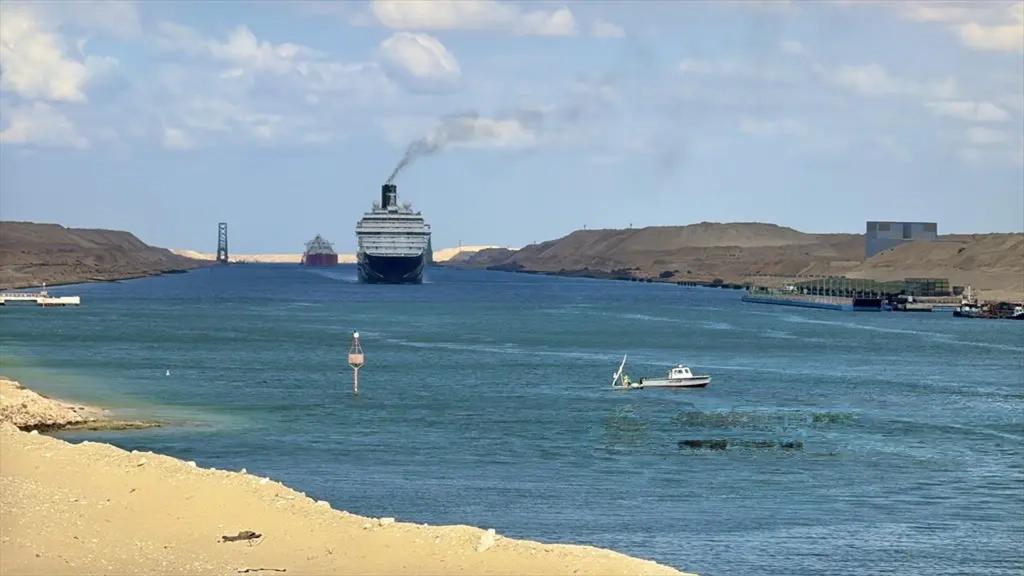
A Ship in the Suez Canal (Anadolu Ajansı)
May–September 1882, following the Urabi Revolt, Britain occupied Egypt, seized the company’s facilities, and temporarily halted traffic through the canal. Transit, which had been permitted only during daylight hours since the canal’s opening, began to operate at night as of 1 March 1887. The Constantinople Convention (Constantinople Convention), signed on 29 October 1888, established the international status of the canal and was signed by France, Austria-Hungary, Spain, the United Kingdom, Italy, the Netherlands, Germany, Russia, and the Ottoman Empire.【22】
In 1870, 486 ships passed through the canal (fewer than two per day); by 1966, this number had risen to 21,250 ships (approximately 58 per day). Net transit tonnage increased from 444,000 tons in the first year to over 278 million tons in 1966. Article 1 of the Convention stipulates that the canal must remain open to all commercial and war vessels, regardless of flag, in both peace and war, and that it may never be blockaded; Article 4 prohibits hostile acts and any actions obstructing free passage within the canal and its ports. Disputes regarding transit fees and disagreements among countries using the canal were resolved through the Sublime Porte acting as the sovereign authority.【23】 【24】 【25】
With the end of Ottoman rule in 1914, British dominance began (though de facto occupation started much earlier), and the canal region played a vital role in British military logistics. The Egypt-United Kingdom Agreement signed on 26 August 1936 reorganized Britain’s military presence in Egypt. The agreement permitted Britain to maintain a maximum of 10,000 ground troops and 400 pilots, along with necessary administrative and technical support personnel, in the canal zone during peacetime and in the absence of exceptional circumstances.【26】 23 July 1952 marked a change in Egypt’s governance following a military coup by the Free Officers Movement. An initial agreement on the withdrawal of British forces from the canal zone was initialed on 27 July 1954, and the final treaty replacing the 1936 agreement and regulating the withdrawal was signed on 19 October 1954.【27】
The United States and the United Kingdom announced a joint proposal to finance the Aswan Dam on 17 December 1955, but withdrew this offer on 19–20 July 1956. In response, Egyptian President Gamal Abdel Nasser issued a decree on 26 July 1956 nationalizing the Suez Canal Company. The decree stipulated that shareholders would receive compensation based on the closing value of their shares on the Paris Stock Exchange. The Suez Canal Authority stated that it had fulfilled its compensation obligations as of 1 January 1963, having paid a total of 28.3 million Egyptian pounds for 800,000 shares. After nationalization and the collective withdrawal of foreign personnel, the canal continued to operate with pilots and staff from Egypt and friendly countries.【28】
Following the nationalization decision, a conference was held in London on 16 August 1956 with participation from 22 states. Turkey was represented at the conference by Ambassador Muharrem Nuri Birgi. The plan presented by U.S. Secretary of State John Foster Dulles was modified by proposals from Turkey, Ethiopia, Iran, and Pakistan to become the “Five Power Plan.” This plan, submitted to the Egyptian government by a commission sent to Cairo, was rejected.
During negotiations held in London from 19 to 22 September 1956, it was decided to establish the Users of the Suez Canal Association. The association was formally established on 1 October 1956, and Turkey became a member.【29】
British, French, and Israeli officials held secret talks between 22 and 24 October 1956 in Sèvres, near Paris. Following these talks, Israel attacked Egypt on 29 October 1956. Britain and France issued an ultimatum to both sides on 30 October, and launched military operations on 31 October after Egypt rejected the ultimatum. A U.S.-proposed ceasefire resolution at the UN Security Council was vetoed by Britain and France. An emergency session of the General Assembly, convened at the initiative of Yugoslavia, adopted a resolution on 2 November calling for a ceasefire and withdrawal, with 64 votes in favor, 5 against, and 6 abstentions.
Both the United States and the Soviet Union condemned the military action. Britain declared a ceasefire on 6 November, and the withdrawal of British and French forces was completed in December. The Suez Canal Authority noted that the military intervention, referred to as the “Triple Aggression,” lasted from 31 October to 22 December 1956, resulting in the closure of the canal. After the sunken vessels were cleared, navigation resumed on 29 March 1957.【30】
The crisis elevated Egypt to a leading position in the Arab world and enhanced Nasser’s prestige; while the standing of Britain and France in the region suffered, the influence of the United States and the Soviet Union in the Middle East increased. Nationalization established a precedent for countries emerging from colonial rule regarding sovereignty over natural resources. The Baghdad Pact’s regional members convened in Tehran on 7 November 1956 to call for respect for Egypt’s sovereignty; Türkiye’s decision to recall its ambassador from Israel was announced on 29 November.【31】
The Suez Crisis is argued to have marked a turning point in bringing NATO’s “out-of-area” concept to the forefront. According to the same perspective, Türkiye viewed the Soviet Union’s influence in the Middle East as a threat to NATO’s southeastern flank; at the North Atlantic Council meeting on 5 September 1956, it supported a U.S. proposal. President Celâl Bayar addressed the political cooperation between NATO and the Baghdad Pact in the TBMM on 1 November 1956, and Prime Minister Adnan Menderes submitted a memorandum to the North Atlantic Council on 11 December 1956 proposing a formal link between NATO and the Baghdad Pact.【33】
When Egypt nationalized the company on 26 July 1956, it did not reject the canal’s international status. The draft resolution submitted by Britain and France to the Security Council in October 1956 included principles of open and non-discriminatory transit, respect for Egyptian sovereignty, and the isolation of canal operations from any country’s politics. On 24 April 1957, Egypt submitted a declaration to the United Nations, pledging to guarantee free and uninterrupted transit to all nations under the framework of the 1888 Convention, and accepted the compulsory jurisdiction of the International Court of Justice for any disputes arising from this declaration.【34】
Nevertheless, Egypt restricted the passage of Israeli ships and certain cargo bound for Israel due to the state of war that had existed between Egypt and Israel since 1948. The Security Council, in its resolution of 1 September 1951 (S/2322), called on Egypt to end restrictions on international commercial shipping. The issue was resolved by Article V(1) of the 1979 Egypt-Israel Peace Treaty, which recognized the right of Israeli ships and cargo to transit the canal freely under the terms of the 1888 Convention.【35】
5 June 1967, with the outbreak of the Six-Day War, Egypt closed the canal; it remained shut for exactly eight years until reopening on 5 June 1975. Fifteen cargo ships, known as the “Yellow Fleet,” were trapped in the canal during the closure. For the following eight years, the canal served as a ceasefire line; following negotiations initiated after the October 1973 war, Israeli forces withdrew from the western bank of the canal by 5 March 1974.【36】
The closure affected South Asian and East African countries the most; the average maritime distance increased by 31.4 percent for Pakistan, 30.6 percent for India, 23.6 percent for Kenya, and 20.4 percent for Sri Lanka. Modeling studies estimating the impact of the closure and reopening calculated that a one percent increase in sea route distance reduced bilateral trade by approximately 0.15 to 0.46 percent. It took approximately three years for trade flows to adapt to the changes in distance.【37】
President Enver Sedat announced on 29 March 1975 before the People’s Assembly that the canal would reopen, and participated in the inaugural convoy on 5 June 1975 aboard the “6 October” tugboat. The canal was cleared of ships sunk during the 1967 and 1973 wars, but its depth and cross-sectional area remained at pre-closure levels. The Timsah and Port Said bypasses entered service in 1980. The canal experienced additional brief interruptions outside the 1956–1957 and 1967–1975 closures; transit was disrupted for three days in 2004 due to the vessel “Tropic Brilliance” and for a period in 2017 due to the vessel “OOCL Japan.”【39】
August 2014 announced and designated as the “New Suez Canal,” the project involves the construction of a new 35 km parallel channel between the 60th and 95th kilometers of the existing canal, along with deepening and widening by a total of 37 km of the Great Bitter Lakes and Ballah bypasses; the total length of the project is 72 km. The new channel is designed to accommodate vessels with a 66 feet draft, featuring a depth of 24 meters and a width of 317 meters at water level. The Suez Canal Authority has outlined the following objectives:【40】
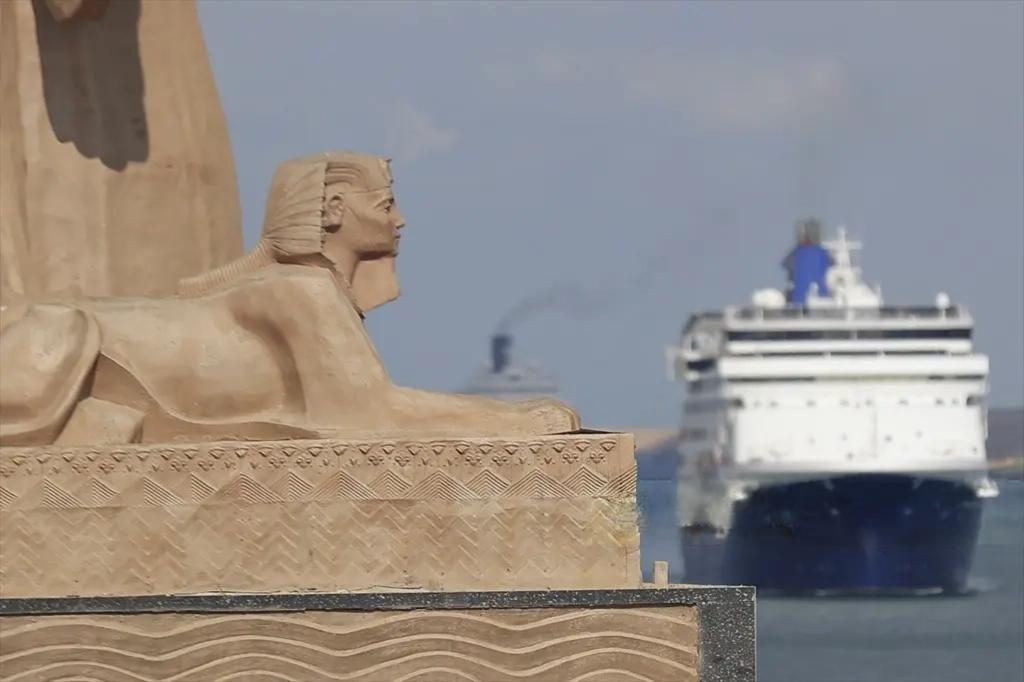
Suez Canal (Anadolu Ajansı)
The project was completed in 11 months, and two-way traffic on the 35 km section began in August 2015. The canal’s annual revenue reached $5.804 billion in 2019 and $10.25 billion in 2023. Thus, while revenues have increased, they have remained below the projected annual revenue target of approximately $13.2 billion for 2023 under the New Suez Canal Project. The estimated budget for the project was $8.2 billion, of which $4.2 billion was allocated to the excavation of the new channel and $4 billion to the construction of six tunnels beneath the canal.【41】 $4.2 billion was allocated to the excavation of the new channel and $4 billion to the construction of six tunnels beneath the canal.【42】
According to current data, approximately 26,000 vessels transited the canal in 2023. By vessel count, bulk carriers accounted for 28 percent, oil tankers for 24 percent, and container ships for 23 percent; however, by gross tonnage, container ships lead with a 43 percent share. It is estimated that the canal carried about 22 percent of global maritime container trade in 2023 and generated $9.4 billion in revenue for Egypt in the previous fiscal year, equivalent to 2.3 percent of Egypt’s 2023 gross domestic product.【43】
Along with worker remittances and tourism, the Suez Canal is one of Egypt’s primary sources of foreign exchange. An assessment published in 2021 indicated that approximately 1 million barrels of oil pass through the canal daily and that 8 percent of global liquefied natural gas (LNG) trade utilizes this route.【44】 China is among the principal investors in the Suez Canal Corridor Project, launched in 2014, and the Suez Canal Economic Zone is regarded as part of the Belt and Road Initiative.【45】
Suez Canal | The World's Most Critical Waterway (Teknik Rehber)
23 March 2021, the container ship Ever Given, en route from Malaysia to the Netherlands, ran aground diagonally in a single-lane section of the canal under conditions of strong winds and sandstorms, completely halting all transit. The vessel was refloated six days later using 13 tugboats. The number of waiting ships quickly exceeded 350, and Richard Mead, editorial director of Lloyd’s List, noted that approximately 450 ships were awaiting passage when the canal reopened.
Estimating that approximately $400 million worth of cargo passes through the canal per hour, the daily value of delayed cargo was estimated at approximately $9.6 billion. The Chairman of the Suez Canal Authority, Usama Rabie, stated that the canal’s daily revenue loss amounted to $14–15 million.【46】 In Allianz’s assessment dated 26 March 2021, it was projected that the daily cost to global trade for each day the canal remained closed could range between $6 billion and $10 billion.【47】
November 2023 onwards, attacks on commercial vessels in the Red Sea caused a significant decline in canal traffic. According to a February 2024 assessment, transits through the canal had decreased by more than 40 percent compared to peak levels, and container tonnage passing through the canal had dropped by 82 percent as of the first half of February 2024. Despite the longer distance, vessel tonnage entering the Gulf of Aden fell by over 70 percent between early December 2023 and early February 2024, while tonnage passing around Cape of Good Hope increased by 60 percent. For example, a tanker voyage from Ras Tanura to Rotterdam is 10,358 km via the Suez Canal but extends to 17,975 km via the Cape of Good Hope. Shipping rates between Shanghai and Europe rose by 256 percent during the same period.【48】
The average daily gross tonnage of vessels transiting the canal fell from 4.40 million GT in December 2023 to 2.27 million GT in January 2024. This decline represented approximately 48 percent compared to the December 2023 average and 62 percent according to early February data. LNG vessel transits also ceased at the beginning of February. In contrast, gross tonnage passing around the Cape of Good Hope increased by 63 percent in January and 74 percent at the beginning of February compared to the same reference period.【49】
The decline in canal traffic also reduced Egypt’s transit fee revenues. Since approximately 31 percent of Djibouti’s foreign trade volume and 34 percent of Sudan’s are transported via the Suez Canal, these countries are particularly vulnerable to disruptions along the route.【50】 The rerouting of vessels around the Cape of Good Hope has extended voyage durations, impacted freight and vessel charter markets, and led to a reallocation of fleet capacity across different routes. Fleet size and capacity planning have become critical as companies adapt to longer voyage times and shifting transportation demands.【51】
Among the projects proposed as alternatives to the canal are Israel’s Eilat–Ashdod railway and land connection, Iran’s North–South Transport Corridor, and Türkiye’s Middle Corridor; however, the Suez Canal is expected to maintain its central position in the medium term.【52】
Parliament of the United Kingdom. Suez Canal (Shares) Act 1876. 39 & 40 Vict., c. 67. August 15, 1876. Accessed November 16, 2026.https://www.legislation.gov.uk/ukpga/Vict/39-40/67/pdfs/ukpga_18760067_en.pdf.
Parliament of the United Kingdom. “Anglo-Egyptian Treaty.” Hansard, House of Commons, vol. 318, November 24, 1936, cols. 251–339. Accessed November 16, 2026.https://api.parliament.uk/historic-hansard/commons/1936/nov/24/anglo-egyptian-treaty.
Allianz. “The Suez Canal Ship Is Not the Only Thing Clogging Global Trade.” March 26, 2021. Accessed November 16, 2026.https://www.allianz.com/en/economic_research/insights/publications/specials_fmo/2021_03_26_SupplyChainDisruption.html.
Anadolu Images. “Suez Canal Sees Heavy Traffic as Officials Discuss Large-Scale Transits.” Photograph, visual no. 30812037. Accessed November 15, 2026.https://www.anadoluimages.com/p/suez-canal-sees-heavy-traffic-as-officials-discuss-large-scale-transits/30812037.
Anadolu Images. “Süveyş Kanalı’nda Gemi Trafiği Görüntülendi.” Photograph, visual no. 30811940. Accessed November 15, 2026.https://www.anadoluimages.com/p/suveys-kanalinda-gemi-trafigi-goruntulendi/30811940.
Anadolu Images. “Süveyş Kanalı’nda Gemi Trafiği Görüntülendi.” Photograph, visual no. 30811948. Accessed November 15, 2026.https://www.anadoluimages.com/p/suveys-kanalinda-gemi-trafigi-goruntulendi/30811948.
Arauz, Wendy. “USS Delbert D. Black (DDG 119) Transits the Suez Canal.” Photograph, visual no. 9499951. U.S. Navy, DVIDS, January 2026. Accessed November 16, 2026.https://www.dvidshub.net/image/9499951/uss-delbert-d-black-ddg-119-transits-suez-canal.
Beaufort, Indra. “USS Roosevelt (DDG 80) Conducts Suez Canal Transit.” Photograph, visual no. 9489601. U.S. Navy, DVIDS, January 2026. Accessed November 16, 2026.https://www.dvidshub.net/image/9489601/uss-roosevelt-ddg-80-conducts-suez-canal-transit.
Beydilli, Kemal. “Mustafa Reşid Paşa.” TDV İslâm Ansiklopedisi, 31:348–350. Ankara: TDV İslâm Araştırmaları Merkezi, 2020. Accessed November 16, 2026.https://cdn2.islamansiklopedisi.org.tr/dosya/31/C31010184.pdf.
Bilge, Mustafa L. “Süveyş.” TDV İslâm Ansiklopedisi, 38:186–187. İstanbul: TDV İslâm Araştırmaları Merkezi, 2010. Accessed November 15, 2026.https://cdn2.islamansiklopedisi.org.tr/dosya/38/C38012498.pdf.
Engin, Vahdettin, and Samet Tufan. “NATO’nun Alan Dışılık Kavramının Ortaya Çıkışı: Süveyş Krizi ve Türkiye’nin Rolü.” Marmara Türkiyat Araştırmaları Dergisi 12, no. 2 (2025): 701–734. Accessed November 15, 2026.https://dergipark.org.tr/tr/download/article-file/4752216.
Feyrer, James. Distance, Trade, and Income – The 1967 to 1975 Closing of the Suez Canal as a Natural Experiment. NBER Working Paper 15557. Cambridge, MA: National Bureau of Economic Research, 2009. Accessed November 15, 2026.https://web.williams.edu/Economics/seminars/feyrer.pdf.
Fondation Napoléon. “Firman Concerning the Suez Canal.” English translation of the firman dated March 19, 1866. L’Isthme de Suez, no. 235 (April 15–18, 1866). Accessed November 16, 2026.https://www.napoleon.org/wp-content/themes/napoleon/annexes/hors-serie/suez/en/html-content/historique/txt-017.html.
Karakaş, Serkan. “The Impact of the Red Sea Crisis on Container Shipping: A Comparison between the Suez Canal and the Cape of Good Hope Route.” Kent Akademisi 19, no. 3 (2026): 1–14. Accessed November 15, 2026.https://dergipark.org.tr/tr/download/article-file/4892788.
Kuş, Ayşegül. “The Opinions and Assessments of the English Diplomat David Urquhart Regarding the Opening of the Suez Canal.” Çağdaş Türkiye Tarihi Araştırmaları Dergisi 23, no. 46 (2023): 239–267. Accessed November 15, 2026.https://dergipark.org.tr/tr/download/article-file/3322829.
Ministry of Tourism and Antiquities. “Ramesses II and Sekhmet.” Discover Egypt’s Monuments. Accessed November 16, 2026.https://egymonuments.gov.eg/en/collections/ramesses-ii-and-sekhmet-6/.
Piquet, Caroline. “The Suez Company’s Concession in Egypt, 1854–1956: Modern Infrastructure and Local Economic Development.” Enterprise & Society 5, no. 1 (2004): 107–127. Accessed November 16, 2026.https://educatoroutreach.uchicago.edu/files/2019/07/sti2014_caroline-piquet_the-suez-companys-concession-in-egypt.pdf.
Rodriguez-Diaz, Emilio, Juan Ignacio Alcaide, and R. Garcia-Llave. “Challenges and Security Risks in the Red Sea: Impact of Houthi Attacks on Maritime Traffic.” Journal of Marine Science and Engineering 12, no. 11 (2024): article 1900. Accessed November 15, 2026.https://www.mdpi.com/2077-1312/12/11/1900.
Sabel, Robbie. “International Law and Freedom of Navigation Through the Suez Canal.” The Suez Canal: Past Lessons and Future Challenges, edited by Carmela Lutmar and Ziv Rubinovitz, pp. 135–145. Cham: Palgrave Macmillan, 2023. Accessed November 15, 2026.https://link.springer.com/chapter/10.1007/978-3-031-15670-0_7.
Serbest, M. Bürkan. “Süveyş Kanalı’nın Ulusallaştırılması Sorunu ve Süveyş Bunalımı.” MANAS Sosyal Araştırmalar Dergisi 6, no. 4 (2017): 689–711. Accessed November 15, 2026.https://dergipark.org.tr/tr/download/article-file/578971.
Suez Canal Authority. New Suez Canal. Broşür, t.y. Accessed November 16, 2026.https://www.suezcanal.gov.eg/English/MediaCenter/Brochures/New%20Suez%20Canal.pdf.
Suez Canal Authority. “Canal Characteristics.” Accessed November 15, 2026.https://www.suezcanal.gov.eg/English/About/SuezCanal/Pages/CanalCharacteristics.aspx.
Suez Canal Authority. “Canal History.” Accessed November 15, 2026.https://www.suezcanal.gov.eg/English/About/SuezCanal/Pages/CanalHistory.aspx.
Suez Canal Authority. “Constantinople Convention.” Treaty dated October 29, 1888. Accessed November 16, 2026.https://www.suezcanal.gov.eg/English/About/CanalTreatiesAndDecrees/Pages/ConstantinopleConvention.aspx.
Suez Canal Authority. “New Suez Canal.” Accessed November 15, 2026.https://www.suezcanal.gov.eg/English/About/SuezCanal/Pages/NewSuezCanal.aspx.
Suez Canal Authority. “بحضور رئيس الهيئة ولفيف من الوزراء والسفراء وممثلي التوكيلات الملاحية.” April 16, 2025. Accessed November 16, 2026.https://www.suezcanal.gov.eg/Arabic/MediaCenter/News/Pages/sca_16-04-2025.aspx.
Technical Guide. "SÜVEYŞ CANAL | — The World’s Most Critical Waterway [Documentary]." YouTube video, 1:45. March 6, 2026. Accessed November 15, 2026.https://www.youtube.com/watch?v=Ox0ZTpUgSSM.
Telci, İsmail Numan, and Recep Yorulmaz. Political Economy of the Suez Canal and the “Ever Given Crisis”. ORSAM Analysis 283. Ankara: ORSAM, 2021. Accessed November 15, 2026.https://orsam.org.tr/dosya/Political_Economy_of_the_Suez_Canal_and_the_YEver_Given_CrisisY.pdf.
U.S. Navy. “USS Gerald R. Ford (CVN 78) Transits the Suez Canal during Operation Epic Fury.” Photograph, visual no. 9552479. DVIDS, March 5, 2026. Accessed November 16, 2026.https://www.dvidshub.net/image/9552479/uss-gerald-r-ford-cvn-78-transits-suez-canal-during-operation-epic-fury.
UNCTAD. Navigating Troubled Waters: Impact to Global Trade of Disruption of Shipping Routes in the Red Sea, Black Sea and Panama Canal. UNCTAD/OSG/INF/2024/2. Geneva: UNCTAD, 2024. Accessed November 15, 2026.https://unctad.org/system/files/official-document/osginf2024d2_en.pdf.
United Nations. “Agreement between the Government of the Republic of Egypt and the Government of the United Kingdom of Great Britain and Northern Ireland. Signed at Cairo, on 19 October 1954.” United Nations Treaty Series 210 (1955): 3–62. No. 2833. Accessed November 16, 2026.https://treaties.un.org/doc/publication/UNTS/Volume%20210/v210.pdf.
United States Department of State. “Editorial Note.” Foreign Relations of the United States, 1952–1954, The Near and Middle East, Volume 9, Section 2, Document 1348. Edited by Paul Claussen, Joan M. Lee, and Carl N. Raether. Washington, DC: United States Government Printing Office, 1986. Accessed November 16, 2026.https://history.state.gov/historicaldocuments/frus1952-54v09p2/d1348.
Uygur, Fatma. “Süveyş Kanalı Projesinde İstanbul’da Cereyan Eden Diplomatik Mücadeleler.” Türkiye Sosyal Araştırmalar Dergisi 22, no. 3 (2018): 699–720. Accessed November 15, 2026.https://dergipark.org.tr/tr/download/article-file/592490.
[1]
Fatma Uygur, “Süveyş Kanalı Projesinde İstanbul’da Cereyan Eden Diplomatik Mücadeleler,” Türkiye Sosyal Araştırmalar Dergisi 22, no. 3 (2018): 699–700, Accessed November 15, 2026.https://dergipark.org.tr/tr/download/article-file/592490.
[2]
James Feyrer, Distance, Trade, and Income – The 1967 to 1975 Closing of the Suez Canal as a Natural Experiment, NBER Working Paper 15557 (Cambridge, MA: National Bureau of Economic Research, 2009), 2, Accessed November 15, 2026.https://web.williams.edu/Economics/seminars/feyrer.pdf; İsmail Numan Telci and Recep Yorulmaz, Political Economy of the Suez Canal and the “Ever Given Crisis”, ORSAM Analysis 283 (Ankara: ORSAM, 2021), 4, Accessed November 15, 2026.https://demo3.orsam.org.tr/dosya/Political_Economy_of_the_Suez_Canal_and_the_YEver_Given_CrisisY.pdf.
[3]
Mustafa L. Bilge, “Süveyş,” TDV İslâm Ansiklopedisi 38 (İstanbul: TDV İslâm Araştırmaları Merkezi, 2010), 186. Accessed November 15, 2026.https://cdn2.islamansiklopedisi.org.tr/dosya/38/C38012498.pdf.
[4]
Suez Canal Authority, “Canal History,” Suez Canal Authority official website, Accessed November 15, 2026.https://www.suezcanal.gov.eg/English/About/SuezCanal/Pages/CanalHistory.aspx.
[5]
Suez Canal Authority, “Canal Characteristics,” Suez Canal Authority official website, Accessed November 15, 2026.https://www.suezcanal.gov.eg/English/About/SuezCanal/Pages/CanalCharacteristics.aspx.
[6]
Suez Canal Authority, “Canal History.”
[7]
Mustafa L. Bilge, “Süveyş,” TDV İslâm Ansiklopedisi, Volume 38 (İstanbul: TDV İslâm Araştırmaları Merkezi, 2010), 186, Accessed November 15, 2026,https://cdn2.islamansiklopedisi.org.tr/dosya/38/C38012498.pdf; Ministry of Tourism and Antiquities, “Ramesses II and Sekhmet,” Accessed November 15, 2026,https://egymonuments.gov.eg/en/collections/ramesses-ii-and-sekhmet-6/.
[8]
Bilge, “Süveyş,” 186.
[9]
Kuş, “David Urquhart’s Views and Evaluations,” 242, 245–254.
[10]
Uygur, “Süveyş Kanalı Projesinde Diplomatik Mücadeleler,” 701–704.
[11]
Suez Canal Authority, “Canal History.”
[12]
Suez Canal Authority, “Canal History.”
[13]
Uygur, “Süveyş Kanalı Projesinde Diplomatik Mücadeleler,” 701, 706; Kemal Beydilli, “Mustafa Reşid Paşa,” TDV İslâm Ansiklopedisi, c. 31 (Ankara: TDV İslâm Araştırmaları Merkezi, 2020), 349, Accessed November 16, 2026,https://cdn2.islamansiklopedisi.org.tr/dosya/31/C31010184.pdf.
[14]
Uygur, “Süveyş Kanalı Projesinde Diplomatik Mücadeleler,” 705–714.
[15]
“Firman Concerning the Suez Canal,” English translation of the firman dated March 19, 1866, Fondation Napoléon, Accessed November 16, 2026,https://www.napoleon.org/wp-content/themes/napoleon/annexes/hors-serie/suez/en/html-content/historique/txt-017.html.
[16]
Kuş, “David Urquhart’s Views and Evaluations,” 249–257.
[17]
Suez Canal Authority, “Canal History.”
[18]
Telci and Yorulmaz, Political Economy of the Suez Canal, 5–6.
[19]
Suez Canal Authority, “Canal History”; Bilge, “Süveyş,” 186; Bilge, Mustafa L. "Süveyş"
[20]
Suez Canal (Shares) Act 1876, 39 & 40 Vict., c. 67, 322, Accessed November 16, 2026,https://www.legislation.gov.uk/ukpga/Vict/39-40/67/pdfs/ukpga_18760067_en.pdf.
[22]
Suez Canal Authority, “Canal History.”
[23]
Telci and Yorulmaz, Political Economy of the Suez Canal, 13–15.
[24]
Robbie Sabel, “International Law and Freedom of Navigation Through the Suez Canal,” in The Suez Canal: Past Lessons and Future Challenges, ed. Carmela Lutmar and Ziv Rubinovitz (Cham: Palgrave Macmillan, 2023), 136, Accessed November 15, 2026.https://link.springer.com/chapter/10.1007/978-3-031-15670-0_7.
[25]
Bilge, Mustafa L. "Süveyş".
[26]
United Kingdom Parliament, “Anglo-Egyptian Treaty,” Hansard, House of Commons, vol. 318, November 24, 1936, col. 258, Accessed November 16, 2026,https://api.parliament.uk/historic-hansard/commons/1936/nov/24/anglo-egyptian-treaty.
[27]
Serbest, “Süveyş Kanalı’nın Ulusallaştırılması Sorunu,” 692–693; United States Department of State, “Editorial Note,” Foreign Relations of the United States, 1952–1954, The Near and Middle East, c. 9, bölüm 2, belge 1348, Accessed November 16, 2026,https://history.state.gov/historicaldocuments/frus1952-54v09p2/d1348.
[28]
Serbest, “Süveyş Kanalı’nın Ulusallaştırılması Sorunu,” 698–700; Suez Canal Authority, “Canal History.”
[29]
Marmara Türkiyat Araştırmaları Dergisi 12, no. 2 (2025): 716–717, Accessed November 15, 2026.https://dergipark.org.tr/tr/download/article-file/4752216; Vahdettin Engin and Samet Tufan, “NATO’nun Alan Dışılık Kavramının Ortaya Çıkışı: Süveyş Krizi ve Türkiye’nin Rolü,” Marmara Türkiyat Araştırmaları Dergisi 12, no. 2 (2025): 716–717.
[30]
Serbest, “Süveyş Kanalı’nın Ulusallaştırılması Sorunu,” 703–705; Engin and Tufan, “NATO’nun Alan Dışılık Kavramının Ortaya Çıkışı,” 720.
[31]
Serbest, “Süveyş Kanalı’nın Ulusallaştırılması Sorunu,” 706–711.
[33]
Engin and Tufan, “NATO’nun Alan Dışılık Kavramının Ortaya Çıkışı,” 713–726.
[34]
Sabel, “Freedom of Navigation Through the Suez Canal,” 137–138.
[35]
Sabel, “Freedom of Navigation Through the Suez Canal,” 138–142.
[36]
Feyrer, Distance, Trade, and Income, 2, 4–5.
[37]
Feyrer, Distance, Trade, and Income, 11–12, 14.
[39]
Telci and Yorulmaz, Political Economy of the Suez Canal, 9–12.
[40]
Suez Canal Authority, “New Suez Canal,” Suez Canal Authority official website, Accessed November 15, 2026.https://www.suezcanal.gov.eg/English/About/SuezCanal/Pages/NewSuezCanal.aspx.
[41]
Suez Canal Authority, “بحضور رئيس الهيئة ولفيف من الوزراء والسفراء وممثلي التوكيلات الملاحية,” April 16, 2025. Accessed November 16, 2026.https://www.suezcanal.gov.eg/Arabic/MediaCenter/News/Pages/sca_16-04-2025.aspx.
[42]
Suez Canal Authority, New Suez Canal, brochure, n.p., “Objectives of the Project” and “Timeframe and Budget of the Project” sections, Accessed November 16, 2026,https://www.suezcanal.gov.eg/English/MediaCenter/Brochures/New%20Suez%20Canal.pdf.
[43]
UNCTAD, Navigating Troubled Waters: Impact to Global Trade of Disruption of Shipping Routes in the Red
Sea, Black Sea and Panama Canal, UNCTAD/OSG/INF/2024/2 (Geneva: UNCTAD, 2024), 5, 9, Accessed November 15, 2026.https://unctad.org/system/files/official-document/osginf2024d2_en.pdf.
[44]
Telci and Yorulmaz, Political Economy of the Suez Canal, 14–15.
[45]
Telci and Yorulmaz, Political Economy of the Suez Canal, 9–13.
[46]
Telci and Yorulmaz, Political Economy of the Suez Canal, 18.
[47]
Allianz, “The Suez Canal Ship Is Not the Only Thing Clogging Global Trade,” March 26, 2021, Accessed November 16, 2026,https://www.allianz.com/en/economic_research/insights/publications/specials_fmo/2021_03_26_SupplyChainDisruption.html.
[48]
UNCTAD, Navigating Troubled Waters, 3–5, 10, 14.
[49]
Rodriguez-Diaz, Alcaide, and Garcia-Llave, “Challenges and Security Risks in the Red Sea,” section 3.2.1 and table 1.
[50]
UNCTAD, Navigating Troubled Waters, 9.
[51]
Karakaş, “Impact of the Red Sea Crisis,” 6–8.
[52]
Telci and Yorulmaz, Political Economy of the Suez Canal, 21–23.

(Generated by Artificial Intelligence)
Suez Canal
Opening Date | 17 November 1869 | ||||||||
|---|---|---|---|---|---|---|---|---|---|
Location | Egypt (west of the Sinai Peninsula) | ||||||||
Channel Type | Sea-level canal | ||||||||
Length | Approximately 193 kilometers (120 miles) | ||||||||
Depth | Approximately 24 meters | ||||||||
Width | Approximately 205–345 meters | ||||||||
Density | More than 20,000 ships annually on average | ||||||||
Seas Connected | Mediterranean Sea and Red Sea | ||||||||
Henüz Tartışma Girilmemiştir
"Suez Canal" maddesi için tartışma başlatın
Location and Technical Features
Naming and Location
Development of Technical Features
Historical Background
Canal Initiatives in Antiquity and the Middle Ages
Ottoman Period
Napoleon’s Egyptian Campaign and the First Half of the Nineteenth Century
Construction Process (1854–1869)
Ferdinand de Lesseps and Concessions
Attitudes of the Great Powers and Diplomatic Struggles in Istanbul
Company Establishment and Excavation Works
Inauguration Ceremony
Company Period
Share Sale, Occupation, and the Constantinople Convention
First Half of the 20th Century
Nationalization and the 1956 Suez Crisis
The Aswan Dam Issue and Nationalization
Diplomatic Process
Military Intervention and Resolution of the Crisis
Consequences of the Crisis and Türkiye’s Position
Freedom of Transit and Legal Status
Closure and Aftermath
New Suez Canal Project
Economic and Strategic Importance
Modern Crises
The Ever Given Crisis (2021)
The Red Sea Crisis (2023–2024)
Chronology of the Canal
Alternative Route Projects