
Bu içerik Türkçe olarak yazılmış olup yapay zeka ile otomatik olarak İngilizceye çevrilmiştir.
+2 Daha
Underwater Acoustics
Sonar System | An acoustic system used for underwater detection and positioning. | ||||||||
|---|---|---|---|---|---|---|---|---|---|
Underwater Acoustics | Underwater acoustics. | ||||||||
First Experimental Study | 1826 | ||||||||
first experimental study | 1826 | ||||||||
Blue Homeland | Marine security, target detection, and underwater surveillance. | ||||||||
Sonar | Acoustic detection system. | ||||||||
Researchers | Jean-Daniel Colladon and Charles-François Sturm | ||||||||
Researchers | Jean-Daniel Colladon and Charles-François Sturm | ||||||||
Underwater Acoustics is the scientific and technological field that studies the generation, propagation, detection, and analysis of sound in water. Due to the rapid attenuation of electromagnetic waves in seawater, acoustic methods are predominantly used for long-range underwater detection. Optical methods may be applicable in specific scenarios where visibility and physical properties of water are favorable. Underwater acoustics encompasses diverse applications such as seafloor imaging, navigation and communication of underwater vehicles, scientific research, environmental monitoring, and detection of submerged objects.
The earliest recorded use of sound underwater dates back to antiquity, but the experimental foundations of the field were established in the 19th century. Jean-Daniel Colladon and Charles-François Sturm conducted one of the first documented experiments in 1826 on Lake Geneva to measure the speed of sound in water.【1】 Experiments during this period demonstrated that the behavior of sound in water is governed by measurable physical properties.
In the early 20th century, the need to prevent maritime accidents and detect submarines accelerated the development of underwater listening and echo-based detection systems. During World War I, hydrophones were used for passive listening; active systems, which transmit sound waves and analyze echoes returning from targets, were developed in subsequent years. During World War II, active and passive sonar systems became essential tools in anti-submarine warfare.【2】
After the war, underwater acoustics expanded beyond military applications into areas such as underwater communication, target detection, marine resource exploration, and environmental measurement. Today, research is underway to combine traditional underwater acoustic methods with machine learning techniques.【3】
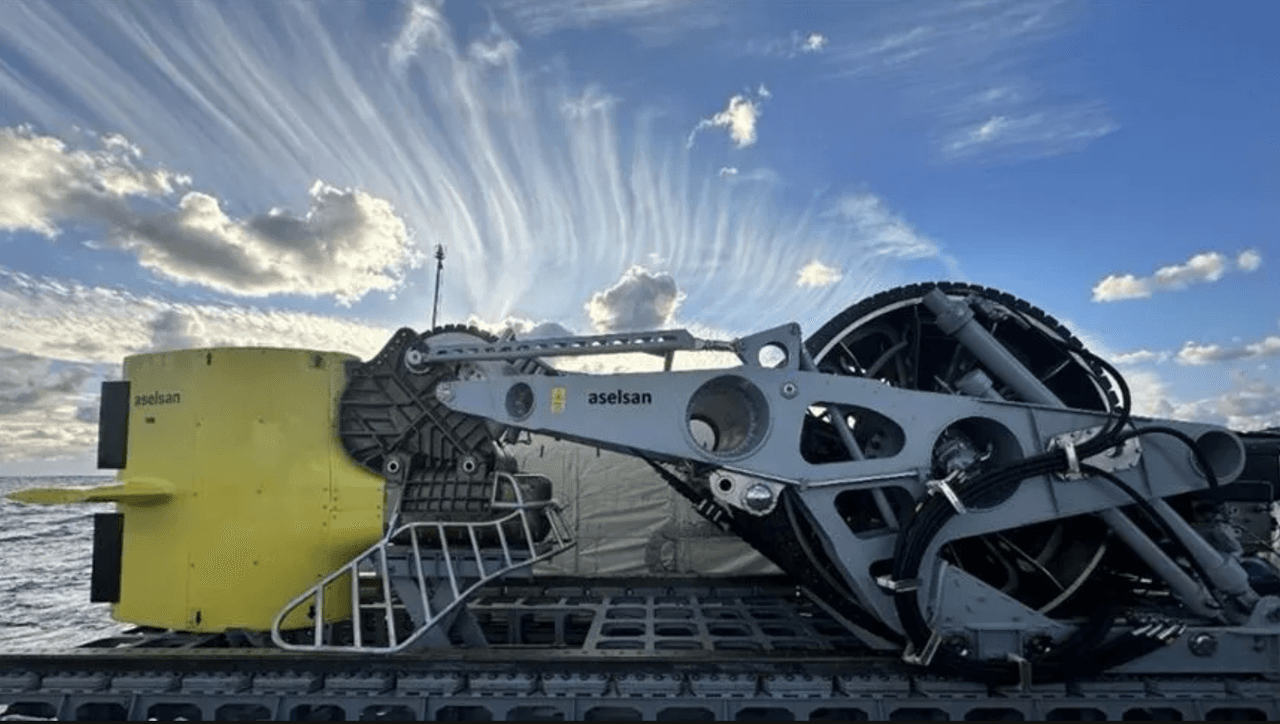
DÜFAS’ın deniz platformundaki çekili sonar bileşeni (AA)
Sound is a mechanical wave that propagates through a material medium as pressure variations. Pressure changes generated by an underwater sound source propagate through water, transferring acoustic energy from the source to the surrounding environment. Sound waves are characterized by physical quantities such as frequency, wavelength, amplitude, and propagation speed. Frequency denotes the number of oscillations per unit time, while amplitude represents the magnitude of pressure variation caused by the wave.
The speed of sound in seawater is not constant. Temperature, salinity, and pressure variations affect sound speed. Increases in temperature and salinity generally increase sound speed, while increasing pressure with depth also alters it. The variation of these parameters with depth can cause sound waves to deviate from straight paths and refract. Empirical equations have been developed to calculate sound speed in seawater based on temperature, salinity, and depth.
Sound waves can reflect and scatter when they encounter the sea surface, seafloor, marine life, or other substances in water. Changes in medium properties cause refraction, while absorption occurs when water and its constituents convert acoustic energy into other forms. As a result of geometric spreading and absorption, sound level decreases with distance. Scattered sound from the surface, seafloor, and other objects can create reverberation, making it difficult to distinguish target signals. Ambient noise in the ocean consists of various natural and anthropogenic components such as wind, wave motion, maritime traffic, biological activity, and geological events.
Frequency selection involves a trade-off between detection range and resolution. Low-frequency sounds, which experience less absorption, are suitable for long-range applications. High frequencies provide higher resolution due to shorter wavelengths but attenuate more rapidly in water. The operating frequency of sonar systems is determined based on mission range, measurement depth, and required resolution.
Sonar is one of the primary technologies that utilize the scientific principles of underwater acoustics to gather information about the environment and targets. The term is an acronym for “Sound Navigation and Ranging.” Sonar systems are used in applications such as target detection, underwater vehicle navigation, marine resource investigation, and environmental mapping. Acoustic data from these systems are processed using signal processing methods to detect, classify, and locate targets. Sonars are divided into two fundamental operational modes: active and passive. Active sonar emits acoustic signals and analyzes echoes reflected from targets, while passive sonar listens for sounds emitted by targets without transmitting any signal. Sonar systems are employed in scientific research, maritime operations, and underwater security activities due to these characteristics.
Transducers are used in sonar systems to generate and detect acoustic energy. Hydrophones are receivers that detect underwater sounds. Arrays of multiple hydrophones positioned at specific locations enable the determination of sound direction by analyzing differences in arrival times and allow focusing on sounds coming from particular directions.
Underwater acoustics is widely used to determine the depth and structure of the seafloor. Single-beam and multibeam echosounders can measure water depth; side-scan and subbottom sonar systems can examine seafloor features and underlying geological layers. These methods are applied in bathymetric mapping, geological research, marine construction, and underwater archaeology.【4】Side-scan sonar data enable imaging of large seafloor areas and the acoustic analysis of natural or anthropogenic objects on the seabed.
Acoustic systems are also used in oceanographic and biological research. Applications include measuring ocean currents, determining the location and density of fish schools, analyzing sounds produced by marine organisms, and monitoring anthropogenic underwater noise. Passive acoustic monitoring allows long-term recording of natural and anthropogenic sounds without introducing new signals into the environment. Fixed hydrophone-based passive acoustic monitoring systems can be used for long-term tracking of the presence, distribution, and seasonal movements of marine mammals.
In ocean acoustic tomography, travel times of sound waves transmitted between specific points are used to infer temperature structures and physical variations over large oceanic areas.
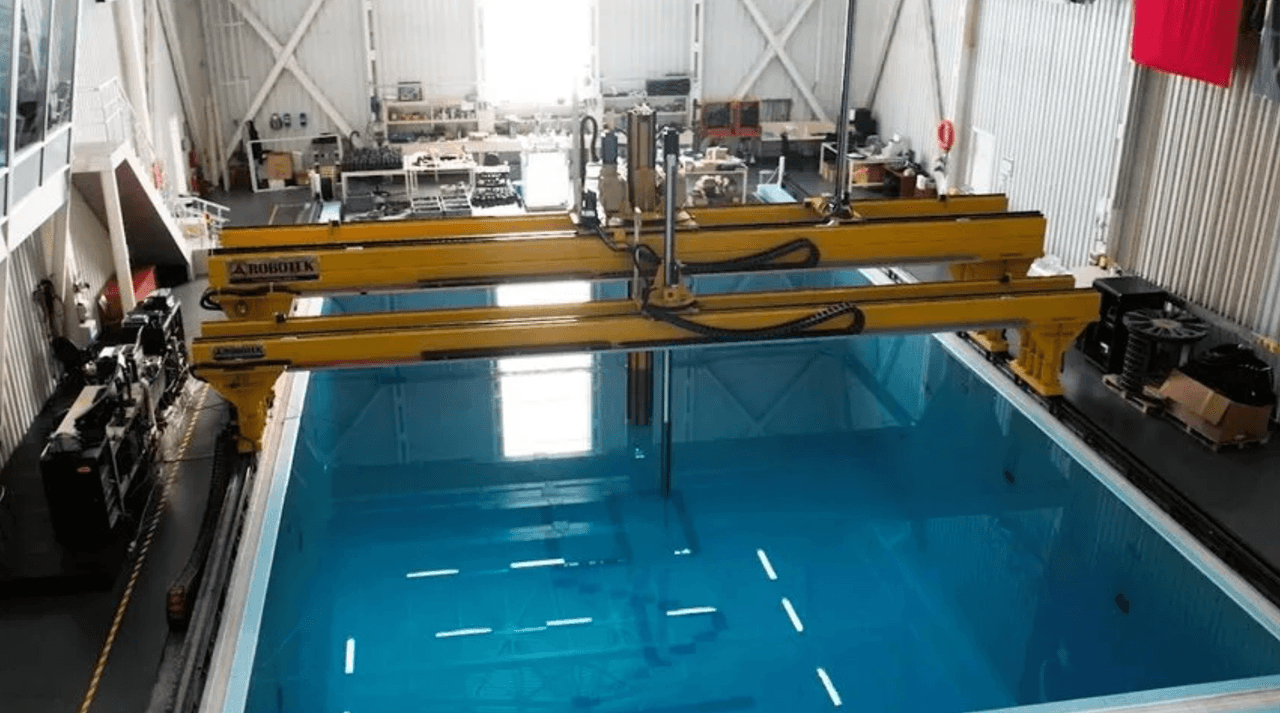
The test infrastructure at the TÜBİTAK MAM Underwater Acoustic Laboratory (AA)
Navigation, positioning, and communication of underwater vehicles also rely on acoustic methods. Due to the rapid attenuation of radio frequency electromagnetic waves in seawater, acoustic links are used especially for long-range wireless underwater communication. However, limited bandwidth, multipath propagation, ambient noise, and delay are among the main technical challenges of underwater acoustic communication.【5】
In security applications, sonars are used to detect and track submarines, torpedoes, mines, divers, and other underwater objects. Acoustic methods are also employed in missions such as locating lost equipment, identifying shipwrecks, monitoring harbors, and inspecting underwater pipelines and cables.
Research in underwater acoustics in Türkiye includes scientific investigation, measurement, and calibration activities as well as the development of sonar systems for maritime platforms. Within the framework of the Blue Homeland initiative, security needs for underwater environments, in addition to surface waters, have increased demand for acoustic detection systems. National sonar technology initiatives in Türkiye have gained institutional and technical infrastructure, particularly through the MILGEM program and the establishment of the TÜBİTAK MAM Underwater Acoustics Laboratory.
In addition to its critical importance for security, sustainable operation, renewal, and adaptation of this technology to mission requirements are essential. Operational logistics during the service life of defense systems encompass maintenance, repair, spare parts supply, and system upgrades. Inability to procure critical components can affect maintenance, repair, and modernization processes. International agreements and political developments can also influence the availability of components and the sustainability of systems.【6】Merely having domestically manufactured hardware is insufficient. Acoustic data detected by sonars are processed by software; signal processing algorithms are required to achieve detection, classification, and localization capabilities. The ability to modify software is crucial for adapting the system to different marine conditions and mission requirements.
Processing and evaluating acoustic data within the country is part of technological independence. Nationalization refers to the development of products and technologies that do not rely on intellectual and industrial property rights held by foreign countries or entities. This approach contributes to the independent use of national defense assets. Therefore, developing underwater acoustic systems and ensuring their support throughout their lifecycle within Türkiye is linked to the sustainability of technical capabilities for Blue Homeland security.
The “National Sonar Unit Production and Integration” project initiated under MILGEM has provided an environment for integrating national sonar efforts with maritime platforms. A technical infrastructure has been established at the TÜBİTAK MAM Underwater Acoustics Laboratory, created as a work package of the project, for the development, testing, and validation of sonar components. Türkiye’s first national sonar array was developed within SAL and completed acceptance testing. The developed sonar array was integrated onto the Heybeliada Corvette in July 2009, and the national sonar transducer TBT-01 has been deployed in the Turkish Navy inventory. The laboratory’s test and calibration infrastructure has enabled performance measurement and validation of sonar components within Türkiye. Thus, Türkiye has acquired the capability to develop, test, and integrate national sonar components onto maritime platforms.
The infrastructure developed during the nationalization process has laid the groundwork for designing sonar systems tailored to diverse underwater missions. The following examples, though not exhaustive of all systems developed in Türkiye, represent four distinct mission areas: hull-mounted anti-submarine warfare, long-range detection, diver detection, and mine detection.
FERSAH is a hull-mounted anti-submarine warfare sonar developed by ASELSAN as part of the mid-life modernization program for Barbaros-class frigates. It has been announced that factory acceptance tests for the system were completed as of 2021.【7】FERSAH is among the national underwater systems used in the modernization of TCG Oruçreis, which completed interim acceptance.【8】The system provides a national sonar solution for surface platforms to detect and track underwater targets.
The Low Frequency Active Sonar System (DÜFAS) was developed by ASELSAN under the coordination of the Presidency of Defense Industries and in accordance with the requirements of the Turkish Naval Forces Command. The system features towable, depth-adjustable, low-frequency active and passive sonar components. DÜFAS was publicly introduced in March 2024 as Türkiye’s first national long-range anti-submarine warfare sonar. Its depth-adjustable design and operation at low frequencies enable long-range detection and tracking of submarines with low acoustic signatures.
ARAS-2023 is Türkiye’s first national portable diver detection sonar, developed by ARMELSAN Defense Technologies Industry and Foreign Trade Inc. Operating as an active sonar, the system automatically detects and tracks divers using either open- or closed-circuit breathing systems and performs target classification. The system entered the inventory of the Turkish Armed Forces in 2022 following sea trials conducted under the TCG Anadolu project. Production activities targeting MİLGEM 6–12 vessels began in 2023. ARAS-2023 is used to protect maritime platforms, harbors, and critical facilities against underwater diver threats.
NUSRAT-1915 is Türkiye’s first indigenous and national mine detection sonar, developed by ARMELSAN. Operating as an active sonar, the system was designed to detect and classify bottom mines and moored mines in the water column. Laboratory tests of the system were completed in 2024 under the TCG Anadolu Technological Capability Obligation Projects, followed by sea trials. In May 2026, it was announced that the sea trials were successfully completed and the system had entered the platform integration phase.【9】NUSRAT-1915 is one of the national sonar systems developed in Türkiye for mine detection and classification.
These four systems were developed to address different underwater security needs. FERSAH is designed for hull-mounted anti-submarine warfare missions, DÜFAS for variable-depth and long-range detection, ARAS-2023 for diver detection and tracking, and NUSRAT-1915 for mine detection and classification.
The development stages of these systems vary. FERSAH and ARAS-2023 have been integrated onto specific platforms; DÜFAS has been publicly introduced during development and testing; NUSRAT-1915 has progressed to platform integration following successful sea trials. National sonar efforts in Türkiye have expanded from developing individual sonar components such as TBT-01 toward integrated systems tailored for diverse mission areas. This process has contributed to building domestic technical capabilities in the design, production, testing, and integration of sonar components onto maritime platforms.
Current research includes efforts to adapt sonar systems to various ships, helicopters, and unmanned underwater vehicles. Autonomous versions of ARAS-2023 and ORKUN-2053 developed for unmanned underwater vehicles are part of these initiatives. Additionally, multistatic sonar projects are underway that aim to operate sonars from different platforms in coordination. Thus, research is expanding beyond single sonar systems toward architectures enabling coordinated operation of multiple sensors and platforms.
These projects are not at the same development stage. According to information released by ARMELSAN, some systems are in production, others in factory acceptance testing, and some are undergoing sea trials. Some of the current systems and projects include:
Projects are ongoing to adapt sonar systems to ships, helicopters, and unmanned underwater vehicles. The nationalization process has extended beyond mere device manufacturing to encompass platform diversity and integrated operational capability. Current research also includes operating sonar systems from different platforms within a multistatic structure rather than independently. In a multistatic configuration, frequency-compatible sonars on the same vessel or different surface ships operate together to detect underwater threats over a wider area.【10】Combined evaluation of data from different sonars and platforms can contribute to fusing target information and generating a unified underwater situational picture. These developments reveal a technical trend toward integrated systems in Blue Homeland underwater detection activities, enabling coordinated use of national sensors alongside manned and unmanned platforms.
Research in underwater acoustics in Türkiye demonstrates the development of technical capabilities to monitor not only surface platforms of the Blue Homeland but also its seafloor and underwater environment components using national technologies.
ARMELSAN Savunma Teknolojileri Sanayi ve Dış Ticaret AŞ. "ARAS 2023 Dalgıç Tespit Sonarı." Accessed August 12, 2026.https://armelsan.com/urunler/aras/
ARMELSAN Savunma Teknolojileri Sanayi ve Dış Ticaret AŞ. "NUSRAT-1915 Mayın Avlama Sonarı." Accessed August 12, 2026.https://armelsan.com/urunler/nusrat/
ARMELSAN Savunma Teknolojileri Sanayi ve Dış Ticaret AŞ. "Yolculuğumuzun Kilometre Taşları." Accessed August 12, 2026.https://armelsan.com/
ASELSAN. “ASELSAN Completed the World’s Most Comprehensive MEKO-Class Frigate Modernization.” April 9, 2025. Accessed August 12, 2026.https://www.aselsan.com/en/news/aselsan-completed-the-worlds-most-comprehensive-meko-class-frigate-modernization
Ainslie, Michael A., Michele B. Halvorsen, and Stephen P. Robinson. “A Terminology Standard for Underwater Acoustics and the Benefits of International Standardization.” *IEEE Journal of Oceanic Engineering* 47, no. 1 (2022): 179–200. Accessed August 14, 2026.https://doi.org/10.1109/JOE.2021.3085947
Akyildiz, Ian F., Dario Pompili, and Tommaso Melodia. “Underwater Acoustic Sensor Networks: Research Challenges.” *Ad Hoc Networks* 3, no. 3 (2005): 257–279. Accessed August 14, 2026.https://doi.org/10.1016/j.adhoc.2005.01.004
Been, Robert, Stéphane Jespers, Stefano Coraluppi, Craig Carthel, Armand Wathelet, Christopher Strode, and Arjan Vermeij. “Multistatic Sonar: A Road to a Maritime Network Enabled Capability.” Undersea Defence Technology Europe, Napoli, 5–7 June 2007. Accessed August 12, 2026.https://www.researchgate.net/publication/228573264_Multistatic_sonar_a_road_to_a_maritime_network_enabled_capability
Discovery of Sound in the Sea. "How Does Sound in Air Differ from Sound in Water?" Accessed August 14, 2026.https://dosits.org/science/sounds-in-the-sea/how-does-sound-in-air-differ-from-sound-in-water/
Discovery of Sound in the Sea. "Hydrophone Arrays." Accessed September 5, 2026.https://dosits.org/galleries/technology-gallery/basic-technology/hydrophone-arrays/.
Discovery of Sound in the Sea. "Reverberation." Accessed August 14, 2026.https://dosits.org/science/movement/how-does-sound-move/reverberation/.
Discovery of Sound in the Sea. "Tutorial: Speed of Sound." Accessed August 14, 2026.https://dosits.org/tutorials/science/tutorial-speed/.
Discovery of Sound in the Sea. "Using Acoustics to Explore the Unknown Ocean." Accessed August 14, 2026.https://dosits.org/people-and-sound/examine-the-earth/using-acoustics-to-explore-the-unknown-ocean/.
Kartal Bulut, Firdevs. “Yerli Mayın Avlama Sonarı Göreve Hazırlanıyor.” Anadolu Ajansı, May 21, 2026. Accessed August 12, 2026.https://www.aa.com.tr/tr/bilim-teknoloji/yerli-mayin-avlama-sonari-goreve-hazirlaniyor/3944518
Mackenzie, Kenneth V. “Nine-Term Equation for Sound Speed in the Oceans.” *Journal of the Acoustical Society of America* 70, no. 3 (1981): 807–812. Accessed August 14, 2026.https://doi.org/10.1121/1.386920.
Mellinger, David K., Kathleen M. Stafford, Sue E. Moore, Robert P. Dziak, and Haru Matsumoto. “An Overview of Fixed Passive Acoustic Observation Methods for Cetaceans.” *Oceanography* 20, no. 4 (2007): 36–45. Accessed August 14, 2026.https://doi.org/10.5670/oceanog.2007.03.
Muir, Thomas G., and David L. Bradley. “Underwater Acoustics: A Brief Historical Overview Through World War II.” *Acoustics Today* 12, no. 3 (2016): 40–48. Accessed August 14, 2026.https://acousticstoday.org/underwater-acoustics-brief-historical-overview-world-war-ii-thomas-g-muir-david-l-bradley/.
Munk, Walter, Peter Worcester, and Carl Wunsch. *Ocean Acoustic Tomography*. Cambridge: Cambridge University Press, 1995. Accessed August 14, 2026.https://doi.org/10.1017/CBO9780511666926.
Sun, Kai, Weicheng Cui, and Chen Chen. “Review of Underwater Sensing Technologies and Applications.” *Sensors* 21, no. 23 (2021): 7849. Accessed August 12, 2026.https://doi.org/10.3390/s21237849
T.C. Presidency of Defense Industries. "Düşük Frekans Aktif Sonar Sistemi Geliştirilmesi (DÜFAS)." Accessed August 12, 2026.https://www.ssb.gov.tr/proje/dusuk-frekans-aktif-sonar-sistemi-gelistirilmesi-dufas
T.C. Presidency of Defense Industries. "IDEF’21 – Multistatik Sonar Süiti Geliştirilmesi Protokolü." August 23, 2021. Accessed August 12, 2026.https://www.ssb.gov.tr/haber/idef21-multistatik-sonar-suiti-gelistirilmesi-protokolu-jn5kgH
T.C. Presidency of Defense Industries. "Mavi Vatan’a Üç Yeni Millî Fırkateyn Geliyor." Accessed August 12, 2026.https://www.ssb.gov.tr/haber/mavi-vatana-uc-yeni-milli-firkateyn-geliyor-aqnAok
T.C. Presidency of Defense Industries. *Demodelik Yönetimi Rehberi.* TSSÖDYP-08. Ankara, 2021. Accessed August 12, 2026.https://tssodypwiki.ssb.gov.tr/images/4/4b/TSSODYP_08_web.pdf
T.C. Presidency of Defense Industries. *Entegre Lojistik Destek Rehberi*. TSSÖDYP-04. Ankara, 2021. Accessed August 12, 2026.https://tssodypwiki.ssb.gov.tr/images/6/63/TSSODYP_04_web_1.pdf
T.C. Presidency of Defense Industries. *Kullanım ve Destek İhtiyaçları Çerçevesinde Yerlileştirme/Millîleştirme Rehberi*. TSSÖDYP-09. Ankara, 2021. Accessed August 12, 2026.https://tssodypwiki.ssb.gov.tr/images/1/15/TSSODYP_09_web_v2.pdf
TÜBİTAK Marmara Research Center. "Sualtı Akustik Laboratuvarı (SAL)." Accessed August 12, 2026.https://mam.tubitak.gov.tr/malzeme/malzeme-ve-proses-teknolojileri-laboratuvarlari/sensor-ve-sistem-teknolojileri-laboratuvarlari/sualti-akustik-laboratuvari-sal/
TÜBİTAK Marmara Research Center. "TÜBİTAK MAM Material Institute (ME) Underwater Studies and MİLGEM 5-8 DSH Sonar System." May 4, 2017. Accessed August 12, 2026.https://mam.tubitak.gov.tr/tubitak-mam-malzeme-enstitusu-me-sualti-calismalari-ve-milgem-5-8-dsh-sonar-sistemi/
Wenz, Gordon M. “Acoustic Ambient Noise in the Ocean: Spectra and Sources.” *Journal of the Acoustical Society of America* 34, no. 12 (1962): 1936–1956. Accessed August 14, 2026.https://doi.org/10.1121/1.1909155.
Yang, Haesang, Keun-Hwa Lee, Youngmin Choo, and Kookhyun Kim. “Underwater Acoustic Research Trends with Machine Learning: General Background.” *Journal of Ocean Engineering and Technology* 34, no. 2 (2020): 147–154. Accessed August 12, 2026.https://doi.org/10.26748/KSOE.2020.015
Yanık, Tolga. “ASELSAN, Türkiye’nin İlk Ufuk Ötesi Denizaltı Savunma Harbi Sonarı DÜFAS’ı Geliştirdi.” Anadolu Ajansı, March 19, 2024. Accessed August 12, 2026.https://www.aa.com.tr/tr/savunma-sanayisi/aselsan-turkiyenin-ilk-ufuk-otesi-denizalti-savunma-harbi-sonari-dufasi-gelistirdi/3168110
[1]
Discovery of Sound in the Sea, “Using Acoustics to Explore the Unknown Ocean,” erişim 14 Ağustos 2026, https://dosits.org/people-and-sound/examine-the-earth/using-acoustics-to-explore-the-unknown-ocean/.
[2]
Thomas G. Muir ve David L. Bradley, “Underwater Acoustics: A Brief Historical Overview Through World War II,” Acoustics Today 12, no. 3 (2016), erişim 14 Ağustos 2026, https://acousticstoday.org/underwater-acoustics-brief-historical-overview-world-war-ii-thomas-g-muir-david-l-bradley/.
[3]
Haesang Yang, Keun-Hwa Lee, Youngmin Choo ve Kookhyun Kim, “Underwater Acoustic Research Trends with Machine Learning: General Background,” Journal of Ocean Engineering and Technology 34, no. 2 (2020): 147–154, erişim 14 Ağustos 2026, https://doi.org/10.26748/KSOE.2020.015.
[4]
Kai Sun, Weicheng Cui ve Chen Chen, “Review of Underwater Sensing Technologies and Applications,” Sensors 21, no. 23 (2021): 7849, erişim 14 Ağustos 2026, https://doi.org/10.3390/s21237849.
[5]
Ian F. Akyildiz, Dario Pompili ve Tommaso Melodia, “Underwater Acoustic Sensor Networks: Research Challenges,” Ad Hoc Networks 3, no. 3 (2005): 257–279, erişim 14 Ağustos 2026, https://doi.org/10.1016/j.adhoc.2005.01.004.
[6]
T.C. Cumhurbaşkanlığı Savunma Sanayii Başkanlığı, Demodelik Yönetimi Rehberi, TSSÖDYP-08 (Ankara, 2021), erişim 12 Ağustos 2026, https://tssodypwiki.ssb.gov.tr/images/4/4b/TSSODYP_08_web.pdf.
[7]
T.C. Cumhurbaşkanlığı Savunma Sanayii Başkanlığı, “IDEF’21 – Multistatik Sonar Süiti Geliştirilmesi Protokolü,” 23 Ağustos 2021, erişim 12 Ağustos 2026, https://www.ssb.gov.tr/haber/idef21-multistatik-sonar-suiti-gelistirilmesi-protokolu-jn5kgH.
[8]
ASELSAN, “ASELSAN Completed the World’s Most Comprehensive MEKO-Class Frigate Modernization,” 9 Nisan 2025, erişim 12 Ağustos 2026, https://www.aselsan.com/en/announcements/detail/261/aselsan-completed-the-worlds-most-comprehensive-mekoclass-frigate-modernization.
[9]
Firdevs Bulut Kartal, “Yerli Mayın Avlama Sonarı Göreve Hazırlanıyor,” Anadolu Ajansı, 21 Mayıs 2026, erişim 12 Ağustos 2026, https://www.aa.com.tr/tr/bilim-teknoloji/yerli-mayin-avlama-sonari-goreve-hazirlaniyor/3944518.
[10]
T.C. Cumhurbaşkanlığı Savunma Sanayii Başkanlığı, “IDEF’21 – Multistatik Sonar Süiti Geliştirilmesi Protokolü,” 23 Ağustos 2021, erişim 12 Ağustos 2026, https://www.ssb.gov.tr/haber/idef21-multistatik-sonar-suiti-gelistirilmesi-protokolu-jn5kgH.
Underwater Acoustics
Sonar System | An acoustic system used for underwater detection and positioning. | ||||||||
|---|---|---|---|---|---|---|---|---|---|
Underwater Acoustics | Underwater acoustics. | ||||||||
First Experimental Study | 1826 | ||||||||
first experimental study | 1826 | ||||||||
Blue Homeland | Marine security, target detection, and underwater surveillance. | ||||||||
Sonar | Acoustic detection system. | ||||||||
Researchers | Jean-Daniel Colladon and Charles-François Sturm | ||||||||
Researchers | Jean-Daniel Colladon and Charles-François Sturm | ||||||||
Henüz Tartışma Girilmemiştir
"Underwater Acoustics" maddesi için tartışma başlatın
Historical Development
Physical Principles
Sonar Systems
Application Areas
Underwater Acoustics in Türkiye
Emergence of the Need for Nationalization
Nationalization of Underwater Acoustic Technologies and National Systems in Türkiye
FERSAH
DÜFAS
ARAS-2023
NUSRAT-1915
Expansion of National Sonar Capability
Current Research and Future Trends