

KURE Kids Header Line
article-image
badge icon

This content was originally written in Turkish for children and is automatically translated into English using artificial intelligence.

Abu al-Wafa al-Buzjani

Last Updated: 14.03.2026

Ebû’l-Vefâ el-Bûzcânî, whose full name is “Ebû’l-Vefâ Muhammed b. Muhammed b. Yahyâ b. İsmâil b. el-Abbâs el-Bûzcânî”, was one of the greatest mathematicians and astronomers produced by the Islamic world during the 10th century. He was born in 940 in the town of Bûzcân in the region of Khorasan and moved to Baghdad at a young age, where he continued his scholarly work in the scientific center of his time. He is remembered for his revolutionary discoveries in trigonometry and geometry.


The epithet “Ebû’l-Vefâ” symbolizes his mastery and generosity in scholarship. He is today recognized as one of the founders of modern trigonometry and a scientist whose name has been given to a crater on the Moon.

His Most Important Works and Discoveries

Bûzcânî was a genius who unified mathematics with shapes and the heavens. Some key aspects of his work include:

  • The Birth of Trigonometry: He defined concepts such as sine and tangent in their modern forms and compiled trigonometric tables.
  • Geometric Constructions: He succeeded in drawing complex geometric figures thought to be impossible using only a straightedge and compass.
  • The Guide to the Stars: He studied the movements of celestial bodies and advanced the science of astronomy through his work titled “al-Majisṭī”.
  • Mathematical Proofs: He was the first to formulate and prove the “sine theorem” in spherical trigonometry.
  • Geometry for Craftsmen: He did not confine geometry to theory but produced practical solutions to assist architects and artisans in their work.


Bûzcânî’s works simplified complex mathematical calculations and enabled astronomers to interpret the heavens with greater accuracy.
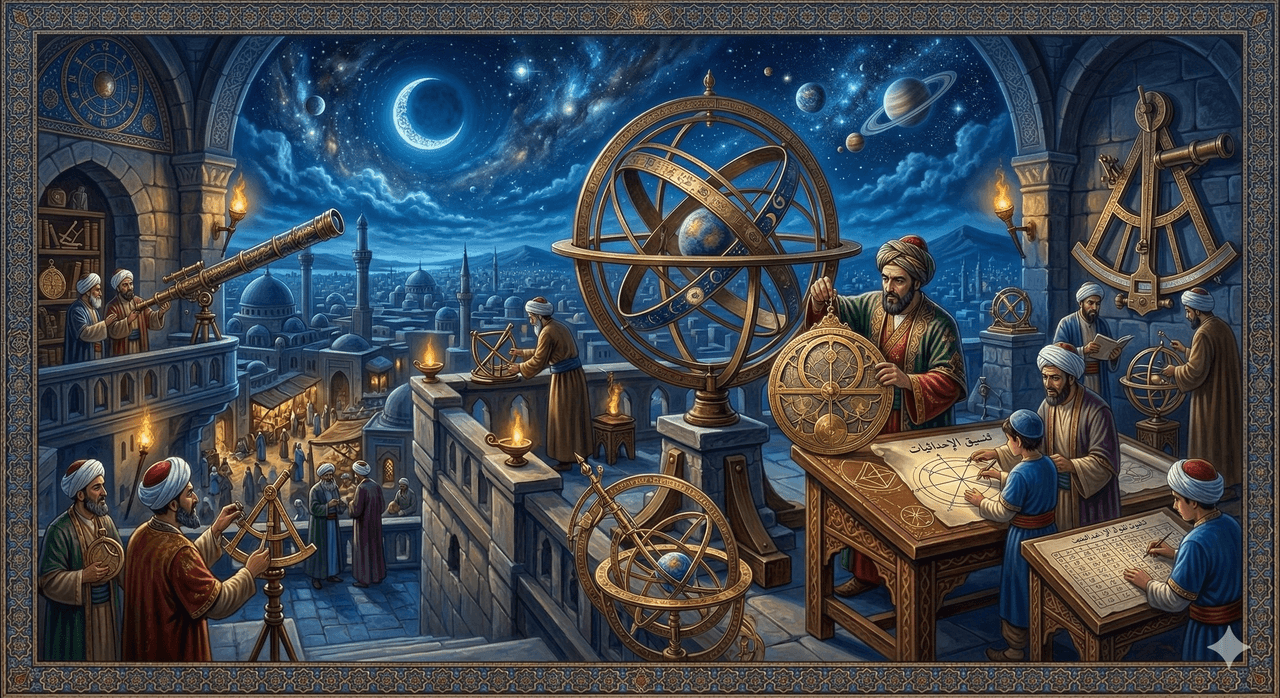


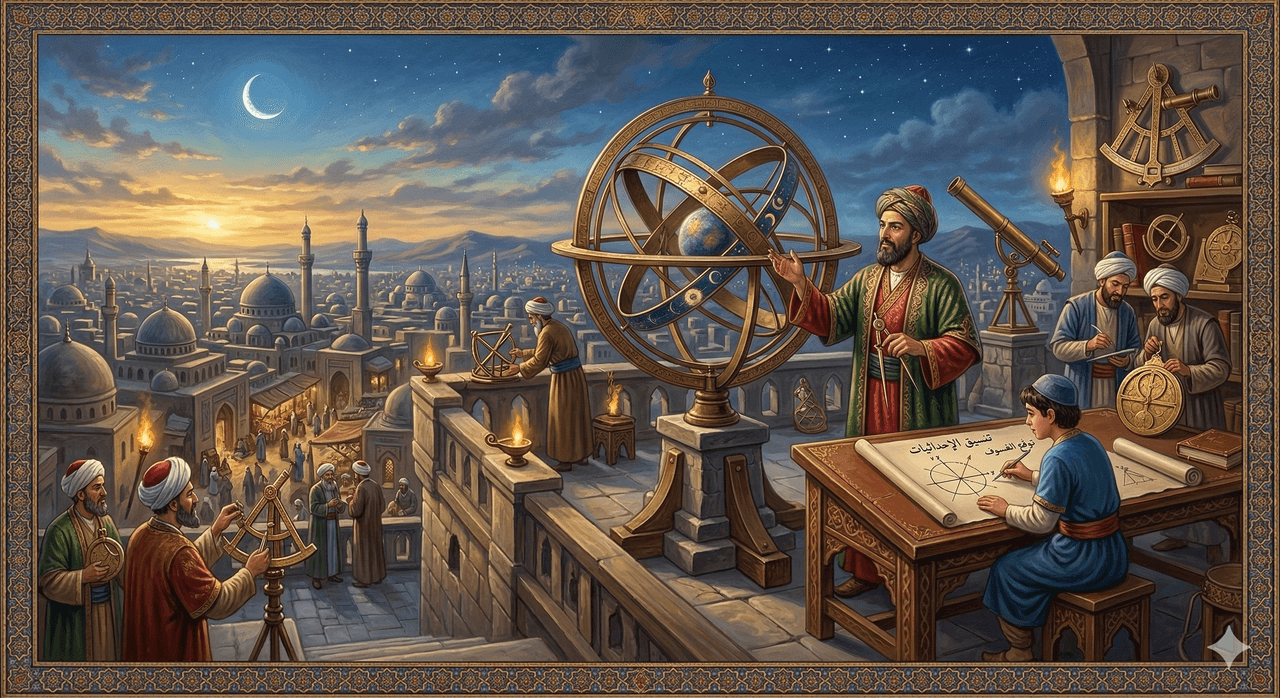
Ebû’l-Vefâ el-Bûzcânî at work. (Generated by artificial intelligence)


His Scientific Method and Practical Approach

Ebû’l-Vefâ believed that knowledge must be applied to real life. In his writings, he did not limit himself to theoretical formulas but also provided technical knowledge needed by artists and architects, as seen in his work “Kitâb fî mâ yahtâcü ileyhi’l-sâni‘ min a‘mâli’l-hendese” (Book on What the Craftsman Needs from Geometrical Operations). He simultaneously employed logic and visualization in solving problems.


He embraced the principle that “a science cannot be considered complete unless it is united with practical utility.” His precise measurements conducted at the observatory in Baghdad served as a guide for sailors and travelers for centuries.

A Genius Beyond His Time

Bûzcânî’s contributions extended beyond the Islamic world and profoundly influenced European science. Scholars in 15th- and 16th-century Europe built their understanding of trigonometry upon the foundations he laid. The naming of a lunar crater “Abul Wafa” stands as a testament to his universal contribution to science. Many of the mathematical formulas we use today bear the imprint of this great genius who worked by candlelight in Baghdad over a thousand years ago.

Don't Forget to Look at These!
Science and Technology
cat img
Natural Sciences
cat img
Art and Literature
cat img
image
Most Read
Thomas Edison
arrow
image
Last Added
Gezegenler Neden Yuvarlaktır?
arrow
ilham-notu-bg
INSPIRATION NOTE FOR CURIOUS KIDS!

Abu al-Wafa al-Buzjani’s life shows us that when curiosity is combined with patience, human beings can even unravel the secrets of the stars in the sky. He did not merely work with numbers; he performed thousands of trials to draw geometric shapes that seemed impossible and spent countless nights observing the heavens to understand the mysterious motions of the Moon. His name lives on today in a crater on the Moon because he never gave up in the face of difficulties and used his knowledge to benefit humanity.


You too should pursue your curiosity as al-Buzjani did and not fear tackling the difficult problems that come your way. Perhaps one day your drawing will bring a building to life or your calculation will illuminate the path of a spacecraft! Remember, the small triangle you sketch in your notebook today may be the first step toward a great discovery that will change the world tomorrow. Believe in yourself, never give up working, and always be a faithful friend to science!

Who Wrote?
Kids Writing
AuthorMustafa Cem İnciMarch 14, 2026
bottom-bg-effect-bottom
bottom-bg-effect-top

Abu al-Wafa al-Buzjani is the genius who established trigonometry as an independent scientific discipline and united geometry with artistic aesthetics. He was not merely a calculator who derived formulas; he was a scientific envoy who translated the complex motions of the celestial sphere into mathematical language. By transforming abstract mathematical concepts into practical solutions applicable in daily life, he left an indelible mark on the history of science.


The Theorist of Trigonometry: He defined concepts such as sine, tangent, and cotangent in their modern forms and compiled trigonometric tables with exceptional precision. He is the person who established mathematics’ “navigation system.”


Geometric Intelligence: He rendered on paper the most complex shapes thought to be impossible to construct with compass and straightedge, providing guidance to architects and craftsmen. He viewed geometry not merely as a subject of study but as an “art of application.”


Observer and Explorer: At the observatory in Baghdad, he conducted meticulous observations of the Moon’s movements, producing some of the most accurate measurements in astronomy. Because of this precision, a crater on the Moon now bears his name.


A Bridge Across Time: He built a centuries-long bridge between the profound knowledge of the East and the technical advancements of the West. Modern trigonometry rises upon the solid foundations he laid a thousand years ago.


Legacy and Influence: Al-Buzjani’s legacy is present everywhere today—from the maps on our smartphones to the architectural blueprints of massive buildings, from orbital calculations of satellites in the sky to maritime navigation techniques. He placed at the heart of science the principle that “true knowledge begins with accurate measurement.” The path he opened remains today the most reliable map for every scientist seeking to uncover the mathematical secrets of the universe.

Bibliographies

"Ebû’l-Vefâ el-Bûzcânî." İslam Düşünce Atlası. Accessed March 9, 2026. https://islamdusunceatlasi.org/buzcani/232.

"Ebû’l-Vefâ el-Bûzcânî." TDV İslâm Ansiklopedisi. Accessed March 9, 2026. https://islamansiklopedisi.org.tr/ebul-vefa-el-buzcani.

"Trigonometri İlminin Kurucusu: Ebü'l Vefâ el-Bûzcânî." Fikriyat. June 10, 2018. https://www.fikriyat.com/galeri/biyografi/trigonometri-ilminin-kurucusu-ebul-vefa-el-buzcani/10.

ilham-notu-bg
ilham-notu-bg
ilham-notu-bg
HEYY!
Did You Know?
These?
Lamb
Lamb
Ask to Küre