




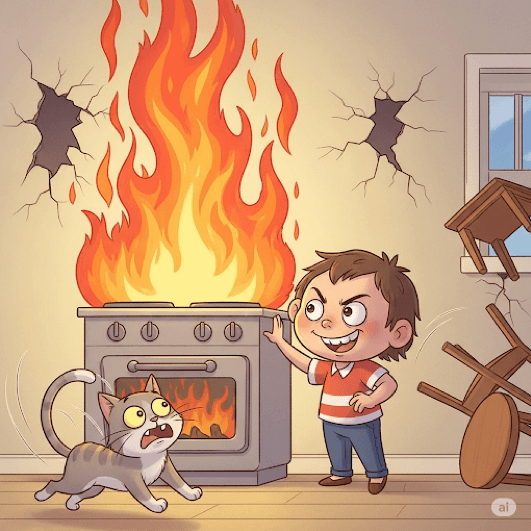
Alongside Kuru, Yaş also burns.
You might be slightly surprised when you first hear this saying. In fact, this proverb describes how innocent and well-intentioned people suffer alongside those who commit a wrongdoing or make a mistake. It is like green, sturdy branches standing next to dry, easily flammable ones in a fire—all of them are consumed by the flames. Let us explore the depth of this saying together.
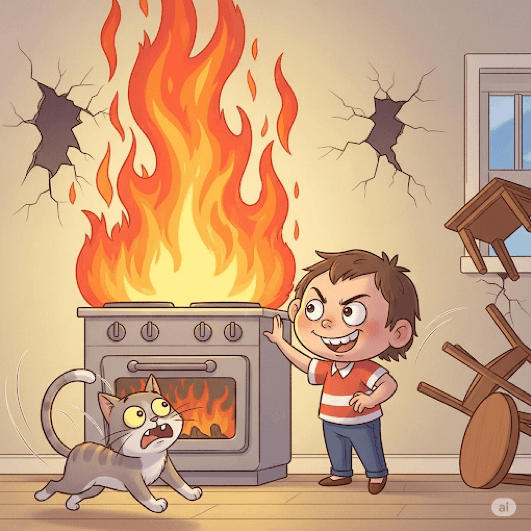
(Generated by artificial intelligence)
Where Does It Come From? 🤔
This proverb is like a story passed down from generation to generation since ancient times. People observed fires in forests or fields and drew lessons from them. When a fire starts, dry branches burn very quickly. Even the green, fire-resistant branches standing beside them are affected by the intense flames and burn along with the dry ones. This observation began to be used as a metaphor for certain situations in social life.
Origin and Meaning? 🌳
The meaning of this proverb is that when a mistake or a bad event occurs, innocent people who have nothing to do with it still suffer as a result. Just as innocent green branches burn in a forest fire. When a group of people does something wrong, even the well-intentioned and innocent individuals within that group can be negatively affected by the consequences. This saying emphasizes that blame or punishment does not remain confined to those who committed the act but can spread to those around them.

(Generated by artificial intelligence)
How Is It Used in Daily Life? 🗣️
Let us consider an example: Several of your classmates misbehaved. As a result, your teacher kept the entire class after the lesson as punishment. In this situation, the proverb “Even green branches burn beside the dry ones” can be applied. The students who did not misbehave—the “green branches”—were punished because of the actions of the “dry branches.”