




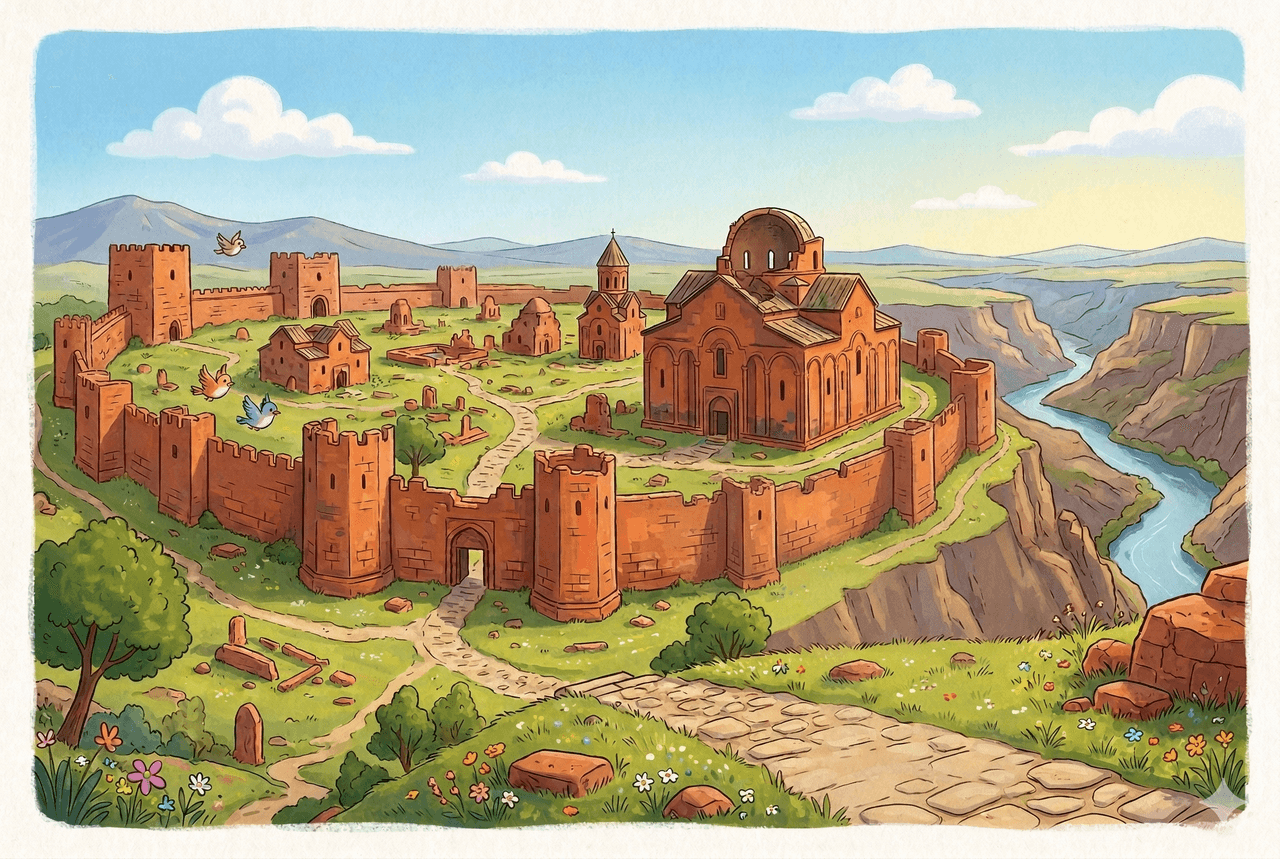

Ani Archaeological Site
Right next to our city of Kars, on the border between Türkiye and Armenia, lies an ancient and mysterious city: Ani Archaeological Site. Have you ever wondered how people built cities thousands of years ago, or where merchants from distant lands conducted their trade? Let’s explore this fairy-tale city together, where the ancient stones whisper stories of the past!
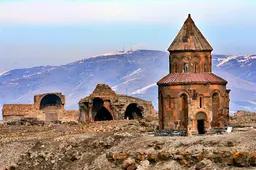
Ani Archaeological Site (Kars Provincial Directorate of Culture and Tourism)
🐪 Where Was a Key Stop on the Silk Road?
Ani was the first resting place on the Silk Road as it entered Anatolia, the ancient trade route stretching from Asia to Europe and carrying valuable goods such as silk and spices. In its heyday, it was a vast commercial city teeming with thousands of residents and traders.
Caravans arriving in the city crossed a remarkable two-story bridge built over the Arpaçay River. Merchants and camels passed through the lower level, while soldiers and pedestrians walked on the upper level. Constructing such a two-tiered bridge in those times was a truly astonishing feat of engineering!
🏰 How Did the Stone Walls Protect the City?
In ancient times, cities were surrounded by massive walls to defend against enemies. Ani was encircled by long, thick ramparts adorned with colorful stones and carved reliefs of lions and snakes. There were seven different gates leading into the city, the most famous of which was the Lion Gate.
The builders of these walls used a clever strategy. The defensive walls consisted of two concentric layers, and the gates were not aligned directly opposite each other. This meant that enemy forces could not easily maneuver their heavy battering rams between the two walls.
⏳ A Journey Through Time
Let us travel back approximately 1,000 years to the summer of 1064. The Seljuk Sultan Alp Arslan arrived here with his army and conquered the city. Thus, Ani became one of the first Turkish settlements in Anatolia, and within its walls, the Ebu'l Menuçehr Camii—the first Turkish mosque in Anatolia—was built.
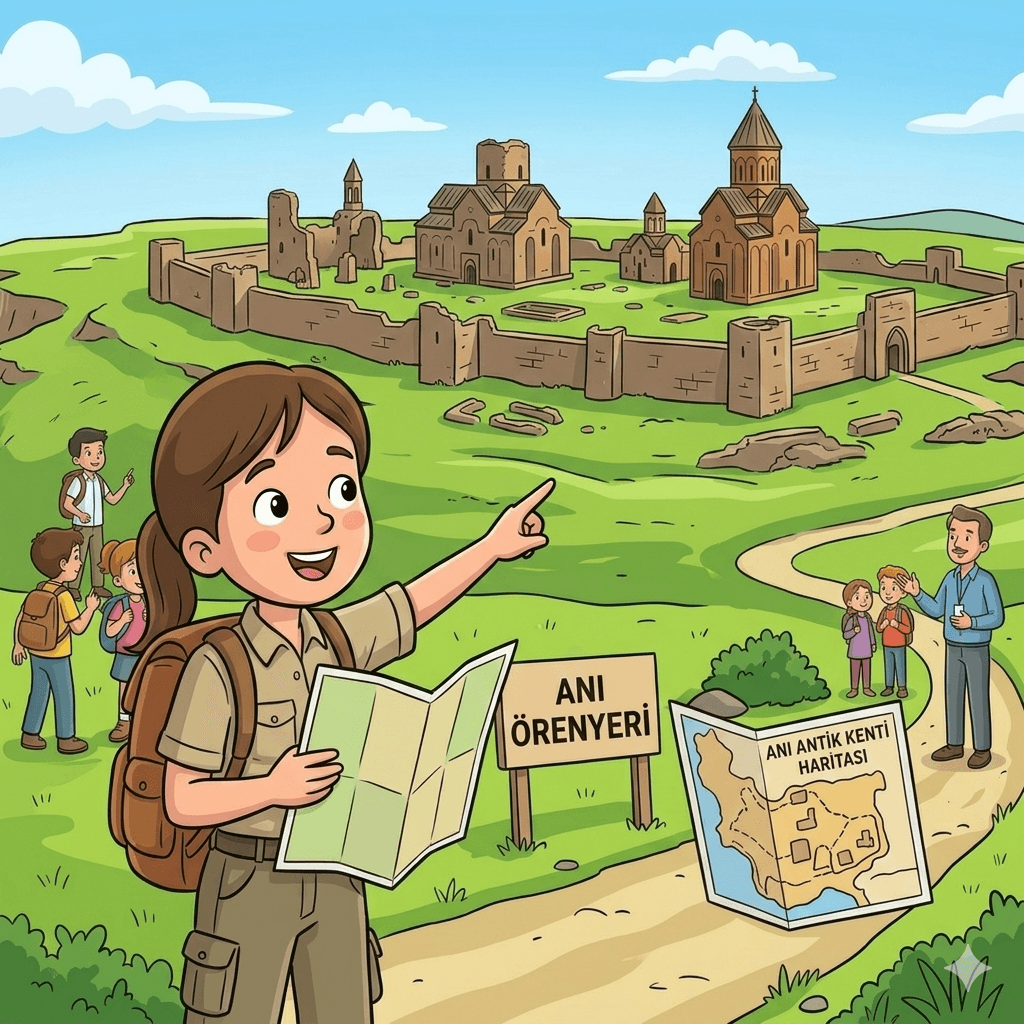
Ani Archaeological Site (Image generated by AI)
🏛️ From Cave Dwellings to Grand Palaces
Ani was not only a city of stone buildings. In the Bostanlar Deresi valley to the west of the city, mysterious caves were carved into the cliffs. In ancient times, people lived in these caves, and some of the hollows were even used as “birdhouses” for pigeons.
At the same time, this city was a place where people of different faiths lived together in peace. Side by side stood churches, mosques, and ancient fire temples, showing how Ani embraced diversity.


