



Atatürk
Atatürk (1881–1938)
He is the founder and first president of the Republic of Türkiye. The great leader, whose real name was Mustafa Kemal Atatürk, was born in the city of Selanik in 1881. From a very young age, he was an eager, diligent, and courageous child. He attended military school, where he was given the name "Kemal" because his mathematics teacher recognized his exceptional intelligence and bestowed this name upon him. Atatürk accomplished great deeds not only in war but also in peace. After the First World War, when our country was in dire straits, he gathered the people around him and launched the War of Independence on 19 May 1919. In 1923, he founded the Republic of Türkiye. After being elected president, he introduced numerous reforms to modernize our country. In 1934, under the Surname Law, he adopted the name "Atatürk," which means "Father of the Turks." He passed away in Istanbul on 10 November 1938, but his ideas and achievements continue to live on.

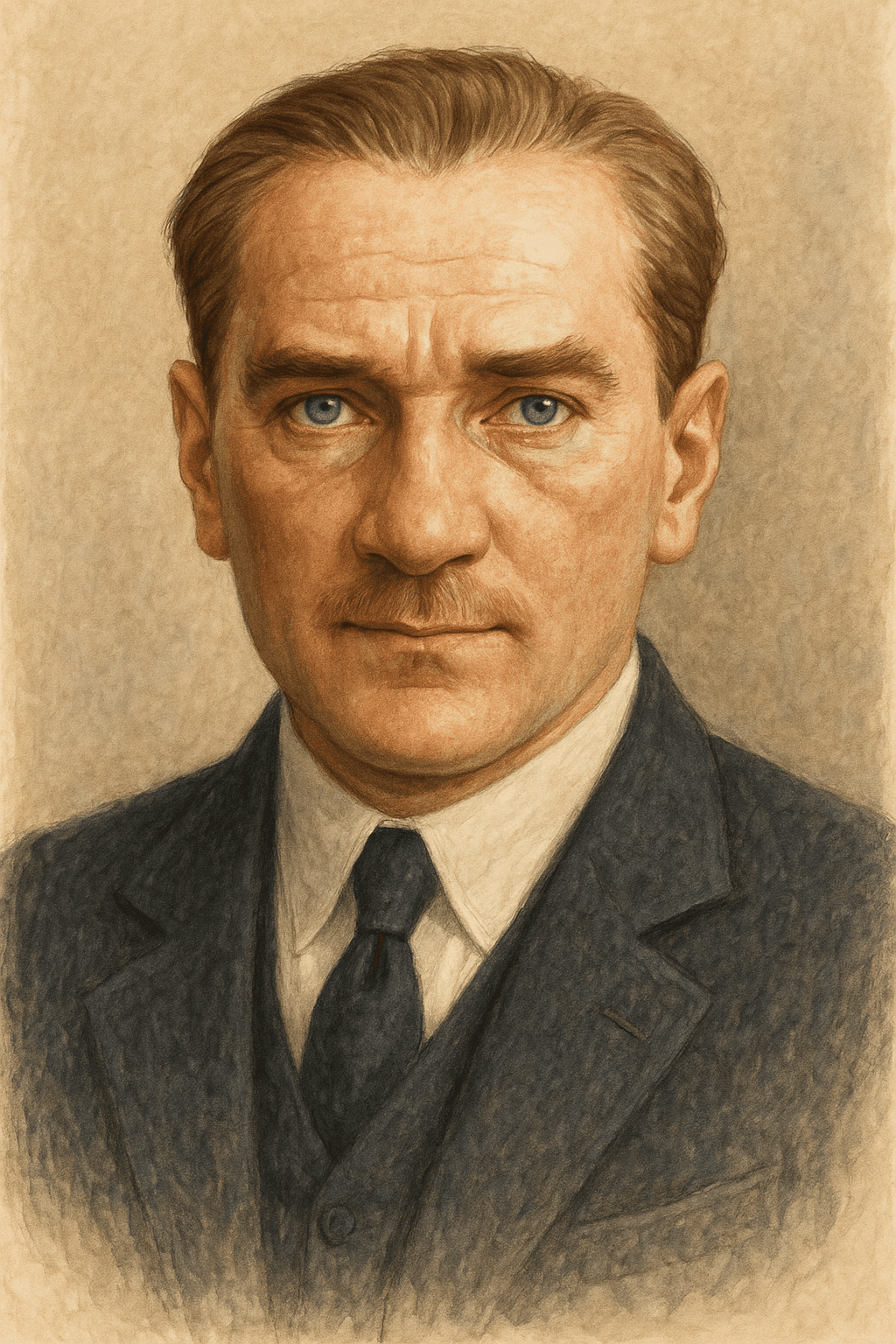
Portrait of Atatürk (Generated by artificial intelligence.)
Family
Mustafa Kemal Atatürk’s family lived in Selanik. His father, Ali Rıza Efendi, worked as a customs official and in the timber trade; he was a calm and affectionate man. His mother, Zübeyde Hanım, was a traditional Turkish woman who placed great importance on Atatürk’s education and upbringing. Atatürk’s childhood was spent with his mother, father, and sister Makbule Hanım. He learned values such as love, respect, and diligence from his family.

Portrait of Atatürk and His Family (Generated by artificial intelligence.)
Military Service
Mustafa Kemal Atatürk wanted to become a soldier from a young age. He worked hard toward this dream and attended the Selanik Military Junior High School. He later studied at the Manastır Military High School and then at the War School in Istanbul. He excelled in subjects such as mathematics, history, and patriotism. After graduating from the War Academy, he became a staff officer and began serving in the Ottoman Army.
Mustafa Kemal participated in many important wars during his military career:
🔸 Trablusgarp War (1911)
When Italy sought to seize Trablusgarp (modern-day Libya), then an Ottoman territory, Mustafa Kemal volunteered to go there. He organized the local population and fought against the occupation. His military intelligence drew attention during this war.
🔸 Balkan Wars (1912–1913)
When Balkan countries attacked the Ottoman Empire, Mustafa Kemal was again on the front lines. He played a key role in the recapture of Edirne and achieved great success.
🔸 Gallipoli Campaign (1915)
This war made Mustafa Kemal known throughout the country. He became known as the Hero of Anafartalar. He inspired his soldiers with the words, "I do not order you to attack; I order you to die!" The enemy forces were repelled, and the occupation of Istanbul was prevented.
🔸 Caucasus Front and Syria-Palestine Front (1916–1918)
He fought against the Russians in Eastern Anatolia and later against the British in Syria. He showed great determination in defending his homeland on every front. During these years, he was granted the rank of "paşa."
🔸 War of Independence (1919–1922)
After the Armistice of Mudros, when Anatolia was occupied, Mustafa Kemal landed in Samsun on 19 May 1919 and launched the struggle for independence. He convened the Erzurum and Sivas Congresses. By establishing the Grand National Assembly of Türkiye, he united the people. Victory was achieved against the Greek army through the Battle of Sakarya and the Great Offensive.

Portrait of Atatürk (Generated by artificial intelligence.)
Emphasis on Science and Education
Mustafa Kemal Atatürk believed that for a country to be strong and independent, it must place absolute importance on science and education. To him, science was a light that showed people the right path. Therefore, he frequently said, "The truest guide in life is science."
Promotion of Science
Atatürk considered scientific thinking extremely important. He advocated replacing old knowledge with modern knowledge based on research and experimentation. He argued that subjects such as mathematics, physics, chemistry, biology, and geography must be taught accurately and clearly in schools. He also wrote a geometry textbook himself!
Establishment of Schools
During Atatürk’s era, new schools were opened in every region. He supported coeducation for boys and girls and ensured that everyone had equal access to education. To teach reading and writing to those who could not, he established "People’s Schools." He personally taught the first lesson, setting an example for the public.
Founding of the Turkish Language Association and the Turkish Historical Society
He established these two important institutions to purify our language of foreign words and to learn accurate information about our history. This enabled the younger generation to better understand their own culture and identity.
Strengthening Universities
Atatürk knew that universities must be strong to produce scientists. He modernized Istanbul University and invited important foreign scientists to Türkiye to teach.

Portrait of Atatürk (Generated by artificial intelligence.)
Republic
Mustafa Kemal Atatürk founded the Republic of Türkiye on 29 October 1923. This was a new form of governance in which the people could elect their own leaders, meaning sovereignty belonged to the people. Atatürk proclaimed this principle to the entire nation with the words, "Sovereignty unconditionally belongs to the nation."
People now began electing those who would govern the country through voting. Thanks to this major change, men and women gained equal rights. Rights such as learning to read and write, voting, and freely expressing opinions became widespread.
The proclamation of the Republic laid the foundation for democracy in Türkiye. Atatürk repeatedly emphasized that the Republic was not merely a form of government but a way of life based on freedom and equality.

Portrait of Atatürk (Generated by artificial intelligence.)
Modernization:
Mustafa Kemal Atatürk implemented many reforms to enable the Turkish nation to develop and reach the same level as modern countries. These reforms are known as the Modernization Reforms. Atatürk believed that society needed to progress in every area. Therefore, he introduced changes not only in education and law but also in people’s daily lives.
🧥 Dress Reform:
Atatürk encouraged people to dress more simply, modernly, and cleanly. He promoted wearing hats, replacing the fez. The attire of civil servants and teachers changed accordingly.
📅 Calendar and Time System:
Previously, the Hijri calendar was used, based on religious principles and unsuitable for the modern world. Atatürk introduced the Gregorian calendar. The time system was also changed, and Sunday became the weekly day of rest.
📏 Units of Measurement:
Previously, old units such as "arşın" for length and "okka" for weight were used. These were inconsistent. Atatürk introduced international units such as meter, kilogram, and liter. This simplified trade, science, and daily life.
🏛️ Surname Law and Abolition of Titles:
Everyone was required to adopt a surname, making individuals easier to identify. Old titles such as ağa, bey, and paşa were abolished. This established equality among people.
While implementing all these reforms, Atatürk spoke with the people, listened to them, and explained the importance of change. Thanks to modernization, Türkiye took a major step toward becoming a modern and progressive country.

Portrait of Atatürk (Generated by artificial intelligence.)
Language and Alphabet Reform
Mustafa Kemal Atatürk carried out a crucial reform to enable the Turkish nation to read and write more easily and to better understand its own language. In 1928, we began using Latin letters instead of Arabic letters. This change is known as the "Alphabet Reform."
According to Atatürk, language was the identity of a nation. He believed that the Turkish nation must love, develop, and correctly use its own language because language is the most important vehicle for carrying a nation’s past, culture, and thoughts. With the Alphabet Reform, the goal was for people to learn reading and writing more easily. Atatürk viewed this change not merely as a shift in writing but as a step toward enlightenment. He personally taught lessons using the new letters and acted as a teacher at the blackboard.
Additionally, in 1932, he founded the Turkish Language Association to initiate scientific research for improving Turkish. Through this institution, efforts were made to replace foreign words in Turkish with Turkish equivalents. As a result, our language became simpler and more accessible to everyone.
He said, "The bond between the national feeling and language is very strong. The national and rich character of language is the main factor in the development of national feeling."
Works
Books He Wrote
Mustafa Kemal Atatürk was not only a leader but also a writer and thinker. To guide students, he wrote a book titled "Geometry Book." In this book, he personally translated many geometry terms used today—such as angle, triangle, vertical, and horizontal—into Turkish, enabling children to understand their lessons better.
Institutions He Founded
Atatürk established two important institutions to study Turkish history and language:
- Turkish Language Association (TDK) (1932): Conducted research to develop Turkish and translate foreign words into Turkish.
- Turkish Historical Society (TTK) (1931): Established to research the past of the Turkish nation and introduce ancient civilizations. These institutions continue their work today.

(Generated by artificial intelligence.)
Contributions to Book Writing
Atatürk personally wrote some sections of history textbooks prepared for high schools. These books described how deeply rooted and powerful the Turkish nation’s past was.
Additionally, dictionaries prepared at Atatürk’s request provided Turkish equivalents for Ottoman Turkish words, helping children better understand the language.
Enduring Works
The institutions Atatürk founded and the books he wrote were not only for his own time but also illuminated future generations. Through his contributions to education, science, and culture, he left unforgettable legacies to the Turkish nation.
Information Note: Atatürk, saying, "The Turkish nation must free its language from the yoke of foreign languages," wished for Turkish to regain its own identity.
His Ideas
Mustafa Kemal Atatürk believed that for a country to be strong, its people must be free to think, live fairly, and equally.
He considered it essential that the people determine their own future. Therefore, he advocated populism and ensured every citizen had the right to speak.
Independence was non-negotiable for him. He expressed this idea when he said, "Freedom and independence are my character."
He also said, "My humble body will surely one day return to the earth. But the Republic of Türkiye will endure forever," expressing his desire for his ideas to live on and be embraced by future generations.

Portrait of Atatürk (Generated by artificial intelligence.)
Value Placed on Youth
Atatürk repeatedly emphasized that youth are the future of a nation. To him, youth were the nation’s most valuable asset. Therefore, he declared 19 May as Youth and Sports Day, formally demonstrating his confidence in the youth.
Additionally, his 1927 speech "Address to the Youth" is like a testament left by Atatürk to the younger generation. In this address, he assigned duties to Turkish youth and expressed his boundless trust in them.
The opening words, "O Turkish youth!" are still recited in schools and memorized by young people today.
His belief in youth reflects his determination to carry modern Türkiye into the future.

(Generated by artificial intelligence.)
Reforms
Mustafa Kemal Atatürk implemented numerous reforms in many areas to make Türkiye a modern and contemporary country. These reforms are known as the "Atatürk Reforms." Atatürk aimed to improve people’s lives and advance the country through these changes.
Political Reforms
- Abolition of the Sultanate (1 November 1922): The Ottoman monarchy ended, enabling public participation in governance.
- Proclamation of the Republic (29 October 1923): A system of governance in which the people elect their leaders was adopted.
- Abolition of the Caliphate (3 March 1924): Religious leadership ended, and the principle of secularism was adopted.
Educational and Cultural Reforms
- Tevhid-i Tedrisat Law (3 March 1924): Education was unified, and all schools were brought under the Ministry of National Education.
- Adoption of the New Turkish Alphabet (1 November 1928): Latin letters replaced Arabic letters.
- Establishment of the Turkish Language Association and the Turkish Historical Society (1931–1932): Research was conducted on the Turkish language and history.
Legal Reforms
- Adoption of the Civil Code (17 February 1926): Equality between men and women was established, and matters of marriage and divorce were regulated.
- Abolition of Sharia Courts (1924): Religious courts were closed, and a secular legal system was introduced.
Social Reforms
- Right to Vote and Be Elected for Women (1930–1934): Women gained the right to participate in municipal and parliamentary elections.
- Surname Law (21 June 1934): Every family adopted a surname; the surname "Atatürk" was granted to Mustafa Kemal.
- Hat and Dress Reform (25 November 1925): Modern clothing was encouraged, and hats replaced the fez.
Daily Life Reforms
- Changes in Calendar, Time, and Measurement Units (1925–1931): The Gregorian calendar and international time and measurement units were adopted.
Economic Reforms
- Turkish Economic Congress (17 February 1923): Goals for economic independence were established.
- Promotion of Agriculture: Farmers received support, and modern agricultural methods were adopted.
- Industrial Development: Factories were established, and industry was encouraged.

Portrait of Atatürk (Generated by artificial intelligence.)
Secularism
Atatürk placed great importance on the principle of secularism. Secularism means the separation of religion from state affairs. This ensures that everyone is free in their beliefs and the state treats all citizens equally.

Portrait of Atatürk (Generated by artificial intelligence.)
Love for the Nation
Mustafa Kemal Atatürk showed immense love and loyalty to his nation throughout his life. All his struggles and reforms were aimed at enabling the Turkish people to live a better life. In his view, the nation was not merely people living on the same land but a large family sharing the same history, language, culture, and values.
Atatürk worked tirelessly to elevate his nation and bring it to the level of modern civilizations. He expanded education, granted rights to women, and ensured public participation in governance. He improved agriculture, industry, health, science, and art to raise the quality of life for the people.
The phrase, "How happy is the one who says I am a Turk!" is the clearest expression of Atatürk’s love and confidence in his nation. With this phrase, he conveyed to everyone the pride of belonging to the Turkish nation and the importance of unity. To him, being Turkish meant being diligent, honest, courageous, and modern.
Atatürk always believed that the Turkish nation could achieve great things. Therefore, he valued youth, women, villagers, and workers. He provided them with educational opportunities and protected their rights. He argued that for the nation to be strong, every individual must be conscious, knowledgeable, and responsible.
In conclusion, Atatürk was not merely a leader; he was a person who loved his people, trusted them, and dedicated his life to their happiness.

Portrait of Atatürk (Generated by artificial intelligence.)
Reforms
Mustafa Kemal Atatürk implemented numerous reforms in many areas to make Türkiye a modern country. Thanks to these reforms, people’s lives became easier, education levels rose, and Türkiye became a strong state.
Agricultural and Economic Reforms
Atatürk said the peasant was "the master of the nation." Therefore, he aided farmers and ensured the use of new agricultural tools.
Factories were established, and industry was developed.
Old measurement units were replaced by international units such as meter and liter.
Domestic production was supported, and the public was encouraged to save.
Social Reforms
The Surname Law ensured that everyone adopted a surname.
Modern clothing styles were adopted through the Hat and Dress Reform.
Institutions such as tekkes and zaviyes were closed, and scientific thinking was promoted.
Women’s Rights Reforms
Atatürk argued that women were as important and valuable as men. Thanks to the rights granted to women, Türkiye became one of the first countries in the world to recognize gender equality, preceding many European nations:
Country Country Women’s Right to Vote and Be Elected:
Türkiye: 1934
France: 1944
Italy: 1946
Switzerland: 1971
Belgium: 1948
In 1930, women gained the right to vote in municipal elections.
In 1934, women were granted the right to vote and be elected as members of parliament.
In the same year, 17 female members of parliament entered the legislature.
Thanks to these reforms, Turkish women became among the first in the world to gain the right to participate in governing their own country. Atatürk expressed the value he placed on women when he said, "O heroic Turkish woman! You deserve to rise on shoulders, not to crawl on the ground."
Art and History
Mustafa Kemal Atatürk said that art and history are the soul of a nation. To him, a country could not develop merely through factories or roads; its artists, architects, painters, and historians must also progress. Therefore, he placed great importance on art and historical studies.
Value Placed on Art
Atatürk emphasized the importance of art with the saying, "A nation without art has lost one of its vital arteries." He made great efforts to promote fine arts such as painting, music, sculpture, and architecture.
He ensured the establishment of the first painting and sculpture museum (in Dolmabahçe Palace).
He supported Turkish artists and encouraged them to study abroad.
He desired monuments to be built for great masters such as Mimar Sinan.
He initiated preservation efforts for historical structures such as Mevlâna, Karatay Medrese, and Selimiye Camii.
Value Placed on History
Atatürk believed that a nation could not take firm steps toward the future without knowing its past. Therefore, he gave special importance to historical research.
He founded the Turkish Historical Society (1931), which worked to study the great civilizations established by the Turkish nation in the past.
Archaeological excavations were launched, revealing information about Anatolian civilizations such as the Hittites.
He emphasized the value of historical knowledge for youth with the words, "When the Turkish child recognizes his ancestors, he will find strength within himself to accomplish greater deeds."
Foundation of Culture:
According to Atatürk, a nation’s culture is shaped by its language, history, and art. Therefore, we must learn our past and support art and artists.

Portrait of Atatürk for Children (Generated by artificial intelligence.)
National Holidays
Mustafa Kemal Atatürk declared certain special days as national holidays to strengthen the nation’s sense of unity and solidarity. These holidays are not merely days of celebration; they are also occasions to remember our past, look toward the future with hope, and keep our country’s values alive.
23 April – National Sovereignty and Children’s Day
The Grand National Assembly of Türkiye opened on 20 April 1920. Atatürk dedicated this important day to all children of the world because he believed children would one day govern the country. This holiday is the first and only one in the world dedicated to children.
19 May – Commemoration of Atatürk, Youth and Sports Day
On 19 May 1919, Atatürk landed in Samsun and launched the War of Independence. This date marks the beginning of the Turkish nation’s struggle for freedom. Atatürk dedicated this day to the youth, showing that he saw them as the future of the country with his words, "O Turkish youth!"
30 August – Victory Day
The Great Offensive Victory on 30 August 1922 was the day enemy forces were expelled from the homeland. This victory is one of the most important steps in Türkiye’s acquisition of independence. Every year, this day is celebrated with pride in the bravery of our armed forces and the courage of our nation.
29 October – Republic Day
On 29 October 1923, Atatürk proclaimed the Republic. This was a major step toward self-governance. With the words, "Sovereignty unconditionally belongs to the nation," Atatürk emphasized that governance belonged solely to the people. This holiday is celebrated as the birthday of the Republic of Türkiye.

Portrait of Atatürk (Generated by artificial intelligence.)
Peace at Home, Peace in the World
Leader of Peace
Mustafa Kemal Atatürk was not only a courageous commander in war but also a statesman who placed peace above all else. He proclaimed this idea to the entire world with the phrase, "Peace at home, peace in the world." This phrase expresses his belief that peace should be lived not only in Türkiye but everywhere in the world.
Efforts for Peace
He signed friendship agreements with neighboring countries.
He lifted a war-weary nation to its feet through peace.
He declared that Türkiye would never attack anyone but would never submit to anyone either.
He always advocated diplomacy (resolution through dialogue).
Death and Eternal Tribute
Mustafa Kemal Atatürk passed away on 10 November 1938 at 09:05 in Dolmabahçe Palace, Istanbul, after a long illness. This news plunged all of Türkiye and the world into deep sorrow.
His body was first taken to Ankara.
It remained temporarily in a provisional tomb for many years.
Later, in 1953, it was moved to the special mausoleum called Anıtkabir.
Today, thousands of people visit Anıtkabir every year.
Legacy of Peace
Atatürk left behind not only a strong state but also a strong understanding of peace. Even in times when war seemed inevitable, he always aimed for peace. We must honor his legacy by striving to live in peace both in our own country and throughout the world.

Portrait of Anıtkabir (Generated by artificial intelligence.)
📚 References
- Presidency of the Republic of Türkiye. "Kemal Atatürk." Official Website of the Presidency of the Republic of Türkiye. Accessed: 13 May 2025. https://www.tccb.gov.tr/cumhurbaskanlarimiz/kemal_ataturk/
- Ministry of Culture and Tourism. "The Life of Atatürk." Ministry of Culture and Tourism of the Republic of Türkiye. Accessed: 13 May 2025. LINK[TR-96300/ataturk39un-hayati.html]
- Ministry of National Defense. "Atatürk." ATA – Atatürk and Turkish Armed Forces Platform. Accessed: 13 May 2025. https://ata.msb.gov.tr/
- Atatürk Research Center. "Mustafa Kemal Atatürk." Atatürk Cultural, Language, and History High Council of the Republic of Türkiye. Accessed: 13 May 2025. https://atam.gov.tr/
- KÜRE Encyclopedia. "Mustafa Kemal Atatürk." KÜRE, Accessed: 15 May 2025. https://preprod.kureansiklopedi.com/en/detail/mustafa-kemal-ataturk-722184.