




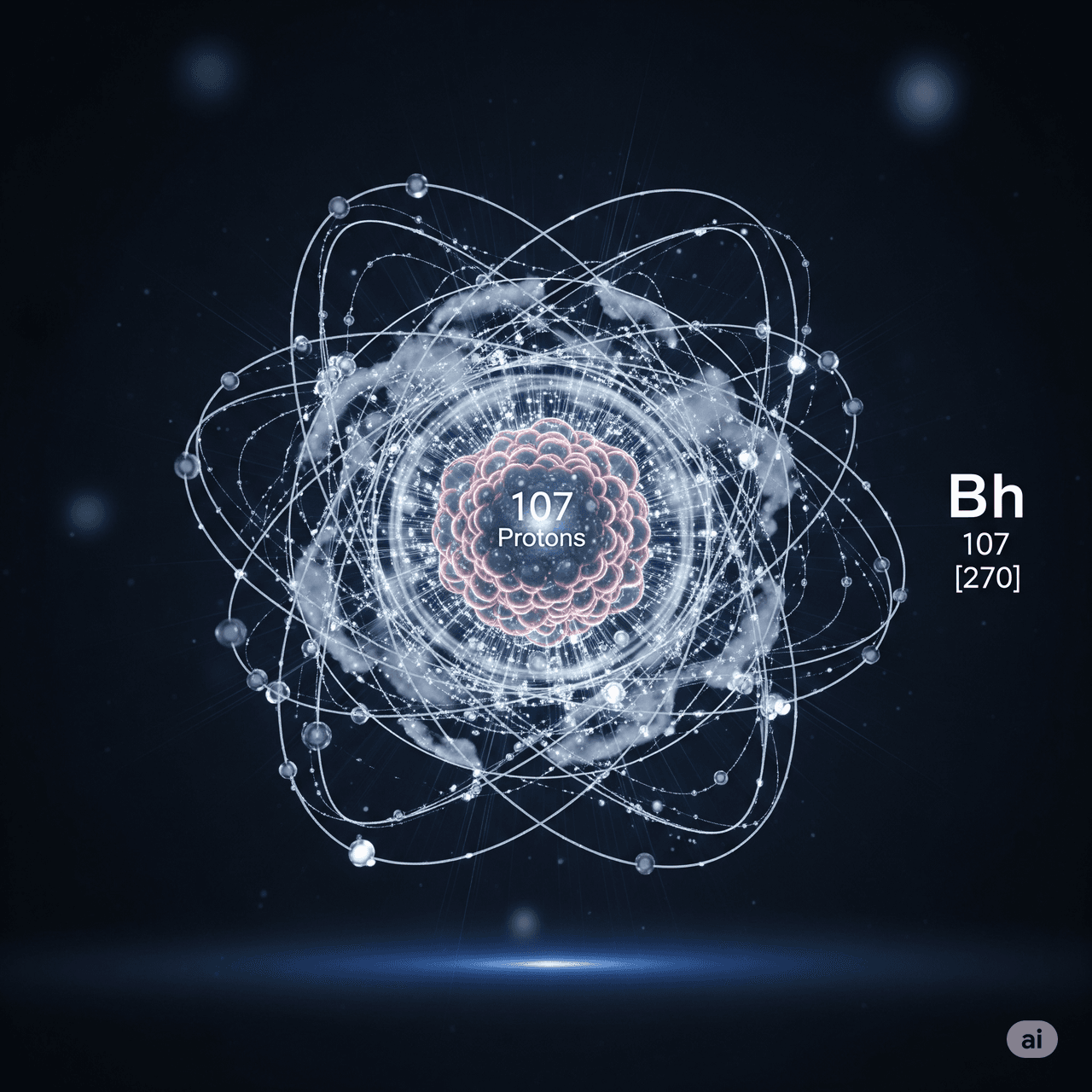
Bohrium Element
Bohrium is a synthetic element with the symbol Bh and atomic number 107. It does not occur in nature and is produced only in laboratories. It is radioactive and has a very short half-life. Scientists study bohrium to understand the properties of superheavy elements.

(Generated by Artificial Intelligence.)
History
Bohrium was discovered in 1981 as a result of nuclear reaction experiments conducted in Germany. Its name is derived from the renowned physicist Niels Bohr. The discovery of this element marked a significant advancement in the study of atomic nuclei and superheavy elements.
Physical Properties
The physical properties of bohrium are not fully known due to the extremely small quantities produced in laboratory conditions. Theoretically, it is predicted to belong to the group of transition metals and have a metallic structure, meaning it may be dense, hard, and lustrous.
Chemical Properties
Bohrium exhibits chemical behavior similar to transition metals and is often compared to ruthenium, osmium, and hassium. Due to its radioactivity, chemical experiments with bohrium can only be conducted under specialized laboratory conditions.
Applications
Bohrium has no applications in daily life or industry. It is used only in scientific research and in minute quantities to study the chemical and physical properties of superheavy elements.
Natural Occurrence
Bohrium does not occur naturally and is produced entirely in laboratory settings. The amounts produced are extremely small, typically consisting of only a few atoms. This makes bohrium exceptionally rare and valuable for scientific research.
Scientific Significance and Future Perspectives
Bohrium is an important element in the study of superheavy elements and atomic nuclei. Through bohrium, scientists can gain deeper insights into the behavior and structure of radioactive elements. In the future, further study of this element may yield new knowledge in nuclear science and fundamental physics.