




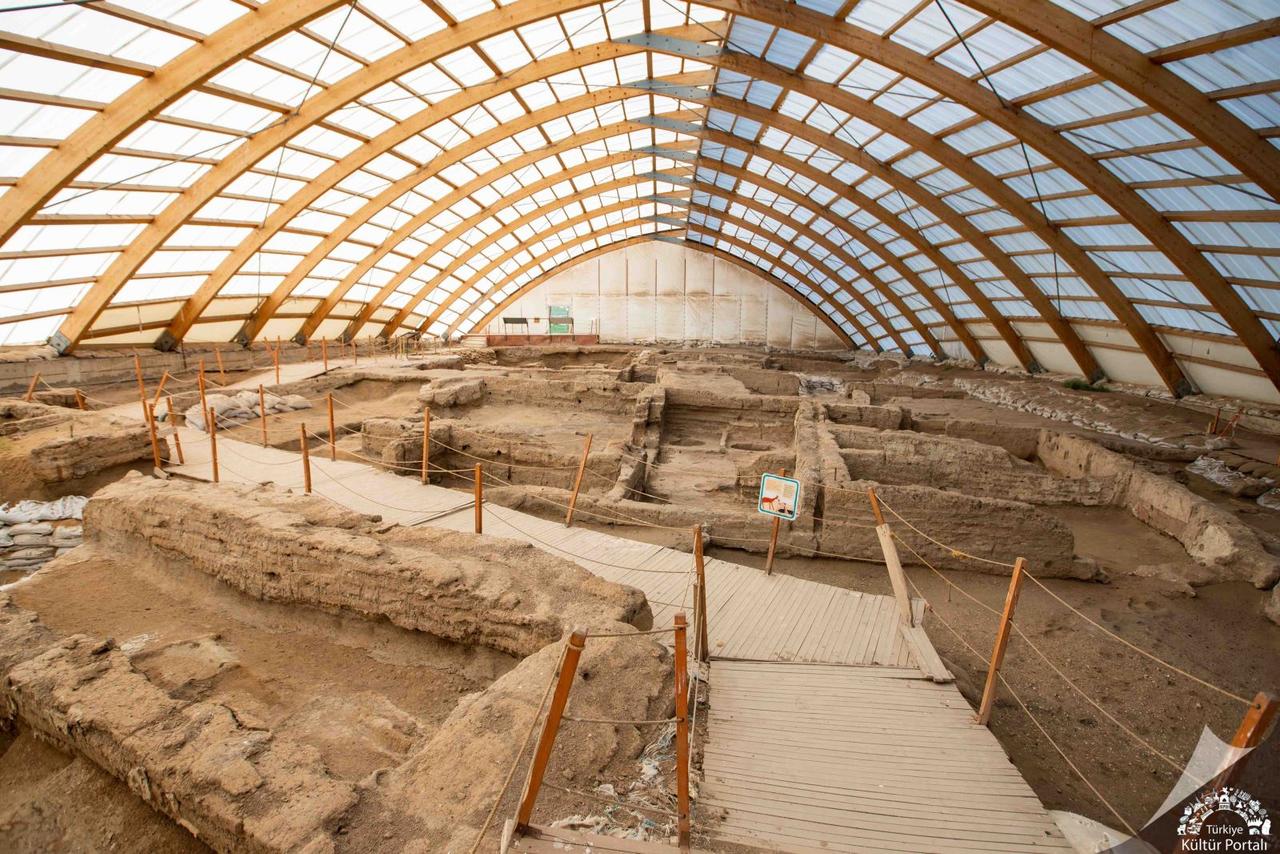
Çatalhöyük Neolithic Ancient City
Çatalhöyük, approximately 9,000 years ago (between 7400 and 6200 BCE), was one of the world’s earliest and most significant large settlements where humans transitioned to a sedentary lifestyle. 📜
This ancient city, located in the Çumra district of Konya, was added to the UNESCO World Heritage List in 2012 and is now protected for all of humanity. 🌍

Çatalhöyük Neolithic Ancient City (Konya Valiliği)
🐝 A Giant Beehive: A City Without Streets
Approximately 8,000 people lived together in Çatalhöyük. 👨👩👧👦
But this city had no streets or roads as we know them today! 🚫🛣️
🏠 Houses were built tightly together, like a giant honeycomb.
🔼 Entry Through the Roof: People entered their homes through a hole in the roof, using a wooden ladder.
🚶♂️ Travel on the Roofs: To move between neighborhoods, people walked across the flat rooftops of the houses.
🗑️ With no streets, they dumped their garbage in the open spaces between houses.
🏡 Mysterious Life Inside the Homes
The homes of Çatalhöyük typically consisted of one main room and small storage areas.
🔥 Kitchen and Hearth: Each house had a hearth and oven for cooking food.
🛏️ Beds and Platforms: Inside the homes, raised platforms made of mud stood above the floor.
People slept, ate, and worked on these platforms.
⚰️ An interesting fact: When loved ones died, they were buried directly beneath these platforms!
🎨 Spotless Walls: The interior walls of the houses were plastered white. Both women and men loved decorating these walls.

Çatalhöyük Neolithic Ancient City (Konya Valiliği)
🎭 The World’s First Artists
The people of Çatalhöyük were highly skilled. They painted murals on their walls that told stories of their time:
🖌️ Wall Paintings: Using red pigments, they painted leopards, deer, birds, and even an erupting volcano!
✋ They also pressed their hands into paint and left handprints on the walls.
🗿 Small Statuettes: They created numerous human and animal figurines from clay and stone.
👑 The most famous is a powerful female figurine seated between two leopards. While some archaeologists believe this represents a “Mother Goddess,” others think it depicts an elderly wise woman or perhaps a toy.
🌾 The First Farmers and the Famous “Black Glass” (Obsidian)
The inhabitants of Çatalhöyük were not only hunters but also among the world’s first farmers.
🌽 What Did They Eat? They cultivated wheat and barley and raised sheep, goats, and cattle.
🪨 Obsidian Trade: The people of Çatalhöyük brought black, shiny, and sharp obsidian stone from distant volcanic regions, such as Cappadocia.
They used this stone to make arrowheads, knives, and even the world’s first mirrors. 🔪🪞

Çatalhöyük Neolithic Ancient City (Konya Valiliği)
🏛️ Çatalhöyük Today
Today, if you visit Konya, you can explore Çatalhöyük. ✈️
Archaeologists are still excavating the site, uncovering new information.
🏠 There, you can enter replica houses built exactly like those from 9,000 years ago and imagine how children lived back then. ✨