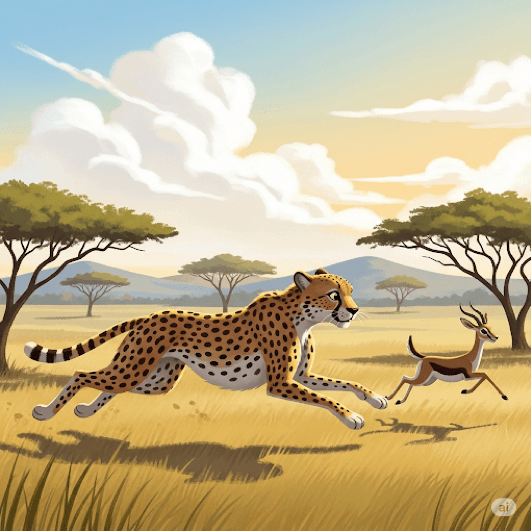




Cheetah
Have you ever thought about the fastest animal on Earth? Among land animals, the title belongs to the cheetah, an animal with an insatiable appetite for speed. What makes it so special is not only its incredible speed but also its body, perfectly adapted to sustain it. Let’s take a closer look at this magnificent creature!

Cheetah (Generated by Artificial Intelligence.)
Where Does It Live? 🌍
Cheetahs typically inhabit the vast grasslands and open terrains of Africa. These environments are ideal for chasing down prey. While they are found mainly in Africa, a very small number of cheetahs also live in certain regions of Asia.
Unlike other large cats such as lions, cheetahs do not live in groups. Male cheetahs may form small coalitions, but females prefer to live alone with their cubs.
What Does It Eat? 🍖
Cheetahs are carnivores. Their preferred prey are animals that can run fast, such as gazelles, antelopes, and impalas, which make up the bulk of their diet.
When hunting, cheetahs sprint at incredible speeds, but these bursts are very short. This is because their body temperature rises dangerously during high-speed chases. Therefore, they must capture their prey quickly. Once caught, they usually drag the kill to a safe location to protect it from stronger predators like lions or hyenas.
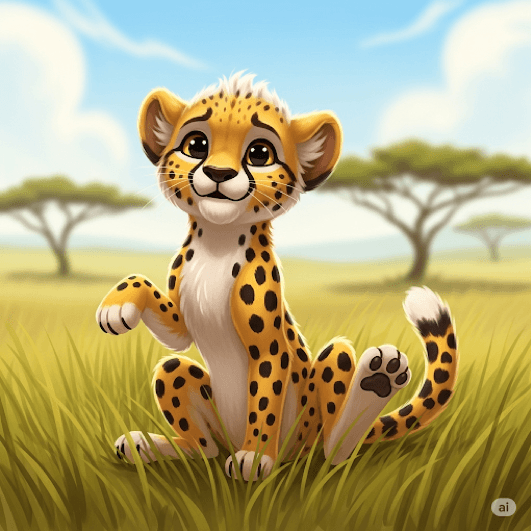
Cheetah (Generated by Artificial Intelligence.)
Physical Characteristics
The cheetah’s body is entirely designed for speed. Its slender, long legs, flexible spine, and large lungs allow it to reach extremely high speeds in a very short time—indeed, it can accelerate to 100 km/h in less than three seconds!
One of its most striking features is the black lines that run from the inner corners of its eyes down to its mouth. These are called “tear marks” and help reduce glare from sunlight, allowing the cheetah to see its prey more clearly. Its tail acts as a superb rudder, helping maintain balance during high-speed runs.
How Does It Grow? 🌱
When born, cubs are blind and defenseless. Their mothers keep them hidden in a den for several weeks. The cubs have a coat of long, fluffy fur along their backs that resembles a porcupine’s quills, helping them blend into their surroundings and avoid detection by other predators.
Cubs stay with their mother for 13 to 20 months, learning how to hunt and survive. After this period, they begin life on their own. However, the survival rate of wild cheetah cubs remains very low.