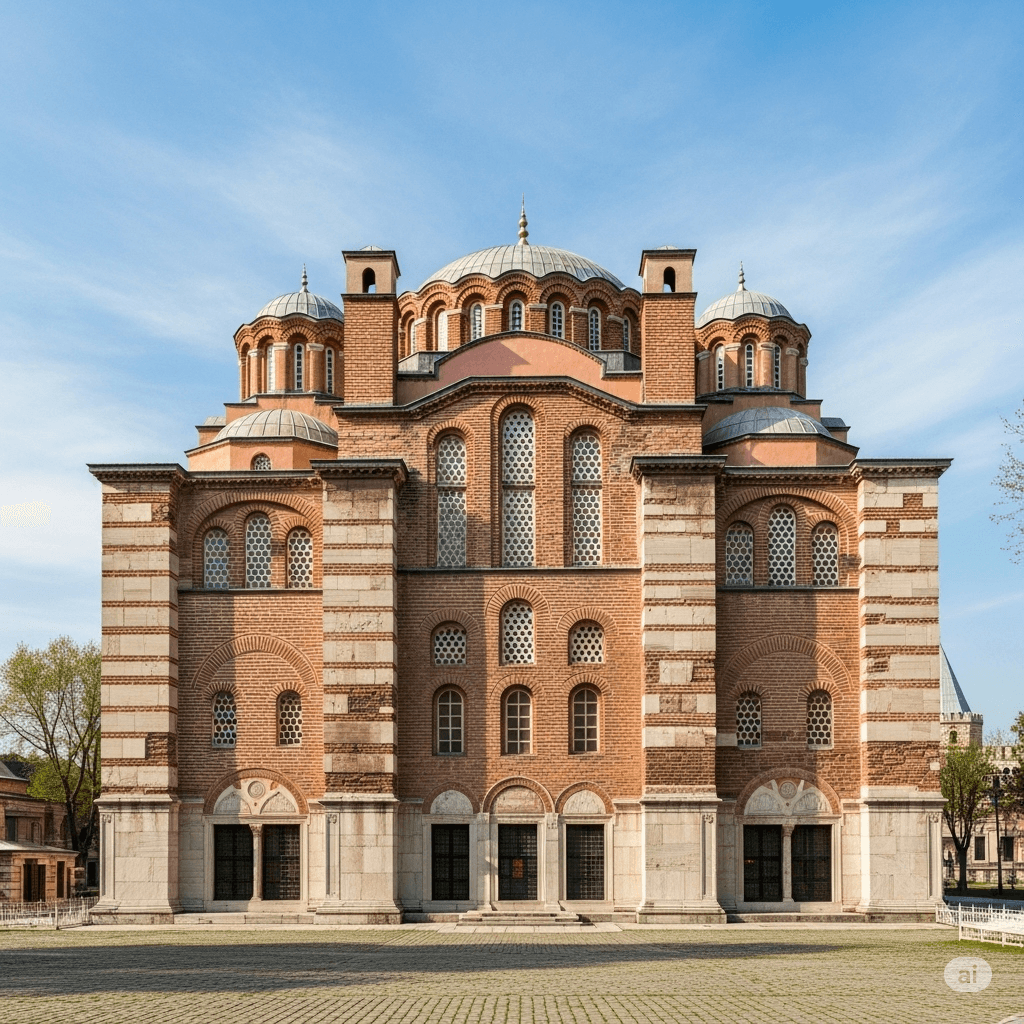




Church Museum of Saint Irene
One of Istanbul’s oldest churches, Aya İrini, acts like a time machine, taking us on a remarkable journey from the Byzantine Empire to the Ottoman era and onward to the present day. This historic structure, whose name means “Holy Peace,” has endured numerous earthquakes and fires over the centuries, yet has remained standing tall! Let us uncover the secrets of this ancient and awe-inspiring building together.
A Mysterious Historical Journey
The Church of Aya İrini was built in the 330s by Emperor Constantine, one of Istanbul’s founders. The original wooden church was completely reduced to ashes during a massive fire sparked by the Nika Revolt. Emperor Justinian I reconstructed it in a more durable form, essentially in its current structure. Subsequent earthquakes and fires followed, but each time the building was repaired and survived.

(Image generated by artificial intelligence.)
A Structure Enchanted by Its Architecture
Aya İrini is the only Byzantine church featuring an atrium, a characteristic inherited from ancient Roman temples. Inside the church, you will find very little ornamentation beyond a cross motif symbolizing Christ. This is because, during that era, the use of paintings or icons in churches was prohibited. Since it was never converted into a mosque during the Ottoman period, its original structure has remained untouched.
From Arsenal to Concert Hall
After the conquest of Istanbul, Fatih Sultan Mehmet chose not to convert Aya İrini into a mosque. Instead, he incorporated it into Topkapı Sarayı and used it as an arsenal and weapons depot. This long-standing use eventually inspired the idea of turning it into a museum, and in the 19th century, it became the first museum of the Ottoman Empire. Today, Aya İrini is renowned worldwide as a venue for classical music concerts, thanks to its exceptional acoustics.

(Image generated by artificial intelligence.)
An Important Part of Cultural Heritage
The Church of Aya İrini is a unique structure that preserves Istanbul’s historical fabric as an integral part of both the Byzantine and Ottoman Empires. Once a church, it later served as an arsenal, then a museum, and now functions as a concert hall. This transformation illustrates how history evolves and how a single building can be repurposed for vastly different functions over time.

(Image generated by artificial intelligence.)