



Fossils
Have you ever wondered how a giant dinosaur that lived millions of years ago or a tiny leaf managed to survive until today? Fossils are exciting clues left to us from Earth’s distant past. Through them, we can learn about the living organisms that once existed and understand what our planet was like long ago.
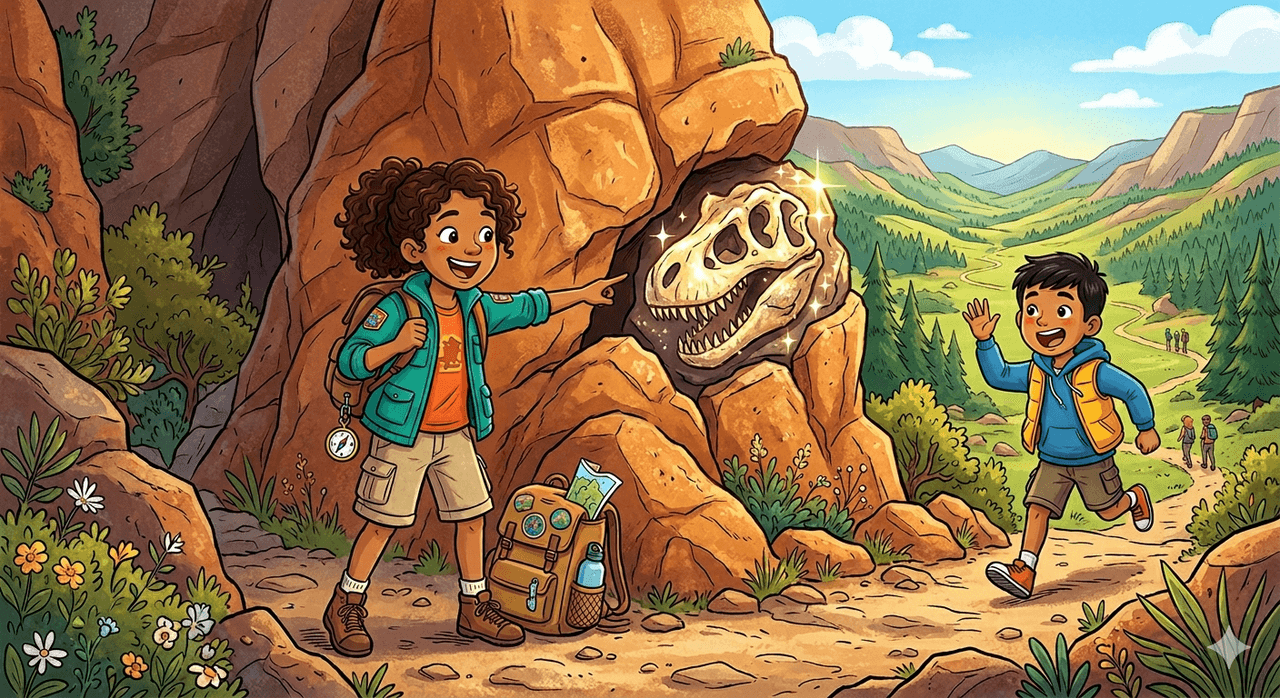
Visual representing fossils. (Generated by artificial intelligence.)
What Is a Fossil?
The petrified remains of plants and animals that lived in the past, or the traces they left behind, are called fossils. When an organism dies, it usually decays and disappears, but under special conditions, its bones, teeth, or shells can remain intact for millions of years and reach the present day.
How Are Fossils Formed?
This process, known as fossilization, takes a very long time and occurs in the following steps:
- Burial: The remains of a dead organism must be quickly covered by sediments such as sand or mud. This occurs most frequently at the bottoms of seas and lakes.
- Mineralization: Over time, while the soft parts of the organism decay, minerals fill the empty spaces in the remaining hard parts.
- Preservation: Thanks to these minerals, the petrified remains are preserved underground for millions of years without decaying.
Time Travel: Türkiye’s Giant Inhabitants
Let us travel back about 8 to 9 million years to the lands of Anatolia! At that time, Türkiye was a very different place from what we see today. Research has uncovered fossils of giant elephants in Edirne and Çanakkale.
The Mastodon species that lived in Çanakkale roamed forested areas near rivers and lakes. The Choerolophodon species found in Edirne lived in drier regions and fed on grasses. These fossils reveal that Çanakkale was covered in dense forests at the time, while Edirne had more open landscapes.
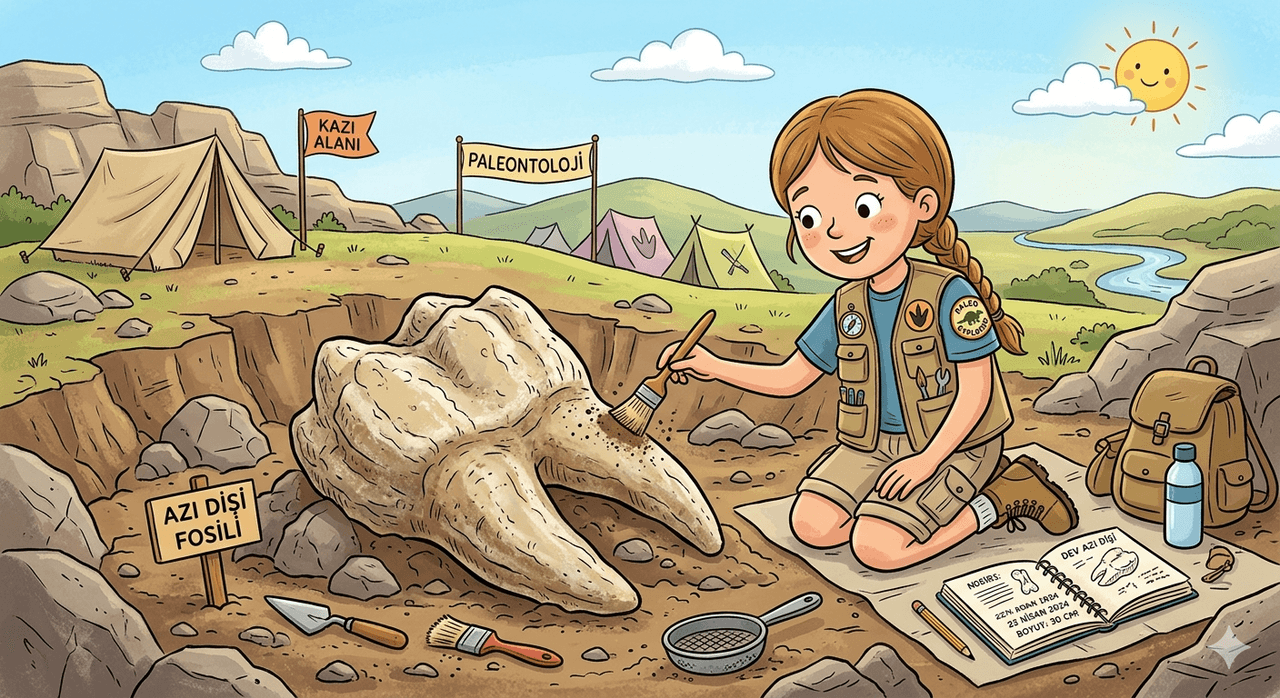
Visual representing paleontological research. (Generated by artificial intelligence.)
Fossil Hunters: Paleontologists
Scientists who study fossils to uncover the mysteries of the past are called paleontologists. Like detectives, paleontologists search for and examine these petrified remains buried underground. In our country, you can see their findings at the Şehit Cuma Dağ Tabiat Tarihi Müzesi, located within the Turkish General Directorate of Mineral Research and Exploration (MTA) in Ankara.