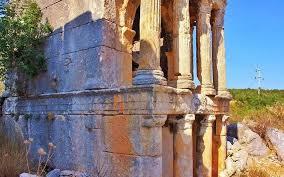




Imbriogion (Demircili) Ancient City and Monumental Tombs
Imbriogion is an ancient settlement located in the village of Demircili, within the Silifke district of Mersin Province, near the Mediterranean coast in southern Türkiye. This ancient city is particularly renowned for its exceptionally well-preserved monumental tombs. A monumental tomb is a large burial structure built specifically for an important and respected individual.
The remains at Imbriogion reveal that approximately 1,800 years ago, during the Roman Empire period (2nd and 3rd centuries CE), the site served as a summer resort for wealthy and noble families. It was a picturesque location where affluent residents of Seleukeia—the major city of the era, now known as Silifke—spent their summers immersed in nature.

Imbriogion (Demircili) Ancient City and Monumental Tombs (Culture Portal)
⏳ Time Travel
To imagine life in Imbriogion, let us travel back 1,800 years to the 200s CE, a time when the Roman Empire held strong influence in this region.
Wealthy Roman families seeking escape from the crowds and heat of the city center came to the cool and scenic village of Demircili, much as people today travel to seaside resorts for summer vacations. Here, they lived in carefully constructed homes and may have relaxed in Roman baths. A Roman bath was a large building where water was heated and people bathed and socialized. At Imbriogion, remains of a Roman bath have been found, featuring a mosaic floor depicting the sea god Poseidon—a picture made from small colored stones.

Imbriogion (Demircili) Ancient City and Monumental Tombs (Culture Portal)
🏠 What Structures Remain?
The most striking structures surviving from Imbriogion are the monumental tombs belonging to noble families.
- Monumental Tombs: These are not merely graves but large stone structures resembling temples, designed to reflect the importance of the deceased. Some are single-story, while others are two-story.
- Columns and Capitals: Some two-story monumental tombs feature Ionic capitals—more restrained in design—on the lower level and Corinthian capitals—more ornate, with leaf-like decorations—on the upper level. A column is a round stone pillar that supports a roof or the upper part of a structure. The capital is the decorative element at the top of the column.
- Heroa (Hero Monuments): Some structures were monuments dedicated to individuals regarded as heroes or who had performed significant deeds in their time. An inscription on the remains of one such heroon indicates that it was built for a family named Anglus.
✨ Why Are the Monumental Tombs Important?
These monumental tombs are more than just burial sites.
- Art and Architecture: Their architectural design and decorative elements, such as reliefs, demonstrate how much importance Romans placed on art and architecture.
- Social Life: The scale and grandeur of these tombs help us understand how wealthy and esteemed the residents of Imbriogion were during that era—just as today, grand monuments are erected to commemorate significant events or individuals.