



Information About Ants
Ants are one of the most commonly encountered and hardest-working creatures in nature. When we see them walking on the ground, we often fail to realize how extraordinary their system of organization is. Yet ants are true environmental engineers, thanks to their diligence, teamwork, and contributions to the natural world.
🐜 What Is an Ant?
Ants are insects, invertebrate animals with six legs. They can live almost anywhere on Earth, from forests and deserts to cities and tropical regions. To date, more than 12,000 ant species have been identified worldwide.
Information note:
Invertebrates are animals that lack a bony skeleton. Ants belong to this group.

A colony scene showing a queen, worker, and male ants together. (Generated by artificial intelligence.)
Social Life of Ants
Ants do not live alone. On the contrary, they work within a complex social structure. In an ant colony there are three main groups:
- Queen Ant: Responsible for laying eggs. In some species she can live up to 15 years.
- Worker Ants: These are female ants that perform all tasks within the colony: nest construction, cleaning, larva care, and food collection.
- Male Ants: Their only role is reproduction and they typically die shortly after mating.
Ant Nests: Cities Beneath the Soil
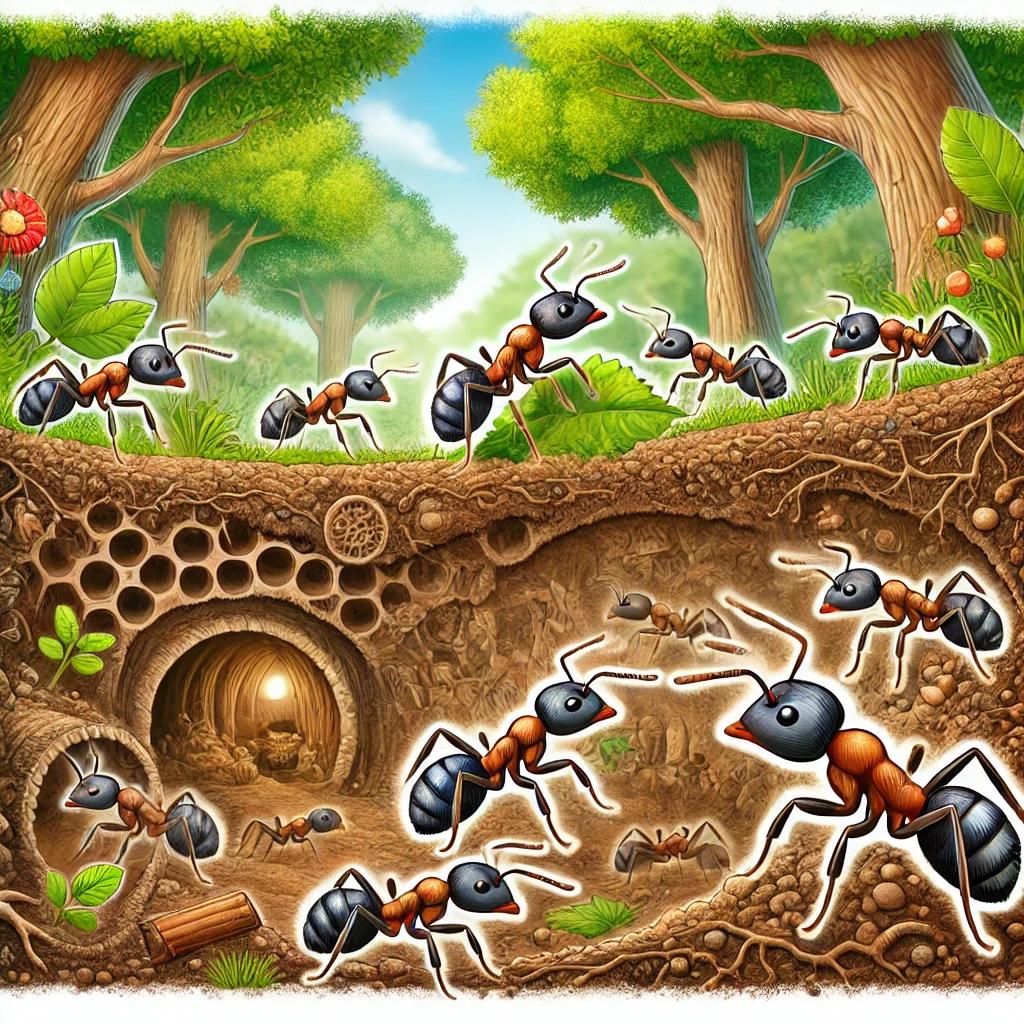
Ants build their own nests. These nests can consist of kilometers of tunnels and chambers beneath the ground. According to research, ants can move tons of soil in a single year. This demonstrates their vital role in aerating the soil and contributing to nutrient cycles.

A cross-section showing tunnels, chambers, and ants performing various tasks. (Generated by artificial intelligence.)
Information note:
Thanks to this soil-moving activity, ant colonies increase soil fertility and facilitate water penetration underground. For this reason, ants are known as the “soil engineers” of ecosystems.
How Do Ants Recognize Each Other?
Ants have a highly developed sense of smell. Using their antennae, they identify other ants in the colony, navigate their surroundings, and detect threats. An ant that finds food secretes a chemical substance called pheromone along the ground to guide others.
Information note:
Pheromones are a hidden chemical communication system among animals. For ants, they function like a “scent map.”
Ant Defense Tactics
Ants have developed various methods to defend their nests. Some species bite, others spray acid, and some even inflate and rupture their bodies to startle attackers. Soldier ants are specifically tasked with nest protection.
Ants in the Fight Against Natural Pests
Ants play a crucial role in controlling natural pests. They balance insect populations in gardens, forests, and fields. By preying on agricultural pests such as aphids and caterpillars, they help maintain ecological balance.

Ants preying on pests such as caterpillars or aphids. (Generated by artificial intelligence.)
How Intelligent Are Ants?
Ants have brains that, relative to their body size, are among the largest nervous systems in the animal kingdom. This enables them to:
- Solve complex tasks.
- Maintain effective communication within the colony.
- Navigate using the position of the sun.
The Role of Ants in Science
Ants have been studied in fields such as biology, robotics, artificial intelligence, and engineering. For example, computer scientists studied how ants find paths and developed ant algorithms. These algorithms are used in computers to determine the shortest and most efficient routes.

A scene showing ants choosing between different paths. (Generated by artificial intelligence.)
What If There Were No Ants?
If ants disappeared from nature, soil aeration would decrease, pest populations would surge, and plant roots would receive insufficient nutrients. This would affect agriculture, forests, and even urban parks. Ants break down leaves and mix them into the soil, help water reach underground layers, and regulate insect populations. Without them, the natural balance would be disrupted and many species would suffer.
The Role of Ants in Nature
- Soil Processors: By digging tunnels, they aerate the soil.
- Food Chain Representatives: They are both predators and prey, helping maintain ecosystem balance.
- Cleaners: They transport dead insects, helping to keep nature clean.
- Plant Protectors: They prey on harmful insects, supporting agriculture.

A general scene showing ants carrying dead insects, aerating the soil, and integrating with nature. (Generated by artificial intelligence.)
Information note:
Ecosystem is the complete network of balanced relationships between living organisms and their environment. Ants are indispensable members of this system.
References:
Ankara University. Ants in the Fight Against Natural Pests. Open Course Material, accessed 2024. https://acikders.ankara.edu.tr/pluginfile.php/103313/mod_resource/content/1/cevre%20s-kar%C4%B1ncalar%20do%C4%9Fal%20zararl%C4%B1%20ile%20m%C3%BCcadele.pdf.
Bilim ve Teknik. “Ants Carry Tons of Soil.” TÜBİTAK Science and Technology Magazine, accessed 2024. https://bilimteknik.tubitak.gov.tr/makale/karincalar-tonlarca-toprak-tasiyor.
Google. “Information About Ants MEB.” Accessed 2024. https://www.google.com/search?q=ant+information+meb.
National Geographic. “Ants.” Animals Facts. Accessed 2024. https://www.nationalgeographic.com/animals/invertebrates/facts/ants.
National Geographic Kids. “Ant Facts.” Accessed 2024. https://www.natgeokids.com/uk/discover/animals/insects/ant-facts/.
National Wildlife Federation. “Ants.” Educational Resources – Wildlife Guide. Accessed 2024. https://www.nwf.org/Educational-Resources/Wildlife-Guide/Invertebrates/Ants.
TRT Belgesel. “Ants.” YouTube Video, published 2023. https://www.youtube.com/watch?v=r62D7vzjSfw.