KURE Kids Header Line
badge icon

This content was originally written in Turkish for children and is automatically translated into English using artificial intelligence.

article-image

Primary and Secondary Colors

Last Updated: 13.04.2026

Have you ever looked up at the sky and wondered where these magnificent colors in nature come from? Colors help us identify everything around us and make our world a much happier place. The vibrant red of an apple, the brilliant yellow of the sun, or the deep blue of the sea—all derive their beauty from light and color. Let us together explore the magical world of colors that accompany us in every moment of life!

Two Friends from Different Cultures Discover Colors (Generated by Artificial Intelligence)

What Are the Primary Colors?

The countless colors we see around us have a fundamental source. We call the colors found in nature in their pure form and that cannot be created by mixing any other colors "primary colors."


According to the paints we use in art classes, there are three primary colors: red, yellow, and blue. These colors are like the largest members of the color family and help create all other secondary colors.


You can easily match these primary colors with objects in nature. For example, when we hear the word red, we think of an apple or a rose. Blue reminds us of the endless sky and the ocean, while yellow brings to mind the sun that warms our hearts or a lemon.

How Are Secondary Colors Formed?

When we mix primary colors together, it is as if magic happens and entirely new colors emerge. These new colors, born from the combination of two primary colors, are called "secondary colors."


For example, when you mix yellow and blue paint while painting, you get green. This green is exactly the color of the grass you run and play on in the park or the leaves of trees.


If you mix red and yellow, you get orange, a color resembling a juicy orange or a carrot.


When you combine red and blue paint, you create a rich purple color like an eggplant or a cluster of grapes.

Are Light Colors the Same as Paint Colors?

The paints we use for drawing contain tiny substances called "pigments" that give them color. The primary colors used in paints (pigments) are different from the primary colors of light that illuminate our surroundings.


In the world of light, the primary colors are red, green, and blue. Yes, you heard correctly; the green we know as a secondary color in paints is actually a primary color in light! When light colors combine, they produce the "white" light that illuminates our surroundings.


In short, white light is not colorless—it is a remarkable beam of light that secretly contains all the colors of nature.

📦 Time Travel

Long ago, in 1666, a curious scientist named Isaac Newton conducted an experiment. He allowed a thin beam of sunlight to enter a dark room and pass through a glass prism (a special piece of glass that bends light and separates it into colors). As the light passed through the glass, it refracted and transformed into the magnificent colors of the rainbow!

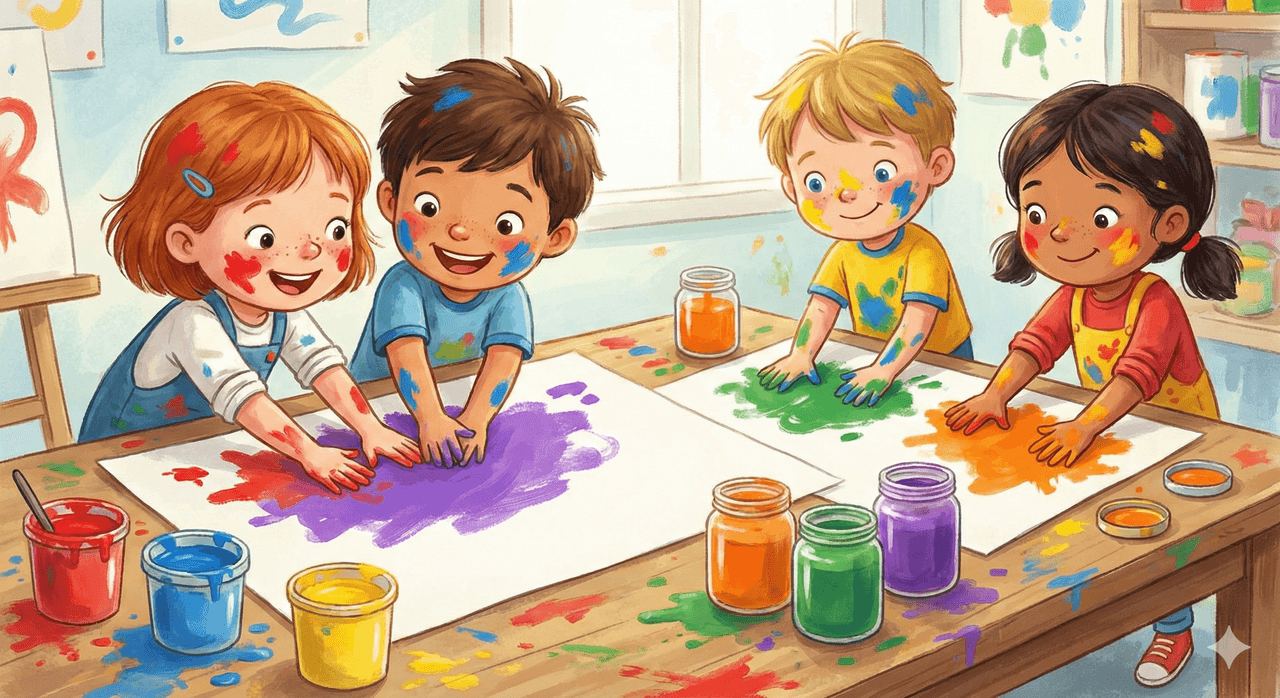
The Child Who Discovered Color Mixing (Generated by Artificial Intelligence)

Don't Forget to Look at These!
Science and Technology
cat img
Natural Sciences
cat img
History and Culture
cat img
image
Most Read
Thomas Edison
arrow
image
Last Added
Kişisel Verileri Koruma Günü
arrow
ilham-notu-bg
INSPIRATION NOTE FOR CURIOUS KIDS!

You can also be a little color inventor at home! Take your watercolors and try creating new colors using only yellow, red, and blue. Can you make your own green, orange, and purple?

Who Wrote?
Kids Writing
AuthorAslınur İLHANApril 13, 2026
bottom-bg-effect-bottom
bottom-bg-effect-top

Colors are characteristics that enable us to understand our world and enhance our lives. When painting with pigments, the primary colors red, yellow and blue are mixed to produce green, orange and purple. When the primary colors of light—red, green and blue—are combined, they produce yellow, cyan (light blue) and magenta (pinkish purple). White light is a broad beam containing all colors.

Bibliographies

Aydemir, Hamid. "Görsel Sanatlar Eğitimi Bağlamında İlkokul Öğrencilerinde Üniversite Farkındalığı Geliştirme: Ana ve Ara Renkler Temelli Bir Etkinlik Uygulaması." *Batı Anadolu Eğitim Bilimleri Dergisi* 16, no. 2 (2025): 2318–42. Accessed February 26, 2026. https://dergipark.org.tr/en/download/article-file/4749809

Demir, Nihal, and Abdülkadir Kabadayı. "Erken Yaşta Renk Kavramının Kazandırılmasında Bilgisayar Destekli ve Geleneksel Öğretim Yöntemlerinin Karşılaştırılması." Uluslararası İnsan Bilimleri Dergisi 5, no. 1 (2008): 1–18. Accessed February 26, 2026. https://d1wqtxts1xzle7.cloudfront.net/76617473/261-libre.pdf?1639761636=&response-content-disposition=inline%3B+filename%3DComparision_of_traditional_and_computer.pdf&Expires=1772105880&Signature=aYgHskLRFAxv8uANFStHO0V5lchSPfh7sPFXdKsnfYFWm342AB9a~3qXbCkrCjD2l9NsNPOIUfm4Y2N37sRs1RtgY-eUry7P~hgvuq1KrTg3gEjT7LzxtO8gOy1PBJCdp7vHfd7d90ESV4d7sR3OVDXTfuH90oOQGHBWK2AckwVNxYEhh~uVbpwLyViMPsjlYtyiTU8C1jLZ3G34M0hgc9sFcUdH-azsctpBn8EFJnt7IYqEiKLvjsQ5GQRKkVv7YhFF6b48Ttjjn26ca96pLQzLBcvU9mqVGdkXFOF0Q6j88WOIufhP9OEvdlTy6Lb3wlz2gpsendx0VhBACi~xPQ__&Key-Pair-Id=APKAJLOHF5GGSLRBV4ZA

Geçen, Fahrettin. "6-7 Yaş Düzeyindeki Okul Öncesi ve İlkokul Öğrencilerinin Renk Algısı." Asos Journal (Akademik Sosyal Araştırmalar Dergisi) 6, no. 86 (December 2018): 152–63. Accessed February 26, 2026. https://d1wqtxts1xzle7.cloudfront.net/108368627/1325053607_14639_20Fahrettin_20GE_C3_87EN-libre.pdf?1701771676=&response-content-disposition=inline%3B+filename%3D6_7_Yas_Duzeyi_ndeki_Okul_Oncesi_Ve_Ilko.pdf&Expires=1772105891&Signature=FODsQrlWau~k5LbILHy-fFOFp8K2hl5hwIfK5SwoQtXQVARjEufUX5ZjDrExF3GVyeyxTllRciVQAK3TnyLclPZadB-FCbEkgN4lOK-U3MKsG75lC6g7KeD9Zvh9HDhKTe9VgG9NMbGAqrA3Jg9iSfv8wZBVA7dMVGwGo6tzm5GAdEq~0eNj0ZuXVNuFpAWS3y2UErWr4nZKwkcDvxYsnv1xSheVMlMwmJn2YIJoPvHSis~EUxIRl0F~sbc-treknbtNpqQx-jHfWAiI11jtMo50yIHft6vWqtARWGM-5-RbRYEPf3kuudC3~CpJiz9jok9Ornful860SNzV1vZlGw__&Key-Pair-Id=APKAJLOHF5GGSLRBV4ZA

Polat, Harun Hilmi. "Renk Teorisi ve Temel Yanılgılar." *Selçuk Üniversitesi Sosyal Bilimler Enstitüsü Dergisi*, no. 28 (2012): 165–73. Accessed February 26, 2026. https://dergipark.org.tr/en/download/article-file/1724503

Şahin Akyüz, Seda, and Emine Çil. "Işığın Ana ve Ara Renklerinin Modelle Öğretimi." *Araştırma Temelli Etkinlik Dergisi (ATED)* 3, no. 1 (2013): 1–11. Accessed February 26, 2026. https://mail.ated.info.tr/index.php/ated/article/view/73/112

ilham-notu-bg
ilham-notu-bg
ilham-notu-bg
HEYY!
Did You Know?
These?
Lamb
Lamb
Ask to Küre