




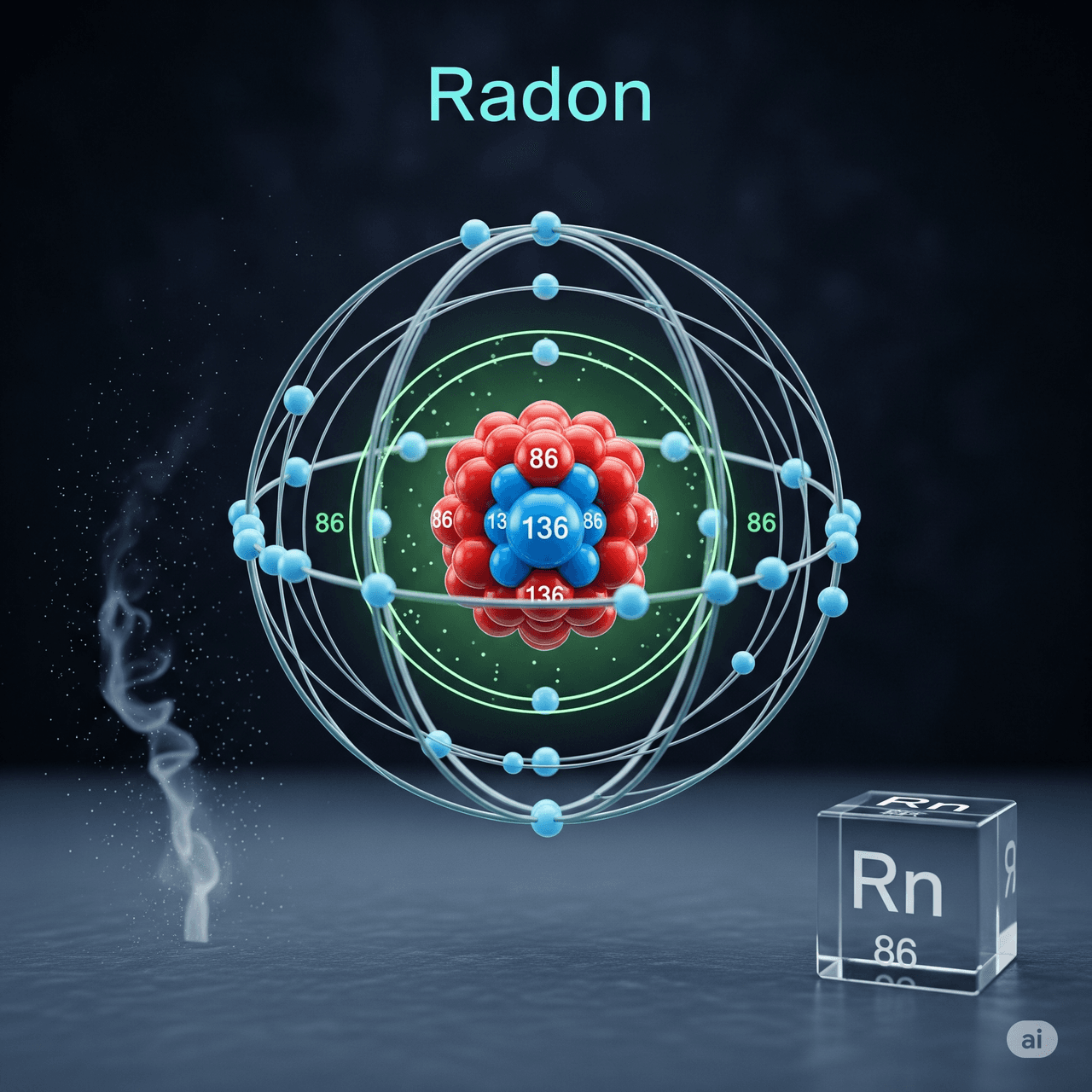
Radon Element
Radon is a radioactive noble gas with the symbol Rn and atomic number 86. It is colorless odorless and tasteless. It forms naturally through the decay of uranium and thorium minerals in the Earths crust. It remains in the air for a short time and poses health risks when inhaled.

(Generated by Artificial Intelligence.)
History
Radon was discovered in the early 1900s. Its name is derived from the word radio indicating its radioactive properties. Scientists have been studying the effects of radon on human health and the environment for many years.
Physical Properties
Radon exists as a gas and is colorless at room temperature. It is denser than air and is considered a heavy gas. While radon gas can circulate freely in nature its accumulation in enclosed spaces can be hazardous.
Chemical Properties
Radon belongs to the group of noble gases and is chemically quite stable. It rarely reacts easily with other elements. However during radioactive decay it emits alpha particles. This property is significant both for scientific research and health considerations.
Applications
Radon is used in very small quantities in medicine for certain cancer treatments and in scientific research. In the past it was also used in radon baths and spa treatments. Today its applications are very limited and require controlled environments.
Natural Occurrence
Radon is produced by the natural decay of uranium and thorium minerals. It is found in low concentrations in soil rock and water. Its accumulation in enclosed spaces can pose health risks which makes radon testing in homes important.
Scientific Significance and Future Perspective
Radon is important among radioactive elements for scientific research. In geology and environmental science measurements of natural radon levels provide information about the structure of the Earths crust. In the future it may be used more safely in medicine and research through controlled and secure application methods.