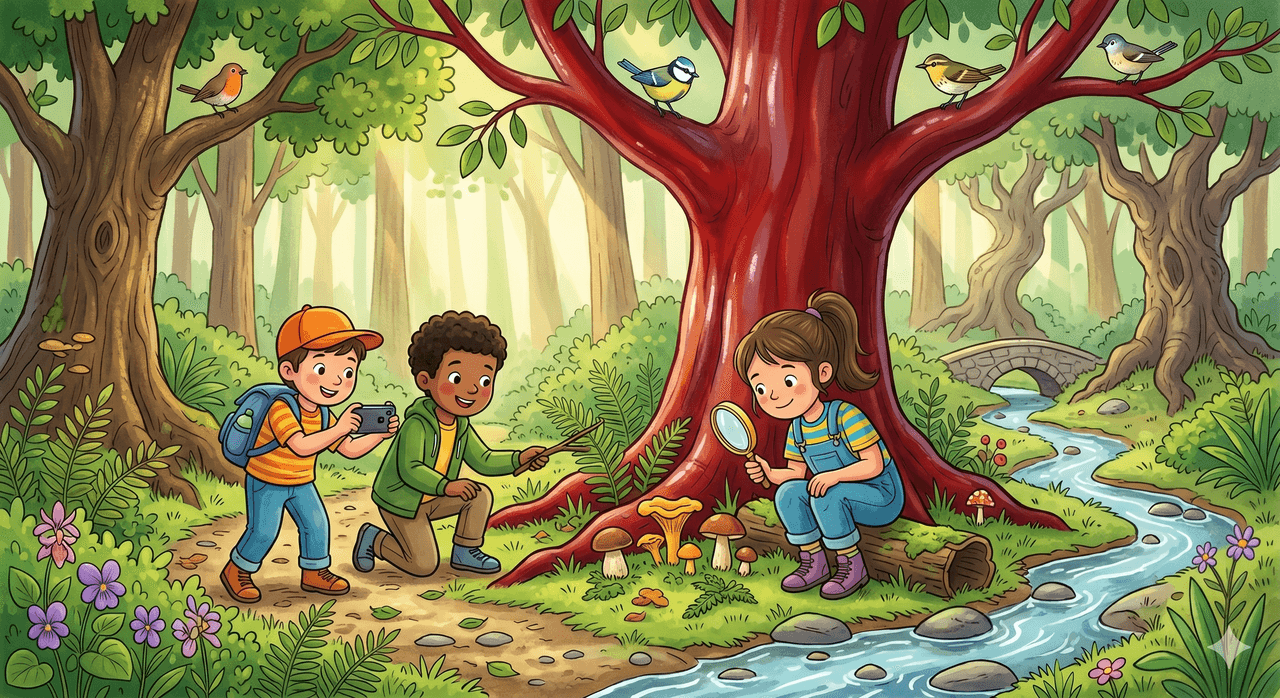




Sandalwood Tree
Have you ever seen a tree with a smooth, bright red trunk standing out during a walk in the forest? This interesting tree is called the Sandal tree. The name may sound familiar, but it is not the same tree used in perfumery Sandal tree; rather, it is a unique, ornamental, and fruit-bearing member of the Mediterranean forests. Let’s take a close look together at the world of this colorful tree!

Sandal Tree (Generated by Artificial Intelligence)
What Kind of Tree Is It and Where Does It Grow?
The Sandal tree, known in science as Arbutus andrachne, is a member of the Ericaceae family. In nature, it typically appears as a large shrub reaching 3 to 4 meters in height, but it can sometimes grow into massive trees up to 12 meters tall.
Its most distinguishing feature, setting it apart from other forest trees, is its smooth trunk that changes color from orange to bright red. In our country, you can frequently encounter it along the coasts of the Mediterranean, Aegean, and Marmara regions.【1】
What Do Its Flowers and Fruits Look Like?
During spring months (between March and May), the Sandal tree blooms with pure white flowers. Scientists observing their growth under a microscope noticed something fascinating: as the flower buds develop, they first take on a cylindrical shape, then resemble an American football.
After the flowers fade, they give way to remarkable fruits. These reddish fruits are rich in vitamins C and E and are edible. In fact, jams, jellies, and fruit preserves are even made from these tasty fruits.

Sandal Tree Flowers (Generated by Artificial Intelligence)
How Do Its Seeds Germinate?
The seeds of the Sandal tree require a period of cold to break dormancy and germinate. They will not awaken from their sleep unless they experience winter’s chill. Scientists simulate this by placing the seeds in a refrigerator at 4°C for approximately 30 to 60 days, a process known as “stratification.” This cold treatment disrupts the seed’s dormant state and prepares it for germination.【2】
How Do People Use It?
The Sandal tree is remarkable not only for its appearance but also for its benefits. Its leaves and flowers are widely used in cosmetics, food, and pharmaceutical industries due to their unique volatile oils.
Its wood is very hard and produces little smoke when burned, making it preferred for fireplaces and the crafting of wooden spoons. Elegant leaves are also used to make decorative wreaths.
Time Travel
The history of the Sandal tree goes back truly far into antiquity! Scientists believe it existed on our planet even before the last Ice Age. In ancient times, the Romans used its fruits as a special dietary food. In the 17th century, its leaves and flowers were used medicinally against diseases such as plague and against poisons.
Citations
【1】
Ebru Hatice Tığlı Kaytanlıoğlu, Hüseyin Fakir ve Nilay Çiçek, “Sandal Ağacı (Arbutus andrachne L.) Yaprak ve Çiçeklerinde Uçucu Bileşen ve Yağ Asidi Kompozisyonu,” Journal of Anatolian Environmental and Animal Sciences 8, no. 2 (2023): 169–175, https://doi.org/10.35229/jaes.1188030.
【2】
Cemile Ebru Onursal ve Şadiye Gözlekçi, “Sandal Ağacı (Arbutus andrachne L.) Tohumlarına Yapılan Bazı Ön Uygulamaların Tohum Çimlenme Oranı ve Süresi Üzerine Etkileri,” Akdeniz Üniversitesi, Ziraat Fakültesi, Bahçe Bitkileri Bölümü, kabul 20 Ağustos 2007, erişim 1 Mayıs 2026, https://dergipark.org.tr/en/download/article-file/18112.