



Signatures of the Ottoman Sultans: TUĞRA
Can any signature be as ornate and powerful? Let’s explore the tugra, the imperial signature of the Ottoman sultans. The tugra was not merely a signature; it was also a work of art and a symbol of authority. This distinctive mark appeared on every important document, from imperial decrees to coins.
The tugra is one of the most exquisite examples of the art of calligraphy, known as hat sanatı. Designed uniquely for each sultan, it indicated that the document had been issued by his command. Within this intricate and artistic design, the names of the sultan and his father are concealed. Let us uncover the secrets of this mysterious form together!
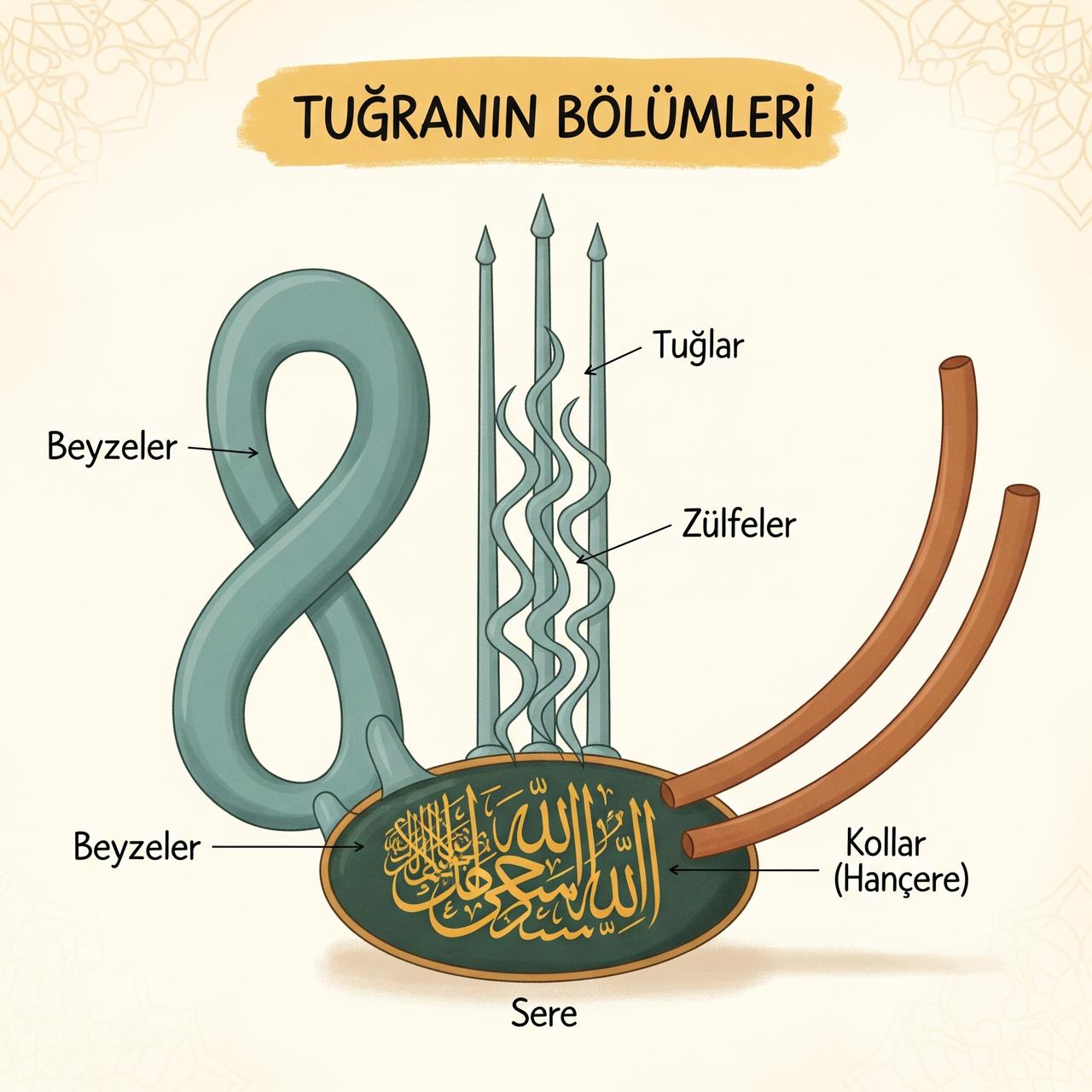
What Are the Parts of a Tugra?
When you look at a tugra, you see many lines and curves. In fact, all these elements come together to form a meaningful whole. Like the pieces of a puzzle, each part has a name and a function. Let us learn the components of a tugra.
Sere (Kursi): This is the central, lowest part of the tugra, serving as its foundation, much like the base of a house. The names of the sultan and his father are written here, along with titles such as “Şah” and “Han.”
Beyzeler: The two large, curved, interlocking shapes on the left side of the tugra are called beyzeler. The word “beyze” means egg, and these forms resemble eggs. They appear like the two large arms extending from the left side of the tugra.
Tuğlar: The three long vertical lines rising upward from the upper part of the tugra are called tuğlar. These can be likened to the finials of a crown or long feathers. These lines typically carry the prayer “el-muzaffer daima,” meaning “may he always be victorious.”
Zülfeler: The flowing, ribbon-like curves descending from the sides of the tuğlar are called zülfeler. They resemble ribbons fluttering in the wind and add movement and beauty to the tugra.
Kollar (Hançere): The two thick lines extending to the right side of the tugra, continuing from the beyzeler, are called kollar or hançere. They represent the strong arms of the tugra.
Time Travel
The history of the tugra stretches back many centuries. The earliest known Ottoman tugra was used by Orhan Gazi, the second sultan of the Ottoman state, approximately 700 years ago. Orhan Gazi’s tugra was very simple, bearing only the words “Orhan bin Osman,” meaning “Orhan, son of Osman.” At that time, the tugra was far from the ornate form we recognize today.
As the years passed and the Ottoman state expanded, the tugra evolved. Each new sultan added new details to his own version. Particularly during the reigns of Fatih Sultan Mehmet and Kanuni Sultan Süleyman, tugras became much more elaborate. Some of the most beautiful and artistic tugras were designed by the master calligrapher Mustafa Râkım Efendi for Sultan Mahmud II. These tugras were so flawless they resembled paintings.
Who Created the Tugra?
Sultans did not draw their own tugras. Specialized, highly skilled individuals were appointed for this task. These experts were known as “Nişancı” or “Tuğrakeş.” The nişancıs were not only masters of calligraphy but also deeply knowledgeable about the state’s laws and protocols.
When an imperial decree (ferman) was written, it was the nişancı’s duty to inscribe the tugra at the top. Once a nişancı drew the sultan’s signature—the tugra—on a document, that document was considered official and valid. Thus, the role of nişancı was of great importance in the Ottoman state.