



Tapureli - Mersin
Tapureli is an ancient settlement located near the district of Erdemli in Mersin Province, in southern Türkiye. Today, this area is known as an ören yeri. An ören yeri refers to a place where people once lived but which has now become a ruin or archaeological site. Tapureli derived its name from the stony and rocky nature of the surrounding terrain. Have you ever walked along a narrow path so full of stones that it was difficult to tread? This ancient settlement was established in precisely such a location. Tapureli lies in a mountainous region at an elevation of approximately 1,050 meters above sea level.
This ancient town served as a settlement for many different civilizations over the centuries. It was particularly significant during the Hellenistic Period (the era following the death of Alexander the Great) and the Early Byzantine Period (the eastern portion of the Roman Empire after its division). Due to its commanding position overlooking the Limonlu Çayı valley, it controlled the major roads and trade routes of its time.

Tapureli (Culture Portal)
Time Travel: The History of Tapureli
Life in Tapureli began approximately 2,300 years ago, during the Hellenistic Period. The inhabitants first established small settlements, later constructing larger structures during the Roman Empire and then the Early Byzantine Period.
Excavations in the area have uncovered churches believed to date from the late 5th to early 6th centuries AD. Have you ever seen the remains of a very old house? Tapureli contains structures of similar character but far older. These churches and other buildings help us understand the beliefs and daily lives of the people who lived here during that era.

Tapureli (Culture Portal)
What Can Be Found at Tapureli? 🏘️
While walking through the Tapureli ören yeri, the ruins you encounter reveal aspects of life in antiquity.
Building Remains: In the core area of the settlement, the remains of houses where people lived can be found, along with five churches dating to the Early Byzantine Period. These churches vary in size and design.
Cemetery Areas (Necropolis): On the southern slope of the town lies the necropolis, known as the ancient burial ground. Here, various types of tombs have been discovered, including lithos (large stone or marble sarcophagi) and tomb chambers.
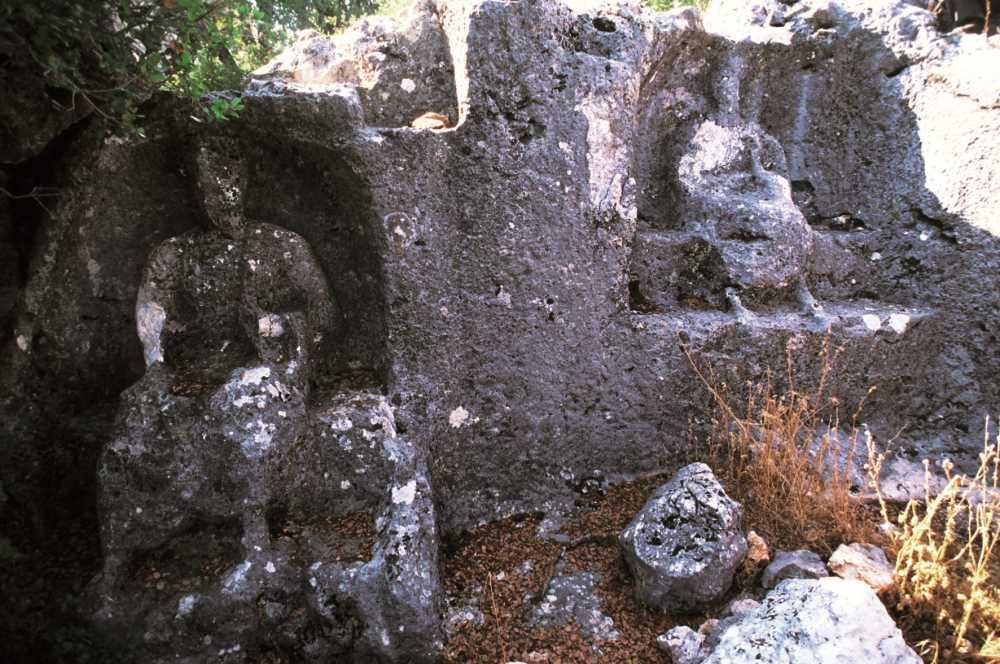
Reliefs: The site also contains reliefs carved into stone, depicting statues and figures. Among them are representations of two soldiers, a seated woman, and a man (a priest and a nun). One of these reliefs, the Seated Philosopher Relief, is currently on display at the Mersin Archaeology Museum. The philosopher represents wisdom and contemplation.