





Travelogues
Imagine traveling to a city you have never heard of, or even to a distant country no one had ever visited before. Wouldn’t you want to write down the interesting foods you saw, the people’s different clothing, and the massive buildings? In very ancient times, people created travel books called seyahatname to share their adventures with others. These books were like the television or internet of their time; people learned about places they had never visited through them.
What Is a Seyahatname?
The word “seyahatname” is formed by combining the Arabic word “seyahat,” meaning “to travel,” and the Persian word “nâme,” meaning “book.” Thus, it literally means “travel book.” Travelers, or seyyahs, described in these books, in a candid tone, how people lived, what they ate, and what games they played in the places they visited.
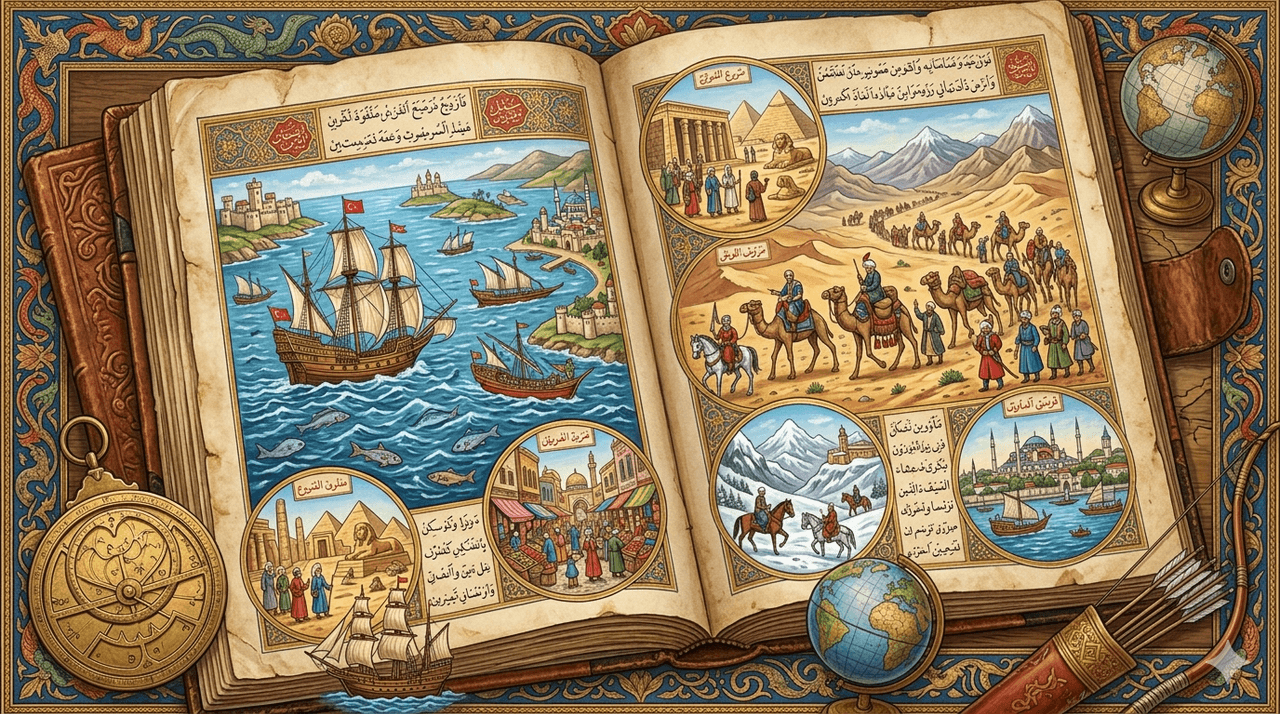
Content of a Seyahatname (Generated by artificial intelligence)
Why Did People Write Seyahatnames?
In ancient times, discovering new places and learning about different societies was a great source of curiosity. People set out on journeys sometimes for trade, sometimes to gain new knowledge, and sometimes simply for adventure. To remember everything they saw and to introduce it to people back home, they recorded their observations in writing. Seyahatnames are invaluable historical treasures that provide us with rich information about the social and economic conditions of their time.
Who Were the First Travelers?
The world’s first travel story can be considered the Epic of Gilgamesh. We know that even in very ancient times, people sailed across open seas from the Eastern Mediterranean to India. During the classical Greek period, the first travel writings began to appear, introducing different countries and beliefs.
Time Travelers: The First Great Explorers
Approximately 700 years ago, Ibn Battuta traveled the world for a full 30 years. He journeyed through many countries from Türkiye to China and compiled his travels into one massive book. At the same time, Marco Polo traveled to Eastern countries and introduced their fascinating ways of life to the Western world.
Travel in Turkish Literature
The Turks have also traveled to distant lands throughout history and recorded what they saw. Initially, these works were written in Persian, but over time Turkish seyahatnames became more numerous. The sailor Pîrî Reis described the ports of the Mediterranean and the lives of its people in his work Kitâb-ı Bahriyye, as if it were a guidebook. Another famous sailor, Seydi Ali Reis, was caught in a storm and carried as far as India; he collected the adventures of his return journey in his book Mir'âtü'l-memâlik.
The Sultan of Travelers: Evliya Çelebi
One of the most famous travelers in Turkish literature and in world history is Evliya Çelebi. This seyyah, who lived in the 17th century, spent a full 50 years traveling throughout Ottoman lands and neighboring countries. He described every place he visited in his monumental 10-volume work, the Seyahatnâme.
Evliya Çelebi What Did He Describe?
Evliya Çelebi did not limit himself to describing buildings; he listed the unique characteristics of every city.
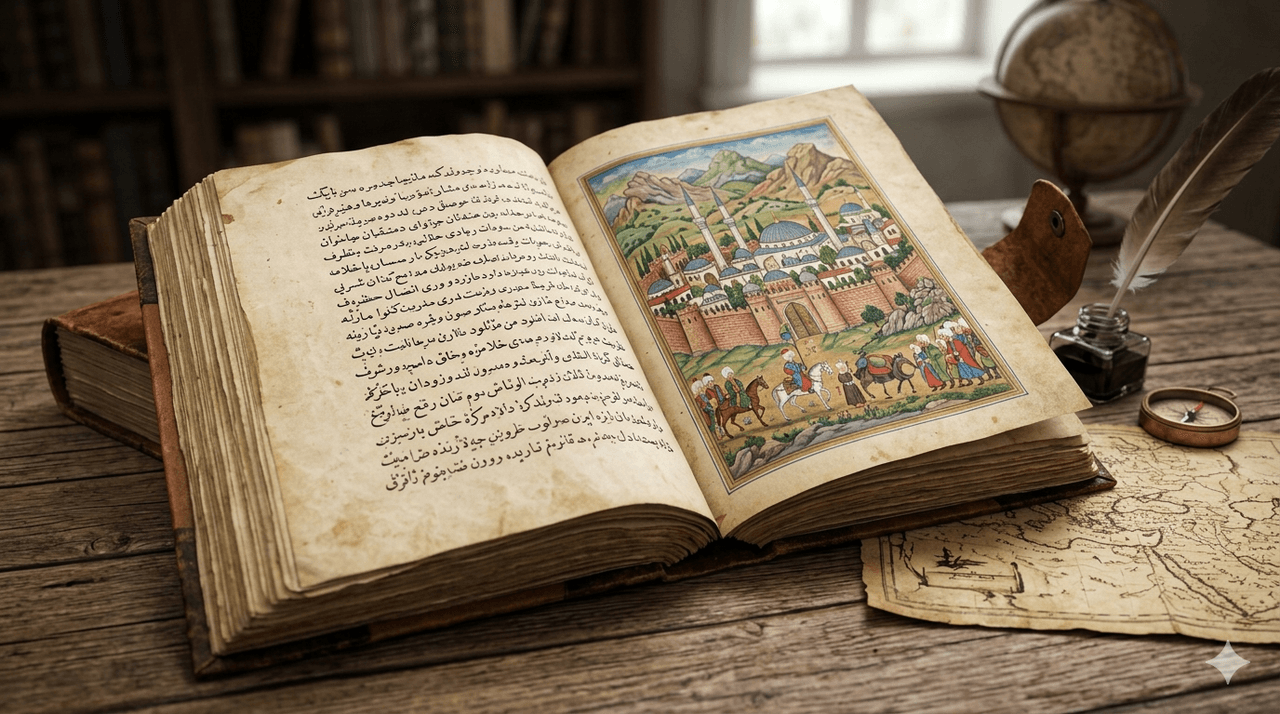
An excerpt from Evliya Çelebi's Seyahatname (Generated by artificial intelligence)
- He described the fortresses, mosques, and bazaars of cities.
- He wrote about the names people used, what they wore, and what professions they practiced.
- He also included in his book the strange stories and miracles he heard in the places he visited.
- He even collected words and songs from different languages, creating a linguistic archive; his book contains examples from nearly 30 languages.
Different Types of Seyahatnames
Seyahatnames were not written solely for the purpose of travel. Sometimes they were composed by ambassadors to describe the countries they visited; these are called Sefâretnâmeler. At other times, they recounted the experiences of those captured in war, known as Esâretnâmeler. Additionally, accounts of pilgrimages to holy lands, called Hac Seyahatnâmeleri, were very common.
Travel Writing Today
Today, the role of seyahatnames has been taken over by “travel writings.” Modern authors do not merely describe the history of a place; they also highlight its beauty and explain why tourists should visit. Writers such as Falih Rıfkı Atay, Reşat Nuri Güntekin, and Ahmet Hamdi Tanpınar have written beautiful travel books that portray both our country and the world.