
KURE Kids Header Line
badge icon

This content was originally written in Turkish for children and is automatically translated into English using artificial intelligence.

article-image

Ulugh Beg

Last Updated: 08.03.2026

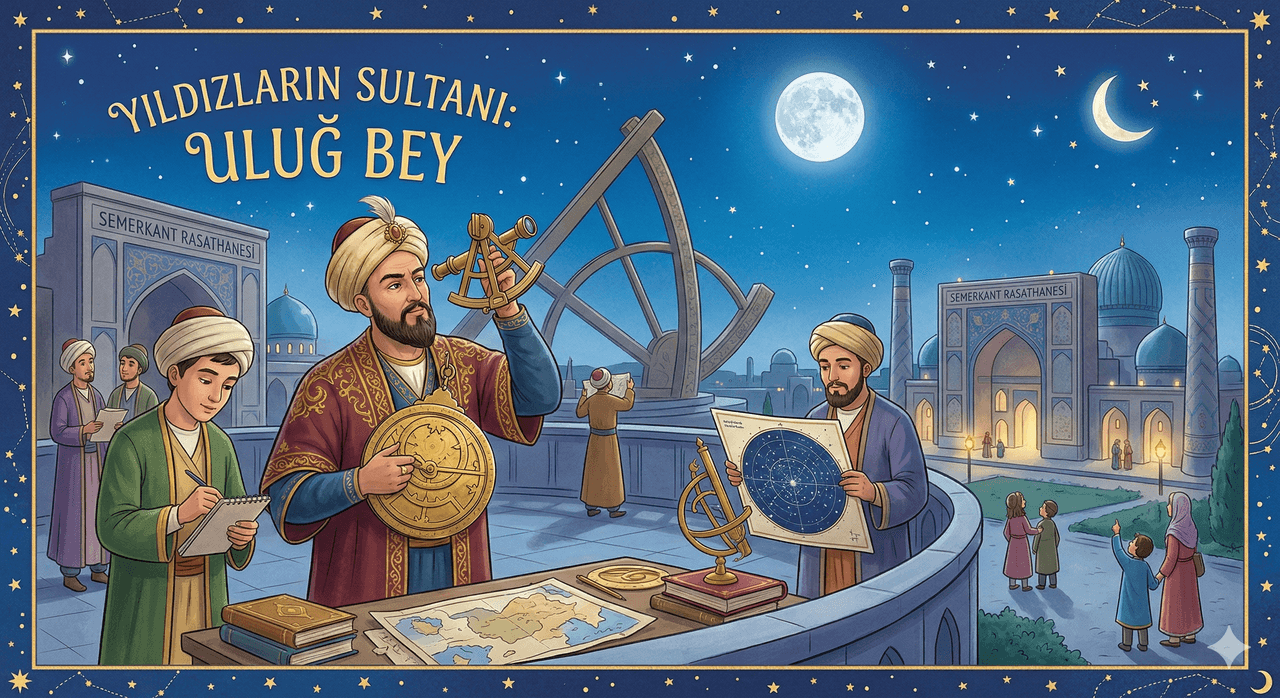
Ulugh Beg (1394–1449) was not only one of the greatest astronomers and mathematicians in Turkic-Islamic history but also the fourth ruler of the Timurid Empire. The grandson of Emir Timur and son of Shahrukh, Ulugh Beg crowned his reign not only with political achievements but also with a “Samarkand Renaissance” marked by the pinnacle of science and reason.


Born as Muhammad Taragay, the ruler was born in the city of Soltaniye in Iran during the military campaigns of his grandfather Timur. From an early age, he received instruction from distinguished tutors at the court and developed a profound passion for mathematics and astronomy alongside his military training.
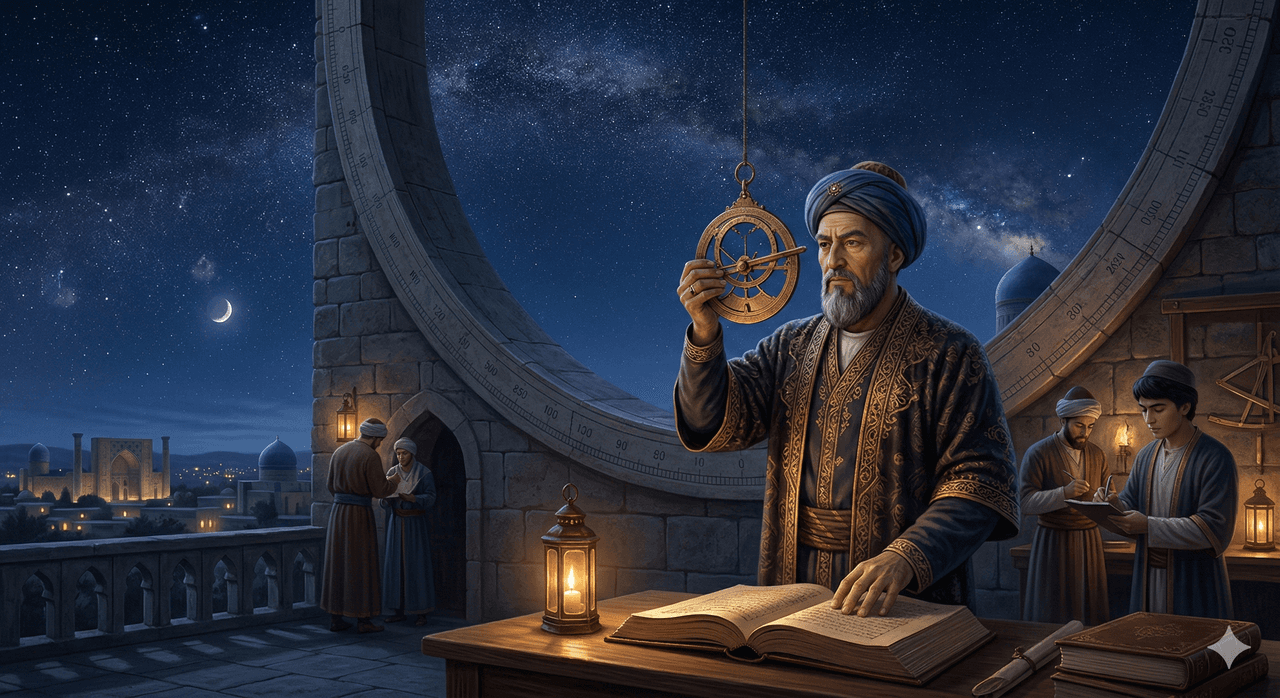

Ulugh Beg at work (generated by artificial intelligence)


Life and Reign

Ulugh Beg was appointed governor of Mawarannahr at the age of fifteen by his father Shahrukh and spent most of his life in the capital city of Samarkand. Unlike his grandfather Emir Timur, he focused not on military conquests but on cultural and scientific advancement. During his reign, he transformed Samarkand into one of the most important centers of science in the world. Although he ascended to the imperial throne in 1447 following his father’s death, his rule was marked by internal turmoil and political struggles.


Scientific Legacy and the Samarkand Observatory

Ulugh Beg’s greatest contribution to history is the massive observatory he commissioned in Samarkand between 1421 and 1429. At this center, equipped with the most advanced observational instruments of its time, he collaborated with the brightest minds of the era, including Kadizade-i Rumi, Ghiyath al-Din Jamshid al-Kashi, and Ali Qushji.


At his observatory, Ulugh Beg systematically studied the night sky. In an era before the telescope had been invented, he used a massive circular measuring instrument to calculate the positions of stars and planets with extraordinary accuracy. The remarkable similarity between his measurements and those made with modern technology continues to inspire admiration in the scientific community.
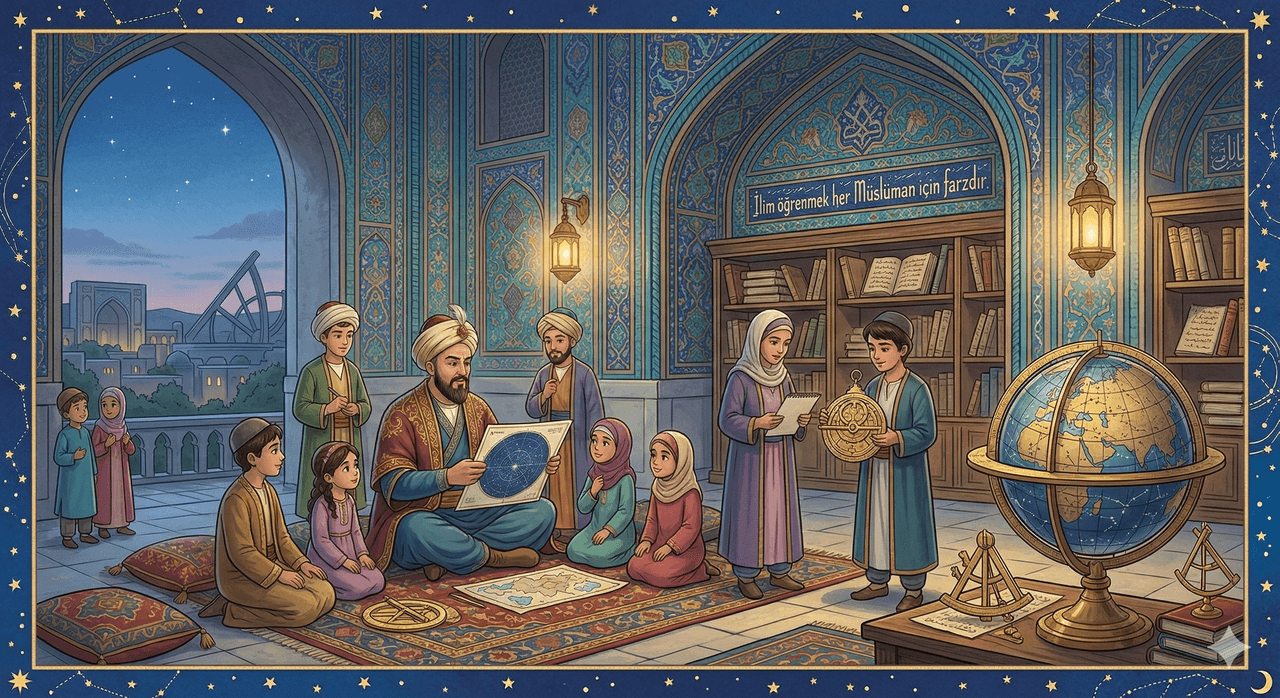

Ulugh Beg transmitting his findings (generated by artificial intelligence)


Works and His Place in Astronomy

Ulugh Beg’s magnum opus is the star catalog known as the “Zij-i Sultanî” or Zij-i Ulugh Beg. This work contains tables detailing the positions of approximately 1,018 stars and astronomical rules. For centuries in the Western world, it was regarded as the most reliable source and was used as a reference by European astronomers until the 17th century.


Ulugh Beg was not merely an astronomer but also a visionary who advocated for the widespread dissemination of education. He inscribed the hadith “Seeking knowledge is an obligation upon every Muslim” on the doors of the madrasas he established in Samarkand and Bukhara, emphasizing that scientific inquiry was a religious duty. Today, the scientific community continues to honor his legacy by naming a crater on the Moon and an asteroid after him.

Don't Forget to Look at These!
Science and Technology
cat img
Natural Sciences
cat img
Art and Literature
cat img
image
Most Read
Thomas Edison
arrow
image
Last Added
Kişisel Verileri Koruma Günü
arrow
ilham-notu-bg
INSPIRATION NOTE FOR CURIOUS KIDS!

The Limit of Curiosity Is the Sky: When you look up at the night sky, remember that every star you see has a name and an order. With the curious gaze of someone like Ulugh Beg, you too can uncover the mysteries of the universe. Even before telescopes were invented, he mapped the stars using nothing but patience and intelligence. Let your greatest tools be your intellect and your curiosity.


Be Both Leader and Student: Ulugh Beg was a powerful ruler, yet he never stopped learning. While governing a vast empire, he would carry books to the observatory and spend hours studying. No matter how successful you become, never lose your love of learning; for true power lies in knowledge.


Help Others Shine: Ulugh Beg discovered brilliant students like Ali Kuşçu and gave them the best possible education. A true leader rises not only through personal achievement but by enabling those around them to shine like stars. You too can multiply goodness and knowledge by sharing what you know with your friends.


Do Not Fear Mistakes, Be Precise: Ulugh Beg calculated the length of a year with an error of only a few seconds compared to today’s technology. This was the result of extraordinary attention and diligence. Whatever task you undertake, strive to perform it with the utmost precision down to the finest detail—that is what makes you “Ulugh” (great).


Let Your Dreams Reach the Moon: If a crater on the Moon is named “Ulugh Beigh,” it is because of the dreams he envisioned and the work he accomplished centuries ago. If you work hard today and dare to dream big, your name too may live on forever—not only on Earth but even in space.

Who Wrote?
Kids Writing
AuthorMustafa Cem İnciMarch 8, 2026

What Did We Talk About?

bottom-bg-effect-bottom
bottom-bg-effect-top

Ulugh Beg was both a powerful ruler and a brilliant astronomer who unraveled the secrets of the heavens; his true greatness lies in transforming Samarkand into one of the world’s most important centers of science. In the massive observatory he established in the 15th century, without the use of a telescope, he studied stars and planets and measured the length of a year with an error of only a few seconds compared to modern calculations. His greatest legacy, the star catalog (Zij), served as a guide for navigators and scientists across the world for centuries. Renowned for his passion for knowledge, Ulugh Beg nurtured great minds such as Ali Qushji and placed the importance of research and education above all else, declaring that "Learning knowledge is an obligation upon every Muslim."

Bibliographies

Fikriyat. "Uluğ Bey Eserleri ve Hayatı Hakkında Tarihi Bilgiler." Accessed February 26, 2026. https://www.fikriyat.com/galeri/tarih/ulug-bey-eserleri-ve-hayati-hakkinda-tarihi-bilgiler.

Kapadokya Üniversitesi. "Öncülere Vefa: Uluğ Bey." Kapadokya Blog. Accessed February 26, 2026. https://blog.kapadokya.edu.tr/onculerevefa/ulug-bey.

Kütahya Dumlupınar Üniversitesi Matematik Bölümü. "Uluğ Bey." Accessed February 26, 2026. https://matematik.dpu.edu.tr/tr/index/sayfa/3125/ulug-bey.

Türk Maarif Ansiklopedisi. "Uluğ Bey." Accessed February 26, 2026. https://turkmaarifansiklopedisi.org.tr/ulug-bey

Unat, Yavuz. "Uluğ Bey." TDV İslâm Ansiklopedisi. Accessed February 26, 2026. https://islamansiklopedisi.org.tr/ulug-bey.

ilham-notu-bg
ilham-notu-bg
ilham-notu-bg
HEYY!
Did You Know?
These?
Lamb
Lamb
Ask to Küre