




What Is a Tongue Twister?
Nursery rhymes are word sequences that are fun to say and pleasing to the ear. They contain abundant rhyme, rhythm, and repetition. Children typically encounter these phrases while playing games, singing songs, or listening to fairy tales. Nursery rhymes both amuse and teach proper language use!
🎵How Did Nursery Rhymes Emerge?
The origins of nursery rhymes lie in the oral culture of the people. Long ago, people began combining words in playful ways to develop their speaking and storytelling skills. This playful form of expression eventually came to be known as “nursery rhyme.” Today, they continue to live on in the speech of both children and adults.

Children speaking using nursery rhymes during eras dominated by oral culture (Image generated by artificial intelligence).
📚Where Are Nursery Rhymes Used?
Nursery rhymes frequently appear at the beginning of children’s games, in the openings of fairy tales, or within riddles. In particular, storytellers use rhythmic nursery rhymes to entertain listeners and prepare them for the story. They also assist learners in correctly producing sounds during the language acquisition process.

A father reading a fairy tale to his child before bedtime (Image generated by artificial intelligence).
🧠In Which Areas Are They Used?
Nursery rhymes are not merely amusing phrases; they are also an important educational tool. They help students focus their attention, pronounce words correctly, and use language fluently.

A classroom studying nursery rhymes (Image generated by artificial intelligence).
In addition, they are used in folk literature, particularly in fairy tales and folk stories, to maintain vivid narration.
🧩An Example of a Nursery Rhyme
"Take these takatukas to the takatukacı to have them takatukalat.
If the takatukacı says he cannot takatukalat the takatukas,
take the takatukas back from the takatukacı without having them takatukalat."
This short, sound-patterned sequence works our language through the repetition of identical sounds. Though it may seem difficult to say, it is entertaining and helps develop the ability to use language quickly.
🎙️Try It Yourself!
Listen to this nursery rhyme with the video and repeat it. At the end, the microphone is yours!
Al Bu Takatukaları (Eba)
💬What Do Nursery Rhymes Offer?
Nursery rhymes strengthen children’s speaking, listening, and comprehension skills. They enrich vocabulary, enhance sound awareness, and teach language through play. Additionally, they develop children’s memorization and attention skills.
🏡Nursery Rhymes in Daily Life
We all use nursery rhymes in daily life without realizing it. The phrases we say while playing games, counting to choose “it,” or having fun with friends are in fact nursery rhymes.
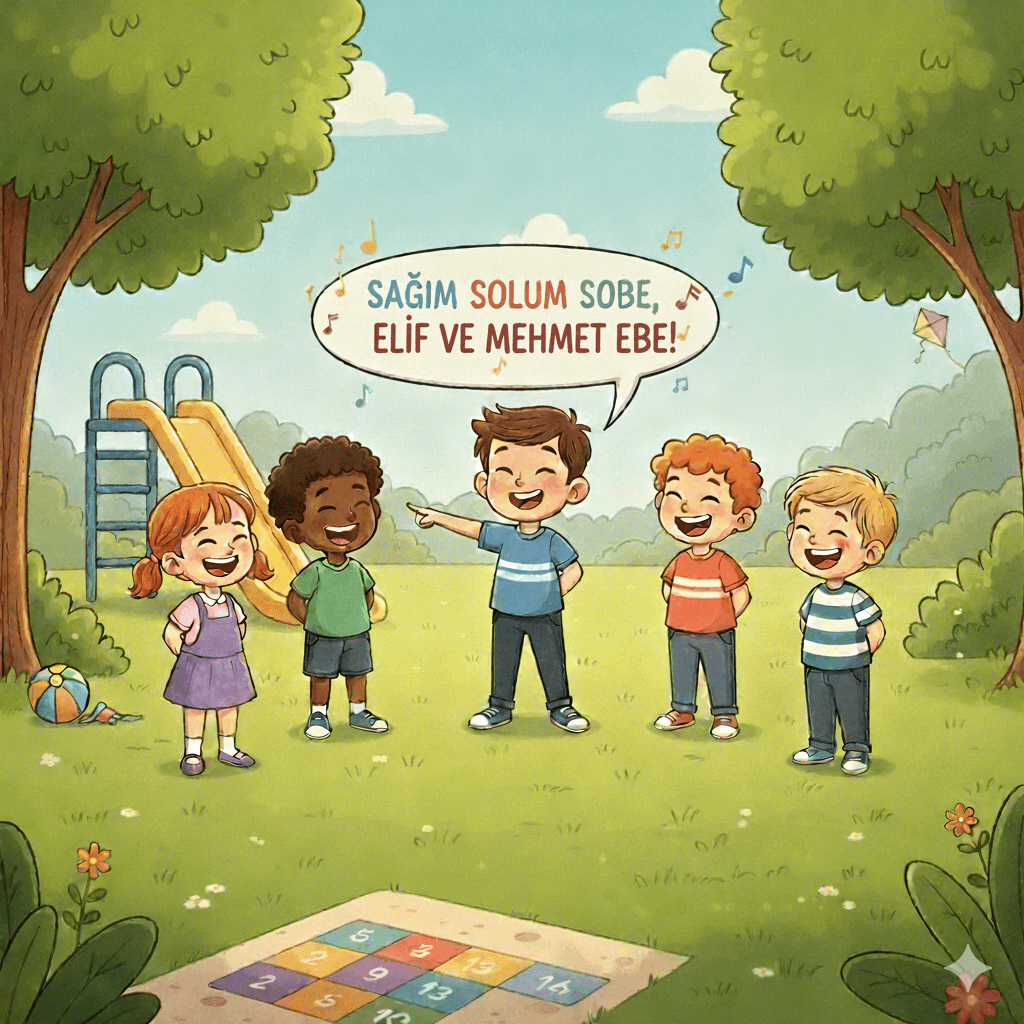
Children reciting nursery rhymes while playing (Image generated by artificial intelligence).
Nursery rhymes show that language is not only used for speaking but also for sharing, enjoying oneself, and strengthening diction and speech patterns. They are both entertaining games and small linguistic treasures that carry the beauty of Turkish.