

KURE Kids Header Line
badge icon

This content was originally written in Turkish for children and is automatically translated into English using artificial intelligence.

article-image

What is the thermosphere?

Last Updated: 01.12.2025

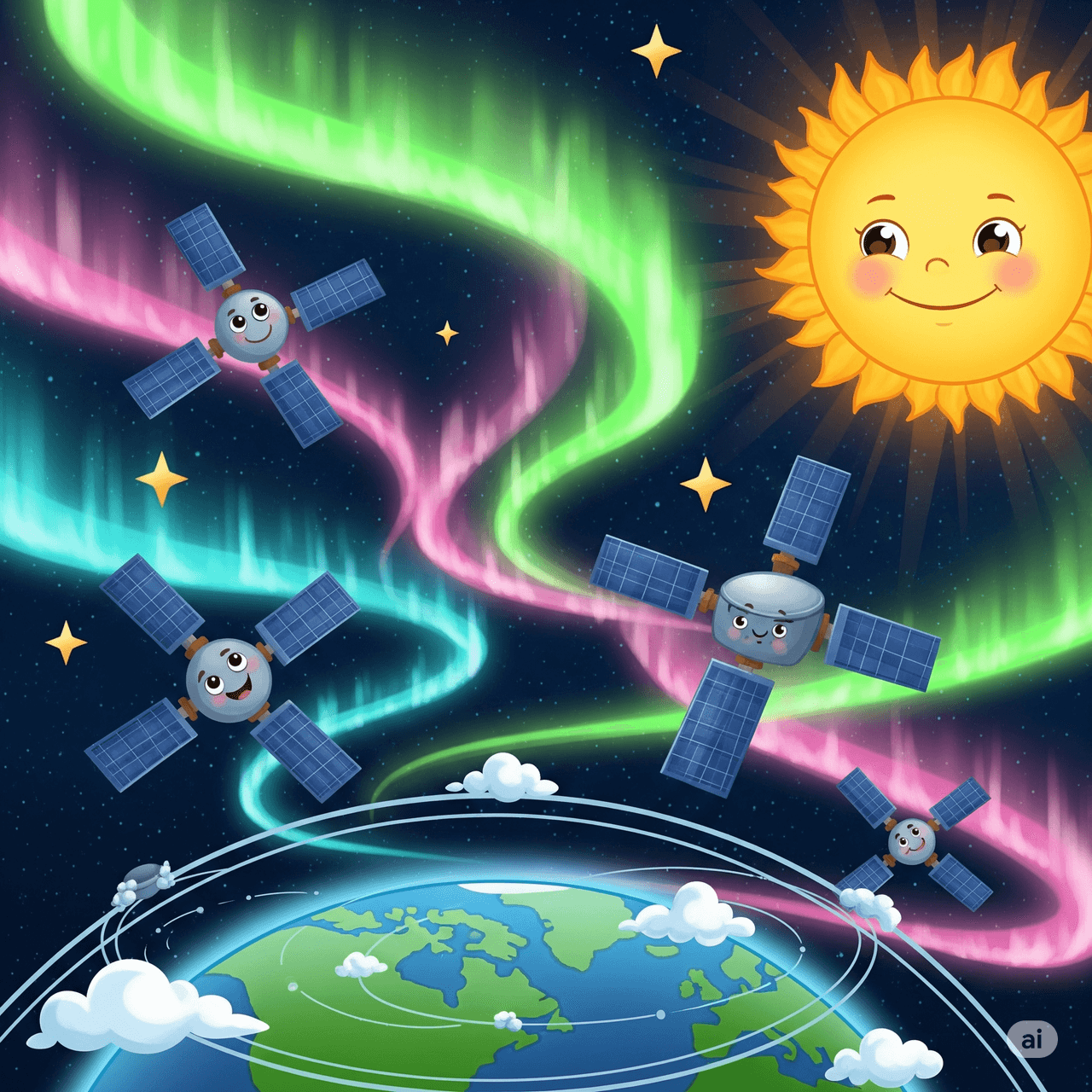
The thermosphere is one of the highest layers of Earth’s atmosphere. It is located at extreme altitudes, closest to space. Here, the air is extremely thin, and temperatures can rise to thousands of degrees!


(Generated by Artificial Intelligence.)


Where Does It Begin and Where Does It End?

The thermosphere begins at approximately 80 kilometers above Earth’s surface and can extend up to 500 kilometers. This layer is where spacecraft begin to orbit, meaning it is the region where satellites and the International Space Station are located.


What Happens There?

  • Colorful lights such as the Northern Lights form in the thermosphere.
  • Because the air is so thin in this region, sound cannot travel.
  • Energy from the Sun heats this layer intensely, but we do not feel it on the ground because there are very few air molecules.
  • Scientists use this layer to study interesting phenomena such as gravity waves and ionospheric disturbances.


(Generated by Artificial Intelligence.)


Why Is It Important?

The thermosphere protects Earth from harmful radiation in space. Additionally, GPS, television, and internet signals passing through this layer can be affected. For this reason, scientists carefully study this layer.

Don't Forget to Look at These!
Science and Technology
cat img
History and Culture
cat img
Art and Literature
cat img
image
Most Read
Thomas Edison
arrow
image
Last Added
Kişisel Verileri Koruma Günü
arrow
ilham-notu-bg
INSPIRATION NOTE FOR CURIOUS KIDS!

When you look up at the sky, you can see not only the stars but also an infinite world waiting to be discovered!

Who Wrote?
Kids Writing
Authorİbrahim FilizDecember 1, 2025
bottom-bg-effect-bottom
bottom-bg-effect-top

The thermosphere is one of the uppermost layers of Earth's atmosphere, extending from approximately 80 km to a height of 500 km. The air is extremely thin, but temperatures can rise to thousands of degrees. The Northern Lights occur here, and satellites orbit within this region. It provides protection against energetic particles from the Sun and can influence communication signals.

Bibliographies


Cervera, M. A., and T. J. Harris. “Modeling Ionospheric Disturbance Features in Quasi‐Vertically Incident Ionograms Using 3‐D Magnetoionic Ray Tracing and Atmospheric Gravity Waves.” *Journal of Geophysical Research: Space Physics* 119, no. 1 (2013): 431–440. Accessed May 27, 2025. https://doi.org/10.1002/2013ja019247

Ganguly, D., P. Ginoux, V. Ramaswamy, O. Dubovik, J. Welton, E. A. Reid, and B. N. Holben. “Inferring the Composition and Concentration of Aerosols by Combining AERONET and MPLNET Data: Comparison with Other Measurements and Utilization to Evaluate GCM Output.” *Journal of Geophysical Research: Atmospheres* 114, no. D16 (2009). Accessed May 27, 2025. https://doi.org/10.1029/2009jd011895

Karlsson, B., C. McLandress, and T. G. Shepherd. “Inter-Hemispheric Mesospheric Coupling in a Comprehensive Middle Atmosphere Model.” *Journal of Atmospheric and Solar-Terrestrial Physics* 71, no. 3–4 (2008): 518–530. Accessed May 27, 2025. https://doi.org/10.1016/j.jastp.2008.08.006

ilham-notu-bg
ilham-notu-bg
ilham-notu-bg
HEYY!
Did You Know?
These?
Lamb
Lamb
Ask to Küre