




Who is Ibn Sina?
Who is Ibn Sina?
(980–1037)
One of the greatest scientists, physicians, and philosophers of the Middle Ages.
Life
Ibn Sina was born in 980 in the village of Afshana, near the city of Bukhara in Central Asia, in what is now Uzbekistan. His father, Abdullah Efendi, was the local governor of a village near Bukhara. His mother, Sitara, was of Tajik origin.
Abdullah Efendi educated Ibn Sina himself during his childhood in mathematics, geometry, and philosophy. He ensured his son received instruction from the most distinguished scholars of the time. By the age of ten, Ibn Sina had memorized the Quran and mastered the Arabic language and literature. He spent the next six years studying Islamic law and jurisprudence, philosophy, logic, and the natural sciences. At thirteen, he began studying medicine. By the age of eighteen, he had become an accomplished physician, and his reputation had spread beyond the borders of his homeland.

(Generated by artificial intelligence)
Works
As far as is known, he wrote 276 books, 43 of which are related to medicine. He was a major Islamic scholar who produced significant works in medicine, philosophy, astronomy, mathematics, chemistry, and physics.
Starting with notes taken in his twenties, he later expanded his work into a 14-volume medical encyclopedia. This book, titled Al-Qanun fi al-Tibb (The Canon of Medicine), is Ibn Sina’s most important work. He wrote Al-Qanun fi al-Tibb in Arabic.
His other major work is Kitab al-Shifa (The Book of Healing). Ibn Sina is regarded as one of the greatest scientists of the Middle Ages, and his works served as foundational texts for centuries in both the Islamic world and Europe. He is known as the “Father of Early Medicine” and the “Prince of Philosophers.”
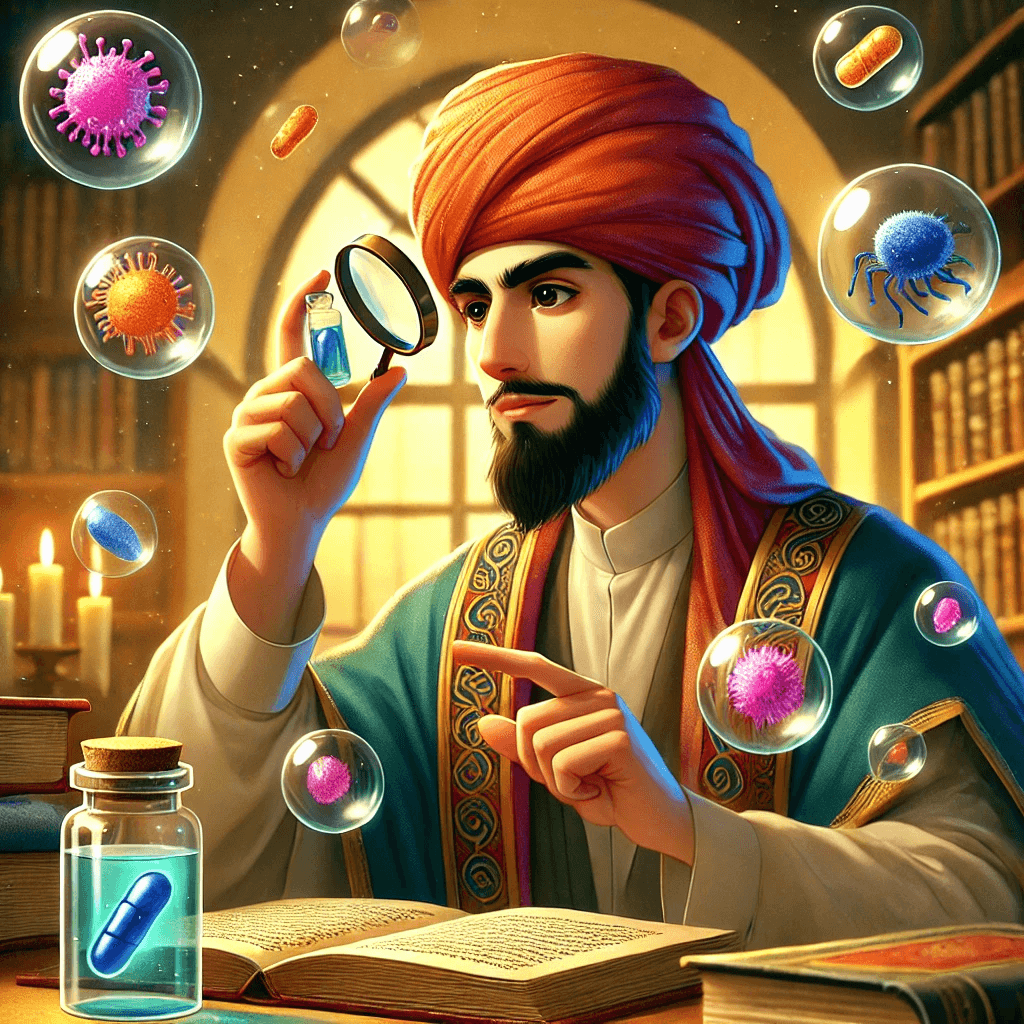
(Generated by artificial intelligence)
Discoveries
Ibn Sina was the first scientist to propose that blood carries nutrients, and that diabetes could be diagnosed through urine analysis. He also discovered measles, anthrax, liver-related diseases, and hepatitis.
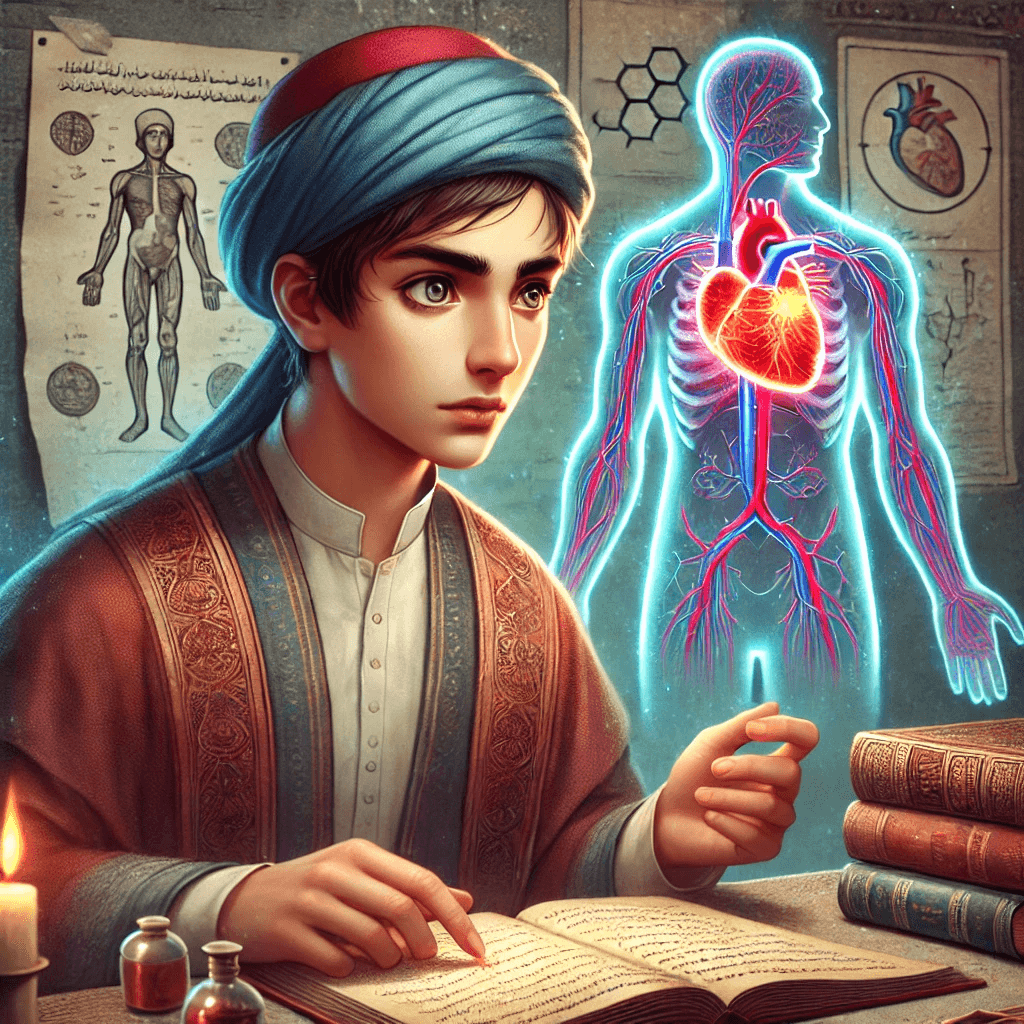
(Generated by artificial intelligence)
Ibn Sina was the first to propose that many diseases are caused by microorganisms invisible to the naked eye. He introduced the concept of microorganisms into medical literature. He was also the first to use anesthetics during surgery, thereby reducing patient pain.
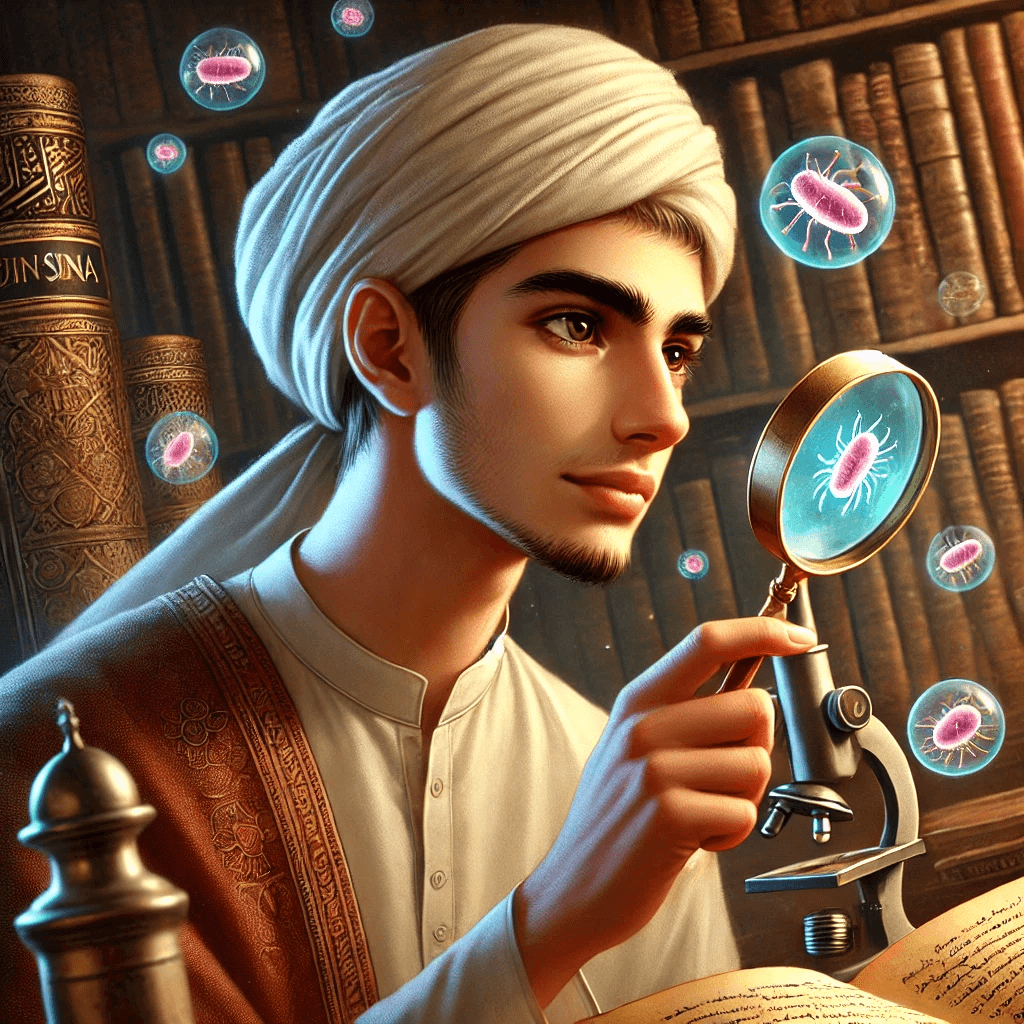
(Generated by artificial intelligence)
Ibn Sina died in Hamadan on 21 June 1037 at the age of 57.
References
Hujjat, Fatima Sherif. “Ibn Sina (Avicenna): The Prince of Physicians.” Avicenna Journal of Medicine 8, no. 1 (2018): 1–3. https://www.ncbi.nlm.nih.gov/pmc/articles/PMC6077049/.
TÜBİTAK Bilim Genç. “Who is Ibn Sina?” Bilim Genç, Scientific and Technological Research Council of Türkiye (TÜBİTAK). Accessed 1 May 2025. https://bilimgenc.tubitak.gov.tr/ibn-sina-kimdir.
Üsküdar University. “Ibn Sina.” Üsküdar University. Accessed 1 May 2025. https://uskudar.edu.tr/tr/bilim-insani/ibni-sina.