




Why Does It Rain?
What Is Rain?
Rain consists of liquid water droplets falling from clouds toward the ground. It forms when water vapor in the atmosphere condenses and returns to its liquid state. Rain is one of the most important components of the natural water cycle.

(Generated by artificial intelligence.)
How Does Rain Form?
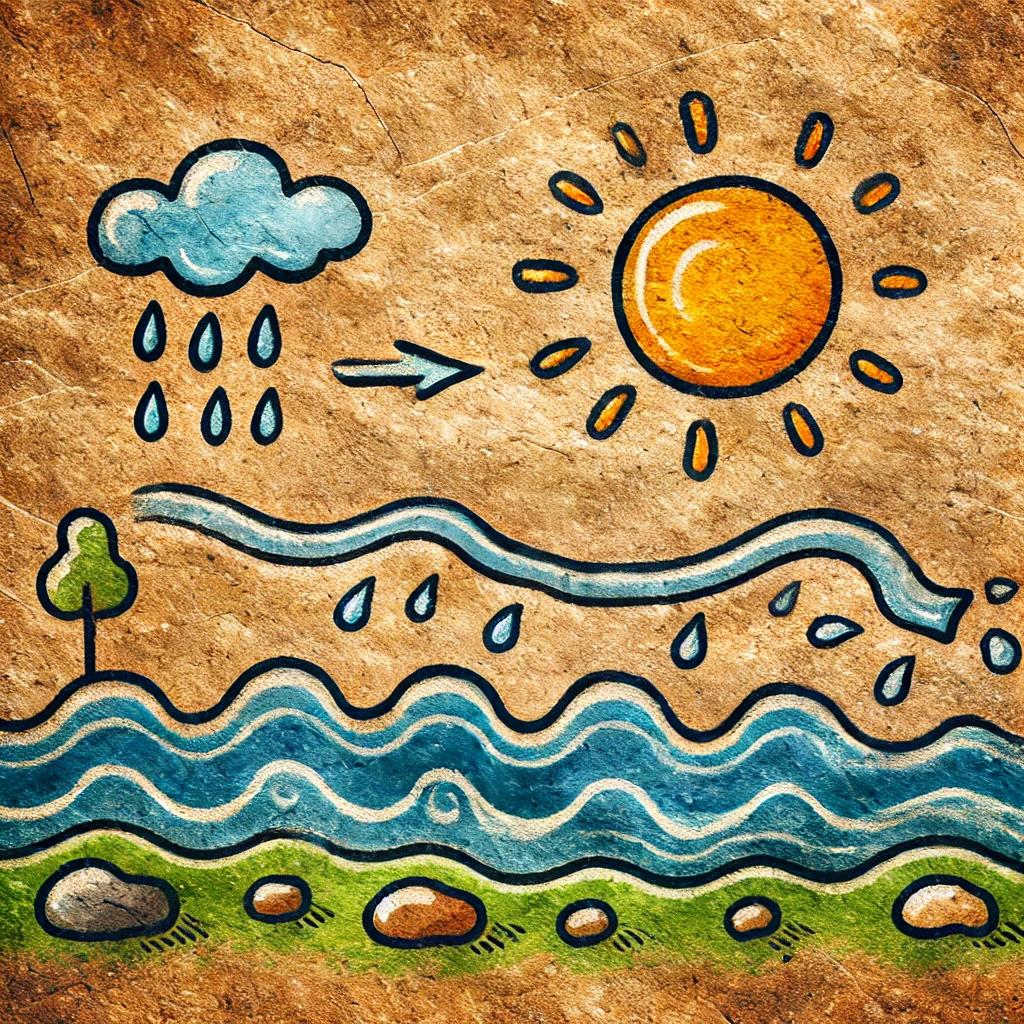
Rain does not form suddenly. This process is called the water cycle, which continuously repeats in nature:
- Evaporation: The Sun heats oceans, lakes and rivers, causing water to evaporate and rise into the air.
- Condensation: As the rising water vapor meets cooler air, it turns into tiny water droplets that form clouds.

(Generated by artificial intelligence.)
3. Coalescence and Growth: Water droplets in clouds merge and become heavier.
4. Precipitation: When droplets reach a certain size, they fall to the ground due to gravity. This is called rain!

(Generated by artificial intelligence.)
Scientific Explanation of Rain
Rain is a weather phenomenon based on physical changes:
- Water vapor is in a gaseous state, while clouds represent water’s transition to its liquid state (condensation).
- For rain to begin, the air must have high humidity, lower temperatures, and the presence of condensation nuclei such as dust or pollen.
- Raindrops are small liquid particles with diameters ranging from approximately 0.5 mm to 5 mm.
Types of Rain
- Convective Rain: Occurs on sunny days, especially in the afternoon. Common in tropical regions.
- Frontal Rain: Occurs where warm and cold air masses meet. It lasts for extended periods.
- Orographic (Mountain) Rain: Forms when moist air is forced upward by mountains.
What If There Were No Rain?
- The soil would dry out and plants could not grow.
- Rivers, lakes and groundwater levels would decrease.
- Living organisms would face water shortages and ecological balance would be disrupted.
- Agriculture would become impossible, forcing people to migrate.
- The atmospheric water balance would be disturbed, increasing desertification.
Without rain, life on Earth would not be possible.

(Generated by artificial intelligence.)
🌱 The Role of Rain in Nature
- Enables plant growth.
- Cools and moistens the soil.
- Fuels reservoirs, lakes and rivers.
- Provides drinking water for animals.
- Replenishes groundwater.

(Generated by artificial intelligence.)
Scientific and Technological Aspects
- Meteorologists use satellite imagery, radar systems and computer models to predict when rain will occur.
- Rain gauges (pluviometers) measure rainfall amounts in millimeters.
- In some regions, techniques such as cloud seeding are being tested to induce controlled rainfall.
- Rainwater harvesting is an environmentally friendly practice that involves collecting and reusing rainwater.
The Rainiest Places on Earth
- Mawsynram (India): Receives approximately 11,871 mm of rainfall annually. It is the wettest place on Earth.
- Amazon Rainforest: Experiences frequent rainfall due to its dense vegetation and active water cycle.
- Coasts of Norway and Colombia: Moist air trapped between mountains and seas produces continuous rainfall.

(Generated by artificial intelligence.)
Rain in Türkiye
- The highest rainfall in Türkiye occurs in the Black Sea Region, especially around Rize and Artvin.
- Central Anatolia and Eastern Anatolia are drier.
- Frontal rains are common in winter, convective rains in spring, and orographic rains in mountainous areas.
- Rain is vital for filling reservoirs, sustaining agriculture and preventing forest fires.
⏳ Time Travel:
Rain and Humanity Throughout History:
For thousands of years, humans have regarded rain as a symbol of fertility. Ancient civilizations held prayers for rain and performed rituals to appease drought deities. In ancient Egypt, the onset of rain signaled the flooding of the Nile River. Even today, in some cultures, rain is seen as a harbinger of nature’s renewal.
References:
- Mutluer, B. “The Formation of Rain.” Turkish Journal of Geography, Issue 3, 2001. https://dergipark.org.tr/tr/download/article-file/3102
- Koç, H. “Atmosphere and Precipitation Mechanisms.” Department of Geography, Uludağ University, Access Date: 2025. https://acikerisim.uludag.edu.tr/server/api/core/bitstreams/b6adc9aa-7cb5-439b-8027-d99d38681695/content
- YouTube. “How Does Rain Form?” MinuteEarth, https://www.youtube.com/watch?v=lSAJdliG_h0
- TÜBİTAK Bilim Genç. “How Are Clouds and Raindrops Formed?” https://bilimgenc.tubitak.gov.tr/makale/bulutlar-ve-yagmur-damlalari-nasil-olusur-0
- National Geographic Kids. “Water Cycle.” https://www.natgeokids.com/uk/discover/science/nature/water-cycle/
- Little Bins for Little Hands. “How Does Rain Form?” https://littlebinsforlittlehands.com/how-does-rain-form/
- National Geographic Education. “Rain.” https://education.nationalgeographic.org/resource/rain/