



Why Is Snow White When Ice Is Colorless?
What Color Is Ice?
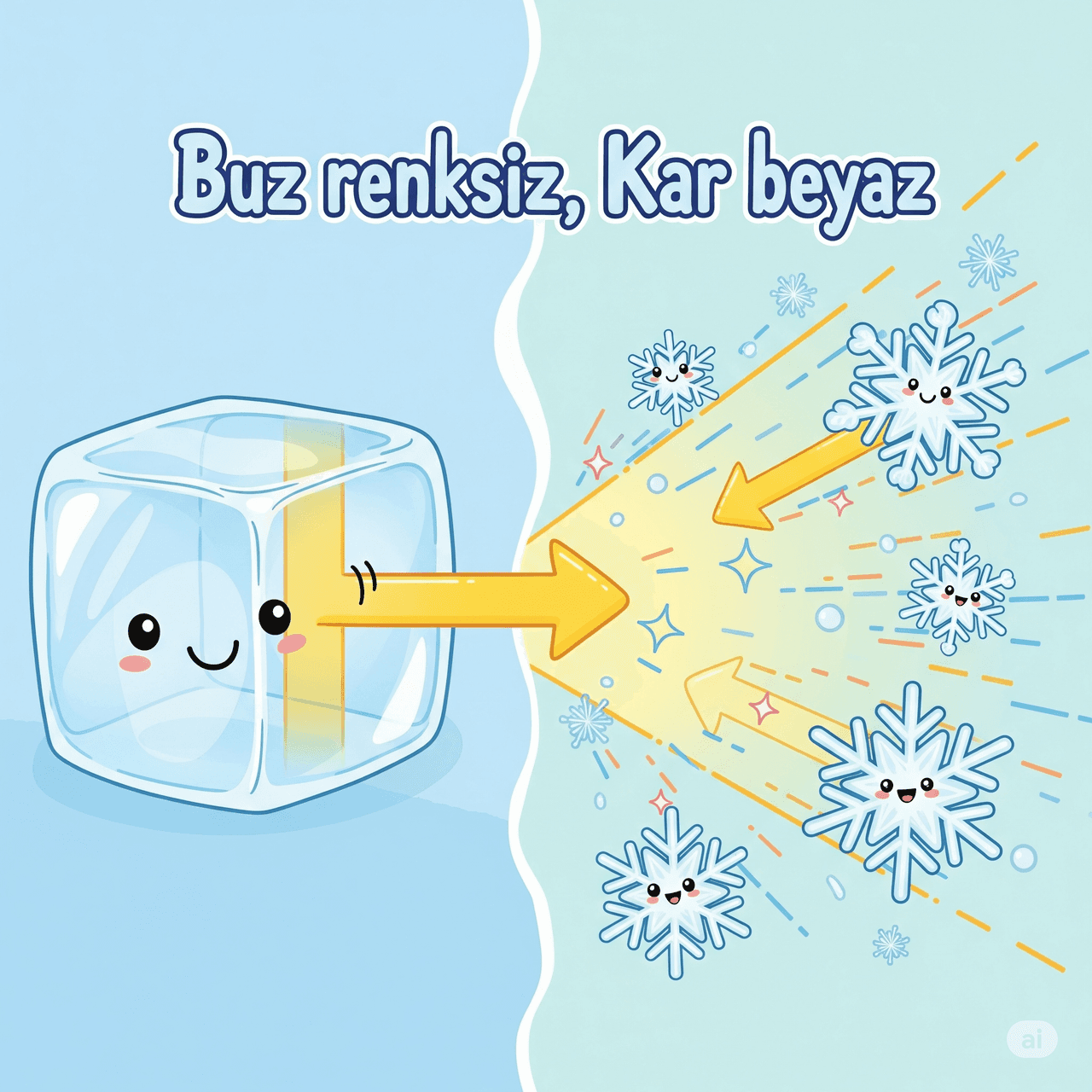
Ice is the solid state of water. When you freeze a glass of water, the resulting ice typically appears transparent. This is because the internal structure of ice is regular and dense. When light passes through ice, it does not scatter much; therefore, ice appears colorless and transparent.

Different Appearance of Ice and Snow (Generated by Artificial Intelligence.)
What Is Snow?
Snow is a type of precipitation formed by the freezing of water vapor. When air temperature drops below 0°C, water vapor in clouds directly transforms into ice crystals. These crystals combine to form snowflakes. Snow can fall in various forms including snowflakes, graupel (soft ice pellets), and a mixture of snow and rain.
Why Does Snow Appear White?
Snowflakes are composed of countless tiny ice crystals. The surfaces of these crystals are irregular and reflect light in many different directions. As a result, all colors of light mix together and reach our eyes as white. In other words, snow is not inherently colorless; it appears white due to the way it reflects light.

Evaporation of Water (Generated by Artificial Intelligence.)
What Is the Role of Light?
While light passes directly through ice, it is repeatedly refracted and scattered within snowflakes. This difference is what makes ice transparent and snow pure white.
Where Does Snow Fall?
Two conditions are necessary for snowfall: low temperature and sufficient moisture. In very cold but dry regions such as Antarctica, snowfall is rare. However, snow is common in mountainous areas and regions near the poles. Sometimes, moist air over lakes can produce heavy snowfall due to the “lake-effect.”